Table of Contents:
- Introduction: What Healthcare Privacy Window Film Solves Right Away
- How Privacy Window Film Supports Patient Confidentiality and HIPAA Safeguards
- Types of Healthcare Window Films: Privacy, Solar Control, and Security
- Zone-by-Zone Planning: Applying Privacy Window Film Throughout Healthcare Settings
- Comfort, Light, and Energy: Solar Control Film in Healthcare Environments
- Security Window Film in Hospitals, Pharmacies, and Clinics
- Why Window Film Often Outperforms Curtains and Blinds in Medical Facilities
- Evaluating Your Medical Facility for Privacy and Window Film Compatibility
- Cost, Timelines, and Expected Lifespan of Healthcare Privacy Window Film
- Frequently Asked Questions About Healthcare Privacy Window Film
- Why Choose Window Film Depot for Healthcare Privacy and Security Film Projects
- Next Steps: Upgrading Privacy, Comfort, and Security in Your Healthcare Facility
Introduction: What Healthcare Privacy Window Film Solves Right Away
Healthcare privacy window film gives hospitals, clinics, and outpatient centers an immediate way to shield patient activity, computer screens, and protected health information from unauthorized views-without blocking daylight or launching a construction project. Window film installation is typically faster and less expensive than glass replacement, making it one of the most practical retrofits available to healthcare facilities under growing pressure.
In 2026, healthcare environments face a tighter enforcement climate around HIPAA, rising physical security threats, and higher patient expectations for comfort and dignity. Because HIPAA requires physical safeguards for patient information, facility leaders need solutions that address visual exposure at every glass surface-fast.
Privacy window film delivers visual privacy, regulatory support, solar control, patient comfort, and safety on existing windows and glass partitions. Window Film Depot specializes in nationwide healthcare window film installations using 3M and other high-performance window film products, and the sections below lay out exactly how these solutions work in real medical buildings.
How Privacy Window Film Supports Patient Confidentiality and HIPAA Safeguards
Privacy window film creates physical visual barriers on glass surfaces throughout a medical facility, directly supporting HIPAA’s requirement for “reasonable safeguards” against unauthorized disclosure of patient information. Privacy window film supports compliance by limiting unauthorized views into spaces where PHI is handled-but no single product guarantees compliance on its own.
The risks are concrete. Unprotected clear glass around reception desks, exam rooms, nurses’ stations, and patient rooms can expose computer screens, medical records, intake forms, and treatment activity to hallways, waiting rooms, parking lots, and sidewalks. Privacy window film blocks visual access to protected health information in exactly these high-risk zones. Window films create visual barriers to protect patient privacy in busy areas where foot traffic is constant.
HIPAA does not mandate specific window film types for compliance. The Privacy Rule requires that PHI be protected in all forms-spoken, written, electronic, and visual-and it is up to each organization’s risk assessment to determine what “reasonable” looks like. Window film can block visual access to patient areas, but healthcare providers should integrate window film into a broader privacy strategy that includes policies, staff training, signage, screen positioning, and access controls.
Real-world corrective actions we see regularly include adding frosted film bands to consultation room doors, obscuring pharmacy prep counters from patient corridors, and blocking hallway sightlines into behavioral health therapy rooms. Legal and compliance teams stay in charge of policies and workflows. A window film contractor like Window Film Depot contributes through sightline analysis, product selection, and installation documentation.
Types of Healthcare Window Films: Privacy, Solar Control, and Security
Window film solutions for healthcare settings fall into several overlapping categories-privacy film, decorative film, solar control window film, and security film-often combined in a single facility to address different needs simultaneously.
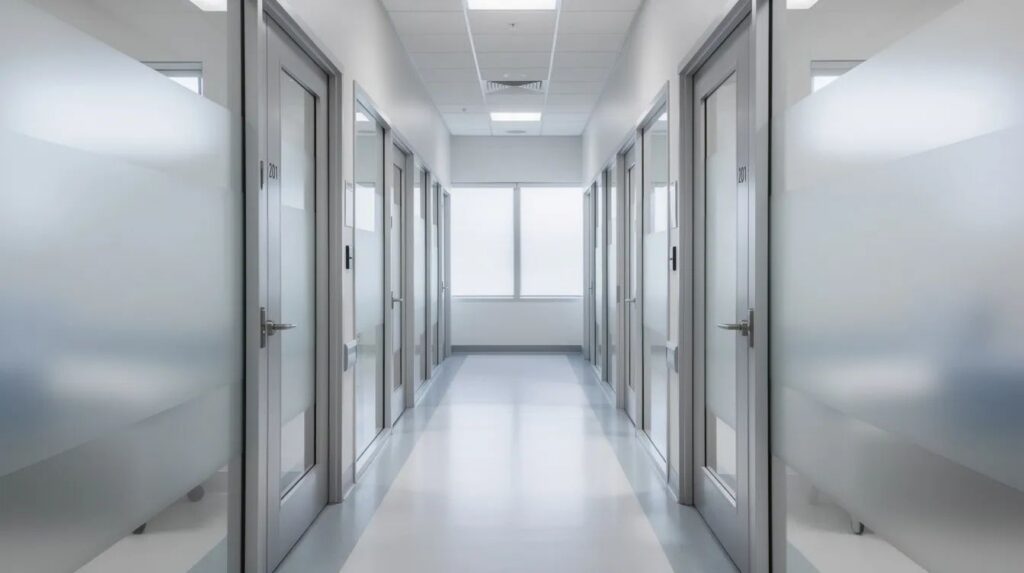
Privacy film refers to frosted, translucent, or patterned films that obscure views through interior glass and exterior windows. Frosted window film obscures views while allowing natural light to pass through, making it the go-to choice for exam rooms, patient rooms, and staff offices. Switchable smart film transitions from transparent to opaque on demand, offering flexibility in consultation suites and conference spaces where visual access needs change throughout the day. Switchable films provide on-demand privacy for consultations without permanently altering the glass, and understanding the difference between transitional and switchable smart films helps healthcare teams match the right technology to each space.
Decorative privacy film includes gradient patterns, nature-inspired designs, and custom branding graphics applied to glass partitions and doors. Decorative films prevent unauthorized viewing of patients or sensitive materials while replacing institutional aesthetics with a calming, human-centered look, and facilities can choose from multiple types of decorative glass films to align privacy with branding goals.
Solar control window film targets heat, glare, and UV radiation. High-performance solar control film rejects up to 80 percent of infrared heat, and window films can block up to 99% of harmful ultraviolet rays. Clear UV-blocking film protects sensitive equipment from UV damage in imaging suites and labs. Spectrally selective films maintain high visible light transmission while cutting solar heat gain-critical in south- and west-facing patient wings, and photochromic options like transitional solar window film that tints on demand can further optimize comfort in sun-exposed healthcare spaces.
Security window film consists of thick polyester layers bonded to glass that make it significantly harder to breach. Security window film makes glass up to 40 times more shatterproof and is specified for pharmacies, emergency rooms, and ground-floor clinics, and facilities should understand how true security films differ from basic shatter-resistant films when setting performance expectations.
Advanced combinations-such as privacy plus solar control, or decorative plus safety glazing-allow medical facilities to meet multiple goals with a single installation, including using 3M Scotchshield Ultra Series safety and security films where impact resistance and glass retention are priorities.
Zone-by-Zone Planning: Applying Privacy Window Film Throughout Healthcare Settings
Every healthcare zone has different privacy and light needs, so applying one dark tint everywhere is usually a mistake. A thoughtful approach maps each area’s patient flow, staff workflows, external views, solar exposure, and after-hours visibility before selecting film.
Window Film Depot typically starts with a facility walkthrough, identifying where screen visibility, patient activity, and PHI are most exposed and determining where advanced privacy and decorative window film systems make the most sense. Here are specific recommendations by zone:
Reception and check-in:
- Frosted film bands at eye level on interior glass to shield appointment screens
- Subtle decorative film on glass partitions near registration
- Window film reduces visual exposure in reception and waiting areas where patient data is exchanged constantly
Waiting rooms:
- Solar control film on exterior windows to cut heat and glare
- Partial privacy on lower glass sections to shield seated patients (including those in wheelchairs) from sidewalks and parking lots
- Natural light can enter spaces while maintaining patient privacy using window films with higher visible light transmission
Exam and treatment rooms:
- Full-coverage frosted or gradient privacy film on doors and sidelites
- Higher-opacity solutions for sensitive specialties like OB/GYN, oncology, and behavioral health
- Frosted film is a common privacy solution in healthcare for these high-sensitivity areas
- Frosted or opaque films prevent passersby from viewing sensitive areas during active treatment
Patient rooms:
- One-way privacy films allow staff to observe patients while obscuring views from outside, balancing dignity with clinical oversight
- Patterned or nature-themed decorative film softens the environment
Specialized spaces:
- Pharmacies and drug storage areas: security film combined with opaque privacy
- Imaging suites: UV protection and selective privacy for limited exterior glass
- Labs: UV film to protect specimens plus privacy for data displays
Comfort, Light, and Energy: Solar Control Film in Healthcare Environments
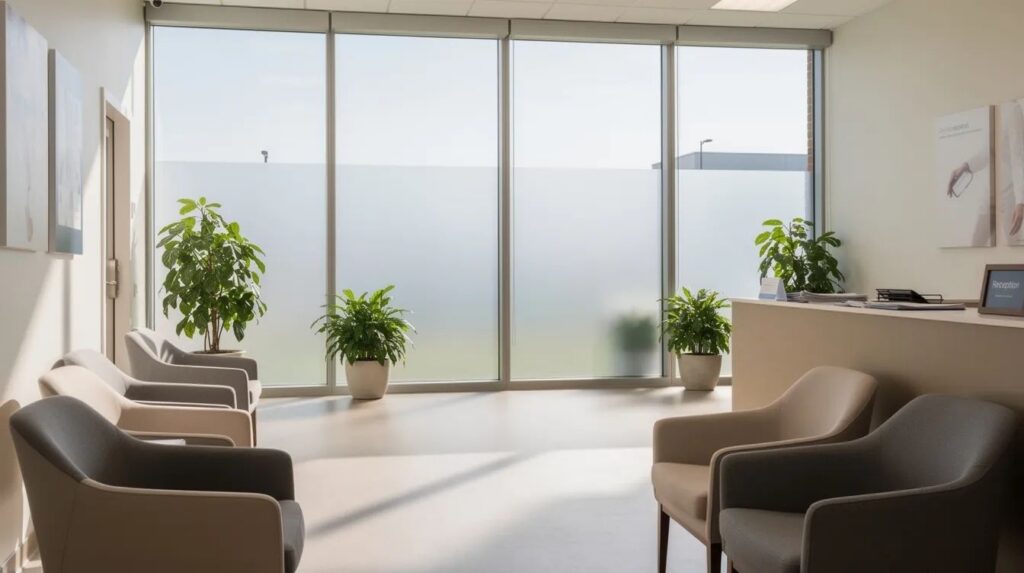
Solar control film plays a direct role in patient comfort, especially in hospital wings and outpatient centers with large exterior windows where patients and staff spend extended periods near glass, delivering many of the same benefits highlighted in commercial window tinting for office buildings.
Modern solar control film reduces glare intensity by up to 80 percent while still allowing significant visible light into patient rooms-keeping spaces bright without the discomfort of direct sun. Solar control film reduces cooling costs by 10 to 20 percent in highly glazed medical buildings, and energy-efficient window films lower energy costs year-round by stabilizing indoor temperatures.
The practical benefits for active healthcare environments are immediate:
- More stable temperatures in waiting areas and infusion bays
- Reduced visible glare on diagnostic monitors, EHR systems, and computer screens
- Less UV exposure on interior finishes, furnishings, and equipment
- Lower cooling loads, with potential to extend HVAC equipment life
Window film installation can lead to significant energy savings, and most healthcare facilities see energy savings within the first billing cycle. A multi-story medical office building retrofitted with solar control film on sun-exposed upper floors can expect measurable reductions in hot spots and staff complaints-results consistent with documented cases where solar film reduced chiller runtime and cut annual energy costs by tens of thousands of dollars.
Solar control can be combined with privacy film in exam rooms and patient areas through dual-performance products, so a single installation addresses both reducing solar heat gain and maintaining natural light goals, and facilities concerned about views after dark should consider best window film options for nighttime privacy when specifying products.
Security Window Film in Hospitals, Pharmacies, and Clinics
Healthcare facilities increasingly need security glazing solutions. Healthcare-related crimes increased by 89% over the past five years, driving hospitals and clinics to harden their physical perimeters without creating a fortress-like atmosphere.
Security window film works by bonding a thick polyester layer to existing glass. Security film holds glass fragments together during impact events-slowing forced entry and reducing injury from flying broken glass during break-in attempts or severe weather. Security window film reduces successful break-in attempts by over 85%, making it a meaningful deterrent for vulnerable entry points and one of several window protection film solutions to reinforce glass in high-risk healthcare zones.
Priority locations for security film installation in medical facilities include:
- Pharmacy windows and drug storage areas
- Emergency department entrances and vestibules
- Behavioral health units
- Ground-floor clinics and medical office windows
- Loading dock office glazing
Security film is not bulletproof and should not replace ballistic glass in facilities with elevated threat profiles. Instead, it is a cost-effective solution that upgrades existing glass as part of a layered security plan alongside cameras, access control, and security personnel protocols. Professional-grade security films meet GSA and ASTM testing standards, and attachment systems can be added to improve performance on larger hospital windows, with security window film installation cost guidelines helping budget owners plan upgrades for vulnerable entrances and pharmacies.
Privacy and security often overlap: some security films can be paired with tinted or frosted layers so that pharmacy staff and valuable assets remain protected while patient areas retain a welcoming appearance.
Why Window Film Often Outperforms Curtains and Blinds in Medical Facilities
When comparing hospital window film to conventional blinds, curtains, and etched glass, three factors stand out for medical environments: infection control, consistency, and maintenance.
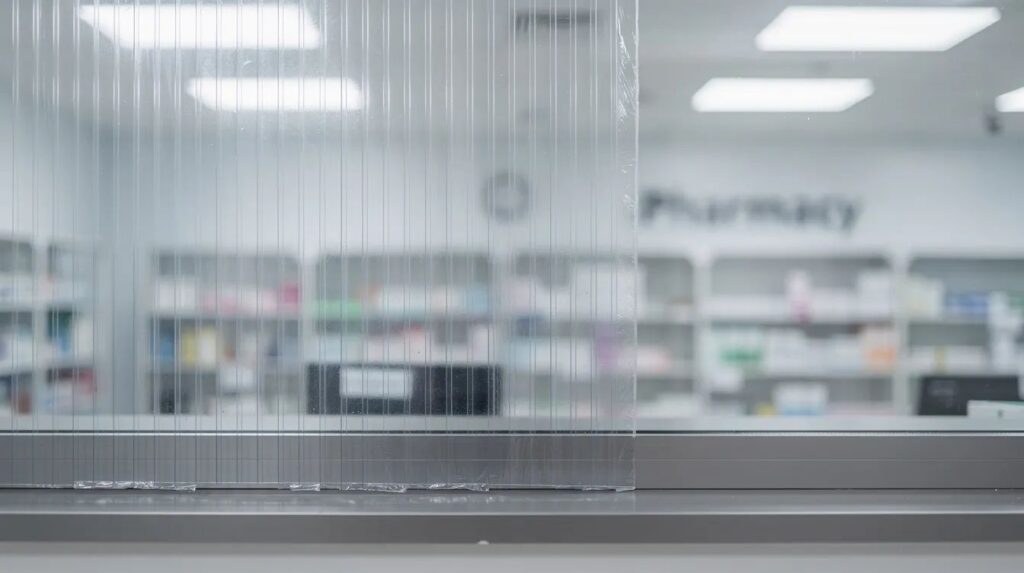
Blinds and fabric curtains accumulate dust and pathogens and require frequent laundering or replacement. Window film is easier to clean and disinfect than traditional curtains or blinds because it forms a smooth, non-porous surface that withstands hospital-grade disinfectants, while providing reliable day-and-night privacy when you choose continuous privacy window film solutions instead of reflective tints. This matters in treatment rooms, patient rooms, and anywhere infection control protocols govern surface management.
Operational advantages go further. Privacy film is always “on”-no one forgets to close it. It does not rattle against windows, interfere with medical booms, or obstruct patient-lift tracks along headwalls. Using privacy film can enhance patient comfort and dignity in healthcare settings by providing consistent coverage without requiring staff action.
Compared to etched or replacement glass, film installs directly on existing glass with minimal disruption and can be updated or removed years later if departments are reconfigured. The cost difference is substantial: a frosted film retrofit runs a fraction of full glass replacement and avoids weeks of construction downtime in occupied medical buildings, and some smaller clinics may even consider do-it-yourself window film installation for limited, non-critical areas.
Where other treatments may still be needed: rooms requiring complete darkness for procedures may need blackout shades in addition to solar control or privacy film. Film performs best as a baseline layer that addresses privacy, UV protection, and comfort continuously.
Evaluating Your Medical Facility for Privacy and Window Film Compatibility
A professional site assessment is essential before ordering film. Glass type, orientation, existing coatings, and sightlines all determine which solution will work and remain warranty-safe.
Window Film Depot’s typical evaluation process for a healthcare building includes:
- Floor plan review – identifying high-risk corridors, reception areas, and patient-facing glass
- Sightline mapping – checking daytime and nighttime views from hallways, sidewalks, and parking areas (what seems private at noon may be fully exposed at night when interior lights are on)
- Glass identification – cataloging single-pane, insulated, laminated, and Low-E glass throughout the facility, since applying the wrong film to certain glass types can create thermal stress or void manufacturer warranties
- Performance specifications – reviewing NFRC ratings for solar performance, safety glazing requirements, and fire/life-safety considerations around stairwells and rated assemblies
Coordination matters. Healthcare projects require working with facility management, infection control teams, safety officers, and sometimes landlords for leased medical office buildings to ensure regulatory compliance with building rules and healthcare regulations. Choosing the right window film for each zone-rather than applying one product everywhere-is what separates a successful retrofit from a costly mistake, and working with a dealer that offers a broad range of commercial window film brands and products simplifies that specification process.
Cost, Timelines, and Expected Lifespan of Healthcare Privacy Window Film
Cost for hospital window film projects depends on total glass area, film type, access conditions (occupied patient rooms versus new construction), and any custom graphics, with ranges similar to published security window film installation price estimates but adjusted for healthcare-specific site conditions.
Here are realistic installed cost ranges per square foot for budgeting purposes:
| Film Category | Typical Installed Cost |
|---|---|
| Frosted/decorative privacy film | $8–$14 per sq ft |
| Solar control film | $6–$12 per sq ft |
| Security film (8–14 mil) | $12–$20 per sq ft |
| Dual-performance combinations | $15–$25 per sq ft |
| Switchable smart film | $29–$75 per sq ft |
| Typical project timelines move through initial assessment, product selection and mockups, infection control planning, phased installation by floor or department, and a final punch-list walkthrough. Most departments can be filmed with minimal disruption over days rather than weeks. |
Commercial-grade privacy and decorative films commonly last 10–20 years or more on interior glass when properly installed and maintained. Exterior solar control films may have shorter lifespans under harsh sun exposure. Manufacturer and installer warranties covering both product and workmanship are standard on professional installations when partnering with a national provider like Window Film Depot.
ROI comes from multiple directions: reduced HVAC costs, fewer glare and heat complaints, improved patient and staff satisfaction scores, avoided costs from curtain laundering or blind replacement, and reduced exposure to security incidents in pharmacies and emergency rooms.
Frequently Asked Questions About Healthcare Privacy Window Film
Below are concise answers to questions Window Film Depot hears most often from hospital engineers, practice managers, and architects about privacy window film in healthcare settings.
Does privacy window film by itself make my facility HIPAA compliant?
No. Privacy film helps maintain HIPAA compliance in healthcare settings by reducing unauthorized visual access to PHI in exam rooms, patient rooms, and workstations, but it is one physical safeguard within a broader program. Compliance depends on risk assessments, staff training, signage, access controls, screen positioning, and guidance from your organization’s privacy officer. The Health Insurance Portability and Accountability Act framework requires layered safeguards-film addresses the visual component effectively.
Will frosted film make exam rooms and patient rooms feel dark?
Quality frosted window film obscures views while allowing natural light to pass through as diffused illumination. Brightness depends on the film’s visible light transmission rating, coverage area, and window orientation. Facilities concerned about blocking daylight can test sample panels or use gradient films that keep upper glass clearer while fully obscuring eye-level views. The goal is to maintain natural light while eliminating direct sightlines.
Can window film be installed in active hospitals without disrupting patient care?
Yes. Installation involves drop cloths, spray solutions, and hand tools-no heavy equipment, structural work, or significant noise. Typical installation times run 30–60 minutes per window. Window Film Depot routinely schedules work around clinical operations during off-peak hours, evenings, or weekends, and coordinates with infection control teams on containment and cleaning protocols to ensure minimal disruption to patient care in active healthcare environments.
Is security window film bulletproof or blast-proof for hospitals?
Security film is not bulletproof. It is engineered to strengthen glass and hold it together under impact and forced entry attempts, buying time for security personnel to respond. For facilities with elevated threat profiles, Window Film Depot works with manufacturers to specify films and attachment systems tested to particular forced entry or blast standards. Expectations should align with real-world performance: security film is a critical layer in a comprehensive plan, not a standalone barrier.
How long does healthcare window film last, and how do we clean it?
Interior privacy films typically last 10–20 years or more. Exterior solar control films on highly exposed glass may have somewhat shorter lifespans. After the recommended cure period (usually 30 days), clean with standard glass cleaners without abrasives or razor blades. Confirm that your infection control team’s disinfectants are compatible with the installed film-most hospital-grade cleaners work well on professional films.
Can privacy window film be removed or changed if a department’s use changes?
Yes. Professional-grade films are removable with the right tools and techniques, allowing reconfiguration as units change from general med-surg to behavioral health or from clinic to administrative space. Switchable smart film provides on-demand privacy in treatment rooms without any removal needed at all. Window Film Depot can plan phased removals and re-installs to minimize downtime and keep glass usable throughout transitions.
Why Choose Window Film Depot for Healthcare Privacy and Security Film Projects
Window Film Depot is a family-owned, national contractor with more than three decades of experience (founded in 1992) delivering turnkey window film solutions for hospitals, health systems, and medical office portfolios across the United States.
What makes us different for healthcare clients:
- Product expertise – We install 3M solar control and privacy films, security glazing upgrades, and decorative and architectural films, selecting the right window film for each clinical zone
- Healthcare protocol compliance – Our teams follow strict infection control and life-safety protocols during every installation in occupied medical environments
- Multi-site capability – We support health systems running nationwide rollouts, coordinating consistent specifications for patient rooms, exam rooms, and pharmacies across different states and building types through nationwide window film installation services
- Consultative approach – We provide sightline studies, energy modeling, sample mockups on patient rooms, and close collaboration with architects, facility managers, and compliance teams to meet both regulatory compliance and design goals
Our experience spans medical services environments from large VA hospitals to outpatient behavioral health clinics, and we bring the same level of precision to every project, including advanced options like 3M cloaking window film installations for sensitive digital displays in administrative and clinical areas.
Next Steps: Upgrading Privacy, Comfort, and Security in Your Healthcare Facility
Healthcare privacy window film is one of the fastest, most practical upgrades you can make to protect patient confidentiality, improve daily comfort, and strengthen safety across your medical facility. It works on existing windows and glass walls with minimal disruption-no construction, no extended downtime.
Here is how to get started:
- Gather basics – Note your facility locations, approximate glass areas, and primary concerns (privacy, glare, security, or all three)
- Pilot first – Consider filming a limited number of patient rooms or an exam room corridor to evaluate impact on privacy, visible glare, and staff feedback before expanding system-wide
- Contact Window Film Depot – Reach out for a site assessment or project review; share floor plans or elevations so our team can recommend the right mix of privacy, solar control, and security films for your healthcare facility
Schedule a consultation with Window Film Depot today to see how the right combination of healthcare privacy window film can protect your patients, your data, and your bottom line, whether you need regional support such as window film installation in the San Francisco Bay Area or commercial window tinting and graphics in Washington, DC.