Table of Contents:
- Understanding the Physics of Window Film and Nighttime Privacy
- Finding the Best Window Film for Nighttime Privacy: Moving from Reflection to Obscurity
- Solution 1: Frosted and Decorative Films for Aesthetic Privacy
- Solution 2: Advanced Dual-Reflective and Opaque Films
- Key Specification Factors for Project Managers
- Partnering with an Expert Installer to Guarantee Satisfaction
- Frequently Asked Questions
- Related Posts from Window Film Depot
Understanding the Physics of Window Film and Nighttime Privacy
To specify the right product and avoid the pitfalls of the nighttime reversal effect, it is crucial to understand the physics at play. The “one-way mirror” effect is not an inherent property of the film itself but a visual result of the interplay between the film and its environment. Understanding this science is the best tool for managing client expectations and ensuring a successful installation.
The Core Principle: Light Differential
The performance of any standard reflective window film hinges on a single concept, the light differential. This refers to the difference in brightness between the interior and exterior of a building. These films are engineered with a micro-thin, metalized layer that is highly reflective.
The rule is simple. The side of the glass with more light will see a reflection, while the side with less light will be able to see through. During the daytime, the sun makes the exterior vastly brighter than the building’s interior. Consequently, the film reflects the bright exterior light, creating a mirror-like appearance for anyone looking in and delivering the desired daytime privacy.
Why Interior Lights Reverse the Effect at Night
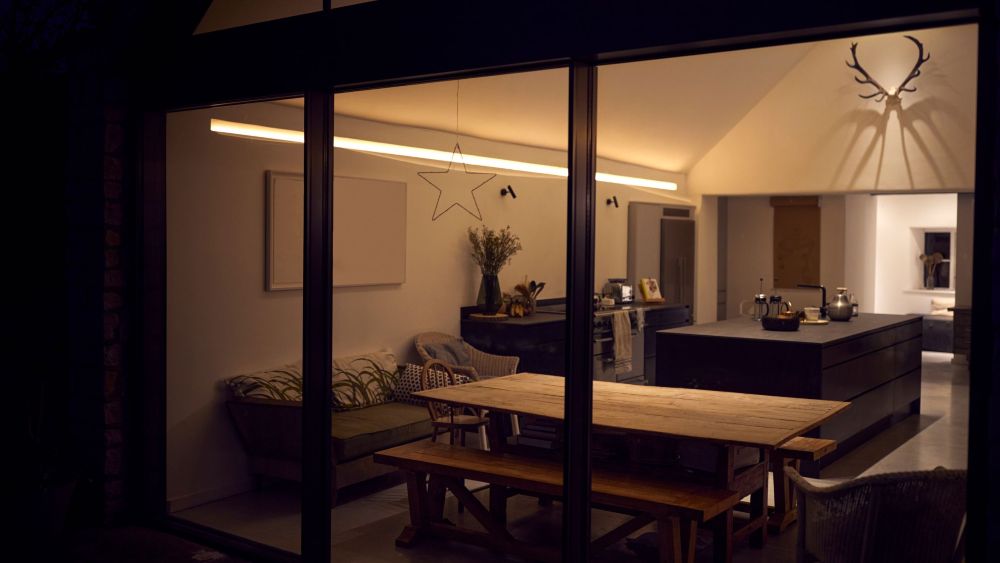
The problem arises when the sun sets and the light differential flips. Once interior lights are turned on in an office or retail space, the inside of the building becomes brighter than the dark exterior.
The reflective film, operating on the same consistent principle, now does the exact opposite of what your client wants. It reflects the brighter interior light back into the room, creating a mirror for the occupants.
To an observer on the outside, the lit interior is now clearly visible through the glass. This is the “reversal effect” in action, and it is the single biggest reason standard reflective films fail to provide nighttime privacy.
Explaining the Physics to Your Client
Communicating this technical limitation to a client does not have to be complex. A clear explanation positions you as a knowledgeable expert who is guiding them toward the correct solution.
You can use the simple analogy of a police interrogation room. Everyone understands that from the dark observation room, you can see into the brightly lit room, but the person inside only sees their own reflection.
When speaking with your client, you can frame the conversation this way:
- Set the Stage: “The privacy film you’re thinking of works based on a light imbalance, much like a mirror. It reflects light back toward the brightest side.”
- Explain Daytime: “During the day, it’s bright outside and darker inside, so the film reflects the sunlight, and people outside can’t see in. This works perfectly for daytime.”
- Introduce the Problem: “At night, however, when your interior lights are on, the inside becomes brighter than the outside. The film then reverses its effect, allowing people to see in while you see a reflection from the inside.”
- Pivot to the Solution: “Because 24/7 privacy is your goal, we need a different type of film that provides opacity without relying on the light balance. Let’s explore some frosted or decorative options that guarantee privacy day and night.”
This approach proactively addresses the limitation and smoothly transitions the conversation toward films that are actually engineered to meet their specific privacy requirements.
Finding the Best Window Film for Nighttime Privacy: Moving from Reflection to Obscurity
Now that we have established the limitations of standard reflective films at night, the path forward becomes clear. To deliver on a client’s request for round-the-clock privacy, we must shift our strategy from relying on an imbalance of light to creating a physical barrier to sight using solutions like frost window film.
The Strategic Shift: Prioritizing Opacity Over Reflectivity
True 24/7 one way privacy window film does not depend on light levels. They work by making the glass itself opaque or, more accurately, translucent. This means they physically scatter or block light in a way that prevents clear viewing from either side, at any time of day or night. For any project manager, this distinction is critical. You are no longer specifying a conditional solution but a constant and reliable one.
An Introduction to 24-Hour Privacy Window Film
When consistent privacy is the primary objective, we turn to three main categories of film, each engineered for this purpose:
- Frosted and Decorative Films: These films create privacy by making the glass translucent. They obscure views completely while still allowing a significant amount of diffused, natural light to pass through.
- Opaque and Blackout Films: For situations requiring total light blockage and absolute visual secrecy, these films are the definitive solution. They prevent any view and block nearly all light transmission.
- Advanced Dual-Reflective Films: While most reflective films fail at night, certain advanced products are engineered to reduce the interior “mirror” effect. They offer a degree of nighttime privacy but are a more specialized solution.
Matching Film Technology to Your Commercial Space
Specifying the correct film is not a one-size-fits-all decision. The optimal choice depends on a careful analysis of the space and the client’s goals. A ground-floor office on a busy street has different needs than an internal glass-walled conference room. The former may need total obscurity from the public, while the latter may only need to prevent casual observation. As your project partner, we help you navigate these variables to ensure the specified film meets the precise functional and design requirements of each unique space.
Solution 1: Frosted and Decorative Films for Aesthetic Privacy
For the vast majority of commercial projects demanding 24/7 privacy, frosted and decorative films are the most versatile and effective solution. They solve the privacy problem directly and open up a world of design possibilities.
Achieving Total Visual Obscurity with Frosted Glass Film for Office and Retail
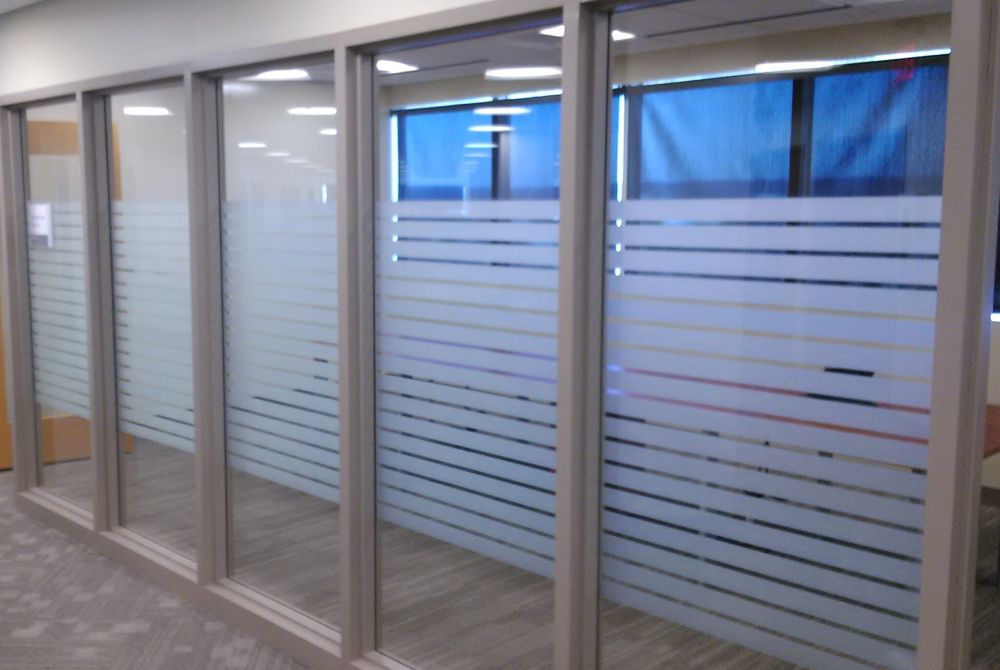
The core technology behind frosted window film is simple yet highly effective. The film has a textured surface that scatters light as it passes through the glass.
This diffusion of light blurs shapes and eliminates detail, rendering the view completely obscure from any distance.
The result is a translucent finish that provides total visual privacy from both sides, day and night, regardless of lighting conditions.
Leveraging 3M Fasara Glass Finishes for Design and Discretion
When a client wants to combine privacy with high-end design, the 3M Fasara family of films is a premier choice. These are sophisticated decorative finishes that replicate the look of etched, cut, and sandblasted glass at a fraction of the cost. With hundreds of patterns available, from simple gradients to complex rice-paper or fabric-like textures, Fasara films allow you to integrate privacy into the building’s interior design. This turns a functional necessity into a powerful aesthetic element.
Balancing Privacy and Natural Light
A common concern when obscuring glass is the potential loss of natural light. This is where frosted films offer a significant advantage over opaque solutions. While they provide complete visual privacy, frosted films are engineered to maintain high levels of light transmission. They diffuse the incoming light, softening it and spreading it more evenly throughout the space. This can reduce glare and create a comfortable ambient glow, allowing you to create a private space that still feels bright and open.
Ideal Applications
The balance of privacy, light, and aesthetics makes frosted and decorative films ideal for a wide range of commercial applications, including:
- Glass Conference Rooms: Provide complete confidentiality for meetings without blocking all light.
- Lobby and Reception Areas: Obscure views into private office areas from the main entrance.
- Interior Office Partitions: Define spaces and create private offices in an open-plan environment.
- Retail Storefronts: Obscure views of back-of-house storage or create branded displays.
- Healthcare and Wellness Centers: Ensure patient privacy in consultation rooms and waiting areas.
Solution 2: Advanced Dual-Reflective and Opaque Films
While frosted films provide a definitive solution for 24/7 privacy by obscuring the view, some projects require a more nuanced approach. For clients who want to maintain some visibility out of the building at night, or for applications where absolute opacity is the goal, we turn to a more technical class of films.
How Dual-Reflective Films Mitigate the “Reversal Effect”
A common client request is for daytime privacy without a highly mirrored look from the inside, especially at night. This is the precise challenge dual-reflective films are designed to address. Unlike a traditional solar film with the same reflectivity on both sides, a dual-reflective film has two distinct surfaces. The exterior-facing side is highly reflective for solar heat rejection and daytime privacy. The interior-facing side, however, has a much lower, more neutral reflectivity.
This design directly mitigates the “mirror” reversal at night. Because the interior surface is less reflective, it dramatically reduces the harsh mirror-like effect, allowing occupants to see outside more clearly after dark compared to standard reflective films. It is critical to set expectations, these films mitigate, they do not eliminate, the light balance principle. Outsiders will still be able to see in if the interior is brightly lit.
When to Specify Fully Opaque or Blackout Films
In situations where privacy is non-negotiable and the view is irrelevant, the most direct solution is an opaque film. These films provide 100% visual privacy by completely blocking the view. They effectively turn a pane of glass into a solid, opaque surface.
You should specify a fully opaque film for applications such as:
- Hiding unsightly areas: Obscuring views into storage rooms, mechanical closets, or behind spandrel glass.
- Total light blocking: Creating a true blackout environment for theaters or labs.
- Creating uniform surfaces: Applying whiteout or blackout window film across glass and wall panels for a seamless look.
Products like the 3M Scotchcal Opaque Graphic Film series come in a wide range of colors, including black and white, allowing you to match the film to the building’s design.
High-Security Applications: Data Centers and Sensitive Areas
For facilities where information security is paramount, visual privacy is a baseline requirement. Data centers, government buildings, and Sensitive Compartmented Information Facilities (SCIFs) almost always call for a complete privacy solution. Here, blackout and whiteout opaque films are the industry standard. They ensure that no sensitive equipment, screens, or documents can be seen from the outside, day or night. For SCIFs in particular, film specifications are extremely rigid and may even require films that offer RF attenuation to block electronic eavesdropping.
Need More Info?
The Window Film Depot team is happy to help.
Key Specification Factors for Project Managers
Selecting the right film is a diagnostic process. As the project manager, leading this conversation with your client is key to avoiding misaligned expectations and costly rework. The following steps will help you translate a general request for “privacy” into a precise technical specification.
A Checklist for Defining Client Requirements
Before you review a single film sample, start by asking clarifying questions to ensure you are solving the right problem.
- Primary Goal: Is the objective daytime privacy, nighttime privacy, or 24/7?
- View Preservation: Is it important for occupants to be able to see out during the day? What about at night?
- Light Levels: Is the goal to maximize natural light, or is glare reduction a priority?
- Interior and Exterior Aesthetics: What is the desired look from inside and outside the building?
Evaluating Building Context and Local Codes
With the client’s needs defined, you must evaluate the physical context. Assess the lighting conditions, both interior and exterior. Note the building’s orientation, as south and west-facing elevations receive more direct sunlight and are prime candidates for high-performance solar control films. Finally, always verify local building codes and any applicable property association regulations. Many jurisdictions have limits on the maximum allowable exterior reflectivity for windows.
Translating Client Needs into a Film Specification
This is where you connect the client’s requirements to a tangible product solution.
- If the client needs 24/7 privacy and a view is not required, then you specify a frosted, decorative, or opaque film like 3M Fasara or Scotchcal.
- If the client needs daytime privacy and wants to preserve the view out, then you specify a traditional or dual-reflective film, but you must manage nighttime expectations.
- If the client needs to see out at night more clearly while getting daytime privacy, then you specify a dual-reflective film, explaining it mitigates but may not eliminate the interior mirror effect.
Your final step is to present your recommended solution. Avoid generic terms like “one-way mirror film.” Instead, use the precise language of the solution you’re recommending, explaining why you’ve chosen it. The most effective tool for gaining buy-in is a physical sample applied to the actual glass on-site. This lets the client see exactly how it performs in their unique environment, eliminating guesswork.
Partnering with an Expert Installer to Guarantee Satisfaction
Specifying the correct window film is a critical first step, but it is only half the equation. An experienced installer acts as a crucial quality control checkpoint, de-risking the project from initial consultation to final sign-off.
The Value of Deep Product Knowledge
A certified partner possesses an encyclopedic knowledge of the 3M window film portfolio. They understand the precise performance metrics of each product. They can articulate why a 3M Fasara Frosted Film will provide total visual obscurity 24/7, or how a 3M Dual-Reflective Film can mitigate nighttime transparency compared to traditional films. This deep knowledge allows them to guide you away from flawed concepts and toward a solution engineered to perform correctly.
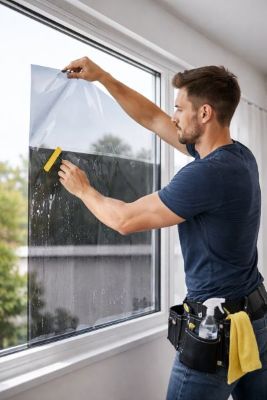
Why Professional Installation is Critical
The performance and lifespan of any high-quality window film are directly tied to the quality of its installation.
A poorly executed application can lead to contamination, bubbling, lifting, and creases, resulting in costly callbacks and a dissatisfied client.
A professional installation is also a prerequisite for validating the manufacturer’s warranty. 3M provides a comprehensive warranty for its films, but it is contingent on the installation being performed by a certified professional according to their strict standards.
From Specification to Execution
Engaging a certified installation partner transforms the process from a procurement task into a collaborative, risk-managed solution.
The partnership begins with a consultation to confirm the project’s true objectives, ensuring you select the optimal film from the start. Then, a team of trained technicians prepares the glass and applies the film with precision, ensuring a defect-free outcome. From material logistics to site cleanup, the partner manages their entire scope of work. This provides you with a single, reliable point of contact and accountability, guaranteeing the job is done right the first time.
Frequently Asked Questions
What is the best window film for nighttime privacy?
For true 24/7 privacy, the best options are frosted or decorative window films. These films obscure the view by scattering light, making the glass translucent regardless of the lighting conditions inside or out. Opaque films are also an option if blocking all light and the view is acceptable.
Will a one-way mirror film give me privacy at night?
No. Standard reflective or “one-way mirror” films only work when the outside is significantly brighter than the inside. At night, when your interior lights are on, the effect reverses, and people outside can see in clearly.
Can I still have natural light with a 24-hour privacy window film?
Yes. Frosted and decorative films are an excellent choice for maintaining natural light. They are translucent, not opaque. They provide complete visual privacy by diffusing light, which also softens it, reduces glare, and creates a pleasant ambient glow in the space.
Is professional installation for commercial privacy window film necessary?
Yes, professional installation is essential. It guarantees a flawless, bubble-free appearance and ensures the film adheres properly for maximum longevity. More importantly, installation by a certified professional is almost always a requirement to validate the comprehensive manufacturer’s warranty that comes with high-quality commercial films.