Table of Contents:
- What Privacy Window Film Actually Does — and Why the Commercial Spec Is Different
- The Commercial Specifier’s Map: Privacy Film Types, Trade-Offs, and Appropriate Applications
- The Day/Night Privacy Problem Your Spec Sheet Is Not Telling You
- UV Blocking, Heat Control, and the Measurable Performance Case for Commercial Installation
- Professional-Grade vs. Generic Film: The Certification and Performance Gap That Carries Project Risk
- Specifying and Managing a Large-Scale Privacy Film Rollout Without Schedule Risk
- From Specification Confidence to On-Budget Delivery: Your Next Steps
- Frequently Asked Questions
What Privacy Window Film Actually Does — and Why the Commercial Spec Is Different
Window Film for Privacy gives offices, clinics, schools, and retail spaces a practical way to block unwanted views without sacrificing natural light. This guide explains how different privacy films perform, which products work best for commercial applications, and how Window Film Depot helps project teams specify and install privacy solutions that meet both design and operational goals.
How Privacy Window Film Works: PET Substrate, Adhesive Systems, and Light Manipulation
Privacy film is a laminated polyethylene terephthalate (PET) substrate, typically between 1.5 and 4 mils thick, that modifies how light passes through or reflects off glass.
The film either scatters incoming light (frosted and patterned films), reflects it directionally (one-way visibility films), or absorbs it (tinted and blackout window film). What changes across product lines is the mechanism, not the substrate. The PET base is consistent across categories. The coating, treatment, and adhesive system determine what the film actually does on the glass.
Pressure-Sensitive Adhesive vs. Static-Cling: A Commercial Decision, Not a Preference
Static-cling film holds against glass by surface tension alone. It installs easily, repositions cleanly, and leaves no residue, which makes it well-suited for short-term applications or tenant improvements where the glass condition needs to be preserved exactly. But surface tension fails under sustained thermal cycling, high humidity, and edge-lift stress on large glass panels. On a 10-foot curtain wall section or a south-facing retail storefront, static-cling film will edge-lift within months.
Pressure-sensitive adhesive (PSA) bonds chemically to the glass surface. On commercial glazing, PSA is the correct specification for any permanent or semi-permanent installation. It tolerates thermal expansion, resists moisture infiltration at the edges, and maintains optical clarity over years rather than months. The choice between adhesive systems is not a matter of installer preference. It is a performance and longevity decision with direct consequences on rework costs and warranty coverage.
How VLT Percentages Translate to Real-World Visibility Outcomes
Visible light transmittance (VLT) measures the percentage of visible light that passes through the film. A film rated at 5% VLT transmits almost no visible light, which is effective blackout in most conditions. A film at 50% VLT transmits roughly half the ambient light, maintaining a bright interior while reducing glare and some degree of visual access. A frosted film at 70% VLT scatters light broadly, creating diffusion without significant light loss.
The practical implication: VLT percentages do not directly map to privacy levels. A 15% tinted film on a window with bright interior lighting may offer less nighttime privacy than a 50% frosted film, because reflectivity governs what an outside observer sees, not transmittance alone. Specifiers who select film based on VLT percentage without accounting for interior lighting conditions and reflectivity are working with an incomplete picture.
Why Residential-Grade Thinking Fails on Commercial Glass
Residential privacy film is specified for single-pane or standard double-pane residential glass, applied to surfaces measured in square feet, in climate-controlled interiors, by a single installer. Commercial glazing introduces an entirely different set of variables: tempered, laminated, and insulated glass units (IGUs) with specific manufacturer restrictions on film application, glass areas measured in hundreds or thousands of square feet, curtain wall systems with thermal expansion tolerances, and building code requirements that residential film products are not tested or certified to meet.
Applying a residential-grade film to commercial glass can void the IGU manufacturer’s warranty, cause seal failure from thermal stress, and create bubbling or delamination on tempered surfaces. These are not theoretical risks. They are documented failure modes that generate change orders, schedule delays, and in some cases, full glass replacement costs.
What Performance Standards Should Commercial Window Film Meet for Institutional Buildings
Commercial and institutional projects require film products that have been independently tested against recognized standards. The relevant benchmarks include ANSI Z97.1 for safety glazing, ASTM E84 for surface burning characteristics in occupied buildings, and ASTM D1003 for optical clarity and haze. In K-12 and healthcare environments, fire-rating requirements may apply to any material applied to glazing within egress corridors.
Beyond safety standards, institutional projects often require documentation for submittal packages: manufacturer test reports, product data sheets, and installer certification records. A film product that meets these requirements represents a fundamentally different category of specification from a retail product, regardless of how similar the two might appear at the point of sale.
The Commercial Specifier’s Map: Privacy Film Types, Trade-Offs, and Appropriate Applications
Frosted and Patterned Films: Office Partitions, Corridors, and Glass Manifestation Compliance
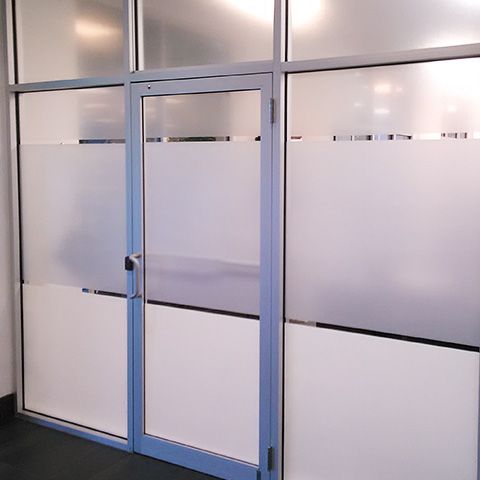
Frosted film is the workhorse of commercial interior privacy specification. It delivers consistent visual obscuration across its full surface area, maintains high VLT (typically 50-80%), and reads as intentional, finished design rather than an afterthought. In open-plan offices, glass-walled conference rooms, and healthcare consultation spaces, frosted film meets both the privacy requirement and the occupant comfort need for natural light.
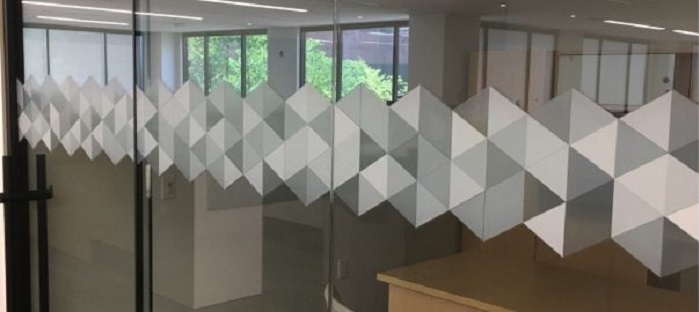
Patterned films, including stripes, gradients, and geometric cuts, serve a dual function in commercial corridors and building lobbies: privacy where needed and glass manifestation compliance under ADA and building code requirements.
Large uninterrupted glass panels in public circulation areas must include visual markers at specified heights to prevent occupant collision. Patterned film applied in compliant bands satisfies this requirement while maintaining the design intent of open, light-filled circulation spaces.
One-Way Visibility Film: What “One-Way” Actually Means and Where It Performs
One-way visibility film works on the principle of differential reflectivity, not a physical one-way mechanism. The reflective side of the film faces the brighter environment and bounces light back toward the observer on that side, while the dimmer interior side sees through the reflective layer. This means the film performs exactly as described when the exterior is brighter than the interior, typically during daylight hours on windows facing natural light.
The performance condition matters for specification. One-way film on a north-facing facade with heavy tree cover performs poorly compared to the same film on a south-facing glass wall. And after dark, when interior lighting reverses the light differential, the privacy effect inverts. The inside becomes visible from outside. Specifying one-way film without documenting this condition to the client is a reliable path to a dissatisfied call at 7 p.m. on a winter evening.
What Is the Best Window Film for Privacy That Still Allows Light Through?
Frosted film at 50-70% VLT consistently delivers the strongest combination of visual privacy and light transmission for occupied commercial spaces. It scatters incoming light uniformly, maintains a bright interior, and performs consistently regardless of time of day or interior lighting conditions, unlike one-way reflective film, which shifts in behavior as ambient light changes. For spaces where both privacy and natural light are non-negotiable, frosted film is the specification to reach for first.
Tinted Window Film: Solar Control, Glare Reduction, and Privacy as a Secondary Benefit
Tinted window film is primarily a solar control specification. It reduces solar heat gain, cuts glare, and blocks UV radiation, with privacy as a secondary outcome rather than the primary performance driver. A standard charcoal tint at 20% VLT significantly reduces visibility from outside during daylight but does not provide the same consistent, view-blocking coverage that frosted film delivers. Specifying tinted film primarily for privacy often results in a solution that underperforms on the privacy side while slightly overperforming on heat control.
The appropriate use case for tinted film is a south- or west-facing perimeter office zone where solar heat gain is the primary problem, glare is a secondary concern, and some degree of exterior visibility reduction is a welcome addition. In that context, tinted film earns its place on the submittal.
Blackout Film: Use Cases, Limitations, and Where Over-Specification Creates Problems
Blackout film, rated at 0-5% VLT, blocks essentially all visible light transmission and provides complete visual privacy in both directions. The correct applications are narrow and specific: server rooms, darkroom facilities, some healthcare imaging suites, and any space where complete light exclusion is operationally required. Blackout film on a general office window eliminates natural light, creates a sealed visual environment, and often generates occupant complaints within weeks of installation.
Over-specifying blackout film in mixed-use spaces is a pattern that emerges when privacy requirements are communicated in binary terms, “we need privacy,” without discussion of how much light transmission the occupants need or expect. The specification conversation should establish both the privacy level and the VLT floor before film selection begins.
3M Fasara Decorative Series: When Aesthetic Specification Meets Commercial Performance Standards
The 3M Fasara series occupies a distinct position in commercial specification. It delivers the optical quality and adhesive system integrity of a professional-grade commercial film while offering a library of patterns, textures, and translucency levels that satisfy design intent. For projects where the architect has specified a particular visual character for glass partitions or feature walls, and where performance documentation is required for submittals, Fasara bridges the gap between what the design team wants and what the construction documents require.
Fasara films carry 3M’s commercial warranty and are produced to consistent optical and dimensional tolerances, which matters on large-format applications where variation between panels is visible. On a 40-foot glass partition wall in a corporate lobby, consistency across every film panel is not an aesthetic preference. It is a specification requirement.
Privacy Film Type Selector
A decision matrix for matching film category to application environment
| Film Type | Typical VLT Range | Privacy Level | Best Application | Adhesive System | Key Certification Note |
|---|---|---|---|---|---|
| Frosted / Patterned | 50-80% | High (both directions, all hours) | Office partitions, conference rooms, corridors, ADA manifestation compliance | PSA (permanent) or static-cling (temp) | Confirm ASTM E84 for egress corridors |
| One-Way Reflective | 10-35% | High daytime / Low nighttime | South/west perimeter offices, lobbies with consistent daylight | PSA recommended for large glass | Document light-condition limitations in spec |
| Tinted | 5-50% | Moderate daytime only | Solar control zones, perimeter offices, retail storefronts | PSA for permanent installation | Verify IGU manufacturer compatibility before spec |
| Blackout | 0-5% | Complete (both directions) | Server rooms, imaging suites, light-sensitive facilities | PSA | Confirm ventilation adequacy — light exclusion raises interior temps |
| 3M Fasara Decorative | 15-75% (pattern-dependent) | Moderate to High | Design-forward partitions, feature walls, branded environments | PSA (commercial-grade) | 3M commercial warranty, ASTM-tested, submittal-ready |
Use static-cling only for applications under 24 months or where glass restoration to original condition is contractually required. For all permanent commercial installations, PSA is the correct specification regardless of film type. On insulated glass units, confirm compatibility with the IGU manufacturer before any film application. Thermal stress from film on sealed units is a warranty and performance issue that the specifier, not the installer, is responsible for catching at the document stage.
The Day/Night Privacy Problem Your Spec Sheet Is Not Telling You
Most privacy film failures are not product failures. They are specification failures. The client expected privacy at 8 p.m. and got a lit fish tank instead. The film performed exactly as specified. The specification just did not account for what happens after dark.
How Ambient Light Differential Governs One-Way Film Performance
One-way reflective film does not “see” direction. It responds to light intensity. The reflective coating returns light toward whichever side of the glass is brighter. When exterior daylight is stronger than interior ambient light, the outside observer sees their own reflection. When interior lighting is stronger, as it is in any lit office after sunset, the equation reverses completely.
This is not a flaw in the product. It is a physical property of reflective coatings, and it applies to every one-way reflective film on the market regardless of brand or price point. The specification question is whether the application conditions match the film’s performance window.
Daytime Privacy vs. Nighttime Exposure: Specifying for the Correct Condition
A south-facing perimeter office with consistent direct daylight is a strong candidate for one-way reflective film. The light differential is large and sustained, privacy performance is reliable during business hours, and the tradeoff of reduced nighttime privacy may be acceptable if the space is unoccupied after dark.
A ground-floor retail space, a school counselor’s office, or a medical clinic exam room presents a different condition. These spaces are occupied during transitional hours, often have bright interior lighting against dimmer exterior conditions, and carry privacy expectations that extend beyond the 9-to-5 window. Specifying reflective film for these environments without explicit documentation of nighttime behavior is where client disputes begin.
Do Privacy Window Films Work at Night?
Frosted and blackout films work at night. They scatter or block light uniformly regardless of which side is brighter, so privacy performance does not shift with the sun. One-way reflective film does not provide reliable privacy at night in any space with interior lighting. Tinted films reduce visibility at night only marginally, enough to soften an interior view but not enough to obscure it.
For any application where privacy is required after dark, the specification should default to frosted film at the appropriate VLT, or to the 3M Night Vision series if daytime glare and solar control are also priorities.

Choosing the 3M Night Vision Series for Applications Where After-Hours Privacy Is Non-Negotiable
The 3M Night Vision series is engineered to extend the effective privacy window beyond daylight hours by combining higher exterior reflectivity with a lower interior reflectivity ratio. This does not eliminate the light-differential physics, no film can, but it significantly shifts the threshold at which the privacy effect degrades. In practice, Night Vision film maintains meaningful exterior obscuration at lower light-differential conditions than standard reflective films.
For lobby glazing, building entry vestibules, or perimeter offices that remain occupied into evening hours, Night Vision film provides the operational continuity that standard one-way film cannot. It also carries 3M’s commercial warranty and full submittal documentation, which matters when the spec package goes to the architect for review.
Communicating Light-Condition Limitations to Clients Before Installation, Not After
The most effective way to manage this issue is a one-page written summary of film behavior under daytime and nighttime conditions, delivered as part of the pre-installation briefing to the client or facilities team. It does not need to be technical. It needs to be clear: during daylight hours, exterior visibility is blocked. After dark with interior lights on, exterior visibility increases significantly. That statement, documented and acknowledged, converts a potential complaint into an informed decision.
Skipping this conversation does not save time. It transfers the explanation to a post-installation service call, usually at the client’s most frustrated moment.
UV Blocking, Heat Control, and the Measurable Performance Case for Commercial Installation
Privacy is the visible value proposition. UV blocking and solar control are the measurable ones, and on large commercial envelopes, they are where the financial case for professional-grade film gets built.
What 99% UV Blocking Means Across a Multi-Glazed Commercial Envelope
Most commercial-grade window films, including 3M’s full product line, block 99% of UV radiation across the 300-380 nanometer spectrum. For a single office window, this protects occupants and furnishings from UV exposure. Scaled across a multi-glazed commercial building with hundreds or thousands of square feet of glass, this performance specification becomes relevant to interior finish lifecycles, occupant health compliance, and in some institutional contexts, documentation requirements tied to occupant safety standards.
UV degradation of flooring, furniture, and display materials is cumulative and irreversible. In retail environments with branded merchandise displays, UV-related fading is a direct inventory cost. Specifying a film that delivers documented 99% UV rejection across the entire glass envelope is a decision with measurable downstream impact on interior asset life.
TSER and Solar Heat Gain: Translating Film Performance Into HVAC Load Reduction
Total solar energy rejected (TSER) measures the percentage of total solar energy, UV, visible, and infrared, that a film prevents from entering the building. A film with a TSER of 55% rejects more than half of incoming solar energy through treated glass. On a west-facing glass curtain wall in Phoenix or Houston, that figure translates directly into reduced cooling load during peak hours.
The practical specification question is how much HVAC load reduction a given film delivers, and whether that reduction can be documented for the mechanical engineer’s energy model. 3M provides TSER values, solar heat gain coefficients (SHGC), and comparative performance data for treated versus untreated glass for every product in its commercial line. These are not marketing claims. They are performance metrics that can be inserted into energy models and verified against post-installation energy monitoring.
LEED Contribution Credits and Energy-Efficiency Glazing Documentation for Institutional Projects
Window film does not earn its own LEED credit category, but it contributes to several credit pathways, most directly under Energy and Atmosphere (EA) credits related to energy performance optimization, and under Indoor Environmental Quality (IEQ) credits related to daylight and views. For institutional projects pursuing LEED certification, the film specification needs to include documented SHGC values, VLT data, and manufacturer performance reports that the commissioning agent can incorporate into the credit submission.
The documentation requirement is another reason why generic film products create specification risk. A product without published, independently tested performance data cannot be cited in a LEED submittal. A 3M commercial film product can.
Balancing VLT Against Privacy Requirements in Occupied Spaces
The practical answer for most occupied commercial spaces is frosted film in the 50-70% VLT range. This delivers strong visual obscuration, with no clear view through the glass from either direction, while transmitting enough visible light that occupants experience the space as naturally lit. The tradeoff is that frosted film obscures view in both directions, which means spaces that benefit from an outward view need a different approach.
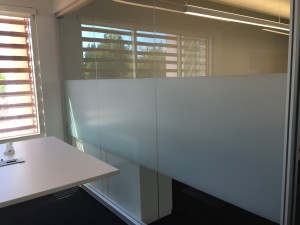
For perimeter offices where occupants want privacy from a corridor but benefit from an outward-facing view, a partial application with frosted film on the lower portion of the glass and clear above is a common and effective solution. The exact height split should reflect the seated eye line of the occupant and the standing eye line of the corridor observer, both of which vary by furniture height and glass panel dimensions. This is a specification detail worth capturing in the drawing set, not leaving to the installer’s judgment on the day.
Professional-Grade vs. Generic Film: The Certification and Performance Gap That Carries Project Risk
The price difference between a commercial-grade 3M film and a generic alternative is measurable. The risk difference is larger than the price difference, and it typically shows up at moments when rework costs are highest.
ANSI Z97.1, ASTM Standards, and IWFA Certification: Why They Matter on Submittals
ANSI Z97.1 covers safety glazing performance requirements for architectural glass, specifically how glazing and applied films behave under impact. ASTM E84 evaluates surface burning characteristics, which is the relevant standard for any film applied to glazing in an occupied corridor, exit access, or other fire-rated assembly. ASTM D1003 covers optical clarity and haze, which governs whether a film maintains acceptable visual quality over its service life.
These standards matter on submittals because building officials and third-party inspectors check them. A submittal package that references a film product without independent test data for the applicable standards will generate a comment or rejection. A submittal that includes 3M’s published test reports, IWFA (International Window Film Association) certification documentation, and manufacturer data sheets clears review faster and with fewer conditions.
What Differentiates 3M Commercial Window Film From Budget Alternatives
The differentiators are not marketing categories. They are measurable product characteristics with direct project consequences.
Warranty Structures, Adhesive Longevity, and Delamination Risk Over the Building Lifecycle
3M’s commercial window film warranties extend to 10-15 years depending on product line, and they cover delamination, bubbling, cracking, and adhesive failure under normal conditions. Generic film products typically carry 1-3 year warranties, and many exclude adhesive failure from coverage entirely.
Delamination on a large commercial installation is not a cosmetic problem. It requires full removal, glass cleaning, and reinstallation at labor rates that can exceed the original material cost on large glass panels. On a building with a 20-year ownership horizon, a 15-year warranty versus a 2-year warranty is a lifecycle cost difference, not a product preference.
Film Thickness, Optical Clarity, and Rework Risk on Large-Format Commercial Glass
Commercial-grade films are produced to tighter dimensional tolerances than retail alternatives. On large-format glass panels, thickness variation creates visible optical distortion: color banding, waviness, and inconsistent haze. These defects are most visible in raking light conditions and on highly polished glass surfaces.
On a 30-foot glass partition wall in a corporate headquarters or a retail storefront with a continuous glass facade, optical inconsistency is a rejection-level defect. Rework on installed film of this scale, including removal, surface prep, and reinstallation, typically runs two to three times the original installation cost.
Security-Grade Film and Glass Security System Integration: The 3M Safety Series
Security film specifications belong in the same conversation as privacy specifications when the project is a school, a healthcare facility, or a high-traffic retail environment. The 3M Safety Series films are engineered to hold glass fragments in place under impact, whether from accidental breakage, forced entry, or blast pressure, and they integrate with glass-break sensors and perimeter security systems through attachment systems that anchor the film to the window frame rather than relying on the adhesive bond alone.
Blast Mitigation Film and Safety Compliance for K-12 and High-Occupancy Retail Environments
Blast mitigation film, typically 7-12 mil thickness with an anchored attachment system, is specified under GSA standards for federal facilities and increasingly adopted in K-12 construction following updated district security protocols. Specifying safety film on glass adjacent to student circulation areas or high-density retail checkout zones represents documented due diligence against foreseeable glass hazard risks in high-occupancy spaces.
The film itself does not stop forced entry. It extends the time required to breach a glass opening, which is the operationally significant metric in a school lockdown or active threat scenario.
Anti-Graffiti Film as a Complementary Specification for High-Traffic Retail Storefronts
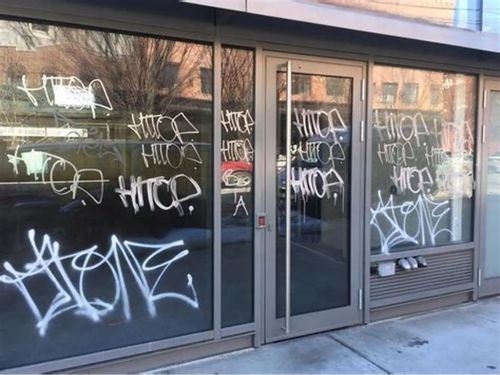
Anti-graffiti film is a sacrificial layer, typically 4 mil clear film, applied over the exterior surface of retail storefront glass. When the surface is tagged or scratched, the film is removed and replaced rather than the glass. On a high-traffic urban retail storefront, glass replacement costs run several hundred dollars per panel per incident. Anti-graffiti film replacement runs a fraction of that cost and can be completed without closing the storefront.
For retail rollouts in urban or transit-adjacent locations, anti-graffiti film is worth specifying as a standard component of the exterior glazing treatment, not as an optional add-on. The payback period on a single avoided glass replacement is typically less than 12 months.
Specifying and Managing a Large-Scale Privacy Film Rollout Without Schedule Risk
Can Window Film Be Applied to Large Commercial Glass Installations?
Large-format commercial glass is entirely compatible with professional film installation. The variables that determine success are access planning, surface preparation, and sequencing logic, not the size of the glass itself. Curtain wall panels, full-height storefront glazing, and continuous interior partition systems are routine scope for experienced commercial installers. What changes at scale is the planning requirement, not the technical feasibility.
Access is the first constraint to resolve. Interior partition glass in an occupied office building requires coordination with facilities to sequence installation around business hours, furniture placement, and network infrastructure. Exterior glazing above the second floor requires lift equipment or swing-stage access, which introduces crane scheduling, permits, and coordination with the general contractor’s site logistics. These are not complications. They are scope items that belong in the specification and the project schedule from the start, not discoveries made during mobilization.
Surface preparation on large commercial glass also carries more consequence than on residential applications. Any contamination, including construction dust, sealant overspray, or residue from temporary protective film, left on the glass before installation compromises adhesion and creates visible defects. On a 60-foot glass facade, a contamination strip at one panel joint is visible from across the street. Pre-installation glass inspection and cleaning is a line item, not an assumption.
How Long Does Professional Window Film Installation Take on Multi-Location Projects?
A single experienced two-person crew can install roughly 500 to 1,000 square feet of film per day under normal commercial conditions, with that range narrowing toward 500 square feet per day on complex geometries, exterior access, or occupied-building constraints. A 10,000-square-foot retail rollout across a single location takes approximately two to three weeks of installation time, plus mobilization, inspection, and punch list.
Multi-location projects compress overall timeline through crew deployment, not speed per location. A national rollout with 50 locations does not take 50 times the single-location schedule. It takes parallel scheduling, crew routing, and regional material staging. The critical path is not installation hours but logistics: material delivery to each location, local access coordination, and inspection sequencing. Projects that treat commercial privacy window film installation as a last-minute finish item, added after other trades clear out, typically create schedule compression that forces rework and re-inspection.
The schedule input to build into your project plan: budget a mobilization day per location, plus installation days based on square footage, plus a half-day inspection buffer. Multi-location rollouts should stage locations by region to minimize crew travel and material shipping lead times.
Building a Specification Package: How to Communicate Film Requirements to Architects, Glazing Subcontractors, and Building Officials
A complete film specification package includes five components:
- Product data sheet with manufacturer test reports covering ASTM E84, ASTM D1003, and ANSI Z97.1 as applicable
- VLT, SHGC, and TSER performance values for the specified product
- Adhesive system documentation confirming compatibility with the IGU manufacturer’s warranty conditions
- Installer certification credentials, including 3M Authorized Dealer status for 3M products
- Warranty documentation covering both material and labor
Glazing subcontractors need the IGU compatibility documentation before they can sign off on film application without voiding their own warranties. Building officials reviewing submittals need the ASTM test reports. Architects need the performance values and product data sheets to confirm the specification matches the design intent. Each audience pulls a different document from the same package.
The specification section itself should appear in Division 08 (Openings) of the project manual, under Section 08 87 (Window Film). Referencing the film specification there, rather than burying it in a finish schedule or leaving it as a verbal instruction, puts the requirement in the right contractual location and makes it visible to the glazing subcontractor during bidding.
Vendor Evaluation Framework: What a Reliable Installation Partner Looks Like at Scale
The vendor question on a large commercial rollout is not “who installs film” but “who manages a multi-location installation program without requiring the project manager to supervise every site decision.” Those are different capabilities, and most regional installers have the first without the second.
SLAs, Quality Assurance Protocols, and Inspection Readiness as Vendor Selection Criteria
A qualified commercial installer at scale operates with documented quality assurance protocols: pre-installation glass inspection checklists, film application standards with defined defect tolerances, and post-installation inspection documentation that the project manager can attach to the closeout package. SLAs should cover response time for warranty claims, turnaround time for punch list corrections, and escalation contacts for schedule disruptions.
Ask for sample inspection reports from completed multi-location projects. An installer who can produce these has the documentation infrastructure for a large rollout. An installer who cannot is managing quality informally, which works on a single-location project and fails on a 20-location national program.
How Installation Labor Costs Compare to Material Costs on Large-Scale Projects
On most commercial film projects, labor runs between 40 and 60 percent of total project cost. Material cost per square foot for commercial-grade film is relatively fixed. Labor cost per square foot varies significantly based on access complexity, occupied-building constraints, and travel logistics on multi-location projects.
This ratio has a practical implication: specifying a lower-cost generic film to reduce material cost while keeping the same installation labor structure does not produce meaningful savings at the project level. A meaningful reduction in material cost on a project where material represents less than half of total cost translates to a modest overall saving, one that disappears with a single rework event. The material cost difference between commercial-grade and generic film is not where the financial risk lives.

Putting the Specification Into Practice: A Multi-Site Retail Rollout Scenario
Phase Sequencing, Scheduling Logic, and On-Site Coordination Across Locations
Consider a 35-location retail chain rolling out frosted window film for privacy on fitting room glass partitions and anti-graffiti film on exterior storefront glazing. Both products, different surfaces, different access requirements, coordinated across a national store network with individual store managers as the local point of contact.
The workable approach: phase by region, with material staged to a regional distribution point rather than shipped location by location. Assign a dedicated project coordinator at the installer’s side to interface with individual store managers on access scheduling. Establish a standard installation sequence, exterior anti-graffiti film first (requires no interior access), interior frosted film second (coordinate with store hours), and hold to it across every location. Variation from the standard sequence is where coordination errors accumulate.
Punch list management across 35 locations requires a digital inspection protocol with photos, GPS-tagged location data, and defect codes that map to the warranty and correction process. A spreadsheet does not scale. The installer should bring the system. The project manager should require it.
How a K-12 Campus Security Film Deployment Manages Occupied-Building Constraints
Security film installation on an occupied school campus introduces constraints that retail rollouts do not face: restricted access during instructional hours, mandatory reentry clearance protocols, and in many districts, third-party security review of contractor access credentials. The installation window is typically before 7:30 a.m. or after 3:30 p.m. on school days, plus full-day access during scheduled breaks.
Schedule the bulk of installation during a scheduled recess or winter break. Use pre-break weeks for access coordination, glass inspection, and material staging to classrooms. Reserve the break window for installation, with a post-break inspection day before students return. This structure delivers a complete installation with no disruption to instructional time and a clear inspection point before the building is re-occupied.
Communicate the installation sequence to the principal and facilities director in writing, with a room-by-room schedule. School administrators manage dozens of concurrent contractor activities, and a written schedule with named contacts removes the ambiguity that generates last-minute access conflicts.
Project Type-to-Film Specification Fast-Reference Guide
| Project Type | Recommended Film | VLT Range | Certification Priority |
|---|---|---|---|
| Corporate office partitions | Frosted / 3M Fasara | 50-70% | ASTM E84, IGU compatibility |
| Perimeter office, south/west exposure | 3M Night Vision or tinted | 15-40% | SHGC documentation for energy model |
| K-12 classroom / corridor glazing | Safety series + frosted | 50-70% | ANSI Z97.1, ASTM E84, blast mitigation spec |
| Retail storefront (urban) | Anti-graffiti + tinted or frosted | 20-50% | IGU compatibility, warranty term |
| Healthcare exam / consultation room | Frosted | 50-65% | ASTM E84, HIPAA privacy documentation |
For any application in an egress corridor or fire-rated assembly, confirm ASTM E84 flame spread compliance before finalizing the specification.
From Specification Confidence to On-Budget Delivery: Your Next Steps
The Core Specification Principles This Guide Has Established
Five principles run through every section of this guide. Film selection is a performance decision, not an aesthetic one. VLT, TSER, adhesive system, and light-condition behavior are the variables that determine whether a specification succeeds in the field. Residential-grade product on commercial glass introduces warranty voids and failure modes that show up after the installer has left the site. Day/night light differential governs one-way film behavior, and documenting that condition to the client before installation is the specifier’s responsibility. Certification documentation, including ASTM, ANSI, and IWFA standards, is what moves a submittal through review without conditions. And at scale, the vendor’s project management capability carries as much risk as the product specification itself.
Why the Vendor Decision Is the Risk-Management Decision on Large Commercial Projects
Every technical decision in this guide depends on an installer who executes it correctly across every location and every panel. A correct specification with an unreliable installer produces the same outcome as a wrong specification with a competent one: rework, schedule delay, and a call to explain why the closeout package is incomplete.
The vendor selection criteria for a large commercial rollout are project management infrastructure, multi-location experience, and warranty support, in that order, before price. An installer who delivers consistent quality across 35 locations at a slightly higher per-square-foot rate produces a lower total project cost than one who delivers variable quality at a lower rate and generates multiple rework mobilizations.
How Window Film Depot’s Position as the #1 U.S. 3M Window Film Installer Serves Your Operational Priorities
Window Film Depot‘s position as the leading 3M-authorized commercial window film installer in the United States means one thing operationally: the infrastructure to execute a large-scale rollout already exists. National coverage, 3M Authorized Dealer certification, documented quality assurance protocols, and the product access that comes with being 3M’s top installation partner in the country are the vendor capabilities that remove schedule risk from a multi-location project.
For a project manager who needs window film for privacy, solar control, safety glazing, or anti-graffiti protection across a national retail footprint or a multi-building campus, the alternative to a qualified national installer is coordinating multiple regional vendors against a single project schedule. That coordination overhead is real, and it lands on the project manager’s desk.
Requesting a Project Assessment: What to Bring and What to Expect
A productive initial project assessment with Window Film Depot requires three inputs: a glass inventory (locations, glass type, square footage by application), a specification intent summary (privacy, solar control, security, or combination), and the project schedule with key milestones. You do not need final drawings. You need enough information to scope the work, identify any IGU compatibility reviews needed, and sequence installation against the construction schedule.
The output is a project-specific recommendation covering film product by application zone, installation sequencing logic, submittal documentation, and a budget range. That recommendation is the foundation of the specification package that goes to the architect and the building official. Bring the project scope. The specification follows from there.
Need More Info?
The Window Film Depot team is happy to help.
Frequently Asked Questions
What is the best window film for privacy that still allows light through?
Frosted film in the 50-70% VLT range is the most reliable specification for occupied commercial spaces that require both visual privacy and natural light. It scatters light uniformly, maintains a bright interior, and performs consistently regardless of time of day or interior lighting levels, unlike one-way reflective film, which shifts in effectiveness as ambient light changes. For spaces where solar control is also a priority, the 3M Night Vision series extends privacy performance into evening hours without sacrificing daytime light quality.
What performance standards should commercial window film meet for institutional buildings?
At minimum, commercial window film for institutional buildings should carry documented test results for ANSI Z97.1 (safety glazing performance), ASTM E84 (surface burning characteristics), and ASTM D1003 (optical clarity and haze). In K-12 and healthcare environments, fire-rating compliance for glazing in egress corridors is an additional requirement. IWFA certification and full manufacturer submittal documentation, including installer credentials, are standard expectations on institutional project submittals.
What is the difference between adhesive and static-cling privacy films for commercial use?
Static-cling film holds by surface tension alone and is appropriate for short-term applications under 24 months or where glass must be returned to its original condition. Pressure-sensitive adhesive (PSA) film bonds chemically to the glass surface, tolerates thermal cycling and edge stress on large panels, and is the correct specification for any permanent or semi-permanent commercial installation. On large glass surfaces, static-cling film is prone to edge-lift under sustained humidity and temperature variation, which is a documented failure mode, not a theoretical one.
How do I specify window film for a multi-location commercial project?
Start by building a glass inventory across all locations, capturing glass type, square footage, and application zone for each site. Pair that with a specification intent summary covering privacy, solar control, security, or combined requirements. From there, select film products that carry the relevant certifications for each application zone and confirm IGU compatibility with your glazing subcontractor. Structure the specification in Division 08 of the project manual and require installer certification documentation as part of the submittal package. For national rollouts, phase the work by region and require the installer to provide a documented quality assurance protocol before mobilization begins.
Can window privacy film be removed without damaging glass or frames?
Professional-grade PSA films can be removed without damaging glass when the process is handled by a trained installer using appropriate solvents and removal tools. Adhesive residue is typically cleanable from standard glass surfaces. On coated, low-e, or specialty glass, removal should be confirmed with the IGU manufacturer before proceeding, as some coatings are sensitive to solvent contact. Static-cling films remove cleanly with no residue. In all cases, removal should be factored into the specification if the application is expected to be temporary or if glass restoration is contractually required.