Table of Contents:
- What “Energy Efficient” Actually Means in a Commercial Window Film Spec
- How Solar Heat Rejection Translates Directly Into HVAC Load and Operating Cost Reduction
- Window Film vs. Window Replacement: The Case for the Faster, Lower-Risk Path
- Selecting the Right 3M Film Series for Your Building Type, Climate, and Compliance Target
- Documenting Energy Performance: LEED Credits, Energy Code Compliance, and Owner Reporting
- What Large-Scale Commercial Installation Actually Looks Like on the Ground
- Building the Business Case: Why Energy Efficient Window Film Wins on Spec, Speed, and Cost
- Frequently Asked Questions
What “Energy Efficient” Actually Means in a Commercial Window Film Spec
The term “energy efficient” is often applied to window film without a clear, shared definition. It is used the same way for appliances, insulation, and glazing systems. For a commercial specification, this ambiguity has real consequences. Two films can carry the same label but deliver very different thermal performance. Results can vary across orientations, seasons, and building types. Before writing a spec or evaluating a product, it is essential to understand which metrics govern performance. You also need to know which values are relevant to your specific project.
How Solar Heat Gain Coefficient and TSER Define Real Performance
Solar heat gain coefficient (SHGC) measures the fraction of incident solar energy that passes through a glazing assembly and enters the building as heat. The scale runs from 0 to 1. A lower number means less solar heat transmitted.
Clear commercial glass typically carries an SHGC of 0.70 to 0.87. High-performance solar control films can reduce that to 0.25 or below on the same glazing unit, representing a significant reduction in cooling load without touching the glass itself.

Total solar energy rejected (TSER) expresses the same relationship from the opposite direction: the percentage of incident solar energy that the film blocks. A film with a TSER of 79% rejects 79 cents of every solar dollar hitting the glass. SHGC and TSER are mathematical complements, but TSER is often the number cited in product marketing because larger percentages feel more intuitive. Both metrics describe the same physical behavior, so confirm which one a product data sheet is leading with before drawing comparisons.
Understanding VLT, Infrared Rejection, and Low-E Properties as a Spec Package
No single metric tells the whole story. Visible light transmittance (VLT) measures the percentage of visible light that passes through treated glass. A high-rejection film with a VLT of 20% will create a cave-like interior, which may be acceptable in some applications but is disqualifying in Class-A office or retail environments where occupant experience and façade aesthetics drive the specification.
Infrared (IR) rejection measures a film’s ability to block near-infrared radiation, the primary heat-carrying component of the solar spectrum. Some films achieve high IR rejection while maintaining relatively high VLT, which is the performance profile most relevant to daylit commercial spaces.
Low-emissivity (low-E) properties refer to a film’s ability to reflect long-wave radiant heat back toward its source. This is a winter-performance characteristic. A film with strong low-E performance reduces heat loss through glass during heating months. It supports year-round energy performance, not just seasonal solar control. For projects targeting ASHRAE 90.1 compliance or LEED documentation, low-E data is required in fenestration analysis.
Evaluate these four metrics together when building your specification:
- SHGC: target below 0.40 for most solar-exposed commercial orientations
- TSER: target 60% or higher for southern and western exposures in warm climates
- VLT: balance daylighting goals against heat rejection, typically 40% or above for occupied office space
- IR rejection: target 85% or higher for ceramic and nano-ceramic film categories
Why Single-Metric Marketing Claims Miss the Full Building Performance Picture
A film marketed on a single number, say 97% infrared rejection, may still underperform on overall SHGC because infrared is only one portion of the solar spectrum. Visible light and ultraviolet radiation also carry energy. A spec written around IR rejection alone can result in a product that passes high-visible-spectrum solar gain while appearing to meet a heat rejection target. For a building owner reviewing energy model outputs, the mismatch shows up as higher-than-projected cooling costs.
This is why performance specifications should require complete solar optical data across the full spectrum, not just the metric that photographs best on a product sheet.
How NFRC Standards and Third-Party Certification Validate What a Film Actually Delivers
The National Fenestration Rating Council publishes standardized test protocols. It also maintains a certified products directory for fenestration components, including applied window films. NFRC-certified performance data is tested under controlled conditions using calibrated equipment. Third-party verification confirms the accuracy of this performance data. When a manufacturer’s published SHGC differs from the NFRC-certified value, use the NFRC number in your spec.
For LEED documentation and energy code compliance submissions, NFRC certification is the expected standard of evidence. Some jurisdictions specifically require it for fenestration compliance pathways under ASHRAE 90.1. Including a requirement for NFRC-certified product data in your RFP language eliminates ambiguity at the product substitution stage.
Commercial Window Film Performance Metrics: A Specification Evaluation Framework
| Metric | What It Measures | Target Threshold (Commercial) | Relevance to Code/LEED |
|---|---|---|---|
| SHGC | Total solar heat entering as fraction of incident energy | Below 0.40 (south/west) | ASHRAE 90.1 fenestration compliance |
| TSER | Percentage of solar energy rejected | Above 60% for high-exposure orientations | Supports EA energy reduction calculations |
| VLT | Percentage of visible light transmitted | 40–70% for occupied office space | Daylighting credit analysis |
| IR Rejection | Near-infrared heat blocked | Above 85% (ceramic/nano-ceramic films) | Occupant comfort, energy model inputs |
| Low-E (Emissivity) | Long-wave radiant heat reflectance | Emissivity below 0.20 preferred | Heating season performance, year-round SHGC |
| UV Rejection | Ultraviolet radiation blocked | 99% standard for most commercial films | Interior asset protection, occupant health |
For reference: standard solar control films typically achieve TSER of 35–60%, ceramic films reach 60–79%, and low-E films add heating-season performance that standard solar films lack.
How Solar Heat Rejection Translates Directly into HVAC Load and Operating Cost Reduction
The Physics of Fenestration: How Uncontrolled Solar Gain Forces HVAC Overcapacity
Glass is thermally transparent in a way that wall assemblies are not. A well-insulated wall with an R-20 assembly conducts very little heat. The same square footage of clear commercial glazing can deliver 200 to 300 Btu/hr per square foot. This occurs under direct afternoon sun in an occupied space. Mechanical engineers account for this by sizing cooling equipment for peak solar gain conditions.
This means the HVAC system runs at full capacity on the hottest days of the year. It also carries excess capacity for the remainder. That overcapacity has a capital cost at installation. It also creates an operating cost every hour compressors run harder than a reduced-gain envelope would require.

Quantifying HVAC Load Reduction: An Illustrative Model for a Multi-Floor Office Building
Estimating Btu/hr Reduction per Square Foot of Treated Glazing
Consider a 12-story office building in Atlanta with 40,000 square feet of south and west-facing clear glass carrying an existing SHGC of 0.70. Peak solar irradiance on a summer afternoon in Atlanta runs approximately 300 Btu/hr per square foot on a south-facing vertical surface. At SHGC 0.70, the glass transmits roughly 210 Btu/hr per square foot as heat.
Installing a high-performance ceramic film that reduces SHGC to 0.25 drops transmitted heat to approximately 75 Btu/hr per square foot, a reduction of 135 Btu/hr per square foot. Across 40,000 square feet, that is 5.4 million Btu/hr of peak cooling load eliminated, or roughly 450 tons of instantaneous cooling demand removed from the mechanical system.
Projecting Annual Cooling Cost Savings from Reduced Mechanical Runtime
Peak load reduction does not translate directly to proportional energy savings because HVAC systems don’t run at peak all year. A reasonable annual savings model for a commercial office building in a climate zone 3 location factors in operating hours, utility rate, and cooling equipment efficiency. At a blended electricity rate of $0.12/kWh, an average COP of 3.5 for the chiller plant, and roughly 1,400 cooling degree days annually, the 40,000 square foot retrofit in this example projects to annual cooling cost reductions in the range of $80,000 to $120,000. Your energy model will refine these estimates for actual equipment, schedules, and rate structures, but the order of magnitude is consistent with documented commercial retrofits.
Year-Round Performance: Balancing Summer Heat Rejection Against Winter Heat Retention
Solar control film applied without low-E properties reduces summer cooling loads. It also blocks passive solar heat gain in winter. This creates a heating cost penalty in colder climates. This is the fundamental trade-off in any fenestration specification. For buildings in climate zones 4 and above, specifying a film with both solar control and low-E characteristics addresses both sides. 3M Thinsulate Window Film is designed for this profile. It provides solar heat rejection in summer. Its low-E coating reduces conductive heat loss during heating months. The net annual energy performance in northern climates is positive across both seasons. This matters when modeling for ASHRAE 90.1 compliance on a full-year basis.
How Much Can Commercial Window Film Save Annually? Setting Realistic Benchmarks
Published studies and utility-verified field results consistently show annual energy cost reductions of 5–15% for commercial buildings where significant glazing area is treated. The range is wide because building geometry, climate, occupancy schedules, and existing HVAC efficiency all affect the outcome.
South and west exposures in sunbelt climates deliver results at the top of that range. North-facing glass in northern climates delivers less solar control benefit but still gains from low-E heat retention. A project-specific energy analysis using actual utility data and building geometry narrows this range to a defensible figure for owner presentation.
Need More Info?
The Window Film Depot team is happy to help.
UV Blocking, Glare Reduction, and Occupant Productivity as Operational Co-Benefits
Most quality commercial window films block 99% of ultraviolet radiation regardless of their solar heat rejection specification. UV blocking is the primary line of defense against interior fading, including flooring, furniture, merchandise, and artwork degradation. Eliminating UV exposure reduces long-term asset replacement costs that rarely appear in energy ROI models but matter to building owners reviewing the full economic picture.
Glare reduction follows from VLT management. Specular glare on monitor screens is a documented productivity inhibitor in open-plan office environments. A film that reduces VLT from 70% to 45–50% without perceptibly darkening the space can eliminate the need for occupants to close blinds, which in turn preserves daylighting, reduces artificial lighting loads, and avoids the thermal comfort complaints that follow when blinds trap heat against the glass. These operational benefits support a more complete business case without overstating the energy savings line.
Window Film vs. Window Replacement: The Case for the Faster, Lower-Risk Path
Why Window Replacement Remains the Default Specification, and Why That Default Is Costly
Window replacement persists as the default fenestration upgrade because it is familiar. Design teams know how to specify it. Contractors know how to bid it, and building owners understand what they are buying. That familiarity creates institutional momentum even when the economics no longer support it. For most commercial renovation projects, a full fenestration replacement is a significant capital event. It often gets deferred, value-engineered, or phased over multiple budget cycles. This happens because the cost-to-performance ratio is difficult to justify against competing building priorities.
The problem with deferring is that the glass keeps performing poorly in the meantime. Every month of delay on a south-facing glazing system running an SHGC of 0.70 adds cost. It increases HVAC overcapacity and elevated cooling costs. It also leads to occupant comfort complaints that could have been resolved in days.
Cost-Per-Square-Foot Comparison: Installed Film vs. Full Fenestration Replacement
The installed cost of commercial window film typically falls between $8 and $20 per square foot depending on film type, building access conditions, and project scale. Full fenestration replacement, including new IGU units, framing, demolition, and installation labor, runs $40 to $100 or more per square foot for commercial curtain wall and storefront systems, with high-performance glazing packages pushing toward the upper range.
For a 40,000 square foot glazing project, that spread is not marginal. At a midpoint comparison of $14 per square foot for film versus $65 per square foot for replacement, the difference is approximately $2 million in direct project cost. A portion of that delta can fund other envelope improvements, mechanical upgrades, or simply stay on the owner’s balance sheet. Energy efficient window film does not close the full performance gap with a newly specified high-performance IGU assembly, but it closes enough of it, fast enough, at a cost that fundamentally changes the capital allocation conversation.
Construction Timeline and Occupant Disruption: A Side-by-Side Reality Check
A full fenestration replacement on a multi-story commercial building is a 6-to-18-month construction event. It requires scaffolding, craning or hoisting new units, temporary weather barriers during installation, and coordination around occupied floors. Even a phased replacement program creates sustained disruption through noise, thermal inconsistency floor-by-floor, and sequences that force tenant relocations or after-hours restrictions.
Window film installation on the same building runs 2 to 6 weeks for a large multi-floor project. Access is interior for most applications, no scaffolding is required, and individual floors are treated in one to two day increments with no meaningful disruption to occupants. There is no weather exposure risk, no structural coordination, and no material lead times measured in months. For a facilities team managing occupied space, that difference in project footprint is often the deciding factor before the cost numbers are even presented.

Payback Period and ROI: Where Film Outperforms Replacement as a Capital Decision
At the energy savings benchmarks established earlier, annual cooling cost reductions in the $80,000 to $120,000 range for a 40,000 square foot commercial retrofit, a $560,000 film installation (at $14 per square foot) delivers a simple payback of 5 to 7 years. A $2.6 million window replacement project targeting similar thermal performance carries a payback of 22 to 32 years on energy savings alone. Most building owners are not underwriting 30-year payback periods on envelope improvements.
The film decision also carries lower risk. If a building is sold, repositioned, or undergoes a full renovation within 10 years, the film investment has already recovered a meaningful portion of its cost. A replacement program that has not reached payback becomes a sunk cost in the same scenario.
What Performance Warranty Should You Require from a Window Film Installer?
Warranty language is where commercial film specifications either protect the owner or expose them to future disputes. Resolve this language before execution, not after a performance complaint.
Manufacturer Warranty vs. Installer Performance Guarantee
A manufacturer warranty from a company like 3M covers product defects: delamination, discoloration, adhesive failure, and measured performance degradation outside specified tolerances. For 3M commercial films, warranty periods typically run 10 to 15 years for non-residential applications, covering film integrity and original performance specifications.
An installer performance guarantee covers the quality of the installation work itself, including adhesion uniformity, edge seal integrity, scratch-free application, and absence of contamination beneath the film. These are separate failure modes. A manufacturer will not honor a film warranty for an installation defect, and an installer guarantee does not cover a film that degrades within specification tolerance. Both documents belong in the contract package.
Red Flags in Subcontractor Warranty Language
Watch for warranty language that:
- Excludes performance degradation claims without a defined measurement protocol or baseline
- Limits remedy to film replacement only, excluding labor costs for removal and reinstallation
- Requires written notice within 30–60 days of defect discovery on defects that may not be visible for months
- Contains carve-outs for “normal fading” without a quantified threshold
- Does not specify which party bears the cost of independent performance testing if a dispute arises
Require the installer to provide written confirmation that the manufacturer warranty transfers to the building owner, not just the installation contractor. On large commercial projects, that transferability clause is non-negotiable.
Selecting the Right 3M Film Series for Your Building Type, Climate, and Compliance Target
3M Prestige Series: High VLT Solar Control for Class-A Façade Preservation
The 3M Prestige Series is the specification of choice when aesthetic preservation is a hard constraint. These films use nano-technology rather than metal layers to achieve high solar heat rejection, with TSER values reaching 60–70%, while maintaining VLT in the 40–70% range depending on the specific product. The practical result is a treated façade that reads as clear glass from the exterior, which matters for Class-A office buildings where landlord or municipal design standards prohibit the mirror-finish appearance of conventional reflective films.
Prestige films are also compatible with the low-emissivity coatings already present on many modern IGU assemblies. Verify compatibility with your glazing manufacturer before specifying on units with existing low-E coatings.
3M Thinsulate Window Film: Low-E Performance for Year-Round Thermal Management
3M Thinsulate Window Film is designed specifically for buildings where winter heat retention is a performance requirement alongside summer solar control.
Its low-E coating reduces glass emissivity to approximately 0.15, which meaningfully reduces conductive heat loss in heating months. In climate zones 4 through 6, Thinsulate supports a positive annual energy balance across both seasons, making it the right specification for northern retrofits where a standard solar control film would penalize winter heating costs.

3M Night Vision Series: Balancing Glare Control and Daylighting in High-Occupancy Spaces
cThe Night Vision Series targets spaces where glare management is the primary driver but significant VLT reduction is not acceptable. These films achieve moderate solar heat rejection while maintaining VLT values of 50% or higher, reducing specular glare on work surfaces without creating a perceptibly dark interior. In high-occupancy floor plates where occupants have historically pulled blinds to manage glare, eliminating daylighting and creating thermal complaints, Night Vision can restore the balance between comfort and transparency.
Matching Film Specifications to Climate Zone, Glazing Orientation, and ASHRAE 90.1 Requirements
Climate zone and orientation are the two variables that most directly govern which film specification to put on a given elevation. A general framework:
- Climate zones 1–3 (hot/humid, hot/dry): Prioritize maximum TSER on all solar-exposed orientations. 3M Prestige or high-rejection ceramic films. North glazing is a secondary priority.
- Climate zones 4–5 (mixed): South and west exposures favor solar control. East exposures are lower priority. Thinsulate or dual-function films address the heating season penalty.
- Climate zones 6–8 (cold): Low-E performance on all orientations reduces heating load. Solar control on south glass remains positive. Thinsulate is the primary specification.
ASHRAE 90.1 Table 5.5 prescribes maximum SHGC values by climate zone and orientation. When specifying film as a compliance pathway, confirm that the NFRC-rated SHGC of the film-plus-glazing assembly meets or beats the applicable table value, not just the film’s standalone rating.
How to Specify Window Film Performance in a Commercial RFP to Avoid Scope Disputes
The most common source of post-award disputes on commercial film projects is performance specification ambiguity. A subcontractor submits a product that technically meets a loosely written SHGC requirement but underperforms on VLT, leading to occupant complaints that the owner attributes to the film product and the installer attributes to the spec.
Avoid this by writing performance specifications that require:
- NFRC-certified data for the specific film-plus-glazing assembly, not the film alone
- Minimum and maximum VLT range, not just a heat rejection floor
- IR rejection minimum and UV rejection percentage
- Compatibility confirmation with existing glazing type and any existing coatings
- A pre-installation mockup on one representative unit with owner sign-off before full installation proceeds
The mockup requirement is the single most effective dispute-prevention tool in a commercial film specification. It creates a documented baseline that all parties have approved before work scales across the building.
Documenting Energy Performance: LEED Credits, Energy Code Compliance, and Owner Reporting
Which LEED v4.1 Credit Categories Window Film Specifications Can Support
Energy efficient window film does not have a dedicated LEED credit category. It contributes as a fenestration improvement within the broader energy and envelope compliance framework. The most relevant credit categories are:
- Energy and Atmosphere (EA): Optimize Energy Performance. Reduced fenestration SHGC directly reduces simulated cooling energy use in the building energy model, which contributes to the percentage reduction required for credit thresholds.
- Indoor Environmental Quality (IEQ): Daylight and Quality Views. Film specifications that maintain high VLT while reducing glare can support daylight credit compliance by allowing daylit floor area calculations to remain valid without blind closure assumptions.
- Sustainable Sites (SS): Heat Island Reduction. Less directly applicable but relevant in projects where façade solar reflectance contributes to site-level calculations.
EA Optimize Energy Performance is typically where film specifications deliver the most documentable LEED contribution, because it ties directly to the building energy model output.
How to Align Film SHGC and TSER Data With Energy and Atmosphere Credit Documentation
The building energy model for EA credit purposes uses the fenestration SHGC value for each orientation. When window film is included in the scope, the modeler must use the NFRC-rated SHGC of the film-plus-glazing assembly in the proposed design case, not the baseline glazing SHGC. The delta between baseline and proposed SHGC values is what drives the simulated energy reduction.
This requires the film manufacturer to provide assembly-specific SHGC data, ideally with NFRC certification for the actual glazing type in the building. Generic product data sheet values for “typical clear glass” are not sufficient for a defensible LEED submission. Specify in the RFP that the installer must provide NFRC-certified assembly data for the project’s actual glazing unit before installation proceeds.
How Window Film Energy Savings Are Verified and Certified for Third-Party Review
For LEED documentation, the energy model output is the primary evidence. Post-installation measurement and verification (M&V) using the International Performance Measurement and Verification Protocol (IPMV) methodology can supplement the model with actual utility data, which strengthens the documentation package and supports ongoing owner reporting.
For projects using utility incentive programs, which many utilities offer for commercial energy efficiency improvements, the utility’s technical review team typically requires manufacturer performance data, installation documentation, and a pre/post energy baseline. Window film projects have qualified for utility rebates in numerous markets, so confirm program eligibility with the local utility before finalizing the project cost model.
Producing the Performance Documentation Your Building Owner or End Client Expects
A building owner reviewing the completed project needs documentation that is actionable for ongoing reporting, not just sufficient for permit closeout. Assemble a project documentation package that includes:
- Installed product specifications (film type, NFRC-certified SHGC and TSER by elevation)
- Installation completion record with floor-by-floor and elevation confirmation
- Manufacturer warranty documents transferred to the building owner
- Installer workmanship guarantee
- Energy model inputs and outputs showing pre/post fenestration performance
- Any utility rebate documentation and application confirmation
If the project is LEED-tracked, the documentation package feeds directly into the credit submission. If it is not, the same package serves as the baseline for future energy audits, lease documentation, and owner sustainability reporting. Building owners increasingly report energy performance metrics to investors, tenants, and rating platforms. Having clean, verified project documentation from installation forward is the professional standard, and it protects all parties if performance questions arise later.
What Large-Scale Commercial Installation Actually Looks Like on the Ground
The performance case for energy efficient window film is well-established by this point in the project cycle. What often stalls a decision is uncertainty about execution, specifically whether a large-scale film installation can be sequenced around occupied building operations without creating the disruption that made window replacement unattractive in the first place.
Phased Scheduling and Multi-Floor Coordination Without Halting Building Operations
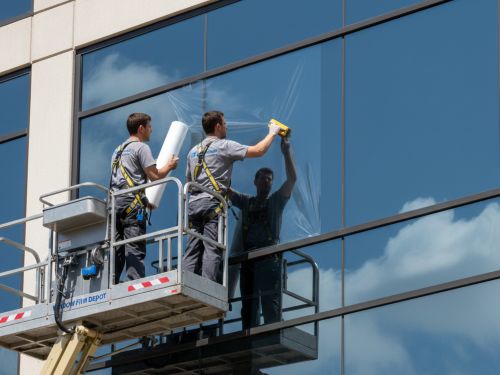
A professional commercial film installation operates on a floor-by-floor scheduling model. Crews work a single floor or elevation at a time, completing work on each zone in one to two days before moving to the next. No floor is out of service during installation. Occupants remain in place. The only practical requirement is access coordination with building management to stage equipment in corridors and confirm elevator scheduling.
For a 12-story building, a phased installation typically runs two to four weeks from mobilization to completion, depending on floor plate size, glass complexity, and crew count. That timeline is compatible with occupied operations, active lease periods, and facilities management schedules that cannot absorb extended construction events.
How Installation Timing Affects Construction Sequencing and Occupancy Transition Risk
On renovation projects where window film is part of a broader scope, installation sequencing matters. Film should be scheduled after interior finish work is complete on each floor but before furniture installation and final cleaning. Dust and particulate from drywall or flooring work can contaminate the adhesive bond during installation, requiring re-work. Film applied after finishes are complete and before occupancy is the cleanest sequencing for both quality and warranty purposes.
For projects involving occupancy transitions, floors turning over from one tenant to another, film installation fits naturally in the turnover window. A two-day installation cycle on a floor being prepared for a new tenant adds no meaningful time to a standard turnover schedule and delivers an upgraded glazing specification without requiring a capital improvement line in the tenant improvement budget.
Window Film Depot’s Large-Scale Project Methodology as the Number One U.S. 3M Authorized Installer
Window Film Depot operates as the largest 3M authorized window film installer in the United States, which has direct operational implications for commercial project managers. Large-scale 3M commercial projects require an authorized installer to qualify for manufacturer warranty coverage on non-residential applications. Working with an authorized partner means the warranty chain is intact from manufacturer to building owner without gaps created by unauthorized product procurement or installation.
For multi-site portfolios or phased multi-building programs, Window Film Depot provides consistent specification, crew training, and project management across locations. That consistency matters when a building owner is reporting energy performance metrics across a portfolio, because variation in installation quality between sites creates variance in measured results that complicates reporting and owner presentations.
How to Evaluate Installer Credentials and Procurement Risk on a Commercial Bid
When evaluating bids on a commercial film project, installer credentials are a procurement risk variable, not just a quality preference. Key qualifications to verify:
- Confirmed authorization status with the film manufacturer (request written confirmation, not just a claim on the bid form)
- Documented commercial project experience at comparable scale, with references from projects of similar square footage and building type
- Certificate of insurance coverage appropriate for commercial work, including completed operations coverage
- Written confirmation that manufacturer warranty transfers to the building owner upon project completion
- Bonding capacity sufficient for the project value
Price is not a reliable proxy for quality on commercial film projects. A lower bid from an unauthorized installer may disqualify the project from manufacturer warranty coverage entirely, shifting all future performance risk to the installer’s workmanship guarantee alone. On a 15-year asset, that is a meaningful exposure.
3M Film Series Fast-Selector: Matching Building Profile to the Right Specification
| Building Profile | Primary Driver | Recommended Film Series |
|---|---|---|
| Class-A office, clear façade required | Aesthetics + solar control | 3M Prestige Series |
| Northern climate, year-round efficiency | Heating + cooling balance | 3M Thinsulate Window Film |
| High-occupancy open plan, monitor glare | Glare reduction + daylighting | 3M Night Vision Series |
| Sunbelt, west/south exposure, max heat rejection | Cooling load reduction | 3M Prestige or Ceramic Series |
| Mixed climate, LEED EA documentation needed | SHGC compliance + low-E | 3M Thinsulate Window Film |
| Retail or lobby, visibility priority | Low VLT impact, some control | 3M Prestige Series (higher VLT variants) |
Confirm NFRC-certified assembly SHGC against ASHRAE 90.1 Table 5.5 for your climate zone before finalizing the specification.
Building the Business Case: Why Energy Efficient Window Film Wins on Spec, Speed, and Cost
Recapping the Performance Argument
The case rests on three measurable advantages. First, performance: high-quality ceramic and nano-ceramic films reject up to 79% of solar energy and reduce SHGC to 0.25 or below on existing glazing, delivering fenestration thermal performance that competes with new high-performance IGU assemblies at a fraction of the installed cost. Second, speed: a multi-floor commercial installation completes in weeks, not months, without scaffolding, structural coordination, or occupant relocation. Third, cost: at $8 to $20 per square foot installed versus $40 to $100 or more for fenestration replacement, film produces payback periods of five to seven years on energy savings alone, a threshold that most building owners can justify within a standard capital planning horizon.
No single improvement in the commercial building envelope delivers that combination on the same timeline.
How to Present This Analysis to a Building Owner or Facilities Decision-Maker
A building owner or facilities director evaluating this investment needs three things from a project manager’s presentation: a credible performance number, a defensible cost model, and a clear risk profile.
For performance, lead with the NFRC-certified SHGC improvement for the specific film and glazing combination on the building. Translate that into projected annual cooling cost reduction using actual utility rates and equipment efficiency data. For cost, present the installed cost per square foot alongside the projected payback period, and compare it explicitly to the cost and payback of the replacement alternative. For risk, confirm the warranty structure: manufacturer coverage on the film, workmanship guarantee from the installer, and transferability to the owner.
If the project has a LEED or sustainability reporting component, add the energy model documentation pathway and any applicable utility rebate programs as closing points. Both reduce net project cost and strengthen the owner’s reporting position.
Engaging Window Film Depot for a Project-Specific Energy Analysis and Specification Consult
Window Film Depot provides project-specific energy analysis and specification support for commercial projects before a purchase decision is required. That analysis covers film selection by orientation and climate zone, projected SHGC improvement on the building’s actual glazing type, and an estimated annual energy savings range based on building size and utility rate structure.
If you are at the RFP development stage, Window Film Depot can help structure performance specification language that protects the owner and avoids the scope ambiguities that generate post-award disputes. If you are preparing a business case for a building owner or client, the energy analysis provides the project-specific data that generic product claims cannot.
Contact Window Film Depot directly to schedule a consultation. Bring your glazing schedule, climate zone, and utility rate data, and the analysis will be specific enough to present to a decision-maker on the first pass.
Frequently Asked Questions
How much money can window film save on commercial building energy bills annually?
Published results from commercial retrofits consistently show annual energy cost reductions of 5–15% for buildings where significant glazing area is treated with solar control film. The actual figure for a specific project depends on building geometry, climate zone, existing HVAC efficiency, and the orientations being treated. South and west exposures in sunbelt climates typically produce savings at the top of that range. A project-specific energy analysis using actual utility rates and building data is the most reliable way to generate a defensible savings estimate for owner presentation.
What window film specifications are required to qualify for LEED Energy and Atmosphere credits?
Window film contributes to LEED through the EA Optimize Energy Performance credit by reducing the fenestration SHGC used in the building energy model. To support a defensible credit submission, the energy modeler must use NFRC-certified SHGC data for the specific film-plus-glazing assembly in the proposed design case, not the film’s standalone rating or a generic product data sheet value. The installer should provide assembly-specific NFRC-certified performance data for the project’s actual glazing type before installation proceeds.
What is the ROI and payback period for installing energy efficient window film in office buildings?
At typical commercial savings benchmarks, a film installation running $8 to $20 per square foot generally delivers a simple payback period of 5 to 7 years on energy savings alone. By comparison, a full fenestration replacement targeting similar thermal performance at $40 to $100 or more per square foot carries a payback of 20-plus years in most scenarios. Film also carries lower capital risk: if the building is sold or repositioned before full payback, the investment has already returned meaningful value, whereas an incomplete replacement program becomes a sunk cost.
How are window film energy savings verified and certified by third parties?
The building energy model is the primary documentation vehicle for LEED and compliance purposes. Post-installation measurement and verification using IPMV methodology can supplement the model with actual pre/post utility data, strengthening the documentation package for both LEED submissions and owner reporting. For utility rebate programs, the utility’s technical review team typically requires manufacturer performance data, installation records, and an established pre-installation energy baseline. Confirm rebate program eligibility with the local utility before finalizing the project cost model, as qualification criteria vary by market.
What performance warranty should I require from a window film installer on a large commercial project?
Require two separate warranty documents: a manufacturer warranty covering product defects and performance degradation (typically 10 to 15 years for commercial 3M products), and an installer workmanship guarantee covering adhesion quality, edge seal integrity, and installation defects. Confirm that the manufacturer warranty transfers directly to the building owner, not just the installing contractor. Review warranty language carefully for exclusions that limit remedy to product replacement only, require impractically short notice periods for defect claims, or leave performance dispute resolution costs undefined. Both documents should be included in the contract package before work begins.
How does installation scheduling and project timing affect window film performance outcomes?
Sequencing film installation after interior finish work is complete but before furniture placement and final cleaning produces the best results for adhesion quality and long-term warranty integrity. Dust and particulate from drywall or flooring work can contaminate the adhesive bond, requiring costly re-work. For tenant turnover projects, a two-day installation cycle per floor fits naturally within a standard turnover schedule without adding meaningful time. On larger multi-floor projects, a phased floor-by-floor approach keeps the building fully operational throughout, with typical project durations of two to four weeks for a 12-story building depending on floor plate size and crew deployment.