Modern windows are getting bigger, and that’s creating new challenges. Larger glass surfaces in homes and offices mean more heat, more glare on screens, fading furniture, and less privacy from neighbors and passersby. Window film offers a practical, affordable way to solve all of these problems at once-without replacing your existing glass or blocking your view with heavy curtains.
In this article, you’ll learn how window films work, which types suit different needs, how they deliver daytime privacy, what installation involves, and how to choose the right product for your space.
Table of Contents:
Why Window Films Are Transforming Modern Windows
Walk through any newly built neighborhood or recently renovated office and you’ll notice a clear trend: more glass. Floor-to-ceiling windows, glass partitions between meeting rooms, sliding glass doors opening onto patios-design in 2025 and 2026 favors openness and natural light. But all that glass comes with trade-offs that blinds and curtains only partially address.
Glare on laptop screens makes afternoon work sessions uncomfortable. Furniture and flooring fade under relentless sun exposure. Energy bills climb when south-facing windows turn a living room into a greenhouse. And street-level windows in a home office give everyone on the sidewalk a front-row seat to your video calls.
Window film is the thin, high-performance layer applied directly to existing glass that tackles all of these issues simultaneously. It’s a solution that has evolved significantly over the past decade, moving well beyond the dark, shiny tints of the past into a range of options that preserve your view, complement your style, and deliver measurable energy savings. Whether you own a home, rent an apartment, or manage a commercial building, there’s a film designed for your situation.
What Are Window Films and How Do They Work?
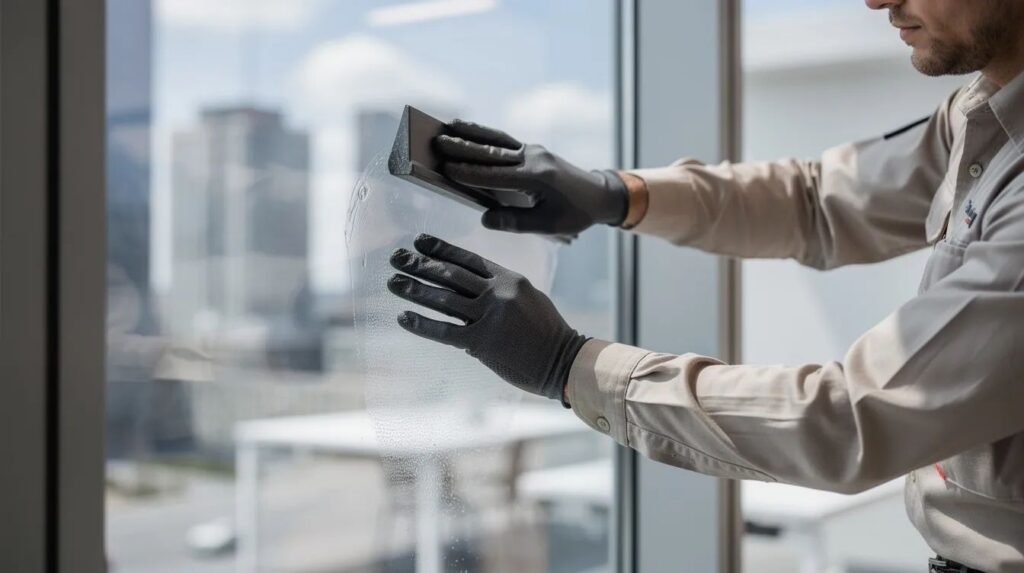
At its core, a window film is a thin layer-usually polyester (PET) or vinyl-bonded to glass surfaces on windows, doors, sidelights, and interior partitions. The typical construction involves several layers working together: an adhesive or static-cling interface that attaches the film to the glass, one or more functional layers (dyed, metallized, or ceramic) that interact with light and heat, UV-absorbing compounds, and a scratch-resistant outer coating.
What makes film effective is how it interacts with sunlight. Window film directly filters sunlight before it enters a space, and different films do this in different ways. Some absorb solar energy and re-radiate it outward. Others reflect specific wavelengths-particularly infrared radiation, which carries heat-while allowing visible light through. Frosted and decorative films scatter and diffuse light instead of transmitting it clearly, which creates privacy without total darkness.
Two technical terms are worth understanding in plain language:
- Visible light transmission (VLT) measures the percentage of visible light that passes through the film and glass together. A film with 70% VLT lets in most daylight; a film with 20% VLT creates a noticeably darker interior.
- Solar heat gain coefficient (SHGC) indicates how much solar heat passes through. A lower number means less heat entering your room-important if cooling costs are a concern.
Today’s premium films can block up to 99% of UV rays, according to the Skin Cancer Foundation, while still allowing comfortable levels of daylight. That combination of protection and transparency is what makes modern film fundamentally different from the heavy window tints of decades past.
Here’s a quick summary of what window films do:
- Control privacy (from partial to near-complete)
- Block UV radiation to protect skin, furnishings, and flooring
- Reduce solar heat gain for lower cooling bills
- Add decorative style to plain glass surfaces
Types of Window Film: From Privacy to Decorative Style
Not all films are built for the same purpose. Some prioritize privacy, others target energy savings, and a growing category exists purely for aesthetics. The right choice depends on your goals, the orientation of your windows, your budget, and whether you need the film to perform day and night.
Below is a breakdown of the main categories.
Privacy and Frosted Window Films
Frosted window film provides a clean, etched-glass look that blocks direct line of sight while still letting in soft, diffused light. It mimics the appearance of sandblasted or acid-etched glass at a fraction of the cost-and without any permanent alteration to your windows.
Privacy window film is popular for bathrooms and offices, and for good reason. Frosted films enhance privacy while allowing light to pass through, which makes them ideal for shower screens, street-level entry doors, and glass conference room walls. A 2024 coworking space, for example, used frosted film on open-plan glass walls to give meeting rooms visual separation without sacrificing the bright, airy feel of the shared space.
Unlike reflective films that depend on exterior brightness, frosted films provide consistent privacy both day and night. Opacity and pattern density vary by product, so you can choose anything from a light frost that softens the view to a dense, fully opaque finish.
- Consistent day-and-night privacy
- Soft, diffused light that preserves brightness
- Modern, minimalist aesthetic popular in Scandinavian-inspired interiors
- Available in multiple textures and densities
One-Way Mirror Films for Daytime Privacy
One-way mirror film is a reflective film that creates a mirror effect on the brighter side of the glass while allowing the person on the darker side to see through. Its primary function is daytime privacy-during daylight hours, outsiders see their own reflection while you maintain a clear view outward.
One-way mirror film offers daytime privacy and reduces visibility from the street, making it a strong option for ground-floor living rooms, home offices facing sidewalks, and retail storefronts that want staff to see out without giving passersby a full view inside.
There’s an important limitation to understand: this effect depends on the light ratio between outside and inside. When exterior light is roughly three to four times brighter than interior light, the mirror effect works well. At night, with indoor lights on and darkness outside, the effect reverses-people outside can see in. This isn’t a product defect; it’s physics.
- Pair one-way film with blinds or curtains for full nighttime privacy
- Choose a tint level that balances outward visibility with your desired reflectivity
- Consider frosted film instead if you need around-the-clock privacy
- Works best on south- and west-facing windows where sun exposure is strongest
Decorative and Stained Glass Window Films
Decorative window film features patterns and artistic designs that add visual interest to otherwise plain glass. Options range from geometric patterns and botanical motifs to textures that mimic rice paper, linen, or hammered glass. These films serve a dual purpose: partial privacy and aesthetic enhancement.
Stained glass window film adds color and partial privacy, replicating the look of traditional stained glass without the cost or permanence of actual leaded glass. Common placements include front doors with sidelights, transom windows above entryways, kitchen windows, clinic waiting rooms, and retail display areas.
Both categories diffuse harsh direct light while allowing daylight through, and they pair well with plain frosted sections for a custom look in renovation projects.
- Adds style and personality to any glass surface
- Provides partial privacy through pattern density and color
- Easy to remove or swap for seasonal or redecorating changes
- Available in designs ranging from traditional to contemporary
Solar Control & UV Protection Films
Sun control films improve energy efficiency by reflecting infrared rays-the portion of the solar spectrum responsible for heat-while allowing visible light to pass through. Depending on the product and glass type, these films can reject up to roughly 70% of solar heat and block 99% of UV radiation.
Ceramic films represent the premium end of this category. Ceramic films block heat and UV rays without interfering with cell signals, which makes them an ideal choice for offices, showrooms, and homes where wireless connectivity matters. Traditional metallized films offer strong heat rejection but can disrupt Wi-Fi and cellular reception.
Research on solar control films applied to south-facing windows found cooling energy reductions of up to 38–68% depending on glass type and building orientation. That’s a significant reduction in both energy costs and carbon footprint.
Concrete scenarios where solar control film delivers the most value:
- South- and west-facing windows in warm climates
- Home theaters and media rooms where heat buildup is distracting
- Offices with large glass curtain walls
- Rooms with hardwood floors, artwork, or upholstered furniture vulnerable to UV fading
Factors to consider before choosing a solar film:
- Glass type (single-pane, double-pane, tempered, low-E)
- Building orientation and local climate
- Any HOA or historic district restrictions on window appearance
- Desired balance between heat rejection and visible light transmission
Safety & Security Window Films
Safety and security films are thicker, multi-layered films engineered to hold shattered glass together during impact. Unlike standard films, which are typically 1–3 mil thick, security films range from 4 to 15 mil and are designed to keep broken glass in place rather than letting it scatter.
Window films delay forced entry attempts through windows by making it significantly harder and more time-consuming to break through the glass barrier, even after the glass itself cracks. Security films also mitigate hazards from severe weather impacts-an increasingly relevant concern as natural disasters and extreme weather events have become more frequent in the mid-2020s.
Common applications include ground-floor doors, school entrances, retail storefronts, and any glass surfaces near walkways or play areas. Installation is more specialized than standard film and often requires professional anchoring systems, particularly in commercial buildings.
- Reduces injury risk from broken glass in accidents and storms
- Delays break-in attempts, adding a critical layer of security
- May support compliance with building safety codes
- Often considered for insurance or liability purposes in commercial settings
Quick reference of all film types:
| Film Type | Primary Purpose | Day & Night Privacy | Light Level |
|---|---|---|---|
| Frosted / Privacy | Privacy + light diffusion | Yes | Moderate–High |
| One-Way Mirror | Daytime privacy | Day only | Moderate |
| Decorative / Stained Glass | Aesthetics + partial privacy | Partial | Moderate–High |
| Solar Control / UV | Heat + UV reduction | No | Adjustable (VLT) |
| Safety & Security | Impact + break-in protection | No | High |
Daytime Privacy, Glare Control, and Comfort
Privacy and comfort are consistently the top reasons homeowners and businesses choose window film. The needs vary widely-a bathroom requires total visual blockage, a home office needs to reduce glare on screens without feeling like a cave, and a street-facing living room benefits from a solution that keeps the view while keeping neighbors’ eyes out.
Different films handle visibility differently under changing light conditions. Frosted and decorative films provide privacy regardless of whether it’s noon or midnight. Reflective one-way films work well during sunny daytime hours but lose their privacy effect after dark. Understanding this distinction before you choose prevents disappointment after installation.
Glare is the other major comfort issue that film addresses directly. Window films minimize eye strain on computer screens and televisions by reducing the intensity of direct sunlight hitting reflective surfaces. If you’ve ever had to reposition your desk or close the blinds entirely to see your monitor, a well-chosen film eliminates that daily frustration while still letting in ambient light.
Consider a 2024 remote worker in a city apartment with a home office window facing an adjacent building just 15 meters away. Frosted film on the lower panes blocked the neighbor’s view into the workspace, while the upper panes were left clear to preserve the sky view and maximize natural light. Window film reduced glare on the monitor without darkening the room, and no curtains were needed during work hours.
How to choose the right film for your privacy situation:
- Daytime only: One-way mirror or lightly reflective film (pair with blinds for evening)
- Day and night: Frosted or opaque privacy film
- Decorative partial privacy: Patterned or stained glass film that obscures detail without full opacity
- Glare-focused: Solar control or ceramic film with moderate VLT
Benefits of Window Films for Homes and Commercial Buildings
Window films deliver value across multiple dimensions simultaneously, which is part of what makes them such a practical upgrade for both residential and commercial spaces.
Privacy without isolation. Whether it’s a ground-floor apartment, a restaurant with floor-to-ceiling windows, or a clinic examination room, film provides the privacy occupants need without walling off daylight or creating a closed-in feeling.
Energy efficiency and reduced costs. By blocking infrared heat before it enters a room, solar films reduce the workload on air conditioning systems. Low-E films act as extra insulation in winter and summer, helping maintain stable indoor temperatures year-round. Window film reduces carbon footprint by decreasing energy consumption-a meaningful consideration as energy costs continue to climb and building codes tighten around efficiency standards.
UV and fade protection. Film that blocks 99% of UV rays dramatically slows the fading of hardwood floors, rugs, upholstered furniture, and artwork. The protection is continuous and passive-no need to remember to close the blinds when the sun shifts.
Safety. Thicker security films hold shattered glass in place, reducing the risk of injury during accidents or storms and adding a physical barrier against break-ins. For educational buildings, healthcare facilities, and retail locations, this layer of protection can support compliance with safety standards.
Aesthetics and design flexibility. Decorative and stained glass films let you add personality to plain glass without permanent changes-a significant advantage in rented spaces or historic buildings where structural modifications may require special permission or aren’t allowed at all. You can update the look of a space in an afternoon and change it again a few years later.
Cost savings vs. full replacement. Replacing windows entirely is expensive and disruptive. Film applied to existing glass delivers many of the same benefits-heat control, UV blocking, privacy-at a fraction of the cost and with minimal disruption.
Top benefits at a glance:
- Lower cooling and heating bills through solar and low-E films
- UV protection that extends the life of interior furnishings by years
- Privacy solutions that work for every room and building type
- Improved comfort and reduced glare for screen-heavy workspaces
- Non-invasive installation that preserves existing window structures
Installation Options: DIY vs. Professional Window Film Application
One of the practical advantages of window film is that it fits a range of installation preferences, from a quick weekend project to a fully managed professional job.
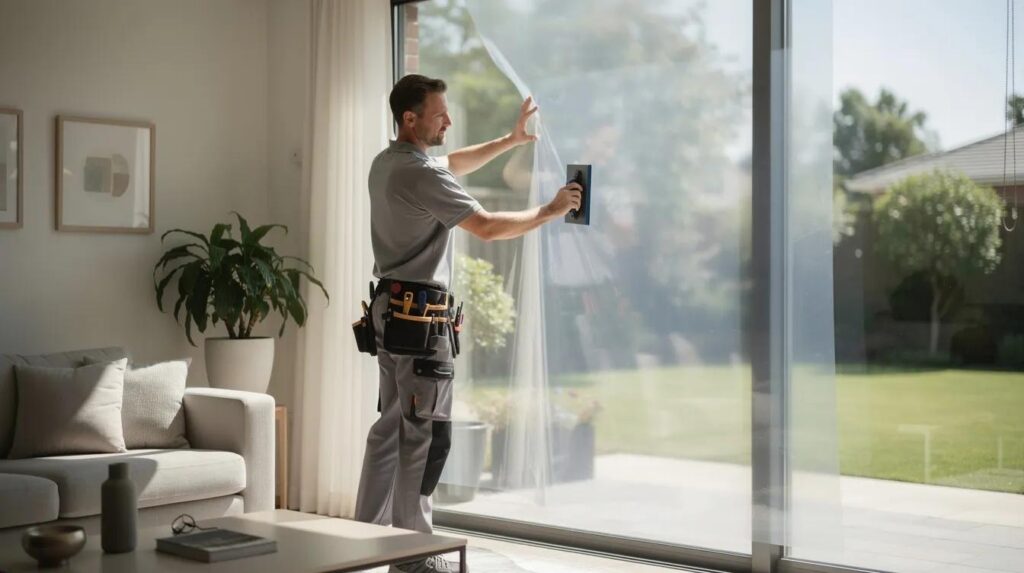
When DIY works well. Most window films are designed for straightforward DIY installation. Decorative films, frosted privacy films, and basic solar films on standard-sized home windows are all manageable without specialized equipment. Window film can be installed without professional tools-in many cases, window film can be installed using just water and soap, a squeegee (or a credit card wrapped in a soft cloth), and a utility knife. Installation typically takes less than 30 minutes for most users per window.
Both static cling and adhesive options are available for window film. Static cling films are repositionable and leave no residue, making them popular with renters. Adhesive films bond more permanently and tend to perform better over years of use.
When professional installation is the better choice. Large glass surfaces, high or hard-to-access windows, security films, and projects where warranty coverage matters are all situations where professional installation pays for itself. A trained installer handles precise measurement, surface prep, squeegee technique to eliminate air pockets, edge trimming, and ensures proper curing conditions.
Curing can take anywhere from a few days to several weeks depending on film thickness, window size, and climate. During this period, minor haze or small water bubbles are normal and will dissipate.
DIY installation tips:
- Clean the glass thoroughly-proper surface preparation is essential for successful installation
- Use a spray bottle filled with a soapy water solution to float the film into position
- Work on an overcast day or in shade to prevent the film from drying and sticking before you’ve positioned it
- Trim edges carefully with a sharp blade for a clean finish
- Avoid touching the adhesive side with your fingers
For projects involving security film, specialty solar products, or commercial buildings, professional installation typically includes a product warranty and workmanship guarantee that protects your investment.
Care, Maintenance, and Longevity of Window Films
Quality window film, properly installed, can last 10 or more years on interior residential surfaces. Premium ceramic and solar films often exceed that range. The lifespan depends on film quality, glass orientation (sun-hammered south-facing windows stress film more), and maintenance habits.
After installation, wait at least 30 days-or as recommended by the manufacturer-before the first cleaning. This allows the adhesive to cure fully and bond to the glass.
For routine cleaning, use a soft cloth or rubber squeegee with a mild, non-ammonia cleaner diluted in water. Avoid paper towels, abrasive sponges, or razor blades, all of which can scratch or damage the film surface.
Signs that a film is reaching the end of its useful life include persistent edge lifting, noticeable yellowing or haze that doesn’t clean away, cracking, and bubbles that appear long after the initial curing period. When these appear, replacement is straightforward-old film is removed, the glass is cleaned, and new film is applied.
Do:
- Clean regularly with soft materials and gentle cleaners
- Address edge lifting early before moisture gets underneath
- Keep window tracks and frames clean to avoid debris scratching the film
Don’t:
- Use ammonia-based glass cleaners (they degrade adhesive over time)
- Scrape the film surface with metal tools
- Apply stickers or tape directly to the film
- Pressure-wash windows with film applied

Frequently Asked Questions About Window Films
Can window films provide both privacy and natural light?
Yes. Frosted and certain decorative films are specifically designed to block direct views while letting diffused daylight pass through. The amount of light depends on the film’s VLT rating-frosted films typically allow 30–70% of visible light, which keeps rooms bright without exposing interiors to outside eyes.
Darker or more reflective films reduce light levels more noticeably and are better suited for rooms where glare reduction is the priority rather than maximum brightness. Combining film with sheer curtains or interior shades gives you additional control over the light-to-privacy balance throughout the day.
Does one-way mirror film work at night?
One-way mirror film is optimized for daytime privacy, when the sun makes the outside significantly brighter than the inside. During those hours, the exterior surface acts as a mirror while interior occupants enjoy a clear outward view.
At night, with interior lights on and darkness outside, the effect reverses. People standing outside can see into the lit room while you see mostly your own reflection. This is a function of how light behaves at reflective surfaces, not a defect in the product.
For bedrooms, bathrooms, or any room where nighttime privacy matters, pair one-way mirror film with blinds, curtains, or roller shades.
Will window film damage my windows or void my warranty?
Quality films that are properly matched to your glass type are designed for safe, long-term use on standard residential and commercial windows-including tempered, laminated, and double-pane glass. Using an incompatible film on certain specialty glass (like some low-E coated units) can cause thermal stress, so matching matters.
Many window manufacturers have published guidelines on compatible film products. Professionally supplied films often come with documented warranty compatibility. Before installation, check both your window warranty and the film warranty, and use a certified installer for complex or high-value glazing to keep everything covered.
How much do window films cost?
Costs vary considerably based on film type, project size, and installation method. Basic DIY decorative or frosted films might cost a few dollars per square foot at retail. Professional-grade solar or security films, installed by a certified team, typically run higher per square foot and include labor, warranty, and post-installation inspection.
Factors that influence pricing include the specific product selected (decorative vs. ceramic vs. security), total square footage, window accessibility (ground floor vs. multi-story), and any additional preparation work. For larger or commercial projects, requesting a tailored quote gives you a far more accurate picture than generic online estimates.
Are window films removable, and can they be replaced?
Most modern adhesive films can be removed by peeling them off the glass and cleaning any residual adhesive with a soapy solution or commercial adhesive remover. Static cling films are even easier-they peel away cleanly and can sometimes be repositioned or reused if handled carefully.
Common reasons for replacement include redecorating, upgrading to a higher-performance film, or swapping out aged film that has begun to discolor or lift at the edges. For large or high windows, professional removal is recommended to avoid damaging the glass or surrounding frames.
Do window films make rooms too dark?
Not necessarily. Many modern films-especially ceramic and spectrally selective options-are engineered to reject heat and UV while preserving the vast majority of visible light. A room with a 50–70% VLT film will feel noticeably bright and open, with the primary difference being less heat and glare rather than less light.
Privacy and reflective films do come in a range of tint levels, so you can choose how much visible light to let through. Testing a small sample on one window before committing to a full installation is an easy way to confirm that the look and brightness level match your expectations, especially in living areas and home offices.
Why Choose Our Window Film Expertise
Choosing the right window film involves more than picking a product off a shelf. The glass type, building orientation, local climate, and your specific goals-whether that’s heat reduction, privacy, security, or aesthetics-all influence which film will actually deliver the results you’re looking for.
Our approach starts with a consultation that covers your needs in detail. We assess your windows, discuss your priorities, recommend compatible products, and handle precise installation with proper curing and edge sealing. After the job is done, we’re available for questions about care, maintenance, and future upgrades.
We work across residential and commercial projects, from single-room privacy upgrades to full building retrofits. Our familiarity with regional climate conditions, common window configurations, and local building codes means recommendations are specific to your situation rather than generic.
When researching film options online, you may come across product spec sheets and technical data hosted on various content servers and platforms such as edgesuite-based CDNs. We help you cut through the technical noise and translate those specifications into practical recommendations.
- Expert product guidance matched to your glass type and goals
- Precise, warranty-backed professional installation
- Transparent written estimates with no hidden costs
- Responsive post-installation support and maintenance advice
- Access to premium film products from trusted manufacturers
Conclusion: A Simple Upgrade With Lasting Impact
Window film is one of the most efficient ways to improve a space without construction, replacement, or major expense. A single installation can reduce heat, block damaging UV rays, add privacy, and enhance the look of your glass-all while preserving the view and natural light you chose those windows for in the first place.
The versatility is what sets film apart. It works in apartments and single-family homes, in office towers and neighborhood storefronts, with solutions ranging from subtle frosted privacy to heavy-duty security protection. And because films can be removed and replaced, you’re never locked into a permanent decision.
If you’re ready to find the right film for your home or building, the best next step is a consultation. Share your goals, get a recommendation tailored to your glass and climate, and see how quickly a simple upgrade can make your space more comfortable, more private, and more energy efficient.
The right window film turns ordinary glass into a surface that works for you-every season, every hour of the day.