Table of Contents:
- Why Glass Privacy Film Is a Specification Decision, not a Design Afterthought
- What Is Privacy Glass Film and How Does It Work?
- The Commercial Privacy Film Taxonomy: Matching Film Type to Project Requirements
- Performance Metrics That Determine Whether a Film Actually Specs Out
- Privacy Film vs. Frosted Glass vs. Blinds: A Project Manager’s Evaluation Framework
- Industry-Specific Applications: How Specification Requirements Shift by Sector
- What to Expect During a Commercial Privacy Film Installation
- How to Specify and Source Privacy Window Film for a Large-Scale Project
- Conclusion: Turning a Specification Decision into a Durable, Scalable Privacy Solution
- Frequently Asked Questions
Why Glass Privacy Film Is a Specification Decision, not a Design Afterthought
Glass film for privacy isn’t just a finishing touch anymore—it’s a key design choice in today’s commercial buildings. With glass-heavy designs now the norm, managing visibility and safeguarding sensitive information is more important than ever. This blog dives into how privacy glass film tackles real operational challenges, boosts compliance, and offers lasting performance without the need to replace existing glass.
The Open-Plan Paradox: When Architectural Glass Creates Operational Risk
Modern commercial architecture delivers transparency as a feature, then immediately creates problems that require solving. Floor-to-ceiling glazing, glass-walled conference rooms, and open sightlines across clinical or financial workspaces look exceptional in a developer’s rendering.
In practice, they expose patient intake conversations, compromise attorney-client privilege, and create constant visual distraction in environments where focus is a productivity input.
The glass itself is not the failure. The failure is treating the resulting privacy deficit as a design question rather than an operational one.
This is the open-plan paradox: the same architectural glass that signals collaboration and openness also broadcasts confidential content to anyone with a sightline. For project managers working on healthcare renovations, corporate tenant improvements, or multi-location retail buildouts, that exposure creates real liability. HIPAA sightline requirements, attorney-client privilege concerns, and basic security protocols do not bend to aesthetic preferences.
How an Underspecified Privacy Solution Becomes a Schedule and Cost Problem
The typical response is to specify window film privacy late, often as a finishing-touch line item added after the primary build schedule is set. That sequencing creates three predictable failure modes.
First, the wrong film type gets specified because no one evaluated the use case against the optical performance data. A gradient film looks right in a sample but delivers partial visibility in an executive conference room where full obscuration is required. Rework follows.
Second, cheap or consumer-grade film gets sourced through a building supply channel. It fails early, delaminates under commercial HVAC cycling, and requires replacement within 18 months, often during tenant occupancy when installation disruption carries a real cost.
Third, no one budgets for a glazing audit before application, so film gets installed on glass with surface coatings, existing tints, or thermal seals that are incompatible with adhesive-backed products. The result is adhesion failure, warranty voids, and a conversation no project manager wants to have six months after substantial completion.
Specifying glass film for privacy correctly, with the right product, the right installer, and the right sequencing, costs the same or less than fixing a mis-specified solution.
What Project Managers Actually Need from a Privacy Film Partner
The specification question is not “which film looks best?” It is: which film type meets the performance threshold for this use case, can be installed on schedule without disrupting occupants, and holds up over a five-to-ten-year lifecycle without requiring intervention?
For multi-location projects, add supply chain consistency and national installer coordination to that list.
A qualified privacy film partner does not simply sell film. They audit your glazing inventory, match product specifications to your compliance and performance requirements, sequence installation around your construction milestones, and provide documentation that supports warranty claims and compliance audits. That is a fundamentally different service model than sourcing product from a distributor and subcontracting installation locally.
Need More Info?
The Window Film Depot team is happy to help.
What Is Privacy Glass Film and How Does It Work?
The Optical Mechanics: Controlling Sightlines Without Replacing Glass
Privacy film achieves visual obstruction by altering how light transmits through glass at the surface level. The film substrate, typically a thin polyethylene terephthalate (PET) layer, is coated or treated to scatter, reflect, or absorb incident light depending on the product type. Frosted film scatters light diffusely, eliminating clear sightlines without blocking the passage of light entirely. Mirrored or reflective film creates a high-reflectance exterior surface that returns ambient light to the viewer rather than transmitting it. Blackout film absorbs light across the visible spectrum, producing full opacity.
None of these products alter the structural properties of the glass. They change only how light behaves at the surface, which means the underlying glazing unit retains its thermal and safety performance characteristics.
Adhesive-Backed vs. Static-Cling Film: Performance and Permanence Trade-Offs
Adhesive-backed film bonds directly to the glass surface using a pressure-sensitive or water-activated adhesive. It is the correct choice for permanent or semi-permanent commercial applications. Once cured, adhesive film resists edge lifting, handles commercial cleaning protocols, and maintains optical clarity without shifting or creeping over time. Removal requires a razor and solvent but leaves the glass undamaged when performed by a trained installer.
Static-cling film relies on electrostatic attraction to the glass rather than a chemical bond. It installs and removes without tools, making it appropriate for short-term applications, seasonal changes, or tenant-installed solutions in spaces where building management prohibits permanent modifications. The trade-off is real: static-cling film is susceptible to edge lift in high-humidity environments, does not hold up under commercial glass cleaning, and shifts visibly over time on large-format applications. For any commercial project with a multi-year horizon, adhesive-backed film is the specification-grade choice.
Does Privacy Film Work Both Ways? Directionality and Viewing Angles
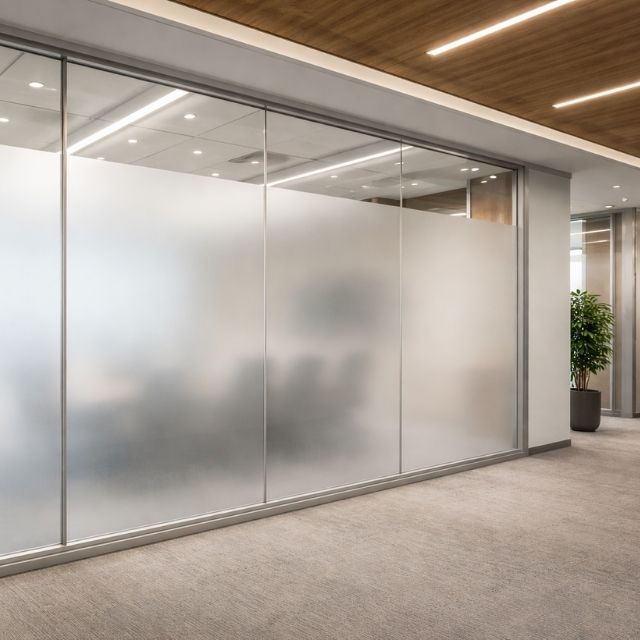
Frosted and etched-effect films obstruct sightlines from both directions equally. A frosted conference room partition blocks viewing in and viewing out, which is the intended result for most interior applications.
One way privacy window film operates differently: it reflects the brighter side and allows visibility from the darker side.
In practice, this means exterior mirrored film provides outward visibility from a lit interior during daylight hours but reverses at night when interior lighting exceeds ambient exterior light.
Anyone specifying one-way film for perimeter office applications needs to account for this reversal in evening-use scenarios.
Application to Existing Glass in Occupied Buildings
Professional installation on existing glass in an occupied building is standard practice for commercial window film. The installation process uses water-based application solution, generates no hazardous fumes, and requires only a clean surface and appropriate temperature conditions to cure correctly. A single installer working on a typical conference room partition completes the work in under two hours with no disruption to adjacent workspaces. The qualification is surface condition: glass with existing coatings, deep scratches, or failed thermal seals requires assessment before film application. A pre-installation glazing audit identifies these conditions and prevents adhesion failures before they happen.
The Commercial Privacy Film Taxonomy: Matching Film Type to Project Requirements
Frosted and Etched-Effect Film: The Office and Healthcare Workhorse
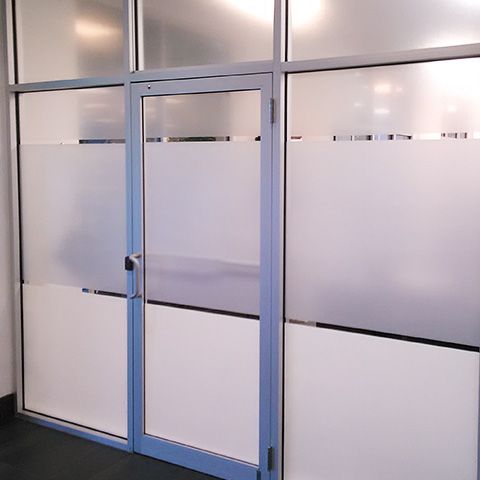
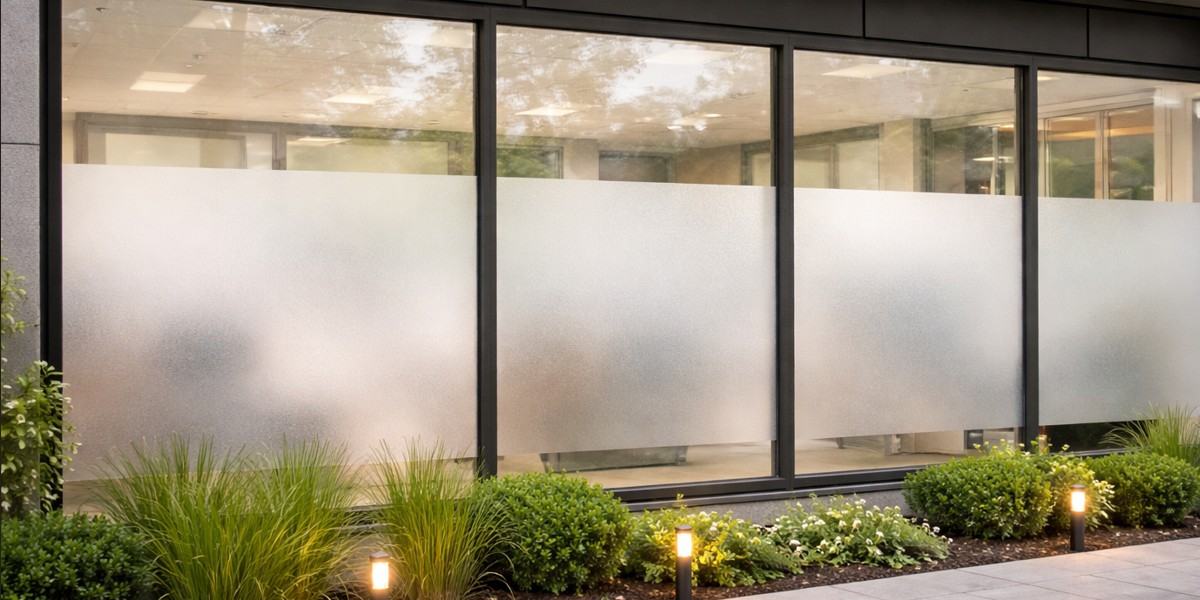
Frosted film is the most widely specified privacy solution in commercial environments for good reason. It delivers consistent, bilateral privacy across a broad range of visible light transmission (VLT) values, typically 30% to 70% depending on the product, which means daylight continues to move through the space while clear sightlines are eliminated. In healthcare settings, frosted film on consultation room glazing and corridor partitions addresses HIPAA sightline exposure without requiring opaque construction. In office environments, it handles conference room glass walls, open-plan partition panels, and executive suite sidelights. Etched-effect variants closely replicate the appearance of sandblasted or acid-etched architectural glass at a fraction of the material and installation cost.
One-Way Mirrored Film: Exterior Privacy with Interior Visibility
One-way mirrored film is specified where maintaining outward visibility matters as much as controlling inward sightlines. Perimeter office glazing, building lobbies with street exposure, and security observation positions all benefit from this product type. The reflective exterior surface also delivers meaningful solar heat rejection, typically in the range of 40% to 60% total solar energy rejected (TSER), which creates a secondary benefit on sun-facing facades. The directionality constraint described above is the primary specification risk. Confirm that the use case accounts for the day-to-night reversal before specifying mirrored film for spaces occupied after dark.
Gradient and Zonal Privacy Film: Controlling Sightlines Without Blocking Daylight
Gradient film transitions from opaque at one edge to fully clear at the other, typically from sill height to eye level, leaving the upper glass clear for daylight. This product type solves a specific problem in low-partition office environments and street-level retail: it blocks standing-height sightlines into the space while preserving the open, light-filled character of the glazing above. Zonal applications use pattern or band configurations to obscure specific sightline zones, such as a horizontal band at seated eye level across a glass storefront, without treating the entire glazed surface.
Blackout and Opaque Film: Full Visual Separation for Regulated Environments
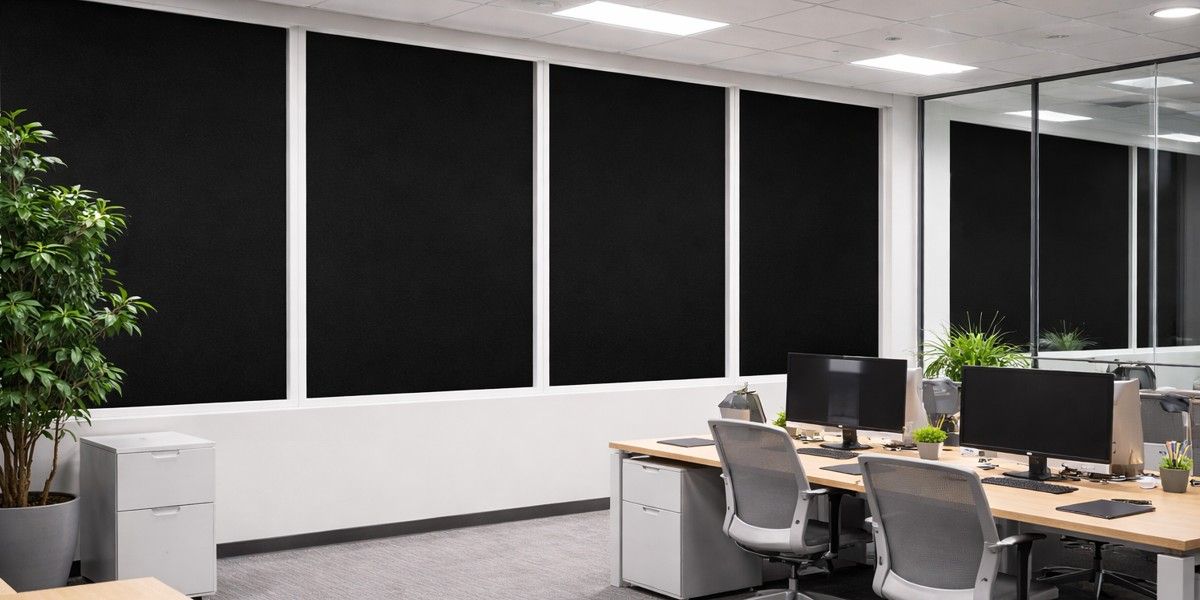
Blackout film transmits no visible light and provides complete visual separation. It is specified for server rooms, data centers, imaging suites, darkrooms, and any environment where complete visual isolation is a functional requirement rather than a preference.
Because it eliminates all daylight transmission, it is rarely appropriate for regularly occupied workspaces unless those spaces require controlled lighting conditions by design. Opaque film in white or custom colors is also used to create clean, diffuse surfaces on glass partitions where branding or wayfinding graphics will be applied on top.
Decorative Glass Film: Combining Brand Identity with Privacy Function
Decorative film serves a dual purpose that pure privacy film does not: it delivers visual obstruction while simultaneously functioning as a branded surface. Custom-cut patterns, corporate logos, and architectural motifs can all be rendered in window film and applied to glass partitions, storefront glazing, or interior doors. For multi-location retail and corporate environments, decorative film provides a cost-effective method for maintaining brand consistency across locations without custom architectural glass procurement at each site. Lead times and minimum order quantities vary by pattern complexity, which makes early specification in the project schedule important.
Privacy Film Type Comparison Matrix
The table below provides a working reference for matching film type to project requirements across the variables that matter most in commercial specification.
| Film Type | VLT Range | Privacy Level | Directionality | Reversible? | Ideal Application | Cost Tier |
|---|---|---|---|---|---|---|
| Frosted / Etched-Effect | 30–70% | High (bilateral) | Both directions equally | Yes (adhesive) | Conference rooms, healthcare partitions, office sidelights | Moderate |
| One-Way Mirrored | 10–40% | High (exterior) / Low (interior, nighttime) | Inward only during daylight | Yes | Perimeter offices, lobbies, security positions | Moderate–High |
| Gradient / Zonal | Varies by zone (0–90%) | Moderate (zone-specific) | Both directions in opaque zone | Yes | Retail storefronts, low-partition offices, street-level glazing | Moderate |
| Blackout / Opaque | 0% | Complete (bilateral) | Both directions fully blocked | Yes | Server rooms, imaging suites, darkrooms, graphic base layers | Low–Moderate |
| Decorative / Branded | 20–80% (pattern-dependent) | Moderate to High | Both directions in pattern area | Yes | Multi-location retail, corporate lobbies, branded partitions | Moderate–High |
Reading the matrix for specification purposes:
- VLT range determines how much ambient light the space retains after film application. Lower VLT means higher privacy depth but a darker interior environment.
- Directionality is the most commonly misunderstood variable. One-way mirrored film is not two-way mirrored film. Confirm the use case includes the lighting conditions under which the film must perform.
- Reversibility applies to professionally installed adhesive-backed film removed by a trained installer. DIY removal on adhesive products frequently damages glass or leaves adhesive residue.
- Cost tier reflects relative installed cost per square foot for professional commercial installation, not product-only pricing. Installation labor, surface preparation, and travel to multi-site locations all factor into final project cost.
For any project spanning multiple locations, decorative and gradient films with custom patterns require early procurement planning. Standard frosted and blackout films are generally available off-the-shelf from professional distributors, but custom patterns and large-format gradient films carry four-to-eight-week lead times that can affect the overall installation schedule if not accounted for in the project timeline.
Performance Metrics That Determine Whether a Film Actually Specs Out
Visible Light Transmission (VLT): Balancing Privacy Depth Against Occupant Comfort
VLT is the single most consequential number in a privacy film specification. It expresses what percentage of visible light passes through the film, and it directly controls the trade-off between how much privacy you get and how dark the interior becomes. A frosted film at 30% VLT delivers deep obscuration and a noticeably dimmed space. The same product at 60% VLT keeps the room bright but reduces privacy depth proportionally.
For most occupied office and healthcare environments, the specification sweet spot is 40% to 55% VLT for interior partitions. This range eliminates clear sightlines while preserving enough ambient light transmission to avoid triggering supplemental lighting during daytime hours. Spaces with high existing daylight, such as south-facing glass or large glazing areas, can tolerate lower VLT values without occupant comfort complaints. Spaces with limited natural light should stay above 50% VLT or accept supplemental lighting as a deliberate trade-off.
The practical mistake is selecting film based on a physical sample viewed under showroom lighting. Specify VLT by number, not by visual impression.
Total Solar Energy Rejected (TSER) and Glare Reduction: The Secondary Performance Layer
Glass film for privacy on perimeter glazing delivers a secondary performance benefit that is worth documenting in your specification: solar heat rejection. TSER expresses the percentage of total incoming solar energy the film blocks, combining visible light, infrared, and UV components. A frosted film on a west-facing facade with meaningful TSER reduces peak afternoon heat gain, which can lower cooling load and improve comfort in glass-heavy spaces that HVAC systems were not originally sized to handle.
Glare reduction tracks closely with VLT. Lower VLT means less transmitted light, which means less glare on screens and work surfaces. On facades with direct sun exposure, combining a moderate-privacy frosted film with a high-TSER product specification delivers both compliance and comfort performance from a single product application.
Not every interior partition application requires TSER consideration, but any perimeter glazing specification should document it alongside VLT.
UV Blocking, Material Composition, and Compliance-Relevant Certifications
PET Substrate Standards and What Third-Party Certifications Signal
Most commercial-grade window film uses a polyethylene terephthalate (PET) substrate, which is chemically stable, dimensionally consistent, and compatible with the adhesive systems used in permanent commercial installations. What separates specification-grade PET film from commodity product is the consistency of that substrate, including uniform thickness, stable optical coatings, and adhesive systems that perform across the temperature cycling typical of commercial HVAC environments.
Third-party certifications signal that a manufacturer has submitted products for independent performance testing rather than self-reporting specifications. Look for AIMCAL (Association of International Metallizers, Coaters and Laminators) membership, which indicates manufacturing process standards, IWFA (International Window Film Association) certified products, and ANSI/IWFA performance standards compliance for VLT, UV blocking, and adhesion.
A vendor who cannot produce third-party test data for the specific product being specified is a vendor whose specs cannot be verified. For any project with compliance implications, that is a disqualifying condition.
LEED-Relevant Material Attributes for Tenant Improvement Projects
Privacy film can contribute to LEED credit documentation in tenant improvement projects, primarily under Energy and Atmosphere (EA) credits for reduced cooling load via solar heat rejection, and potentially under Materials and Resources (MR) credits if the product meets low-emitting material thresholds. Manufacturers producing films with third-party Greenguard or Greenguard Gold certification provide the documentation chain that LEED submittals require. If your project is pursuing LEED certification, confirm material certification status before specifying, not after the film is on the glass.
Privacy Film Performance Standards for Healthcare and Regulated Environments
HIPAA does not prescribe a specific VLT value or film product, but it does require that covered entities implement physical safeguards adequate to protect patient information from incidental disclosure.
For sightline compliance, that standard is typically interpreted as preventing a standing observer in a public corridor from reading a screen or identifying a patient through glass.
A frosted film at 40% VLT or lower, applied full height to consultation room and exam room glazing, satisfies that standard in most compliance reviews.
For environments subject to Joint Commission survey, including hospitals and ambulatory care facilities, documentation of the privacy measure, including product specification, installation date, and area of application, supports the physical environment compliance record. Maintain that documentation as part of the facility’s as-built package.
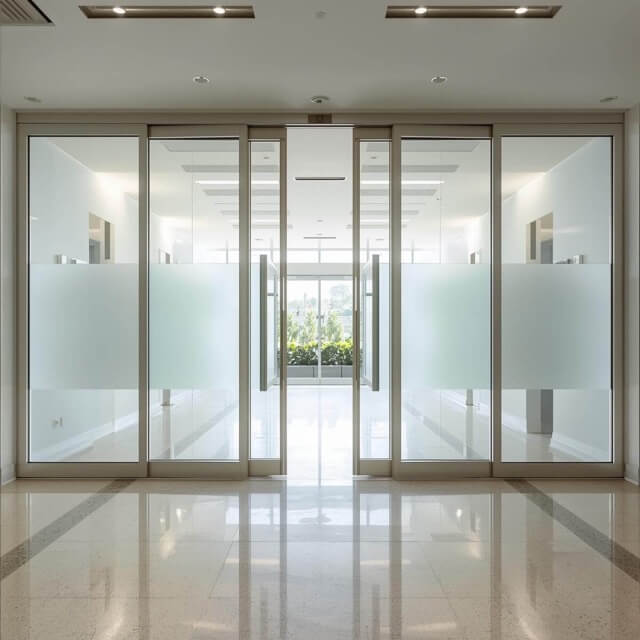
3M Fasara Series as a Specification Benchmark
The 3M Fasara series represents the clearest specification benchmark in commercial privacy film for one reason: the product line is deep enough to cover nearly any commercial use case from a single manufacturer, with consistent warranty terms and verifiable test data across the line. VLT ranges within the Fasara series run from approximately 14% for dense frost patterns to 72% for light diffusion films, covering interior partitions, perimeter glazing, and decorative applications within one product family.
3M backs commercial Fasara installations with a seven-year warranty against delamination, peeling, and optical degradation when installed by a 3M-authorized dealer. That warranty term matters for long-horizon projects: it aligns with most commercial lease cycles and provides recourse documentation if film performance degrades ahead of schedule. For national rollouts where consistent product performance across locations is a procurement requirement, a single manufacturer with national distribution and an authorized installer network removes the variability that comes from specifying by category and sourcing locally.
Privacy Film vs. Frosted Glass vs. Blinds: A Project Manager’s Evaluation Framework
Total Cost of Ownership: Installation, Maintenance, and Lifecycle Replacement
Frosted architectural glass costs, on average, several times more than professionally installed privacy film on an equivalent square-footage basis, including material and labor. That delta is significant on a single conference room. On a renovation involving thousands of square feet of glazing, it represents a material budget reallocation. Privacy film also installs without structural modification, requiring no glazing replacement, no curtain wall disruption, and no extended lead time for custom glass fabrication.
Maintenance cost for adhesive-backed commercial film is essentially the same as standard glass cleaning. Compatible cleaning solutions and non-abrasive tools preserve the coating surface. Lifecycle replacement for commercial-grade adhesive film in a normal office environment typically runs seven to twelve years before optical degradation requires re-application. Factoring in a per-square-foot removal and reapplication cost at that interval, the total cost of ownership over a long building lifecycle still sits well below the cost of frosted glass.
Blinds introduce a maintenance variable that neither glass nor film creates: mechanical failure. Motor replacement, cord systems, and cleaning protocols for horizontal blinds in high-traffic commercial environments generate recurring costs that are rarely captured in the initial specification comparison.
Reversibility, Tenant Flexibility, and Lease Considerations
Privacy film is reversible. A trained installer removes adhesive film with a razor blade and solvent without damaging the glass surface, which means the glazing is restored to its original condition at lease end.
That reversibility matters in tenant improvement contexts where lease agreements require the tenant to restore the premises. Film removal is a line item, not a capital project.
Frosted glass is permanent. If a tenant’s space configuration changes and a previously frosted partition now needs to be clear, the glass must be replaced. That inflexibility carries a real cost in multi-tenant buildings where space use evolves over a typical ten-year lease cycle.
Blinds offer reversibility but not flexibility. They occupy wall space, require hardware installation that does involve the building envelope, and limit glazing configuration options when space layouts change.
Schedule Impact: Lead Times, Disruption Window, and Retrofit Feasibility
Standard commercial privacy film is available from professional distributors within one to two weeks. Custom patterns and large-format gradient films require four to eight weeks as noted earlier. Either timeline fits within a typical construction schedule without requiring early procurement action in most cases.
The installation disruption window is minimal. A two-person installation crew applies film to a standard glass-walled conference room in three to four hours, with wet application solution dry to the touch within 24 hours and fully cured within 30 days. There is no off-gassing, no noise generation, and no requirement to vacate adjacent spaces.
Frosted glass replacement requires a glazing contractor, structural access, and lead time on fabricated glass units, typically three to six weeks minimum for custom sizes. Blinds install faster but require drywall anchor work, header hardware, and motor rough-in for motorized systems. Neither alternative matches film on retrofit feasibility in an occupied building.
DIY-Grade vs. Professional-Grade Privacy Films
Consumer-grade film is manufactured to a price point, not a performance standard. Thinner PET substrate, weaker adhesive systems, and narrower roll widths mean visible seams on large glazing panels, earlier edge lifting under cleaning and humidity cycling, and no warranty coverage for commercial applications. The product is appropriate for a residential bathroom window. It is not appropriate for a healthcare facility, a corporate tenant improvement, or any application where the film will be cleaned with commercial-grade products more than a few times per year.
Professional-grade film is specified to documented performance standards, applied with professional-grade mounting solution and tools that prevent air bubbles and edge contamination, and backed by manufacturer warranties that cover commercial applications. The installed cost difference between DIY and professional application on a single conference room may be modest. The cost of removing failed consumer film, preparing the glass surface, and reinstalling correct product in an occupied building is multiples of that, in addition to whatever disruption and tenant relationship damage the failure created.
Industry-Specific Applications: How Specification Requirements Shift by Sector
Office Environments: Conference Rooms, Open-Plan Partitions, and Executive Suites
Office environments account for the largest volume of commercial privacy film applications, and the specification requirements vary significantly by zone within the same building. Conference rooms require full bilateral obscuration, typically frosted window film for offices at 40% to 50% VLT applied full-height, because they host sensitive conversations and presentations visible to corridor traffic. Open-plan partitions between workstations use lighter frost or gradient films that reduce visual distraction without blocking light between zones. Executive suites on perimeter glazing may combine one-way mirrored film on exterior glass with frosted film on interior sidelights.
Corporate design standards increasingly require consistency across all locations in a portfolio, which makes product line depth and national installer availability relevant specification criteria alongside product performance.
Healthcare Facilities: HIPAA Sightline Compliance and Patient Privacy Protocols
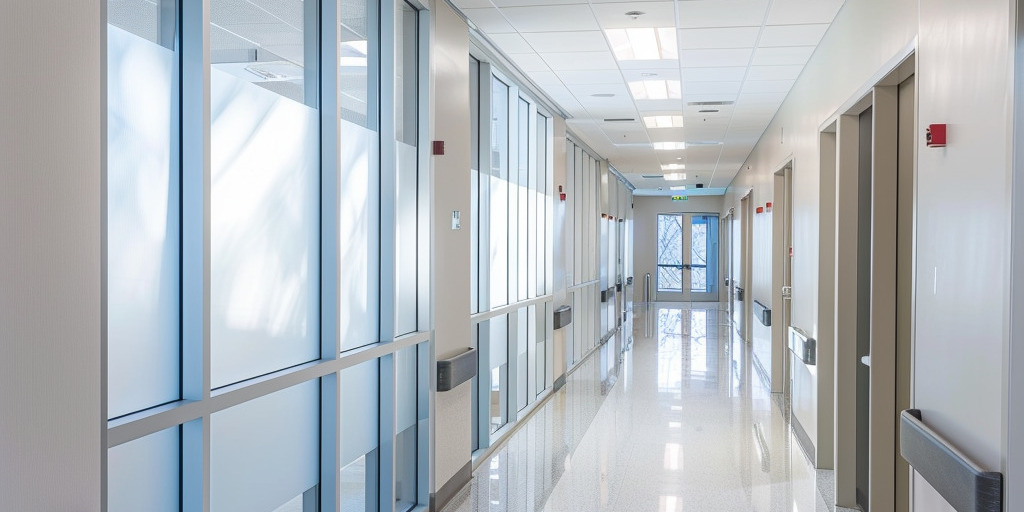
Healthcare is the sector where privacy film specification carries the most direct compliance consequence. Exam rooms, consultation rooms, patient intake areas, and pharmacy windows all represent sightline exposure points where inadequate visual privacy creates HIPAA liability. The specification requirement is clear: the film must prevent a standing observer in a public corridor from identifying a patient or reading clinical information on a display.
Full-height frosted film at 40% VLT or below typically satisfies this threshold. Film on interior vision panels in patient room doors requires the same treatment. Document product specifications, installation dates, and affected areas as part of the facility’s physical safeguard record. When Joint Commission surveyors review physical environment compliance, that documentation supports the record without requiring on-the-spot explanation.
Education Campuses: Classroom Visibility, Safety Glazing, and Multi-Building Rollouts
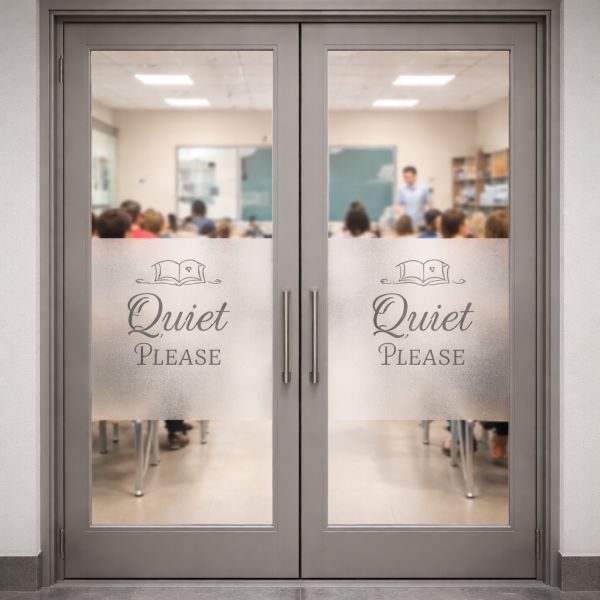
Education environments present a unique specification tension: classroom doors require vision panels for safety and supervision, but those same panels can create distraction during instruction.
The solution is partial-height frosted film applied to the vision panel, obscuring the lower portion where seated students are visible from the corridor while leaving the upper portion clear for a standing observer’s safety check.
Multi-building campus rollouts require the same supply chain and installer coordination discipline as multi-location commercial projects. A campus where film application varies by building because each was sourced separately creates maintenance complexity and inconsistent occupant experience. Specifying one product from one manufacturer, installed by one contractor under a single project agreement, delivers consistent results and a single warranty contact.
Retail Environments: Brand-Consistent Decorative Film Across Multi-Location Deployments
Retail specification for glass film for privacy is typically decorative and functional simultaneously. Storefront glazing with brand pattern film controls sightlines into stockrooms and back-of-house areas while functioning as a branded surface visible from the street. This dual-purpose application makes early procurement planning essential, as custom-cut branded film requires design approval, production, and quality review before installation begins.
Multi-location retail rollouts amplify every procurement variable. A large-scale deployment where film is sourced regionally introduces color variation, pattern inconsistency, and installation quality variance that is visible to customers comparing the brand experience across locations. A national installer with centralized procurement, controlled product sourcing, and a quality verification protocol eliminates that variance, which is why retail clients with large location counts consistently prefer single-vendor national agreements over decentralized local sourcing.
What to Expect During a Commercial Privacy Film Installation
Pre-Installation Assessment: Glazing Audit, Surface Condition, and Film Compatibility
A professional installer does not arrive on day one with film in hand. The process begins with a glazing audit that documents the glass type, surface condition, existing coatings, thermal seal status on insulated glass units, and any previous film applications. This audit determines film compatibility. Not every film adheres correctly to every glass type, and installing adhesive film on glass with an incompatible existing coating is the leading cause of adhesion failure and warranty voids.
The audit also identifies glass that requires surface preparation: mineral deposits, adhesive residue from previous graphics or film, and construction debris all compromise adhesion if not removed before application. Surface preparation is not optional on a professional installation. It is what separates an installation that holds up for ten years from one that starts lifting at the edges within eighteen months.
Installation in Occupied Buildings: Minimizing Operational Disruption
Professional window film installation in occupied commercial buildings is standard practice, not an exception. The application process uses water-based mounting solution, generates no dust or fumes, and requires only temporary access to the glass surface, typically a two-to-four hour window per installation zone. Adjacent workspaces are not affected, HVAC can remain operational, and occupants can return to the space the same day in most cases.
The one condition that affects scheduling is temperature: film should not be applied to glass below 40 degrees Fahrenheit or above 100 degrees, which is relevant for exterior-facing applications during winter months in cold climates. A qualified installer accounts for ambient temperature conditions in the project schedule.
Installation Sequencing for Multi-Floor and Multi-Location Projects
Large-scale projects require installation sequencing that aligns with construction milestones, tenant move-in schedules, and building access logistics. A multi-floor corporate headquarters renovation typically sequences privacy film installation immediately after glass cleaning and before furniture installation. The glass is accessible, the surface is clean, and there is no furniture to protect from overspray.
For multi-location rollouts, sequencing requires coordination between the project manager, the installation contractor, and each site’s facilities contact. A national installer with project management infrastructure handles this coordination through a centralized scheduling system, sending crews to each location within a compressed rollout window rather than negotiating access at each site independently. The difference between a 30-location rollout completed in six weeks and the same project taking six months is almost entirely a function of installer coordination capability.

Quality Control Checkpoints: What Consistent Installation Looks Like at Scale
Quality consistency across locations is not automatic. It requires documented checkpoints. A professional installation program includes pre-installation surface inspection with photo documentation, film lot tracking to verify consistent product across all locations, post-installation inspection against a defined acceptance standard, and a corrective action protocol for any application that does not meet that standard.
The acceptance standard for a professional commercial installation typically covers no bubbles larger than 1/4 inch after the 30-day cure window, no edge lifting, and no visible seams on full-height applications. Photo documentation at each location creates an as-installed record that supports warranty claims and provides baseline evidence if film condition is disputed during a future lease review. Require this documentation as part of the project deliverables.
Evaluating a Window Film Installer’s Capability for Large-Scale Commercial Projects
The question is not whether an installer can apply film. The question is whether they can manage a project. For large-scale commercial work, evaluate on four criteria.
First, manufacturer authorization. A 3M-authorized installer has passed training and quality requirements that a non-authorized installer has not. Manufacturer authorization also unlocks the manufacturer warranty. Installations by non-authorized contractors frequently void product warranties.
Second, project management infrastructure. Can the installer provide a project schedule, crew deployment plan, and progress reporting? A residential film applicator who has done some commercial work operates differently than a commercial contractor with a dedicated project management team.
Third, multi-location experience. Ask for references from projects of comparable scope, covering similar square footage, similar location count, and similar construction timeline constraints. A contractor who has managed a large-scale rollout has solved problems that a contractor who has completed many individual projects in isolation has not encountered.
Fourth, insurance and compliance documentation. Commercial projects require appropriate liability coverage, workers’ compensation insurance, and the ability to meet site-specific safety and badging requirements. Confirm these before the contract is executed, not after a crew shows up on site without required credentials.
How to Specify and Source Privacy Window Film for a Large-Scale Project
Building the Film Specification: What to Document Before Going to Bid
A bid package without a complete film specification invites substitution. Contractors will price to the lowest compatible product unless the specification constrains them to a defined performance standard. Document these six variables before the bid goes out:
- Film type and pattern (frosted, mirrored, gradient, blackout, or decorative)
- VLT target range by application zone (for example, 40–50% for conference rooms, 0% for server rooms)
- Compliance requirement, if applicable (HIPAA sightline, LEED documentation, Joint Commission)
- Application method (permanent adhesive-backed or static-cling)
- Manufacturer and product series, or equivalent performance standard with substitution approval required
- Warranty minimum term and coverage scope
Include a glazing schedule that lists every glass surface by location, dimensions, film type, and any surface condition notes from a preliminary audit. This document becomes the bid reference, the installation guide, and the post-installation acceptance checklist. Projects that skip this step routinely encounter substitution disputes, coverage gaps, and warranty conflicts that a two-page specification would have prevented.
Vendor Vetting Criteria: Installer Credentials, National Coverage, and Project Management Infrastructure
Manufacturer authorization is the first filter. An installer who is not authorized by the film manufacturer cannot deliver a manufacturer-backed warranty, regardless of what their contract states. For 3M Fasara and other commercial product lines, authorization requires documented training, quality audits, and ongoing compliance with manufacturer standards. Confirm authorization status directly with the manufacturer before the contract is executed.
National coverage means more than having installers in multiple cities. It means centralized project management, consistent crew training standards, and a single point of accountability for the entire project. A network of independent regional subcontractors coordinated loosely by a general contractor does not deliver this. A national installer with its own crews, its own scheduling infrastructure, and its own quality control protocols does.
Project management infrastructure is what separates a contractor who can do the work from one who can manage the project. Before awarding a contract, request a sample project schedule for a comparable rollout, ask how progress is reported across locations, and confirm that the contractor has a dedicated project manager assigned to your account.
Warranties and Performance Guarantees from a National Privacy Film Vendor
A specification-grade commercial installation carries two warranty layers: the manufacturer product warranty and the installer workmanship warranty. Both must be present and documented.
For commercial privacy film from a major manufacturer, the product warranty should cover delamination, peeling, bubbling, and optical degradation for a minimum of seven years from installation date. This is the standard for 3M commercial products installed by authorized dealers. Warranties shorter than five years on permanent adhesive film indicate either a lower-tier product or an installation outside the manufacturer’s authorized network.
The workmanship warranty covers installation defects: seams, edge lift caused by improper surface preparation, and application errors that appear within the cure window. A professional installer warrants workmanship separately from product performance, typically for one to two years. Confirm that the workmanship warranty covers occupied-building re-entry, meaning the contractor will return to a live facility to correct defects without requiring a full building access window.
Require warranty documentation in writing, tied to specific product lot numbers and installation dates by location. A blanket warranty statement is not useful when you need to file a claim for a specific building in year four of a seven-year term.
Privacy Film Durability and Long-Term Cost of Ownership in High-Traffic Settings
Durability in commercial settings depends on three variables: substrate quality, adhesive system, and cleaning protocol compatibility.
Substrate thickness matters in high-contact applications. Film on door vision panels, low-height partitions, and accessible glass surfaces in healthcare or education settings takes physical contact that film on ceiling-height conference room glass never experiences. Specify a minimum 4-mil substrate for any surface below standing eye level in a high-traffic environment. Thinner film in these positions shows edge wear and surface abrasion within a few years under normal cleaning cycles.
Adhesive system performance determines whether film holds up through commercial HVAC cycling, which creates glass expansion and contraction that consumer-grade adhesives cannot accommodate. Pressure-sensitive adhesive systems designed for commercial glass maintain consistent bond strength across the temperature ranges typical of commercial building envelopes.
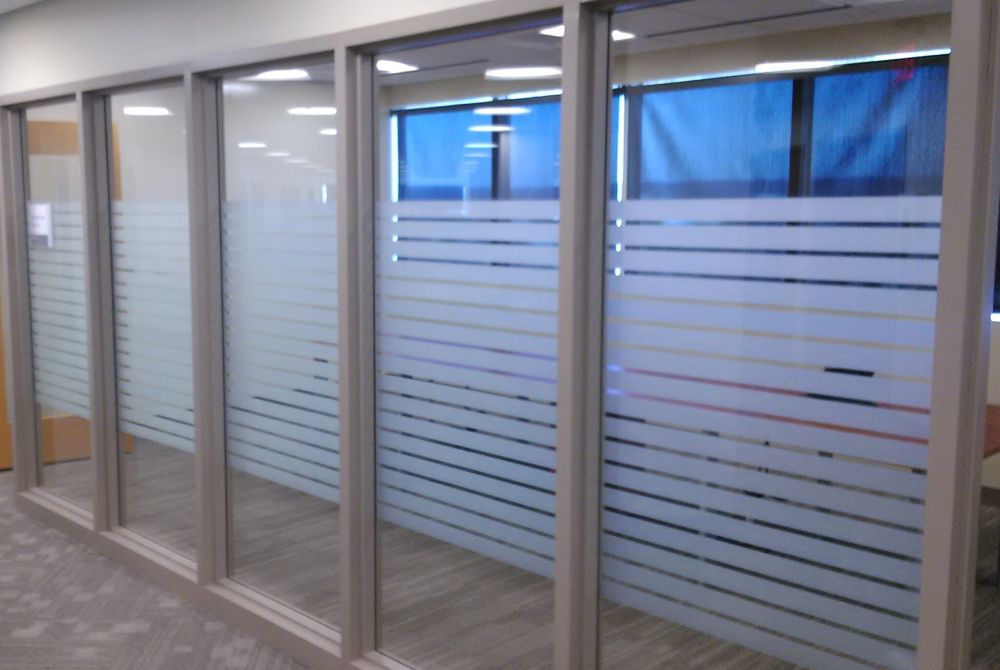
Cleaning protocol compatibility is the most overlooked durability variable. Ammonia-based glass cleaners degrade many film coatings over time. A professional installation includes written cleaning guidelines specifying compatible products. Facilities managers who follow those guidelines see film perform to its rated lifecycle. Facilities that do not, and then attribute early degradation to product failure, generate warranty disputes that proper documentation would resolve immediately.
Supply Chain Reliability and Consistency Across Locations
Product lot variation is real and visible. Two rolls of nominally identical frosted film from different production runs can differ measurably in tint, surface texture, and light diffusion characteristics. In a single-location installation, this is invisible. Across a large rollout where film is sourced locally at each site, it produces a brand experience that varies location by location in a way that photographs document clearly and clients notice.
The solution is centralized procurement: one purchase order, one product lot, shipped to all locations through a single distribution point. A national installer with established manufacturer relationships manages this as standard practice. Confirm centralized procurement is part of the contract terms before the rollout begins, not after inconsistencies appear at an early location.
Quick-Reference Specification Checklist
Use this checklist to confirm your specification package is complete before issuing a bid.
- Film type: frosted, mirrored, gradient, blackout, or decorative (specify pattern and series)
- VLT target: defined by zone (conference room, perimeter glazing, corridor partition, door vision panel)
- Compliance requirement: HIPAA sightline, LEED documentation, Joint Commission physical environment record
- Application method: permanent adhesive-backed (commercial standard) or static-cling (temporary only)
- Installer credential: manufacturer-authorized, with authorization confirmed directly with the manufacturer
- Warranty minimum: 7-year product warranty from the manufacturer, 1-year workmanship warranty from the installer, both in writing with product lot and location documentation
Conclusion: Turning a Specification Decision into a Durable, Scalable Privacy Solution
The Five Decisions That Determine Project Outcome
Every commercial privacy film project resolves to five specification decisions. Get them right, and the installation performs to specification for a decade without intervention. Miss one, and the failure mode is predictable.
The first is film type selection. The product must match the use case, not just visually, but in terms of directionality, VLT, and compliance threshold. A gradient film in a HIPAA-regulated exam room is not a substitution for full-height frosted film, regardless of how similar the samples look.
The second is VLT specification by number, not by visual impression. Define the target range for each application zone in the project documentation.
The third is installer authorization. Manufacturer warranty coverage depends on it. This is a binary criterion: the installer is authorized or they are not.
The fourth is centralized procurement for multi-location projects. Supply chain consistency does not happen by default. It requires a deliberate contracting decision that consolidates purchasing under one agreement.
The fifth is documentation. As-installed records, product lot numbers, warranty terms, and compliance evidence need to exist as a complete package, not as scattered emails and installation receipts. Projects that treat documentation as an administrative formality lose warranty claims and fail compliance audits that a complete record would have resolved.
How to Engage Window Film Depot for Project-Specific Specification Support
Window Film Depot works with commercial project managers at the specification stage, not just at the installation stage. The process begins with a project brief covering the application type, facility sector, square footage, location count, and any compliance requirements. From that brief, the team develops a product recommendation, a preliminary specification document, and an installation approach that accounts for construction sequencing and occupant conditions.
For multi-location projects, Window Film Depot coordinates national installation through its authorized installer network, manages centralized product procurement, and provides project-level documentation that supports warranty, compliance, and as-built requirements.
If you are in the early stages of specifying glass film for privacy on a commercial renovation or multi-site rollout, contact Window Film Depot to request a project consultation. Bring the glazing schedule if you have it. If you do not, the consultation will help you build one.
Frequently Asked Questions
What is the best privacy film for commercial office spaces with HIPAA or confidentiality requirements?
Full-height frosted window film at 40% VLT or lower is the standard specification for healthcare and confidentiality-sensitive environments. This product type provides bilateral obscuration that prevents a standing observer in a public corridor from identifying a patient or reading information on a display, satisfying HIPAA physical safeguard requirements in most compliance reviews. Specify adhesive-backed commercial-grade film and document product specifications, installation dates, and affected areas as part of the facility’s as-built and compliance record.
How do I ensure consistent installation quality across multiple locations or a nationwide rollout?
Consistency at scale requires three things: a single specified product from one manufacturer, centralized procurement through one purchase order and one product lot, and a national installer with its own crews and quality control protocols rather than a loose network of regional subcontractors. Require film lot tracking documentation and post-installation photo records at every location. These form the baseline for warranty claims and give you objective evidence if quality is disputed at any site.
Can privacy film be applied to existing glass in occupied buildings without disrupting operations?
Yes. Professional window film installation in occupied commercial buildings is standard practice. The process uses water-based mounting solution, produces no fumes or dust, and typically requires a two-to-four hour access window per installation zone, with occupants able to return the same day. The primary scheduling consideration is ambient temperature: film should not be applied to glass below 40 degrees Fahrenheit or above 100 degrees, which affects exterior-facing applications in cold-climate winter schedules.
What is the difference between DIY-grade and professional-grade privacy films?
Consumer-grade film is manufactured to a price point using thinner substrate, weaker adhesive systems, and narrower roll widths that produce visible seams on large glazing panels and early edge lifting under commercial cleaning cycles. It carries no warranty coverage for commercial applications. Professional-grade film is specified to documented performance standards, installed with professional tools that eliminate air bubbles and edge contamination, and backed by manufacturer warranties designed for commercial use. The cost difference between the two on a single installation is modest. The cost of removing failed consumer film, preparing the glass, and reinstalling correct product in an occupied building is considerably higher.
What warranties and performance guarantees should I expect from a national privacy film vendor?
A specification-grade commercial installation should carry two documented warranty layers. The manufacturer product warranty should cover delamination, peeling, bubbling, and optical degradation for a minimum of seven years from installation, which is the standard for major commercial manufacturers when installed by an authorized dealer. The installer workmanship warranty, typically one to two years, should cover installation defects and include occupied-building re-entry for corrections. Require both warranties in writing, tied to specific product lot numbers and installation dates by location.
What factors affect privacy film durability and long-term cost of ownership in high-traffic commercial settings?
Three variables drive durability: substrate thickness, adhesive system quality, and cleaning protocol compatibility. Specify a minimum 4-mil substrate for any surface below standing eye level in high-traffic environments such as healthcare or education facilities. Use pressure-sensitive adhesive systems rated for commercial glass, which accommodate the thermal expansion and contraction caused by HVAC cycling. Finally, provide facilities staff with written cleaning guidelines at installation. Ammonia-based cleaners degrade many film coatings prematurely, and following the correct protocol is the single most cost-effective step in extending film to its rated seven-to-twelve-year lifecycle.