Table of Contents:
- Why Frosted Film for Glass Is the Better Alternative to Etched Glass
- Specifying the Right Frosted Film for Glass: Performance Metrics for Project Success
- From Boardrooms to Lobbies: Versatile Applications for Frosted Film
- The Logistics of Large-Scale Installation: Why Your Installer Is Your Most Critical Partner
- Partnering with a #1 3M Installer for Guaranteed Project Success
- Conclusion: Transforming Window Film from an Expense to a Strategic Asset
- Frequently Asked Questions
- Related Posts from Window Film Depot
Why Frosted Film for Glass Is the Better Alternative to Etched Glass
When you need to introduce privacy into an existing glass-walled space, the traditional approach involves replacing clear glass with etched or sandblasted panes. From a project management perspective, this is a capital-intensive, high-disruption process. Modern commercial-grade frosted film for glass offers a far more strategic alternative, solving the same core problems with greater efficiency, flexibility, and control over the project outcome.
Why Frosted Film is a Superior Choice for Commercial Renovations
For any large-scale renovation or multi-site rollout, success is measured by budget adherence, timeline efficiency, and consistent quality. This is where frosted film fundamentally outperforms etched glass. It is not simply a less expensive substitute, but a more intelligent solution engineered for the demands of commercial projects.
Professionally installed frosted film allows you to achieve the exact aesthetic of etched glass without the inherent drawbacks of permanent glass alteration.
The film is applied directly to existing glass surfaces, transforming them in place. This simple difference in application method unlocks significant advantages in cost, speed, and long-term adaptability for your properties.
A Project Manager’s Comparison: Cost, Timeline, and Flexibility
When evaluating solutions for a national portfolio or a large single-site renovation, the operational impact is just as important as the final look. Let’s break down how frosted film and etched glass compare on the factors that matter most to a project manager.
Cost Analysis: Installation and Lifecycle
The upfront cost of procuring and installing frosted film is significantly lower than that of replacing existing glass with etched panels. The etched glass process requires custom fabrication, shipping of heavy and fragile materials, and the labor to both remove old glass and install new panes. Film, by contrast, is a lightweight material applied by specialized technicians with minimal equipment.
The lifecycle cost advantages are even more compelling.
- Repairs: If a section of film is scratched or damaged, only that section needs to be replaced. This is a quick and inexpensive fix. A deep scratch on an etched glass panel often means the entire pane must be replaced, re-incurring significant material and labor costs.
- Tenant Turnover: In commercial properties, tenant needs change. When a space is vacated, any custom-etched branding on the glass becomes a liability, requiring costly replacement to make the space ready for a new lessee. Frosted film with old branding can be cleanly removed, preserving the original glass for the next occupant.
Timeline and Disruption: A Critical Difference
In a live environment or a tight renovation schedule, minimizing disruption is critical. The installation of etched glass involves cordoning off areas, noise from demolition and installation, and potential for dust and debris. The material itself has long lead times for manufacturing and delivery, introducing potential project delays.
Frosted film installation is a clean, quiet, and fast process. A skilled team can apply film to dozens of panels in a single day, often working after hours to ensure zero disruption to business operations. This allows you to execute privacy and branding updates across an entire building or portfolio with unparalleled speed and minimal impact on tenants.
Flexibility and Future-Proofing
Permanent solutions like etched glass lock you into a single design. For a dynamic business, this lack of flexibility is a significant constraint. Frosted film makes your glass surfaces adaptable assets.
- Brand Updates: If your company rebrands, the logos on your glass can be updated just as easily as your website. The old film is removed and new designs are applied.
- Space Reconfiguration: An office that needs to be converted into a high-security conference room can have a more opaque film applied. A space being opened up for collaboration can have its privacy film removed entirely. This non-destructive application gives you the freedom to adapt your space as your needs evolve.
Beyond Privacy: Integrating Branding with Decorative Glass Film
While solving the privacy dilemma is a primary driver, decorative glass film also serves as a powerful medium for reinforcing brand identity. This is where the solution moves from purely functional to strategically communicative, a key consideration for national rollouts where brand consistency is paramount.
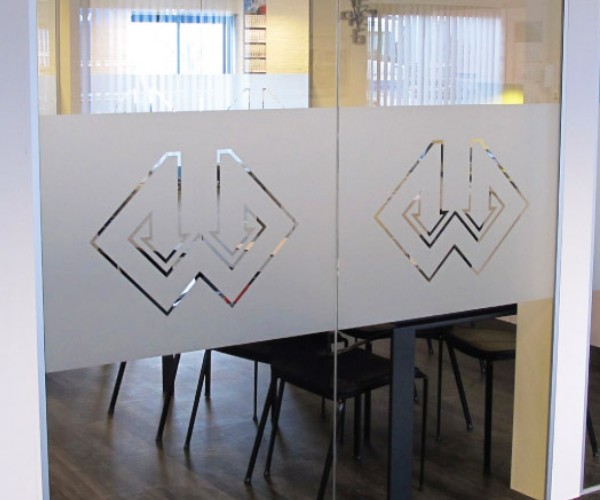
Using advanced digital cutting technology, films can be precisely shaped into intricate logos, custom patterns, or wayfinding text. This ensures that the brand mark on a conference room in one city is perfectly identical to one in another, down to the millimeter. You can specify different light transmission levels to create subtle or bold effects, or even use colored and textured films to align with specific brand palettes.
This level of customization transforms standard glass partitions into high-impact branding opportunities, reinforcing corporate culture and impressing clients.

Specifying the Right Frosted Film for Glass: Performance Metrics for Project Success
Choosing the right frosted film is less about aesthetics alone and more about aligning material specifications with project goals. As a project manager, understanding the key performance metrics is crucial for de-risking your investment and ensuring the final installation meets stakeholder expectations for privacy, durability, and design. This decision directly impacts not just the look of the space, but also its long-term maintenance and functionality.
Understanding Light Transmission vs. Privacy Levels
A common misconception is that more privacy requires sacrificing natural light. In reality, the two are controlled by different properties of the film. The key is to balance the desired level of visual obscurity with the preferred amount of daylight to create a space that feels both secure and open.
- Visible Light Transmission (VLT): This metric, expressed as a percentage, measures how much visible light passes through the film. A higher VLT means more natural light enters the space. Many high-quality frosted films offer VLTs of 70% or more, allowing you to maintain a bright, welcoming environment.
- Privacy or Obscurity Level: This is determined by the film’s light diffusion properties. A film can have a high VLT but still offer complete visual privacy by scattering light as it passes through. This obscures direct lines of sight, rendering figures and objects on the other side indistinct.
For example, a project goal might be to create confidential client meeting rooms without making them feel dark. The solution is to specify a film with a high VLT but a high level of diffusion. This ensures conversations remain private while the space continues to benefit from shared light from a corridor or atrium.
Assessing Durability and Cleanability for High-Traffic Areas
In commercial environments like retail storefronts, office corridors, and healthcare facilities, window tint films are subject to constant interaction. Specifying a film that cannot withstand daily wear and tear will lead to premature replacement, creating budget overruns and operational disruptions.
When evaluating films, consider the following factors:
- Material Composition: Professional-grade films are typically made from durable polyester, which offers superior dimensional stability and clarity compared to less expensive vinyl alternatives.
- Scratch-Resistant Coatings: Look for films with a robust topcoat designed to resist incidental scratches and scuffs, especially for films on doors or low-level glass partitions.
- Cleaning Protocols: The film must be easy to clean with standard, non-abrasive commercial cleaning agents. Confirming the manufacturer’s recommended cleaning process ensures your maintenance teams can care for the installation without damage.
- Manufacturer Warranty: A comprehensive warranty from a reputable manufacturer is a reliable indicator of the product’s expected lifespan. For commercial projects, a warranty of 10 years or more is a good benchmark for quality.
An Introduction to Premium Options: The Role of 3M Fasara Finishes
For projects demanding a higher level of design sophistication, the 3M Fasara glass finish family offers an excellent alternative to costly etched or textured glass. These are not basic frost films, but rather architectural finishes that emulate the appearance of specialty glass with remarkable accuracy.
3M Fasara finishes are available in over 100 distinct patterns, including finishes that replicate the look of rice paper, sandblasted glass, and complex geometric etches. This extensive library provides a powerful design tool, allowing you to create unique brand experiences, define spaces with subtle textural cues, and achieve a high-end aesthetic while maintaining budget flexibility.
Need More Info?
The Window Film Depot team is happy to help.
For a project manager overseeing a national brand rollout, a key benefit is consistency. Using a specified 3M Fasara pattern ensures that the conference room glass in a New York office will have the exact same finish as one in a Los Angeles branch. This level of control is nearly impossible to achieve with traditional glass etching, which can vary between vendors.
From Boardrooms to Lobbies: Versatile Applications for Frosted Film
Beyond its technical specifications, the true value of frosted film lies in its versatility. It is a strategic solution that can be adapted to solve distinct challenges in nearly any commercial space, from enhancing confidentiality to reinforcing brand identity and meeting safety codes.
Achieving Confidentiality in Conference Rooms and Private Offices
The modern open-plan office has increased the need for designated areas of privacy. Frosted film is an ideal solution for retrofitting existing glass walls in conference rooms, executive offices, and HR departments. Instead of a simple monolithic application, consider a gradient film that provides complete privacy at eye level while remaining clear at the top, preserving a sense of openness. Alternatively, you can use custom cut film to create bands or patterns that offer partial privacy, obscuring computer screens without completely closing off the room.
Enhancing Storefronts with Branded Privacy Window Film
Your storefront and main entrance are the first physical touchpoints for clients and employees. Frosted film provides an efficient and scalable way to incorporate creative branding directly onto this prime real estate. Company logos, brand patterns, or mission statements can be precision-cut from frosted film and applied to glass doors and windows. This application is particularly powerful for multi-location rollouts. By establishing a single design standard and working with a national installation partner, a project manager can ensure absolute brand consistency across every site, eliminating the risk of variations that often arise when sourcing local vendors.
Applying Distraction Markers on Glass Partitions
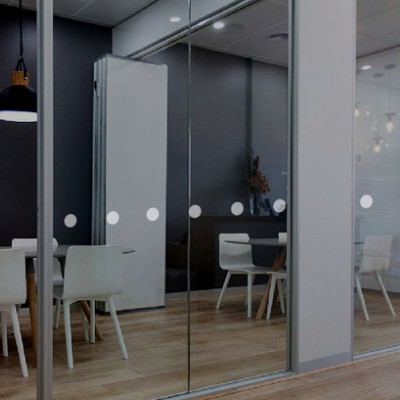
Large panes of clear glass in high-traffic areas can pose a safety hazard.
Building codes often require distraction markers to make the glass more visible and prevent collisions.
While this is a compliance requirement, it is also a design opportunity. Instead of simple dots, these markers can take the form of elegant lines, subtle brand elements, or intricate patterns that contribute to the overall interior design.
This turns a functional necessity into a decorative feature, enhancing both safety and aesthetics simultaneously.
The Logistics of Large-Scale Installation: Why Your Installer Is Your Most Critical Partner
Executing a design vision across a national portfolio presents a challenge of scale that goes far beyond material selection. For frosted window film applications, success hinges on flawless, consistent installation. Your choice of installation partner is one of the most critical decisions you will make, directly impacting project timelines, budget adherence, and the integrity of your brand.
The Challenge of Managing Multiple Subcontractors
Imagine coordinating a frosted film installation for 50 or 100 locations. When you source a different local installer for each city, the project management overhead becomes immense. You are no longer managing a single project, but dozens of disconnected sub-projects, each with its own risks. The administrative burden multiplies with every new vendor as you vet unfamiliar companies, chase down insurance certificates, and manage varied labor rates. This decentralized approach fragments accountability and transforms a straightforward rollout into a logistical labyrinth.
The High Cost of Inconsistency
Beyond the administrative challenges, a multi-vendor approach introduces the significant risk of brand inconsistency. Your brand standards are precise for a reason. With different installers, you open the door to a host of variations that can dilute your brand’s image. A logo that is cut perfectly in one office may be poorly weeded or misaligned in another. Even subtle differences in application quality, such as visible seams or trapped bubbles, can make a premier commercial space feel unprofessional. The cost of this inconsistency is not just the price of a potential rework, it is an erosion of the high-quality brand experience you have worked to build.
De-Risking Your Project with a Single Installation Partner
Consolidating your frosted film installation with a single, national partner shifts the dynamic from reactive problem-solving to proactive project control. By entrusting the entire scope to one expert entity, you effectively de-risk the logistical and brand-related components of your renovation project. This single point of accountability provides a clear and streamlined path to success.
The benefits of this consolidated approach include:
- Standardized Quality: One partner means one non-negotiable standard for material, cutting, and installation technique across every location.
- Streamlined Communication: You have a single point of contact who oversees the entire portfolio, simplifying communication and reporting.
- Predictable Pricing: A master service agreement establishes consistent, transparent pricing, simplifying your budgeting process.
- Centralized Scheduling: A national partner manages the complex scheduling of their certified installation teams, coordinating with your local site managers to ensure minimal disruption.
- Total Accountability: If an issue arises at any site, you have one phone call to make. The responsibility for resolution is clear.
Partnering with a #1 3M Installer for Guaranteed Project Success
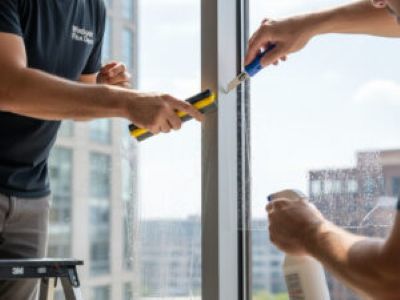
When selecting a national partner, their relationship with the material manufacturer is a key indicator of capability. As a #1 National 3M Certified Installer, we provide a level of expertise and reliability that is independently verified and recognized by the industry leader in film technology. This partnership is a guarantee of quality that we extend to every project.
What It Means to Be a Top-Tier 3M Certified Installer
Achieving and maintaining a top-tier 3M certification is a rigorous process. It requires our installation teams to undergo extensive, hands-on training directly from 3M, mastering the specific application techniques for their full range of architectural films, including the popular 3M Fasara and Dusted Crystal Film series. This certification is a project manager’s assurance that every installation will be performed to the manufacturer’s exact specifications, a critical requirement for validating the comprehensive 3M warranty.
The Advantage of Deep Expertise in Custom Cut Film
Frosted film applications in commercial environments often call for intricate, plotter-cut logos or complex patterns. This is where deep technical expertise becomes paramount. Our teams possess the specialized skills to translate a complex digital design into a flawless physical installation. We understand the nuances of file preparation for digital cutting, the precision required for weeding intricate patterns, and the techniques for multi-layer registration. Our experience ensures the final result is as crisp and impactful as the original design intent.
A Streamlined Process for Multi-Location Projects
Our project management methodology is built to solve the challenges of large-scale rollouts. We provide a single, unified process that gives you complete visibility and control from start to finish.
Our process includes:
- Centralized Specification: We work with your design team to select the ideal film based on desired light transmission, privacy, and aesthetic, creating a single blueprint for every site.
- Dedicated Project Management: Your project is assigned a single manager who becomes your primary point of contact, coordinating all site surveys, material logistics, and installation scheduling.
- Nationwide Execution by Certified Experts: We deploy our network of 3M Certified installers to every location. You get the benefit of local execution without the risk of sourcing local vendors yourself.
- Consistent Reporting and Closeout: Upon completion of each site, we provide a standardized closeout package with photo verification, simplifying your own project tracking.
Conclusion: Transforming Commercial Spaces with Strategic Film Solutions
We have established frosted film as a high-performance architectural solution, not just a decorative finish. When approached with strategic intent, it becomes a powerful tool for solving complex design challenges across a portfolio of commercial properties. The right film, specified and installed correctly, is a decision that pays dividends in budget control, project velocity, and brand integrity.
For a project manager overseeing a multi-location renovation, success hinges on predictable outcomes and scalable solutions. Frosted window film directly supports these objectives. Film installation is a dry, quiet process that can often be completed during off-hours, eliminating the operational downtime associated with glass replacement. Financially, the cost savings are substantial, not just in upfront labor but also in long-term flexibility. As branding evolves or tenants change, film can be updated or removed without requiring a full-scale replacement of the glass itself.
Your Checklist for Deploying Frosted Film at Scale
Executing a large-scale frosted film project successfully requires a systematic approach. Centralizing the process with a single, experienced partner is the most effective way to de-risk a national rollout and ensure quality control. Use this checklist to align your team and prepare for a productive consultation.
- Define Functional Goals: Determine the film’s purpose for each area. Is it for full privacy, partial obscurity, or distraction marking? Clarify the required light transmission levels.
- Finalize Design Elements: Have your vector-based logo files (.AI or .EPS) and brand guidelines ready if you plan to incorporate custom graphics.
- Gather Preliminary Site Information: Compile a list of all locations, the approximate number of glass panes, and rough dimensions for each to help scope the project.
- Establish a Project Timeline: Map out your ideal installation schedule, noting any critical deadlines or access restrictions for each site.
- Select a National Installation Partner: Choose a vendor with a proven, managed network of installers who can execute to a single, exacting standard.
Next Steps: Initiating Your National Project
With your requirements defined, the next step is to engage a specialist. A productive consultation focuses on a collaborative review of your project’s unique goals. An experienced partner will use this information to recommend specific film products, discuss installation logistics, and outline a clear project plan. This is the moment where your strategic planning translates into a tangible, executable project, setting the foundation for a successful transformation of your commercial spaces.
Frequently Asked Questions
What is the difference between frosted film and etched glass?
Frosted film for glass is a high-performance polyester material applied directly to existing glass surfaces to create the look of etched or sandblasted glass. Etched glass is a permanent alteration where the glass itself is abraded to create a frosted appearance. Film is a more cost-effective, faster to install, and non-destructive alternative that can be removed or replaced.
Can frosted film provide privacy but still let in light?
Yes. High-quality frosted films are designed to diffuse light, which provides visual privacy by obscuring direct lines of sight. At the same time, they can have a high Visible Light Transmission (VLT) rating, allowing a large percentage of natural light to pass through. This keeps spaces feeling bright and open while ensuring confidentiality.
How durable is commercial privacy window film?
Commercial-grade privacy window film is made from durable polyester and features a scratch-resistant coating to withstand wear and tear in high-traffic areas. When professionally installed and properly maintained, it is a long-lasting solution. Reputable manufacturers like 3M offer warranties of 10 years or more for commercial applications.
Can you put logos or custom designs on frosted film?
Absolutely. Using digital plotter-cutting technology, frosted film can be precision-cut into intricate logos, text, or custom patterns. This process, known as custom cut film, is an excellent way to integrate branding into glass partitions, storefront graphics, and conference rooms.
Why should I use one national installer for a multi-location project?
Using a single national installation partner de-risks a large-scale rollout by ensuring brand consistency, quality control, and streamlined project management. A single partner provides one point of contact, standardized pricing, and total accountability, eliminating the logistical challenges and quality variations that arise from managing multiple local subcontractors.