Table of Contents:
- Why Commercial Window Frosting Is a Different Problem Than It Looks
- Frosted Film vs. Spray vs. Static Cling: Which Product Category Belongs on a Commercial Spec Sheet
- The 3M Frosted Film Advantage: Performance Data That Holds Up to Procurement Scrutiny
- DIY vs. Professional Installation in a Commercial Setting: A Cost-Benefit Framework
- Planning a Large-Scale Window Frosting Project: Timelines, Phasing, and Vendor Qualification
- Applying Frosted Film Across Commercial Environments: Schools, Retail, and Corporate Offices
- From Specification Decision to Delivered Project: Next Steps with Window Film Depot
- Frequently Asked Questions
Why Commercial Window Frosting Is a Different Problem Than It Looks
Window Frosting gives commercial buildings a practical way to add privacy, improve aesthetics, and enhance glass performance without replacing existing glazing. This guide explains how frosted window film compares with spray coatings and static cling products, which specifications matter most, and how Window Film Depot helps project teams deliver durable, code-compliant installations at commercial scale.
The DIY Assumption That Derails Commercial Projects
Most window frosting projects that go sideways at the commercial level start with the same mistake: someone with budget authority runs a quick search, finds the same consumer products that work fine for a home office or a single conference room door, and applies that logic to a 40,000-square-foot corporate campus or a school district renovation. The products look similar. The process sounds simple. The price delta seems hard to justify.
Then the adhesive fails on low-E glass. The spray frosting peels under commercial cleaning protocols. The static cling film migrates in a south-facing retail storefront. What started as a line-item savings becomes a rework event, a compliance gap, or a vendor dispute that nobody planned for.
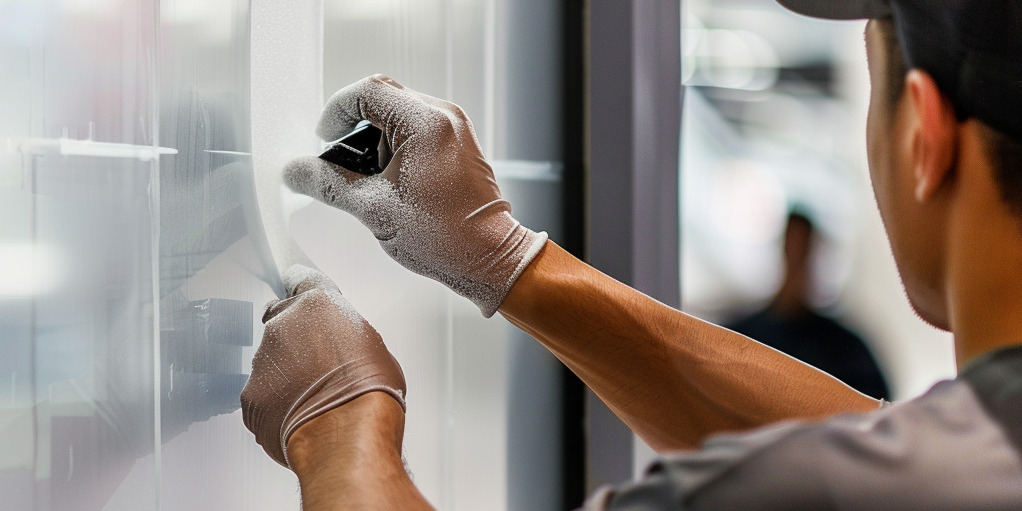
Commercial window frosting is not a scaled-up version of a residential project. It is a specification decision with procurement, performance, and liability dimensions that consumer-grade products were never designed to handle.
What “Window Frosting” Actually Means in a Specification Context
What is window glazing? In a commercial specification, window frosting is shorthand for a range of applied film and surface treatments that modify glass for privacy, light control, UV rejection, safety reinforcement, or some combination of all four. The term covers meaningfully different product categories with different performance profiles, installation requirements, and compliance implications.
When a facilities manager or architect puts “frosted glass” on a spec sheet, they are typically describing an outcome, not a product. The path to that outcome, whether through factory-etched glass, applied adhesive film, or a surface spray, has real consequences for cost, timeline, replaceability, and long-term performance.
Frosted Glass vs. Frosted Film: A Definitional Line That Matters for Procurement
Frosted glass is glass that has been permanently altered through acid etching or sandblasting during manufacturing. It delivers a consistent appearance and requires no ongoing maintenance, but it is expensive, requires full glass replacement to modify, and offers no UV or solar performance beyond what the base glass provides.
Frosted film is a surface-applied product that achieves the same visual effect at a fraction of the cost, with the added advantages of replaceability, performance layering, and customization. For commercial procurement, this distinction matters because film can be specified, updated, or removed without a glass replacement budget. That flexibility has real value in tenant improvement projects, leased spaces, and phased rollouts.
The Full Performance Spectrum: Privacy, UV Rejection, and Safety in a Single Specification
The competitive advantage of professional-grade frosted film over any DIY alternative is not appearance. It is performance density. A single film specification can address privacy, occupant comfort, regulatory compliance, and security simultaneously, something no spray product or static cling film approaches.
Visible Light Transmission and What It Means for Occupant Comfort
Visible light transmission, or VLT, expresses the percentage of visible light a film allows through the glass. A film rated at 50% VLT transmits half the incoming light, diffusing it rather than blocking it. In commercial environments, VLT selection directly affects glare on screens, perceived brightness in open-plan offices, and compliance with daylighting requirements in some code jurisdictions.
Specification-grade frosted films are available across a wide VLT range, typically from roughly 20% to 85%, allowing designers and facilities managers to match the film to occupancy type. A healthcare waiting area and a financial services trading floor have different requirements, and the spec should reflect that.
UV Rejection Rates and Solar Heat Gain Coefficient as Facility Metrics
High-quality frosted film blocks a substantial portion of UV radiation, which matters for LEED compliance, furniture and flooring preservation, and occupant health in spaces with extended sun exposure. The solar heat gain coefficient, or SHGC, measures how much solar energy passes through the glass assembly. A lower SHGC reduces cooling load, which shows up directly in energy operating costs.
Neither metric appears on a can of frosted glass spray or a static cling product. These are specification-grade performance values that only adhesive film products, particularly those from manufacturers like 3M, document with independently verified data. For facilities teams managing energy budgets across multiple locations, these numbers are not cosmetic details.
Security-Grade Applications: Impact Resistance, Safety Film, and Blast Mitigation
Some frosted film products do more than control light. Safety-grade and security-grade films hold glass fragments together on impact, a requirement in school buildings, government facilities, and any environment subject to CPSC 16 CFR 1201 or ANSI Z97.1 safety glazing standards. Blast-mitigating films add a further layer of protection by bonding to the glass with a thick adhesive system that resists pressure wave events.
This is where the specification decision moves well beyond aesthetics. A school district installing frosted film on a classroom door is not just managing visibility into the room. They may also be fulfilling a security upgrade requirement. A film that meets the privacy spec but not the safety standard fails the project, regardless of how it looks.
Frosted Film vs. Spray vs. Static Cling: Which Product Category Belongs on a Commercial Spec Sheet
How Each Product Type Performs Under Commercial Conditions
The three product categories a commercial buyer encounters most often, adhesive frosted film, frosted glass spray, and static cling film, are not interchangeable. Each was designed for a different use context, and only one performs reliably under the conditions commercial buildings impose.
Adhesive Frosted Film: Durability, Adhesion Standards, and Fade Resistance
Pressure-sensitive adhesive frosted film bonds directly to the glass surface. When installed correctly, achieves a rated service life of ten years or more. It withstands commercial cleaning agents, temperature cycling, and direct sun exposure without lifting, yellowing, or hazing. Manufacturers like 3M test and specify adhesion to low-E, tempered, and laminated glass because modern commercial glazing rarely uses standard annealed glass.
Manufacturers achieve fade resistance in specification-grade film by combining UV-stabilized polyester substrates with protective hardcoats rather than relying on pigment alone. The appearance stays consistent over the product’s rated lifecycle, which is why it can carry a manufacturer warranty.
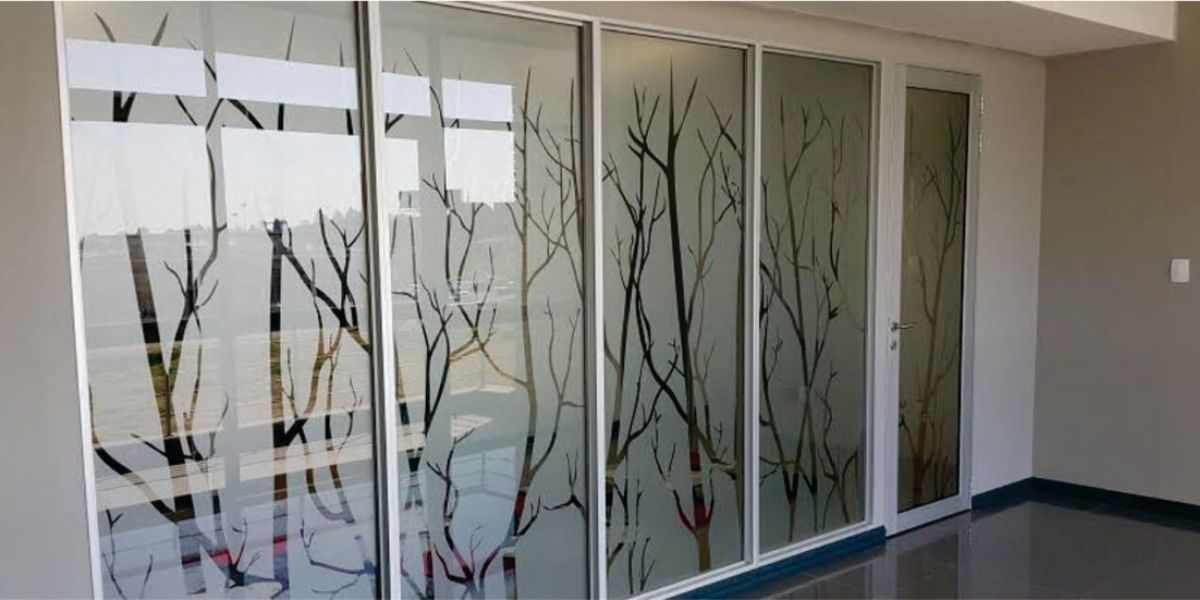
Frosted Glass Spray: Why It Fails the Permanence and Rework Test at Scale
Frosted glass spray applies a thin acid-etching or lacquer-based coating to the glass surface. In a single-room application with controlled conditions, it can produce a reasonable visual result. At commercial scale, the problems compound quickly.
The coating bonds inconsistently across large glass surfaces, particularly in humid or dusty environments. It cannot be removed cleanly without risking glass damage. There is no documented UV or solar performance, no safety rating, and no manufacturer warranty applicable to a commercial installation. Most critically, any rework requires stripping the existing coating, which adds labor and disposal costs that eliminate any initial price advantage.
Static Cling Film: Appropriate Use Cases and Where It Falls Short Institutionally
Static cling film uses electrostatic adhesion rather than a pressure-sensitive adhesive. It is repositionable, removable, and easy to apply without professional tools. That makes it appropriate for short-term applications, including temporary privacy screens, event signage on glass, and seasonal decoration.
In permanent commercial installations, the limitations are significant. Static cling film lifts in humid environments. It fails in direct sun on south- or west-facing exposures. It also slides under its own weight on tall glass panels.t carries no safety rating and no warranty. For any application that requires performance data, multi-year durability, or regulatory compliance, static cling is not a viable specification.
Which Is Better for Commercial Use: Frosted Glass Spray or Film?
For a residential touch-up or a single decorative panel, frosted glass spray is a serviceable option. For any commercial application, adhesive frosted film is the only defensible choice. It withstands cleaning solvents, UV exposure, temperature variation, and code scrutiny. Frosted glass spray offers no path to a warranty. It carries no safety certification process and no track record in institutional environments. Commercial frosted window film provides all three.
Is Frosted Film Suitable for Commercial Buildings and Offices?
Specification-grade adhesive frosted film is not only suitable for commercial buildings, it is the standard solution for privacy glass in corporate, retail, healthcare, and education environments. The relevant certifications depend on the application:
- Safety glazing compliance under ANSI Z97.1 or CPSC 16 CFR 1201 for door lites and hazardous locations
- Solar performance documentation for LEED v4 credit compliance
- Antimicrobial surface certification for healthcare environments, available on select product lines
- Title 24 and local energy code compliance where SHGC thresholds apply to renovations
A specification-grade film product from a certified manufacturer carries documented test data for each of these criteria. That documentation is what a compliance reviewer or building inspector will ask for.
Does Frosted Window Film Meet Building Codes and Safety Standards for Commercial Use?
It depends on the product and the application. Not all frosted film is safety film. A decorative film rated for privacy and UV control will not satisfy a safety glazing requirement at a hazardous location unless it is also tested and rated for impact resistance. The specification has to match the end use.
This is precisely why commercial window frosting projects require a qualified installer working from a documented specification, not a supply-and-install arrangement sourced from a consumer product page. The installer’s job is to confirm that the specified film meets the code requirement for each glass location, document the installation for the project record, and provide warranty coverage that covers both the product and the workmanship.
Product Category Specification Selector
| Criteria | Adhesive Frosted Film | Frosted Glass Spray | Static Cling Film |
|---|---|---|---|
| Durability lifecycle | 10+ years with warranty | 1–3 years (variable) | 6–18 months typical |
| Removal without glass damage | Yes, with proper technique | High risk of damage | Yes, residue-free |
| Warranty availability | Manufacturer + installer warranty | None | None |
| Safety/compliance certifications | Available (ANSI, CPSC, LEED) | Not available | Not available |
| Installation scalability | Full commercial/multi-site | Limited, inconsistent at scale | Temporary use only |
| Total cost of ownership | Lowest over lifecycle | Highest (rework costs) | Moderate (replacement frequency) |
The takeaway for procurement: adhesive frosted film is the only category that clears all six criteria. The other two may have a place in limited, non-permanent contexts, but they do not belong on a commercial specification for permanent glazing treatment.
The 3M Frosted Film Advantage: Performance Data That Holds Up to Procurement Scrutiny
Why Product Provenance Matters in Institutional and Commercial Procurement
A specification is only as reliable as the manufacturer behind it. In commercial procurement, product provenance determines whether a spec holds up during a compliance review, an insurance claim, or a warranty dispute. Generic or private-label frosted film products may look identical on a sample card and cost less per square foot, but they typically lack third-party test data, documented adhesion profiles for specialty glass types, and a warranty structure that survives multi-year institutional use.
3M window films are tested to ASTM, ANSI, and ISO standards, with published performance data for each product. That documentation is what a building inspector, LEED reviewer, or risk manager will request. A vendor who cannot produce it puts the project record at risk.
3M Fasara Decorative Film: Design Flexibility at Commercial Scale
The 3M Fasara film line is the product most specifiers encounter first when sourcing frosted window film for corporate interiors, retail environments, or glass partition systems. It covers more than 100 pattern and opacity options, ranging from clean translucent frost to textured architectural patterns, with VLT values spanning roughly 20% to 85% depending on the design selected.
For commercial projects, the practical advantage is design consistency at scale. A corporate tenant with multiple locations can specify a single Fasara pattern, and every installation matches, because the product is manufactured to consistent tolerances across production runs. That repeatability is not available from spray applications or unbranded film rolls.
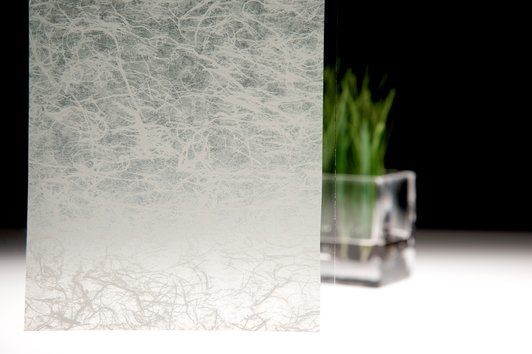
Fasara films also apply to a broad range of glass substrates, including tempered, laminated, and low-E coated glass, which covers the glazing types found in most post-2000 commercial construction. The adhesive system is engineered for each substrate category, which eliminates the adhesion failure risk that generic films carry on specialty glass.
3M Safety Series Film: Impact Resistance Ratings and Security Integration
Where Fasara addresses aesthetics and privacy, the 3M Safety Series addresses structural performance. These products are independently tested to ANSI Z97.1 and CPSC 16 CFR 1201 safety glazing standards, meaning they hold glass fragments together on impact rather than allowing the glass to scatter. For door lites, sidelights, and any glazed opening in a hazardous location as defined by code, this is a compliance requirement, not an optional upgrade.
Safety Series films can also be specified with an attachment system that bonds the film edge to the frame, extending impact resistance and, in blast-rated configurations, resisting pressure wave separation. School security upgrades increasingly combine frosted safety film on classroom door vision panels with electronic access control, addressing both the visibility risk and the forced-entry risk in a single glazing treatment. The film’s opacity is a design choice. The safety rating is the specification requirement driving the project.
How Long Does Window Frosting Film Last?
Specification-grade adhesive frosted film carries a rated service life of ten to twelve years in interior applications, with some exterior-grade products warranted for seven to ten years under direct weather exposure. 3M backs its commercial film lines with a manufacturer warranty that covers delamination, bubbling, cracking, and significant color shift within the warranty period.
Interior frosted films consistently meet or exceed their rated lifecycle in commercial environments when installed correctly and maintained appropriately. The performance gap between rated and actual service life is almost always traceable to installation error or an incompatible substrate, not product failure.
Manufacturer Warranty vs. Installation Warranty: What to Demand from Your Vendor
A manufacturer warranty covers the film product. It does not cover the installation. If film fails because of improper surface preparation, an incorrect adhesive cure process, or application to an incompatible substrate, the manufacturer warranty does not apply. That gap is where poorly qualified installers create liability exposure for the facility owner.
A qualified installer provides a separate installation warranty that covers workmanship, typically for one to two years, but sometimes longer on commercial projects. Demand both in writing before issuing a purchase order. The installation warranty is the document that gives you recourse when something goes wrong in year one, which is when installation defects surface.
Maintaining Frosted Window Film in High-Traffic Commercial Spaces
Frosted film in commercial environments requires only routine maintenance: cleaning with a soft cloth or squeegee, a non-ammonia glass cleaner, and no abrasive tools. Most specification-grade films include a hardcoat surface layer that resists scratching from normal cleaning contact.
One maintenance issue worth flagging for facility teams is edge lifting caused by repeated contact with wet mop heads or floor cleaning equipment near base-of-glass installations. Specifying a film with a sealed edge finish and briefing cleaning staff on the appropriate proximity threshold eliminates this issue. It is a facilities management protocol point, not a product deficiency.
DIY vs. Professional Installation in a Commercial Setting: A Cost-Benefit Framework
Why the DIY Math Breaks Down Beyond a Single Office Door
A single office door is forgiving. The glass panel is small, the consequences of a bubble or misaligned edge are cosmetic, and a redo costs an afternoon. Scale that logic to a 200-panel corporate office build-out or a school district with 14 buildings, and every variable compounds. Surface preparation time, film waste from miscuts, cure time management across dozens of panels, and the coordination required to keep spaces accessible during installation all add costs that the per-square-foot material price does not capture.
The DIY calculation also ignores what happens when something goes wrong. A misapplied film on a tempered glass unit voids any product warranty. A compliance-critical installation performed without documentation creates a gap in the project record. Neither outcome has a clean, inexpensive resolution.
What Professional Window Film Installation Actually Costs, and What It Prevents
Professional installation for commercial frosted window film typically runs between $8 and $20 per square foot, depending on film specification, glass accessibility, and project complexity. That range reflects labor, materials, surface preparation, quality inspection, and warranty coverage in a single line item.
Labor Cost Scenarios: Single-Site vs. Multi-Location Rollout
On a single-site project of 500 to 1,000 square feet, professional installation delivers the most visible efficiency advantage in surface prep and quality control. A trained installer team completes the project in one to two days with zero warranty voids and a documented punch list.
On a multi-location rollout, the math shifts further in favor of professional installation. A vendor with multi-site delivery capacity can schedule crews across locations in sequence, manage material logistics centrally, and provide a single project record covering every installation. Self-performed work across multiple sites requires site coordinators at each location, separate material orders, inconsistent quality outcomes, and no unified warranty coverage.
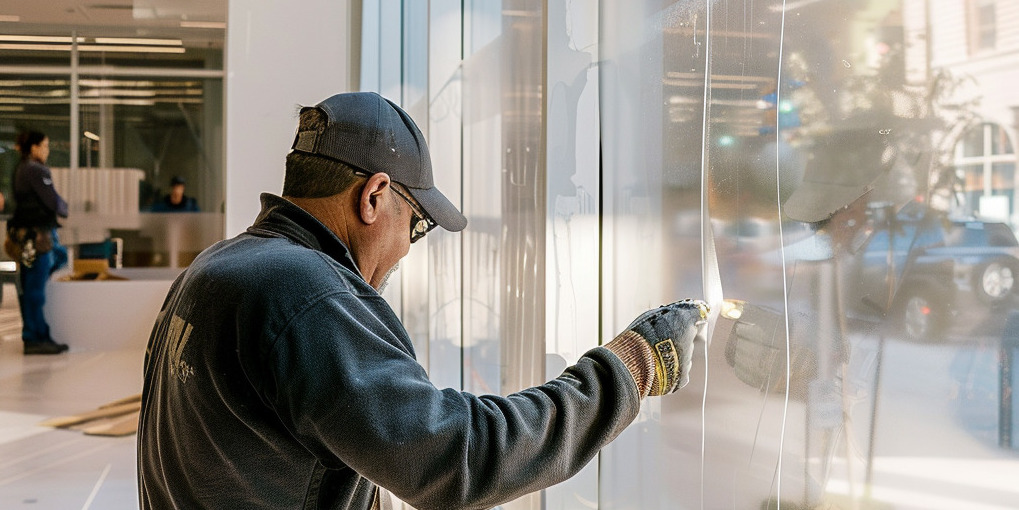
The Hidden Costs of Rework, Warranty Voids, and Compliance Failures
Rework on a failed DIY installation typically costs more than the original professional installation would have. Removing improperly applied film, re-prepping the glass surface, and re-applying the correct film on a tight schedule can add substantially to the per-square-foot cost in most scenarios. Add the cost of missed compliance documentation, project delays, and potential liability exposure on safety-critical glazing, and the apparent savings disappear quickly.
Can Frosted Window Film Be Installed on Large Commercial Projects?
Yes, and it is a routine project type for qualified commercial film installers. Projects ranging from single-floor office renovations to multi-building campus rollouts are standard scope for experienced installation teams. The key variables are crew sizing, scheduling sequencing, and access coordination with the facility, not the film application itself.
What changes at scale is the project management requirement. Large commercial installations need a documented scope of work, a glass inventory by location, a quality inspection protocol, and a scheduling plan that accounts for occupied spaces, HVAC cure requirements, and construction sequencing. A qualified vendor builds all of that into the project plan before the first roll of film is cut.
How Long Does Professional Frosted Window Film Installation Take?
Timeline benchmarks by project type:
- Single conference room or office suite under 200 square feet: one day, including prep and cure
- Full-floor corporate build-out of 1,000 to 3,000 square feet: two to four days
- Multi-floor or campus project of 5,000 to 20,000 square feet: one to three weeks, depending on phasing and access scheduling
- Multi-location retail or school district rollout: four to twelve weeks, sequenced by site priority
These benchmarks assume normal access conditions and a pre-approved specification. Projects with occupied spaces, restricted access windows, or coordination with active construction timelines require buffer time built into the schedule, typically 15% to 20% of the base estimate.
Can Frosted Window Film Be Removed Without Damage to Glass?
Properly specified and professionally installed adhesive frosted film can be removed cleanly without damaging the glass surface. The removal process involves scoring the film edge, applying a release solution, and peeling the film off in sections, followed by adhesive residue removal with a non-abrasive solvent. On standard annealed or tempered glass, a trained installer leaves no permanent marks.
The exceptions are glass surfaces that were already compromised before installation, glass with pre-existing coatings not accounted for in the original specification, or film that has been in place well beyond its rated service life. A pre-installation glass condition assessment, which any qualified vendor should perform, catches these scenarios before they become removal problems.
Planning a Large-Scale Window Frosting Project: Timelines, Phasing, and Vendor Qualification
Building the Project Specification: Scope Definition Before Vendor Outreach
Vendor outreach before a completed scope definition wastes time for both parties and produces bids that cannot be compared meaningfully. Before contacting any vendor, a project manager should have four things documented:
- A glass inventory covering locations, dimensions, glass type (tempered, laminated, low-E, annealed), and current surface condition
- A performance requirement by zone, including privacy level, safety glazing compliance need, and any UV or SHGC targets
- An access schedule identifying which spaces are occupied, which have restricted access windows, and what the project completion deadline is
- A budget range, not a final number, but enough to qualify whether a given vendor’s pricing model fits the project
With that documentation in hand, a vendor can provide a meaningful bid rather than a ballpark estimate that shifts after the site walk.
Phased Rollout Planning for Multi-Location Retail, K-12 Schools, and Corporate Campuses
Multi-location projects rarely benefit from a simultaneous full-deployment approach. Phased rollouts reduce risk, allow for specification refinements after the first installation, and keep project cash flow manageable across a fiscal year.
Phase Sequencing Logic: Prioritizing High-Traffic and Compliance-Critical Zones
Phase one should cover the locations or zones where the compliance requirement is hardest or the operational impact of delay is highest. For a school district, that means classroom door lites with safety glazing requirements before decorative film on administrative spaces. For a retail chain, that means flagship locations with brand visibility before secondary markets.
This sequencing also creates a quality benchmark. The first phase becomes the reference installation for the rest of the project, which gives the facilities team and the vendor a shared standard before the bulk of the work is committed.
Coordination with General Contractors and Facilities Teams
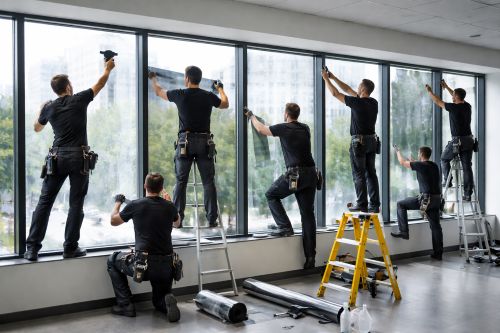
On new construction or renovation projects, film installation is typically a late-stage finish trade, scheduled after glazing is complete, HVAC is operational, and the space is at normal temperature and humidity. Coordinating that window with the general contractor’s punch list schedule requires a vendor who communicates in construction project management terms, not consumer service terms.
Facilities teams on occupied campuses need a vendor who can work in active spaces with minimal disruption, sequence work around class schedules or business hours, and clean up completely at the end of each work session. These are standard expectations for a qualified commercial installer and should be confirmed in the scope of work before contract execution.
What to Require from a Vendor Bid: Quality Assurance, Scheduling Commitments, and Single-Source Accountability
A credible commercial vendor bid includes more than a price per square foot. Require the following before issuing a purchase order:
- Confirmation of 3M-authorized installer status, which is a prerequisite for manufacturer warranty coverage
- A project schedule with defined milestones and site-by-site completion dates
- A written quality assurance protocol covering how defects are identified, documented, and remediated
- A single point of contact for the full project scope, not a different crew coordinator at every location
- Written documentation of both the manufacturer warranty terms and the installer’s workmanship warranty
A vendor who cannot provide all five of these items is not structured for commercial project delivery, regardless of their per-square-foot price.
An Illustrative Multi-Site Rollout Scenario
Project Parameters: Scope, Timeline, and Budget Benchmarks
Consider a regional healthcare network with eight clinic locations requiring privacy window film on patient consultation rooms and waiting areas, totaling approximately 6,400 square feet of glass across all sites. The specification requires privacy-level opacity at consultation windows, UV rejection at waiting area glazing, and safety film compliance at door lites per state health facility code. Estimated budget runs from $95,000 to $115,000 fully installed, with a target completion of ten weeks from contract execution.
A phased approach sequences the two highest-volume locations in weeks one and two, with the remaining six sites in three subsequent two-week phases. Each phase covers two locations, with crews moving between sites to maintain schedule density.
How Professional Installation Protected Schedule and Specification Compliance
In this scenario, the pre-installation glass audit at one location identifies a section of existing low-E glass that the original spec did not account for. A professional installer flags this before the film order is placed, allowing the specification to be updated to a compatible adhesive formulation without delaying the project. A self-performed installation would have applied the wrong film, likely discovered the adhesion failure weeks later, and faced a rework event in an occupied clinical space.
The completed project delivers a single project record covering all eight locations, with installation photos, glass type documentation, warranty certificates, and compliance confirmation for each safety glazing location. That record goes into the facility’s building documentation and satisfies the health facility code requirement without a second site visit.
Applying Frosted Film Across Commercial Environments: Schools, Retail, and Corporate Offices
K-12 and Higher Education: Privacy Compliance, Safety Film Requirements, and Institutional Durability
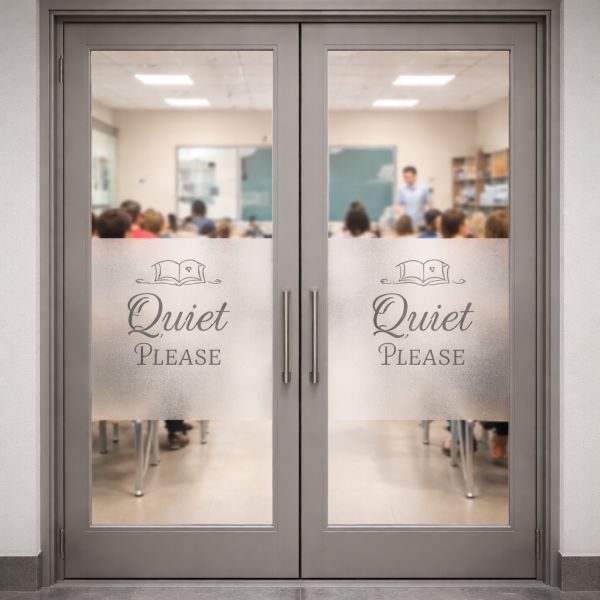
Education projects carry the densest overlap of compliance requirements in the window frosting category. Classroom door vision panels need safety glazing ratings. Administrative offices require privacy from corridors. Counseling rooms and health clinics trigger FERPA and HIPAA privacy considerations depending on district policy. A single product specification rarely satisfies all three zones, which is why glass inventories in school projects need to be mapped by use type before a film spec is written.
Institutional durability is the other pressure point. School glazing gets cleaned with commercial-grade solvents on daily schedules, takes contact from students, and faces decades of use without replacement budgets. Specification-grade adhesive film with a hardcoat surface handles this load. Consumer-grade frosted products do not.
For districts running security upgrades, the combination of frosted safety film on door lites addresses both visibility and impact resistance in a single product. It satisfies the security requirement without requiring glass replacement, which keeps projects within renovation budgets rather than capital replacement budgets.
Retail Environments: Brand-Consistent Decorative Film at Multi-Location Scale
Retail is where window frosting intersects directly with brand standards. A regional chain that specifies frosted privacy film on fitting room doors or storefront partition glass needs that film to look identical across every location. Slight variation in opacity or tone is visible to customers and inconsistent with brand presentation.
This is the production tolerance argument in practice. Specification-grade film from a manufacturer like 3M is produced to consistent tolerances across production runs, so a pattern or opacity selected for a flagship location installs identically at location 40. Spray applications and generic film rolls cannot make that guarantee.
Multi-location retail projects also benefit from a single vendor managing material procurement and crew scheduling across all sites. Fragmented sourcing produces inconsistent results and no unified warranty record.
Corporate Offices and Glass Partitions: Balancing Open-Plan Aesthetics with Functional Privacy
Open-plan offices create a structural privacy problem. The architectural intent is visual connectivity. The operational reality is that conference rooms, HR offices, and executive suites need visual separation from the floor. Frosted film on glass partitions and interior glazing resolves this without walls.
The design decision in corporate environments typically centers on opacity gradient. A full-opacity frost on a conference room partition blocks all visibility. A mid-opacity film at seated eye level, leaving the upper pane clear, maintains light flow while providing seated privacy. These are specification choices, not installation choices, and they require a vendor who can discuss VLT ranges and application heights as part of the design consultation, not just quote square footage.
Frameless glass partition systems, common in post-2015 commercial interiors, also require a film that bonds cleanly to structural glazing without visible edge gaps. Professional installation with proper edge termination is the only way to achieve a finished appearance on these systems.
Matching Film Opacity to Occupancy Type
The right opacity level depends on what the space does, not just how much privacy the occupant wants. A practical framework:
- High-privacy zones such as exam rooms, counseling offices, and HR suites: 10% to 25% VLT frosted film blocks direct line of sight completely while maintaining diffused light
- Moderate-privacy zones such as conference rooms and collaboration spaces: 40% to 55% VLT provides seated privacy without creating a visually closed room
- Low-privacy zones such as reception areas and open office perimeters: 65% to 85% VLT delivers glare softening and a frosted aesthetic without meaningful visibility restriction
For exterior-facing applications where privacy needs to work in both directions, during daytime and after dark, a qualified installer can advise on whether a single film or a combination approach is appropriate. The physics of one-way privacy films change with interior and exterior light levels, and that nuance matters for after-hours security in retail and healthcare settings.
Glass Doors, Partitions, and Curtain Wall: Application Surfaces Beyond Standard Window Panes
Most commercial film applications involve surfaces beyond a standard window pane. Glass doors, interior partitions, storefront systems, and curtain wall assemblies each present different substrate conditions, edge configurations, and access constraints.
Curtain wall glazing in particular often involves insulated glass units with low-E coatings on specific surfaces. Applying film to the wrong surface of an IGU traps solar heat and can cause thermal stress fractures, a failure mode that costs far more than the original installation. A qualified installer verifies surface specifications before cutting film, not after.
Interior partitions and glass doors are the most common application surfaces in corporate and healthcare projects, and they are also the most forgiving. The film installs on a controlled interior surface, cures at stable temperature and humidity, and is accessible for quality inspection without scaffolding. For new construction projects, scheduling film installation after the HVAC system is operational is the single most effective step a project manager can take to ensure proper cure.
From Specification Decision to Delivered Project: Next Steps with Window Film Depot
Recapping the Commercial Case: Why Film, Why Professional, Why Now
The argument across this guide reduces to a straightforward procurement principle: the product category and installation method you choose for commercial window frosting determines whether the project delivers a compliant, warrantied, durable result or a maintenance liability.
Adhesive frosted film, professionally installed, is the only option in the market that clears every commercial criterion, including durability, compliance, removability, warranty, and scalability. Spray and static cling products have their contexts. Commercial glazing specifications are not among them.
Need More Info?
The Window Film Depot team is happy to help.
The professional installation case is not about convenience. It is about project risk. Rework costs more than original installation. Compliance gaps create liability. Warranty voids leave the facility owner unprotected. A qualified commercial installer eliminates all three exposure points before they happen.
How Window Film Depot Delivers at Commercial and Institutional Scale
Window Film Depot operates as a 3M-authorized commercial installer with the project management infrastructure to handle multi-site rollouts across corporate, education, healthcare, and retail environments. That means a single point of contact for the full project scope, a documented quality assurance process at every installation, and warranty coverage that combines 3M’s manufacturer backing with a workmanship guarantee.
For project managers building a vendor roster, the relevant proof points are track record and structure. Window Film Depot has delivered large-scale frosted film projects, including multi-floor office renovations, school district safety upgrades, and retail chain rollouts, with the scheduling commitments, compliance documentation, and project records that institutional procurement requires.
Initiating Your Project Consultation: What to Bring to the First Conversation
A productive first consultation starts with your glass inventory. If you have dimensions, glass types, and a general sense of which zones require which performance level, the project can be scoped, specific film products recommended, and a structured bid provided in one meeting. If the inventory is not yet complete, a site assessment is the right starting point.
Bring your timeline and any compliance requirements you have already identified. The earlier those constraints enter the conversation, the more accurately the project plan reflects your actual schedule. Contact Window Film Depot to schedule a project consultation and get a specification-grade assessment of your window frosting scope.
Frequently Asked Questions
What is the difference between frosted window film and frosted glass spray?
Frosted window film is a pressure-sensitive adhesive product that bonds directly to the glass surface, carries a rated service life of ten or more years, and is available with safety certifications, UV performance data, and manufacturer warranty coverage. Frosted glass spray applies a surface coating that produces a similar visual result but bonds inconsistently, cannot be removed cleanly without risk of glass damage, and carries no compliance certifications or warranty applicable to commercial use. For any permanent commercial application, they are not interchangeable options.
Does frosted window film meet building codes and safety standards for commercial use?
It depends on the product and the application. Not all frosted film is safety film. A decorative film rated for privacy and UV control will not satisfy a safety glazing requirement at a hazardous location unless it is also tested and rated for impact resistance under ANSI Z97.1 or CPSC 16 CFR 1201. The specification must match the end use, and a qualified installer should confirm code compliance for each glass location before installation begins.
Can frosted window film be installed on large commercial projects?
Yes, and it is a routine project type for qualified commercial film installers. Projects ranging from single-floor office renovations to multi-building campus rollouts and multi-location retail chain deployments are standard scope for experienced teams. The keys to success at scale are a thorough glass inventory, a documented scope of work, a phased scheduling plan, and a vendor with established multi-site delivery capability.
What warranty do professional frosted window film installations come with?
A properly structured commercial installation carries two separate warranties. The manufacturer warranty, such as the one 3M provides on its commercial film lines, covers the product itself against defects including delamination, bubbling, cracking, and color shift within the warranty period. The installation warranty, provided by the installer, covers workmanship and is typically one to two years on commercial projects, sometimes longer. Both should be delivered in writing before a purchase order is issued.
What is the cost comparison between DIY frosted film and professional installation?
Professional installation for commercial frosted window film typically runs $8 to $20 per square foot, covering materials, labor, surface preparation, and warranty documentation. DIY application may appear less expensive on a per-square-foot material basis, but it does not account for film waste from miscuts, warranty voids on misapplied product, the absence of compliance documentation, or the cost of rework when installation defects surface. On any project beyond a single room, rework alone typically exceeds the cost of professional installation from the outset.
Can frosted window film be removed without damage to glass?
Professionally installed adhesive frosted film can be removed cleanly from standard commercial glass without permanent marking. The process involves scoring the film edge, applying a release solution, peeling in sections, and removing adhesive residue with a compatible solvent. The exceptions are glass surfaces with pre-existing coatings not accounted for in the original specification, or film that has been in place well beyond its rated service life. A pre-installation condition assessment by a qualified vendor identifies these scenarios before they become removal problems.