Table of Contents:
- Why Window Film Is a High-Stakes Specification Decision, not a Simple Product Purchase
- Window Film Fundamentals: How It Works and Why the Physics Matter at Scale
- The Core Types of Commercial Window Film: A Specification Framework by Use Case
- Professional-Grade vs. Consumer-Grade Window Film: Why Product Selection Determines Project Outcomes
- Energy Efficiency and Total Cost of Ownership: Framing the Numbers for a Facilities Budget
- Security and Safety Film Specifications for Institutional and Education Environments
- Window Film vs. Blinds, Shades, and Glazing Alternatives: A Commercial Decision Framework
- Large-Scale Window Film Installation: Managing Retrofit, New Construction, and Multi-Site Rollouts
- How to Evaluate and Select a Certified Window Film Partner for Enterprise Projects
- Conclusion: Specification Decisions at This Scale Deserve an Enterprise-Grade Partner
- Frequently Asked Questions
Why Window Film Is a High-Stakes Specification Decision, not a Simple Product Purchase
Window Film gives commercial building owners a practical way to improve energy efficiency, security, privacy, and occupant comfort without replacing existing glazing. This guide explains how different Window Film products perform, which specifications matter most, and how Window Film Depot helps project teams select and install solutions that meet operational, compliance, and budget goals.
Most consumer-facing content on window film treats it as a finish accessory, something you peel, stick, and swap out when you redecorate. That framing is accurate for a homeowner tinting a single bathroom window.
It is actively misleading for a construction or facility manager specifying film across a 200,000-square-foot office campus or a K-12 district with 14 buildings.
The commercial reality is different in almost every dimension. Product grades diverge significantly on rejection percentages, warranty terms, and certification compliance.

Installation tolerances matter because commercial glazing systems, including curtain walls, insulated glass units, and structural silicone applications, carry failure modes that residential windows simply do not. And procurement decisions made at the spec sheet stage determine whether a project qualifies for LEED credits, meets blast-resistance code requirements, or holds up under the warranty review that follows a glass breakage incident.
What Gets Left on the Table: Energy Performance, Security Compliance, and Liability Exposure
A construction manager who treats bathroom window film as a commodity line item typically captures a fraction of the value available in a well-specified installation. The remainder falls into three categories that rarely appear on a simple product comparison sheet.
Energy performance is the most quantifiable gap. High-performance solar control films can reduce a building’s solar heat gain coefficient to the 0.20 to 0.30 range, which translates directly to HVAC load reduction and measurable utility savings. Specifying a lower-grade film to save a few cents per square foot at purchase can cost multiples of that in annual energy expenditure over a ten-year period.
Security compliance is less visible but higher-stakes. Safety and security films rated to ANSI Z97.1 or GSA/ASTM blast standards are not interchangeable with standard solar film, not in thickness, not in adhesive system, and not in the documentation they produce for insurance and code compliance. Substituting a non-rated product because it looks similar is a liability exposure, not a cost savings.
The liability dimension extends to occupant injury risk, glazing warranty preservation, and, in institutional settings, duty-of-care obligations. These are budget line items in disguise.
How Casual Procurement Decisions Compound Risk Across Multi-Site Projects
A single-building specification error is recoverable. The same error replicated across 20 retail locations or a healthcare network’s regional campuses is not. Projects where a non-certified installer applied film to insulated glass units without proper stress analysis have resulted in voided glazing manufacturer warranties across entire portfolios. Correcting that outcome mid-project can cost more than the original specification budget.
Multi-site rollouts amplify every upstream decision, including product selection, installer qualification, and quality control protocol, because variance compounds rather than averages out. The specification framework matters more, not less, at scale.
Window Film Fundamentals: How It Works and Why the Physics Matter at Scale
Solar Heat Gain Coefficient, Visible Light Transmittance, and IR Rejection Explained
Window film works by modifying the solar optical properties of existing glazing. Three numbers govern commercial specification decisions.
Solar heat gain coefficient (SHGC) measures the fraction of solar energy that passes through the glazing system as heat. A lower SHGC means less heat entering the building. Unfilmed clear glass typically carries an SHGC of 0.82 to 0.86. A quality solar control film can bring that figure to 0.23 to 0.40, depending on product and glazing type.
Visible light transmittance (VLT) measures the percentage of visible light passing through the film.
Commercial applications typically target 35 to 50 percent VLT to balance daylighting with glare control, though exterior-facing office towers and retail environments have different thresholds based on occupant task requirements.

Total solar energy rejected (TSER) is the integrated measure that combines reflectance, absorptance, and transmittance. For commercial specification, TSER is often the more useful benchmark because it reflects real-world performance across the full solar spectrum, not just visible wavelengths.
How Film Interacts with Different Glazing Types
Film selection cannot be decoupled from substrate analysis. Annealed glass is the most tolerant of film-induced thermal stress, which makes it the most forgiving substrate for a wide range of film types. Tempered glass has stress tolerances that can be exceeded by high-absorption films in certain orientations and climates, a risk that requires heat stress analysis before specification.
Insulated glass units (IGUs) introduce a second constraint. High-absorption films applied to the interior surface of an IGU can trap heat in the airspace and increase edge seal stress, potentially voiding the IGU manufacturer’s warranty. Spectrally selective and low-absorption products are the appropriate specification for most IGU applications.
This is where commercial specification diverges most sharply from consumer practice. Matching film to substrate is a technical evaluation, not a product catalog selection.
Where Window Film Fits in the Broader Building Envelope Strategy
Window film addresses the solar gain component of envelope performance, typically 25 to 40 percent of total cooling load in glass-intensive commercial buildings. It does not add meaningful R-value, so it does not replace insulation in opaque wall assemblies or address conductive heat loss in cold climates at the same rate. The accurate framing for a facilities budget is that film optimizes the thermal performance of existing glazing without replacement cost, and it layers productively with mechanical upgrades, LED lighting retrofits, and building automation improvements.
What Does Window Film Actually Block?
The solar spectrum reaching a commercial window consists of three components, and film products address each differently.
- Ultraviolet radiation (UV, 300-380nm): Most quality window films block 99 percent or more of UV radiation, which is the primary driver of material fading in flooring, furnishings, and retail merchandise.
- Infrared radiation (IR, 780nm-2500nm): IR carries a significant share of the sun’s heat energy. High-performance and spectrally selective films target infrared rejection specifically, reducing heat gain without proportionally reducing visible light.
- Visible light (380-780nm): Films modulate VLT based on tint level and coating type. The design goal in most commercial applications is to reduce glare and solar heat gain while preserving usable daylight, a balance that varies by occupancy type and orientation.
Understanding this distinction matters practically. A film marketed primarily on UV blocking may deliver minimal heat reduction, while a film optimized for infrared rejection may offer superior thermal performance at higher VLT. These are not equivalent products, and the specification language should reflect which performance priority governs the project.
The Core Types of Commercial Window Film: A Specification Framework by Use Case
Solar and Heat Control Films: SHGC Targets and TSER Benchmarks for Commercial Glazing
Solar control films are the highest-volume category in commercial window film installation, and they vary substantially in performance tier. Entry-level dyed films deliver TSER in the 35 to 45 percent range and degrade in rejection performance over time as dye oxidizes. Metalized and hybrid films improve on that range, typically achieving TSER of 50 to 65 percent with better long-term stability. Ceramic window film and spectrally selective premium products reach TSER above 70 percent while maintaining VLT values of 40 to 60 percent, which is the specification range that matters most for occupied office and retail environments where glare control and daylighting are both requirements.
For commercial projects targeting ASHRAE 90.1 compliance or LEED EA credits, specifying to a documented SHGC target, typically 0.25 or below for high-solar-exposure facades, and requiring manufacturer test data to NFRC standards gives the project team a defensible compliance record.
Safety and Security Films: Thickness Standards, Blast Mitigation, and ANSI Compliance
Safety and security films function differently from solar control products. Their primary mechanism is holding fragmented glass in place on the frame following impact or pressure events, reducing the injury risk from secondary fragmentation.
Thickness is the primary structural variable. Films in the 4-mil range provide basic glass retention for accidental impact. The 8-mil threshold is the typical starting point for institutional safety applications, including K-12 environments where forced entry delay is a design objective. Blast mitigation applications specify films in the 12-mil to 14-mil range, applied with structural silicone attachment systems that transfer load to the frame rather than relying on adhesive alone.
Compliance documentation is non-negotiable in this category. ANSI Z97.1 certification covers safety glazing performance for human impact. GSA/DoD standards, including ASTM F1642 and ISO 16933, govern blast resistance applications. For government facilities, healthcare, and any project with a defined threat profile, requiring film with documented third-party test data to the applicable standard is a baseline requirement, not an upgrade.
Privacy and Decorative Films: Frosted, Etched, and Static Cling Options for Commercial Interiors
Privacy and decorative films address a different set of requirements than performance products, though they often appear in the same project alongside solar or security specifications.
Frosted and etched-appearance films are the standard specification for conference rooms, executive suites, healthcare consultation spaces, and any glazed partition where visual privacy is required without blocking light transmission.
Permanent cast or coated films offer the durability appropriate for high-traffic installations. Static cling and repositionable options serve temporary applications, such as construction site signage, seasonal branding, or leased spaces where permanent modification is not permitted.

Decorative films also carry a design coordination function on corporate and retail projects. Pattern, opacity level, and surface finish should be coordinated with interior design specifications rather than selected independently.
Spectrally Selective Films: When You Need Light Without Heat
Spectrally selective films represent the current performance ceiling for solar control applications where maintaining high VLT is a priority. These products use nano-ceramic or multi-layer sputtered metallic coatings to selectively block infrared wavelengths while transmitting a high percentage of visible light, achieving combinations that are physically impossible with conventional dyed or single-layer metalized films.
The practical application is any building type where occupant experience depends on natural light but solar heat gain is a significant mechanical load: museum and gallery spaces, open-plan corporate offices with floor-to-ceiling glazing, or retail environments where merchandise visibility drives revenue. 3M Prestige Series films are the benchmark product in this category, with published SHGC values reaching as low as 0.21 on compatible substrates.
Film Type Selection by Building Category
There is no single correct answer for every project, and any specification guide that suggests otherwise is oversimplifying. The right film category depends on which performance priorities govern the project, the glazing substrate, the occupancy type, and the compliance environment. The matrix below maps these variables as a starting framework. Each scenario should be validated with substrate compatibility analysis and manufacturer documentation before procurement.
| Building Category | Primary Priority | Secondary Priority | Recommended Film Category | Key Specification Checkpoints |
|---|---|---|---|---|
| Corporate Office (glass-intensive) | Heat rejection, glare control | Daylighting, aesthetics | Spectrally selective solar control | SHGC target, VLT minimum (35-50%), TSER above 60%, IGU compatibility |
| K-12 Education | Forced entry delay, safety | Heat control, UV blocking | Safety/security (8-mil minimum) + solar overlaminate | ANSI Z97.1 rating, attachment method, glazing compatibility analysis |
| Retail | Heat control, visibility | Branding, UV protection | Solar control or spectrally selective | VLT compatibility with merchandise display lighting, fade protection, TSER |
| Healthcare | Privacy, safety | UV blocking, heat control | Privacy/frosted for partitions + safety film for exterior glazing | Privacy levels for clinical areas, safety certification for patient zones |
| Government / Institutional | Blast mitigation, security | Energy performance | Blast-rated safety film (12-14 mil) with structural attachment | ASTM F1642 or ISO 16933 test data, frame attachment specification |
How to use this matrix:
- Identify your primary performance priority from the building category row.
- Confirm glazing substrate compatibility before finalizing film category selection.
- Require manufacturer-published test data for the applicable certification standard, not marketing summaries.
- For multi-category buildings, such as a healthcare campus with administrative offices, clinical spaces, and a pharmacy retail front, specify by zone rather than applying a single film type building-wide.
- Validate LEED contribution potential with your sustainability consultant if EA credits are part of the project’s certification strategy.
Mixed-use, historic preservation, and high-security government projects introduce additional specification variables that warrant direct consultation with a certified commercial installer before any product selection is finalized.
Professional-Grade vs. Consumer-Grade Window Film: Why Product Selection Determines Project Outcomes
How Specification Grades Differ: Warranty Terms, Rejection Percentages, and Certification Standards
The performance gap between consumer-grade and specification-grade window film is not marginal. It is structural, and it shows up in three places that matter to a facilities budget: warranty terms, rejection percentages, and third-party certification.
Consumer products typically carry five-year warranties with broad exclusion language around commercial use. Professional specification-grade films carry ten- to fifteen-year warranties that cover commercial applications explicitly, include adhesive and film integrity guarantees, and are backed by manufacturers with the technical infrastructure to process claims on multi-building portfolios. Rejection percentages follow the same pattern: consumer films commonly deliver TSER in the 30 to 45 percent range, while specification-grade products from manufacturers like 3M reach 70 percent or above. That difference represents a measurable delta in HVAC load, not a marketing distinction.
Certification is where the gap becomes a compliance issue rather than a performance preference. Specification-grade safety films carry documented ANSI Z97.1 or ASTM certifications with third-party test data. Consumer products rarely produce this documentation, which means they cannot satisfy the compliance record requirements for institutional projects.
The Difference Between DIY and Professional Window Film Installation for Commercial Applications
For commercial glazing, the installation method is as consequential as the product itself.
Professional installation involves substrate preparation, precise cut tolerances for curtain wall and storefront systems, heat stress analysis on film-substrate combinations, and a documented quality control process that produces installation records for warranty and compliance purposes.
DIY application of a residential window film tolerates a degree of variation that commercial glazing systems do not. A misapplied film on an insulated glass unit can accelerate edge seal failure. Film applied without proper surface preparation on a high-rise curtain wall can delaminate under thermal cycling, creating a warranty void on both the film and the glazing.
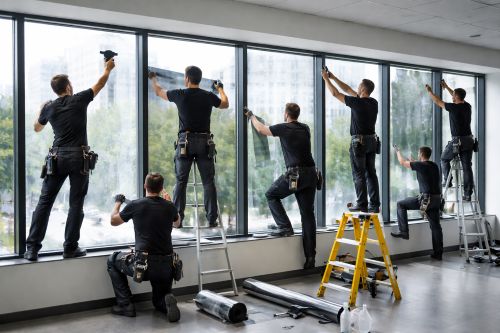
The labor cost difference between professional and DIY installation is real, but it is small relative to the cost of glazing replacement or portfolio-wide warranty remediation.
3M Prestige Series and 3M Safety Series: Performance Metrics That Consumer Products Cannot Match
Two product lines set the practical performance ceiling for commercial specification. The 3M Prestige Series addresses solar control applications where high visible light transmittance is a design requirement. Its nano-ceramic construction delivers SHGC values as low as 0.21 with VLT options from 40 to 70 percent, a combination that dyed or single-layer metalized consumer films cannot achieve. The product line also carries documented NFRC test data, which is the baseline for LEED EA credit contributions.
The 3M Safety Series addresses security applications from basic glass retention to blast mitigation. Products in this line are available in thicknesses from 4 mil to 14 mil, with structural attachment options for high-threat environments. Third-party test documentation to ASTM F1642 and GSA standards is available for the relevant products in the line. That means reproducible test data from an accredited laboratory, which is what institutional procurement requires.
The Hidden Cost of Underpowered Film: Premature Failure, Voided Warranties, and Liability Gaps
Specifying a lower-grade product to reduce upfront cost per square foot frequently produces a negative total cost outcome. Dyed films degrade in rejection performance over three to five years as dye oxidizes, which means the energy savings projections used to justify the project do not hold over the intended lifecycle. Replacing film on a large installation at year five instead of year twelve eliminates the payback model entirely.
Warranty voids compound the exposure. If a non-compatible film is applied to an IGU and the edge seal fails, the glazing manufacturer will not cover the replacement cost, and the film installer’s warranty will not cover glass. That gap falls to the owner, and on a portfolio-scale project, it can represent a significant unplanned capital expenditure.
The liability dimension is most acute in safety applications. A safety film that lacks documented certification but was specified as a security measure creates a due-diligence gap. If a glazing failure results in occupant injury and the specified film cannot produce ANSI or ASTM test documentation, the institutional owner’s exposure is substantially different than if a certified product had been installed.
How Window Film Specifications Vary Between Commercial, Educational, and Retail Environments
The same building type does not produce the same specification. A corporate office prioritizes TSER and VLT balance for occupant comfort and energy performance. A K-12 facility prioritizes safety film thickness and forced-entry delay, often layering solar film over a security substrate. A retail environment trades some heat rejection performance for higher VLT to protect merchandise visibility and display lighting integrity, while adding UV protection to address fade risk in high-value inventory.
Healthcare adds a zone-based complexity: clinical areas require privacy film on interior partitions, exterior patient areas need safety film on accessible glazing, and administrative zones follow a standard solar control specification. Applying a single product building-wide on any of these project types is a specification error, not a cost efficiency.
Energy Efficiency and Total Cost of Ownership: Framing the Numbers for a Facilities Budget
Quantifying HVAC Load Reduction and Energy Cost Impact in Commercial Buildings
Solar control window film reduces cooling load by blocking the portion of solar energy that would otherwise enter the building as heat. In glass-intensive commercial buildings, generally defined as those with a window-to-wall ratio above 40 percent, solar gain through glazing can account for 25 to 40 percent of total cooling load. A film that moves SHGC from 0.82 to 0.25 on those surfaces substantially reduces the heat entering through glass, which translates directly to reduced mechanical load during peak cooling hours.
The practical utility savings figure depends on local energy rates, climate zone, building orientation, and HVAC system efficiency. A reasonable planning benchmark, based on documented post-installation case studies in commercial office window tinting and retail applications, is $0.10 to $0.25 per square foot of treated glazing annually. For a building with significant south- and west-facing glazing, that range can produce meaningful annual energy savings from the film alone, before accounting for extended HVAC equipment life from reduced peak load cycling.
Payback Period Modeling: An Illustrative Framework for Renovation Project Managers
A straightforward payback model for solar control film uses three inputs: installed cost per square foot, annual energy savings per square foot, and film warranty period.
Installed cost for professional-grade solar control film on commercial glazing typically runs $8 to $14 per square foot, depending on product tier, glazing access complexity, and project scale. Using a midpoint installed cost of $11 per square foot and annual savings of $0.15 per square foot, the simple payback period is approximately 7.3 years against a 12- to 15-year warranty. At $0.20 per square foot in annual savings, that payback compresses to 5.5 years.
This model is illustrative, not a project-specific projection. An accurate model requires actual utility rate data, building energy modeling, and climate-adjusted solar insolation figures. The point for a facilities budget conversation is that the payback structure is favorable relative to most envelope upgrades, and it is documentable, which matters for capital project justification and sustainability reporting.
LEED Compliance Contributions and the Role of Window Film in a Broader Sustainability Strategy
Window film contributes to LEED v4 and v4.1 primarily through the Energy and Atmosphere credit category, specifically EA Optimize Energy Performance. A reduction in SHGC on a meaningful percentage of the building envelope improves the energy model and can contribute to incremental point accumulation when the building is within reach of a certification threshold.
Film also contributes to the Materials and Resources category in some scenarios, particularly when it extends the useful life of existing glazing and displaces the energy and material cost of full replacement. The contribution is indirect but documentable. Sustainability consultants working on LEED projects should be briefed on the installed film specifications, including product, SHGC, and treated area, rather than left to estimate.
The broader narrative value for institutional clients is that window film is a visible, low-disruption sustainability investment that produces documented outcomes. For facilities directors reporting to boards or municipal oversight bodies, that combination of tangible savings and certification-aligned performance is a meaningful asset.
Liability Mitigation as a Budget Line: Security Film, Blast Resistance, and Institutional Risk
Safety and security film reduces liability exposure in ways that belong on the facilities budget as a risk management expenditure, not just a building improvement. In K-12 and higher education environments, security film on exterior glazing demonstrates active investment in forced-entry mitigation, which is relevant to duty-of-care obligations and increasingly to insurance underwriting criteria.
For government and healthcare facilities with defined threat profiles, blast-rated film with documented ASTM compliance provides the written evidence trail that risk managers and legal counsel require when assessing institutional exposure. The cost of that documentation, including certified product, professional installation, and compliance record, is modest relative to the cost of a single liability event.
Some institutional insurers now recognize certified safety film installations in risk assessments, which can affect premium calculations. That connection between product specification and insurance cost is worth raising directly with the facility’s risk management team before finalizing the project budget.
Security and Safety Film Specifications for Institutional and Education Environments
What Safety and Security Certifications Should Commercial Window Film Installers Have?
Certifications for commercial window film installation exist at two levels: product certifications and installer credentials. Both matter for institutional projects, and conflating them is a procurement error.
Product certifications are assigned to the film itself by accredited laboratories. ANSI Z97.1 governs safety glazing performance for human impact resistance. ASTM F1642 and ISO 16933 govern blast mitigation performance. CPSC 16 CFR 1201 is a safety glazing standard relevant to certain regulated environments. The certified product must be the product actually installed. Substitutions, even within a manufacturer’s product line, can invalidate the certification record.
Installer credentials indicate that the installer has been trained and authorized by the film manufacturer to install its products. 3M Authorized Dealers, for example, are required to complete manufacturer training programs and maintain installation quality standards to preserve their authorized status. For institutional projects, specifying an authorized installer for the specified product line is not optional. It is the condition under which the manufacturer warranty applies.
K-12 and Higher Education: Security Film as an Active Safety Infrastructure Investment
K-12 facilities face a specific security challenge that window film addresses effectively: delaying forced entry through glazed openings long enough for law enforcement response. Research on forced-entry events consistently indicates that barrier resistance time, even a 30- to 60-second delay at the entry point, can meaningfully affect outcomes.
An 8-mil safety film on exterior entry glazing, applied with a proper daylight edge attachment, increases the time required to breach a glazed opening compared to unfilmed glass. It does not make glass impenetrable, and specifications that imply otherwise overstate the product’s capability. What it does is convert a passive glazing element into an active delay barrier, which is a meaningful addition to a layered security infrastructure alongside access control and surveillance systems.
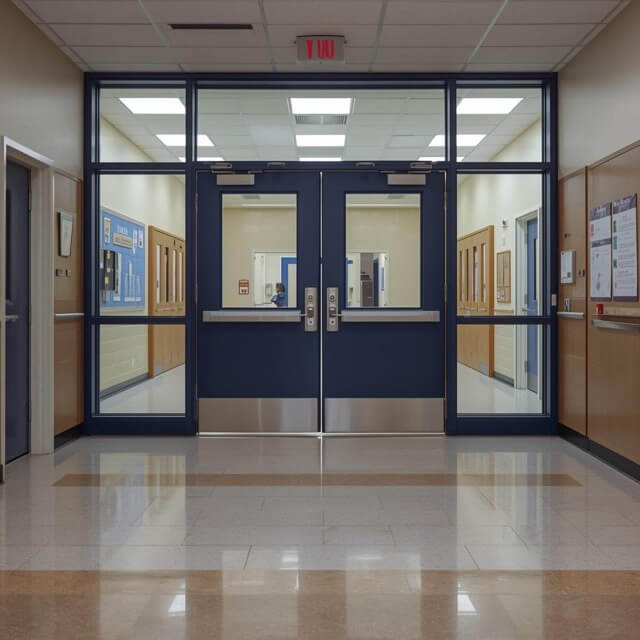
For higher education campuses with large glass-intensive building portfolios, the specification challenge is consistency across building vintages. Older annealed glass, tempered units, and modern IGUs may all be present in the same project, requiring a zone-by-zone substrate analysis before film type and attachment method can be finalized.
Government, Healthcare, and High-Traffic Retail: Threat Profiles and Corresponding Film Grades
Different institutional environments carry different threat profiles, and the film specification should reflect the actual risk rather than a generic security upgrade.
Government facilities, particularly those classified under GSA facility security levels 3 and 4, have documented blast and forced-entry design requirements. Film specifications for these environments begin with blast-rated products at 12 mil or above and include structural attachment systems. The specification package must include third-party test documentation to the applicable standard, as the authority having jurisdiction will require it.
Healthcare environments have a different primary concern: patient and staff safety in glazed clinical areas, combined with privacy requirements in consultation and patient room spaces. The relevant specification is typically a safety film rated for human impact on accessible interior and exterior glazing, layered with frosted or privacy film where visual separation is required.
High-traffic retail environments face smash-and-grab risk as the primary threat. A 4- to 8-mil safety film on storefront glazing significantly increases the time and effort required to breach the glass, which is the deterrent mechanism. Visible light transmittance requirements remain high in retail, so the film selection needs to balance retention performance with maintaining the display window function.
Blast Mitigation Film: When and How to Specify It for Code-Sensitive Projects
Blast mitigation film applies to a defined set of projects: federal buildings subject to ISC Security Design Criteria, facilities within assessed blast radius of high-risk targets, and any project where a threat assessment has identified explosive threat as a design parameter.
The product specification starts at 12 mil for most applications. The attachment system is as important as the film itself. Standard pressure-sensitive adhesive attachment relies on the adhesive bond to hold the film to the frame under blast loading, a bond that can fail under the pressure differential of a significant event. Structural silicone attachment, which bonds the film edge to the frame with a continuous silicone bead, transfers the blast load to the frame rather than the adhesive, and is the appropriate specification for high-threat environments.
Installation sequencing also matters. Blast film on exterior-facing glazing should be applied before any interior finish work in that zone is complete, because the structural silicone attachment requires curing time and the installation creates temporary accessibility requirements. Coordinating the film installation into the broader renovation schedule, rather than treating it as a last-minute finish item, is the difference between a compliant installation and a rushed one.
Window Film vs. Blinds, Shades, and Glazing Alternatives: A Commercial Decision Framework
Operational and Maintenance Cost Comparison Across the Lifecycle
Mechanical window treatments, including blinds, shades, and automated solar screens, carry ongoing maintenance costs that window film does not. Motorized shade systems require periodic actuator and drive maintenance, control system updates, and fabric or slat replacement on a five- to ten-year cycle. Manual blinds in high-use commercial environments accumulate damage from routine operation and require replacement more frequently than facility managers typically budget for.
Window film, once professionally installed, requires no mechanical maintenance. Cleaning is compatible with standard commercial window cleaning protocols, and the film surface does not accumulate the particulate buildup that shade fabrics attract. Over a ten-year ownership period, the total cost of ownership for a professionally installed film system is typically lower than an equivalent motorized shading system on a per-square-foot basis, even accounting for the film’s upfront installation cost.
What Glazing Replacement Can Do That Film Cannot, and Vice Versa
Glazing replacement is the right answer for a defined set of conditions: failed IGU seals, thermally compromised frames, glazing that no longer meets current code for its application, or new construction where the envelope specification starts from scratch. Film applied to compromised glazing does not recover the glazing system’s performance, and the specification conversation should shift to replacement in those scenarios.
What film delivers that glazing replacement cannot, at comparable cost, is speed, minimal disruption, and retrofit applicability. A full glazing replacement on an occupied commercial building is a multi-month, high-disruption project. Film installation on the same building can typically be completed zone by zone without vacating occupied spaces, at a fraction of the cost. For buildings where the glazing is structurally sound and the primary need is performance improvement, film is the appropriate intervention.
When to Specify Film as a Retrofit vs. Upgraded Glazing in New Construction
New construction is the scenario where film and glazing specifications intersect most directly. An architect specifying high-performance glazing for a new building may achieve SHGC targets that eliminate the need for solar control film entirely. But on renovation and tenant improvement projects where the existing glazing is fixed and the performance gap needs to close, film is the cost-effective path to compliance with current energy codes or sustainability targets.
The decision framework is straightforward: if the glazing is performing structurally and the primary gap is thermal or optical performance, specify film. If the glazing itself is failing or the thermal performance gap exceeds what film can close on the existing substrate, specify replacement and use the new construction glazing specification to meet the performance target without a film overlaminate.
Privacy and Glare Control: Where Film Outperforms Mechanical Window Treatments at Scale
For large-footprint applications requiring consistent privacy or glare control across hundreds of glazed openings, film delivers an operational advantage that mechanical treatments cannot match. A frosted film installation on 300 interior office partitions performs identically on day one and year ten, requires no user adjustment, and does not fail because an individual unit’s mechanism breaks.
Motorized shading systems on the same 300 openings introduce 300 individual failure points, a control system with software dependencies, and an ongoing maintenance schedule. In environments like open-plan corporate campuses, healthcare facilities, or school buildings where consistent performance across a large number of openings is operationally important, film’s passive reliability is a real specification advantage.
Large-Scale Window Film Installation: Managing Retrofit, New Construction, and Multi-Site Rollouts
Integrating Window Film Installation into Active Renovation Project Schedules
Window film installation is one of the few envelope upgrades that can proceed in occupied buildings without vacating spaces, but that flexibility disappears if it gets scheduled as an afterthought. The installation requires clean, accessible glazing surfaces, which means it must follow interior demolition and rough construction but precede final interior finishes, furniture placement, and IT buildout in each zone. Sequencing the film scope into the overall project schedule at the preconstruction phase, not during closeout, is what preserves that advantage.
On active renovation projects, coordinate film installation zone by zone against the interior completion sequence. A typical commercial floor plate can be filmed in one to two days with a professional crew, which means the scope can track the general contractor’s zone-by-zone turnover schedule without becoming a critical path item, provided the installer has confirmed mobilization availability in advance.
Multi-Site Coordination: Specification Consistency Across Building Types and Geographic Regions
Consistency is the central challenge in multi-site rollouts, and it is harder to achieve than it looks on paper. The same film specification behaves differently on a 1990s annealed glass office building in Phoenix and a modern IGU curtain wall in Chicago. A nationally consistent specification must account for substrate variation, climate zone, and local building code requirements, which means the specification document itself needs zone-specific execution notes, not a single line item applied uniformly.
The practical approach is to establish a master specification with approved product alternatives for substrate-specific scenarios, then require the installer at each site to document which product was applied and why, against the master spec. That documentation trail allows a facilities team to maintain a coherent portfolio record rather than a disconnected set of location-specific files.
The Vendor Fragmentation Risk: Why Piecemeal Installer Networks Undermine Timeline and Quality
The most common failure mode in national window film rollouts is not product selection. It is vendor fragmentation. A construction manager who sources a local installer for each location ends up managing a dozen or more different subcontractors, a dozen different warranty documents, inconsistent installation quality, and no single point of accountability when a problem surfaces mid-project while earlier locations are already closed out.
Fragmented installer networks also create specification drift. Each local installer has product preferences, and without a single contracting entity enforcing the approved specification, substitutions accumulate. By project completion, what was specified as a uniform 3M Prestige Series installation across 20 locations may be a patchwork of products with different rejection percentages, different warranty terms, and different compliance documentation, none of which surfaces until a warranty claim or energy audit forces a review.
How to Ensure Consistent Quality Across Multiple Window Film Installations Nationwide
Quality consistency at national scale requires three controls: a single approved specification, a single contracting entity responsible for all locations, and a documented inspection protocol at each site.
The inspection protocol matters as much as the other two. A post-installation inspection should verify film type and lot number against the specification, check edge adhesion and bubble-free application across a sample of glazing units, and produce a photographic record of the completed installation. That record is the evidence base for warranty claims and the audit trail for institutional compliance requirements. Without it, quality assurance is nominal rather than real.
Need More Info?
The Window Film Depot team is happy to help.
Cost and Timeline Considerations for Window Film Installation on a National Scale
National rollouts carry different cost and timeline dynamics than single-location projects. Mobilization costs, including travel, logistics, and equipment, are a larger share of total installed cost per location when locations are geographically dispersed. Consolidating the rollout into regional clusters, where a crew completes multiple nearby locations in a single mobilization, meaningfully reduces per-location cost compared to individual site deployments.
Timeline planning should account for glazing access constraints at each location. Multi-story buildings require lift or scaffold access for exterior-facing high glazing, which adds scheduling lead time and cost. Interior-only installations on ground-floor or accessible glazing are faster to mobilize and complete. A realistic national rollout covering 20 to 30 locations typically spans three to six months when sequenced in regional clusters, assuming the master specification and installer network are in place before the first mobilization.
How to Evaluate and Select a Certified Window Film Partner for Enterprise Projects
Finding a Certified Window Film Installer for a Large Multi-Location Project
Manufacturer authorization is the baseline qualification, not a differentiator. For 3M products, authorized dealer status requires documented training and ongoing quality compliance. Start there, then evaluate national project management capability, specifically whether the installer has a centralized project management structure that can coordinate across locations, or whether they are a regional installer agreeing to take on a scope that exceeds their operational model.
The distinction matters because authorized dealer status certifies product installation competence, not project logistics capability. A highly skilled single-market installer may deliver excellent work in their home market and be unable to manage quality, documentation, and communication across a 25-location national rollout.
Credentialing Criteria: Manufacturer Certification, Insurance, and Installation Compliance Standards
Four credentials should be non-negotiable for institutional and multi-site projects.
- Manufacturer authorization for the specified product line, with current documentation
- General liability insurance at a limit appropriate for the project scope, typically $2 million per occurrence minimum for large commercial projects
- Workers’ compensation coverage for all installation personnel
- Documented installation procedures that address substrate compatibility analysis, quality control checkpoints, and post-installation inspection protocol
Insurance certificates should name the owner and general contractor as additional insureds. Gaps in coverage on a multi-location project create liability exposure that falls to the construction manager when an installation incident occurs at a location where the local subcontractor’s coverage is inadequate.
What a National Installer Network Should Demonstrate Before You Sign
Before executing a contract for a national rollout, the installer should be able to show, not simply describe, three things: a reference list of comparable multi-location projects with contact information, a sample project management and reporting package from a completed multi-site engagement, and a clear organizational chart showing who owns project coordination, quality assurance, and client communication across locations.
If the installer cannot produce these materials, the project management capability they are describing is theoretical. References from comparable projects are the only reliable evidence that the operational model works at the scale you are contracting for.
What a Well-Structured Multi-Site Rollout Engagement Should Look Like
A well-structured multi-site engagement follows a defined sequence regardless of project scale.
- Pre-project site survey: glazing inventory, substrate type, access requirements, and local code review at each location before the master specification is finalized
- Specification validation: master spec reviewed against survey findings, with substrate-specific product selections documented
- Regional cluster scheduling: mobilization sequence planned to minimize travel cost and align with each location’s renovation schedule
- Installation with real-time documentation: each location produces a completion record including film lot number, treated area, and photographic inspection documentation
- Portfolio closeout package: consolidated warranty documentation, installation records, and compliance certifications delivered as a single package at project completion

That closeout package is the deliverable that makes the installation useful for long-term facilities management. Warranty claims, energy audits, insurance reviews, and future renovation planning all reference it.
Vendor Qualification Checklist: Five Non-Negotiables for Multi-Location Window Film Projects
Use this checklist before contracting any window film partner for projects covering more than five locations or 50,000 square feet of glazing.
- Manufacturer authorization: confirmed authorized dealer status for the specified product line, with current documentation
- National project management structure: dedicated project coordinator with cross-location accountability, not a regional installer accepting overflow scope
- Insurance compliance: general liability at $2M per occurrence minimum, workers’ compensation, and additional insured endorsement capability
- Multi-site reference projects: verifiable references from completed projects of comparable scale and building type
- Portfolio closeout documentation: demonstrated ability to deliver consolidated warranty records, installation logs, and compliance certifications as a single project package
Conclusion: Specification Decisions at This Scale Deserve an Enterprise-Grade Partner
Recapping the Core Specification Framework
The specification framework this article has built covers three decisions that determine project outcomes: film type matched to building category and primary performance priority, product grade that meets the warranty, rejection, and certification requirements the project demands, and installer credentials that ensure the specified product is applied correctly and documented completely. None of these decisions is independent. A correctly specified film applied by a non-authorized installer voids the manufacturer warranty. A certified installer applying an underpowered product cannot close the performance gap that drove the project in the first place.
The Single-Partner Advantage: How Window Film Depot Eliminates Fragmentation Risk at National Scale
Window Film Depot operates as a national commercial window film contractor with an authorized installer network structured specifically for multi-location and institutional projects. That means a single specification, a single contract, a single point of accountability, and a consolidated closeout package across every location, regardless of geography or building type. The vendor fragmentation risk that undermines most national rollouts is a structural problem that requires a structural solution, not better coordination between disconnected local subcontractors.
For construction and facility managers who have spent any time managing a fragmented subcontractor network on a multi-site project, the operational difference is immediate. One call resolves a quality issue at any location without requiring you to identify which of a dozen vendors is responsible.
Initiating a Project Consultation with Window Film Depot’s Commercial Team
The right starting point for any multi-location or large-scale window film project is a pre-specification consultation, not a product quote. Window Film Depot’s commercial team reviews glazing inventory, building type, performance priorities, and project schedule before recommending a specification, which is the sequence that produces installations that perform as projected and close out with complete documentation.
Bring your glazing schedule, your energy performance targets, and your project timeline. That is enough to start a productive specification conversation and produce a project framework you can take into budget and procurement with confidence.
Frequently Asked Questions
What are the different types of commercial window films and which is best for my building type?
The main categories are solar and heat control films, safety and security films, privacy and decorative films, and spectrally selective films. The right choice depends on your building’s primary performance priority: a corporate office with floor-to-ceiling glazing typically calls for a spectrally selective product that balances heat rejection with high visible light transmittance, while a K-12 facility prioritizes an 8-mil or thicker safety film for forced-entry delay. Because most commercial buildings have multiple glazing zones with different requirements, the most accurate approach is to specify by zone rather than selecting a single product for the entire building.
How do I find a certified window film installer for a large multi-location project?
Start with manufacturer authorization. For 3M window film, this means confirming the installer holds current authorized dealer status, which requires documented training and quality compliance. Beyond that baseline, evaluate whether the installer has a centralized project management structure capable of coordinating across all your locations, since regional authorization does not automatically translate to national project logistics capability. Ask for verifiable references from completed multi-site projects of comparable scale before executing any contract.
What are the cost and timeline considerations for window film installation on a national scale?
Installed cost for professional-grade solar control film on commercial glazing typically ranges from $8 to $14 per square foot, depending on product tier, glazing access complexity, and project scale. Mobilization costs are a larger factor when locations are geographically dispersed, so consolidating the rollout into regional clusters meaningfully reduces per-location cost. A national rollout covering 20 to 30 locations typically spans three to six months when sequenced in regional clusters, assuming the master specification and installer network are in place before the first mobilization begins.
What safety and security certifications should commercial window film installers have?
There are two distinct credential levels to evaluate. Product certifications, such as ANSI Z97.1 for human impact resistance and ASTM F1642 or ISO 16933 for blast mitigation, are assigned to the film itself by accredited laboratories. Installer credentials, such as 3M Authorized Dealer status, confirm that the installer has completed manufacturer training and maintains the quality standards required to preserve the product warranty. For institutional projects, both levels of certification are required, and the certified product on the data sheet must be the product actually installed.
How can window film be integrated into renovation project schedules without delays?
Film installation requires clean, accessible glazing surfaces, so it should be sequenced after interior demolition and rough construction but before final finishes, furniture placement, and IT buildout in each zone. A professional crew can typically complete a standard commercial floor plate in one to two days, which means the film scope can track zone-by-zone turnover without becoming a critical path item. The key is to plan the installation into the preconstruction schedule rather than treating it as a closeout task, which preserves the flexibility to work in occupied buildings without disruption.
How do I ensure consistent quality across multiple window film installations nationwide?
Consistency at national scale requires three controls working together: a single approved master specification with documented product alternatives for substrate-specific scenarios, a single contracting entity accountable for all locations, and a standardized post-installation inspection protocol at each site. That inspection should verify film type and lot number against the specification, confirm edge adhesion and application quality across a representative sample of units, and produce a photographic record. The resulting portfolio closeout package, consolidating warranty documents, installation logs, and compliance certifications, is what makes quality assurance verifiable rather than assumed.