Table of Contents:
- Why Window Film Matters for School Safety and Comfort in 2026
- What Is Safety and Security Window Film for Schools?
- Key Benefits of Window Film for Schools: From Forced Entry Delay to Energy Savings
- Types of Window Film for Educational Facilities
- Compliance, Codes, and Grant Funding for School Security Film
- How the School Window Film Installation Process Works
- Common Mistakes Schools Make with Security and Decorative Film
- Why Choose Window Film Depot for Your School or District
- FAQs about Window Film for Schools
- Next Steps: Schedule a School Window Film Assessment
Why Window Film Matters for School Safety and Comfort in 2026
Since the Uvalde tragedy in 2022 and the Covenant School attack in Nashville in 2023, states have moved aggressively to harden glass entry points in school buildings. Texas adopted forced entry–resistant glazing standards in late 2022. Tennessee requires entry-resistant film on public school windows. Schools in Tyler, TX, and Ohio have already completed window film installations to meet these new benchmarks.
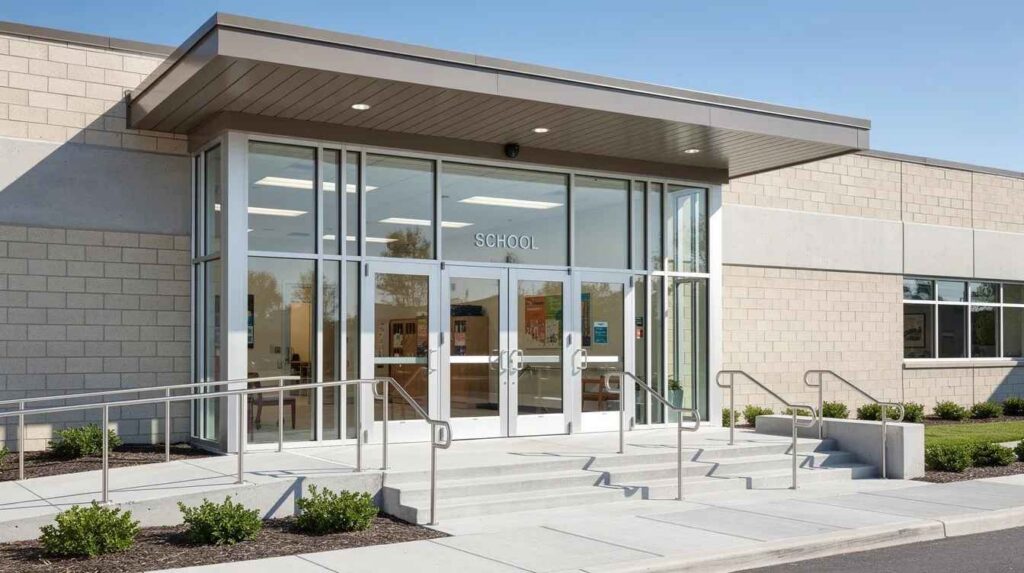
Window film for schools now addresses far more than security. It spans safety and security, energy savings, privacy, and aesthetics across K–12 campuses, colleges, and other educational facilities. Intruders frequently exploit glass doors and sidelights to gain entry during break ins and active shooter events. Safety security window film holds broken glass in place and can delay forced entry, giving teachers and first responders critical extra time.
Window Film Depot has partnered with school districts nationwide since 1992, delivering retrofit glazing and turnkey installations. This article covers product options-safety security film, frosted window film, decorative film, sun control films-along with grant funding routes, compliance requirements, and what to expect from a project.
What Is Safety and Security Window Film for Schools?
Safety and security window film is a multi-layer polyester film applied directly to existing glass windows and doors. It strengthens traditional glass into a safety security window system without requiring full glass replacement.
Films range from 4–6 mil for basic safety up to 8–15 mil for high-performance security applications. They can be clear, tinted, or reflective and are paired with adhesive layers. For maximum forced entry resistance, the film is anchored to the frame using structural adhesive or mechanical attachment systems.
Here is what security window film delivers-and what it does not:
| Capability | What It Does | What It Does Not Do |
|---|---|---|
| Fragment retention | Holds shattered glass together, reducing injury from flying shards | Make glass unbreakable |
| Forced entry delay | Slows intruders by minutes, not seconds | Guarantee prevention of entry |
| Impact resistance | Resists blunt-force and storm debris impacts | Provide ballistic or “bulletproof” protection |
| Compared to full ballistic glazing at $125–$400+ per square foot, security film installed with proper anchoring runs roughly $7–$19 per square foot-a fraction of the cost with far less disruption to school operations. Without strong edge attachment, however, even thick film fails in real-world forced entry attempts. The entire assembly-glass type, frame condition, and anchoring-determines performance. |
Key Benefits of Window Film for Schools: From Forced Entry Delay to Energy Savings
Well-specified film for schools solves multiple problems simultaneously. Different types of window films serve various applications in educational settings, but they share a common advantage: they upgrade existing glass without replacing it.
Security and safety benefits. Safety security film holds shattered glass together, dramatically reducing injury from broken glass during storms, natural disasters, or intrusion attempts. It can delay forced entry during an active threat, turning seconds of vulnerability into minutes of protection. Schools report 85% fewer successful break-ins after installation. That extra time allows lockdown procedures to activate and first responders to arrive.
Comfort and learning environment. Solar control films minimize glare on digital screens and improve visibility in sun-exposed classrooms, libraries, and media centers, delivering many of the same benefits highlighted for commercial window tinting and office window film installation. Window film can block up to 99.9% of UV rays, providing uv protection for students, staff, flooring, art, and lab materials. Window films can help create a more conducive learning environment by managing heat and glare without sacrificing natural light.
Financial impact. Window films can reduce energy consumption by lowering HVAC load, especially in older buildings with large exterior windows. Temple College in Texas installed solar film across roughly 30,000 square feet and saved approximately $33,917 annually, with some buildings achieving payback in just 1.3 years. Window films can be a cost-effective retrofit solution for schools operating on tight budgets.
Privacy and branding. Window films can provide privacy while allowing natural light to enter-ideal for counseling offices, nurse stations, and resource rooms. Decorative film options double as wayfinding or school branding tools while still supporting safety measures.
Types of Window Film for Educational Facilities
Most campuses combine multiple film types, zoning each building by risk, sun exposure, and function. Here is how the main categories break down.
Safety and security film. Clear and tinted safety security window film in thicknesses like 8 mil and 10 mil is used on glass doors, sidelites, and entry vestibules. Armorcoat 8mil silver security film is popular for school glass due to its balance of clarity and protection. 3M Safety & Security Window Film is widely recommended for schools and pairs with anchoring systems to resist forced entry, rioting, or storm debris, and Window Film Depot offers a broad range of these window glass film products and brands. Armorcoat 8mil silver security film is also favored for its reflective properties that add daytime privacy.
Frosted window film and privacy film. Frosted window film is used on interior classroom doors with vision lites, office fronts, and counseling areas. Options range from full-coverage frost to gradient bands that maintain life-safety sightlines for supervision. Colored and tinted window film adds privacy to classrooms without blocking all light.
Decorative film. Decorative films can enhance school branding and visual appeal with school logos, mascots, and motivational graphics applied to glass. Patterns and colors can identify grade-level wings or secure zones without constructing new walls.
Solar control films. 3M sun control films and similar products manage heat and glare on large south- or west-facing glass. These films aid both energy savings and daytime privacy while keeping interior spaces bright enough for instruction.
Compliance, Codes, and Grant Funding for School Security Film
Codes and safety measures have evolved significantly since 2018. Multiple states now reference specific standards for entry resistant film in school facilities.
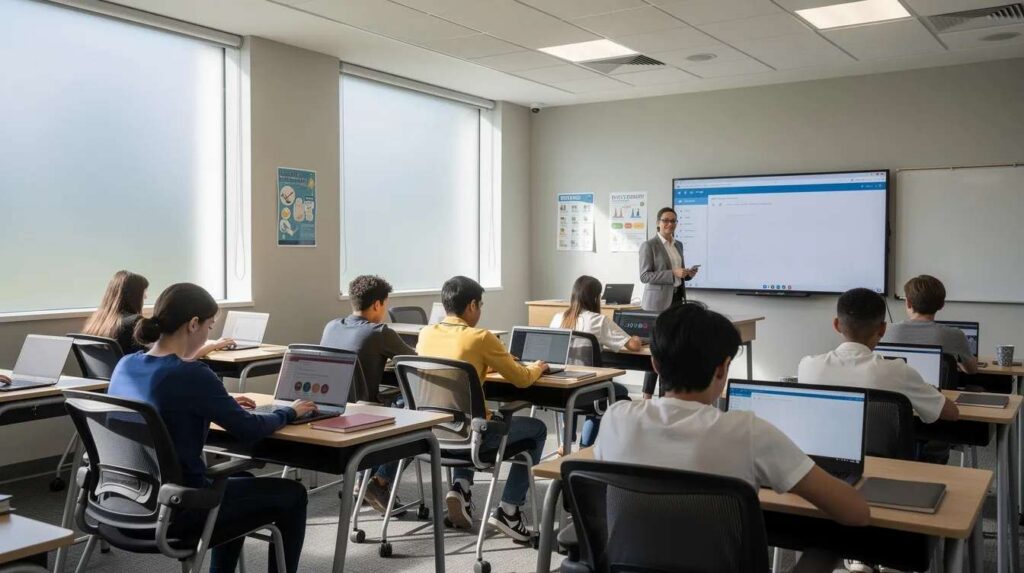
State-level requirements. Under Texas 19 TAC § 61.1031, schools must modify glass windows and doors near exterior entries so glass “cannot be easily broken” to allow an intruder to gain entry. Forced entry–resistant film is explicitly cited as an approved method. Tennessee requires entry-resistant film on public school windows. Louisiana references ASTM F3561 for forced entry resistance of fenestration systems, establishing baseline performance levels for school glazing.
What “entry-resistant” means. Standards like ASTM F3561 simulate an active shooter approach: ballistic weakening followed by pendulum impacts and reach-through attempts. Schools should request documented performance data from vendors-not just film material specs, but tested system performance including frame anchoring.
Grant funding landscape. The School Violence Prevention Program offers up to $500,000 per award for security upgrades, including glass hardening and proven window protection film solutions to reinforce glass windows and doors. State-level school safety grants in Virginia, Texas (SB 30), and other states can cover safety security film, door hardware, and related improvements.
Practical advice. Coordinate with facilities, security professionals, and procurement early. Work with vendors who understand EDGAR-compliant purchasing and the procurement process for grant-funded projects. Proper documentation is essential for grant audits.
How the School Window Film Installation Process Works
Most projects can be completed with limited disruption-over summer break, long weekends, or after-hours. Installation is quick, easy, and inexpensive for schools compared to full glazing replacement.
Assessment and specification. An on-site survey covers all exterior windows, glass doors, and critical interior glazing. Zones are prioritized: main entrances, vestibules, administrative offices, and ground-level classroom glass. Film type-safety security film, frosted, solar, or decorative-is selected by location with clear rationale.
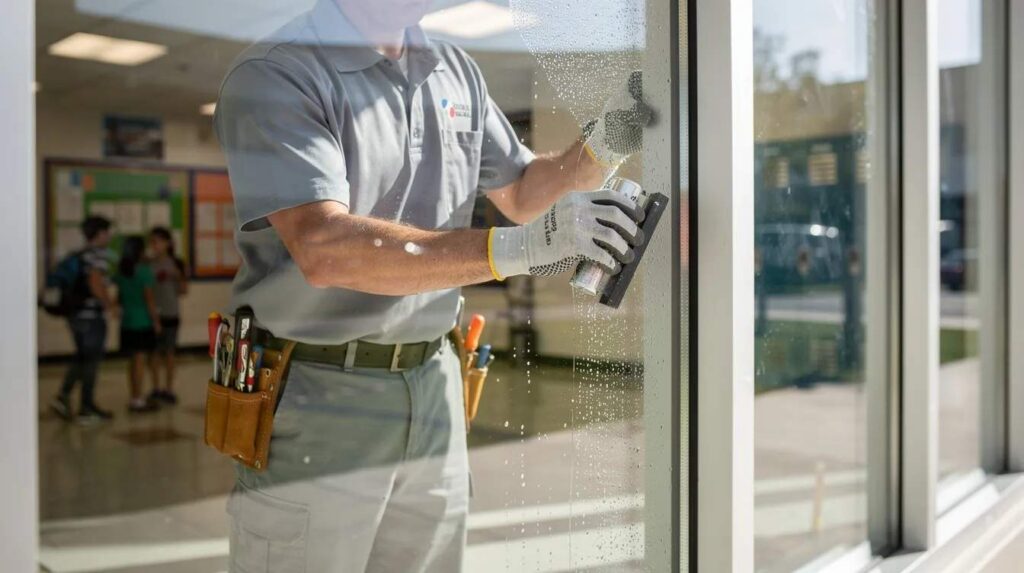
Preparation and installation. Glass is cleaned, measured, and film is custom-cut. The wet-application method involves squeegeeing out moisture, detailing edges, and allowing proper cure time. For security applications, 3M IPA wet glaze anchoring systems maximize protection during installation. Sealing edges with structural adhesive is emphasized by installers to ensure the film-to-frame bond resists shear and peel forces. A note for emergency planning: the sticky side of the film faces outside for emergency access by first responders.
Quality control and documentation. A final inspection and punch list are completed with the school representative. Product data sheets, warranties, and maintenance instructions are provided. Administrators receive a briefing on what safety security window film can and cannot do during an intrusion.
Window Film Depot handles multi-campus districts and statewide roll-outs with consistent standards and centralized project management, so every building meets the same specifications.
Common Mistakes Schools Make with Security and Decorative Film
Decades of retrofitting educational facilities across the U.S. reveal patterns that administrators should avoid.
Security-related mistakes:
- Treating security film as a stand-alone solution instead of integrating it with door hardware, access control, cameras, and lockdown procedures
- Installing security window film without proper edge attachment, which significantly reduces forced entry resistance
- Assuming any “tint” or decorative film automatically adds safety or security performance-many decorative films are not safety-rated
Budget and planning errors:
- Focusing only on main entrances and ignoring vulnerable side doors, basement windows, or cafeteria glazing
- Waiting until late summer to start the procurement process, leading to rushed decisions and missed compliance deadlines
Design and comfort missteps:
- Over-darkening classrooms with aggressive solar film, creating visibility or lighting issues that undermine the intended learning environment
- Adding privacy film that blocks critical sightlines for supervision or conflicts with fire and life-safety requirements
Best practices: Engage a qualified specialist early. Request a campus-wide glazing assessment ranked by risk and budget, and consider working with experienced 3M window film product and installation specialists. Verify product testing, warranties, and installer credentials before signing any contract.
Why Choose Window Film Depot for Your School or District
Window Film Depot is a proven national partner for school facilities-not a general commercial window tinting shop.
- Experience and scale. Family-owned since 1992, with thousands of school and campus installations completed nationwide. Deep expertise in 3M safety and security film, solar control films, privacy and decorative solutions, and specialty security glazing.
- Project management. Turnkey services from product selection through grant and budget guidance, professionally installed systems, and ongoing support. National roll-out capability across all 50 states for large districts and higher-education systems ensures consistent specifications across every building.
- Compliance and quality. Top-tier manufacturers, tested safety security window film products, and installers trained to meet or exceed industry standards. Clear documentation and warranties that hold up during audits and insurance reviews.
Window Film Depot understands K–12 procurement constraints, board approvals, and the community expectations around safety and security projects that make this work different from standard commercial window tinting, and backs that expertise with a full catalog of security, solar, and decorative window films.
FAQs about Window Film for Schools
These FAQs address the most common questions from superintendents, facility directors, and campus safety officers.
Does security window film prevent forced entry into schools?
Security window film does not guarantee prevention of forced entry, but it significantly delays intruders; schools should also understand the difference between shatterproof-style safety films and true security window films. Properly anchored film can turn a few seconds of vulnerability into several minutes-enough time for lockdown procedures and law enforcement response. It is one layer in a broader set of safety measures, not a standalone barrier.
How long does safety security window film last on school glass?
Quality safety security window film typically lasts 10–15 years with proper maintenance, offering strong value relative to typical window security film installation costs and price estimates. Most premium films carry manufacturer warranties of 10–15 years. Lifespan depends on climate, glass orientation, and whether maintenance guidelines are followed.
Can frosted window film and decorative film also be safety-rated?
Standard decorative film and frosted window film are not automatically safety-rated. However, safety-rated versions exist, and in many cases a safety film can be layered beneath a decorative or privacy film. Always verify that the combined system meets your required performance standard.
Will window film make our classrooms too dark?
Modern spectrally selective and ceramic sun control films reject heat while maintaining high visible light transmission-often above 70%. The right film selection preserves natural light and a bright interior. Over-darkening only happens when the wrong product is specified for the space.
Is safety and security window film eligible for grant funding?
Yes. Federal programs like the School Violence Prevention Program and numerous state safety grants support glass hardening measures including installing security window film. Documentation of product specs and compliance is typically required for audits.
How much does window film for schools typically cost?
Costs vary by film type, square footage, glass condition, and anchoring requirements. Basic security film runs roughly $7–$10 per square foot installed; high-performance forced entry systems range $12–$19. As a real-world example, DeSales School budgets $125 per window for 120 windows. This is a cost effective solution compared to full glazing replacement, which can exceed $125–$400+ per square foot for ballistic-rated glass.
Districts in Texas and beyond can leverage local Dallas/Fort Worth window film installation expertise for education facilities as part of a broader safety and energy-efficiency strategy.
Next Steps: Schedule a School Window Film Assessment
Glass remains one of the most vulnerable elements in any school building. With rising expectations for school safety from parents, boards, and regulators, treating it as a top priority is no longer optional.
Current and upcoming grant funding cycles create real opportunities to offset costs. Professionally installed window film solutions deliver security, comfort, and energy savings with minimal disruption compared to full glazing replacement.
Contact Window Film Depot for a no-obligation campus glazing assessment and budgetary proposal. Share this article with your district safety committee or schedule a virtual walk-through to prioritize your buildings by risk and budget.
Window Film Depot supports both individual campuses and multi-site districts across the U.S., providing consistent standards and documentation at every step, drawing on its experience delivering commercial window tinting and office building window film installations. Let us help you create safer, more comfortable, and more efficient schools for your students and staff.