Introduction: Why Window Film Matters in Modern Healthcare Facilities
In 2026, hospital facility managers face a difficult balancing act: control rising energy costs, strengthen physical security, maintain patient confidentiality, and improve the patient experience, all without shutting down active clinical spaces for major construction. Window film for hospitals addresses every one of these pressures through a single, minimally invasive retrofit.
Window Film Depot has been installing 3M and other high-performance films in healthcare facilities nationwide since 1992. Our turnkey project management handles everything from initial glass audits to phased overnight installations on active medical campuses, so patient care never stops.
This article covers the real-world benefits of hospital window film, including patient comfort, HIPAA-related visual privacy, protection against break-ins, defense against harmful UV rays, and measurable energy savings. You will find zone-by-zone recommendations, a walkthrough of the installation process, answers to the most common questions from healthcare administrators, and the reasons facility managers across the country partner with Window Film Depot.
Table of Contents:
- How Window Film Improves the Healthcare Environment
- Solar Control Films: Patient Comfort, UV Protection & Energy Efficiency
- Privacy, Decorative & Frosted Film for Sensitive Healthcare Areas
- Safety & Security Window Film: Break-In, Impact & Weather Protection
- Window Film vs. Blinds, Curtains & Glass Replacement in Hospitals
- How Hospital Window Film Installation Works (With Minimal Disruption)
- Beyond Energy: Natural Light, Glare Reduction, UV Protection, and Comfort
- Frequently Asked Questions About Window Film for Hospitals
- Why Choose Window Film Depot for Healthcare Facilities
- Next Steps: Schedule a Hospital Window Film Assessment
How Window Film Improves the Healthcare Environment
Hospital window film is a retrofit glazing upgrade: a thin, engineered layer applied directly to existing glass walls and exterior windows without demolition. It modifies how glass handles light, heat, privacy, and impact, making it ideal for busy healthcare environments where construction disruptions are not an option.
The connection between the built environment and patient outcomes is well documented. A 2025 systematic review of 43 studies in hospital settings found that better lighting control and glazing design substantially influence thermal comfort, patient sleep quality, and staff performance. Access to daylight improves patient satisfaction and recovery, but uncontrolled sunlight creates problems. Window film enhances patient comfort in hospital settings by preserving natural daylight while filtering out excessive heat and glare. Window films can help reduce glare on medical monitors and equipment, and they improve visibility on screens by reducing glare, which prevents excessive eyestrain from glare in healthcare settings. The result is that glare reduction enhances comfort for patients and staff in hospitals.
Privacy and dignity matter just as much. Tinted and frosted films prevent sightlines into exam rooms, NICUs, and behavioral health units while still admitting soft natural light. From an infection control perspective, smooth surfaces of window films are easier to clean and disinfect than fabric treatments like curtains or slatted blinds that harbor dust and pathogens. Different types of films are installed in various hospital areas to meet specific needs, delivering comfort, safety, visual privacy, aesthetic appeal, and operational efficiency across the entire healthcare building.
Solar Control Films: Patient Comfort, UV Protection & Energy Efficiency
Unprotected glass on south- and west-facing hospital façades turns patient rooms into greenhouses by midafternoon. Nurses field temperature complaints, mechanical systems run at peak capacity, and cooling costs climb. Solar control films reduce solar heat gain and glare in patient rooms by using spectrally selective coatings that allow visible wavelengths through while blocking infrared and ultraviolet energy, and specialized 3M sun control, safety, and decorative films give hospitals a wide range of performance options.
High-performance solar control film rejects up to 80% of infrared heat, and solar control film can block up to 86% of solar heat depending on the product and glass type. At the same time, solar control film blocks up to 99% of UV radiation, protecting patients and interiors alike. Solar control film reduces glare intensity by up to 80 percent, so nurses can read monitors clearly and patients can rest without squinting. High-performance window films block significant amounts of solar heat, and energy-efficient window film can improve indoor temperature stability throughout the day, reducing hot spots near windows in ICUs, recovery rooms, and waiting rooms.
The financial case is equally strong. Hospitals can save 10 to 20 percent on cooling costs when treating large sun-exposed façades, with typical payback periods of two to five years. Window film can reduce HVAC load significantly in hospitals, especially those with curtain wall construction. Consider a 500,000-square-foot medical center that retrofits its west-facing glazing with solar control film: annual HVAC savings can reach tens of thousands of dollars, all without the cost or disruption of full glass replacement.
Beyond energy efficiency, solar control film protects interior furnishings, flooring, artwork, and sensitive equipment from uv exposure and fading. For hospitals in colder regions, low-E and all-season films add winter insulation value, lowering heating costs and delivering year-round energy savings that compound over the film’s lifespan.
Privacy, Decorative & Frosted Film for Sensitive Healthcare Areas
Patient confidentiality is not optional. Federal CMS rules expect hospitals to maintain reasonable physical safeguards for visual privacy, and window film supports HIPAA compliance by safeguarding patient information visible through glass partitions, sidelites, and corridor windows. In high-traffic areas like registration desks, imaging suites, and behavioral health units, clear glass without treatment is a liability.
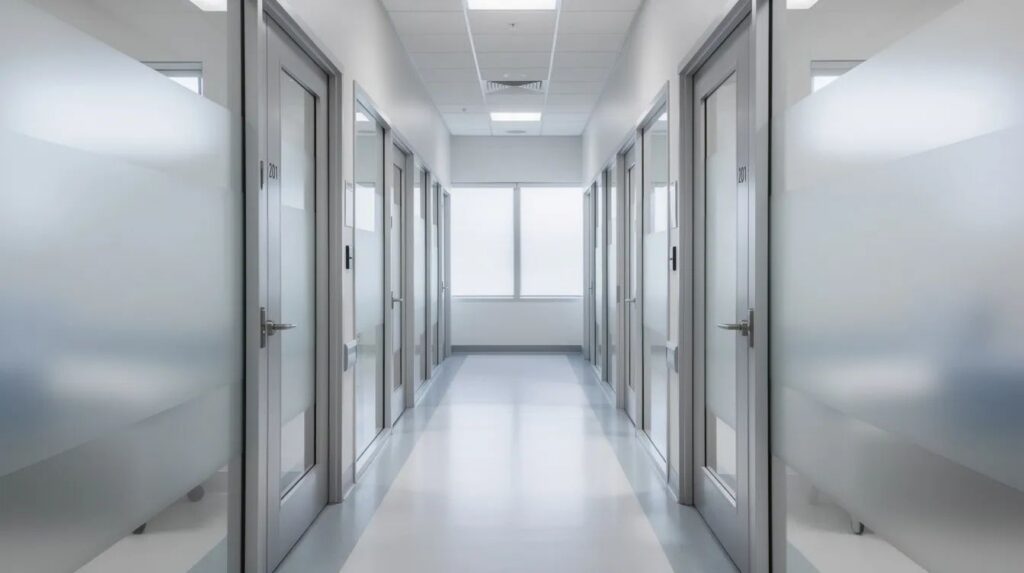
Frosted window film is popular for enhancing patient privacy because it delivers a translucent, sandblasted-look finish that obscures identifiable details at eye level while still admitting soft natural daylight. Frosted window film obscures views while allowing natural light, making it a practical choice for ICU doors, hallway vision panels, and glass partitions separating clinical areas from public corridors. Privacy window film blocks visual access while allowing natural light to flow deeper into the building, preserving the circadian cues that support healing.
Decorative film goes further by combining privacy with branding and wayfinding. Decorative films enhance aesthetic appeal in healthcare environments, and decorative film enhances aesthetics while providing privacy. Think nature motifs on oncology floors, playful graphics for pediatric wings, or gradient patterns on a fully glazed corridor connecting operating rooms, where opacity rises from transparent at the top to fully frosted at eye level. Privacy films can be applied to surgical windows and patient rooms, and in procedure suites, switchable smart film provides on-demand privacy in treatment rooms, allowing privacy films to switch from transparent to opaque for flexible consultations at the touch of a switch.
All of these films share a practical advantage over curtains: they are non-porous, resist bacterial colonization, and withstand hospital-grade disinfectants. Window Film Depot works with architects and interior designers to select patterns, opacity levels, and brand-consistent colors for each healthcare environment, ensuring modern hospital design standards are met from the first consultation.
Safety & Security Window Film: Break-In, Impact & Weather Protection
Workplace violence incidents in medical facilities have risen sharply since the early 2020s, and pharmacy thefts, ER confrontations, and severe weather events add to the threat landscape. Security window film reinforces glass against forced entry by bonding a thick, multi-layer polyester film to the glass surface with specialized adhesive, often anchored to the surrounding frame for maximum hold, and understanding the difference between shatterproof and true security window films helps hospitals choose the right level of protection. When glass cracks or shatters under impact, the film holds shattered glass fragments in place, preventing flying glass shards from injuring staff and patients.
Security window film reinforces glass against impact and forced entry, making it a critical layer in any hospital security strategy for ground floor windows, ground floor entrances, pharmacy storefronts, and emergency rooms. Security film delays unauthorized access during break-ins, buying precious minutes for lockdown protocols and security response during an attempted breach. Professional-grade security films meet GSA and ASTM standards, including categories tested for forced entry resistance and blast mitigation.
In behavioral health and memory care units, safety film upgrades interior vision lites and wired glass panels to reduce elopement and accidental injury risks without sacrificing transparency. Security window film protects against blast events and severe weather, which is especially valuable for hospitals in hurricane and tornado zones where shattered glass endangers patients, staff, and expensive medical equipment, and hospitals can also evaluate complementary window protection film solutions to reinforce glass against a range of threats.
There are important limitations to acknowledge. Security film is not bulletproof and does not replace bullet-resistant glazing where code requires it. Frame strength and edge anchoring are just as important as the film itself. But as a cost-effective retrofit that dramatically reduces injury risk and slows entry speed, it is one of the highest-value physical security upgrades a hospital can make compared to full structural changes.
Window Film vs. Blinds, Curtains & Glass Replacement in Hospitals
Facility managers evaluating glare control and privacy options typically weigh blinds, curtains, new glazing, and window film. Each has a place, but professional-grade window films from Window Film Depot consistently deliver the broadest benefits with the least disruption.
Blinds and curtains create infection control headaches. Fabric collects dust, moisture, and pathogens; slatted blinds require frequent manual cleaning that rarely happens on schedule. Both have cords and moving parts that wear out or become ligature risks in behavioral health settings. Window film delivers privacy, uv protection, and glare control with no moving parts, no laundering, and no cleaning downtime, keeping the professional appearance of clinical spaces intact.
Glass replacement is sometimes necessary, but it is capital-intensive, permits-heavy, and disruptive to occupied floors. Solar control and safety films can replicate or exceed the performance of upgraded glazing, including improved temperature control and significant energy savings, at a fraction of the per-square-foot cost and installation time. For a 1970s-era hospital with single-pane wired glass in corridors, safety film can be installed in days rather than the months required for invasive glass replacement.
High-quality films from manufacturers like 3M commonly last ten to fifteen years in medical environments when properly installed, and they carry warranties covering peeling, bubbling, and discoloration. If a section is damaged, it can be replaced individually without touching adjacent glass. Window Film Depot also advises clients honestly when glass replacement is the better path, such as when frames are severely deteriorated or insulated glass units have failed.
Choosing the Right Window Film by Healthcare Zone
Hospitals are not uniform buildings. Each department has distinct priorities for privacy, security, daylight, and energy performance, which is why a one-size-fits-all film specification fails.
Patient rooms and ICUs benefit from light solar control film paired with frosted bands at the lower portion of exterior windows. This combination preserves outdoor views and circadian-supporting natural daylight for patient care while blocking solar heat and maintaining dignity. Solar control at moderate visible light transmittance levels (50–70% VLT) keeps rooms bright without excessive heat.
Operating rooms and procedure suites require neutral, color-accurate solar films that protect lighting quality and sensitive equipment without introducing color shifts. Clear UV-blocking films are common here, ensuring uv rays do not degrade materials or instruments.
Waiting rooms, lobbies, and corridors are prime candidates for decorative film and solar control film working together to minimize glare, reinforce wayfinding, and establish a welcoming healthcare environment. Branded graphics or gradient patterns make these high traffic areas feel intentional rather than institutional.
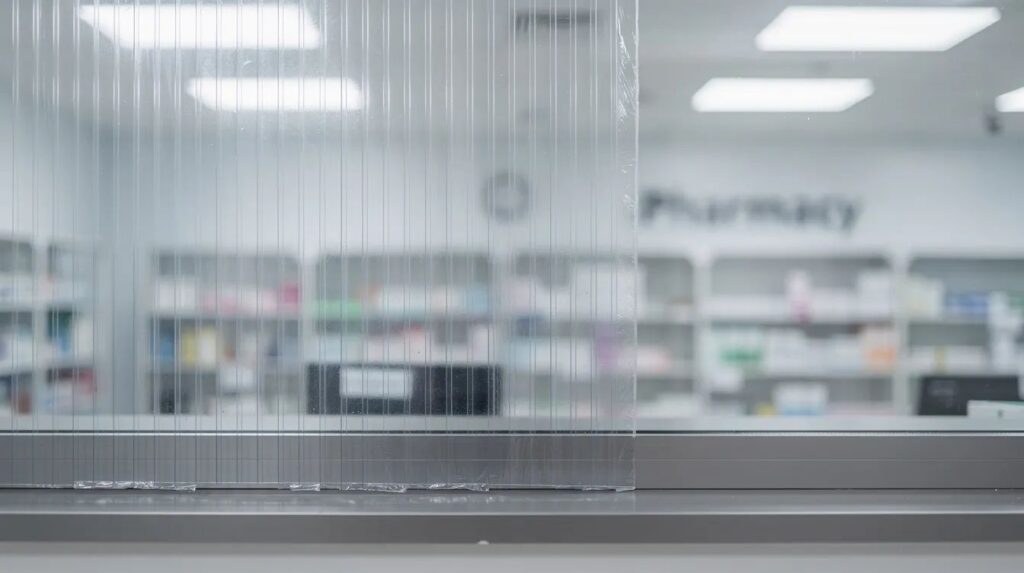
Pharmacies, labs, and drug storage areas call for security film to deter smash-and-grab thefts and delay forced entry into controlled substance areas. Combining security film with frosted film on ground floor windows adds visual deterrence and protects patients and staff on the inside.
Behavioral health and pediatric areas need the toughest safety film available, often combined with calming decorative designs that meet ligature-safe and anti-elopement considerations. Administrative offices and conference rooms round out the schedule with a mix of solar control for lower energy costs, privacy bands on glass walls, and branded decorative film that reinforces a professional appearance.
Window Film Depot routinely conducts full-facility surveys, mapping every glass surface by zone and recommending a tailored film schedule aligned with infection control and accreditation requirements, backed by America’s leading 3M window film installation services.
How Hospital Window Film Installation Works (With Minimal Disruption)
Professional installation in active hospitals is routine for Window Film Depot. Every project is planned around patient care schedules, clinical workflows, and infection control standards so that medical environments stay fully operational.
The process begins with a site assessment and glass audit. Our team identifies glass types, documents film goals (energy, privacy, safety), and flags sensitive areas like isolation rooms and operating rooms. Product specification follows, with mockups and samples reviewed by facilities staff, architects, and infection prevention teams before any film is ordered.
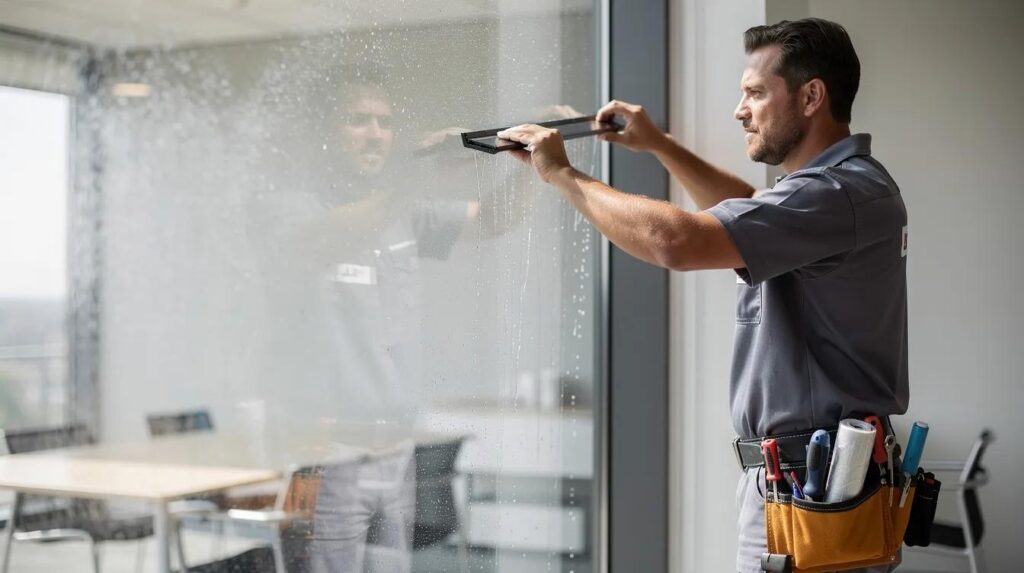
On-site work follows a clean, controlled sequence. Installers clean each glass surface with hospital-approved solutions, cut film precisely, apply it using slip solution and professional squeegees, and finish with edge detailing and bubble inspection. For 24/7 healthcare facilities, installation is scheduled during off peak hours: nights, weekends, and low-census periods. Room-by-room phasing keeps units operational, and patient moves are minimized through tight coordination with nursing leadership.
Infection control protocols are followed at every stage: PPE, dust containment, and clean work practices are standard. Installers coordinate directly with clinical staff to avoid active sterile procedures and critical care disruptions. Most individual patient-room windows are completed within 30 to 60 minutes each, while larger curtain walls are handled in phased overnight sessions.
As a national installer, Window Film Depot manages multi-building medical campuses and health-system-wide rollouts, delivering consistent specifications and workmanship across every location through nationwide window film service locations. Professional window film installers with healthcare experience make the difference between a seamless project and one that disrupts care.
Frequently Asked Questions About Window Film for Hospitals
Hospital facility managers, architects, and biomedical engineering teams tend to raise similar questions when evaluating hospital window film. Here are the answers to the most common ones.
How much can hospital window film reduce energy costs?
Savings depend on climate, glass area, and existing glazing type, but many large healthcare facilities see 10 to 20 percent reductions in cooling energy on treated façades. In multi-story hospitals with extensive curtain walls, annual savings can reach tens of thousands of dollars. Typical simple payback falls within two to five years, and the film improves energy efficiency for the duration of its lifespan.
Does window film make hospital rooms too dark?
Modern spectrally selective films prioritize visible light while cutting infrared heat and UV. High-VLT options (60–80% visible light transmittance) maintain bright, welcoming patient rooms that support mood and circadian rhythm. Window Film Depot provides on-site samples and VLT options, so clinical teams can evaluate how spaces will look before committing to a full rollout.
Is security window film bulletproof or intruder-proof?
Security window film is not bulletproof and does not make glass unbreakable. What it does is hold glass fragments bonded together upon impact and significantly slow forced entry attempts. This delay gives staff and security teams more time to react during an attempted breach and reduces injury from flying glass shards in lobbies, emergency department entrances, and pharmacy windows.
Can window film be installed in occupied hospital units?
Yes. Installations are scheduled around patient care with minimal disruption. Rooms can be temporarily vacated or portions of a unit done sequentially. Installers use clean, low-odor methods and coordinate with facilities and infection prevention teams to meet all hospital protocols.
How long does hospital window film last?
High-quality architectural films commonly last 10 to 15 years or more, depending on sun exposure and cleaning practices. Window Film Depot specifies films with manufacturer-backed warranties appropriate for commercial healthcare settings, covering peeling, bubbling, and discoloration.
Will window film void my existing glass or façade warranties?
This depends on the glass manufacturer and building age. Many older warranties have already expired, while newer ones may permit certain approved film types. Window Film Depot reviews warranty documents, recommends compatible films including manufacturer-approved 3M products, and coordinates with glazing vendors when needed to protect patients and preserve your investment.
Why Choose Window Film Depot for Healthcare Facilities
Window Film Depot is a national, family-owned window film contractor with more than three decades of experience serving hospitals, clinics, and multi-campus health systems. As a 3M Authorized dealer and installer for solar, safety, and decorative films, we bring both product expertise and deep familiarity with hospital facility standards, risk management, and accreditation-driven safety requirements.
Our service model is turnkey: from product selection and energy modeling to professional installation and post-project support, one team manages the entire process, leveraging 3M window film installation expertise for commercial facilities. We handle multi-site healthcare systems across states with consistent specifications and workmanship, so healthcare administrators do not have to re-educate a new vendor at every campus.
What sets us apart is healthcare-specific experience. Our crews have worked in active OR suites, ICUs, behavioral health units, and sterile processing areas. We coordinate directly with facilities, infection control, and security teams to deliver tailored solutions that meet hospital protocols without slowing down patient care.
We also supply wholesale rolls of architectural film to glazing and construction partners serving regional hospitals and clinics, drawing from a broad catalog of window glass film products and brands. Whether you need a single pharmacy window secured or a system-wide rollout across dozens of buildings, Window Film Depot has the track record, national footprint, and alignment with hospital goals of safety, energy efficiency, and improved patient experience to deliver, with proven window film installation capabilities in Washington, DC, and nationwide.
Next Steps: Schedule a Hospital Window Film Assessment
Hospital window film improves patient comfort, strengthens physical security, enhances patient confidentiality, lowers energy costs, and creates a more welcoming healthcare environment, all without the disruption and expense of major construction. Every glass surface in your facility is an opportunity to protect patients, support staff, and reduce operating costs.
We invite facility managers, architects, COOs, and practice administrators to contact Window Film Depot for a no-obligation assessment of your hospital or healthcare campus. You can start by sharing basic building details like location, age, bed count, and glazing types. Request energy savings estimates or a security risk review for critical areas like pharmacies and ER entries. Or schedule a pilot installation on a single unit or façade to see measurable results before committing to a system-wide rollout.
Your existing windows and glass walls are untapped assets. Partner with Window Film Depot to turn them into high-performance tools for better patient care and staff safety. Reach out today to get started.