This is a practical buying and planning guide for window film for commercial doors in 2026, written for facility managers, building owners, architects, and security professionals who need actionable specifications, real performance data, and a clear path from assessment to installation.
Table of Contents:
- Introduction: Why Window Film for Commercial Doors Matters in 2026
- Key Benefits of Window Film for Commercial Glass Doors
- Types of Window Films for Commercial Doors
- Dual Reflective Window Film for Storefront and Lobby Doors
- How Window Film on Doors Impacts Sun Control, Comfort, and Energy Savings
- Security and Safety Window Film for Commercial Entry Doors
- Privacy, Branding, and Decorative Films for Interior and Exterior Doors
- Choosing the Right Window Film for Your Commercial Doors
- Installation Process for Window Film on Commercial Doors
- Maintenance, Durability, and Warranty Expectations
- FAQs: Window Film for Commercial Doors
- Why Choose Window Film Depot for Your Commercial Door Projects
- Next Steps: Planning Your Commercial Door Window Film Project
Introduction: Why Window Film for Commercial Doors Matters in 2026
Picture a retail chain with glass doors across dozens of U.S. locations in Atlanta, Phoenix, and Dallas. After two consecutive years of utility rate increases, every west-facing vestibule is a furnace by 2 p.m., cooling costs are climbing, and smash-and-grab incidents have forced store managers to rethink door security entirely.
Window film for commercial doors is a retrofit polyester film applied directly to existing glass doors, sidelites, and transoms. It changes how glass handles heat, light, impact, and privacy without replacing the door or storefront system. Compared to full glass replacement, it is a cost-effective alternative to replacing glass, typically installed in hours rather than weeks, with no structural disruption.
This guide tackles the three core pain points that drive most commercial door film projects: sun control and glare, security and glass protection, and privacy and branding for glass doors in a commercial building. You will discover specific product categories, real project outcomes, and a decision framework built from over three decades of Window Film Depot’s commercial installation experience.
Key Benefits of Window Film for Commercial Glass Doors
Commercial entrance doors are often the weakest point in a building’s comfort, safety, and energy envelope. Window films can quickly change that.
- Sun control and glare reduction. Lobbies, vestibules, and revolving doors take direct solar exposure that makes reception areas uncomfortable for staff and visitors. Window films significantly reduce glare in commercial spaces, protecting computer screens, security monitors, and digital signage from washout. People walking through a bright, glare-free entry immediately sense a more professional environment.
- Cooling costs and energy savings. Solar control films applied to high-traffic door systems can significantly reduce cooling costs by cutting solar heat gain at the glass. Heat rejection rates can reach up to 55% with window film, translating to measurable HVAC load reduction, especially on south- and west-facing doors in warm climates.
- UV protection. Up to 99% of UV radiation is blocked by quality solar and dual reflective films, slowing fading on flooring, merchandise, and interior finishes immediately inside glass doors. Retailers with displayed inventory near entrances see meaningful preservation of product quality over time.
- Safety and security. Safety film helps doors meet local building codes for safety glazing, reduces injury risk from accidental breakage, and provides added protection by delaying forced entry. Window film for commercial doors enhances security against break-ins, giving security teams and law enforcement more response time.
- Privacy and brand presentation. Privacy films obscure views into sensitive areas while allowing light in. Printed graphics on doors reinforce brand identity and create a sleek, unified appearance across multiple locations.
Post-2020 energy codes, heightened retail security concerns in settings like schools and storefronts, and rising expectations for modern building entrances all make 2026 the right time to evaluate these upgrades.
Types of Window Films for Commercial Doors
The right film depends on whether the priority is energy efficiency, security, privacy, or aesthetics. Multiple films can be combined on different doors across the same commercial building.
- Solar control window films. Available in neutral, reflective, and dual-reflective window film options. Visible light transmission ranges from as low as 5% (where 5% visible light transmission films block most sunlight) up to 70% for spectrally selective products. Darker films reject more heat; lighter films preserve a more open appearance. Low-E films retain indoor heat during colder months, making them useful in mixed climates. Sun control films help maintain a comfortable indoor environment year-round.
- Safety and security films. Clear and tinted options in thicknesses from 4 to 15 mil. Security films prevent shattering and damage from impact by holding glass fragments together during breakage. Thicker engineered systems combine film with structural anchoring for forced entry delay and blast mitigation and are part of the broader window glass film products and brands available for commercial projects.
- Privacy window film. Frosted, opaque, and one-way daytime privacy options serve office entry doors, conference room doors, and medical facilities. BDF NA05 film transmits about 5% of visible light, providing near-total visual blocking for back-of-house doors or storage areas. Smart films can switch from transparent to opaque for instant privacy in executive suites or healthcare exam rooms, and there are at least seven types of decorative film for glass doors that can layer privacy with branding and design.
- Decorative and branded films. Glass finishes that mimic etched glass, patterned films, and custom-printed graphics for corporate branding on entry doors. Decorative films come in various colors and appearances, giving architects and tenants creative flexibility.
- Specialty films. Anti-graffiti films protect surfaces and are replaceable after tagging, scratching, or acid etching on exterior storefront doors. Anti-fog and low-reflectivity options serve healthcare and transit hub applications and are part of the window film solutions for safety, solar, and decorative needs that facility teams can standardize across their portfolios.
Dual Reflective Window Film for Storefront and Lobby Doors
Dual reflective window film uses a darker, more reflective exterior surface to reject heat and glare, paired with a more neutral, less reflective interior surface that preserves inside views and avoids the mirror effect at night. This combination makes it especially popular for glass doors on retail storefronts, office lobbies, and multi-tenant commercial building entrances.
The appeal is straightforward: strong sun control and energy savings while keeping a professional appearance from the outside. At night, reduced interior reflectivity means occupants can see out, and the space feels open rather than enclosed.
Typical performance metrics for dual reflective lines include total solar energy rejected values between 53% and 76%, depending on the visible light transmission level selected. UV rejection exceeds 99% across most product lines. These numbers translate into noticeably cooler vestibules and lower cooling loads on doors that face afternoon sun.
Dual reflective film may not be ideal where historic district guidelines restrict mirrored appearances or where interior design calls for ultra-neutral glass. Compatibility with tempered, heat-strengthened, and insulated glass units near doors requires manufacturer-approved film-to-glass calculations to avoid thermal stress.
Window Film Depot has installed dual reflective film on national retailer entrance doors and bank lobbies as part of broader 3M window film products and installation programs, cutting vestibule temperatures and improving customer comfort during daylight hours while maintaining clear nighttime visibility from inside.
How Window Film on Doors Impacts Sun Control, Comfort, and Energy Savings
Doors matter more than most facility teams realize. A pair of west-facing glass doors with sidelites can admit more low-angle afternoon sun than a much larger north-facing window wall. That concentrated solar load drives up HVAC demand and creates hot spots within 10 to 20 feet of the entry.
Solar control window films reduce the solar heat gain coefficient on door lites and adjacent sidelites, directly lowering the amount of heat entering the building. Window films can reduce heat by up to 55%, and energy-saving window film can yield significant savings when doors and primary glazing are treated together. Real-world commercial case studies show whole-building energy savings of roughly 8% to 9% when film is part of a comprehensive glazing retrofit, with simple paybacks in the range of three to four years.
Beyond raw energy savings, comfort improves for staff working at reception desks near entrances. Radiant heat drops, glare on computer screens and security monitors decreases, and the space near the door becomes a comfortable environment rather than a zone people avoid.
Regional considerations matter. In hot markets like Texas, Florida, Arizona, and Georgia, more aggressive sun control films with lower VLT make sense on doors. In mixed or northern climates, lighter spectrally selective films balance winter passive solar gain with summer heat reduction.
In a 2024 project, Window Film Depot helped a multi-site retailer reduce vestibule temperatures by 8 to 10°F with solar control film on doors and sidelites, cutting energy costs at each location and eliminating complaints from front-of-house staff about afternoon heat.

Security and Safety Window Film for Commercial Entry Doors
Commercial doors are primary targets for smash-and-grab theft, forced entry, and accidental impact. Safety and security window films address all three.
Safety film works through multiple layers of polyester bonded to glass with pressure-sensitive adhesive. When glass breaks, the film holds shards together, reducing injury and maintaining the barrier. Safety films protect against forced entry and ballistic threats when engineered into a complete system with anchoring and frame attachment.
There is a critical difference between basic safety film, which upgrades a door to meet safety glazing standards and contain fragments during accidental impact, and engineered security systems that combine thick film (typically 8 mil or more) with structural sealants and frame anchors. In independent testing, an 8-mil microlayered security film with an exterior overlay and structural attachment maintained door integrity under rifle fire, kicking, and body blows for over 90 seconds before breach. Without film, the same glass fails almost instantly.
Typical use cases include:
- Retail storefront doors in high-crime urban corridors, where window films can deter smash-and-grab thefts and provide a meaningful delay
- School and campus buildings seeking safer vestibules and access control zones
- Government and healthcare facilities needing compliance with specific security standards
3M security films are used in commercial installations for added protection, backed by 3M commercial window film warranty coverage, and upgrading windows with safety films enhances overall security across the property. On doors, film must work around panic bars, continuous hinges, and locking hardware. Edge anchoring and attachment systems are essential on doors that swing and endure repeated daily use.
Window Film Depot has executed multi-site security film rollouts for national retailers and school districts, treating hundreds of glass doors across dozens of locations with consistent specification and installation quality. One Houston-area retail project saw break-ins drop from four incidents in 18 months to zero over the following 14 months after 8-mil security film was installed on ground-floor doors and windows.
Privacy, Branding, and Decorative Films for Interior and Exterior Doors
Glass doors are not just performance elements. They are communication surfaces that manage sightlines and reinforce brand identity.
Privacy options:
- Frosted films for conference room doors, HR office doors, and healthcare exam suite doors provide enhanced privacy while allowing light transmission. No walls, no blinds, just clean visual separation.
- Gradient films and banded designs offer partial privacy on office suite entry doors, blocking eye-level views while keeping the top and bottom of the glass open.
- Daytime privacy films prevent outside visibility while allowing inside views, useful for exterior doors to back-of-house, storage, or staff areas. Dark window films provide excellent daytime privacy for commercial settings, though curtains or blinds are needed for nighttime privacy with window films since the effect reverses after dark.
Branding and wayfinding:
- Custom-printed logo films on main entry doors, hours-of-operation graphics, and directional cues for multi-tenant buildings create a cohesive look. Window films can add elegance and sophistication to spaces without the cost of etched glass.
- Integration of brand colors and patterns into door glass helps unify interiors across multiple locations.
Decorative films enhance aesthetics without additional hardware. Installation of decorative films requires no special cleaning or maintenance, and they can be changed over time for rebrands, lease turnovers, or seasonal campaigns at a fraction of the cost of replacing glass.
Concrete design ideas: a frosted sidelite band at eye level for privacy in a law office, a full-height etched-glass look for a financial firm’s lobby, or patterned film on classroom doors in K-12 schools for both privacy and a welcoming appearance.
Choosing the Right Window Film for Your Commercial Doors
Choosing film is an engineering and design decision, not just picking a tint. The wrong choice can cause glass stress, poor aesthetics, or underwhelming performance.
Key decision factors:
| Factor | What to Evaluate |
|---|---|
| Primary goal | Energy savings, sun control, security, privacy, branding, or a prioritized combination |
| Glass type and door construction | Tempered vs. laminated vs. IGU; frame material (aluminum, steel, wood); door swing and traffic level |
| Orientation and climate | Sun path, seasonal exposure, heating vs. cooling dominance |
| Aesthetic requirements | Neutrality, reflectivity, interior vs. exterior appearance, landlord or historic district guidelines |
| A simple decision framework: |
- Identify your top two performance goals.
- Collect basic glass and door information: photos, dimensions, glass markings, and door schedules for your commercial building.
- Consult a professional dealer-installer like Window Film Depot to match goals with product families. Choosing without a film-to-glass compatibility assessment is an error that can lead to thermal breakage or voided warranties.
Window Film Depot often coordinates with architects and facility managers early in design or renovation projects to ensure door films align with the overall glazing and building envelope strategy, avoiding rework and ensuring the price reflects accurate scope, supported by the company’s nationwide, award-winning installation team.
Installation Process for Window Film on Commercial Doors
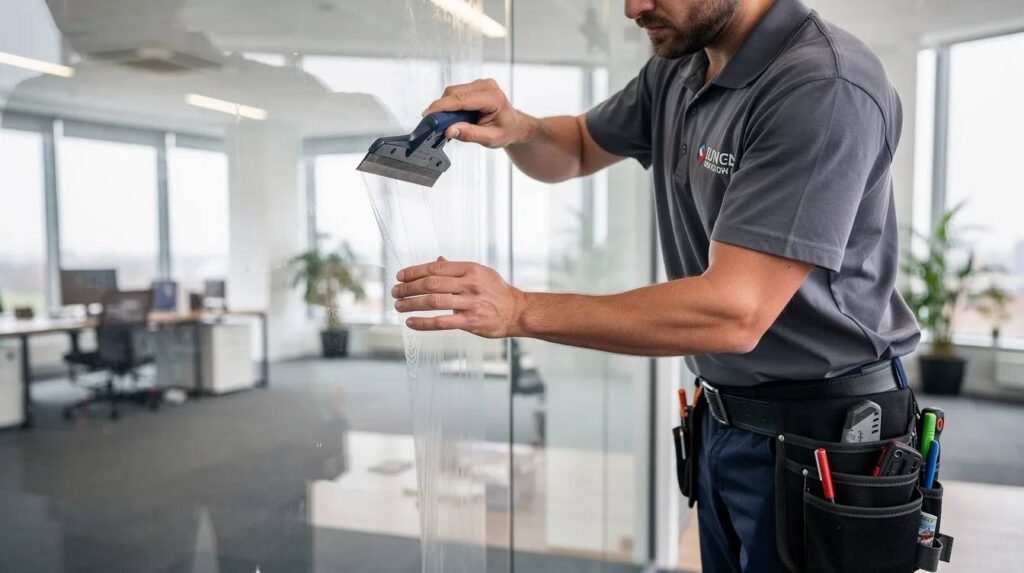
Professional installation is critical on high-touch door surfaces where film edges, hardware cutouts, and alignment are constantly tested by daily use, making it important to partner with an experienced 3M window film installation company.
The typical process:
- Site assessment. Measurement of doors, sidelites, and transoms. Documenting glass type, door hardware, and existing coatings or decals.
- Surface preparation. Deep cleaning of glass, removal of old adhesives, and protection of flooring and thresholds around the work area.
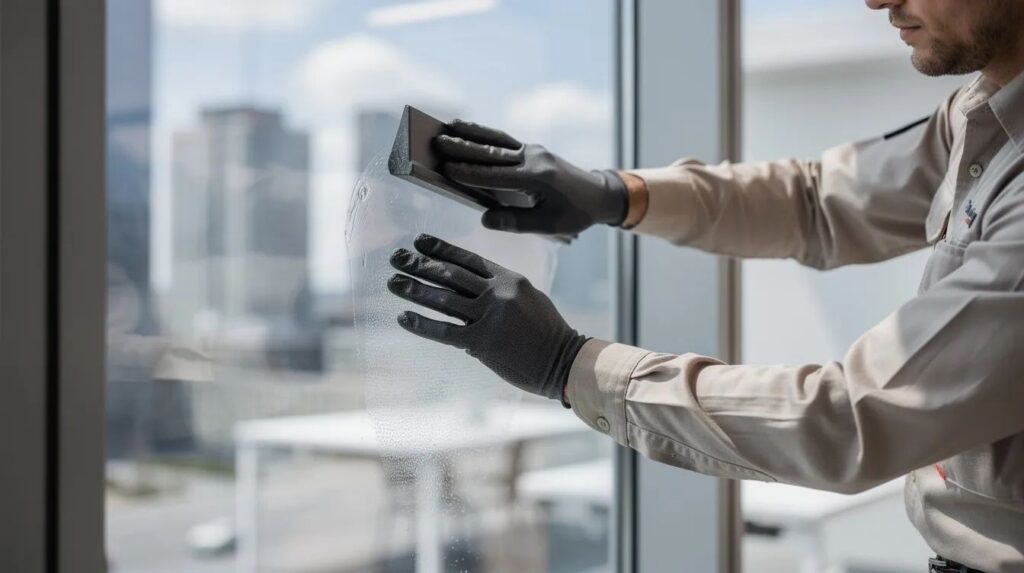
- Precision cutting. Using plotters or on-site templating for door lites, sidelites, and around panic bars, locks, hinges, and rail hardware. This step determines long-term durability.
- Wet application and finishing. Film is applied with a solution, squeegeed to remove air and moisture, and trimmed with extra care on door edges and top and bottom rails to minimize future edge lift.
- Inspection and curing. A quality check followed by curing period communication, advising staff not to tape signs or suction-cup items to freshly installed doors.
DIY storefront door kits sold online cannot match professional-grade commercial installations, particularly for security film systems that require structural anchors and sealants. The difference in longevity and performance is substantial.
Window Film Depot operates nationwide, allowing consistent standards and installation methods for door film programs across dozens or hundreds of facilities in a single rollout, with locations serving all 50 states and the depth of resources expected from America’s leading 3M window film installation company.
Maintenance, Durability, and Warranty Expectations
Well-installed film on commercial doors can last many years, but door surfaces experience more contact and cleaning than fixed windows.
Best practices:
- Clean with non-abrasive cloths and mild, ammonia-free cleaners. Avoid razor blades or abrasive pads.
- Use caution with tape, suction cups, and adhesive-backed signage on filmed doors, as these can lift edges over time.
Durability benchmarks:
- Interior-applied solar and dual reflective films on doors typically last 15 to 20 years with proper care.
- Anti-graffiti film on storefront doors is designed to be sacrificed and replaced after tagging, scratching, or acid etching, often at a fraction of full door replacement cost.
- Exterior-applied films on high-traffic doors may have shorter lifespans due to weather and physical contact.
Warranty considerations:
- Major manufacturers like 3M offer commercial warranties covering peeling, cracking, demetallization, and adhesion failure, often for 10 to 15 years depending on the product line.
- Using a manufacturer-authorized dealer like Window Film Depot is essential to ensure warranty validity. Unauthorized installation can cancel coverage entirely.
Add window film on doors to your preventive maintenance checklist. An annual inspection for edge lift or damage around handles and push bars catches small issues before they become replacements.
FAQs: Window Film for Commercial Doors
These are the questions facility managers and business owner teams ask most often when evaluating window film for commercial doors.
Does window film make commercial glass doors too dark for customers or staff?
Not necessarily. Visible light transmission options range from 13% to over 50% for common storefront door films. Dual reflective and spectrally selective films manage heat without overly darkening the glass. A 30% to 40% VLT film typically preserves an inviting room atmosphere while cutting glare and heat significantly.
Can window film be installed on tempered or laminated glass doors?
Most commercial doors use tempered or laminated glass, and both are compatible with many films. However, film-to-glass compatibility charts and professional assessment are important to avoid thermal stress issues, especially on insulated glass unit doors or doors with partial shading from overhangs. Films are tested and matched to glass types before installation.
Will security window film stop a break-in through glass doors?
No film makes glass unbreakable. But properly installed security film with anchoring can significantly reduce the speed of forced entry, deter opportunistic smash-and-grab attempts, and give law enforcement or security teams more response time. In documented tests, anchored 8-mil film systems delayed breach for over 90 seconds under sustained attack.
How long does it take to install window film on a set of commercial doors?
A single entrance with double doors and sidelites is often completed in a few hours. Larger lobby or multi-entrance projects may take a day or more. Most work can be scheduled during off-hours to minimize disruption to business operations and visitors.
Does window film void my door or glass warranty?
Review your manufacturer documentation. Reputable film manufacturers publish compatibility guidelines, and using an authorized dealer helps protect both glass and film warranties. Window Film Depot coordinates with glass and door manufacturers when needed to ensure coverage remains intact.
What is the return on investment for sun control film on glass doors?
ROI is driven by energy savings, equipment life extension, and comfort improvements. Typical simple paybacks fall in the three- to four-year range when doors are part of a full-building glazing project. A hotel project using ceramic sun control film on exterior doors and windows achieved ROI in approximately 3.4 years. Doors are a relatively low-cost component of the overall upgrade but often address the highest-impact comfort zones.
Why Choose Window Film Depot for Your Commercial Door Projects
Window Film Depot is a specialized partner for commercial door and glazing upgrades, not just a product reseller.
- Experience. Family-owned since 1992, Window Film Depot is a national 3M window film dealer with repeated National Dealer of the Year recognition. Over three decades of work on commercial buildings, retail chains, schools, and government facilities have built deep expertise in door-specific applications.
- Scope and scale. Whether you need a single-building upgrade or a multi-site rollout where hundreds of glass doors must be surveyed, specified, and serviced consistently across North America, Window Film Depot has the project management infrastructure prepared for that scale.
- Technical expertise. In-house teams handle security glazing standards, energy modeling support, and coordination with architects, general contractors, and facility teams. Every project is managed, not just sold.
- Product breadth. Access to 3M solar control films, dual reflective window film, security and anti-graffiti films, privacy and decorative films, and architectural finishes. Wholesale roll supply is also available for trade partners and companies managing their own installation teams.
Window Film Depot has completed projects at major transit hubs, national retail brands, and higher-education campuses, bringing the same attention to a single office door as to a 200-location rollout.
Next Steps: Planning Your Commercial Door Window Film Project
You now understand the options. Here is how to move forward:
- Walk your property. List all glass doors, sidelites, and transoms that cause issues: heat, glare, theft risk, privacy gaps, or branding needs.
- Gather information. Take photos, rough dimensions, and note any available glazing information or door schedules for your building.
- Contact Window Film Depot. The team provides remote assessments using photos and drawings or on-site surveys for larger properties.
- Review a tailored proposal. Receive recommended window films by door location, estimated energy savings where applicable, and security or privacy upgrades aligned with your risk profile.
Whether you manage retail storefronts, a school campus, a government property, or a multi-tenant office building, Window Film Depot delivers nationwide service and can coordinate with active renovation or security projects already underway.
Schedule a site visit or request a quote to get your commercial door film project started.