Table of Contents:
- The Valid Instinct Behind the Search, and Where It Breaks Down
- Security Window Film vs. Standard Tinted or Solar Film: Understanding the Performance Difference
- The Installer Qualification Checklist: What Certifications and Credentials Actually Matter
- National vs. Local: Why Scale and Experience Are the Right Evaluation Axis for Enterprise Projects
- How Much Does Commercial Security Window Film Installation Cost
- Practical Project Planning: Retrofits, Timelines, and Installation Realities
- Beyond Standard Film: Custom Glass Security Systems for High-Risk Environments
- How to Evaluate and Select the Right Commercial Window Film Installer for Your Project
- Stop Searching by Zip Code. Start Evaluating by Capability.
- Frequently Asked Questions
The Valid Instinct Behind the Search, and Where It Breaks Down
Searching for window security film installation near me is a reasonable starting point. Proximity matters for coordination, site access, and local code familiarity. The instinct makes sense. Where it breaks down is the assumption embedded in that search: that geography is the primary qualification criterion.
For a residential homeowner getting three windows tinted, proximity is probably enough. For a construction manager sourcing a subcontractor for a 40-location retail rollout or a school district security retrofit, proximity is nearly irrelevant compared to what the installer can actually deliver.
The commercial window film market is heavily fragmented. A large share of installers operating under “commercial” branding built their businesses on residential work and added commercial to their service list without meaningfully changing their crew size, equipment, bonding, or project management infrastructure.
When a “near me” search surfaces a local installer with good reviews, those reviews likely reflect residential jobs. That track record tells you almost nothing about their capacity to coordinate multi-floor access scheduling, maintain chain-of-custody documentation, or hold a timeline across parallel worksites.
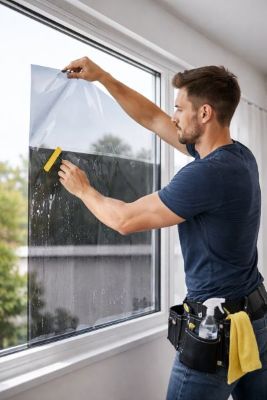
Residential Installers vs. Commercial-Grade Contractors: The Structural Capability Gap
The gap between residential and commercial window film installation is not a difference in skill. It is a difference in operational infrastructure. A residential installer typically runs a one- or two-person crew, schedules jobs sequentially, and carries general liability insurance sized for homeowner work. A commercial-grade contractor operates with dedicated project managers, multi-crew deployment capacity, commercial bonding, and the documentation systems that general contractors and facilities directors actually require.
The differences that matter on a commercial project come down to four areas.
Crew depth: Commercial projects often require parallel installation across multiple floors or zones to meet phased construction timelines. A two-person crew cannot do this.
Documentation: Commercial GCs require daily logs, material certifications, and as-built documentation. Most residential installers do not produce these as a standard deliverable.
Insurance: Commercial bonding and liability limits appropriate for occupied commercial buildings are substantially higher than residential minimums. A certificate of insurance that satisfies a homeowner’s request will not satisfy a facilities procurement team.
Product access: Some commercial-grade security films require authorized installer status from the manufacturer to be installed under warranty. A residential installer may not hold those authorizations.
What Vendor Qualification Stakes Actually Look Like on Multi-Location Projects
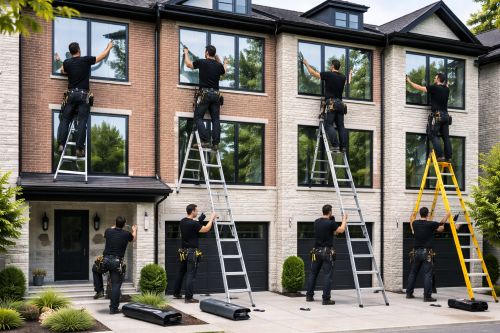
On a single-site project, a poorly qualified installer creates a localized problem. On a multi-site project, the same installer creates a cascading failure. If crew capacity is insufficient, your first location falls behind schedule, which delays the next one, which compresses your closeout window across the entire program. If the installer lacks manufacturer authorization, your warranty is voided across every location they touch, not just the one where the film was applied incorrectly.
The financial exposure on a 20-location security film project is not trivial. Between material costs, labor, and potential rework from a warranty void, a single unqualified installer decision can generate significant remediation costs. That risk profile demands a categorically different qualification process than a residential installation gone wrong.
The Reframe: From Proximity-Based Search to Capability-Based Evaluation
The right question is not “who installs security window film near me?” It is “which installer has the documented capability, manufacturer authorizations, and project delivery infrastructure to execute this specific scope reliably?” That question produces a very different candidate list, one organized around verified credentials, past project scale, and warranty coverage rather than map pins.
The rest of this guide gives you the framework to run that evaluation.
Security Window Film vs. Standard Tinted or Solar Film: Understanding the Performance Difference
Why the Film Category Determines the Threat You Can Actually Mitigate
Not all window film is security film. This distinction matters because the film category defines what threat the installation actually addresses. Specifying the wrong product category, often because an installer defaults to what they know or what their distributor stocks, leaves the building owner with a product that performs well in one dimension while offering no protection in the dimension that motivated the specification.
Forced Entry and Smash-and-Grab Resistance
Security film’s primary structural function is to hold glass fragments in place after impact. A standard solar or tinted film is engineered for optical and thermal performance, not impact resistance. When glass breaks under a forced entry attempt, solar film provides no meaningful delay. Security film, typically ranging from 4 mil to 14 mil in thickness, adheres the glass fragments to the film layer, slowing penetration and increasing the time and effort required to breach the opening. That delay is the core value proposition in retail smash-and-grab protection and perimeter security applications.
Blast Mitigation and Pressure Event Performance
In blast mitigation applications, covering government facilities, transportation hubs, and high-occupancy commercial buildings in threat-elevated zones, the failure mode is not a single impact point but a pressure wave that breaks glass across an entire facade simultaneously. Security film specified for blast mitigation is tested to GSA and Department of Defense standards that measure fragment retention under pressure events, not just point-impact resistance. Standard film is not designed for this threat class and provides no measurable protection in blast scenarios. Specifying solar film where blast mitigation is required does not just underperform; it provides nothing of value against that specific threat.
UV and Solar Heat Gain Control as a Secondary Benefit
Most commercial-grade security films do deliver meaningful UV blocking and some reduction in solar heat gain coefficient (SHGC) as secondary benefits. This is worth noting in total cost of ownership conversations, as energy performance data can support budget justification with facilities and finance stakeholders.
However, UV and heat reduction are not differentiators between security and non-security film. Do not let a vendor pitch solar performance as evidence of security capability. They are separate specifications that happen to coexist in some products.

Performance Standards That Apply to Security Window Film in Commercial Settings
Commercial security window film is evaluated against a defined set of performance standards that specify test conditions, threat levels, and acceptable outcomes. The primary standards a construction manager should recognize:
- ANSI Z97.1 and CPSC 16 CFR 1201: Safety glazing standards that apply to film-and-glass assemblies in building applications.
- ASTM F1233: Standard test method for security glazing materials and systems, measuring forced entry resistance across multiple attack methods.
- GSA-TS01-2003: General Services Administration blast mitigation standard, applicable in government and federal facility specifications.
- EN 356 and EN 13541: European equivalents for attack resistance and blast pressure testing, relevant for international or multinational projects.
An installer who cannot map their product recommendations to these standards by name is not operating at commercial specification depth.
The Difference Between Residential and Commercial-Grade Security Window Film
Residential security film typically runs 4 to 7 mil, meeting basic safety glazing requirements and providing moderate impact resistance for home window film applications. Commercial-grade security film starts at 7 mil and extends to 14 mil and above for high-security applications, with some specialized products incorporating multi-layer constructions that combine security performance with blast mitigation properties.
Beyond thickness, commercial film products differ in adhesive system design. A commercial-grade film uses an anchored or attachment system that bonds the film to the frame rather than just the glass surface. This is what prevents the glass-and-film assembly from being pushed inward as a unit during a forced entry attempt. Residential film typically uses a standard pressure-sensitive adhesive that bonds glass to film but does not anchor the assembly to the frame.
Where 3M Safety Series and 3M Ultra Series Film Fit Within the Performance Spectrum
3M Safety Series films are engineered for fragment retention and safety glazing compliance, making them appropriate for applications where the primary concern is occupant protection from accidental breakage or low-to-moderate forced entry risk. The 3M Ultra Series represents 3M’s highest-performance security film line, with products designed for blast mitigation and high-threat forced entry scenarios.
For most commercial retail, hospitality, and office applications, the Safety Series provides the right balance of performance and cost. For government facilities, critical infrastructure, and education environments with specific threat assessments, Ultra Series products combined with an anchoring attachment system meet the more demanding specification requirements. Product selection should follow the threat assessment, not the installer’s default inventory.
The Installer Qualification Checklist: What Certifications and Credentials Actually Matter
What Qualifications Should a Commercial Window Film Installer Have
A qualified commercial window film installer holds a specific combination of manufacturer authorizations, trade credentials, and operational infrastructure. The authorization piece matters because manufacturers like 3M structure their warranty programs around authorized installer networks. Work performed by an unauthorized installer may void the product warranty entirely, regardless of installation quality.
At minimum, a commercial installer should hold current authorized status with the film manufacturer specified for your project, carry commercial general liability insurance with limits appropriate for occupied building work (typically $1M per occurrence or higher depending on project scope), hold commercial bonding, and demonstrate documented experience with projects of comparable scale and building type.
Need More Info?
The Window Film Depot team is happy to help.
Trade membership in the International Window Film Association (IWFA) signals a baseline commitment to industry standards and ongoing training, though it is not a substitute for manufacturer authorization or verified project history.
3M Authorized Installer Status: What It Means and Why It Affects Your Warranty
3M’s authorized installer program requires installers to complete product-specific training, demonstrate installation proficiency, and maintain ongoing compliance with 3M’s installation standards. This is not a simple dealer registration. It ties directly to 3M’s warranty coverage.
When a 3M authorized installer applies 3M film to your project, the warranty covers both the product and the installation, providing a single point of accountability for material and labor defects. When an unauthorized installer applies 3M film, even genuine product purchased through distribution, the manufacturer warranty typically covers only material defects. The installer’s workmanship falls entirely outside the warranty scope. On a commercial project with thousands of square feet of film, that gap in coverage represents significant financial exposure if adhesion failures or delamination occur post-installation.
IWFA Membership, Liability Insurance, and Commercial Bonding Requirements
IWFA membership gives you a baseline signal but should not be the primary qualification criterion. What matters more in subcontractor qualification is the specific coverage details on the installer’s certificate of insurance. Verify that the liability limits match your project’s exposure, that the policy covers commercial work in occupied buildings, and that your organization is named as an additional insured.
Commercial bonding, specifically a contractor’s license bond, protects the project owner if the installer fails to complete the work or causes damage. Many residential-oriented installers carry the minimum bond required for a contractor’s license in their state, which may be far below the value of your film installation contract. Request documentation of bond value and verify it is proportionate to your contract amount.
Manufacturer Warranty vs. Installer Warranty: Understanding the Coverage Gap
A manufacturer warranty and an installer warranty cover different failure modes and carry different remediation obligations. The manufacturer warranty covers product defects, including delamination, adhesive failure, color shift, and performance degradation within specified parameters. The installer warranty covers workmanship, including improper surface preparation, edge sealing failures, and installation defects that cause the film to fail prematurely.
The gap risk emerges when a defect occurs and each party attributes it to the other’s responsibility. A manufacturer may claim the adhesion failure resulted from improper surface preparation while the installer claims the film itself was defective. Without a single authorized installer who holds both types of accountability, the project owner becomes the mediator in a dispute between two parties. Working with a manufacturer-authorized installer closes this gap because the manufacturer’s warranty program incorporates both product and installation accountability into a single coverage structure.
Using This Checklist to Reduce Subcontractor Qualification Risk
Run every prospective installer through the same qualification sequence before shortlisting. Treat authorization status, insurance documentation, and bonding as pass/fail criteria, not considerations to weigh against price. An installer who offers a lower bid but fails the authorization check represents a warranty liability that will exceed any savings if post-installation defects occur.
The rubric below translates these criteria into a structured evaluation format you can apply consistently across multiple installer candidates.
Installer Qualification Comparison Rubric
Use this rubric to evaluate any prospective commercial window film installer before awarding a contract.
- Dimension 1: Manufacturer Authorization
- Holds current authorized installer status with the specified film manufacturer: Pass / Fail
- Can provide written confirmation of authorization from the manufacturer: Pass / Fail
- Authorization covers the specific product line specified for your project: Pass / Fail
A single “Fail” in this dimension is disqualifying for projects where manufacturer warranty coverage is required.
- Dimension 2: Insurance and Bonding
- Commercial general liability insurance, minimum $1M per occurrence: Verified / Not Verified
- Policy explicitly covers commercial work in occupied buildings: Yes / No
- Your organization is named or can be named as additional insured: Yes / No
- Contractor bond value equals or exceeds contract amount: Yes / No
- Dimension 3: Commercial Project Experience
- Has completed commercial projects of comparable scope (square footage and building type): Yes / No
- Can provide references from at least two commercial GCs or facilities directors: Yes / No
- Has managed multi-location projects with parallel installation teams: Yes / No
- Dimension 4: Project Delivery Capacity
- Crew depth sufficient to meet your project timeline without serial scheduling: Adequate / Insufficient / Unknown
- Carries commercial project management infrastructure (daily logs, material certs, as-built documentation): Yes / No
- Has a dedicated project manager assigned, not just a crew lead: Yes / No
- Dimension 5: Warranty Coverage
- Manufacturer warranty applicable to your project through this installer: Yes / No
- Written installer workmanship warranty provided: Yes / No
- Clear escalation path if a warranty dispute arises post-installation: Yes / No
Scoring Guidance
Score “Yes” or “Pass” responses as 1 point each across Dimensions 2 through 5. Dimension 1 is pass/fail at the category level. A candidate who clears Dimension 1 and scores 10 or higher across the remaining dimensions meets minimum commercial qualification thresholds. Any candidate below 8 points or failing Dimension 1 should be removed from consideration before price comparison begins.
National vs. Local: Why Scale and Experience Are the Right Evaluation Axis for Enterprise Projects
Can a Single Installer Handle Multi-Location Window Film Projects
Yes, but only if the installer was built for it. Multi-location deployment requires more than a large crew. It requires a project management infrastructure capable of coordinating site access across multiple facilities managers, tracking material shipments to parallel job sites, maintaining consistent installation standards across different crews, and rolling up documentation to a single reporting structure. Most installers operating at the local level were not built with this infrastructure because their market never demanded it.
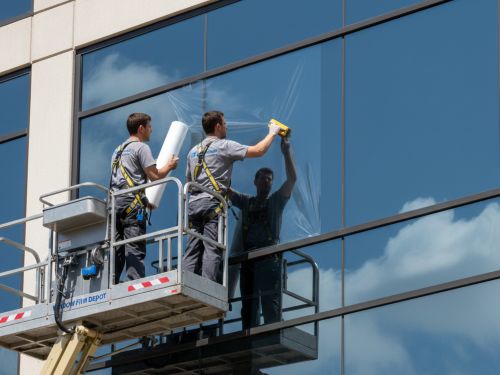
The practical ceiling for a local installer is usually one active project at a time. A 12-location retail security film rollout running on a shared store opening schedule cannot wait for sequential deployment. When location three is ready for installation the same week as location seven, you need an installer who can staff both simultaneously with qualified crews, not subcontracted day labor who have never applied security film.
What Local Installers Typically Cannot Offer at Enterprise Scale
A local installer found through a window security film installation near me search may be genuinely skilled and properly credentialed for single-site work. The limitation is not competence. It is capacity and systems.
Specific gaps that surface on enterprise projects include parallel crew deployment across multiple regions, centralized procurement that ensures consistent product lot numbers across locations (relevant for color-matching and warranty documentation), unified insurance coverage extending to all project locations under a single certificate, and standardized reporting templates that satisfy general contractor and owner requirements.
These are organizational capabilities, not technical ones. A two-person crew can install film correctly. They cannot staff three simultaneous locations in different cities while producing uniform closeout documentation for each.
Multi-Site Coordination, Single Point of Contact, and Timeline Accountability
The project management burden on a multi-site security film program is consistently underestimated until it lands on your desk. If you source a different local installer for each location, you are now managing five or ten separate vendor relationships, each with its own schedule, insurance certificate, reporting format, and escalation path. A delay at one location does not automatically trigger a recovery plan at another. You are managing that manually.
A single national installer consolidates all of that into one contract, one project manager, and one accountability structure. When a site access issue pushes location four back by two days, the project manager redistributes crew capacity without your involvement. That operational flexibility is not available when you are coordinating five independent subcontractors.
Timeline accountability is where fragmented sourcing fails most visibly. A single-point-of-contact model gives you one party responsible for delivering on schedule across the entire program, and one party to hold when the schedule slips.
How National Installer Capacity Reduces Subcontractor Fragmentation
Subcontractor fragmentation compounds risk at every stage of a commercial project. Qualification risk multiplies when each local vendor requires separate verification. Insurance exposure multiplies when policies have inconsistent terms. Warranty coverage fragments when different installers hold different authorization levels with the same manufacturer.
A national large-scale window film installation contractor eliminates these multiplication effects. One qualification event covers all locations. One insurance certificate with appropriate limits and additional insured status applies program-wide. One manufacturer authorization means consistent warranty coverage across every square foot of film installed, regardless of which crew applied it.
For a construction manager running a 20-location program, the reduction in administrative overhead alone justifies the sourcing decision before you account for the performance and warranty benefits.
Window Film Depot’s Commercial Project Credentials
Window Film Depot operates specifically in the commercial and institutional space, with a project history spanning retail chain rollouts, K-12 and higher education security retrofits, government and federal facility installations, healthcare campuses, and multi-tenant commercial office properties. The installer network is structured to support parallel deployment across regions, with project management oversight that produces the documentation and reporting standards commercial GCs and facilities teams require.
3M authorized installer status covers the full 3M Safety Series and Ultra Series product lines, which means manufacturer warranty coverage applies uniformly across every project location. This is not incidental. It is the structural difference between a vendor who can offer enterprise accountability and one who cannot.
How Much Does Commercial Security Window Film Installation Cost
Moving Beyond Per-Square-Foot Pricing: A Total Cost of Ownership Framework
Per-square-foot pricing is a useful starting point for budget ranging, but it is a poor decision tool for project approval. A lower bid looks like a significant savings until you factor in warranty coverage, product specification accuracy, and the cost of rework if the winning installer lacks manufacturer authorization or has specified an underperforming film product.
The right framework for commercial security film is total cost of ownership across a defined project lifecycle, typically five to ten years and aligned with the film warranty period. That calculation incorporates installation cost, energy savings from reduced solar heat gain, avoided glass replacement costs, and potential insurance premium reductions alongside the installed price.
Cost Variables: Single-Site vs. Multi-Site Projects
For a single-site commercial installation, cost variables typically include the film product tier (safety glazing film runs lower than blast-mitigation-grade products), glass area and accessibility (high-rise or atrium glazing requires lift equipment that adds to labor cost), surface preparation requirements (existing film removal or specialty coatings add scope), and attachment system specification (anchored systems for blast or forced entry performance add material and labor cost over standard adhesive installation).
On a multi-site rollout, the per-location cost typically decreases as project scale increases. Consolidated procurement, shared mobilization costs, and reduced project management overhead per location all compress unit costs. A 20-location program will generally price meaningfully lower per site than five separate single-site contracts with different vendors.
How Energy Savings, Insurance Reductions, and Avoided Replacement Costs Shift the TCO Calculation
Commercial-grade security film with meaningful solar heat gain reduction can produce measurable HVAC load reductions in glazing-heavy buildings. Actual savings vary by climate zone, glass type, and building orientation, but facilities teams on large glass-facade buildings have documented annual energy cost reductions that offset a portion of the installation cost over the warranty period.
Some commercial property insurers adjust premiums for buildings with documented security improvements, including certified security film installation. The documentation produced by a properly credentialed installer, covering product certifications, installation records, and warranty coverage, is what makes that conversation with the insurer possible. A handwritten receipt from a local installer does not support an insurance premium review.
Avoided replacement cost is the most direct TCO contributor in high-vandalism or smash-and-grab-exposed environments. A single commercial glass replacement event in a retail or hospitality setting can run several thousand dollars including emergency glazing, board-up, and business interruption. Security film that prevents or delays that event pays for itself in a small number of avoided incidents.
Labor Consolidation Savings on Multi-Site Rollouts
Sourcing a national installer for a multi-site program eliminates redundant mobilization costs. Each separately contracted local installer charges for mobilization, covering equipment transport, site setup, and project initiation overhead, on their individual job. A national contractor mobilizes once per region and amortizes that cost across multiple locations in a single deployment run. On a 15-location program spread across three metro areas, the difference between five mobilizations and fifteen can represent a meaningful share of total labor cost.
Building a Realistic Budget Estimate
The variables that most reliably shift commercial window film installation cost are glass accessibility, existing film removal, film product specification, and attachment system requirements. Projects with standard ground-floor or low-rise glazing, no existing film, and a mid-tier security film product will price at the lower end of the commercial range. Projects with multi-story curtain wall systems, existing film to remove, blast-mitigation specification, and anchored attachment systems will price substantially higher.
To build a realistic budget estimate before detailed scoping, gather square footage by zone (ground floor vs. upper floors), document existing glazing conditions, and obtain a preliminary threat assessment that identifies the required performance standard. That information allows an experienced commercial security window film installer to provide a range estimate with enough precision for budget approval, without requiring a full site survey at every location before you know whether the project is fundable.
Practical Project Planning: Retrofits, Timelines, and Installation Realities
Can Security Window Film Be Retrofitted on Existing Windows
Security window film is a retrofit product by design. The entire value proposition for commercial building owners is that existing glazing can be upgraded to a higher security performance level without replacing the glass. New construction is a minority use case. The more common application is an existing building with standard float glass that needs security performance added.
The retrofit process involves surface preparation (cleaning and, where necessary, removing existing film or coatings), film application, edge sealing, and where an anchored attachment system is specified, frame hardware installation. None of these steps require window removal or modification of the glazing system itself.
How Long Does a Commercial Window Security Film Installation Take
A single-story commercial retail space with 2,000 to 3,000 square feet of glazing typically takes one to two days with a properly staffed commercial crew. A multi-story office building or campus facility with 20,000 or more square feet of glazing is a multi-week project that requires phased scheduling to maintain building occupancy and operations.
The curing period matters for timeline planning. Security film adhesive requires 30 to 60 days to fully cure, during which the film should not be cleaned with abrasive products or exposed to physical contact. This does not affect building use, but it does affect your punch list and closeout timing if the project includes glazing inspections as part of commissioning.
How Building Type, Glass Specification, and Project Scope Affect Scheduling
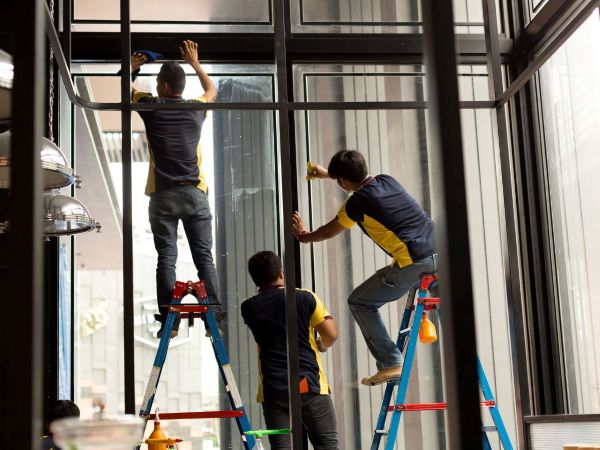
Tempered glass requires different handling than annealed glass, and low-e coatings on insulated glass units restrict which film products can be applied without voiding the IGU manufacturer warranty. An installer who does not assess glass type before specification may apply a product that causes thermal stress fractures in tempered or heat-strengthened glass. That failure mode is both expensive and entirely preventable with proper pre-installation assessment.
Building occupancy also drives scheduling. Healthcare and education facilities require installation that avoids disruption to occupied spaces, often limiting work to off-hours, weekends, or phased zone closures. A contractor without experience in occupied facility work will underestimate the scheduling complexity this creates.
Setting Timeline Expectations and SLA Benchmarks Before Contract Execution
Before contract execution, define the specific milestones that matter: mobilization date, zone completion sequence, final inspection date, and documentation delivery deadline. Get these in writing as contract deliverables, not verbal commitments.
SLA benchmarks worth including in a commercial window film contract:
- Crew deployment within a specified number of days of site-ready notification
- Daily progress reporting against a defined square footage target
- Punch list response time for identified deficiencies
- Warranty documentation delivery within a defined period after project closeout
An installer who resists putting schedule commitments in writing is telling you something important about their confidence in their own capacity.
Beyond Standard Film: Custom Glass Security Systems for High-Risk Environments
When Standard Security Film Reaches Its Performance Ceiling
Standard security film, even high-mil commercial-grade product, has defined limits. It is engineered to retain glass fragments after impact and delay forced entry attempts. What it cannot do is prevent glass from breaking under sustained attack, stop a determined threat with sufficient time and tools, or provide ballistic resistance. In environments where the threat assessment identifies these scenarios as credible risks, standard film is a baseline measure, not a complete solution.
The performance ceiling becomes visible when you map the building’s threat profile against the film’s tested performance envelope. A retail location with smash-and-grab exposure and a short police response time has a different risk equation than a government facility with an assessed threat of coordinated forced entry or explosive device placement. The first scenario is well-addressed by commercial security film. The second requires a layered approach.
Is 3M Security Window Film Effective for Retail, Education, and Government Facilities
For retail applications, 3M security window film is effective and well-matched to the primary threat: opportunistic smash-and-grab and break-in attempts where delay and deterrence are the goal. Fragment retention slows penetration, and visible glass integrity after an impact often causes an opportunistic threat to abandon the attempt.
For K-12 education, the application is primarily intruder delay at entry points, buying time for lockdown protocols to engage after a breach attempt begins. Security film on vestibule and classroom glazing is a documented component of layered school security upgrades, frequently specified alongside access control and surveillance systems rather than as a standalone measure.
For government facilities with federal threat assessments, 3M Ultra Series products with GSA-TS01 blast mitigation compliance address the performance requirements that standard film does not. Product selection depends on the specific threat level assigned to the facility. A field office carries a different specification than a courthouse or embassy.
Engineered Glass Security Solutions: Layered Approaches for High-Risk Environments
When film alone does not close the performance gap, the next layer is typically a combined film-and-frame system that anchors the glazing assembly to resist both impact and blast pressure as a structural unit. Beyond that, laminated security glass, polycarbonate interlayers, and purpose-built security glazing systems address threats that film-only solutions cannot.
In education environments, multi-layered vestibule glazing combining security film on existing glass with a secondary polycarbonate panel provides a substantial delay time improvement over film alone without requiring full window replacement. This approach is increasingly specified in school security assessments as a cost-effective upgrade path for existing buildings.
For high-security retail or government facilities, a comprehensive glazing security specification may include “unbreakable glass” products, multi-layer laminates, and forced entry rated framing systems. These are distinct product categories from security film and require a different kind of installer, one with experience in engineered glazing systems, not just film application.
Evaluating Whether Your Project Requires a Custom Security Glazing Specification
Start with the threat assessment. If one does not exist for the facility, it should be conducted before the glazing specification is finalized. A threat assessment defines the credible threat scenarios, the required delay or resistance time, and the performance standards the glazing system must meet. The specification follows the assessment, not the other way around.
If your threat assessment identifies risks beyond opportunistic forced entry, including coordinated attack, blast, or ballistic scenarios, bring a glazing security specialist into the specification process before selecting products. Security film is the right answer for a large share of commercial projects. For the subset where it is not, specifying it anyway creates the appearance of a security upgrade without the corresponding performance.
How to Evaluate and Select the Right Commercial Window Film Installer for Your Project
Translating the Capability Framework Into a Practical Vendor Selection Process
The qualification criteria covered earlier in this guide, covering manufacturer authorization, insurance and bonding, and project delivery capacity, are most useful when applied in sequence rather than simultaneously. Treating every criterion as equally weighted at the same stage creates evaluation paralysis. The more efficient approach is a two-stage filter: eliminate disqualifying gaps first, then compare capable candidates on fit and value.
Stage one is pass/fail. Manufacturer authorization, appropriate insurance limits, and commercial bonding are binary requirements. An installer who fails any of these does not advance, regardless of price or proximity. This stage should take minutes per candidate once you have the right documentation in hand.
Stage two is comparative. Among candidates who clear stage one, evaluate project delivery capacity, multi-site experience, and references from projects of comparable scale. This is where the difference between a capable single-site installer and a true enterprise commercial security window film installer becomes visible. Ask for specific project examples, not just years in business.
Questions Every Construction Manager Should Ask Before Awarding a Window Film Contract
The questions below are designed to surface capability gaps that a credential review alone will not reveal. An under-resourced installer will either hedge, generalize, or overstate.
“How many active commercial projects is your team currently running, and what is your crew deployment capacity if two projects require parallel staffing?” This surfaces real capacity, not theoretical capacity.
“Which 3M product lines does your authorization cover, and can you provide written confirmation from 3M?” Authorization is product-specific, not blanket.
“Walk me through your documentation deliverables for a project closeout. What does the package include?” A commercial contractor answers this without hesitation. A residential-oriented installer struggles with specifics.
“Have you managed a multi-location rollout where sites were installing simultaneously? Who was the GC, and can I contact them?” Past multi-site experience with a verifiable reference is the only evidence that counts.
“What happens if your crew’s schedule slips at one location? How does that affect the rest of the program?” This reveals whether they have a project management structure or just a schedule.
One more question that construction managers often skip: “Who is the project manager assigned to this contract, and what is their direct contact information?” If the answer is the same person applying the film, you do not have a commercial project management structure. You have a crew lead.
Red Flags That Indicate an Installer Is Under-Resourced for Commercial Project Demands
Some gaps are easy to spot on a credential checklist. Others only appear in conversation or during the proposal review. Watch for these warning signs.
The proposal quotes price per square foot but does not specify the film product by name, thickness, or manufacturer. This suggests the installer is pricing generically and will specify product based on availability, not performance requirements.
Insurance documentation shows a residential-scale policy or lists a different business entity than the one you contracted with. Both signal a disorganized operation or a contractor who blurs the line between residential and commercial work.
References are all from residential customers or small single-site commercial jobs. Positive reviews from homeowners tell you nothing about how this contractor performs under a GC contract with schedule accountability.
The installer cannot name the specific performance standard, such as ASTM F1233, GSA-TS01, or ANSI Z97.1, that their recommended product meets for your application. Specification depth is a basic capability marker for commercial work.
They are reluctant to put milestone dates in the contract. Schedule commitments in writing are standard practice for commercial subcontractors. Resistance to them is a red flag, not a negotiating position.
Quick-Pick Installer Selection Guide
Use this as a fast-reference screen before investing time in a full proposal review.
Pass/Fail Gates (any “No” disqualifies):
- Holds current manufacturer authorization for the specified product line: Yes / No
- Carries commercial general liability insurance at required project limits: Yes / No
- Holds contractor bond proportionate to contract value: Yes / No
Capability Checks (look for clear, specific answers):
- Can staff parallel sites simultaneously without subcontracting to unknown crews: Yes / No
- Provides reference from a comparable commercial project with GC contact: Yes / No
- Delivers standard closeout documentation package: Yes / No
A candidate who passes all three gates and answers “Yes” to all three capability checks is ready for detailed proposal review. Any remaining “No” responses are conversations to have before you proceed.
Stop Searching by Zip Code. Start Evaluating by Capability.
What This Framework Means for Your Next Sourcing Decision
The framework in this guide boils down to one operational shift: move the qualification screen to the front of the sourcing process, not the back. Most project managers shortlist by availability and price, then discover credential gaps during contract review or, worse, after installation. Running authorization, insurance, and capacity checks before you request proposals eliminates that sequence and protects your project from the most expensive failure modes, including warranty voids, schedule failures, and rework.
The window security film installation near me search is not wrong. It is incomplete as a qualification method. Proximity is a logistical convenience, not a performance credential. The installers who can deliver on a commercial security film project at scale are not necessarily the ones who appear first in a local search. They are the ones who pass the qualification criteria this guide outlines.
Why Window Film Depot Is Built for the Projects Local Installers Cannot Handle
Window Film Depot’s model is built around the project requirements that eliminate most local installers from consideration. That means 3M authorized installer status across the Safety Series and Ultra Series product lines, commercial project infrastructure that produces the documentation GCs and facilities teams require, and multi-site deployment capacity that supports parallel installation without subcontracting to unverified crews.
The sectors covered, including retail chain rollouts, K-12 and higher education security retrofits, government and federal facilities, and healthcare campuses, reflect a project history calibrated to commercial and institutional demand. That distinction matters when your project has a defined performance specification, a fixed schedule, and a warranty requirement that a local installer simply cannot satisfy.
Your Next Step: Initiate a Commercial Project Consultation
Bring your project scope, square footage estimate, and preliminary threat or performance requirements. A commercial project consultation with Window Film Depot produces a product recommendation mapped to your performance standard, a realistic budget range before full site survey, and a clear view of timeline and deployment structure for your specific scope.
Contact Window Film Depot to start the conversation. The qualification criteria are already in place. The project management infrastructure is built for this. What the consultation gives you is confirmation that the scope is matched to the right solution before you commit budget or schedule.
Frequently Asked Questions
What qualifications should a commercial window film installer have?
A qualified commercial window film installer should hold current authorized installer status with the film manufacturer specified for your project, carry commercial general liability insurance with limits appropriate for occupied building work, and maintain commercial bonding proportionate to contract value. Documented experience with projects of comparable scale and building type, along with IWFA membership, rounds out the baseline credential set. For projects specifying 3M products, written confirmation of 3M authorized installer status is a non-negotiable requirement for warranty coverage to apply.
What is the difference between residential and commercial-grade security window film?
Residential security film typically runs 4 to 7 mil and uses a standard pressure-sensitive adhesive that bonds film to glass only. Commercial-grade security film starts at 7 mil and extends to 14 mil and above, often incorporating anchored attachment systems that bond the entire glass-and-film assembly to the window frame. This anchoring is what provides meaningful resistance to forced entry, because it prevents the assembly from being pushed inward as a unit. The performance standards applicable to commercial installations, including ASTM F1233 and GSA-TS01-2003 for blast mitigation, are not relevant to residential product specifications.
How long does professional window security film installation take?
A single-story commercial retail space with 2,000 to 3,000 square feet of glazing typically takes one to two days with a properly staffed commercial crew. Larger projects, such as multi-story office buildings or campus facilities with 20,000 or more square feet of glazing, are multi-week engagements requiring phased scheduling to maintain building occupancy. Plan for an additional 30 to 60 days of adhesive curing time after installation before the film reaches full bond strength, which affects punch list and closeout scheduling.
How much does window security film installation cost for commercial buildings?
Commercial security window film installation pricing varies based on film product tier, glass accessibility, surface preparation requirements, and whether an anchored attachment system is specified. Per-square-foot pricing is a useful starting point for budget ranging, but total cost of ownership over the film’s warranty period, typically five to ten years, is the more accurate decision framework. That calculation incorporates energy savings from reduced solar heat gain, avoided glass replacement costs in high-vandalism environments, and potential insurance premium adjustments for documented security improvements. Multi-site rollouts generally price lower per location than equivalent single-site contracts due to consolidated procurement and shared mobilization costs.
Is 3M security window film effective for retail and education facilities?
Yes, with important distinctions by application. For retail, 3M safety series security film is well-matched to the primary threat of opportunistic smash-and-grab and break-in attempts, where fragment retention and breach delay are the goal. For K-12 education, security film on vestibule and classroom glazing is a documented component of layered school security programs, providing intruder delay at entry points while lockdown protocols engage. In both cases, film works most effectively as part of a layered security approach rather than a standalone measure.
Can a single installer handle multi-location window film projects?
A single installer can manage multi-location projects, but only if they have the organizational infrastructure built for it. This means parallel crew deployment capacity across regions, centralized procurement to ensure consistent product lot numbers and warranty documentation, unified insurance coverage extending to all project locations, and a project management structure that produces standardized reporting for each site. Most local installers found through proximity-based searches were built for sequential single-site work and lack the systems required for simultaneous multi-location deployment. Verifying multi-site project history with a referenceable general contractor contact is the most reliable way to confirm this capability before contract award.