Table of Contents:
- What Opaque Window Film Actually Is — and Where It Sits on the Privacy Spectrum
- Commercial and Institutional Applications That Demand Precision
- The Performance Specifications That Separate a Confident Spec from an Expensive Rework
- How Opaque Film Supports Security, Compliance, and Aesthetic Consistency
- Specifying and Installing Opaque Film Across Large-Scale and Multi-Site Projects
- Specifying Opaque Window Film with Confidence
- Frequently Asked Questions
What Opaque Window Film Actually Is — and Where It Sits on the Privacy Spectrum
Most specification errors with privacy film happen before a product is ever selected, especially when Opaque Window Film is treated as a one-size-fits-all solution. The category gets collapsed into a single descriptor, “privacy film,” and project managers end up ordering something that solves half the problem while creating a new one.
Why “Privacy Film” Is Not a Single Category
Privacy film is a functional outcome, not a product type. Films that deliver privacy range from light-diffusing decorative finishes to total blackout materials, and the performance difference between them is not incremental. It’s categorical.
Specifying the wrong one for a given application can mean a conference room that reads as private during the day but becomes fully transparent after dark, or a healthcare partition that meets aesthetic requirements but fails a compliance review.
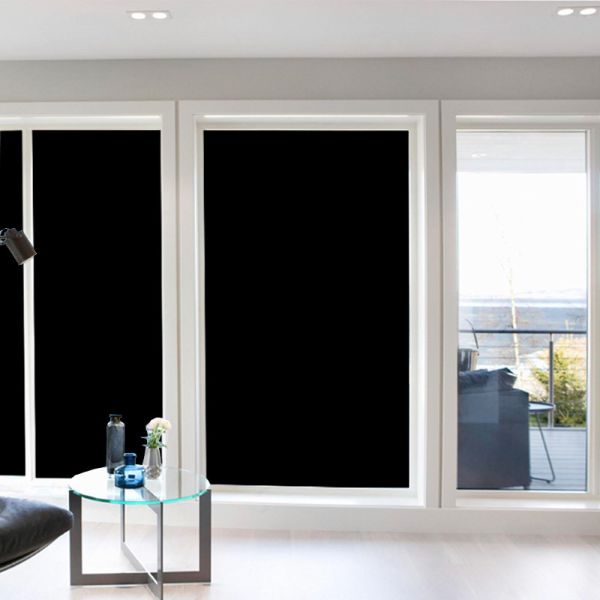
The Opacity Spectrum: From Light Diffusion to Total Blackout
Film opacity runs on a continuum, and the commercial market breaks roughly into three functional zones:
- Diffusion films scatter light without blocking it, creating a frosted appearance with moderate privacy at close range.
- Mid-range opaque films block direct sightlines while still transmitting diffused light, typically in the 10–50% visible light transmission (VLT) range.
- Total blackout films drop VLT to near zero, eliminating all visual transmission and most light passage.
Each zone has a distinct use-case footprint. Diffusion films work well where aesthetics matter and privacy is secondary. Mid-range films are the workhorse of commercial partition applications. Blackout films belong in projection rooms, server environments, or anywhere light contamination is a functional problem.
How VLT Percentages Translate to Real-World Privacy Performance
VLT, the percentage of visible light a film allows through, is the most direct predictor of privacy performance, but it doesn’t tell the whole story on its own. A film with 20% VLT provides meaningful daytime privacy, but at night, with interior lights on, that same film may offer very little visual protection. The direction of the light gradient determines who can see what.
This matters for specification because many commercial environments need privacy during hours when interior lighting is active. A conference room, a patient exam room, an HR office — all of these spaces need to account for evening and artificial light conditions, not just daylight performance.
Does Opaque Window Film Still Let Light Through?
It depends on where on the opacity spectrum the film sits. Frosted and mid-range films do transmit diffused light, which is why they’re popular in partition and interior glazing applications. They maintain the visual openness of a glass office environment while blocking direct sightlines. True opaque and blackout films transmit negligible light, trading daylighting benefits for complete visual blockage. The practical question for any specification is whether the space needs natural light or absolute privacy. Those requirements pull in opposite directions as you move toward full opacity.
Is Opaque Window Film the Same as Blackout Film?
Not exactly. “Opaque” describes a film’s visual blocking performance, its ability to prevent sightlines through glass. “Blackout” typically refers to a subset of opaque films engineered to also block light transmission almost entirely, often used in media rooms, sleep environments, or facilities with strict light-control requirements. All blackout films are opaque, but not all opaque films are blackout-rated. A film can block sightlines effectively at 15% VLT without qualifying as blackout material. In commercial specifications, that distinction matters when you’re writing performance language into a subcontract or coordinating with a lighting designer.
Need More Info?
The Window Film Depot team is happy to help.
Frosted vs. Opaque vs. One-Way Mirror Film: A Technical Breakdown
Frosted and Decorative Diffusion Films
Frosted films, including 3M Fasara glass finishes, scatter light to create a soft, etched-glass appearance. VLT typically ranges from 50–80%, meaning they transmit significant light while obscuring detail at close range. Privacy is directional and distance-dependent. Someone standing two feet from the glass sees less than someone at ten feet, and ambient lighting on both sides affects the read. These films are the right call when the design intent is visual softening, brand expression, or partial privacy in a shared environment.
Total Opaque and Blackout Films
At VLT values below roughly 10%, films deliver complete visual blockage under most lighting conditions. These materials are used in clinical settings, private offices with sensitive activity, and any application where the design brief explicitly requires that no visual information passes through the glass. Because they also block most solar heat gain, they have thermal performance implications worth flagging with the mechanical engineer on larger facade applications.
One-Way Mirror and Reflective Films
Reflective films create a one-way mirror effect. The reflective side appears opaque to the observer, while the other side remains visible. The critical constraint is that this effect only functions when the lit side of the film is brighter than the unlit side. Flip that light differential, and the privacy disappears. This makes reflective film appropriate for exterior-facing applications in daylight hours, but unreliable in interior partitions or any application where controlled lighting is present on both sides of the glass.
The single most common misspecification is selecting one-way mirror film for an interior application and discovering after installation that conference room lighting at 6 PM makes the glass fully transparent from the outside. Build the lighting condition into your selection criteria from the start.
Film Type Comparison Matrix
| Film Type | Privacy Level | VLT Range | Day Performance | Night Performance | Typical Environment | Best Use Case |
|---|---|---|---|---|---|---|
| Frosted / Decorative Diffusion | Low–Moderate | 50–80% | Partial, distance-dependent | Low (backlit interiors visible) | Office partitions, storefronts, reception | Aesthetic branding, visual softening, open-plan zones |
| Mid-Range Opaque | Moderate–High | 10–50% | Strong directional privacy | Moderate (dependent on interior light) | Conference rooms, HR offices, clinics | Daily privacy in business-hours environments |
| Total Opaque / Blackout | Complete | 0–10% | Complete visual blockage | Complete visual blockage | Media rooms, exam rooms, server areas | Absolute privacy or light-control requirements |
| One-Way Mirror / Reflective | High (conditional) | 5–20% | High on reflective side | Low (reverses in artificial light) | Exterior glazing, security observation | Exterior privacy in daylight-only conditions |
Commercial and Institutional Applications That Demand Precision
Film selection doesn’t exist in a vacuum. The correct product for any given application is determined by the glass substrate, the environmental conditions, the compliance requirements of the space, and how the film interacts with adjacent systems. The categories below represent the highest-stakes application environments in commercial renovation, and each one has specification nuances that separate a clean installation from a callback.
Interior Glass Partitions in Open-Plan Office Environments
Open-plan offices built around glass partitions have a design tension baked in. The architecture relies on visual connectivity and borrowed light, but functional spaces, including conference rooms, private offices, and HR suites, require real privacy. Mid-range opaque films in the 20–40% VLT range typically thread this needle. They block sightlines for standing and seated occupants without turning the glass into a wall, preserving the light transmission that makes the partition system worth having in the first place.
The specification variable that project managers most often underestimate is film placement. Full-height opaque film on a conference room partition reads differently than a band application, which delivers privacy at seated eye level with transparency above. The latter maintains light flow while meeting the functional requirement, and it’s a detail worth coordinating with the interior designer before the order is cut.
Classroom Door Glazing and Educational Facility Compliance
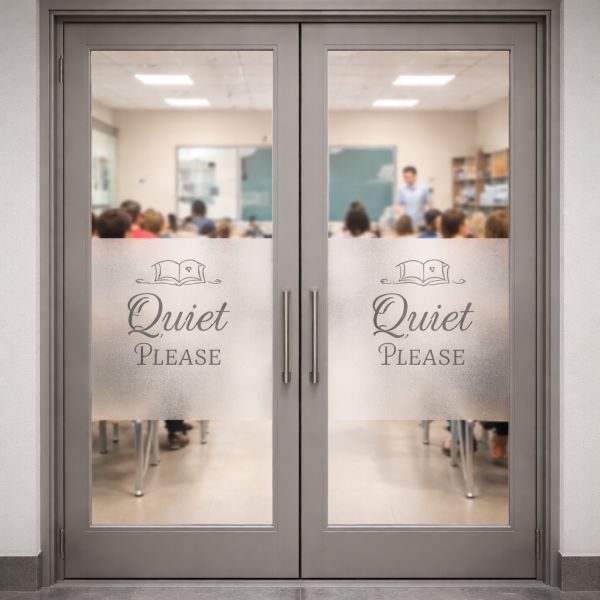
Many jurisdictions now require glass manifestation on school door glazing — visual markers that prevent occupants from walking into transparent panels and signal to responders during lockdown events. Film satisfies this requirement, but only when the specified product meets the visibility and placement standards in the applicable building code. In practice, this means the film must be visible at two heights, typically 36–42″ and 60″ AFF, and provide sufficient contrast against the glazing.
Frosted or opaque bands applied to door lites are a common, cost-effective solution. If a school district is also pursuing privacy on classroom door glass, a growing requirement in security-conscious renovation programs, the specification needs to satisfy both the manifestation standard and the privacy intent simultaneously. That’s a case where product selection and placement are inseparable, and where getting the specification wrong creates both a safety compliance problem and a rework cost.
Healthcare, Retail, and Institutional Facade Applications
Exterior vs. Interior Application: Surface, Adhesive, and Durability
Exterior and interior applications are not interchangeable, and the adhesive system is why. Interior films are formulated for controlled environments with stable temperature, no UV weathering, and no precipitation exposure. Exterior-grade films use adhesive systems designed to handle thermal cycling, moisture, and direct UV exposure, and they carry different warranty terms to reflect that. Applying an interior film to an exterior surface, or vice versa, voids the warranty and accelerates failure.
In healthcare and institutional facade applications, where privacy window film for commercial buildings may be specified on curtain wall glazing or storefront systems for patient privacy or solar control, the film must also be compatible with the specific glass type. Tempered, window laminate, and insulated glazing units each have different thermal expansion characteristics, and the wrong film on the wrong substrate can cause seal failure in an IGU or stress fractures in tempered glass. Substrate compatibility is a question to answer during pre-installation assessment, not after the film is on the glass.
Interior Glass Partitions: Adhesive and Application Considerations
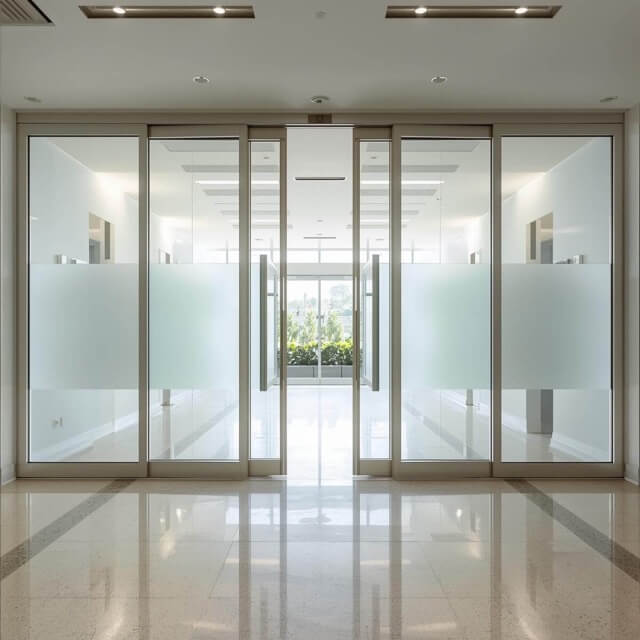
Interior glass partitions, whether frameless or framed, floor-to-ceiling or partial-height, are well-suited to opaque and frosted films because the controlled environment extends film life and eliminates the substrate stress issues associated with exterior exposure. The main specification consideration is adhesive type. Pressure-sensitive adhesive (PSA) films bond permanently and are the standard for commercial installations. Static cling films exist for temporary applications but are not appropriate for permanent commercial specifications. They’re prone to edge lifting in high-traffic environments and won’t hold up to repeated cleaning.
The Performance Specifications That Separate a Confident Spec from an Expensive Rework
A spec sheet for commercial window film contains more decision-relevant data than most project managers stop to read. Knowing which metrics actually govern field performance, and which are marketing noise, is what separates a specification that holds up from one that generates callbacks six months after installation.
Reading a Film Spec Sheet: The Metrics That Matter
VLT, Diffused Light Transmission, and UV Rejection
VLT tells you how much visible light passes through the film as a percentage. On an opaque film spec sheet, you’ll often see a second metric: diffused light transmission. This measures how much scattered, non-directional light the film passes, distinct from direct-view transmission. A film with 5% VLT and 8% diffused light transmission is still effectively opaque to the eye but allows a faint ambient glow — relevant if the space requires both privacy and an indication that the lights are on behind the partition.
UV rejection is the third metric worth reading carefully. Most commercial-grade opaque films block 99% of UV-A and UV-B, which matters for flooring, furniture, and artwork protection but also for LEED documentation. If energy and sustainability credits are part of the project scope, confirm that the film’s UV rejection data is independently verified, not just a manufacturer claim.
Adhesive Type and What It Means for Different Substrates
Pressure-sensitive adhesive (PSA) films use a dry application method. The liner is removed, the film is positioned, and pressure activates the bond. Wet-application films use a slip solution during installation to allow repositioning before the adhesive sets. Neither is universally superior. The right choice depends on the substrate and the installer’s method.
Use dry application to achieve a faster cure, especially on smooth, flat glass. Wet application gives the installer more working time on large panels or complex cuts, reducing the risk of trapped bubbles on high-VLT films where defects are visible. For opaque and blackout films, where the surface hides minor imperfections, dry application is typically standard. On frameless partition systems with precise edge alignment requirements, wet application gives the margin needed to get it right.
Durability, Warranty, and Lifecycle Expectations
How Long Does Opaque Window Film Last in High-Traffic Environments?
Commercial-grade opaque window film, professionally installed on interior glass, typically carries a 10-year manufacturer warranty with a service life that extends well beyond that under normal conditions.
The variables that shorten film life are mechanical abrasion, harsh cleaning chemicals, and exposure to direct moisture — all controllable with a basic maintenance protocol.
High-traffic environments such as school corridors, retail entries, and healthcare waiting areas accelerate edge wear if the film is not installed with proper edge sealing. Specify edge-sealed installation on any application where the film edge will be exposed to repeated contact or cleaning.
Commercial-Grade vs. Consumer-Grade Film: Why the Distinction Matters at Scale
Manufacturers engineer consumer-grade films for single-room, owner-installed use with a 2–5 year service expectation. They use lighter adhesive, thinner polyester substrates, and UV stabilizers that degrade faster under commercial conditions. At scale, across 50 offices, 12 school buildings, or a multi-floor healthcare retrofit, teams absorb the cost difference between commercial and consumer film quickly through avoided rework. Consumer film that fails in year three across hundreds of windows does not deliver value.
What Opaque Film Blocks Beyond Light: Heat, UV, and Glare
Total opaque and blackout films are the strongest performers on solar heat gain reduction, for the straightforward reason that blocking light also blocks the radiant energy it carries. A blackout film on a south- or west-facing facade can meaningfully reduce solar heat gain through that glazing, which has measurable implications for HVAC load in perimeter zones.
Mid-range opaque films in the 10–40% VLT range still deliver meaningful heat and UV rejection, typically blocking a significant portion of solar heat gain while rejecting 99% of UV radiation. Glare reduction scales with opacity, which is relevant for screen-heavy environments like trading floors, classrooms with projector setups, or medical imaging rooms adjacent to exterior glazing.
Can Opaque Window Film Be Removed Without Damaging Glass?
Yes, with the right process. Commercial PSA films are designed to be removable, and a professional removal using low-heat application and proper adhesive solvent leaves the glass clean without scratching or etching. The risk of glass damage comes from aggressive scraping on tempered glass, using the wrong solvent on coated glass, or attempting removal on film that has exceeded its service life and begun to delaminate. On specialty substrates, including anti-reflective coatings, low-e glass, or certain architectural films applied at the factory, verify removal compatibility before proceeding. That’s a pre-project assessment item, not a field decision.
How Opaque Film Supports Security, Compliance, and Aesthetic Consistency
Privacy is the lead function of opaque window film, but it’s rarely the only requirement a commercial project needs it to satisfy. Security performance, energy compliance, and visual consistency across a building or campus are specifications that film can support when selected with those outcomes in mind.
Glass Film as a Security and Safety Glazing Layer
Safety and anti-shatter films hold glass fragments in place on impact, reducing injury risk from broken glazing. These films are engineered with thicker polyester substrates, typically 4–8 mil versus 2 mil for standard privacy film and use a stronger adhesive attachment system. Some products combine privacy or opaque performance with safety-rated construction, delivering both privacy and fragment retention from a single product.
For applications that require both properties, such as a school entry vestibule, a healthcare triage window, or a retail cash office, specify a combined privacy and safety film instead of layering two products. Layering films on a single lite is technically possible but introduces adhesive compatibility variables and voids most manufacturer warranties.
LEED, Energy Efficiency Credits, and Building Envelope Considerations
Window film can contribute to LEED certification under the Energy and Atmosphere and Indoor Environmental Quality categories, primarily through reduced solar heat gain (SHGC improvement) and UV protection for interior materials. The documentation requirement is a certified performance data sheet showing the film’s solar optical properties, specifically SHGC, total solar energy rejected (TSER), and UV rejection percentage.
Not all opaque films qualify for the same credit pathways. High-opacity and blackout films perform well on SHGC metrics but may not meet daylight and views requirements if applied to primary glazing in occupied spaces. Coordinate with the LEED consultant before specifying opaque film on glazing that is part of the building’s daylighting or views calculation.
Maintaining Visual Consistency Across Multiple Zones and Facades
Decorative Window Film for Offices and Schools: Aligning Brand and Function
On multi-zone projects, whether a corporate campus, a school district renovation, or a healthcare network, visual consistency across locations is a legitimate specification requirement. Mismatched film finishes across conference rooms, lobby glazing, and perimeter offices are visible and distracting, and they signal to occupants and visitors that the project lacked coordination.
Specify film by product code, not by description. “Frosted white” covers a wide range of finishes across manufacturers. The same 3M Fasara product code installed across all locations delivers identical appearance regardless of which crew or which building handled the work.
Using 3M Fasara Glass Finishes to Specify Consistent Aesthetics at Scale
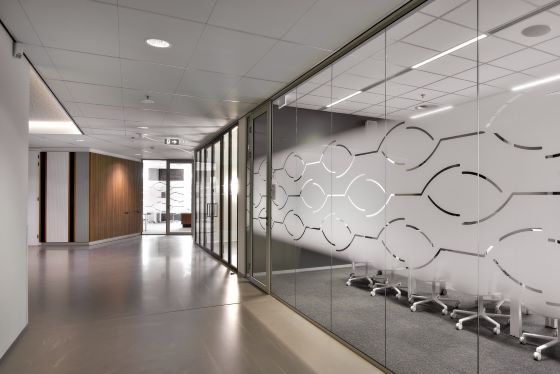
The 3M Fasara line gives specifiers a documented product family with consistent light transmission, surface texture, and color values across multiple SKUs. For a project where the interior designer has specified a particular aesthetic, such as a silk-texture diffusion film for all interior partitions, using a single Fasara product code in the specification locks in that appearance across every location. It also simplifies procurement, warranty management, and future replacement sourcing.
Specifying and Installing Opaque Film Across Large-Scale and Multi-Site Projects
Why Multi-Site Rollouts Expose the Limits of Commodity Sourcing
Single-location projects allow close oversight. Multi-site rollouts — a regional bank refreshing 40 branches, a school district updating 15 buildings — don’t. When teams source film through a commodity distributor and local crews install it based on availability, variables multiply: different installation crews, inconsistent surface prep standards, varying adhesive cure protocols, and no single point of accountability when something fails.
The cost of that inconsistency isn’t just aesthetic. A film installed incorrectly on a tempered lite that causes a stress fracture six months later creates a glass replacement claim that exceeds the original film cost by a significant margin. At scale, the specification and the installer are equally part of the risk profile.
What to Expect from Specification Through Completion with a National Installer
Pre-Project Site Assessment and Glass Surface Compatibility Checks
A structured pre-project assessment documents the glass types across all locations, including tempered, laminated, insulated, and coated substrates, and matches each to the appropriate film product and adhesive system. This step catches incompatibilities before installation begins rather than during glass replacement. It also produces a location-by-location specification matrix that drives consistent procurement across the project.
Quality Control, Scheduling Coordination, and Documentation Across Locations
National installer programs include installation standards, crew certification requirements, and documented quality checkpoints at each location. Completion documentation, including photos, installation records by glass unit, and warranty registration, creates the paper trail that protects both the project manager and the building owner. For multi-site projects, that documentation package is also the foundation for future maintenance or replacement work.
Do I Need a Professional to Install Opaque Window Film at Commercial Scale?
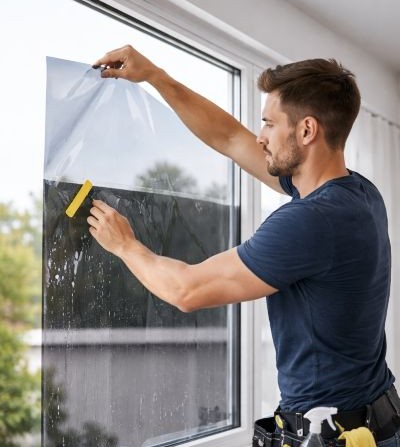
For a single office window, a careful DIY installation is feasible. For commercial-scale projects with multiple locations, specialty substrates, compliance documentation requirements, and warranty coverage, professional installation is the specification standard, not an upgrade.
The technical variables that affect adhesion, substrate compatibility, and long-term performance at scale require trained applicators, proper equipment, and post-installation quality verification.
An uncertified installation also voids most manufacturer warranties, which matters when you’re writing a 10-year performance expectation into a subcontract.
What Is the Best Opaque Window Film for Commercial Buildings?
The honest answer is that “best” is project specific. A healthcare network with exterior privacy requirements on curtain wall glazing needs a different product than a law firm specifying conference room partitions. That said, 3M’s commercial film lines cover the full specification range and offer the documentation, warranty infrastructure, and installer certification programs that large-scale projects require.
Quick-Pick Film Selection Guide
| Project Type | Film Category | 3M Product Tier |
|---|---|---|
| Corporate conference rooms / private offices | Mid-range opaque, 20–40% VLT | 3M Fasara (interior partitions) |
| School door glazing / manifestation compliance | Frosted band or opaque band | 3M Fasara or Scotchshield Safety Film |
| Healthcare exam rooms / clinical privacy | Total opaque, sub-10% VLT | 3M Night Vision or Blackout series |
| Exterior facade / solar control with privacy | Exterior-rated reflective or opaque | 3M Prestige or Night Vision Exterior |
| Multi-site brand consistency | Matched decorative finish across zones | Single 3M Fasara SKU, specified by product code |
| Safety + privacy combined | Safety-rated film with privacy performance | 3M Scotchshield Ultra Safety Film |
Use this as a starting point for initial specification conversations. Substrate compatibility, local code requirements, and lighting conditions at each location will refine the final product selection.
Specifying Opaque Window Film with Confidence
The Specification Variables That Determine Project Success
Every specification decision in this article reduces to a small set of variables that interact in ways that matter for field performance. Get them right, and the installation is clean, the client is satisfied, and the warranty is intact. Get any one of them wrong, and the path to rework is short.
The variables that determine outcome:
- VLT and opacity level matched to the privacy requirement and the lighting conditions the space actually operates in, not just daytime performance.
- Film category selected for the application environment: interior versus exterior, controlled climate versus thermal cycling, standard glass versus coated or insulated substrates.
- Adhesive system matched to the substrate and installation method, with edge sealing specified wherever wear or repeated cleaning is expected.
- Use commercial-grade product with a documented warranty and independently verified performance data. Do not use consumer-grade film priced to appear competitive at the line-item level.
- Installation by certified applicators with a quality verification process, not whoever is available locally at the time of scheduling.
None of these are difficult decisions once the project conditions are documented. The specification errors that generate rework almost always trace back to one of them being treated as a default rather than a decision.
The Case for a Single National Partner on Multi-Site Work
On a single-location project, gaps in coordination are manageable. A project manager can oversee surface prep, confirm substrate compatibility on-site, and verify installation quality before signing off. Multi-site projects don’t offer that margin.When different crews execute the same specification across 20 or 40 locations on different schedules, the outcome depends entirely on the consistency of the process behind it.
A national installer brings a standardized specification process: pre-project glass surveys that document substrate types across every location, product selection driven by compatibility data rather than availability, and installation crews trained to the same standards regardless of geography. Completion documentation, including installation records, warranty registration by glass unit, and photographic verification, creates the project record that protects the building owner and the project manager if a performance question surfaces years later.
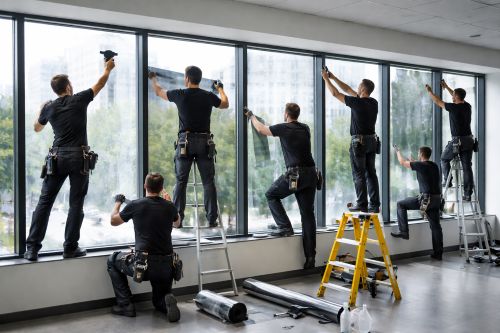
The alternative is managing a patchwork of local vendors, each with their own standards and their own interpretation of the specification. On a 15-building school district rollout, that’s 15 different conversations about what “opaque film” means, 15 different surface prep approaches, and 15 separate warranty relationships to track if something fails. The project budget rarely accounts for that overhead, and it compounds when teams investigate a failure at one location across all sites.
A single national partner with documented processes converts that variable into a fixed one. The specification is executed the same way at every location. The quality record exists. The warranty is held by one entity. When the building owner calls in year three, there’s one phone number.
Request a Project Consultation to Lock In the Right Specification
The specification work for opaque window film on a commercial project should happen before product selection, not after. A pre-project consultation with an experienced installer produces the substrate compatibility matrix, confirms the film category for each application zone, identifies any code or compliance requirements that shape the specification, and gives the project manager a documented product selection they can write into a subcontract with confidence.
For projects already in progress, a consultation can catch specification gaps before installation begins, at the point where corrections cost time but not glass replacement budgets.
Window Film Depot operates nationally with the installer certification, product relationships, and project documentation infrastructure to handle multi-site commercial rollouts from initial specification through completion. Whether the project is a single-floor office renovation or a district-wide school refresh, the starting point is the same: a conversation about the glass, the spaces, and what the specification needs to achieve.
Request a project consultation to get a specification recommendation grounded in your actual project conditions, including substrate types, application environments, compliance requirements, and timeline. This step converts a product decision into a predictable installation outcome.
Frequently Asked Questions
What is the difference between frosted and opaque window film?
Frosted window film scatters light to create a soft, etched-glass appearance while still transmitting a significant amount of visible light, typically in the 50–80% VLT range. It provides partial privacy that is distance-dependent and affected by lighting on both sides of the glass. Opaque window film, by contrast, is engineered to block direct sightlines more completely, with VLT values typically ranging from 0–50% depending on the product tier. The right choice depends on whether the priority is aesthetic softening with borrowed light or reliable visual privacy under varying lighting conditions.
Can opaque window film be removed without damaging glass?
Yes, when removal is performed by a trained professional. Commercial PSA films are designed to release cleanly using low-heat application and the appropriate adhesive solvent, leaving the glass surface undamaged. The risk of damage increases with aggressive mechanical scraping, incompatible solvents on coated glass, or film that has exceeded its service life and begun to delaminate. On specialty substrates such as low-e glass or anti-reflective coatings, verify removal compatibility during the pre-project assessment rather than making that determination in the field.
How long does opaque window film last?
Commercial-grade opaque window film installed on interior glass by a certified applicator typically carries a 10-year manufacturer warranty, with a realistic service life that extends well beyond that under normal conditions. The factors that accelerate wear are mechanical abrasion, harsh cleaning chemicals, and moisture exposure. In high-traffic environments, specifying edge-sealed installation significantly extends the film’s useful life by protecting the most vulnerable point of adhesion.
Do I need a professional to install opaque window film?
For a single residential window, a careful DIY installation is workable. For commercial projects with multiple locations, specialty glass substrates, compliance documentation requirements, or warranty coverage expectations, professional installation is the baseline standard. At commercial scale, the technical variables around adhesion, substrate compatibility, and quality verification require trained applicators and proper equipment. An uncertified installation also voids most manufacturer warranties. This creates significant exposure when teams write performance into a long-term subcontract.
What opaque film blocks heat and UV rays most effectively?
Total opaque and blackout films, those with VLT below roughly 10%, deliver the strongest solar heat gain reduction because blocking light also blocks the radiant energy it carries. These films can make a measurable difference in HVAC load on south- and west-facing glazing. Mid-range opaque films in the 10–40% VLT range still reject 99% of UV radiation and reduce a meaningful portion of solar heat gain. This performance makes them effective for most commercial privacy applications where spaces still require some daylight transmission.
Is opaque window film suitable for exterior or interior use?
Both, but product selection must match the application environment. Manufacturers formulate interior-rated films for stable, controlled conditions, and these films cover most commercial partition, door glazing, and interior facade applications. Exterior-rated films use adhesive systems engineered for thermal cycling, UV exposure, and moisture, and they carry different warranty terms to reflect that. Applying an interior film to an exterior surface voids the warranty and accelerates product failure. The film manufacturer’s substrate compatibility data should drive the final product decision for any exterior application.