Table of Contents:
- The Nighttime Privacy Problem: Why Reflective Films Fail After Dark
- A Common Project Pitfall: Misunderstanding 24-Hour Security Demands
- Understanding the Science: The Principle of Light Differential
- The True Solution: Frosted and Decorative Film for Day and Night Privacy
- A Consultant’s Guide to Specifying 3M Privacy Solutions
- Application Showcase: Solving Real-World Privacy Challenges
- Key Specification Criteria for Your Next Project
- Conclusion: Specifying with Confidence for Guaranteed Privacy
- Frequently Asked Questions
- Related Posts from Window Film Depot
The Nighttime Privacy Problem: Why Reflective Films Fail After Dark
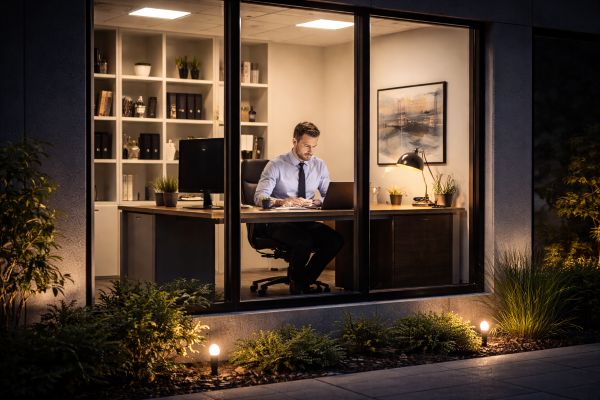
A project specification calls for privacy on street-level office windows. The client wants a sleek, modern look during the day and complete confidentiality for their team after hours. You specify a high-quality reflective film, known for creating a “one-way mirror” effect. The installation is flawless, and during the day, the result is perfect. But the first evening the office lights are on, you get an urgent call from the client. The privacy has not just disappeared, it has reversed. This scenario is a common and costly misstep that undermines both the project’s goals and the client’s trust.
The “fishbowl effect” is what happens when a reflective window film, installed for daytime privacy, becomes completely transparent from the outside at night. When the sun goes down and interior lights switch on, the building’s windows transform from reflective mirrors into clear displays.
Anyone on the street can see directly into the office, observing employees, sensitive documents, and expensive equipment. Instead of providing security, the film inadvertently puts the space on display. For those inside, the window feels like a dark, transparent void, creating a sense of exposure. This reversal of the intended effect is a direct failure to meet the client’s core requirement for day and night privacy window film.
A Common Project Pitfall: Misunderstanding 24-Hour Security Demands
As a project manager, success depends on accurately translating client needs into technical specifications. When a client requests “privacy film,” it is a critical error to assume a standard reflective solution will suffice. The true demand is often for continuous, 24 hour privacy window film, especially for ground-floor offices, conference rooms, or sensitive R&D areas.
Specifying a daytime-only reflective film for a 24-hour need is a fundamental misunderstanding of the project requirements. It leads to change orders, budget overruns, and a loss of confidence. The key is to probe deeper during the planning phase and clarify whether the need for privacy extends beyond daylight hours. If it does, a standard reflective film is the wrong tool for the job.
The risks of specifying the wrong film for office glass privacy are significant.
- Security Compromise: The fishbowl effect makes the office an easy target. It allows outsiders to monitor activity, identify personnel, view confidential information, and case the location of valuable assets.
- Aesthetic Inconsistency: The sleek mirror finish that enhances a building’s façade during the day vanishes at night. It is replaced by a patchwork of brightly lit, transparent squares that look unprofessional and disrupt the intended architectural aesthetic.
- Erosion of Occupant Comfort: Employees working late may feel exposed and unsafe. This can negatively impact morale and productivity, turning a space intended for focus into one that feels unsecure.
Understanding the Science: The Principle of Light Differential
To avoid these pitfalls, it’s essential to understand the science that governs how these films operate. Reflective films fail at night not because of a product defect, but because of a principle of physics.
Light differential is the difference in brightness between the two sides of a pane of glass. This concept is the single most important factor in how reflective window films work. The film itself is not inherently “one-way.” Instead, its metallized layer reflects light toward the side with greater illumination. Understanding this is non-negotiable for project managers, as it dictates whether a film will provide privacy or expose a space.
During the day, the exterior is significantly brighter than the building’s interior. The film’s surface reflects a high percentage of this powerful exterior light, creating a mirror-like appearance. From the inside, occupants can see out clearly. However, this effect is entirely dependent on the sun.
When night falls, the light differential reverses. The outside becomes dark, while the office interior is illuminated. Now, the interior space is the brighter side. The reflective film, obeying the law of light differential, begins reflecting the light from within. For someone inside, the window becomes a mirror. For an observer on the dark street, the film becomes virtually transparent, giving them an unobstructed view into the workspace. The privacy solution has become a security liability.
The True Solution: Frosted and Decorative Film for Day and Night Privacy
Given the limitations of reflective films for nighttime privacy, the project specification must shift from a strategy of reflection to one of obscurity. This is where frosted and decorative films provide a definitive, reliable solution that guarantees privacy 24/7, regardless of lighting conditions.
The fundamental difference lies in how the film interacts with light. Instead of mirroring light, which is conditional, a translucent film works by scattering it. A frosted or decorative film is not opaque, it is translucent, meaning it allows light to pass through but diffuses it in the process. This diffusion effectively obscures the view by breaking up the light that forms a clear image, leaving only a blurred impression of color and movement. This physical property is constant, providing a privacy shield that works day and night from both sides of the glass.
The privacy mechanism of frosted window film is its textured surface, which intercepts light rays and scatters them in countless directions. This process is purely physical and does not depend on a light imbalance. Consider a brightly lit conference room on a dark night. With a frosted film, an observer outside would not see inside. They would perceive a soft, even glow of light from the window. The details of the room, its occupants, and any sensitive information remain completely obscured.
A common concern is the potential loss of natural light. Modern decorative films are engineered to solve this exact challenge. Performance specifications include a Visible Light Transmission (VLT) value, allowing you to choose a film that meets your client’s needs. You can select a frosted window film solution for office use that provides complete visual privacy while still allowing over 70% of natural light to enter the room. This ensures spaces remain bright and welcoming, supporting employee well-being without ever compromising on security.
A Consultant’s Guide to Specifying 3M Privacy Solutions
When specifying a film for 24/7 privacy, turning to a trusted manufacturer like 3M is critical for ensuring performance, durability, and client satisfaction. Their portfolio of decorative films offers a range of solutions that meet the highest professional standards.
The 3M Fasara Glass Finishes Series
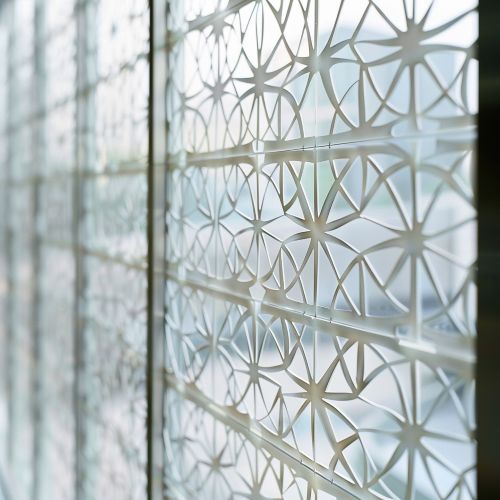
For projects where aesthetics are paramount, the 3M Fasara Glass Finishes series is a premier choice. This line offers over 100 designs that move beyond simple frost to mimic the look of etched, cut, sandblasted, and even textured glass.
- Design Flexibility: Patterns range from fine gradients to bold geometric shapes and organic designs inspired by linen or rice paper.
- Customized Privacy: The variety of patterns and opacities allows for a tailored approach, providing complete privacy in some areas and partial obscurity in others.
- Cost-Effective Aesthetics: Fasara films provide the look of custom-etched glass at a fraction of the cost, making high-end design accessible for a wider range of budgets.
3M Dusted and Frosted Crystal Films
When a project calls for clean, classic, and highly effective privacy, 3M Dusted and Frosted Crystal films are the industry-standard solution. These films replicate the uniform appearance of acid-etched or sandblasted glass.
- 3M Dusted Crystal Film: This film provides a softer, lighter appearance, similar to a light acid-etch. It’s an excellent choice for creating privacy without heavily obscuring the light.
- 3M Frosted Crystal Film: Offering a higher level of opacity, this film closely resembles sandblasted glass. It provides maximum privacy and light diffusion, making it ideal for street-level offices, sensitive conference rooms, and healthcare environments.
The highest-quality commercial privacy film will only perform as well as its installation. Partnering with a 3M Authorized and certified installer is a critical step in mitigating project risk. An expert installation partner acts as a consultant, ensuring the correct film is chosen and the application is flawless. This guarantees a perfect visual result and ensures the validity of the 3M warranty, providing long-term peace of mind.
Application Showcase: Solving Real-World Privacy Challenges
These principles are best understood through real-world applications where the correct film solves specific client challenges day and night.
Scenario: Securing Street-Level Offices and Conference Rooms
A client needs to prevent passersby from seeing sensitive information or observing private meetings in a ground-floor office. A standard reflective film fails spectacularly after sunset. A reliable solution is a translucent frosted film, such as a 3M Crystal Glass Finish.
- Day: The film obscures the view from outside while allowing diffused, non-glare sunlight to fill the office.
- Night: The effect remains unchanged. The frosted texture continues to obscure any detailed view, rendering figures and objects as indistinct shapes. The client’s requirement for continuous privacy is met with a clean, modern aesthetic.
Scenario: Enhancing Privacy in Retail and Hospitality
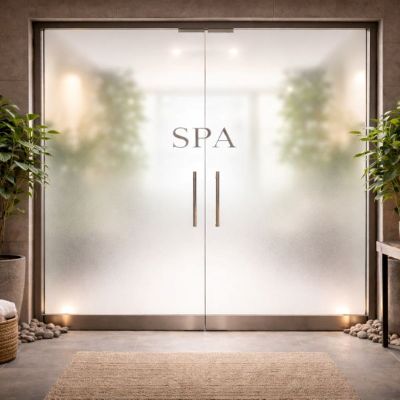
A hotel needs to separate a spa treatment area from a hallway, or a boutique needs to obscure its stock room. Here, decorative films from a series like 3M Fasara provide a dual benefit.
A pattern can be selected to complement the client’s interior design, integrating privacy with branding.
A gradient film, for example, can provide full privacy at the bottom of the glass and gradually become clear at the top, maintaining a sense of openness while shielding specific areas.
Scenario: Meeting Compliance in Healthcare and Education
For projects in healthcare and education, privacy is often a matter of compliance and duty of care. Regulations like HIPAA or policies protecting student information demand robust solutions. In these environments, an opaque or high-density translucent film is the standard. For patient rooms or waiting areas, a high-density frosted film ensures total visual privacy while allowing soft, natural light, which contributes to a healing environment. For university offices, a professional frosted film ensures conversations and documents remain private from students in the hallway.
Key Specification Criteria for Your Next Project
To prevent the common error of specifying a reflective film for a 24/7 privacy application, focus your scope on the following criteria.
- Define the Privacy Level: Clarify with your client if they need a translucent or opaque film. Translucent films, like frosted and etched finishes, obscure the view while allowing light through. Opaque films, like “blackout” or “whiteout” window film, block both the view and the light for applications where no visibility is desired.
- Match Aesthetics to Brand: Present decorative film as a design tool. A 3M Dusted Crystal finish provides a subtle sandblasted look for a corporate setting. A 3M Fasara film with a fabric pattern can become a central design feature in a hospitality space.
- Focus on the Right Metrics: When reviewing product data sheets for a 24 hour privacy window film, the most important “metric” is the visual characteristic of the film itself. Look for manufacturer language that states the film is designed for “privacy” or “obscuring views.” Always obtain a physical sample to confirm the level of obscurity meets client expectations.
Your final specification document must be precise. To prevent a contractor from defaulting to an incorrect reflective film, use unambiguous language.
- State the Objective: “Furnish and install decorative window film to provide 24-hour visual privacy, fully obscuring direct line of sight from both interior and exterior under all lighting conditions.”
- Specify the Film Category: Use precise terms. Instead of “privacy film,” write “a translucent, non-reflective frosted decorative film.”
- Reference an Approved Product: To eliminate ambiguity, name a specific product, such as: “Film shall be 3M Frosted Crystal Film, Series 7725SE-324, or a pre-approved equal meeting all performance criteria.”
- Demand a Mock-Up: For critical applications, specify that a sample installation must be completed on-site for client approval before proceeding with the full installation.
Conclusion: Specifying with Confidence for Guaranteed Privacy
The challenge of specifying the correct window film for 24/7 privacy is a critical hurdle in commercial projects. By understanding the science and focusing on purpose-built solutions, you can deliver guaranteed privacy and aesthetic excellence.
- Reflectivity is conditional. A “one-way mirror” effect depends on a light differential, making it an unreliable solution for nighttime privacy.
- Obscurity provides 24/7 privacy. True, around-the-clock privacy is achieved by diffusion. Frosted and decorative films like the 3M Crystal and Fasara series are designed to obscure the view by scattering light, a property independent of lighting conditions.
- Aesthetics and function work together. Modern decorative films offer a vast palette of textures and patterns, allowing you to meet stringent privacy requirements while enhancing interior design.
The modern workspace demands both transparency and security. Specifying a standard reflective film contradicts these needs, creating a vulnerability the moment the sun sets. By selecting advanced frosted or decorative films, you align your specification with the reality of the modern commercial environment. This demonstrates a deeper understanding of client needs and positions you as a project manager who delivers sophisticated, reliable solutions.
Engaging with a film technology consultant is the most efficient path to a perfect specification. An expert can help you analyze the specific needs of each space, present a curated selection of films, and provide samples for stakeholder approval. This collaborative approach removes guesswork, mitigates risk, and ensures the final installation delivers on its promise of guaranteed privacy and client satisfaction.
Frequently Asked Questions
What is the best window film for 24/7 privacy?
The best option for reliable day and night privacy window film is a frosted, decorative, or opaque film. Unlike reflective “one-way mirror” films that fail at night, these films work by obscuring the view through light diffusion or complete blockage, a physical property that is not dependent on the difference in light levels between the inside and outside.
Will frosted window film make my office too dark?
No, a frosted window film for office spaces is designed to be translucent, not opaque. It allows a significant amount of natural light to pass through, creating a soft, diffused glow that keeps the space bright and welcoming. Products are available with various Visible Light Transmission (VLT) ratings, so you can choose a film that provides the desired level of privacy while maximizing daylight.
What is the difference between translucent and opaque window film?
Translucent film, like frosted or etched styles, obscures the view for privacy but still allows light to pass through. It’s ideal for conference rooms and offices where you want both privacy and natural light. Opaque film, such as black, white, or colored vinyl, blocks both the view and all light from passing through. It’s used for areas requiring total visual blockage and light control, like a sensitive lab or storage room.
Is decorative window film as effective as etched glass?
Yes, and it offers several advantages. High-quality decorative films, such as the 3M Fasara series, expertly replicate the look of etched, sandblasted, or custom-textured glass at a fraction of the cost. They provide the same level of privacy and aesthetic sophistication while being faster to install and fully removable, offering greater design flexibility for future updates.
How do I make sure the contractor installs the correct privacy film?
Your project specification is your primary tool. Be precise. Instead of asking for “privacy film,” specify “a translucent, non-reflective frosted film for 24-hour privacy.” To eliminate all doubt, name a specific product (e.g., “3M Frosted Crystal Film”) as the basis of design and require the contractor to submit a physical sample for your approval before the full installation begins.