Table of Contents:
- Unpacking the Hidden Costs of UV Radiation in Commercial Properties
- Debunking Myths: Why Standard Glazing Isn’t Enough for True UV Protection
- The Science of Protection: Decoding UV Rejection Specifications for Project Managers
- Strategic Specification: Harnessing 3M™ Advanced Film Technology for Superior Asset Preservation
- Seamless Integration at Scale: The Indispensable Role of Expert Installation for Large Projects
- Conclusion: Safeguarding Investments with Proactive UV Mitigation Strategies
- Frequently Asked Questions
- Related Posts from Window Film Depot
Unpacking the Hidden Costs of UV Radiation in Commercial Properties
Ultraviolet (UV) radiation, largely invisible to the human eye, represents a pervasive and often underestimated threat to commercial interiors. While natural light is essential, its UV component relentlessly degrades a wide array of materials. This degradation affects dyes in retail merchandise, finishes on office furnishings, pigments in valuable artwork, and the structural integrity of textiles and wood. The process manifests as fading, discoloration, embrittlement, and overall material breakdown, steadily diminishing the aesthetic appeal and intrinsic value of interior assets.
The Silent Threat: How UV Degrades Assets and Devalues Spaces

Consider a high-end retail establishment where merchandise fading under daylight can lead to direct financial losses through markdowns or unsellable inventory. In corporate offices, accelerated wear on carpets, upholstery, and desk finishes necessitates premature replacement, driving up operational expenditures. For facilities housing historical documents or art collections, uncontrolled UV exposure risks irreplaceable damage. The cumulative effect is a significant reduction in the perceived quality and longevity of a space, directly impacting client satisfaction and future investment returns.
Quantifying the Financial Impact: Calculating Loss from Fading Merchandise and Furnishings
UV damage causes significant financial losses beyond simple aesthetics for retail project managers. Faded merchandise leads to inventory write-offs, reduced profit margins, and potential brand reputation damage. Data shows that even partial fading can necessitate 20-50% markdowns on high-value products. In hospitality and offices, UV exposure accelerates the aging of furnishings and flooring. Assets lasting 15 years may require replacement in just seven years, doubling long-term costs. These hidden expenses strain facility budgets and impact a property’s attractiveness to tenants. Managers must account for accelerated depreciation to forecast operational expenses and maintain asset value.
Beyond Aesthetics: Health Implications and Occupant Wellness
While asset protection is paramount, the impact of unfiltered UV radiation extends to the health and well-being of building occupants. Prolonged exposure to UVA and UVB rays through unprotected windows is a recognized factor in skin damage, premature aging, and an increased risk of skin cancers. It also contributes to eye conditions such as cataracts and macular degeneration over time.
For project managers tasked with creating modern, health-conscious environments, providing robust UV window film protectionis a critical component of occupant wellness strategies. Meeting client demands for healthier indoor spaces now explicitly includes mitigating environmental stressors like excessive UV exposure. A protected environment contributes to a more comfortable, safer, and ultimately more productive space for employees, and a more reassuring one for clients and visitors.
The Project Manager’s Imperative: Connecting UV Protection to Client Satisfaction and Building Value
For Project Manager Paul, delivering a commercial property that meets stringent client demands for asset preservation and occupant wellness is non-negotiable. Integrating comprehensive UV protection is not merely an optional upgrade. It is an essential risk mitigation strategy and a direct pathway to enhancing building value and client satisfaction. By specifying advanced UV-blocking film solutions, a project manager can:
- Preserve Capital Assets: Protect interior investments, from tenant improvements to high-value merchandise, ensuring their longevity and appearance.
- Enhance Occupant Comfort: Create a healthier, more comfortable indoor climate by reducing skin and eye exposure risks.
- Uphold Brand Standards: Maintain the pristine condition of interiors, which directly reflects on a client’s brand image and quality perception.
- Boost Property Attractiveness: Differentiate the property in competitive markets by offering superior asset protection and wellness features, increasing lease rates and tenant retention.
This proactive approach demonstrates foresight and a commitment to long-term value, aligning directly with the project manager’s imperative to deliver excellence.
Debunking Myths: Why Standard Glazing Isn’t Enough for True UV Protection
The Limits of Untreated Glass: Understanding UVA and UVB Penetration
A common misconception among stakeholders is that standard architectural glass provides adequate UV protection. In reality, while clear glass blocks nearly 100% of UVB rays (which cause sunburn), it allows a substantial amount of UVA radiation to pass through.
UVA penetrates deeper into both materials and skin, causing cumulative, long-term damage. This results in the fading of interior assets, material degradation, and serious health risks. Relying on untreated glass leaves a building’s interior and its occupants vulnerable to these invisible, deep-penetrating waves.
The solar spectrum includes wavelengths from infrared to ultraviolet. While visible light is readily perceived, the destructive potential of UVA remains unnoticed. Relying on standard glazing to prevent asset fade or protect occupants is a critical oversight, as the pervasive UVA wavelengths continue to cause significant, irreversible damage daily.
A Critical Comparison: Factory Tints vs. Advanced Window Film Technology
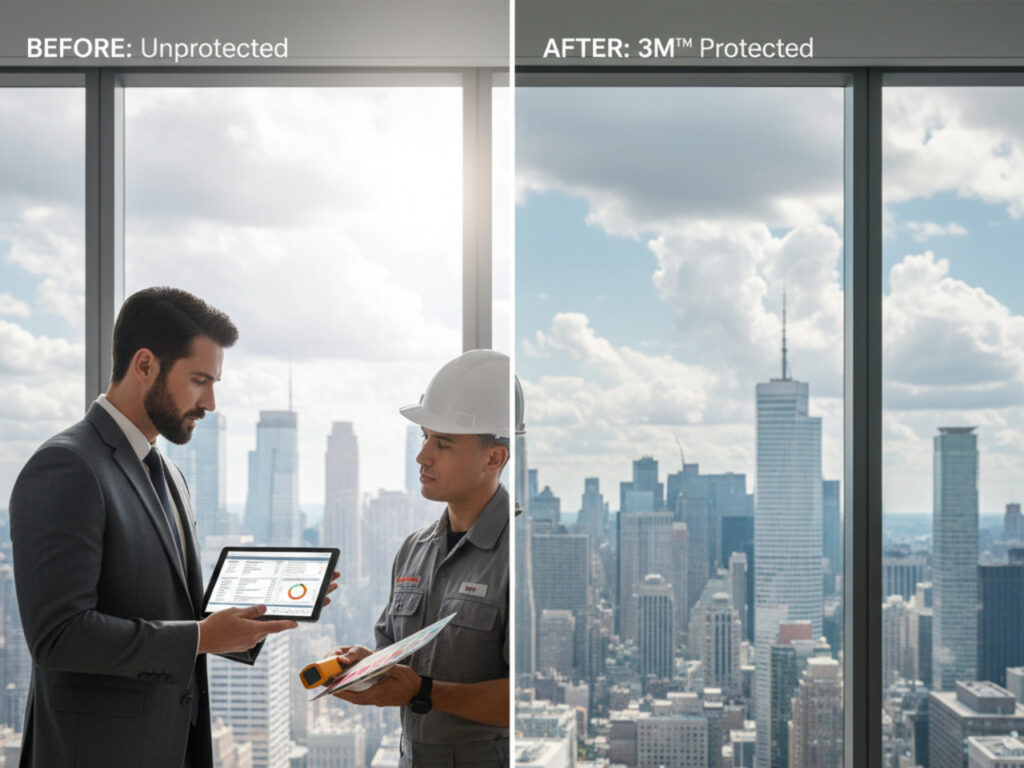
Many believe factory-tinted glass offers superior UV protection for commercial buildings. While these tints reduce heat and glare, their primary function is often aesthetic. Their UV blocking capabilities vary significantly and are rarely engineered for total rejection. This level of filtration is insufficient for protecting high-value assets over the long term. Adding a specialized 3M film ensures much more consistent and comprehensive protection.
Advanced UV protection window film technology, particularly high-performance laminates like 3M films, is specifically designed with proprietary multi-layered constructions and UV absorbers. These films are engineered to selectively filter the solar spectrum, allowing desirable visible light while rejecting up to 99.9% of both UVA and UVB rays. This precise engineering provides a level of protection that factory tints simply cannot match, establishing a clear technical advantage for film solutions in critical applications.
The Illusion of Protection: Why Clear Glass Can Still Cause Significant Damage
The appearance of clear glass often contributes to the illusion of safety. If the glass is transparent and allows ample visible light, it is frequently assumed to be harmless. However, as previously established, the most damaging portion of the UV spectrum, UVA, passes through clear glass largely unimpeded. This means that a vibrant display in a retail storefront or custom furnishings in an executive suite, bathed in seemingly benign natural light, are still actively deteriorating.
Ongoing exposure leads to a slow, methodical degradation that becomes strikingly visible over time. This gradual damage results in substantial financial depreciation and undermines high-value quality standards. Without a dedicated UV barrier, standard glass remains clearly vulnerable to damage. Relying solely on standard glazing for UV protection represents a critical oversight for large projects. Modern glass does not inherently provide adequate protection against the full UV spectrum. Specifying and professionally installing 3M UV film is an essential risk mitigation strategy. It safeguards capital investments and ensures the sustained value of the built environment.
The Science of Protection: Decoding UV Rejection Specifications for Project Managers
What 99.9% UV Rejection Truly Means for Your Project’s Longevity
Project managers overseeing large-scale installations must understand UV rejection specifications effectively. A 99.9% UV rejection signifies a near-total block of damaging UVA and UVB radiation. This level of protection far exceeds what standard insulated glass units provide. Achieving this threshold directly extends the longevity of expensive interior assets. It prevents premature fading, discoloration, and material degradation in commercial settings. This represents a crucial safeguard against substantial financial loss from asset fade. Such performance aligns perfectly with client demands for preserving their high-value investments.
Differentiating the Spectrum: UV, Visible Light, and Infrared Energy Management
Effective solar control is not merely about blocking all sunlight, it is about intelligently managing the different components of the solar spectrum. This spectrum is primarily composed of three distinct energy bands, each with unique characteristics and implications for building performance and occupant comfort:
- Ultraviolet (UV) Light: This short-wavelength radiation, ranging from 100 to 400 nanometers (nm), is responsible for material degradation and skin damage. High rejection is critical for asset preservation.
- Visible Light: Ranging from approximately 400 to 700 nm, this is the light we perceive. Optimizing its transmission is essential for maintaining natural daylighting and views without excessive glare.
- Infrared (IR) Energy: Beyond 700 nm, IR is primarily felt as heat. Effective IR rejection is crucial for reducing solar heat gain, which directly impacts HVAC loads and energy consumption.
A sophisticated window film solution differentiates these spectral components, allowing for precise control over heat, light, and UV without compromising one for the other.
Inside Spectrally Selective Films: Precision Engineering for Optimal Performance
Spectrally selective films represent the pinnacle of modern window film technology. They selectively filter specific wavelengths instead of just darkening the glass. Multi-layer optical technology uses hundreds of microscopic layers to manage solar energy. These layers reflect heat and UV rays while allowing visible light through. This offers exceptional heat rejection and near-total UV protection simultaneously. The film maintains optical clarity and a virtually unnoticeable aesthetic. Project managers can enhance occupant comfort and reduce energy costs without compromising light. This technology protects assets while maintaining the building’s original exterior appearance.
Performance Metrics: Durability, Clarity, and Long-Term Asset Preservation
Evaluating window film performance extends beyond its initial UV rejection percentage. A holistic assessment requires examining several key metrics that dictate long-term effectiveness and client satisfaction.
- Durability: Professional-grade films are engineered for resilience. This includes robust scratch-resistant coatings that protect against everyday wear, and advanced adhesive systems designed to prevent bubbling, peeling, or delamination over years of exposure to environmental stressors. A strong manufacturer’s warranty is often indicative of this inherent durability.
- Clarity: Optical clarity ensures that the film does not introduce haze, distortion, or color shift, preserving the quality of natural light and views. High-performance films maintain exceptional transparency, which is critical for projects where aesthetics and unobstructed visibility are paramount, such as retail storefronts or high-end office spaces.
- Long-Term Asset Preservation: The culmination of high UV rejection, spectral selectivity, durability, and clarity is effective, long-term asset preservation. By minimizing UV exposure and mitigating solar heat gain, these films significantly slow down the degradation of interior materials, safeguarding the value and appearance of everything from inventory and displays to furniture and flooring. This preventative measure avoids costly replacements and upholds the project’s aesthetic integrity for years.
Industry Standards and Certifications: Ensuring Compliance and Reliability
Specifying window films for large projects necessitates adherence to established industry standards and a reliance on certified product performance. These benchmarks provide project managers with an objective means of evaluating film quality, ensuring compliance with building codes, and verifying manufacturers’ claims. Key considerations include:
- National Fenestration Rating Council (NFRC) Ratings: The NFRC provides unbiased performance ratings for fenestration products, including window films. These ratings detail critical metrics such as Solar Heat Gain Coefficient (SHGC), Visible Light Transmittance (VLT), and U-factor, allowing for direct comparison of energy performance.
- Manufacturer Warranties: Reputable manufacturers back their products with comprehensive warranties covering film failure, delamination, bubbling, and often, fading. These warranties are a testament to product quality and offer long-term assurance for the client’s investment.
- Product Testing and Certifications: Films should undergo rigorous testing for various properties, including UV transmission, tensile strength, and adhesive performance. Certifications from recognized bodies confirm that a product meets specific performance criteria and safety standards, which is vital for risk mitigation on any project.
Strategic Specification: Harnessing 3M™ Advanced Film Technology for Superior Asset Preservation
An Overview of 3M™ Sun Control Window Film Series: Prestige, Ceramic, and Night Vision
3M™ Sun Control Window Films are recognized for their advanced engineering and comprehensive performance across diverse project requirements. Understanding the core characteristics of each series allows for precise selection tailored to specific client needs and facility types.
- 3M™ Prestige Series: Utilizing proprietary multi-layer optical film technology, Prestige films are non-metallized and non-corrosive, offering exceptional heat rejection without altering the building’s exterior or interior appearance. They are celebrated for their high visible light transmission, low reflectivity, and superior clarity, making them ideal where aesthetics and natural light are paramount.
- 3M™ Ceramic Series: These films are also non-metallized, providing excellent heat rejection and glare control with a more natural, subtle appearance. Their ceramic composition ensures durability and signal-friendly performance, making them suitable for buildings with wireless connectivity requirements.
- 3M™ Night Vision Series: Designed to enhance daytime privacy and significantly reduce glare, Night Vision films offer good solar heat rejection and a darker tint that still allows for clear outward views, especially at night. This series balances performance with a more pronounced aesthetic impact.
Each series delivers the critical 99.9% UV rejection essential for preventing asset fade.
Tailoring Solutions: Matching Specific 3M™ Films to Commercial, Retail, and Education Facility Needs
Strategic film selection involves aligning the unique attributes of 3M™ film series with the distinct operational and aesthetic demands of various commercial environments.
- Retail Environments: For storefronts and display windows, the 3M™ Prestige Series is often the optimal choice. Its high visible light transmission ensures merchandise remains vibrant and visible, while its superior UV and IR rejection safeguards products from fading and reduces heat, enhancing customer comfort without compromising natural light.
- Office Buildings: The 3M™ Ceramic Series or select Night Vision films can address common office pain points. Ceramic films provide excellent glare reduction and heat control, contributing to a more comfortable and productive workspace without a dark, tinted appearance. Night Vision films are beneficial for perimeter offices requiring enhanced daytime privacy and reduced glare on computer screens.
- Educational Facilities: Here, a combination of sun control and often, safety and security features are crucial. While the primary goal might be to reduce heat gain and glare in classrooms for student comfort and focus, films like those from the Prestige or Ceramic series deliver vital UV protection for classroom materials, furniture, and IT equipment. These films also contribute to energy efficiency, directly impacting operational budgets.
Beyond UV Blocking: Integrating Solar Heat Gain Reduction and Glare Control for Comprehensive Benefits
High-performance 3M window films offer integrated advantages that significantly enhance building performance. Solar heat gain reduction directly lowers cooling costs and HVAC loads. These energy savings provide a tangible return on investment for project stakeholders. Effective glare control creates more comfortable interiors by minimizing eye strain. This improves visibility in spaces with computer screens or direct sun exposure. These benefits extend beyond asset preservation to improve occupant comfort and facility aesthetics. This comprehensive approach addresses multiple client demands through a single, efficient solution.
Need More Info?
The Window Film Depot team is happy to help.
The Role of 3M™ Films in Achieving Sustainability Goals and LEED Credits
Integrating 3M™ advanced window films into project designs offers a clear pathway toward achieving sustainability goals and earning LEED credits. By substantially reducing solar heat gain, these films minimize energy consumption for cooling, directly contributing to credits in the “Energy and Atmosphere” category.
Additionally, by optimizing daylighting and mitigating glare, these films support credits related to “Indoor Environmental Quality.” Specifying these solutions demonstrates a commitment to sustainable building practices, enhancing both the project’s environmental profile and its long-term operational efficiency.
Exploring Commercial Window Film for Fading Solutions with 3M™ Technology
When a client’s primary concern is fading, the answer is advanced 3M™ Sun Blocking Window Film technology. The engineering behind the Prestige, Ceramic, and Night Vision series guarantees that nearly all damaging UV radiation is blocked. This extreme rejection, combined with superior solar heat control, fundamentally addresses the root causes of interior asset degradation. Recommending 3M™ films is a strategic investment in preventative maintenance for project managers. It ensures that high-value assets, from retail merchandise to fine art, retain their original quality for years. This commitment to preservation solidifies long-term project value and guarantees client satisfaction.
Seamless Integration at Scale: The Indispensable Role of Expert Installation for Large Projects
The Complexities of Large-Scale Commercial Window Film Application
Executing advanced UV protection for large-scale projects introduces challenges beyond simple film application. Project managers must navigate vast square footage, diverse window designs, and strict timelines while maintaining operational continuity. This complexity requires a partner capable of managing intricate logistics and multi-zone coordination. Standard window tinting services often lack the consistency required for these demanding environments. In large ventures, the margin for error is minimal; minor inconsistencies can jeopardize aesthetics, performance, and long-term costs. Professional management ensures a unified standard that protects both the building’s appearance and the client’s investment.
Ensuring Consistency and Quality Across Diverse Building Envelopes and Fenestration Types
Maintaining uniform performance across large-scale deployments requires a nuanced understanding of diverse window glazing systems. Modern commercial buildings often combine insulated units, tempered glass, and specialized Low-E coatings, each reacting differently to film application. Selecting the wrong film for a specific glass type can lead to thermal stress or adhesion failure.
Achieving a seamless aesthetic without visible imperfections requires highly skilled technicians who can align film specifications with the building’s envelope. This precision is essential for preserving a cohesive architectural vision and brand image across multiple sites.
The Unparalleled Value of a National, Certified 3M™ Window Film Installer
For significant commercial undertakings, partnering with a national, certified 3M™ Window Film Installer is a strategic imperative. This certification ensures the installer adheres to rigorous training, manufacturer specifications, and proprietary techniques for optimal durability.
A national presence provides standardized processes and efficient coordination across geographically dispersed sites. For project managers, this offers a unified point of contact, significantly de-risking the installation phase. It provides total confidence that the UV protection will meet its performance metrics consistently across the entire portfolio.
Leveraging Window Film Depot: Why #1 U.S. 3M™ Installer Status Matters for Your Timeline and Budget
Window Film Depot’s status as the #1 U.S. 3M™ Installer translates directly into tangible benefits for project managers focused on timelines and budgets. This preeminent position is indicative of unparalleled experience and operational efficiency in managing large, complex installations. Our extensive network and proven methodologies allow for:
- Expedited Project Timelines: With seasoned crews and robust project management capabilities, installations are completed efficiently, minimizing disruption and helping meet aggressive project schedules.
- Optimized Budget Management: Our scale and expertise lead to reduced material waste, fewer re-dos, and long-term film performance that mitigates future maintenance or replacement costs. This directly contributes to a stronger return on investment for the client.
- Logistical Superiority: The capacity to coordinate across multiple locations, managing material delivery and crew deployment, ensures seamless execution for national retail rollouts or multi-building campuses.
By leveraging Window Film Depot’s expertise, project managers secure a partner capable of executing advanced UV protection solutions with precision, efficiency, and a deep understanding of commercial project demands.
Warranty Assurance and Long-Term Performance Guarantees
A fundamental component of any significant project investment is the assurance of long-term performance and robust warranty coverage. Professional installation by a certified 3M™ installer is the prerequisite for validating 3M’s comprehensive manufacturer-backed warranties. These warranties cover not only the film product itself but also the installation, safeguarding against issues such as bubbling, peeling, cracking, or delamination. In contrast, generic films or amateur installation often come with limited or non-existent warranties, leaving project owners exposed to significant financial risks if the product fails prematurely. Partnering with a reputable installer like Window Film Depot ensures that any warranty claims, however rare, are handled efficiently, providing peace of mind and protecting the client’s investment in advanced UV protection for decades.
Conclusion: Safeguarding Investments with Proactive UV Mitigation Strategies
Reaffirming the Project Manager’s Pivotal Role in Comprehensive Asset Protection
As Project Managers, your responsibility extends beyond structural integrity and immediate functionality. It encompasses the long-term preservation of your client’s investments, ensuring that interior assets retain their value and aesthetic appeal for the entire lifespan of the building. Recognizing and actively mitigating the silent threat of UV radiation is not merely a detail, it is a fundamental component of comprehensive asset protection and a testament to meticulous project planning. Proactively addressing UV exposure through advanced film technology directly translates to client satisfaction, preventing the premature degradation of high-value items such as retail merchandise, delicate artwork, office furnishings, and expensive flooring.

Summarizing the Tangible Benefits of Professional-Grade 3M™ UV Films for Large-Scale Projects
Implementing professional-grade 3M™ UV films offers a multifaceted solution that goes far beyond basic window tinting. These specialized films provide a critical layer of defense, delivering demonstrable economic and functional advantages for any large-scale commercial or institutional project.
Here are the primary benefits observed:
- Near-Total UV Rejection: Superior 3M films block up to 99.9% of harmful UVA and UVB radiation, dramatically slowing the fading and deterioration of interior assets. This far exceeds the capabilities of standard glazing or residential-grade solutions.
- Asset Longevity and Value Preservation: By preventing asset fade, these films protect inventory, displays, and décor from costly damage, safeguarding your client’s financial outlay. This directly translates to avoiding depreciation and replacement costs.
- Enhanced Occupant Well-being: While primarily focused on asset protection, reducing UV exposure also contributes to a healthier indoor environment for occupants by minimizing skin and eye damage risks.
- Reduced Operational Costs: The mitigation of asset degradation lessens the need for frequent replacements or refurbishment, leading to significant long-term operational savings for the building owner.
- Meeting Stringent Client Demands: For projects with specific requirements for art galleries, museums, luxury retail, or high-end office spaces, these films provide a verifiable solution to protect sensitive materials, meeting and exceeding client expectations.
The Strategic Advantage of Partnering with Specialized Experts like Window Film Depot
The efficacy of advanced UV protective films is intrinsically linked to their precise application and correct specification. This is where partnering with specialized experts like Window Film Depot becomes a strategic imperative, rather than a mere convenience. Our teams possess the in-depth knowledge of 3M product lines and the technical expertise required for flawless installation on large-scale architectural projects. This ensures that the chosen film performs to its maximum potential, adhering to all manufacturer specifications and warranty conditions. Relying on certified professionals guarantees the longevity and performance of the film, providing peace of mind and protecting the integrity of your project from inception through its operational life. Our partnership eliminates the risks associated with improper selection or installation, translating directly into reliable asset protection and predictable project outcomes for UV protection for glass windows.
The Future of Building Protection: Evolving Film Technologies and Building Demands
The landscape of building design and functionality is constantly evolving, with increasing demands for sustainability, occupant comfort, and asset protection. Advanced film technologies, particularly those developed by 3M, are at the forefront of meeting these future requirements. As environmental challenges and client expectations continue to intensify, the integration of high-performance films will shift from being an advantageous add-on to a foundational element of responsible building design. These films are not just about UV protection, they are part of a broader suite of solutions that contribute to energy efficiency, enhanced security, and improved aesthetic appeal. Project Managers who proactively adopt these evolving technologies position their projects as future-proofed, delivering superior long-term value and sustained performance in a dynamic market.
From Theory to Application: Illustrative Scenarios of Advanced UV Protection in Action
The theoretical benefits of advanced UV protection films become critically apparent when applied to specific commercial environments. Understanding how to block UV rays from windows effectively is about more than just comfort; it is about safeguarding valuable assets and ensuring client satisfaction.
Protecting High-Value Merchandise in National Retail Rollouts
In retail environments, merchandise is the core asset, and its presentation directly impacts sales. Luxury apparel, electronics, furniture, and other high-value items are particularly susceptible to irreversible damage from UV radiation. Fading protection, discoloration, and material degradation reduce perceived value, leading to markdowns, returns, and significant financial losses. Implementing advanced 3M UV protection film across national retail rollouts is a proactive strategy to extend the lifespan of merchandise, maintain aesthetic integrity, and preserve profit margins, directly addressing client demands for asset preservation.
Preserving Educational Resources and Artwork in Academic Institutions
Academic institutions, libraries, and museums house invaluable collections of books, historical documents, artwork, and textiles that are highly vulnerable to UV exposure. Prolonged sunlight can cause paper to yellow and become brittle, dyes in fabrics to fade, and pigments in paintings to degrade. These changes are often irreversible, diminishing the historical, educational, and monetary value of the collections. Strategically applied 3M UV blocking film offers a transparent, non-invasive solution to filter out virtually all harmful UV radiation, ensuring the long-term preservation of these irreplaceable resources without compromising natural light.
Enhancing Comfort and Productivity in Modern Commercial Office Spaces
Modern office designs frequently incorporate extensive glazing to maximize natural light and views. While aesthetically pleasing, this also exposes interiors to significant UV radiation, leading to faded office furnishings, carpet degradation, and potential health concerns for occupants. Beyond asset protection, unmitigated UV exposure can contribute to discomfort, eye strain, and increased air conditioning loads due to solar heat gain. Advanced 3M films offer a multi-faceted solution, providing near-total UV rejection alongside glare reduction and thermal control, thereby enhancing occupant comfort, protecting interior assets, and contributing to a more productive and energy-efficient workspace.
Mitigating Risk in Architectural Designs with Extensive Glazing
Contemporary architectural trends favor expansive glass facades and skylights, creating stunning visual statements but also presenting inherent risks from solar radiation. Without proper UV mitigation, new constructions or renovations with extensive glazing face accelerated fading of all interior elements, from flooring and wall coverings to custom fixtures and upholstery. Integrating high-performance UV protective films early in the design or construction phase is an essential risk mitigation strategy. It safeguards the project’s aesthetic and financial investment from day one, ensuring the longevity of interior finishes and upholding the design intent for years to come.
Practical Strategies for How to Block UV Rays from Windows in Diverse Commercial Environments
Effectively blocking UV rays in commercial settings requires a deliberate, strategic approach, moving beyond reactive measures to proactive planning.
Needs Assessment and Specification
The initial step involves a thorough assessment of the specific commercial environment, identifying the types of assets at risk, the degree of UV exposure, and any additional performance requirements (for example, heat reduction, privacy, security). This analysis informs the precise specification of the appropriate 3M window film, which can range from virtually clear films designed solely for UV rejection to more comprehensive solutions offering solar control and enhanced security.
Professional Consultation and Installation
Engaging a certified 3M installer, such as Window Film Depot, early in the project lifecycle is crucial. Their expertise allows for detailed site surveys, accurate measurements, and the development of a tailored installation plan that adheres strictly to 3M’s application protocols. This professional approach guarantees optimal performance and maximizes the film’s lifespan.
Long-Term Performance and Maintenance
Once installed, 3M advanced UV protection films are designed for exceptional durability and require minimal maintenance, typically just standard window cleaning. This long-term performance ensures a sustained return on investment by continually protecting interior assets, reducing energy costs, and maintaining the aesthetic integrity of the commercial space without ongoing operational burdens.
Frequently Asked Questions
What level of UV protection do 3M window films provide for commercial properties?
3M Sun Control Window Film offers up to 99.9% rejection of both UVA and UVB radiation, which is significantly higher than what standard glass provides. This near-total UV blocking film protection is crucial for preventing asset degradation and protecting occupants.
How do 3M films help reduce financial losses from fading merchandise?
By blocking almost all harmful UV rays, 3M films dramatically slow the fading and deterioration of retail merchandise, office furnishings, and other interior assets. This helps preserve product value, reduces the need for markdowns, and avoids costly premature replacements, directly impacting a client’s bottom line.
Are 3M window films only for UV protection, or do they offer other benefits?
While paramount for UV protection for glass windows, 3M films offer integrated benefits, including solar heat gain reduction, which lowers cooling costs and improves energy efficiency. They also provide glare control for enhanced occupant comfort, and certain series can maintain natural light and aesthetics without significant tinting.
Can 3M window films contribute to LEED certification?
Yes, integrating 3M advanced window films can contribute to LEED (Leadership in Energy and Environmental Design) credits, particularly in the “Energy and Atmosphere” category by reducing energy consumption for cooling. They can also support “Indoor Environmental Quality” credits by improving occupant comfort and promoting effective daylighting.
Why is professional installation crucial for large commercial window film projects?
Professional installation by a certified 3M installer, such as Window Film Depot, ensures consistent quality, adherence to manufacturer specifications, and optimal film performance across diverse fenestration types and large square footage. This expertise is vital for validating 3M’s comprehensive warranties, mitigating project risks, and guaranteeing the long-term effectiveness of the UV protection solution.