Table of Contents:
- Why Apartment Window Film Is a Smart Upgrade in 2026
- Key Benefits of Apartment Window Films (Privacy, Comfort, Savings)
- Types of Window Films for Apartments (How to Pick the Right Film)
- Privacy Window Film Options for Renters
- One-Way and Reflective Films: How They Really Work
- Energy Efficiency and Heat Control in High-Rise Apartments
- Maintaining Clear Views While Adding Film
- Installation in Rented Apartments: Rules, Leases & Landlords
- How Professional Installation Works (Step-by-Step with Window Film Depot)
- Common Mistakes to Avoid with Apartment Window Film
- Why Choose Window Film Depot for Apartment Window Films
- FAQs About Apartment Window Film
- Next Steps: Get a Quote or Wholesale Supply
Why Apartment Window Film Is a Smart Upgrade in 2026
If you live or work in a multi-family building, you already know the problem: rising utility costs, hotter summers, more hours spent working from home, and neighbors close enough to wave at through your windows. Apartment window film addresses all of these things at once, and it does so without a single pane of glass being replaced.
Modern window films can add privacy, improve energy efficiency, block UV radiation, and make your space more comfortable year-round. Whether you’re a renter in a studio, a condo owner on the 30th floor, or a facility manager responsible for hundreds of units across multiple buildings, the right film turns existing glass into a high-performance surface.
Window Film Depot is a family-owned, national 3M window film dealer and installer based in Marietta, Georgia, providing professional solutions for residential multi-family and commercial properties since 1992. In the sections ahead, you’ll find the details you need to choose a film, understand installation, navigate lease restrictions, and avoid common mistakes.
Key Benefits of Apartment Window Films (Privacy, Comfort, Savings)
A thin layer of film applied to your existing glass can transform an apartment without any structural changes. Here’s what that means in practice.
UV and fading protection. UV protection films block up to 99% of harmful UV rays, which is essential for people spending long hours near windows. That kind of rejection protects hardwood floors, artwork, and furniture from UV-related fading-a serious concern in south- or west-facing units in cities like Atlanta or New York where sunlight pours in for hours. It also reduces UV exposure on your skin during extended time at a home office desk.
Heat and glare control. Window films help control heat and reduce glare in indoor spaces, making screens easier to read and rooms more comfortable during bright midday sun. If you’ve ever had to close curtains just to see your laptop, solar control film solves that problem while keeping the view.
Thermal comfort and savings. Properly selected solar control films can reduce summer heat gain significantly, helping HVAC systems work less-especially in top-floor and corner units loaded with glass. Window films can improve energy efficiency in apartments by lowering peak cooling loads, which translates to real savings on utility bills over time.
Privacy and safety. Decorative films can enhance aesthetics and maintain privacy without obscuring light, while safety and security films hold shattered glass together to protect occupants. Clear or nearly invisible films exist for residents who don’t want a dark or mirrored look, and decorative privacy films can add style in bathrooms and street-facing bedrooms.
Additionally, building owners can scale these benefits across hundreds of units for portfolio-wide comfort and efficiency gains, making apartment window film one of the most cost-effective retrofit upgrades available.
Types of Window Films for Apartments (How to Pick the Right Film)
“Window films” is a broad category. Choosing the right film depends on your goals: privacy, heat control, safety, aesthetics, or a combination. Here’s a reference guide to the major types.
Solar control films are designed to manage heat and glare. They’re usually lightly tinted or have a subtle reflective layer, and they work best on sun-exposed façades of multi-story buildings. High-performance models can reject 60–70% of total solar energy while still letting in useful brightness.
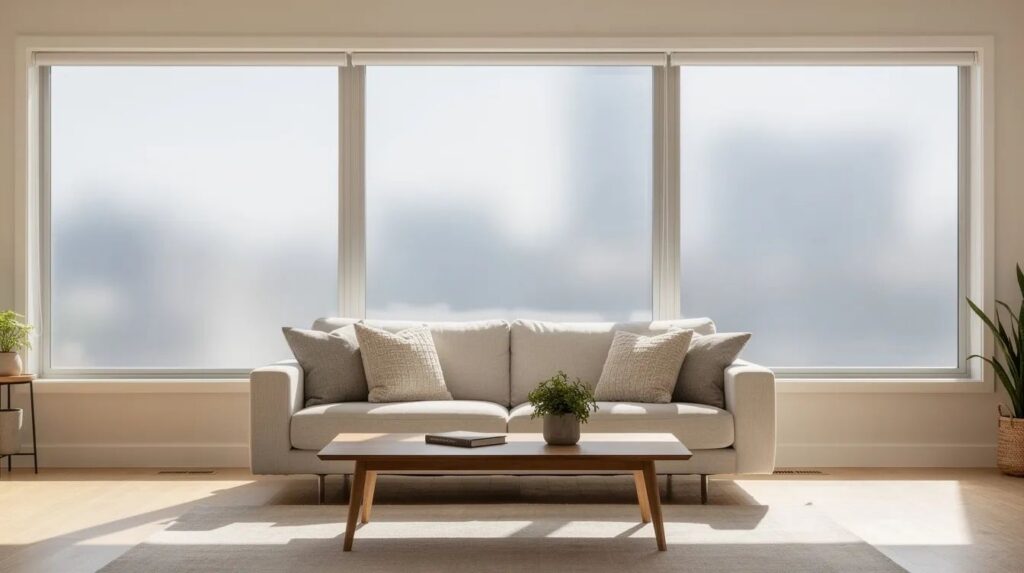
Privacy films include frosted, matte, or patterned options that obscure views from both sides. They’re ideal for bathrooms, street-facing windows, and situations where a neighboring building sits just a few feet away. Frosted films provide total bathroom privacy while allowing natural light to enter.
One-way and reflective films use metallic or ceramic layers to create a mirror effect on the exterior side during the day, offering privacy without sacrificing outward views from inside. Performance depends heavily on lighting conditions, which we’ll cover in detail below.
Safety and security films are thicker, multi-ply polyester products that hold glass together against impact, storms, or attempted break-ins. Safety and security films help hold shattered glass together and deter intruders, and they’re commonly applied to ground-level or lobby glazing in apartment buildings.
Decorative and branded films include patterns, gradients, colors, printed graphics, and custom designs used to enhance lobby glass, amenity spaces, and interior partitions.
Window Film Depot supplies and installs 3M and other high-performance products, and can help match film type to building codes, HOA rules, and façade appearance requirements.
Privacy Window Film Options for Renters
Renters face a specific set of challenges: close neighbors, street-level units, and lease agreements that restrict permanent changes. The good news is that privacy window film has come a long way for people in exactly this situation.
Static cling films are non-adhesive and offer easy installation and removal, making them a strong renter-friendly option. You press them onto clean glass, and they hold through surface tension-no adhesive residue when you remove them at lease end. Many window films are designed to be renter-friendly and removable, so you don’t need to worry about damage deposits.
Popular styles include a frosted “etched glass” look for bathroom windows offering privacy without blocking natural light, gradient films that cover the bottom half of bedroom windows while leaving the top open, and patterned designs that let light diffuse through while obscuring details. Imagine a first-floor bathroom in New York City facing an alley: a frosted film gives you complete privacy day and night without making the room feel like a cave. Or consider a Chicago high-rise balcony door with direct neighbor sightlines-a gradient film handles the problem elegantly.
Keep in mind that fully frosted films block views entirely, while lightly textured films obscure shapes but may still show silhouettes at night when interior lights are on. For renters wanting adhesive-backed films with stronger performance, the path forward is talking to your landlord or property manager. Present privacy film as a reversible upgrade that reduces complaints and improves tenant satisfaction. Window Film Depot can work directly with building owners to approve standard film specs across all apartments in a property.
One-Way and Reflective Films: How They Really Work
“One-way window film” is one of the most searched terms in this category, but the name can be misleading. No standard film gives you a true one-way mirror around the clock. Performance depends on light levels, not magic.
Here’s how it works: reflective films create a mirror effect on the brighter side of the glass. During the day, outdoor sunlight is far stronger than indoor lighting, so the exterior surface acts like a mirror. People outside see their own reflection while you enjoy a clear view from inside. Reflective films provide daytime privacy by creating a one-way mirror effect, and many apartment residents in sunny climates rely on them.
At night, the equation flips. With lights on inside and darker conditions outdoors, privacy is reduced or reversed-silhouettes and room details become visible from outside. This means you’ll still need curtains or blinds for nighttime privacy. No standard film can give perfect night privacy with lights on and full outward clarity at the same time.
A real-world example: a resident in Dallas using reflective film on west-facing living room windows gets strong daytime privacy and meaningful heat rejection. But once the sun sets and lamps go on, they draw the shades.
When comparing reflective one-way style films to non-reflective privacy films, the trade-offs come down to aesthetics, HOA acceptance, and how much tint you’re comfortable with. Window Film Depot typically recommends reflective films for high-rise façades, office conversions, and glass-heavy living rooms. For units where exterior appearance rules are strict, a dual-reflective or frosted product may be a better solution.
Energy Efficiency and Heat Control in High-Rise Apartments
Floor-to-ceiling glass in modern apartment towers looks stunning, but it creates real problems: hot spots near windows, high cooling bills, and temperature complaints from tenants in sun-facing units. Solar control window films address this directly.
These films reduce solar heat gain by reflecting and absorbing infrared energy before it enters the space. High-performance models can reject up to 60–70% of total solar energy. Some films can reduce temperature swings in rooms with large windows, which is particularly valuable in corner units or penthouses with glass on multiple exposures. Summer heat can increase the effectiveness of solar window films, meaning the payback is strongest in the months you need it most.
Consider a hypothetical 20-story apartment building in Phoenix that retrofits all south- and west-facing glass with 3M solar control film. Over a 12-month period, the property manager sees fewer tenant comfort complaints, measurable kWh savings, and more stable temperatures across floors. Some property managers track this data on a central server to compare pre- and post-film performance building by building.
Seasonal changes require tailored window film installations. In cities like NYC, seasons affect window film performance-summer demands maximum heat rejection while winter benefits from films that still allow passive solar warmth. Spectrally selective films handle this well: they cut infrared heat from summer sun while preserving visible light and some warming benefit in colder months, so window films can improve energy efficiency in winter as well as summer, and a wide range of window glass film products and brands are available to fine-tune performance for different building types.
Window Film Depot routinely works with facility managers and energy consultants to model savings using manufacturer performance specs and DOE benchmarks. Film is a retrofit glazing solution-no need to replace costly insulated glass units-making it one of the fastest ways to upgrade the building envelope with minimal disruption to occupied apartments.

Maintaining Clear Views While Adding Film
One of the most common fears about apartment window film is that it will darken your windows or ruin your view. For most modern films, that fear is misplaced.
Spectrally selective films are designed to be nearly invisible from inside. They carry a light neutral tint yet still block significant UV and a large portion of infrared heat. Visible light transmittance can exceed 70%, which means the room stays bright and the view stays sharp. These products are popular for skyline or waterfront apartments where view quality is non-negotiable.
Films can actually improve perceived clarity by cutting harsh glare and reducing reflections on interior surfaces, making outdoor details easier to see during bright conditions. A high-floor apartment overlooking Lake Michigan in Chicago, for instance, benefits from a light neutral film that eliminates the washed-out brightness of direct sun without sacrificing the panorama.
Concerns about distortion, haziness, or bubbling come down to two things: film quality and installation skill. High-quality products from manufacturers like 3M maintain optical clarity and durability over many years. Professional installation eliminates the creases, trapped air, and peeling that plague cheap DIY attempts.
For cleaning filmed windows, use a soft cloth and non-abrasive cleaners-no razor blades or ammonia-based sprays on the film surface. After installation, expect a cure time of several days to a few weeks depending on film type and climate; minor haziness during this period is normal and resolves on its own. Window Film Depot regularly installs films on Class A multifamily towers and luxury condos where clear views are essential, and can recommend specific products for premium vistas.
Installation in Rented Apartments: Rules, Leases & Landlords
Many renters worry whether they’re even allowed to install window film. The answer depends on your lease and your approach.
Start by reviewing your lease for clauses about window alterations, exterior appearance changes, and damage to glazing. If the language is unclear, request written permission from your landlord or property manager before proceeding. Non-adhesive static cling films generally fall outside most restriction clauses because they leave no residue and can be removed in minutes. Professionally installed adhesive films offer better performance but typically require building management approval.
When approaching your landlord, lead with the benefits: reduced heat complaints, lower energy usage on shared utilities, improved curb appeal, and zero structural changes, especially if you’re concerned about the best window film for nighttime privacy in bedrooms and living rooms. Frame it as an upgrade, not a modification. Suggest using a building-standard film installed by a trusted provider like Window Film Depot to keep the exterior appearance consistent across units.
Common landlord concerns include uniform look from outside, risk of glass damage, and warranty questions. A professional installer addresses all three by choosing manufacturer-approved films for the specific glass type in the building and providing warranty documentation.
Condo and co-op owners should check HOA rules, architectural guidelines, or façade committee requirements that may limit reflective films or certain tint levels. Window Film Depot can assist with specification documents, sample submittals, and small demo installations so boards and owners can see and approve the film before a complete roll-out.
How Professional Installation Works (Step-by-Step with Window Film Depot)
Professional installation ensures smooth, bubble-free results, protects glass warranties, and keeps disruption minimal for occupied apartments. Expert installation can enhance window film performance significantly compared to DIY attempts.
Consultation. The process starts with an initial consultation-onsite or virtual-to understand your goals, inspect existing glass types, and recommend specific films from 3M and other lines. This is where the installer determines whether your windows are single-pane, double-pane, low-E, or tempered, and which products are safe to apply.
Site assessment. For multi-unit properties, the team takes precise measurements, reviews access points (elevators, loading docks, parking), and coordinates scheduling with building management to minimize tenant disruption.
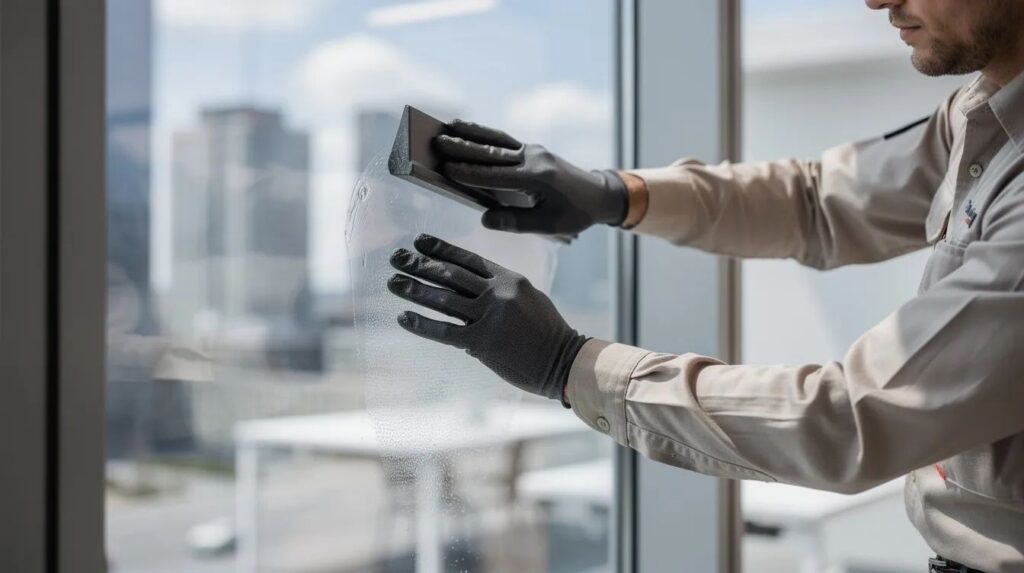
Installation day. Installers protect floors and furniture with drop cloths, then thoroughly clean each pane of glass. Film is cut to size, applied with a slip solution, and a squeegee is used to push out water and air for a perfectly smooth finish. Edges are trimmed for a clean, nearly invisible look.
Timelines. A small apartment may be complete in a few hours. A multi-building project might be phased across days or weeks so that no single floor is disrupted for long.
Safety and insurance. Professional installers ensure proper application of window films, and fully insured teams provide peace of mind during installation. Window Film Depot’s crews are experienced with high-rise, institutional, and government work-the same standards applied to schools and healthcare buildings carry over to your apartment.
After installation, you’ll receive aftercare instructions, warranty documentation, and a direct contact for any questions. If you spot rare edge lifting or contamination after cure time, the team will correct it promptly.
Common Mistakes to Avoid with Apartment Window Film
The right choices make film a smart investment. A few common missteps, however, can lead to disappointment or damage. Here are the tips that matter most.
Choosing the wrong film for the goal. A decorative frost won’t do much for heat control. A very dark tint might violate building rules or make your space feel gloomy. Match your film to the actual problem you’re solving-don’t buy based on how a product looks on Amazon listings without checking performance specs.
DIY installation on large panes. Cheap films and untrained hands produce bubbles, creases, peeling, and optical distortion that are visible to neighbors and reduce the overall look of the building. Large-pane work is not a weekend project.
Misunderstanding one-way privacy. Many people assume reflective film will give full nighttime privacy. When interior lights are on and it’s dark outside, silhouettes become visible. Plan on using blinds or shades after dark or choosing a day-and-night privacy window film that provides consistent coverage regardless of lighting conditions.
Ignoring glass type and warranty. Some highly absorptive or reflective films aren’t suitable for certain double-pane or low-E glass. Applied incorrectly, they can cause thermal stress or void the glass manufacturer’s warranty. A professional checks compatibility before making any recommendation.
Skipping landlord or HOA approval. Installing film that changes the exterior appearance without permission can result in lease violations, fines, or forced removal. Always get written approval first.
Window Film Depot helps apartment residents and building owners avoid these pitfalls by providing product education, site assessment, and manufacturer-backed specifications before any film is applied, drawing on its experience as a leading 3M window film installer offering a full range of 3M products and installation services.
Why Choose Window Film Depot for Apartment Window Films
Window Film Depot is a family-owned business founded in 1992 in Marietta, Georgia, with over three decades of experience in residential, commercial, and institutional window film projects nationwide, with installation locations and service coverage across all 50 states. That longevity matters-companies that have been doing this work since the early days of modern film technology understand the nuances that newer companies often miss.
The product lineup includes 3M solar control films, privacy films, security glazing solutions, anti-graffiti films, decorative and architectural films, and branded graphics, along with other high-quality window films for safety, anti-graffiti protection, solar control, and decorative privacy. This breadth means you don’t need to juggle multiple vendors for different needs across a property.
For property managers and REITs, Window Film Depot’s strength is in B2B and multi-family execution: managing national roll-outs, coordinating with on-site teams, and ensuring consistent film specifications across buildings in multiple states. Services are turnkey consultation, product selection, project management, installation, and post-installation support, plus wholesale film rolls for glass and glazing trade partners across North America.
Real-world experience backs this up. Window Film Depot has retrofitted large apartment complexes for glare control in Texas, delivered window film installation projects in Washington, DC, and other major metros, added privacy films to street-level units in busy urban corridors to reduce tenant turnover, and handled high-rise installations where access and scheduling are as important as the film itself.
Every installer is fully insured and trained to manufacturer standards. Warranties are backed by both Window Film Depot and the film manufacturers. Whether you’re an individual condo owner or a portfolio property manager, contact Window Film Depot for a customized apartment window film plan, especially if you’re evaluating how one-way mirror and reflective window films work in real projects and what to expect from their performance.
FAQs About Apartment Window Film
Below are answers to the follow-up questions apartment residents and managers ask most frequently.
How long does apartment window film last?
High-quality films from manufacturers like 3M typically last 10–15 years or longer on interior applications. Lifespan depends on sun exposure, glass orientation, and cleaning habits. Films on south- and west-facing windows in hot climates may age slightly faster, but professional-grade products maintain their durability and optical quality well beyond a decade.
Can window film damage my windows or void the glass warranty?
When the right film is matched to the right glass type, the answer is no. Problems arise when highly absorptive films are applied to thermally sensitive glass without checking manufacturer guidelines. Professional installers assess glass composition before choosing a film to prevent thermal stress and protect warranties.
Will privacy window film work at night?
Frosted films provide consistent privacy day and night because they obscure views in both directions regardless of lighting. Reflective films lose their one-way effect at night when interior lights create more brightness inside than outside. If nighttime privacy in a bedroom or living room is essential, combine reflective film with blinds or choose a frosted option.
How much does apartment window film cost?
Pricing varies by film type, window access, and project size. Residential solar control films generally range from $6 to $15 per square foot installed. Large multi-unit projects often see lower per-square-foot costs due to scale. Window Film Depot provides free estimates based on your specific windows and goals.
Can I remove the film when I move out?
Yes. Professionally installed adhesive film can be removed with the right tools and solutions, typically leaving no damage. Static cling films simply peel off. If you’re concerned about residue, a professional removal service ensures the glass is returned to its original condition.
Does window film really help with energy efficiency?
It does. Solar control films reduce solar heat gain, which lowers peak cooling loads and can deliver measurable kWh savings. Studies of commercial buildings have documented cooling load reductions of over 20% with exterior-applied film. In apartment settings, the savings are most noticeable in sun-heavy units, and payback timelines for larger properties can be under two years.
Do you offer wholesale window films for contractors and glaziers?
Window Film Depot supplies wholesale film rolls to glass shops, glazing contractors, and facility service companies across North America. Trade partners get access to a full catalog of 3M and other high-performance films, competitive pricing, and technical support for project specification.
Next Steps: Get a Quote or Wholesale Supply
Apartment window film is one of the fastest, most cost-effective ways to improve privacy, comfort, and energy efficiency without replacing glass. Whether you’re reading this as a renter exploring options for a single room or a property manager evaluating a portfolio-wide retrofit, the next step is straightforward.
For apartment renters and owners: Contact Window Film Depot for a free consultation or estimate. Have your city, approximate window sizes, photos, and goals (privacy, heat control, UV protection) ready to streamline the process.
For property managers and institutional buyers: Schedule a building walk-through, portfolio review, or pilot installation on one façade or set of units to see the results before committing to a full roll-out.
For trade partners: Glass shops, glazing contractors, and facility service companies can source high-performance window films wholesale through Window Film Depot with nationwide coverage and technical support.
Reach out by phone, email, or the contact form on the Window Film Depot website. In a market where building performance demands and occupant comfort expectations keep rising, partnering with an experienced window film specialist positions your property for the next decade.