Table of Contents:
- Why Commercial Privacy Window Tint Is a Specification Decision, not a Decorative Upgrade
- Privacy Film Types Compared: A Commercial Specification Framework
- Performance Specifications That Define Commercial-Grade Privacy Window Film
- Compliance, Safety Standards, and Certification
- Professional Installation vs. DIY: Why Enterprise Scale Changes Every Variable
- Privacy Window Tint Applications by Sector
- Total Cost of Ownership: What Commercial Privacy Film Projects Actually Cost at Scale
- Conclusion: Specification Confidence at Scale
- Frequently Asked Questions
Why Commercial Privacy Window Tint Is a Specification Decision, not a Decorative Upgrade
Privacy Window Tint failures on commercial projects rarely start during installation. Most problems begin when teams specify film based on appearance instead of performance, compliance, and substrate compatibility. Commercial environments place far greater demands on privacy window film than residential applications, including thermal cycling, institutional cleaning, warranty requirements, and code compliance. This blog explains how specification decisions affect long-term film performance, project risk, and installation success across commercial environments.
The Hidden Risk of Treating Privacy Film as a Consumer Product on Commercial Projects
Most privacy film failures on commercial projects don’t start at installation. They start at procurement. A project manager sources film through a retail channel, a general contractor pulls a familiar SKU, or a facilities team orders based on appearance rather than performance data. The product arrives, gets installed across several thousand square feet, and within 18 months the film is delaminating, the adhesive is failing on low-e glass, or a compliance review flags the installation as non-conforming.
Consumer-grade film is engineered for residential light duty: flat glass, controlled environments, low UV exposure, and tolerant end users. Commercial environments impose conditions that consumer film is not rated for, including HVAC-driven thermal cycling, high-traffic surface contact, institutional cleaning protocols, and in many cases, code-compliance requirements that consumer products simply don’t document.
The downstream cost of this mismatch is rarely just the film. It includes removal labor, surface remediation if adhesive has bonded incorrectly, re-specification, and schedule impact on dependent trades.
How Specification Failures Cascade
A misspecified film creates a chain of problems that compounds at scale. The most common failure sequence: a non-pressure-sensitive adhesive film is applied to a coated glazing system it wasn’t rated for, the bond degrades under thermal stress, and bubbling or edge-lift begins within the first heating season. On a single-location project, that’s a rework line item. On a 40-location retail rollout, it’s a project-defining budget event.
Adhesive selection is particularly consequential. Most commercial-grade privacy window film uses a dry-adhesive system, commonly referenced as DOAS (dry optically clear adhesive), that bonds to the glass substrate at the molecular level and is engineered for specific glass types, coatings, and environmental conditions. Specifying the wrong adhesive type for a tempered, laminated, or low-e glass unit can void both the film warranty and, in some cases, the glass manufacturer’s warranty.
The specification document needs to capture not just film type, but substrate compatibility, adhesive system, installation environment conditions, and the glass coating category. Without those parameters locked in writing, a subcontractor substitution mid-project is nearly impossible to catch before the damage is done.
Reframing the Buying Decision: Performance, Compliance, and Vendor Reliability
For a commercial project, the relevant questions about privacy window tint are not “does it look frosted?” or “how dark is it?” The relevant questions are: What is the verified VLT range? What UV rejection rate is documented? Is the film certified for use on safety glazing assemblies? Does the installer carry a manufacturer warranty that covers commercial application? Can the same specification be executed consistently across all project locations?
Aesthetics remain a legitimate specification variable, particularly in retail and corporate environments where brand consistency matters. But aesthetic requirements need to be expressed as measurable performance outputs, not visual preferences. A patterned film still needs a VLT specification. A custom-graphic installation still needs an adhesive-type designation and a warranty eligibility confirmation. Treating those as afterthoughts produces projects that look right on day one and fail by year two.
Need More Info?
The Window Film Depot team is happy to help.
Privacy Film Types Compared: A Commercial Specification Framework
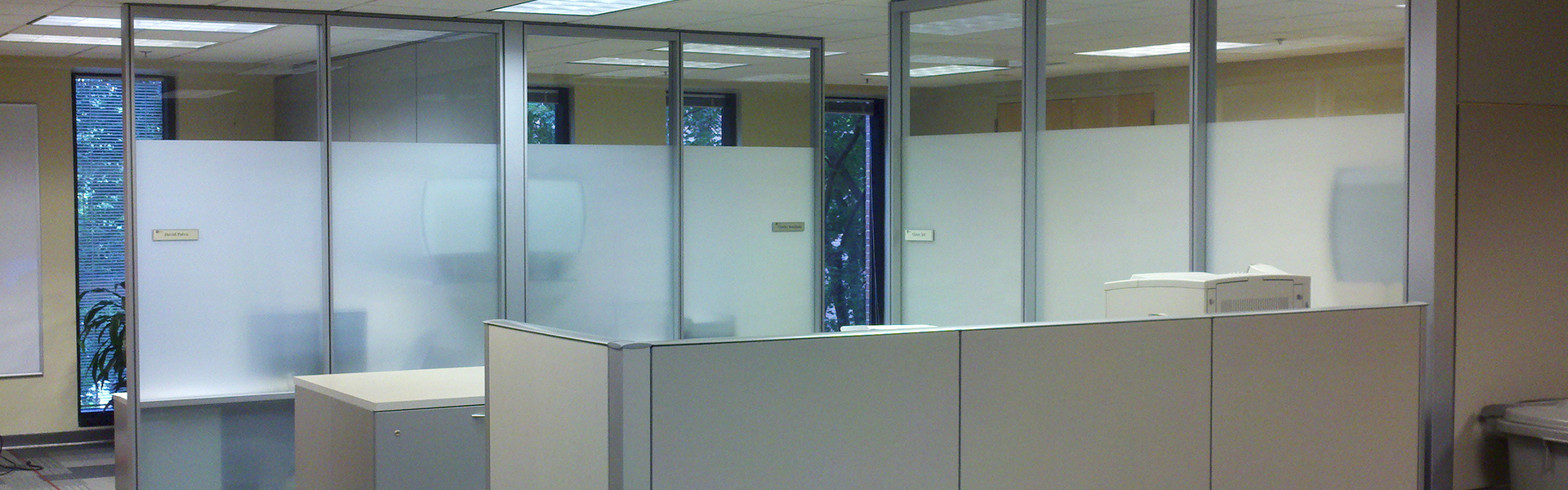
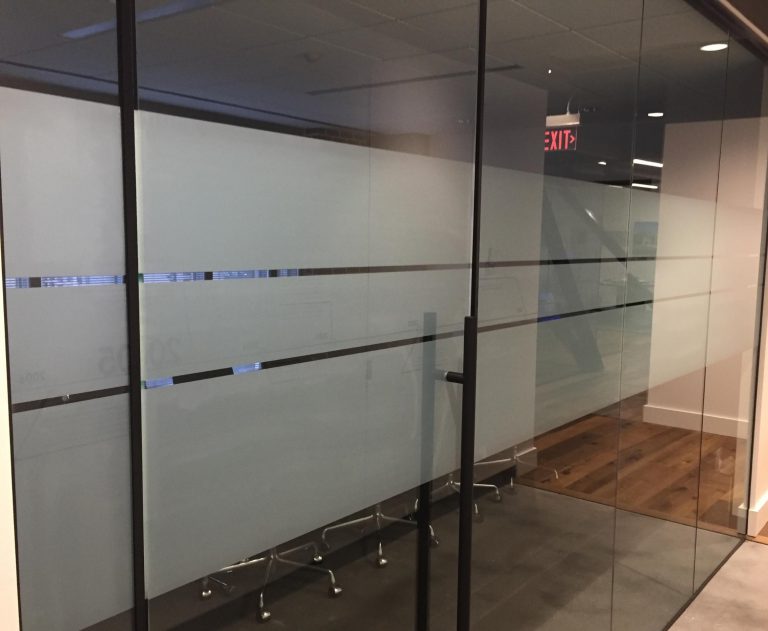
Frosted Window Film for Offices and Institutional Facilities
Performance Profile: VLT Ranges, Light Diffusion, and Privacy Depth
Frosted window film works by scattering transmitted light rather than blocking it, which creates visual obscuration without significantly reducing overall light levels. Commercial-grade frosted films typically offer VLT ranges between 40% and 70%, depending on density and pattern coverage. That range matters: a 40% VLT frosted film in a north-facing corridor performs very differently from the same film on a south-facing glass partition where occupant glare and solar heat gain are active concerns.
Privacy depth, meaning how effectively the film prevents a legible view of people or content behind the glass, is a function of both VLT and diffusion angle. Denser frosted films with tighter diffusion angles provide near-complete visual obscuration at close range, which is the appropriate specification for healthcare consultation rooms or legal conference spaces. Lighter, higher-VLT frosted films offer silhouette-level privacy suitable for open-plan corridors or collaborative office zones.
Best-Fit Applications: Conference Rooms, Corridors, Healthcare Partitions
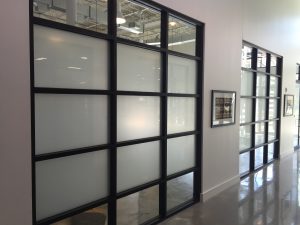
Frosted bathroom window film for offices and institutional facilities is the standard specification for interior glass privacy in most commercial environments. Conference room sidelites, corridor partitions, and healthcare consultation areas all benefit from its combination of light transmission and consistent bilateral privacy. The film obscures equally from both sides, which is the correct behavior for shared-use spaces.
For healthcare applications specifically, frosted film on clinic partitions needs to meet cleanability standards. Specify a film with a hard-coat surface layer rated for disinfectant-compatible cleaning protocols, and confirm the adhesive system is rated for high-humidity environments if the application includes bathrooms or procedure rooms.
One-Way Mirror Window Film for Commercial Buildings
How Daytime vs. Nighttime Privacy Mechanics Work at the Glass Level
One-way mirror window film for commercial buildings creates privacy by exploiting a reflectance differential between two environments. During daylight hours, the brighter exterior reflects off the metallized film surface, preventing a clear view inward while allowing occupants to see out. This works reliably as long as the exterior light level exceeds the interior, which is the normal condition for perimeter glazing during business hours.
At night, or in any condition where interior lighting outpaces exterior ambient light, the dynamic reverses. Interior occupants become visible from outside, and the reflective view from inside disappears. This is not a product defect. It is a physical consequence of how reflective film mechanics work. Any specification for one-way mirror film on a building that operates after dark needs to account for this limitation explicitly, either through supplemental window treatments or by selecting a different film type for those elevations.
One-Way Mirror Film vs. Frosted Privacy Film: Functional Differences for Commercial Applications
The functional difference is directionality and viewing behavior. Frosted film provides privacy from both sides simultaneously by diffusing light regardless of which direction it travels. One-way mirror film provides asymmetric privacy: outward visibility from the inside and reflective obscuration from the outside, but only under the right lighting conditions.
For a corporate headquarters with occupied offices behind perimeter glazing, one-way mirror film is often the preferred specification because it preserves exterior views for occupants while providing street-level privacy. For an interior conference room partition where both sides are occupied interior spaces, frosted film is the correct specification because lighting conditions on both sides are roughly equal, making one-way mechanics non-functional.
Decorative, Patterned, and Custom-Graphic Film
Balancing Aesthetic Specification with Measurable Performance Data
Decorative and custom-graphic privacy films present a specification challenge because procurement conversations tend to focus on visual output, such as pattern, opacity, and brand color matching, while performance data gets treated as secondary. That hierarchy needs to be inverted on commercial projects.
A patterned film covering 60% of a glass surface and leaving 40% clear has an effective VLT that reflects the clear-area fraction, not the opaque-area fraction. Specify full-panel VLT as a weighted average across the actual installation, not just the film material rating. Confirm that the substrate and adhesive system behind the decorative layer carry the same warranty eligibility and compliance documentation as a standard privacy film. Decorative appearance does not exempt a film from performance accountability.
Adhesive vs. Static-Cling Film: Why the Substrate and Bonding Method Matter at Scale
PET Film Substrate and DOAS Adhesive: Specification Implications for Longevity
Commercial-grade privacy window tint is manufactured on a polyethylene terephthalate (PET) film substrate, a dimensionally stable, optically clear base layer that maintains consistent performance under thermal and UV stress. The adhesive layer bonded to this substrate is engineered to specific glass surface types and environmental conditions, with DOAS adhesive formulations providing the bond stability required for long-term commercial applications.
Specifying by adhesive type is not an overreach on a commercial project. It is the variable that determines whether the film maintains bond integrity on a south-facing triple-pane unit in Phoenix versus a north-facing single-pane unit in Minneapolis. Film specified without adhesive-type documentation leaves too many variables open for substitution.
Where Static-Cling Film Fails Commercial Performance Thresholds
Static-cling film holds to glass through electrostatic attraction rather than adhesive bonding. That mechanism performs adequately in low-stress, short-duration, climate-controlled environments: a temporary privacy screen in a leased office, a short-term retail installation, a trade show display.
On commercial projects with multi-year performance requirements, static-cling film fails reliably. Edge-lift begins as thermal cycling stresses the film perimeter. Humidity fluctuations in lobbies and healthcare environments cause cling-layer degradation. The film is not eligible for manufacturer warranties on commercial applications, and it provides no UV rejection capability at commercial-grade thresholds. Including static-cling film in a commercial specification as a cost-reduction measure creates a maintenance liability that outpaces the upfront savings within the first year.
Film Type Selection Matrix
Use this matrix to match film type to project requirements before finalizing a specification. All performance values reflect commercial-grade products. Consumer-grade equivalents will not meet the warranty or compliance columns.
| Film Type | VLT Range | UV Rejection | Adhesive Type | Warranty Eligible | Compliance Applicability | Recommended Sectors |
|---|---|---|---|---|---|---|
| Frosted / Diffusion | 40–70% | Up to 99% | DOAS / Pressure-sensitive | Yes (professional install) | Safety glazing, HIPAA-adjacent environments | Office, healthcare, education, institutional |
| One-Way Mirror / Reflective | 5–35% (exterior view blocked) | Up to 99% | DOAS | Yes (professional install) | Solar control compliance, LEED documentation | Corporate perimeter glazing, retail storefronts |
| Decorative / Patterned | Variable (30–75% weighted) | Up to 99% | DOAS / Pressure-sensitive | Yes, if substrate-matched | Brand-consistency specifications, ADA wayfinding | Retail, hospitality, corporate, education |
| Static-Cling | 40–70% | Minimal | None (electrostatic) | No | Not applicable to commercial code contexts | Temporary or short-term installations only |
Two specification notes anchor this matrix to real project conditions.
UV rejection at 99% is achievable across all adhesive-bonded film types, including decorative and frosted products, because UV blocking is a function of the PET substrate and coating stack rather than the film’s visual appearance. This matters for LEED documentation and for protecting interior furnishings and merchandise in retail environments. Confirm UV rejection data is provided as a tested specification value, not a marketing claim, and request the test standard reference (typically AIMCAL or NFRC methodology).
Warranty eligibility for all adhesive-bonded film types is conditional on professional installation by a manufacturer-certified applicator. That is not a fine-print restriction. It is a quality-control mechanism that exists because the most common commercial film failures trace back to installation conditions: surface contamination, improper curing time, moisture during application, or incorrect film selection for the glass type. Pulling warranty coverage into the specification document and tying it to installer certification requirements is one of the highest-value steps a project manager can take before issuing a subcontract.
Performance Specifications That Define Commercial-Grade Privacy Window Film
Visible Light Transmission: How VLT Selection Affects Daylighting, Glare Control, and Occupant Comfort
VLT is the single specification variable with the most downstream consequences in a privacy film project, and it is routinely underspecified. Selecting a VLT range based on appearance samples rather than measured daylighting data produces installations that either over-darken occupied spaces, triggering occupant complaints and supplemental lighting costs, or underdeliver on glare control, which is a measurable productivity and compliance factor in task-intensive environments.
For office environments, the typical specification target for privacy film on interior partitions runs between 45% and 65% VLT, preserving ambient light diffusion while achieving usable privacy depth. Exterior glazing applications that also serve a solar control function may specify lower, in the 20–40% range, but that decision requires coordination with the building’s daylighting model and, on LEED projects, documentation against ASHRAE 90.1 fenestration requirements.
The practical implication: request the film manufacturer’s photometric test data, not just a VLT number. VLT measured at the glass assembly level, accounting for the existing glazing unit, will differ from the film’s standalone rating. That delta matters for occupant comfort calculations and compliance documentation.

UV Blocking and Infrared Rejection: Specification Benchmarks for Energy and Fade Performance
UV Rejection Thresholds: What 96%+ Blocking Means for LEED and Facility Protection
Commercial-grade privacy window tint films achieve UV rejection rates of 96% to 99% across the spectrum, with higher-performing products rejecting ultraviolet radiation at both the UV-A and UV-B bands. That threshold is relevant in two contexts: facility asset protection and green building documentation.
For LEED projects pursuing credits under Energy and Atmosphere or Indoor Environmental Quality categories, UV rejection data must be submitted as tested values referencing a recognized methodology such as NFRC 300 or equivalent. A manufacturer’s marketing claim is not sufficient documentation for a LEED reviewer. Specify that the film supplier provide the test report, not just the specification sheet.
For facility managers concerned with merchandise, furnishings, and flooring longevity, high UV rejection rates at the 99% threshold significantly reduce ultraviolet contribution to fading compared to unfilmed glass. That performance translates directly to lower replacement cycles for high-value interior contents.
IR Rejection and Heat Control: Solar Energy vs. Visible Light Tradeoffs
Infrared rejection addresses a different part of the solar spectrum than UV blocking, and the two values do not move together. A film with 99% UV rejection may deliver anywhere from 35% to 80% IR rejection depending on the coating technology. Standard dyed films sit at the lower end, while ceramic and spectrally selective films achieve the higher range.
The specification tradeoff is this: higher IR rejection typically corresponds to lower VLT, because the coating stack that blocks IR energy also attenuates visible light. Ceramic films partially resolve this by targeting IR wavelengths more selectively, but they carry a cost premium that needs to be evaluated against the building’s heat gain profile and HVAC offset potential. On south- and west-facing glazing in high-solar-load climates, the energy offset frequently justifies the premium. On north-facing interior partitions, it does not.
Glare Reduction and Fade Control as Measurable Specification Outputs
Glare reduction is expressed as a percentage reduction from baseline visible light transmittance, and it functions as a direct occupant productivity metric in office, education, and healthcare environments. A film that significantly reduces glare on a south-facing workstation can eliminate the need for individual blinds, which improves daylighting consistency and reduces the HVAC load from blinds trapping heat against glass.
Fade control is a composite output driven by UV rejection, IR reduction, and visible light filtration acting together. No single value captures it completely, which is why some manufacturers publish a “fade rejection” index that weights all three factors. When specifying for retail or museum environments where merchandise or exhibits are UV-sensitive, request this composite index rather than UV rejection alone. It gives a more accurate prediction of interior protection performance over the film’s service life.
Lifespan and Warranty Coverage of Commercial-Grade Privacy Films
Commercial-grade adhesive-bonded privacy film, professionally installed on compatible glass substrates, carries manufacturer warranties ranging from 5 years to lifetime coverage depending on the product line and application type. The 3M Fasara series, for instance, carries a 10-year warranty for interior commercial applications when installed by a 3M-authorized dealer. That warranty is conditional on three factors: correct substrate compatibility, professional installation, and installation environment documentation.
Films installed on incompatible glass coatings, or in high-humidity environments without the appropriate adhesive specification, typically carry no warranty coverage regardless of the installer’s credentials, because the failure mode was a specification error, not an installation error. This is why the performance specification document and the warranty document need to be reviewed together, not sequentially.
Compliance, Safety Standards, and Certification
Does Privacy Window Film Meet Building Codes and Safety Standards?
The short answer: some products do, and some do not, and the specification document must distinguish between them. Commercial window tint applied to safety glazing assemblies falls under building code requirements for post-installation glass performance. The film cannot reduce the glazing assembly below the safety performance thresholds established for that application, which means the film itself must be tested and listed for use on safety glass.
Films that are not tested for safety glazing compatibility, including most consumer-grade products, cannot be legally specified for applications where the underlying glass is required to be safety-rated. That includes school corridor windows, stairwell glazing, and any location where the International Building Code designates safety glazing requirements.
ANSI Z97.1, ASTM C1172, and OSHA-Adjacent Requirements
Three standards frame the compliance verification process for most commercial projects:
- ANSI Z97.1 governs the safety performance of glazing materials, including the impact resistance requirements that filmed glass assemblies must maintain. Teams must list films used on safety glazing locations under this standard or test them to demonstrate equivalent performance.
- ASTM C1172 covers laminated architectural flat glass and becomes relevant when teams apply film to laminated or insulating glass units where the film’s thermal contribution could affect the unit’s structural rating.
- OSHA 1910.37 addresses egress visibility requirements for films installed near emergency exit paths. High-opacity films cannot obstruct egress identification.
Verification means requesting the specific test reports for each of these standards from the film supplier, not just a general statement that the product is “code compliant.” Compliance is assembly-specific and location-specific, and the documentation needs to match the actual glass type in the project.
How 3M Certification Differs from Unbranded Alternatives in Specification and Liability Contexts
3M Fasara and 3M Safety Series: Product-Line Specificity as a Compliance Signal
3M’s commercial film product lines are segmented by application type, and that segmentation carries compliance implications. The 3M Fasara series is a decorative and privacy film line engineered for interior glass, available with documented UV rejection and warranty coverage for commercial applications. The 3M Safety Series addresses impact and fragment-retention performance, providing post-breakage protection that can satisfy safety glazing application requirements when the film is tested to the relevant ANSI or GSA standards.
The significance of product-line specificity is this: when a project specification references a 3M Safety Series product by name, the compliance documentation chain is traceable from the product to the test report to the installer certification. That traceability is what survives an inspection, an insurance review, or a liability claim.
What Happens When a Non-Certified Film Fails an Inspection or Insurance Review
Non-certified film failures in compliance contexts create two problems simultaneously. The first is the direct cost of removal and re-installation with a compliant product. The second is the liability exposure created by the period during which non-compliant film was in place, particularly in safety glazing locations or healthcare environments where the regulatory stakes are higher.
Insurance carriers reviewing a post-incident claim will request documentation of the installed film’s certification status. If the film cannot be traced to a tested, listed product installed by a qualified applicator, the claim may be denied or coverage reduced. That outcome is the documented consequence of treating film as a commodity procurement rather than a tested building product.
LEED Compliance Window Film: Documenting Solar Control Performance for Green Building Credits
LEED v4 and v4.1 projects pursuing credits under Energy and Atmosphere EA Credit: Optimize Energy Performance, or under Daylight credits in the Indoor Environmental Quality category, can document solar control window film as a contributing measure. The documentation requirements are specific: the film must have tested solar heat gain coefficient (SHGC) and visible transmittance values at the assembly level, referenced to NFRC methodology, and the submitted values must reflect the glass-plus-film assembly, not the film alone.
Work with the film supplier to obtain NFRC-compliant assembly data for the specific glass type in the project. Generic VLT and SHGC values from a product data sheet will not satisfy a LEED reviewer. This is also an area where installer certification matters: a 3M-authorized commercial installer can provide the assembly documentation package as part of project closeout, while an uncertified installer typically cannot.
Professional Installation vs. DIY: Why Enterprise Scale Changes Every Variable
How 3M Certified Installers Differ from DIY or General Contractors
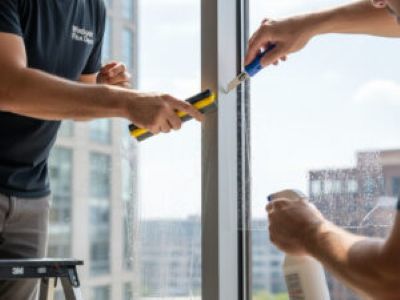
The difference comes from documented processes, verified substrate knowledge, and accountability infrastructure rather than primarily from technical skill. A 3M-certified commercial installer completes product-specific training, maintains installation process documentation that satisfies manufacturer warranty requirements, and follows a certification standard that auditors can review after installation.
A general contractor or facilities crew applying film without manufacturer certification may achieve an acceptable result on a straightforward single-pane application. They will not have the process documentation needed to activate warranty coverage, and they will not have the substrate-specific training to recognize when a glass type requires a different adhesive specification. On a project involving low-e glass, insulating glass units, or specialty coatings, that knowledge gap produces failures that aren’t visible on installation day.
Warranty Voids, Liability Gaps, and the True Cost of Subcontractor Misspecification
When a subcontractor installs the wrong film, or installs the right film incorrectly, the warranty is void before the project is even complete. That is not an edge case. Commercial film projects most commonly fail when the specification document does not lock in installer certification requirements before teams award the subcontract.
The cost model is straightforward: the original installation represents 100% of the budgeted film cost. A failed installation that requires removal and re-specification typically costs 150–200% of the original budget because teams must add unplanned removal labor and surface preparation costs.On a multi-location project, that multiplier applies across every affected site. Specifying installer certification requirements at contract award, not after problems surface, is the only leverage point that prevents this outcome.
What Happens If Privacy Film Is Installed Incorrectly on a Large Project
Adhesive-bonded privacy window tint is removable from most glass types without permanent damage, but the conditions that make removal clean versus damaging are the same conditions that should have been verified before installation. Film on standard annealed or tempered glass generally removes without surface damage when a qualified installer uses the appropriate solvent and technique. Film that has been on glass for more than two to three years, or film installed on a coated or tinted glass unit with an incompatible adhesive, may leave adhesive residue that requires additional remediation.
Removability, Conditions, and Re-application Protocol
Clean removal depends on three factors: film age, glass surface type, and adhesive system. New installations under 12 months on standard glass remove with minimal effort. Older installations require a trained installer to use scored removal techniques and solvent application to avoid scratching the glass surface during removal.
Teams must allow a cure period for any residual adhesive treatment and complete a surface inspection before applying new film after removal. Applying new film over a surface that still contains adhesive residue causes immediate bond failures. Document this protocol in the project specification so teams pre-approve rework procedures with the subcontractor instead of negotiating them after problems occur.
Standardizing Privacy Film Across Multiple Locations
Specification standardization across multiple locations is achievable, but it requires upfront investment in a master specification document that travels with the project to every site, along with a delivery mechanism that enforces it. The master specification needs to define film product by manufacturer part number, adhesive type, target VLT at the glass assembly level, installation environment conditions, and the certification requirement for the installer. Every field deviation from that document needs a documented change order.
National Installer Networks as a Quality Control Mechanism for Multi-Site Rollouts
A national installer network with manufacturer certification provides the enforcement mechanism that a standalone specification document cannot. When the same certified installer organization executes work across all locations under a single scope of work, one accountable party controls surface preparation, film handling, curing conditions, and QC inspection criteria instead of distributing those variables across regional subcontractors with inconsistent training.
This is the primary logistical advantage of engaging a national commercial window film supplier with a certified installer network over sourcing locally at each location. Local sourcing introduces specification drift: regional subcontractors substitute equivalent products, apply regional pricing pressure to film selection, and have no cross-site accountability. The upfront savings are nominal. The consistency losses are measurable.
How to Specify Privacy Window Film for a Multi-Building Retrofit Without Installation Errors
A multi-building retrofit specification that reaches closeout without rework typically follows this sequencing:
- Conduct a pre-specification glass audit across all locations, documenting glass type, coating category, and thermal performance data for every elevation in scope.
- Produce a master film specification tied to each glass type category, with adhesive system, VLT target, UV rejection minimum, and warranty requirement documented by assembly type, not by location.
- Issue the master specification as a controlled document to all participating installers, with a change-order process for any field condition that deviates from documented glass types.
- Require pre-installation mockup approval at one representative location before full rollout begins.
- Build a QC inspection protocol into the scope, with installer-submitted photographic documentation at each location against a defined checklist.
The mockup step is the one most frequently skipped and most frequently regretted. A single verified installation at one representative location catches specification errors, such as incompatible adhesive, unexpected glass coating, or VLT discrepancy, before they propagate across the full project. The cost of a mockup is a fixed line item. The cost of a system-wide rework is not.
Privacy Window Tint Applications by Sector
Office Environments: Balancing Open-Plan Transparency with Confidentiality Zones
Modern office floor plans create a specification tension that privacy window tint resolves differently depending on zone type. Open-plan collaboration areas benefit from higher-VLT frosted film (55–70%) on glass partitions, enough diffusion to reduce visual distraction without making the space feel enclosed. Confidential zones require a different specification: legal and HR offices, executive suites, and board rooms typically warrant denser frosted film in the 40–50% VLT range, providing near-complete visual obscuration while still transmitting usable ambient light.
One-way mirror film is appropriate for exterior perimeter glazing where occupants need outward views and street-level privacy is the primary requirement. It is not appropriate for interior partitions between two occupied office spaces, where lighting conditions on both sides will equalize and render the one-way mechanic non-functional.
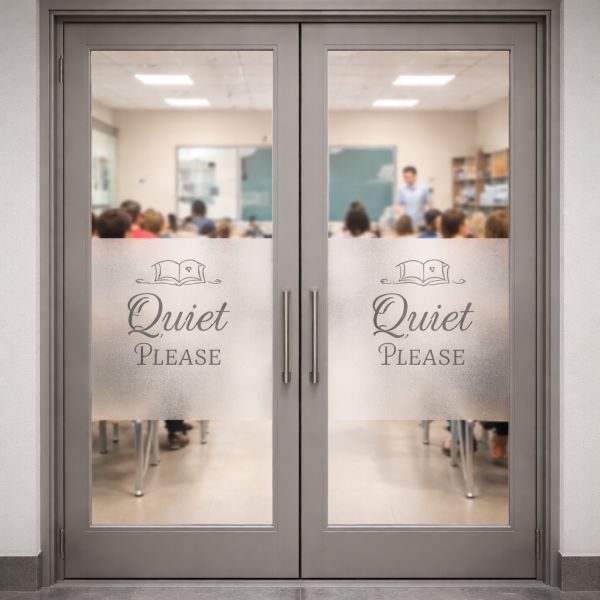
Education Facilities: Safety, Code Compliance, and High-Traffic Durability
K-12 and higher education projects carry compliance obligations that eliminate several film categories from consideration before aesthetics enter the conversation. The International Building Code requires any glazing in a corridor, stairwell, or classroom sidelite designated as a safety glazing location to use film tested and listed for safety glass assemblies. This requirement narrows the eligible product set to tested safety film products instead of standard frosted or decorative film.
Durability is the secondary specification driver. School environments impose cleaning frequencies and chemical exposures that will degrade films without hard-coat surface layers within the first academic year. Specify hard-coat PET substrate film rated for institutional cleaning protocols, and document that rating in the specification before the installer is selected.
Retail Environments: Brand-Consistent Decorative Film Across Multiple Storefronts
Retail rollouts introduce a specification challenge that single-site projects don’t face: visual consistency across locations with different glass types, orientations, and ambient light conditions. A custom-graphic film that matches brand color specifications at one storefront may read differently on a southeast-facing unit in a different climate zone. Color rendering consistency across locations requires photometric verification at the glass assembly level, not just approval of a film sample in isolation.
Patterned and custom-graphic films for retail also need documented UV rejection values. Merchandise protection is a measurable specification output in retail environments, and high-threshold UV rejection across the installed film area is achievable without compromising the decorative layer. Require the UV rejection test value as part of the product submittal, not as a separate request after procurement closes.
Healthcare and Institutional Facilities: Privacy, Cleanability, and Compliance
Healthcare applications have the most demanding intersection of privacy performance, cleanability, and compliance documentation of any commercial sector. Patient consultation rooms, clinic corridors, and procedure area partitions need frosted film that delivers complete visual obscuration at close range while tolerating daily disinfectant cleaning, including quaternary ammonium compounds and bleach-based solutions that will degrade standard film surfaces within months.
Specify film with a hard-coat surface layer rated for healthcare cleaning protocols, and confirm adhesive compatibility with high-humidity environments for bathrooms and procedure rooms. Document these requirements in the specification as tested performance criteria, not surface descriptions. HIPAA does not directly regulate window film, but facilities that fail to maintain visual privacy in patient areas face documentation and accreditation exposure that makes specification accuracy a compliance-adjacent decision.
Total Cost of Ownership: What Commercial Privacy Film Projects Actually Cost at Scale
Per-Unit Film Cost vs. True Project Cost
Film material cost is typically 20–35% of total installed project cost on a commercial privacy window tint project. Labor, coordination, site access management, and quality inspection account for the remainder. A project manager who builds a budget around film unit pricing and treats labor as a simple multiplier is working from an incomplete model before the first site walk occurs.
Multi-site logistics add cost categories that don’t appear in single-location estimates: master specification management, installer coordination across time zones, photographic QC documentation, and change-order administration when field conditions deviate from documented glass types. Budgeting for these line items at project inception, rather than absorbing them as overruns, is what separates accurate commercial film project budgets from optimistic ones.
The Hidden Costs of Choosing the Wrong Privacy Film Supplier
The cost of a misspecified film supplier compounds in three phases. First is discovery: the point at which film performance failures become visible, which on adhesive-bonded commercial film typically occurs 6–18 months post-installation. Second is remediation: removal, surface preparation, re-specification, and re-installation, which runs 150–200% of the original installation cost per affected location. Third is schedule impact: teams must replan dependent tenant improvements, furniture installations, and operations that relied on a completed window film scope.
A supplier without documented installer certification, glass-type compatibility records, or warranty infrastructure cannot limit exposure in any of these phases. The selection criteria that appear to create savings at procurement, such as lower film cost, local sourcing, and minimal documentation requirements, are the same criteria that remove every cost control mechanism if the installation fails.
Warranty Implications of Professional vs. DIY Application Over a Multi-Year Horizon
A 10-year manufacturer warranty on a commercial privacy film product is not a guarantee against failure. It is a cost transfer mechanism that only activates under specific conditions: professional installation by a certified applicator, correct substrate specification, and documented installation environment parameters. A DIY or uncertified installation produces the same film on the glass but removes warranty activation entirely.
Over a 10-year horizon, the cost difference between warranted and unwarranted installations is not the warranty premium itself. The full replacement cost of any failed section can represent a significant portion of the original scope on a large project. Model that risk as an uninsured liability, not as a hypothetical, when evaluating the cost difference between certified and uncertified installation.
Long-Term Energy Savings as a Budget Offset
Solar control privacy film on south- and west-facing exterior glazing generates a measurable HVAC offset that belongs in any honest total cost of ownership model. A spectrally selective film achieving meaningful IR rejection on a large perimeter glazing area in a high-solar-load climate can reduce peak cooling load per square foot of treated glass, depending on the existing glazing unit’s baseline SHGC. That reduction translates to compressor runtime savings that compound over the film’s service life.
The illustrative model: a substantial area of treated glass in a high-solar-load climate, evaluated over a 10-year film lifespan, can produce an energy offset that represents a significant portion of the original film installation cost. Actual figures require a building-specific energy model, but the offset is real, documentable, and relevant to any stakeholder evaluating energy-efficient window film as a capital expenditure.

Vendor Qualification Checklist: Five Non-Negotiables Before Committing to a Multi-Site Project
Evaluate every commercial window film installer against these criteria before issuing a contract:
- Manufacturer certification: verify the installer holds current certification for the specific film product line in the specification, not just general film experience.
- Multi-site project history: request references for projects with three or more locations executed under a single specification document.
- Glass-type compatibility documentation: confirm the installer can provide written compatibility verification for every glass type in the project scope before installation begins.
- Warranty activation process: obtain written confirmation showing how the manufacturer registers the warranty and which project-closeout documents the installer provides.
- Change-order protocol: confirm that the installer follows a formal process to document field deviations from the specification, approve substitutions, and record all changes.
Conclusion: Specification Confidence at Scale
The Commercial Specification Framework From Film Type to Certified Installation
Teams make the specification decisions that determine whether a commercial privacy window tint project delivers its intended performance before a single square foot of film touches glass. Teams must lock in film type, VLT range, adhesive system, substrate compatibility, UV rejection threshold, and installer certification during specification. Every failure mode covered in this guide traces back to decisions teams made, or failed to make, at that stage. The framework is not complicated, but teams must follow a deliberate sequence. Start with the glass audit, then finalize the master specification, qualify the installer, approve the mockup, and begin the rollout last.
Why National 3M Certification and Project Management Experience Are the Final Differentiators
Film product quality across the commercial-grade market has converged enough that the specification decision is increasingly about delivery infrastructure, not just product performance. A nationally certified installer organization with documented multi-site project management experience provides consistency enforcement, warranty activation, and accountability that a regional subcontractor network cannot replicate, regardless of how competitive the local pricing appears.
3M certification signals something specific in a specification context: a documented training standard, a product-specific knowledge base, and a traceable accountability chain from film to installer to manufacturer warranty. On a project where compliance documentation, insurance coverage, or LEED certification is in scope, that traceability is not optional.
Initiating a National Project Specification Review With Window Film Depot
Window Film Depot operates as a national 3M-authorized commercial film installer with project management infrastructure built for multi-location rollouts. The right starting point for a new project is a specification review, not a product quote. A specification review aligns film type, adhesive system, glass compatibility, and installer certification requirements with your actual project conditions before teams make procurement decisions.
Contact Window Film Depot to schedule a national project specification review. Bring your glass audit data, project scope, and compliance requirements. Leave with a specification document that controls the variables that cause commercial film projects to fail.
Frequently Asked Questions
What is the difference between one-way mirror film and frosted privacy film for commercial applications?
The core difference is directionality. Frosted film diffuses light traveling from either direction, providing equal privacy on both sides of the glass simultaneously. One-way mirror film creates asymmetric privacy: under normal daytime conditions, the brighter exterior reflects off the metallized surface, blocking inward views while preserving outward visibility for occupants. For interior partitions between two occupied spaces, frosted film is the correct specification because ambient light levels on both sides equalize, making the one-way mechanism non-functional.
How do I specify privacy window film for a multi-building retrofit without installation errors?
Start with a pre-specification glass audit that documents glass type, coating category, and thermal data for every elevation in scope. From that audit, build a master specification that assigns film product, adhesive type, VLT target, and warranty requirement by glass assembly category rather than by location. Require mockup approval at one representative site before full rollout, and build a photographic QC protocol into the installer’s scope. The mockup step catches adhesive compatibility issues and VLT discrepancies before they propagate across the entire project.
Does privacy window film meet building codes and safety standards for commercial buildings?
Some products meet these standards and some do not, which is why the specification must distinguish between them. Teams must test and list film applied to safety glazing locations, such as school corridor windows or stairwell glazing, for compatibility with safety glass under standards including ANSI Z97.1. Manufacturers generally do not test consumer-grade and decorative films to these standards, which prevents teams from legally specifying them in those locations. Always request the specific test reports for the actual glass type in the project instead of accepting a general “code compliant” claim.
What happens if privacy film is installed incorrectly on a large project — can it be removed and reinstalled?
Adhesive-bonded film is removable from most glass types without permanent surface damage, but the outcome depends on film age, glass surface type, and the adhesive system used. Films under 12 months old on standard annealed or tempered glass generally remove cleanly. Older installations or films applied to coated glass with an incompatible adhesive may leave residue requiring additional remediation. Re-application requires a full cure and surface inspection before new film is applied. Document the removal and re-application protocol in the original specification so rework procedures are pre-agreed, not negotiated after a failure occurs.
How do 3M certified installers differ from DIY or general contractors in privacy film installation?
The distinction comes from documented processes, substrate expertise, and accountability infrastructure. A 3M-certified installer completes product-specific training, maintains the installation documentation required to activate manufacturer warranties, and follows a certification standard that auditors can review after installation. A general contractor or uncertified crew may produce an acceptable result on simple single-pane glass but will lack the substrate-specific knowledge to identify when a low-e or insulating glass unit requires a different adhesive specification, and will not have the documentation to support warranty claims if something goes wrong.
What are the hidden costs of choosing the wrong privacy film supplier for a large-scale project?
The costs compound in three phases. Discovery typically occurs 6–18 months post-installation when adhesive failures or edge-lift become visible. Remediation, covering removal, surface preparation, re-specification, and re-installation, commonly runs 150–200% of the original installation cost per affected location. Schedule impact is the third phase, as dependent trades, tenant improvements, and operations planned around a completed film scope require replanning. Suppliers without documented installer certification, glass compatibility records, or warranty infrastructure offer no cost control mechanism in any of these phases. The first site failure typically eliminates the procurement savings that made local or uncertified sourcing appealing.