Table of Contents:
- Why Under-Specified Glazing Becomes a Post-Occupancy Problem
- The Core Performance Benefits That Belong in Your Specification Justification
- Understanding the Film Types Available for Office Environments
- How to Specify Office Window Tinting on Large-Scale or Multi-Location Projects
- What to Expect from Professional Installation: Timeline, Process, and Quality Benchmarks
- Common Mistakes Managers Make When Sourcing Window Film Subcontractors
- How Window Film Integrates with Existing Glass and Building Systems
- Conclusion: Specification Decisions That Hold Up After Occupancy
- Frequently Asked Questions
Why Under-Specified Glazing Becomes a Post-Occupancy Problem
Office Window Tinting is often overlooked during specification, yet it directly impacts comfort, energy use, and occupant satisfaction. Many buildings meet code requirements but still fail to control heat and glare across perimeter zones. This blog explains how office window tinting closes those performance gaps, improves working conditions, and prevents costly post-occupancy issues in commercial environments.
The Scenario Every Renovation Manager Recognizes
The punch list is closed, the client has taken occupancy, and within 60 days you’re fielding complaints about overheated workstations along the south facade and employees who can’t see their monitors before noon.
The glazing met code. The HVAC was commissioned correctly. Nothing was installed wrong — it just wasn’t specified well enough to handle what a floor plate full of people and screens actually demands from the building envelope.

Heat and Glare Complaints After Handover
South- and west-facing exposures routinely generate 10 to 15 degrees Fahrenheit of ambient temperature differential compared to interior zones, even in buildings with modern curtain wall systems. Occupants notice it immediately. Facilities teams respond by increasing air supply to perimeter zones, which creates its own complaints: drafts, noise, and inconsistent temperatures across the floor. Glare is the parallel problem. Direct solar gain through clear or lightly tinted glass makes monitor work difficult for three to five hours a day depending on orientation, and no amount of screen repositioning fully compensates.
These aren’t edge cases. They’re predictable outcomes of glazing selected for code compliance and cost rather than occupant performance.
How Glazing Performance Gaps Translate Into Client KPI Failures
If your client’s project brief included energy use intensity targets, LEED certification points, or occupant satisfaction benchmarks, glazing performance gaps directly undermine those deliverables. An overheated perimeter zone drives cooling loads up. A glare-saturated open floor plan drags down occupant satisfaction scores. Neither outcome is recoverable after the fact without a retrofit, and retrofits in occupied spaces cost significantly more than getting the specification right before handover.
Why Window Film Is Consistently Left Off the Specification Sheet
The “Afterthought Add-On” Misconception and Its Real Costs
Office window tinting has a positioning problem in commercial construction. It’s widely perceived as a cosmetic finish or a tenant improvement item, which means it gets treated like paint selection: addressed late, often by the client rather than the design team, and rarely written into a performance specification with measurable criteria. That perception has real financial consequences.
When film is sourced ad hoc after occupancy complaints surface, the project is already in a reactive posture. Installation in occupied spaces requires evening or weekend scheduling, coordination around active workstations, and temporary furniture protection, all of which add cost that wouldn’t exist if film had been scoped and installed during the renovation window when trades were already on site and spaces were clear.
How Under-Specification Creates Rework Risk in Occupied Spaces
The rework risk isn’t limited to cost. Schedule disruption in occupied buildings is the version of rework that damages client relationships most. A three-floor office tinting project that could have been completed in five days during the fit-out phase stretches to three weeks when it has to work around business hours, department moves, and facilities coordination. Film selection also tends to be inconsistent when sourced reactively. Different floors may end up with different visible light transmittance values, creating an aesthetic mismatch that clients notice and that’s expensive to correct.
The Case for Treating Window Film as a Performance Specification
Reframing Film as Part of the Building Envelope, Not a Finish Upgrade
Office window tinting performs as a building envelope component, not a surface finish. It modifies how the glazing system transmits, absorbs, and reflects solar energy, directly affecting thermal loads, daylighting quality, and HVAC system demand.
Specified correctly, film complements the glass selection and the mechanical system rather than compensating for them after the fact. That reframe matters because it determines where in the specification film gets written, who is responsible for it, and what performance criteria it must meet.
Need More Info?
The Window Film Depot team is happy to help.
Alignment With Energy Efficiency and Occupant Comfort KPIs
When film is treated as a performance specification, it maps directly to the KPIs your clients are already tracking. Solar heat gain coefficient targets, energy use reduction goals, and occupant comfort benchmarks all have corresponding film performance metrics. Specifying film with defined SHGC, total solar energy rejected, and visible light transmittance values gives you a documented basis for claiming those KPIs at project close, not just an informal assertion that the building should feel better.
The Core Performance Benefits That Belong in Your Specification Justification
Solar Heat Rejection and Cooling Load Reduction
High-performance solar control window film reduces the amount of solar energy transmitted through the glass before it becomes heat load inside the building. For a south- or west-facing office floor plate, that reduction translates directly to lower cooling demand during peak hours, which is when mechanical systems are most stressed and energy costs are highest.
What SHGC and TSER Mean for an Office Floor Plate
Solar Heat Gain Coefficient (SHGC) measures the fraction of incident solar energy that passes through the glazing system into the space. A lower SHGC means less solar heat admitted. Total Solar Energy Rejected (TSER) is the inverse metric, representing the percentage of solar energy the combined glass-and-film system blocks. For a renovation manager writing a specification, TSER is often the more useful number because it provides a single figure to benchmark against the project’s energy model assumptions.
Reducing Cooling Loads With Solar Control Window Film
Quality solar control films applied to clear single-pane or lightly tinted glass can reduce solar heat gain substantially depending on film selection and glass type.
For an office floor plate, that translates to documented cooling load reductions of up to 30 percent on treated exposures. Across multiple floors or buildings, that reduction has a measurable impact on energy use intensity and reduces mechanical system runtime, both of which matter to clients with sustainability reporting obligations.

UV Protection and Interior Asset Preservation
99% UV Rejection and What It Means for Furnishings, Finishes, and Flooring
UV radiation causes cumulative, irreversible damage to interior finishes: carpet fading, furniture discoloration, flooring warping, and artwork degradation. High-performance window films reject up to 99 percent of UV radiation, which is the primary driver of solar-accelerated material degradation. For renovation projects where the client has invested in high-specification interior finishes, UV protection is a documented way to preserve that investment over the building’s service life.
UV Blocking as a Client-Facing Deliverable
UV rejection is one of the few window film for heat performance metrics that translates cleanly into a client conversation without requiring technical explanation. A film that blocks 99 percent of the UV radiation responsible for fading carpet and furniture is a concrete, verifiable deliverable that clients understand and value, particularly in retail, hospitality, and executive office environments where interior aesthetics are part of the brand standard.
Glare Reduction and Measurable Occupant Comfort
VLT, Screen Glare, and Occupant Productivity
Visible Light Transmittance (VLT) is the percentage of visible light a film allows to pass through. Lower VLT reduces glare but also reduces natural light. The specification challenge is selecting a VLT level that controls glare at workstations without making the space feel dim, a balance that varies by orientation, ceiling height, and distance from the glass. Research on office environments consistently links glare reduction to improved task accuracy, reduced eye strain complaints, and higher occupant satisfaction scores.
Specifying Glare Control Without Sacrificing Natural Light
Modern solar control films achieve meaningful glare reduction at VLT levels between 40 and 70 percent, preserving most of the daylight quality occupants and designers expect while eliminating the worst of the direct-sun problem. The key is matching VLT to exposure. A north-facing elevation with minimal direct sun can tolerate a higher VLT, while a west-facing facade that receives several hours of direct afternoon sun warrants a more aggressive specification. A blanket spec across all exposures typically over-tints some zones and under-addresses others.
Energy Efficiency Credentials: LEED, ENERGY STAR, and Building Performance Targets
How Commercial Window Film for Offices Contributes to Certification Points
Window film contributes to LEED credit categories including Energy and Atmosphere (reduced cooling loads), Indoor Environmental Quality (glare control and thermal comfort), and Materials and Resources (extending the service life of existing glazing rather than replacing it). The contribution isn’t token. Documented SHGC and TSER improvements from a specified film installation provide quantifiable inputs to the energy model used for EA credit calculations. For projects pursuing LEED certification, film is a cost-efficient path to incremental points that are otherwise difficult to capture without major system upgrades.
Documenting Performance Metrics for Owner Reporting
The documentation side matters as much as the performance itself. Manufacturers provide certified performance data for film products, covering SHGC, TSER, VLT, and UV rejection rates, that can be incorporated directly into energy model inputs and owner sustainability reports. Specifying film with documented performance credentials rather than selecting it informally gives the project team a defensible, verifiable record of the envelope improvements delivered, supporting both certification submissions and post-occupancy KPI reporting.
Understanding the Film Types Available for Office Environments
Not all window film performs the same function, and selecting the wrong type for a given zone is one of the most common specification errors on commercial office projects. The categories below map to distinct performance objectives. Understanding the difference upfront prevents the kind of mid-project substitution requests that create schedule and budget friction.
Solar Control Films: The Workhorse of Commercial Office Specification
Solar control film is the correct baseline specification for most commercial office exposures. It addresses the two most common post-occupancy complaints, heat buildup along perimeter zones and glare at workstations, without significantly altering the visual character of the space.
3M Prestige Series: Non-Metallized, High-VLT Solar Performance
The 3M Prestige Series uses a non-metallized, multi-layer optical film construction to reject up to 97 percent of infrared heat while maintaining VLT levels between 40 and 70 percent. The non-metallized construction means no interference with wireless signals, a relevant consideration for open-plan offices with dense device environments. The Prestige Series is the appropriate specification for facades where maintaining a clear, natural appearance is a client priority alongside solar performance.
3M Night Vision Series: Where Glare Control Meets Aesthetics
The Night Vision Series delivers stronger glare control at lower VLT levels, making it the right choice for west-facing facades with sustained direct afternoon exposure.It maintains a neutral exterior appearance without a reflective or mirrored look. This matters on buildings where design standards or lease requirements govern facade aesthetics. Where the Prestige Series optimizes for daylight preservation, Night Vision optimizes for occupant comfort under high solar load conditions.
Low-E and Energy-Retention Films for Year-Round Thermal Performance
How Low-E Film Addresses Both Cooling and Heating Season Loads
Solar control film is a one-directional solution: it blocks heat coming in. Low-emissivity (low-e) window film works in both directions, reflecting radiant heat back into the space during winter as well as blocking solar gain in summer. For office buildings in mixed climates where heating season energy costs are a genuine factor, low-e film improves the year-round thermal performance of the glazing system without glass replacement. It’s the specification to reach for when the energy model needs to show improvement across both seasonal loads, not just peak cooling demand.
Safety, Security, and Shatter-Resistant Film for Commercial Buildings
Glass-Hazard Mitigation, Ballistic Resistance, and Code Considerations
Engineers design safety and security films to hold glass fragments in place after breakage, whether caused by impact, blast pressure, or seismic events. Thicker safety films, typically 8 to 14 mil, provide glass-hazard mitigation that meets GSA and ASTM standards for forced entry resistance. Ballistic-resistance films go further, tested to specific threat levels under UL 752 and similar standards.
For many commercial office specifications, the relevant code question isn’t ballistic resistance but glass-hazard mitigation: does the installation comply with applicable safety glazing requirements, and does the film carry the certifications to support that compliance claim?

When Security Film Belongs in the Specification Alongside Solar Control
Security film and solar control film serve different primary functions, but they’re not mutually exclusive. In lobby glazing, ground-floor storefronts, and executive floor perimeters, combining a security film with solar control properties into a single specified product eliminates the need to stack films, which introduces adhesion complexity and warranty complications. Several manufacturer product lines address both requirements in a single construction. Identify these zones early in the specification process so the film selection reflects the full performance requirement, not just the most visible one.
Decorative and Privacy Films: Managing Visual Comfort and Zoning
Balancing Aesthetic Requirements With Performance Mandates
Decorative and one way privacy window film, including frosted, patterned, or gradient options, serve a different function than solar control or security film but often appear in the same specification package on office renovations. Conference rooms, executive suites, and collaborative zones frequently require visual privacy without full wall construction. The specification risk is selecting a decorative film based purely on appearance and discovering after installation that it contributes nothing to solar or UV performance. For any zone with privacy film on an exterior-facing elevation, confirm whether you need a performance film underneath it or a dual-function product to meet the zone’s energy and comfort targets.
Film Selection by Application: A Decision Framework for Renovation Managers
The matrix below maps the primary decision variables, including office zone, facade orientation, glazing type, and performance priority, to the appropriate film category. Use it as a starting point for specification, not a final answer. Specific products within each category still require selection based on certified performance data for the glass type in question.
Film Type Selection Matrix
| Office Zone | Orientation | Glazing Type | Primary Performance Priority | Recommended Film Category |
|---|---|---|---|---|
| Open-plan workstation floor | South / West | Clear single-pane or lightly tinted | Heat rejection + glare control | Solar control, high-TSER (e.g., 3M Night Vision) |
| Open-plan workstation floor | North / East | Any | Glare control, daylight preservation | Solar control, high-VLT (e.g., 3M Prestige) |
| Executive offices / perimeter offices | South / West | Clear or tinted single-pane | Heat rejection + aesthetics | Solar control, non-metallized, high-VLT |
| Lobby / ground-floor storefront | Any | Any | Security + solar control | Dual-function safety/solar or safety film + solar overlaminate |
| Conference rooms / collaborative zones | Interior partition | Any | Privacy + aesthetics | Decorative or privacy film (confirm solar requirement separately) |
| Any zone, mixed climate | Any | IGU (double-pane) | Year-round energy performance | Low-E retention film (verify IGU manufacturer approval first) |
| High-security floor or executive level | Any | Any | Ballistic / forced-entry resistance | Certified security film (UL 752 or GSA-compliant) |
A few clarifications affect how you use this matrix in practice.
Orientation overrides zone type as the primary driver for solar control selection. A north-facing open floor plate rarely needs aggressive heat rejection, and over-specifying there creates unnecessary darkening without a performance payoff.
Glazing type gates the film selection before performance metrics do. IGU and low-e coated glass have thermal stress and compatibility constraints that eliminate certain film categories outright. The matrix reflects general guidance, and glazing manufacturer review is required before finalizing film on IGU or coated glass.
Multi-function zones, such as a glass-walled conference room on a west facade, require a film that addresses all active performance requirements. Stacking films is technically possible but introduces warranty and adhesion complexity that a single specified dual-function product avoids.
How to Specify Office Window Tinting on Large-Scale or Multi-Location Projects
Getting film performance right is one problem. Getting it written into the specification in a way that survives the procurement process and holds subcontractors accountable is a different one, and it’s where most multi-site specifications fall apart.
Writing Film Into the Construction Specification Correctly
Performance Metrics to Include: SHGC, TSER, VLT, and UV Rejection Rate
A film specification that lists only a product name gives the subcontractor too much latitude and gives the project team no defensible benchmark at closeout. A performance-based specification defines the minimum acceptable values for SHGC, TSER, VLT, and UV rejection rate by exposure zone, and requires the installer to submit certified manufacturer data demonstrating compliance before installation begins. This structure also protects the project if a specified product becomes unavailable mid-project, because an approved-equal substitution can be evaluated against the same criteria.
Specifying Approved Film Families vs. Leaving Selection to the Subcontractor
The practical middle ground for most commercial office projects is to specify an approved product family, such as the 3M Prestige or 3M Night Vision series, with defined minimum performance thresholds, and require the subcontractor to select within that family based on the glass type and exposure conditions at each location.
This approach maintains quality control without locking the installer into a single SKU that may not be optimal across every facade orientation in a multi-building rollout.

Can Window Film Be Applied to Existing Glass Without Replacement?
In most commercial renovation scenarios, yes. Window laminate installs directly on existing glass without removal or replacement, though the compatibility question is more nuanced than a simple yes or no.
Compatibility With Single-Pane, IGU, and Low-E-Coated Glass
Clear single-pane glass is straightforward: nearly any film can be applied without thermal stress concerns. Insulating glass units (IGUs) introduce thermal stress risk because film changes the heat absorption balance between the panes, which can cause differential expansion and seal failure. Low-e coated glass, already a performance glazing, has its own compatibility constraints, since applying an additional solar control film can push the glass beyond its thermal stress threshold or void the original manufacturer’s warranty.
The specific risk level depends on the glass construction, the film’s absorption characteristics, and the climate. Manufacturers provide thermal stress analysis tools that accept the glass spec and film performance data to calculate whether the combination falls within safe parameters.
When to Involve the Glazing Manufacturer Before Specifying
On any project with IGU or low-e glass, consult the glazing manufacturer before specifying film, not after awarding the subcontractor. Secure written confirmation that the proposed film does not void the IGU warranty. Some manufacturers maintain approved product lists. Others require a formal thermal stress calculation submitted for review. Resolving this during the specification phase prevents a situation where the film subcontractor arrives on site and the glass manufacturer voids the warranty if installation proceeds.
Multi-Site Contract Structure: Ensuring Consistency Across Locations
Single-Vendor vs. Multi-Vendor Procurement for National Rollouts
Project teams often frame the procurement decision on a multi-location rollout as a cost question, but it is more accurately a quality control and schedule risk question. Using separate regional vendors across locations reduces the likelihood that teams maintain a single performance standard consistently. Different crews, different application practices, different material sourcing, and different warranty terms create a fragmented accountability structure that’s difficult to manage from a central project office.
A single national vendor with local installation capacity at each site maintains consistent film selection, consistent application standards, and a single warranty and SLA structure across the entire contract. For a manager responsible for five buildings in three cities, that consolidation matters when a warranty claim or quality issue surfaces after occupancy.
Establishing Performance and Aesthetic Standards That Transfer Across Buildings
The standard that needs to transfer across buildings is more than just film SKU. Specify the acceptable VLT range so different buildings don’t end up with visibly different tint levels, along with the edge finish tolerance, the acceptable level of installation artifacts such as bubbles, edge gaps, and contamination, and the post-installation curing period before final inspection. These standards, written into the contract rather than left to verbal understanding, give the project team a consistent basis for acceptance across every location.
Coordinating Window Film With Other Active Renovation Trades
Sequencing Film Installation Within the Broader Project Schedule
Film installation should follow all dusty trades and precede occupancy by at least five to seven days to allow for curing. The sequencing risk that most projects underestimate is the interaction with painting and drywall work. Particulate contamination on glass surfaces during installation is the leading cause of adhesion defects and visible debris under the film. If the schedule requires film installation while other trades are active, the specification should require glass surface preparation immediately before installation and temporary protection of adjacent work areas.
Protecting Completed Film During Remaining Construction Activity
Freshly installed film is vulnerable to mechanical damage from ladders, scaffold contact, and cleaning chemicals for the first 30 days of curing. The installation contractor should provide temporary protective covering for installed film in any zone where construction activity continues after installation, and the project specification should assign responsibility for that protection explicitly rather than leaving it to informal coordination between subcontractors.
What to Expect from Professional Installation: Timeline, Process, and Quality Benchmarks
Schedule and quality are the two variables that determine whether window film installation helps or hurts your project close. Understanding realistic throughput and what professional application looks like in practice lets you build a credible schedule and set appropriate client expectations.
How Long Does Professional Window Film Installation Take Per Floor?
Realistic Throughput Benchmarks for Planning Purposes
A professional two-person installation crew typically completes 1,000 to 1,500 square feet of glass per day under standard commercial office conditions. A mid-size office floor plate with approximately 3,000 to 5,000 square feet of exterior glazing requires two to four days per floor, depending on glass configuration and film type. Multi-floor projects benefit from sequential floor scheduling. Crews move floor by floor and allow early floors to begin curing while they install film on later floors.
Variables That Affect Schedule: Glass Size, Film Type, and Access Conditions
Large monolithic glass panels install faster per square foot than divided-light or mullioned configurations because each panel requires only one cut and application cycle.
Security and thicker safety films require more careful handling and positioning, adding time per panel compared to standard solar control films.
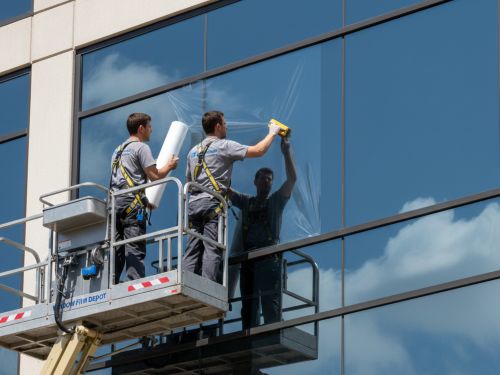
Access conditions, especially on high floors that require interior lifts or buildings that need exterior access, add setup time. Project teams must include that time in the schedule estimate before awarding the subcontractor.
Can Installation Proceed Without Disrupting Occupied Spaces?
Installation in occupied spaces is a standard operating condition for professional commercial film installers, not an exception requiring special handling.
Zero-Disruption Protocols and Off-Hours Scheduling
A professional installer working in an occupied office uses water containment mats at the base of each window to manage solution runoff, works in sections that leave the majority of the floor undisturbed, and coordinates with facilities to manage any temporary furniture moves required for access. For particularly sensitive environments such as trading floors, call centers, or executive suites during client periods, off-hours scheduling is a standard option that most professional installers build into their commercial pricing without requiring a premium.
What Occupants Should Be Told and When
Occupants should receive notice 24 to 48 hours before installation in their zone that light construction activity will take place near the windows. The notice should specify that the work is non-disruptive and low-odor, since modern adhesive films have minimal off-gassing, and include an estimated timeframe for work in their area. Proactive communication here is low-cost and prevents the kind of occupant complaints that escalate to facilities management during installation.
Installation Quality Benchmarks: What Separates a Professional Application
Adhesion, Clarity, Edge Finishing, and Curing Standards
A professionally installed film has no visible bubbles or contamination particles within 24 hours of installation. Edges are cut clean to within 1/16 inch of the frame without lifting or gaps. Clarity under normal viewing conditions is consistent across the panel with no streaking or haze from adhesive contamination. Small water pockets visible immediately after installation are normal and resolve during the curing period, typically 30 days for full adhesive cure, though the film is fully functional before that point.
What a Post-Installation Quality Inspection Should Cover
A thorough post-installation inspection should address the following:
- Bubble and contamination check at normal viewing distance across 100 percent of installed panels
- Edge finish inspection for lifting, gaps, or uneven trim
- Clarity comparison across panels on the same elevation to identify inconsistent application
- Verification that the correct film SKU was installed on each exposure zone per the specification
- Documentation of any deferred panels requiring follow-up due to broken seals or glass damage discovered during installation
The project manager or owner’s representative should complete this inspection within five business days of installation, while the installer remains mobilized or on short recall to address any remediation items.
Warranties: What They Cover and What Questions to Ask
Manufacturer Warranty vs. Installer Workmanship Warranty
These are two separate warranties with different coverage scopes. The manufacturer warranty, typically 10 to 15 years on commercial-grade films from major manufacturers, covers product defects such as delamination, excessive fading, and adhesive failure under normal conditions. It does not cover installation defects. The installer workmanship warranty covers application quality: bubbles, contamination, edge failures, and improper film selection that results in thermal stress damage. Both warranties need to be in place and clearly scoped before the subcontract is executed.
SLA Frameworks for Multi-Location Commercial Contracts
On a multi-location contract, the warranty structure needs to define response time for claims by location, not just a general coverage term. A documented SLA specifying a 48-hour response acknowledgment and a five-business-day remediation window for warranty claims at any covered location gives the project owner an enforceable standard and gives the project manager a mechanism to hold the installer accountable without renegotiating terms on every claim. Request this in writing during the subcontractor evaluation phase, not after you sign the contract.
Common Mistakes Managers Make When Sourcing Window Film Subcontractors
The specification work covered so far, from film type selection and performance metrics to glazing compatibility and installation sequencing, only holds if the subcontractor you award can actually execute it. Most post-occupancy failures in commercial office window tinting projects trace back not to wrong film selection, but to wrong vendor selection.
Selecting on Price Without Vetting Technical Qualifications
A low bid from an unqualified installer is one of the more expensive line items a renovation manager can approve. The rework cost of re-installing incorrectly applied film in an occupied space, including furniture moves, off-hours scheduling, and client relationship repair, routinely exceeds the original contract value.
What Certifications and Authorization Levels Signal Real Competency
Technical qualifications in window film installation are not self-reported. Manufacturer authorization programs, where installers are trained, tested, and certified on specific product lines, are the primary verification mechanism.
An authorized installer has demonstrated application competency on the films they’re certified to install and has access to manufacturer technical support when field conditions require it.
General contractors who subcontract film work to uncertified crews have no reliable basis for predicting application quality.

Why 3M Authorized Dealer Status Matters as a Qualification Filter
3M’s authorized dealer program is one of the more rigorous qualification frameworks in the commercial film industry. Authorized dealers maintain trained installation staff, use genuine 3M product, and are backed by 3M’s commercial warranty structure. When you specify a 3M product family and require a 3M authorized installer, you’re not just selecting a vendor. You’re activating a warranty chain that runs from manufacturer to installer to completed installation, a chain that doesn’t exist if the installer isn’t authorized.
Failing to Confirm National Coverage and Multi-Site Capacity
The Risk of Regional Installers on Multi-Location Projects
A regional installer who excels in one metro area presents genuine risk on a five-city rollout. The failure mode isn’t usually quality in their home market. It’s what happens when they subcontract out-of-area locations to crews they don’t directly manage, using materials sourced locally without consistent specification review. The result is visible VLT variation between buildings, inconsistent edge finish quality, and warranty coverage fragmented across multiple subcontractors.
How to Evaluate a Vendor’s Scalability Before Award
Ask directly: how many simultaneous multi-location projects is the vendor currently executing, and what is their crew deployment model outside their primary market? A vendor with genuine national capacity maintains employed or closely managed installation crews in multiple regions, not a broker network of independent contractors. Request references from clients with three or more locations under a single contract. If those references don’t exist, the vendor’s scalability claim is untested.
Overlooking Performance Guarantees and Accountability Frameworks
The Difference Between a Sales Promise and a Documented SLA
Every vendor will tell you they stand behind their work. The question is what that commitment looks like in writing, with specific response times and remediation windows attached. A verbal assurance of support is not an accountability framework. It’s a starting position for a negotiation that happens after something goes wrong.
How to Compare Window Film Vendors for Large Commercial Projects
Evaluate vendors on three documented criteria during the selection phase:
- Written warranty terms specifying coverage scope, exclusions, and duration for both product and workmanship
- SLA language defining response time for warranty claims by location, not just a general coverage statement
- Demonstrated experience with projects at your scale, with verifiable references from clients managing multi-site contracts
A vendor who can’t provide all three during the proposal phase is telling you something important about how they’ll perform after the contract is signed.
How Window Film Depot’s National Installation Model Addresses These Risks
Ranked #1 U.S. 3M Window Film Installer: What That Designation Means in Practice
Window Film Depot holds the designation of the #1 3M window film installer in the United States by volume. That ranking reflects consistent, large-scale execution across commercial projects, not a single high-profile installation. It means 3M has validated Window Film Depot’s technical standards, application practices, and product usage at a level that no regional installer can match by definition.
Single-Contract Coverage, Consistent Standards, Multi-Location Execution
For a project manager overseeing a multi-floor or multi-city office renovation, the practical value of that model is straightforward: one contract, one point of contact, one warranty structure, and one performance standard applied across every location. Film selection is consistent. Crew training is consistent. Documentation for each location feeds into a single reporting structure. When a warranty claim surfaces six months after occupancy in a building two cities away, there’s no question about who owns it.
Putting It Into Practice: A Multi-Site Rollout Scenario
An Illustrative Model of Multi-Floor Scheduling, KPI Alignment, and Variance Control
Consider a national professional services firm completing a 12-location office renovation across six cities, with energy use intensity reduction and occupant comfort scores as client-reported KPIs. Each building has different glazing, some single-pane and some IGU, along with different facade orientations.
Under a single-vendor model with a qualified national installer, the process runs as follows. Pre-award glazing review confirms film compatibility at each location and flags any IGU manufacturer sign-off requirements. A single film specification, defining approved product families, minimum TSER and VLT thresholds by exposure zone, and edge finish tolerances, applies across all 12 locations. Teams deploy crews sequentially by building cluster and submit certified performance data for each location at completion. The client receives a consolidated post-installation report that documents actual film performance metrics against specification targets for sustainability reporting.
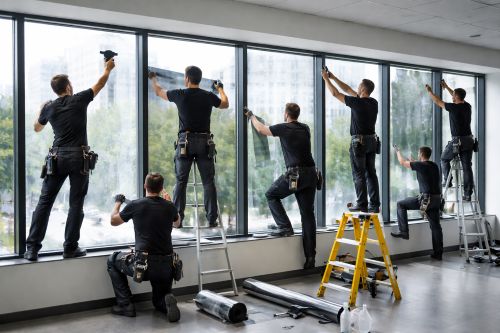
Variance control comes from the specification itself, not from hoping each crew interpreted verbal direction consistently. That’s the model.
How Window Film Integrates with Existing Glass and Building Systems
Thermal Stress and Glass Compatibility: What the Spec Must Address
IGU Warranties, Thermal Breakage Risk, and Manufacturer Sign-Off Protocols
Film on IGU glass without glazing manufacturer approval creates a project liability that surfaces months after occupancy, when seal failure becomes visible and the manufacturer declines warranty coverage. Resolve this during pre-award, not during installation. Require the film subcontractor to submit a thermal stress analysis for each glass type on the project before mobilization, and require written manufacturer confirmation before any IGU installation proceeds.
Film and HVAC System Interaction: Recalibrating Load Assumptions
How Solar Load Reduction Affects Mechanical System Performance Post-Install
A meaningful reduction in solar heat gain changes the actual load the HVAC system is managing. In buildings where the mechanical system was already operating near capacity on peak summer days, that reduction is immediately beneficial and typically self-correcting through standard controls. In buildings with newer building automation systems, inform the controls engineer of the film specification so setpoint calibration reflects the new envelope performance. This task requires brief coordination, not a system redesign, but skipping it causes the building automation system to continue optimizing against pre-film load assumptions.
Building Automation and Smart Glass Environments
Where Window Film Fits When Dynamic Glazing Is Already Specified
Electrochromic and dynamic glazing systems adjust tint state in response to light levels or occupancy signals. Window film applied over an active dynamic glazing system is generally not appropriate. The film interferes with the intended variable-tint function and may void the dynamic glazing warranty. Where dynamic glazing is already installed, the correct evaluation is whether the dynamic system is performing adequately against the project’s solar and glare KPIs. If it isn’t, the remediation path is recalibration of the dynamic system’s control logic, not film overlay. Window film is the right solution where the glazing is static and under-performing, not where a dynamic system is already in place but poorly tuned.
Quick-Reference Specification Checklist for Renovation Managers
Before awarding a window film subcontract on any commercial office project, confirm the following five checkpoints:
- Glass compatibility verified. IGU and low-e glass types have been reviewed against the proposed film, and glazing manufacturer sign-off is in writing where required.
- Performance metrics specified. The subcontract defines minimum SHGC, TSER, VLT, and UV rejection values by exposure zone, not just a product name.
- Installer authorization confirmed. The awarded contractor holds current manufacturer authorization, such as 3M authorized dealer status or equivalent, for the specified product line.
- Warranty terms documented. Both manufacturer product warranty and installer workmanship warranty are scoped in writing, with coverage terms, exclusions, and claim response times defined.
- Multi-site standards written into the contract. For projects with more than one location, VLT range, edge finish tolerance, and post-installation acceptance criteria are documented and apply uniformly across all sites.
Conclusion: Specification Decisions That Hold Up After Occupancy
Recapping the Performance Case: From Glazing Gap to Verified KPI
The performance case for office window tinting doesn’t rest on a single benefit. It rests on the intersection of several: solar heat rejection that reduces peak cooling loads, UV protection that preserves interior finishes, glare control that supports productive workstation environments, and documented performance metrics that feed directly into energy certification and client KPI reporting. None of those outcomes require new glass. They require the right film, specified to measurable standards, installed by qualified crews.
Why Vendor Selection Is as Critical as Film Selection on Commercial Projects
A correctly specified film installed by an unqualified contractor produces the same post-occupancy complaints as an under-specified project. Film selection and installer selection are both performance decisions, not a product choice followed by a procurement formality. The accountability frameworks, SLA terms, national coverage, and installer qualifications covered in this article are not procurement due diligence for its own sake. They’re the mechanism that connects a specification on paper to a verified outcome in the field.
Window Film Depot as the National Partner for Office Renovation at Scale
Window Film Depot has built its position as the #1 3M window film installer in the U.S. on the model that commercial renovation projects require: authorized installation of proven product lines, consistent standards across multiple locations, single-contract accountability, and the technical depth to navigate glazing compatibility, HVAC interaction, and project-level documentation requirements.
For managers running multi-floor or multi-site office renovations where performance and schedule predictability are non-negotiable, that model eliminates the primary risks associated with sourcing window film as a commodity subcontract.

The Logical Next Step for Managers Currently in Specification or Procurement
If your project is currently in the specification or subcontractor evaluation phase, the right next step is a pre-specification consultation, not a quote request. Bring your glazing schedule, your facade orientations, and your energy or comfort KPIs. Window Film Depot’s team can confirm film compatibility, recommend the appropriate product families by zone, and structure a contract that covers every location under a single performance standard. That conversation costs nothing and eliminates the most common sources of post-occupancy rework before crews install the first panel.
Frequently Asked Questions
How much does commercial office window tinting cost for a multi-floor building?
Commercial window film pricing varies based on film type, glass configuration, building access, and total square footage. Solar control films for standard office glazing generally represent a fraction of the cost of glass replacement while delivering comparable performance improvements. On multi-floor or multi-site projects, consolidated single-vendor contracts typically yield better per-square-foot pricing than sourcing regionally, with the added benefit of consistent quality across all locations.
What is the best window film for energy efficiency in office buildings?
The most effective specification depends on your glazing type and facade orientation. For south- and west-facing exposures with single-pane or lightly tinted glass, a high-TSER solar control film such as the 3M Night Vision Series delivers strong cooling load reduction. For facades where daylight preservation is a priority, the 3M Prestige Series offers meaningful solar heat rejection at higher VLT levels. In mixed climates where both heating and cooling season performance matter, a low-e film addresses year-round thermal loads. A pre-specification glazing review is the most reliable way to match film to the specific conditions at your site.
How long does professional window film installation take and can it be done without disrupting occupancy?
A professional two-person crew typically installs 1,000 to 1,500 square feet of glass per day under standard commercial conditions, which translates to two to four days per floor for most mid-size office floor plates. Installation in occupied spaces is a standard operating condition for qualified commercial installers, not a special-case scenario. Crews work in sections, use water containment at each window, and coordinate furniture access with facilities staff. For sensitive environments, off-hours scheduling is routinely available without requiring a premium.
What certifications or standards should a commercial window tinting contractor have?
At minimum, the contractor should hold current manufacturer authorization for the product line being installed. For projects specifying 3M films, that means 3M Authorized Dealer status, which verifies trained staff, genuine product sourcing, and access to 3M’s commercial warranty chain. For safety and security film applications, confirm that the installer can demonstrate compliance with applicable ASTM or GSA standards. General-contractor-managed crews without direct manufacturer authorization are a significant quality risk on commercial projects.
What is the ROI timeline for office window tinting investments?
Payback periods for commercial window film vary by building, climate, utility rates, and glazing type, but many commercial office projects achieve measurable returns within two to five years through reduced cooling energy costs alone. Including the full benefit set improves that figure. UV protection extends interior finish life, reduces HVAC maintenance demand, and avoids post-occupancy retrofit costs. Projects that specify film during the renovation window, rather than installing it reactively after occupancy complaints, achieve the best cost-per-benefit outcome because crews complete installation while spaces are clear and trades are already mobilized.
Do window film installers offer warranties and what do they cover?
There are two distinct warranties on any professional commercial installation. The manufacturer warranty, typically 10 to 15 years on commercial-grade films from major manufacturers, covers product defects such as delamination, adhesive failure, and excessive fading under normal conditions. The installer workmanship warranty covers application quality, including bubbles, edge failures, contamination, and installation errors. Both warranties should be scoped in writing before the subcontract is executed. On multi-location projects, the warranty structure should also include a documented SLA defining response and remediation timelines by site, not just a general coverage statement.