Table of Contents:
Understanding the Purpose of View-Blocking Films
When a project brief calls for a film to “block the view,” the first critical question is what primary objective is behind that request. This category of films is designed exclusively for controlling visual access. Unlike security or solar films, their main function is to manage what people can and cannot see, serving goals from confidentiality in a corporate office to aesthetic enhancement in a retail space.
Specifying a “view blocking film” without further detail is insufficient. The functional requirements for privacy are nuanced, and selecting the right film depends entirely on the specific level of obscurity the client needs.
Defining Visual Privacy: From Full Blackout to Decorative Obscurity
Visual privacy exists on a spectrum. The film you specify must align with the project’s exact position on that spectrum, which ranges from total opacity to subtle distortion.
A true commercial blackout film offers zero light transmission and complete visual blockage. It is the correct specification for environments requiring total darkness and secrecy, such as secure SCIFs, photographic darkrooms, or laboratories with light-sensitive equipment.
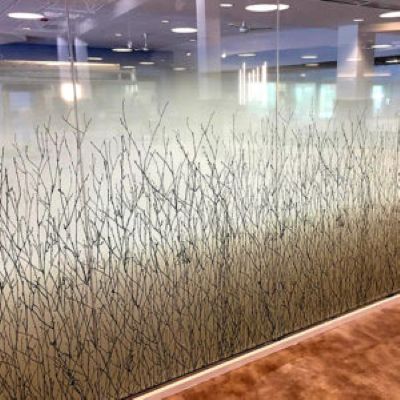
In contrast, decorative or frosted window films provide privacy by obscuring vision, not by eliminating light. These films diffuse light, blurring shapes and movement to create privacy while maintaining a bright, open feel.
Products like 3M Fasara Glass Finishes offer hundreds of patterns, from simple frosted glass effects to complex etched designs. This allows you to tailor the level of obscurity and aesthetic to match the interior design intent.
Applications for Decorative and Privacy Window Film
Decorative and frosted glass films are versatile tools for solving common design challenges in commercial interiors. By specifying a product line like 3M Fasara, you can address multiple needs with a single, cost-effective application, transforming existing glass into a functional design element. These films are ideal for retrofitting spaces to enhance privacy without undertaking a full demolition and rebuild.
Common applications include:
- Conference Rooms: Applying a frosted or patterned band across glass walls prevents distractions and ensures confidentiality during meetings while still allowing light to pass through.
- Office Partitions: Creating visual separation in open-plan offices helps define work zones and reduces the “fishbowl” effect for employees.
- Lobby and Entryway Glass: Incorporating branded elements, logos, or artistic patterns enhances the aesthetic of a building’s entrance while managing sightlines.
- Healthcare and Wellness Facilities: Ensuring patient privacy in waiting areas, treatment rooms, and corridors in a way that feels clean and modern.
Achieving One-Way Vision for Daytime Privacy
One of the most frequently misunderstood requests is for “one-way glass.” This effect is typically achieved with a reflective window film that creates a mirror-like appearance on one side. Its effectiveness, however, is entirely dependent on a light differential.
The film works by reflecting light on the brighter side. During the day, the exterior is brighter than the interior, so people outside see a reflection while those inside can see out clearly. This is ideal for daytime privacy in perimeter offices or for security monitoring stations. The critical specification risk here is failing to account for nighttime conditions. When it is dark outside and lights are on inside, the effect reverses. The interior becomes the brighter side, and the glass becomes a mirror to those inside while allowing outsiders to see in. If 24-hour privacy is the requirement, a reflective film is the wrong solution. A blackout or translucent privacy film must be specified instead.
The Difference Between Commercial Blackout Film and Light Blocking Treatments
People often use the terms “blackout” and “light-blocking” interchangeably, but they represent different performance levels with significant project implications. Misunderstanding this distinction can lead to a failed installation that does not meet client expectations.
A commercial blackout film is engineered for 100% opacity. It blocks virtually all visible light from passing through the glass, creating total darkness. This is a non-negotiable requirement for spaces like operating rooms, secure government facilities, or any area where even minimal light intrusion is unacceptable. Other light blocking window treatments may only block 95% to 99% of light. While this is sufficient for reducing glare in a media room, it is inadequate for a true blackout application. A project manager must confirm the exact level of light reduction required by the client and specify the film’s opacity rating accordingly to prevent costly rework.
Beyond Visuals: Managing Heat, Glare, and UV for Performance
While privacy films manage what people can see, sun control films manage the invisible, energetic transmissions through glass. For a project manager, misidentifying a sun control requirement as a simple privacy need can lead to significant performance gaps, resulting in unmet energy targets and dissatisfied tenants. This category of films is engineered not for visual obstruction, but for precise control over the solar spectrum to enhance building performance and protect assets.
The Science of Modern Sun Control Window Films
Modern sun control films are a testament to advanced materials science, moving far beyond the simple dark tints of the past. Engineers design these sophisticated, multi-layered products to be spectrally selective, meaning they can differentiate between different wavelengths of the sun’s energy.
In many commercial applications, this technology is also referred to as window film insulation, as these advanced films improve the insulating performance of existing glass. By reducing heat transfer through windows, they help stabilize interior temperatures, lower HVAC demand, and enhance overall energy efficiency without the need for full window replacement.
Using technologies like nano-ceramics or sputtered metals, these films can reject a high percentage of invisible infrared light, which is the primary source of solar heat. Simultaneously, they can block nearly all damaging ultraviolet (UV) light. The critical advantage is that they accomplish this while allowing a significant portion of natural visible light to pass through. This preserves views and reduces the need for artificial lighting.
Controlling Glare and Heat with 3M Sun Control Films
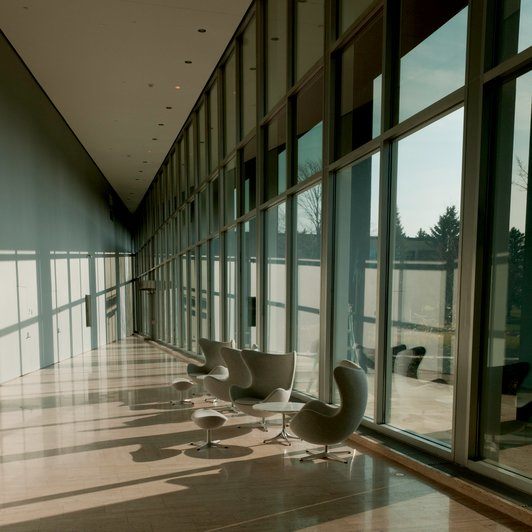
Uncontrolled sunlight entering a commercial space creates two distinct problems for project managers, which are excessive heat gain and disruptive glare. Heat gain drives up cooling costs as HVAC systems work overtime to maintain a comfortable temperature. Glare reduces occupant comfort, lowers productivity by making screens difficult to read, and can force tenants to close blinds, defeating the purpose of large windows.
3M™ Sun Control Window Films are specifically engineered to mitigate these issues. For example, the 3M™ Prestige Series uses non-metalized, multi-layer optical film technology to reject up to 97% of infrared light and up to 60% of the heat coming through windows. This directly translates to lower energy consumption and can contribute to LEED certification credits. By selecting the right film, you provide a solution that improves the tenant experience and delivers measurable operational savings for the building owner.
Protecting Assets with UV Protection Films
The same sunlight that brightens a space also carries UV radiation, the single largest contributor to fading. Over time, this can cause significant damage to valuable assets inside a building, leading to costly replacement of furniture, flooring, and equipment. For retail spaces, it can render merchandise unsellable.
UV protection films are an essential specification for preserving the value of interior assets. Engineers design these films to be a near-total barrier, blocking up to 99.9% of the sun’s harmful UV rays. They act as a powerful safeguard for:
- Retail merchandise, window displays, and signage
- Office furniture, fabrics, and carpeting
- Hardwood floors and custom millwork
- Artwork, photographs, and historical artifacts
Balancing Natural Light with Comfort and Energy Savings
The ultimate goal of modern architectural design is often to maximize daylighting. This objective is frequently at odds with the need for energy efficiency and occupant comfort. This is the core challenge that advanced sun control films are designed to solve. By precisely managing solar energy, these films allow architects and builders to execute designs with large glass facades without the associated penalties of high energy bills and uncomfortable interior spaces.
Securing the Signal: RF Blocking Film for Secure Facilities
Shifting from managing the physical environment to securing the digital one, we enter a highly specialized category of film technology. When a project requires a blocking film for a secure area, specifying a sun control or privacy film would be a critical failure. RF blocking films serve a singular, technical purpose, which is to prevent the transmission of electronic signals through glass, thereby protecting sensitive information from electronic eavesdropping.
What Is RF Attenuation and When Is It Required?
RF attenuation is the measurable reduction in the strength of a radio frequency signal. In the context of window film, installers apply it to glass to create a barrier that stops or weakens signals from devices like cell phones, Wi-Fi networks, and sophisticated electronic surveillance equipment. This level of security is specified for facilities where the information discussed or processed inside is of high value or sensitivity.
Securing Sensitive Compartmented Information Facilities (SCIFs)
The construction of Sensitive Compartmented Information Facilities, or SCIFs, represents the most stringent application for RF blocking films. These are government-accredited, physically and technically secure rooms designed to house classified U.S. intelligence.
For these projects, RF attenuation film is a non-negotiable component required to meet strict government standards like the Intelligence Community Directive (ICD) 705. The film works in concert with other shielding materials in the walls, floors, and ceilings to form a complete, sealed enclosure known as a Faraday cage. This system ensures no compromising electronic emanations can escape the facility.
Preventing Eavesdropping in Corporate and Government Environments
Beyond top-secret government applications, RF blocking film is increasingly specified in corporate and public sector environments where information security is paramount. Consider its use in:
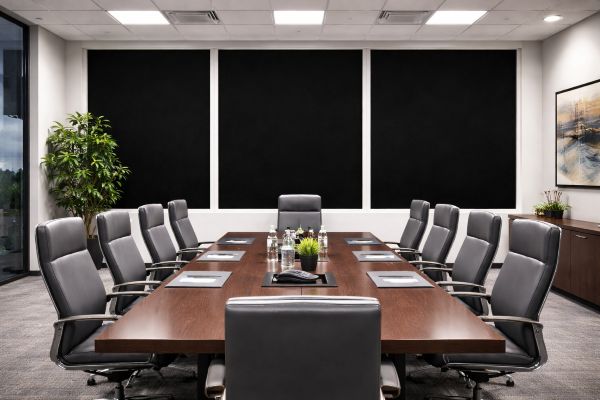
- Executive Boardrooms: Protecting discussions related to mergers, acquisitions, and proprietary financial data.
- Research and Development Labs: Safeguarding trade secrets, prototypes, and intellectual property from corporate espionage.
- Legal Offices: Ensuring attorney-client privilege during sensitive case discussions.
- Data Centers: Adding a layer of physical security to prevent wireless intrusion.
Understanding Technical Specifications for RF Blocking Film
Unlike aesthetic or sun control films, teams choose RF blocking films based on their certified performance data. Relying on a generic request for “RF film” is a project risk, as the specific security requirements dictate the necessary level of performance. These films are specified by their ability to attenuate signals, measured in decibels (dB), across a range of frequencies. A project’s security consultant will define the required attenuation levels. Your film installation partner must then select and properly install a product proven to meet or exceed those technical specifications.
From Ambiguity to Precision: Why Expert Consultation Is Critical
The term blocking film is an open invitation for error. When specifications lack precision, the consequences can range from minor aesthetic issues to catastrophic failures that trigger costly rework and damage client relationships. Expert consultation and precision installation close the gap between a film’s potential and its real-world performance.
The Dangers of Incorrect Film Specification
Key risks of improper specification include:
- Performance Failure: A solar control film that fails to reduce heat as promised or a decorative film that offers insufficient privacy represents a direct breach of project requirements.
- Glass and Glazing Damage: This is one of the most severe and costly risks. Applying a high-absorption film to the wrong type of glass, such as some insulated or treated panes, can cause thermal stress fractures and voided warranties.
- Aesthetic Degradation: A high-quality film applied by an untrained hand can result in bubbling, peeling edges, and visible contamination. This immediately undermines the professional finish of a space.
- Voided Warranties: Most reputable film manufacturers, like 3M, have strict installation protocols. Using a non-certified installer can void the manufacturer’s warranty, leaving the client without recourse if the product fails.
The Value of a National Installation Partner
For project managers overseeing regional or national rollouts, consistency is paramount. A brand’s image must be uniform across every location. Sourcing and managing dozens of local installers is a logistical challenge that almost guarantees inconsistent results. A national installation partner eliminates this complexity. By providing a single point of contact, you streamline communication, procurement, and quality control, ensuring teams deploy the exact same film specification and installation standard across all sites.
Partnering with the #1 U.S. 3M Window Film Installer
3M’s reputation for research and manufacturing quality is unmatched. Their products offer proven performance backed by one of the most comprehensive warranties available. The value of that warranty and the performance of the film itself, however, are entirely dependent on the quality of the installation.
As the largest 3M authorized dealer and installer in the United States, we provide an unparalleled guarantee of quality. Our teams are rigorously trained and certified directly by 3M, ensuring every application adheres to the manufacturer’s strict protocols. This partnership means your project benefits not only from superior product technology but also from the highest standard of installation craftsmanship. Choosing the right partner removes the risk from specification and installation, ensuring the final result meets project goals and client expectations.
Need More Info?
The Window Film Depot team is happy to help.
Next Steps for Your Project
Engaging a specialist early in the planning process is the most effective way to align film technology with your project’s goals. A qualified consultant acts as an extension of your team, helping you navigate the technical landscape to define a clear and accurate scope of work. To prepare for a productive consultation, focus on defining the problem you need to solve. Instead of requesting a product, describe the desired outcome. For example:
- “We need to prevent visibility into our ground-floor executive offices.”
- “The west-facing side of our building becomes unusable in the afternoon due to heat and glare.”
- “Our client requires a solution to reinforce their storefront glass against smash-and-grab theft.”
With a clear problem statement, a film specialist can guide you to the precise solution, provide relevant performance data, and develop a specification that protects your project from the risks of ambiguity.
Frequently Asked Questions
What is the difference between blocking film and privacy window film?
The term “blocking film” is a generic phrase that can be misleading. A privacy window film is a specific type of film designed to control what can be seen through glass, using effects like frost, patterns, or one-way mirroring. The term blocking film could also refer to films that block light, heat, or even radio frequency signals, so it’s critical to specify the exact function you need.
Can window film really lower my energy bills?
Yes, high-performance sun control films are specifically engineered to lower energy costs. They work by rejecting a significant percentage of solar heat (infrared light) before it enters your building. This reduces the load on your HVAC system, leading to measurable savings on cooling expenses, especially in buildings with extensive glass.
Does one-way privacy film work at night?
One-way privacy film works based on a light differential, meaning it creates a mirror effect on the side that is brighter. During the day, it prevents people from seeing inside. At night, when lights are on inside and it’s dark outside, the effect reverses. People outside can see in, and those inside will see a reflection. For 24-hour privacy, a different solution like a frosted or blackout film is required.
Why is professional installation so important for commercial window film?
Professional installation ensures the film performs as intended and lasts for its full lifespan. Certified installers use proper techniques to prevent bubbling, peeling, and contamination. They can also identify if a specific film is compatible with your glass type to avoid thermal stress fractures. Using a certified installer is often required to validate the manufacturer’s warranty.
What kind of film is required for a secure facility like a SCIF?
Secure facilities like SCIFs (Sensitive Compartmented Information Facilities) require a specialized RF attenuation film. This is not a privacy or sun control film. Its sole purpose is to block radio frequency and wireless signals from entering or leaving the room, preventing electronic eavesdropping and data theft. This film is specified based on its certified performance in blocking specific frequency ranges.