Table of Contents:
- What is privacy glass?
- How privacy glass works: from frosted to smart glass
- Types of privacy glass and films: pros, cons, and best uses
- Where privacy glass makes the biggest difference
- Choosing privacy glass without sacrificing light
- How professional installation works
- FAQs about privacy glass
- Why choose a specialist for your project
- Get a Security Glass Assessment and Project Quote
What Is Privacy Glass? (Fast Answer)
Privacy glass is any glazing solution that limits visibility through a window or partition while still allowing natural light into the space. Privacy glass includes various technologies for achieving visual and acoustic privacy, from acid-etched and sandblasted finishes to laminated interlayers, switchable smart glass, and applied window films. These solutions work on both new glass and existing windows.
The most common locations where privacy glass solves real problems in 2026: front doors and sidelites, bathroom windows, street-facing living rooms, ground-floor bedrooms, conference rooms, medical clinics, schools, and financial offices. Privacy glass eliminates the need for traditional window coverings like curtains and blinds, giving occupants daylight, energy efficiency, and a clean aesthetic without sacrificing light or closing off rooms. This article focuses on architectural privacy glass solutions and retrofit-friendly options that avoid full glass replacement where possible.
How Privacy Glass Works: From Frosted to Smart Glass
Different privacy glass types manipulate how light passes through glass: scattering it, absorbing it, or redirecting it to protect privacy. Privacy glass allows light while limiting visibility through it.
Frosted glass is produced by sandblasting or acid-etched surface treatments that roughen the glass so it diffuses light and blurs visibility. The result is a smooth, misty finish that admits soft daylight while obscuring detail. Frosted glass provides permanent privacy through surface treatments, making it a go-to for bathrooms and entry doors.
Textured privacy glass uses pressed or rolled patterns (rain, reed, chinchilla, linen, pebbled) that distort shapes and movement while still admitting daylight. Patterned glass reduces transparency and adds a decorative touch, giving designers flexibility near front doors and sidelites.
Tinted or reflective glass reduces visibility by darkening the material. Coloured, smoked, or tinted interlayers absorb parts of the visible spectrum, providing daytime privacy when the exterior is brighter. The trade-off: darker tint means lower visible light transmission and more reliance on electric lighting.
Laminated glass bonds two sheets of glass around an interlayer (PVB or EVA) that can be frosted, printed, or tinted. This permanently obscures views, adds impact resistance, and contributes to security and sound control. Laminated glass incorporates opaque interlayers for added privacy and holds shards together if broken.
The most common technology for switchable privacy glass is PDLC (polymer dispersed liquid crystal). A PDLC film embedded between glass layers contains liquid crystals suspended in a polymer matrix. When an electrical current is applied, the liquid crystals align, and the glass turns transparent. Power off, and the crystals scatter light, creating an opaque, frosted appearance. In the off state, PDLC glass appears frosted and blocks visibility. Switching happens in under 60 milliseconds in many products, and clear-state power draw runs about 0.5 watts per square foot.
SPD (suspended particle device) glass transitions quickly between lighter and darker states to control light, offering continuous dimming rather than a binary privacy flip. Electrochromic glass is primarily used for controlling sunlight, glare, and solar heat; it changes tint gradually rather than instantly, taking minutes to shift states. Both serve solar control roles more than full privacy.
Switchable film can also be applied to existing glass and wired to low-voltage power, offering a retrofit path without full glass replacement. High-performance window films (frosted, gradient, one-way reflective) installed on existing glass are often more affordable and faster to deploy across large buildings. Privacy glass films can be applied to existing glass surfaces with minimal disruption.
Types of Privacy Glass and Films: Pros, Cons, and Best Uses
Here is a comparison of major privacy glass options so you can shortlist what fits your project.
Frosted glass (factory or film): Frosted glass diffuses light while obscuring visibility with a soft, uniform translucency. Strong privacy at close range. Ideal for bathrooms, interior partitions, and front door inserts. Film versions are removable and cost-effective for retrofits; factory frosted or acid-etched glass offers a smoother, easy-to-clean surface, long-term durability, and an upscale appearance suited to offices, lobbies, and high-end residential projects. Static frosted glass typically costs $20 to $60 per square foot installed.
Textured and patterned glass: Textured glass obscures images while allowing light to pass through, offering medium-to-high privacy that still shows movement and shadows. Rain glass mimics heavy rain for high obscurity. Reeded glass features vertical patterns for modern aesthetics. Popular for cabinet doors, stairwells, and decorative doorglass. Nature-inspired textures, linear reeded patterns, and geometric designs are trending through 2026.
Laminated privacy glass: Laminated glass can enhance safety and noise control in construction. The interlayer can be frosted, white, colored, or printed, providing impact resistance and improved security while obscuring views. Suited for doors, street-level glazing, schools, and healthcare facilities where code compliance, thickness requirements, and permanence matter.
Switchable privacy glass and switchable privacy film: Switchable privacy glass changes from opaque to transparent with electricity, using polymer-dispersed liquid crystal technology. PDLC film in privacy glass aligns under an electric current for transparency; remove the current and the glass switches to a frosted, opaque state. Clear-state visible light transmission reaches roughly 80%, while the frosted state drops to about 8%. The glass switches states with an electric current. This is a premium solution for conference rooms, executive offices, clinic doors, and patient rooms. Smart glass costs $50 to $150 per square foot installed, compared to $20 to $60 for static frosted alternatives. Switchable smart glass can be integrated into automated building systems for scheduled privacy transitions.
Privacy window films: Frosted films, gradient films for partial coverage, decorative patterns, and reflective one-way films applied to existing glazing. Films are practical for large retrofits or leased spaces. A frosted band at eye level or branded film stripes can protect privacy while preserving clear views at the top and bottom for daylight.
Where Privacy Glass Makes the Biggest Difference
Privacy needs differ across homes, offices, and public buildings. Here is what typically works best by location.
Front doors and sidelites: High priority for both privacy and security. Common solutions include frosted glass, textured or acid-etched inserts, laminated glass with privacy interlayers, and retrofit privacy films that obscure street views without darkening the entryway. A front door with clear glass sidelites is one of the most exposed points in any house.
Bathrooms and showers: Frosted or acid-etched glass for windows and shower enclosures offers permanent privacy. Privacy window films work when replacing glass is not practical. Silhouette visibility remains possible at night under strong backlighting; higher-opacity or patterned options reduce that risk near close neighbors.
Offices and conference rooms: Glass-front offices and conference rooms are standard in modern workplaces. Switchable privacy glass is ideal for modern office and residential spaces where HR conversations, client meetings, and strategy sessions require confidentiality at the flip of a switch; in clear mode, the space stays open and bright. Opaque privacy glass panels can double as projection screens or whiteboards. Switchable privacy glass enhances natural light while ensuring privacy. Full-height frosted film and branded decorative films are affordable alternatives.
Healthcare, education, and public buildings: Patient rooms, counseling offices, nurse stations, registrar windows, and school administration offices all have regulatory and comfort-driven privacy needs. Laminated glass, patterned film, and smart glass support privacy while maintaining supervision and natural light. Smart glass can provide soundproofing and physical security compared to standard partitions.
Interior partitions and open-plan layouts: Frosted or patterned glass for meeting rooms, focus pods, and co-working spaces keeps interiors visually open while reducing distraction and creating a defined privacy level for each zone.
Choosing Privacy Glass Without Sacrificing Light
More privacy means less visible detail, but not necessarily less light. Careful selection can protect privacy without sacrificing light and openness.
Start with a checklist: identify which direction your windows face, how close neighbors or sidewalks are, and when privacy matters most (day vs. night, weekdays vs. evenings). Think about visible light transmission (VLT); a frosted or acid-etched finish can still deliver bright, diffused daylight, while heavy tint or blackout options cut both vision and light.
Recommended privacy levels by location:
- Bathrooms, street-level bedrooms: high-obscurity frosted or patterned glass
- Front doors and sidelites: medium obscurity with textured or frosted options
- Conference rooms and collaboration spaces: flexible switchable privacy glass
Consider permanence vs. flexibility. Laminated glass or factory frosted glass suits long-term installations and new construction. Removable privacy films fit leased spaces, evolving layouts, and changing branding.
Common design mistakes to avoid: choosing very dark tint for a front door that makes the entry feel gloomy; using reflective one-way film without accounting for nighttime visibility (when interior lights are on, the mirror effect reverses and people outside can see in); installing fully opaque panels where some visual connection or borrowed light would be useful. Involve a glazing or film specialist early in the design process, especially for large commercial projects, to coordinate privacy needs with energy performance, safety glazing codes, and aesthetics.
How Professional Privacy Glass and Film Installation Works
A professional installer handles the process from consultation through completion with minimal disruption to your business or daily life.
Consultation: Site visit or virtual walkthrough, assessment of existing glass (tempered, laminated, insulated units), measurement of doors and windows, and discussion of privacy goals, natural light concerns, and budget.
Solution design: Recommending combinations such as frosted film bands on conference rooms, acid-etched glass for front doors, laminated glass in high-risk areas, or switchable privacy glass for high-profile meeting spaces. Custom patterns and branding are available where relevant.
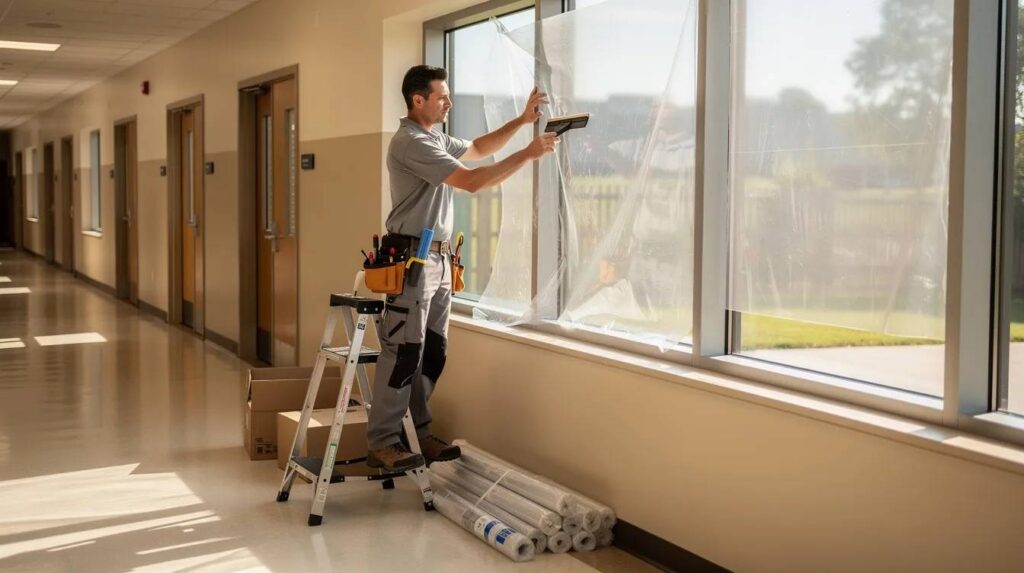
Installation (films): Cleaning and prepping glass, precision cutting, application with slip solution and squeegee, trimming edges, and curing. Most film jobs cause minimal downtime and can be completed outside peak hours. For laminated and switchable privacy glass, coordination with glaziers or contractors is needed, along with electrical connection for PDLC smart glass and testing switching performance with wall switches and building controls.
Post-installation care: Clean with a soft cloth and mild, non-ammonia glass cleaner. Avoid abrasives and razor blades. Film warranties typically range from 10 to 20 years for adhesive integrity and color stability. Smart glass electrical components carry 5- to 10-year warranties in most cases.
FAQs About Privacy Glass
These answers address the most common questions from homeowners, facility managers, architects, and tenants.
What is the difference between frosted glass and obscure glass?
Obscure glass is an umbrella term for any glass that distorts or blocks views, including textured, patterned, tinted, and frosted varieties. Frosted glass is one specific type of obscure glass created by sandblasting or acid etched treatments for a smooth, misty finish. Both allow natural light in, but textured obscure glass shows more pattern and form, while frosted glass has a softer, more uniform appearance suited to bathrooms and modern interiors.
Can privacy glass completely block people from seeing inside at night?
Frosted, heavily textured, and high-opacity films prevent clear views both day and night. Silhouettes and light glow may still be visible if interior lights are bright and someone stands close to the glass. Reflective one-way films only provide privacy when it is brighter outside than inside, so they lose effectiveness at night without additional treatments like shades.
Is switchable privacy glass energy efficient?
PDLC switchable privacy glass is chosen primarily for visual privacy and design flexibility. It can support energy efficiency when paired with low-E coatings or installed as part of insulated glass units. The electrical draw to switch states is low (about 0.5W per square foot), but solar control layers and spectrally selective coatings have a larger impact on overall energy savings than the switching effect alone.
Can I add privacy to existing windows without replacing the glass?
Most homes, offices, schools, and storefronts can gain privacy using retrofit window films: frosted, patterned, gradient, tinted, or reflective films applied directly to existing windows. No full glass replacement is needed, disruption is minimal, cost is lower, and films can be removed or changed as layouts or branding evolve.
How do I clean and maintain privacy glass and films?
Use a soft cloth or squeegee with mild, non-abrasive glass cleaner. Avoid harsh chemicals, razor blades, or abrasive pads that can damage etched surfaces or scratch films. Properly installed privacy glass and films are designed for long-term use, and regular gentle cleaning maintains clarity and appearance.
Is laminated privacy glass safer than standard glass?
Laminated glass includes a plastic interlayer between two sheets of glass that holds shards together if broken, reducing injury risk, deterring forced entry, and helping meet safety glazing requirements. When that interlayer is frosted or printed, laminated privacy glass combines safety, acoustics, UV reduction, and privacy in a single product, making it a strong choice for doors, sidelites, and public-facing glazing.
Why Choose a Specialist for Your Privacy Glass Project
The right partner matches privacy glass options and film solutions to real-world conditions, code requirements, and budget, avoiding expensive trial-and-error. Window Film Depot brings over three decades of experience comparing frosted glass, laminated glass, smart glass, and privacy films objectively, then recommending the right mix for homes, offices, schools, and healthcare facilities.
With a history of multi-site and large-scale rollouts, Window Film Depot coordinates standardized privacy solutions across offices, branches, or campuses while accommodating local building codes and unique site constraints. Turnkey services cover consultation, product selection, procurement, professional installation, and post-install support. Trained technicians, proper tools, manufacturer-backed warranties, and clean installations minimize disruption to your business or daily life.
Next Steps: Plan Your Privacy Glass or Film Upgrade
Take inventory of where you feel exposed today: front door, bathroom window, bedroom, conference room, or street-facing glass. Picture those same spaces with comfortable privacy and soft natural light.
Gather photos and measurements of problem areas. Define your privacy priorities: daytime vs. nighttime, full vs. partial, permanent vs. flexible. Consider which spaces might benefit from switchable privacy glass that can flip between transparent and opaque on demand.
Contact Window Film Depot for a consultation, cost estimate, and sample review before making final decisions. Thoughtful privacy glass choices improve comfort, security, style, and productivity in both homes and workplaces, without closing rooms off from the outside world.