Table of Contents:
- Introduction: Why Storefront Privacy Film Matters in 2026
- How Storefront Privacy Window Film Works
- Key Benefits of Window Film for Storefront Privacy
- Best Types of Privacy Window Film for Storefronts
- Storefront Design Strategies: Balancing Privacy, Branding, and Daylight
- Daytime Privacy vs Nighttime Privacy: What Store Owners Must Know
- Energy Savings, UV Protection, and Comfort for Commercial Storefronts
- Installation Process for Storefront Privacy Film
- Soapy Water, Bubbles, and Maintenance: Practical Care Tips
- Cost, ROI, and Budgeting for Storefront Privacy Film
- Common Mistakes to Avoid with Storefront Privacy Films
- FAQs About Storefront Privacy Window Film
- Why Choose Window Film Depot for Storefront Privacy Solutions
- Next Steps: Plan Your Storefront Privacy Film Project
Introduction: Why Storefront Privacy Film Matters in 2026
Picture a boutique on a busy Atlanta sidewalk that wants customers to see curated displays but not the back-office clutter behind the sales counter. Or a healthcare retail clinic that needs HIPAA-friendly front windows so patients checking in aren’t visible from the parking lot. Both problems share one solution: window film for storefront privacy.
Privacy window film is a thin, retrofit layer applied directly to existing glass. Unlike blinds or curtains, it requires no daily operation, and unlike replacing glass entirely, it works with the windows you already have. The result is a cost-effective way to control who sees what through your storefront, while also reducing glare on displays and POS screens, blocking UV rays, managing heat, and opening up branding opportunities with decorative graphics.
This article is written from the perspective of Window Film Depot, a family-owned 3M-authorized dealer and installer that has served commercial buildings, retail chains, and independent storefronts since 1992. Below, you will learn the best film types for your storefront, what actually works for daytime privacy versus night, realistic cost and ROI expectations, how installation works (including the soapy water method), and how to choose a qualified installer.
How Storefront Privacy Window Film Works
Privacy films modify the way light and reflection behave at the glass surface. This is not just generic “tinting.” Depending on the product, the film uses one of three optical principles: reflectivity, translucency, or full opacity.
One-way mirror films block visibility from the inside during the day by increasing the reflectivity of the exterior surface. In real projects, one-way mirror films work by leveraging light differentials. When the sun is brighter outside than the lights inside, the glass acts like a mirror from the street. People walking past see their own reflection, not your inventory or office. Reflective films create a mirror-like appearance outside, which is why they work so well for daytime privacy. However, this effect depends entirely on the light balance between the two sides.
Frosted films obscure views while allowing natural light to pass through. They scatter incoming light using a diffusion layer, blurring shapes and details on both sides of the glass without turning the space dark. Blackout films completely block visibility and light, providing total opacity for areas that need it.
Consider a café with large street-facing glass in Dallas. During a summer afternoon, a reflective privacy film makes the windows opaque from the sidewalk while the staff inside enjoy a clear view out and comfortable natural light. A frosted band across the lower half of the same windows could hide seated diners from knee-height views while letting sunlight stream through the upper pane.

Key Benefits of Window Film for Storefront Privacy
Privacy film does more than block views. It directly affects customer comfort, brand image, and your operating costs. Window film enhances privacy for storefronts while delivering several practical returns that most business owners do not initially expect.
Visual privacy from sidewalks. Films shield back-of-house areas, storage zones near storefront glass, or reception areas from outside view. You can add privacy to specific sections of glass without blacking out the entire window, keeping the space open and inviting.
Glare reduction on screens and displays. Direct western sun exposure in the late afternoon can make it nearly impossible to read a digital menu board, card terminal, or POS screen. Privacy films reduce glare and eye strain in workspaces, and window films can minimize glare on screens and displays, making the sales floor functional even during peak sun hours.
Customer and staff comfort. Privacy films block up to 55% of solar heat, which means a more comfortable environment near the glass. Staff working checkout stations or greeting customers no longer feel the harsh light radiating off the storefront.
Merchandise protection. Privacy films can block up to 99% of harmful UV rays. That matters when you are displaying clothing, artwork, cosmetics, or food packaging that fades under prolonged sunlight. Privacy films protect furniture from harmful UV rays and keep interiors looking fresh longer.
Security pairings. For high-value retail like jewelers, electronics shops, and pharmacies, some privacy films can be combined with security glazing. Security and commercial graphics film products hold shattered glass together during impacts, making smash-and-grab theft significantly harder to execute.
Professional appearance. Privacy films enhance the professional appearance of offices, and they can provide a cleaner appearance to public spaces, making your storefront look polished rather than cluttered.
Best Types of Privacy Window Film for Storefronts
Storefront glass has different needs than interior office partitions or conference rooms. Film selection should account for street visibility, branding goals, and customer experience. Different film types offer varying levels of privacy and aesthetics, so matching the right product to your situation is critical.
Dark tinted commercial window film. Dark tinted films provide a classic look while blocking visibility from the street. With visible light transmittance (VLT) typically between 5% and 35%, they increase privacy while still allowing occupants to see out. This is a popular option for fashion retailers, vape shops, and electronics stores that want a discreet exterior without sacrificing light entirely. Products like the BDF NA05 film provide 95% daytime privacy, giving strong one-way obscurity during business hours.
Reflective (one-way mirror) film. Reflective films improve aesthetics while enhancing privacy, producing a sleek, modern facade. They offer strong daytime privacy for urban street retail and medical storefronts. The trade-off: at night, the mirror effect diminishes, and certain mirror finishes may not match every brand’s design language.
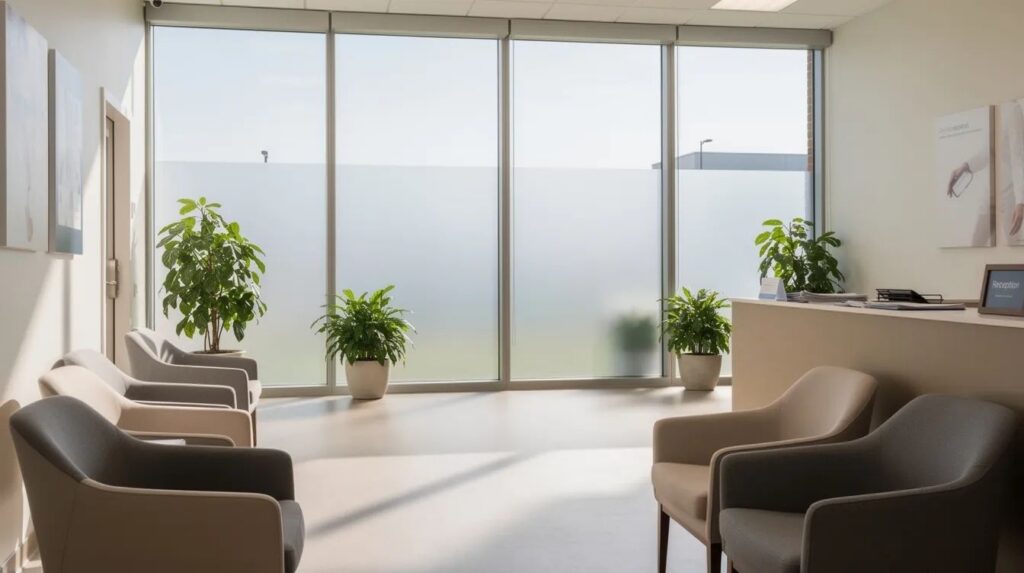
Frosted privacy film. Frosted films blur details while allowing natural light to pass through, making them ideal for partial coverage on the lower portion of storefront windows or doors. Salons, clinics, and professional offices frequently use them to hide specific zones while keeping upper glass clear for daylight. They work equally well on interior glass dividers and reception areas.
Blackout film. Blackout films completely block visibility and light. They are most appropriate for storage zones, back-of-house doors with glass, or temporarily vacant units. Rarely is blackout film used across an entire primary storefront, because it eliminates merchandising opportunities.
Cloaking films. A newer category: cloaking films obscure digital screens from outside view. If your storefront has visible monitors displaying proprietary data or patient information, cloaking film makes those screens appear dark from the sidewalk while remaining perfectly readable inside.
Decorative and branded films. Decorative films can display logos and patterns for branding, combining functional privacy with brand recognition. A gradient pattern, frosted stripe, or printed logo on the main entrance turns the glass itself into a marketing surface.
Storefront Design Strategies: Balancing Privacy, Branding, and Daylight
Effective storefront privacy is rarely all-or-nothing. The goal is usually to hide specific views while still merchandising products and drawing customers in. Window films enhance aesthetics with various colors and designs, giving you creative tools alongside functional privacy.
Zoning strategies. The most practical approach is to zone different privacy levels across the storefront glass. Use frosted or patterned privacy film at eye level to block views of desks, treatment chairs, or cluttered workstations. Keep the upper glass clear or lightly tinted for daylight and visibility of signage. Frosted films create a modern, sleek appearance for offices and street-facing professional spaces when applied as a continuous band.
Partial-coverage banding. A 24- to 36-inch frosted stripe across the lower half of a window works exceptionally well for reception areas, nail salons, and medical storefronts. It provides discretion without a closed-off feel. Customers still see your branding and interior ambiance through the clear upper section.
Practical example. Consider a small urban pharmacy: blackout film covers the storage bay windows on the side of the building, frosted film runs across the consultation area glass, and branded decorative film with the pharmacy logo marks the main entrance doors. Each zone serves a distinct purpose, and the overall appearance is cohesive and professional. Privacy films can support branding by maintaining an attractive storefront rather than hiding behind mismatched blinds or paper taped to windows.
Window Film Depot can work from architectural drawings or photos to propose layout options that integrate privacy film, commercial graphics, and code-required safety markings on doors and sidelites, drawing on its full range of window film solutions so every element is covered before the crew arrives.
Daytime Privacy vs Nighttime Privacy: What Store Owners Must Know
This is the single most misunderstood topic in storefront privacy film, and getting it wrong leads to disappointment.
One-way mirror films block inside visibility during the day because outside sunlight is significantly brighter than interior lighting. The glass surface reflects the brighter side, acting like a mirror to passersby. During business hours on a sunny street, this effect is strong and reliable for daytime privacy.
At night, the equation flips. When your interior lights are on and the street is darker, people outside can see in through reflective or tinted film more easily. Silhouettes, interior layouts, and even merchandise become visible. Dark or reflective films still reduce clarity compared to bare glass, but they do not deliver full nighttime privacy.
Realistic expectation: a boutique with tinted film will appear mirrored and private all afternoon, but once the sun sets and interior lighting takes over, outlines of racks and displays become visible from the sidewalk. If full after-hours privacy matters – for a jewelry store, a medical office, or a restaurant with a VIP room – consider the best window film for nighttime privacy and pair privacy window film with interior roller shades, sheer curtains, or security shutters. Some businesses also adjust interior lighting angles to reduce outward visibility at night.
Myth vs reality: “One-way” film does not mean invisible from outside 24/7. It means one-way visibility based on which side is brighter, and true day-and-night privacy window film solutions rely on different technology. Set your expectations accordingly, and you will be satisfied with the result.
Energy Savings, UV Protection, and Comfort for Commercial Storefronts
Storefront glass is usually the largest single source of solar heat gain in retail and restaurant spaces, especially for locations with long operating hours and south- or west-facing facades.
Modern commercial window film can reject a substantial share of incoming solar energy. Products like 3M’s Prestige Series reject up to 97% of infrared light while maintaining visible clarity, and some reflective exterior films reject roughly 81% of total solar energy. For many standard privacy film installations, tinted films can reduce cooling costs by up to 30%, which adds up quickly in warm climates. Installing privacy films can lower energy bills significantly, particularly for businesses running HVAC systems ten or more hours per day.
UV protection matters for merchandise longevity. Premium films block up to 99% of UV rays, reducing fading on displayed clothing, cosmetics, artwork, and packaging. That translates to fewer markdowns and longer shelf appeal.
Reducing glare is another comfort factor. Films help with the visibility of illuminated signs, tablets, digital menu boards, and payment terminals facing large windows. In quick-service restaurants and modern boutiques, this alone can improve the customer experience and reduce checkout errors.
High-quality window films are durable and cost-effective over their lifespan. Window Film Depot can model potential energy savings using building data and film performance specs and recommend 3M window film products and installation options – a service that is especially valuable for multi-site facility managers and national brands looking to significantly reduce energy costs across a portfolio of commercial spaces.
Installation Process for Storefront Privacy Film
Storefront projects in commercial buildings should use professional 3M window film installation. Warranty coverage, safety on large panes, and clean appearance all depend on proper technique – particularly on doors, oversized glass, and high-reach applications.
Assessment and scheduling. The process starts with an on-site assessment: measuring glass dimensions, checking for existing coatings or surface damage, identifying glass type (annealed, tempered, laminated), and evaluating sun exposure. Work is typically scheduled during off-peak hours – evenings, early mornings, or closed days – to minimize disruption to customers and staff.
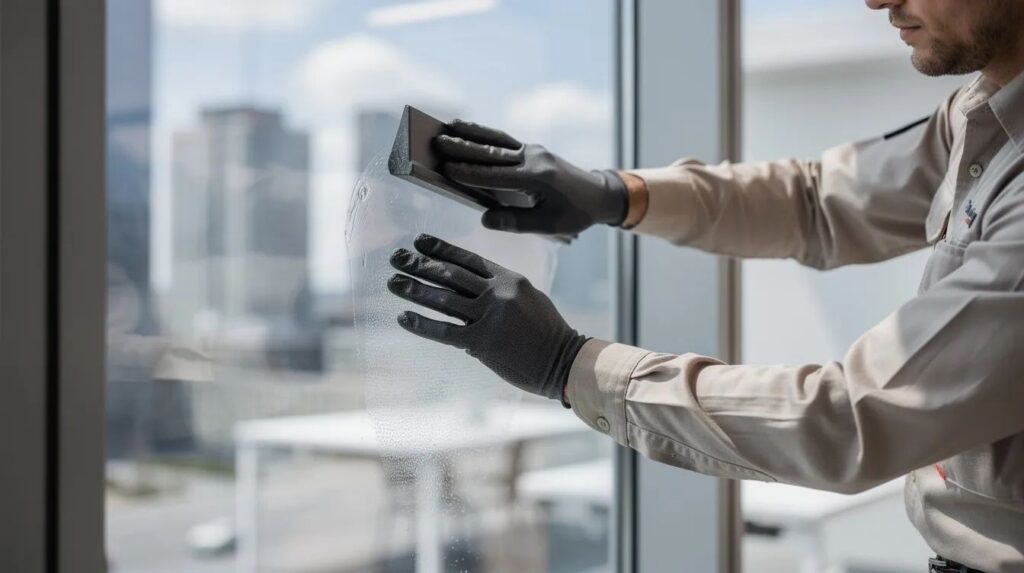
Installation steps. Technicians clean the glass thoroughly, then apply soapy water to the window for easier film placement. The standard solution uses about 16 oz. of water and 8 drops of soap to create the right slip. Installers remove the backing liner using two pieces of tape pressed to one corner of the film, then position the film on the wet surface. A squeegee pushes out water and bubbles after application, and edges are trimmed precisely with a fine blade. Install window films inside unless specified as exterior films – the interior surface is standard for most commercial privacy applications because it protects the film from weather and extends its useful life.
Timing. A typical 30-foot-wide storefront can often be completed in a single day by a trained crew, depending on film type and access conditions. Multi-location roll-outs follow the same process at scale.
Safety in commercial spaces. Window Film Depot’s crews protect merchandise and flooring during installation, work around active customers when necessary, and adhere to landlord or mall management rules. All installers are trained and insured for national roll-outs across various types of commercial buildings, including garage-level retail, house-converted offices, and high-rise storefronts.
Soapy Water, Bubbles, and Maintenance: Practical Care Tips
If you have looked into DIY film installation, you have probably seen advice about using a spray bottle filled with soapy water. The same principle applies to professional installations, just with calibrated slip solutions and specialized tools.
The soapy water solution serves a specific purpose: it lets the film slide into exact position on the glass surface before being locked down with a squeegee. Without it, the adhesive grabs immediately and repositioning becomes impossible. Professionals use a squeegee to push out water and bubbles after application, working from the center outward to ensure a smooth, bubble-free finish.
What to expect after installation. Slight haziness or small water pockets are completely normal in the first few days. These clear as the film cures and moisture evaporates through the adhesive layer. Depending on climate and film thickness, full curing can take several days to a few weeks. Do not be alarmed – this is not a defect.
Cleaning and maintenance. Wait approximately 30 days before cleaning newly filmed glass. When you do clean, use soft cloths or a rubber squeegee with mild soap and water. Avoid ammonia-based cleaners, abrasive pads, and razor blades, as all of these can scratch or degrade the film. Privacy films can last 7 to 15 years with proper care, so a little patience during the cure period pays off for over a decade of performance.
When to call your installer. Light haze and minor moisture spots during curing are fine. Large bubbles that do not diminish after two to three weeks, peeling edges, or contamination stuck under the film are not normal and warrant a call to your installation team.
Cost, ROI, and Budgeting for Storefront Privacy Film
Several factors determine the total price of a storefront privacy film project: total square footage of glass, type of film (standard tinted vs. specialty options like cloaking or blackout), degree of customization (logos, patterns, gradient banding), and site conditions such as height, access, and union building requirements.
Typical cost ranges. For 2025–2026, commercial privacy films with professional installation generally fall in the low-to-mid teens per square foot for standard products, with premium, decorative, or switchable films running several dollars higher. Custom branding work and complex multi-film layouts add to the total, but these are typically a fraction of what full glass replacement or permanent architectural modifications would cost.
Thinking about ROI. Energy savings in sunny markets, longer merchandise and furnishing life, enhanced customer comfort, and elimination of replacement blinds or screens that collect dust and break all contribute to payback. Documented case studies show payback periods of three to five years for many commercial projects, and some installations with utility rebates recover costs even sooner.
Example scenario. A retailer with roughly 500 square feet of glass across a south-facing storefront in a warm climate installs mid-range solar privacy film. The incremental reduction in cooling load, combined with fewer UV-damaged markdowns and improved customer dwell time, begins to justify the investment within a few seasons.
Multi-location scaling. For chains and franchises, Window Film Depot’s experience with national roll-outs means standardized film specs, consistent quality across every building, and simplified procurement. Standardizing the film type and VLT across locations keeps budgeting predictable and ensures your brand’s appearance stays uniform whether you have five stores or five hundred, all sold and installed under a single program.
Common Mistakes to Avoid with Storefront Privacy Films
Most film-related disappointments come from incorrect expectations or poor product and installer choices, not from the technology itself.
Wrong film for the job. Choosing a light decorative pattern when you need near-total privacy, or installing heavy blackout film across a primary display window that should be drawing foot traffic. Match the film’s opacity and style to the specific role each pane of glass plays.
Ignoring the day-vs-night difference. Assuming a reflective film will keep your store invisible around the clock is the most common misconception. If nighttime privacy matters, plan for supplemental coverings.
Cheap, non-commercial films. Films sold online for residential use and installed DIY on large storefront glass are prone to bubbling, discoloration, and premature failure. Limited warranties and incompatible adhesives can even cause glass breakage on certain glazing types. Commercial-grade film from an authorized dealer is a different product entirely.
Code and safety oversights. Covering doors and sidelites without required safety markings or ADA-compliant contrast bands is a problem inspectors will catch. Films on fire-rated glass or exit-route glazing must meet local building code requirements.
Skipping professional consultation. Coordinating with landlords, franchise design standards, and brand guidelines is much easier when you involve a qualified installer such as a 3M window film installation company early in the planning process, before film is ordered or a corner of glass is covered.
FAQs About Storefront Privacy Window Film
Can people still see into my store at night with privacy window film?
Most daytime privacy films – including reflective and tinted options – do not provide full nighttime privacy. When your interior lights are brighter than the ambient light outside, the one-way effect reverses, and silhouettes or merchandise become visible from the street. Think of a boutique that appears mirrored and opaque all afternoon but reveals clothing racks once the sun sets and the store lights take over. The solution is straightforward: pair your privacy film with roller shades, interior screens, or adjusted lighting angles for after-hours confidentiality.
Will privacy film make my storefront too dark for displays?
Not if you select the right product. Lighter tints, frosted banding, and spectrally selective films preserve display visibility while still controlling glare and privacy. A heavily tinted film with 5% VLT will darken a window considerably, but a frosted stripe or 35% VLT tint keeps displays clearly visible from the sidewalk. Consult with your installer to match film performance to your merchandising strategy – darker options work well for high-glare locations, while display-centric windows benefit from lighter or partial-coverage films.
How long does commercial storefront window film last?
Premium commercial films, including the 3M product lines Window Film Depot installs, typically last 7 to 15 years or more depending on film type, sun exposure, and maintenance. Many come with commercial warranties of 10 to 15 years. When it is time for replacement, removing and reapplying film is still far cheaper and less disruptive than replacing the glass itself.
Can I remove or change the film if I rebrand or remodel?
Yes. Professionally installed films are removable, though removal is best handled by trained technicians to avoid adhesive residue or damage to the glass surface. Many retailers update decorative and branded films during remodels or rebrands. Window Film Depot can coordinate removal and reinstallation cycles across multiple stores, keeping the process efficient and the appearance consistent.
Does storefront privacy film go on the inside or outside of the glass?
Most privacy window film for commercial storefronts is installed on the interior surface. This protects the film from weather, vandalism, and cleaning chemicals, extending its useful life. Some specialty exterior-grade films exist for situations where interior access is limited or specific solar performance is needed. A site evaluation determines the best approach based on existing coatings, accessibility, and exposure.
How soon after installation can I clean the windows?
Wait approximately 30 days before the first cleaning. During the curing period, slight haze or small moisture pockets are normal and will clear on their own. When you do clean, use soapy water and a soft cloth – never ammonia-based cleaners or abrasive tools. This simple routine keeps the film looking sharp for years.
Why Choose Window Film Depot for Storefront Privacy Solutions
Window Film Depot is a national, family-owned specialist in commercial window film, founded in 1992 and headquartered in Marietta, Georgia. For over three decades, the company has served retailers, restaurants, healthcare clinics, government facilities, and institutional clients across North America.
3M-authorized dealer and installer. Window Film Depot carries and installs the full range of 3M solar control, privacy, security, decorative, and anti-graffiti films. This authorized status means access to premium products, manufacturer-backed warranties, and trained installation crews who meet 3M’s quality standards.
Deep commercial experience. From single storefronts to multi-state roll-outs, Window Film Depot handles projects at every scale. Typical engagements include retrofitting a regional eyewear retailer with frosted privacy banding and branded film across dozens of locations, or updating a healthcare chain’s storefronts for HIPAA-friendly reception privacy – all managed under a single point of contact.
Integrated solutions. Privacy film is often just one piece of the puzzle. Window Film Depot can combine privacy film with solar control for energy efficiency, security glazing for added protection, anti-graffiti coatings for high-traffic urban locations, and custom commercial graphics for branding – all in one project.
Turnkey service. The team works directly with facility managers, architects, and franchise design teams to specify the right commercial window film, ensure compliance with building codes and landlord standards, and deliver a create-to-completion process: consultation, product selection, professional installation, warranty support, and ongoing service for future remodels or rebrands.
Next Steps: Plan Your Storefront Privacy Film Project
You now understand what window film for storefront privacy is, the main film types and their trade-offs, the critical difference between daytime privacy and nighttime privacy, and how the right film can improve privacy, reduce energy bills, and protect your space without sacrificing natural light or brand impact.
Here is what to do next: take photos of your storefront from both inside and out, noting any problem times of day when glare or privacy is worst. Gather approximate glass measurements – even rough dimensions help your installer build an accurate quote. Identify which zones of glass need privacy, which should stay clear for displays, and whether you want to incorporate branding or decorative elements. Then contact Window Film Depot to start a conversation.
Window Film Depot offers free consultations and detailed proposals for both single locations and multi-site locations nationwide. Whether you manage a garage-turned-retail space, a house-converted professional office, or a 200-location franchise, the team can spec the right film, schedule installation around your business hours, and deliver a storefront that feels welcoming, comfortable, and secure for everyone who walks through your doors.
Reach out to Window Film Depot today to request a quote and take the first step toward a smarter, more private storefront.