Table of Contents:
- How Commercial Energy Saving Window Film Works on Your Building
- What Is One Way Mirror Film vs One Way Window Glass?
- Energy Savings, Cost Reduction, and ROI for Commercial Buildings
- Comfort, Productivity, and Aesthetics in Modern Commercial Space
- Sustainability, Codes, and Green Building Certifications
- How Commercial Window Film Installation Works with Window Film Depot
- Frequently Asked Questions About Commercial Energy Saving Window Film
- Why Commercial Clients Choose Window Film Depot
- Next Steps: Evaluate Commercial Energy Saving Window Film for Your Building
Commercial Energy Saving Window Film: Fast Wins on Energy Bills and Comfort
Between 2024 and 2026, rising energy costs and stricter building performance standards have forced commercial property owners to find fast, non-disruptive ways to improve energy efficiency. Full window replacement is expensive and slow. That is where commercial energy-saving window film comes in.
In plain terms, it is a retrofit layer applied to existing windows that improves insulation and solar control without replacing glass. Commercial window films enhance energy performance without major construction. Industry data consistently shows 15–30% cooling energy savings with typical payback in 2–5 years for mid- to high-rise commercial buildings. Window films can reduce HVAC costs by up to 30%, and they are generally a cost-effective retrofit compared to replacing windows.
These films work for offices, retail chains, schools, hospitals, and government facilities – any commercial space with large glass areas where HVAC strain and tenant comfort complaints are common. Window Film Depot, a family-owned national 3M dealer-installer with a commercial focus since 1992, has delivered these solutions across thousands of projects. The rest of this guide draws on that hands-on expertise.
How Commercial Energy Saving Window Film Works on Your Building
Commercial window films are produced as thin, engineered polyester laminates applied to the interior face of existing commercial windows. Multiple layers work together to manage solar radiation at the glass surface.
Here is what each layer does:
- Infrared reflection and absorption: Solar control window films can reflect up to 80% of solar energy, keeping heat from entering the building. Spectrally selective films reject infrared heat while allowing visible light through, maintaining natural light and daylight levels inside.
- Low-e performance: Low-e films improve insulation by reflecting indoor heat back into the space. Insulating films help retain warmth in winter and reflect heat in summer, effectively improving U-value.
- UV protection: Modern window films can block up to 99% of UV rays, protecting interiors and occupants. Energy-efficient window films can reflect up to 80% of solar energy while looking neutral or lightly tinted – no “mirror” look required unless a reflective aesthetic is desired.
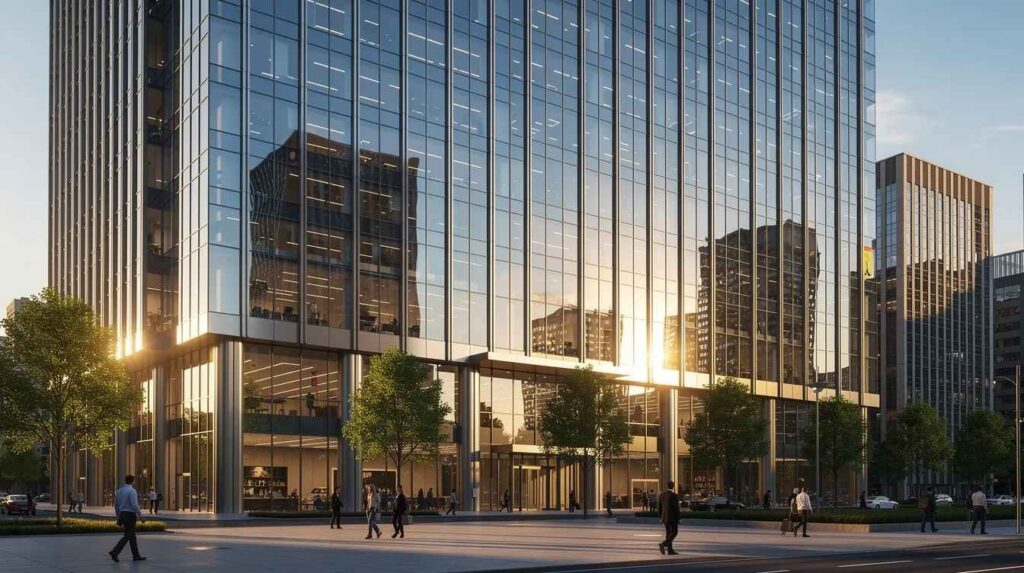
Window films can reject up to 79% of solar heat. Thermal performance improves with the addition of solar control films. Consider a typical 10-story office with west-facing glass: film cuts peak solar load, eliminates hot spots near perimeter workstations, and stabilizes temperatures across floors.
Energy Savings, Cost Reduction, and ROI for Commercial Buildings
Film directly lowers energy bills by reducing cooling demand in summer. Properly installed window films can reduce cooling expenses by 10 to 30%. With low-e products, heating losses drop too – nearly 40% of heating loss in commercial buildings is through windows, so the impact in winter is significant.
Installing window films can lead to energy savings of up to 30%. Window films can also reduce cooling expenses by 10 to 30 percent across climates. 3M Prestige sun control window film can reduce HVAC requirements by up to one ton per 100 square feet, which helps reduce peak demand charges – a major cost driver in dense urban markets like Atlanta, Dallas, and New York. Energy savings offset installation costs within two to five years, and in favorable conditions, businesses see payback periods of less than two years.
Illustrative scenario: A 100,000 sq ft office installing 3M Prestige or Thinsulate film on sun-exposed façades could save $12,000–$15,000 annually on energy use, with installation costs partially covered by potential rebates of $1–$2 per square foot or custom incentives covering up to 40–50% of project cost. Window Film Depot can coordinate with local utilities to identify these rebates and offset installation costs, and detailed 3M window film cost breakdowns help owners understand payback and lifecycle value, creating a quick return on investment.
Comfort, Productivity, and Aesthetics in Modern Commercial Space
Managing solar heat and reducing glare directly affect occupant experience. Improved indoor temperatures can enhance employee comfort and productivity, and less glare improves comfort for building occupants across every floor.
Commercial window films can reduce glare by up to 80%. Window films reduce glare on computer screens in open offices, call centers, classrooms, and healthcare facilities. They minimize glare on digital displays while allowing natural light to reach interior workstations. Energy-efficient window films filter out harsh sunlight without forcing occupants to pull blinds all day, and window films help create a more productive workspace overall.
Spectrally selective and daylight-redirecting films bring sunlight deeper into floorplates while keeping perimeter zones from overheating. Aesthetic options range from nearly invisible commercial window tinting and solar control films for Class A office towers to reflective surfaces that add daytime privacy or a uniform exterior look for aging curtain walls. Films also protect floor coverings, merchandise, and artwork from fading caused by UV damage – window films can block up to 99% of UV rays, extending replacement cycles and supporting facility budgets.

Sustainability, Codes, and Green Building Certifications
Commercial energy-saving window films connect directly to corporate ESG goals and carbon reduction commitments. Window films help lower a building’s carbon footprint by reducing energy use, and they can reduce carbon emissions from energy production across a portfolio, especially when paired with a broad portfolio of high-performance window film products tailored to each facility.
Installing window films can contribute to LEED certification. Specifically, installing window films can contribute up to 8 points towards LEED certification under Energy & Atmosphere and Indoor Environmental Quality categories, supporting green building certifications and local building performance standards. 3M Prestige window films can become carbon negative within months in many climates, reinforcing their eco-friendly and energy-efficient profile.
Window Film Depot provides product data, performance modeling, and documentation packages to help owners, engineers, and architects justify projects to internal sustainability teams, drawing on its experience specifying and installing the full range of 3M window film products in complex commercial environments.
How Commercial Window Film Installation Works with Window Film Depot
Installation is completed from the interior – no need to remove glass or significantly disrupt daily operations when you work with an experienced 3M window film installation company. The typical process follows a clear sequence:
- Energy and glass survey – assess glass type, orientation, and existing coatings
- Product selection – match 3M sun control window film, Prestige, or Thinsulate to your building’s needs
- Proposal with modeled energy savings – including potential rebates
- Pilot test area if needed for stakeholder approval
- Phased installation – technicians clean glass, precisely cut and apply film, protect furniture, and coordinate after-hours or weekend work for high-traffic spaces
Window Film Depot operates nationwide, handling multi-site rollouts for retailers, banks, and corporate portfolios with centralized project management and consistent quality, supported by installation teams in all major service locations. Commercial films installed properly last many years – typically 10–15 years with robust warranty coverage, and maintenance is limited to simple cleaning with non-abrasive products.
Frequently Asked Questions About Commercial Energy Saving Window Film
Facility managers and owners often ask similar practical questions before approving a film project.
Does commercial energy saving window film make offices too dark?
No. Modern spectrally selective films deliver strong heat rejection with high visible light transmission. 3M Prestige films keep interiors bright while cutting solar heat and glare. Darker or more reflective options exist for privacy or exterior aesthetics but are not mandatory for energy savings. During consultation, Window Film Depot provides side-by-side samples on your existing glass so decision-makers can evaluate actual light levels before committing.
How long does commercial window film last, and what warranties are available?
High-performance solar control films typically last 10–15 years in most commercial applications, often longer with indoor installation in moderate climates. Manufacturer warranties cover bubbling, peeling, discoloration, and adhesive failure. 3M-backed installations through Window Film Depot include robust commercial warranty terms, detailed in 3M residential and commercial window film warranty documentation. Maintaining films with non-abrasive cleaners keeps them clear and effective throughout their lifespan.
Can energy-saving window film be installed on any commercial glass?
Most commercial window types are compatible, but glass composition, existing coatings, size, and orientation must be evaluated to avoid thermal stress and seal failure on insulated glass units. Window Film Depot performs a glass audit during assessment, matching film types to single-pane, double-pane, or low-e glass. This professional assessment is a key reason DIY approaches are not recommended for large commercial buildings.
Will installing window film disrupt tenants or require shutting down floors?
Most commercial installations are completed from the inside with minimal disruption, often scheduled after hours or in phases. Furniture may need to move a few feet from windows, and installers cordon off small work zones as they progress. Window Film Depot’s national team routinely works in live environments – hospitals, schools, and 24/7 offices – following strict site safety and security protocols.
How do I know which energy-saving window film is right for my commercial building?
The optimal film depends on climate, façade orientation, glass type, desired appearance, and whether cooling or heating savings take priority. Window Film Depot performs a site visit, analyzes utility data when available, and uses energy modeling tools to compare options like 3M Sun Control, Prestige, and Thinsulate films from its comprehensive Window Film Depot product lineup. Treat film selection as a performance-driven specification – similar to choosing glazing for new construction – rather than a purely cosmetic decision.
Why Commercial Clients Choose Window Film Depot
Window Film Depot is a family-owned, 3M-authorized dealer-installer founded in 1992 and headquartered in Marietta, Georgia, with a flagship installation team based in Marietta, GA serving clients nationwide. The company brings deep product expertise in 3M solar control, security, decorative, and daylight-redirecting films, backed by national installation coverage and turnkey project management for multi-location rollouts as America’s leading 3M window film installation company.
Clients include facility managers, REITs, school districts, government agencies, and healthcare systems, many of whom rely on regional installation teams in markets like Columbus, OH for responsive service. Beyond energy saving window films, Window Film Depot bundles security glazing, privacy films, and architectural finishes into a single retrofit program – maximizing value from each site visit and supporting storefront window tinting and retail film installations that protect merchandise while enhancing curb appeal. Decades of completed commercial projects and long-term relationships with repeat corporate clients speak for themselves.
Next Steps: Evaluate Commercial Energy Saving Window Film for Your Building
Before committing to costly glass replacement or major HVAC upsizing, treat window film as a first-line strategy to save energy and improve comfort. Start by gathering recent energy bills, identifying problem façades or tenant complaints, and contacting Window Film Depot for a site assessment and preliminary savings estimate.
Engage early in capital planning cycles so film solutions align with budget timelines and other building envelope upgrades. Call, submit a project inquiry online, or request a portfolio of completed projects matching your building type or region. The value proposition is straightforward: rapid installation, measurable energy savings on utility bills, improved comfort across every commercial window, and credible support for your building’s sustainability goals – all while maintaining your existing windows.