Navigate this guide quickly using the sections below.
Table of Contents:
- What Is a Window Protector?
- Types of Window Protection
- Construction Site Window Protection
- Residential Glass Protection
- UV-Resistant Protection and Energy Savings
- Choosing Protection for Commercial Buildings
- How Professional Installation Works
- Common Mistakes to Avoid
- Frequently Asked Questions
- Why Choose Our Team
Whether you manage a 10-story office renovation or you are repainting trim in a residential condo, unprotected glass is a liability. A single cement spill, a stray welding spark, or months of UV exposure can turn an expensive pane into a replacement headache. This guide breaks down every major window protector category-films, screens, and coatings-so you can match the right product to your project, your budget, and the level of risk your glass actually faces.
Window Protector Basics: What It Is and Why It Matters
A window protector is any product designed to shield glass from damage, contamination, or degradation. In 2026, that definition spans a wider range than most people expect: self-adhesive films, liquid-applied peelable coatings, physical screens, and permanent glazing upgrades like laminated safety glass all fall under the umbrella. The common thread is that each solution sits on or over the glass surface to absorb, deflect, or block threats the glass itself cannot handle alone.
Glass surfaces in modern buildings are more vulnerable than ever. Large curtain walls, insulated glazing units with Low-E coatings, and oversized sliding windows are standard in both commercial and residential construction-yet they are easily etched by stucco overspray, scratched by scaffolding contact, or degraded by prolonged UV exposure. Window protectors allow unobstructed views while providing protection against exactly these risks. They can also serve as a foundational layer for thermal and security benefits, making them relevant well beyond the construction phase.
Consider two quick scenarios. First, a downtown storefront undergoing a façade remodel in mid-2026: a peelable coating keeps mortar and paint spills off the glass until the project wraps. Second, a homeowner repainting interior trim near large sliding windows: a temporary adhesive film catches overspray and peels away cleanly the same afternoon.
Key benefits at a glance:
- Impact protection from minor tool contact and incidental debris
- Scratch resistance against dust, cleaning abrasions, and construction materials
- UV-resistant performance that prevents fading of indoor finishes
- Privacy and glare control with specialty film options
- Lower cleanup costs and fewer glass replacements at project close-out
This guide is written for facility managers, contractors, architects, and property owners who need professional-grade solutions-not weekend tape-and-cardboard workarounds.
Types of Window Protection: Films, Screens, and Coatings
Not every window protector works the same way or solves the same problem. This section compares the main categories so you can narrow your options before requesting a quote or placing an order.
Adhesive window protection films are the most common temporary solution. Made of PE, PVC, or polyester backings with pressure-sensitive acrylic adhesives, they range from about 2 mil for light-duty surface protection up to 8 mil for security applications. Thicker safety and security films hold broken glass fragments together during impacts, and security window films hold shattered glass together and delay intruder entry. On a job site, even a standard 2–3 mil film shields glass from paint, plaster, and tools. Products like Trimaco’s window film are UV-resistant and puncture-resistant, making them a reliable choice when construction dust, debris, and weather exposure are all factors.
Liquid-applied peelable coatings take a different approach. Spray-on or roll-on formulations dry into a flexible skin that resists cement, stucco, and paint spills. They conform to irregular shapes-mullions, curved frames, and recessed glass-where flat film would be difficult to install. Coverage rates typically run 140–180 sq ft per gallon at two coats, giving estimators a solid planning benchmark.
Traditional and specialty screens include standard insect window screens for keeping mosquitoes and bugs out, pet-resistant screens with heavier gauge mesh, and impact-rated defender-type screens. Security screens are made of heavy-duty woven stainless-steel mesh and allow airflow while still providing a physical barrier. Defender screens can deflect impacts from golf balls and hail, and they provide 99.9% UV protection. Security bars, made of heavy-duty steel or iron, offer high physical deterrence for ground-floor windows in certain environments.
Permanent architectural options round out the category. Laminated glass has a plastic interlayer that keeps pieces attached when broken, which is why it is required in many hurricane and high-wind zones. Polycarbonate shields provide high resistance to physical impact while preserving views. These products are specified during design and are not interchangeable with temporary protection.
Common use cases across all categories:
- Construction and remodeling site protection
- Anti-graffiti and vandalism deterrence
- Security upgrades for retail and government buildings
- Energy efficiency and solar control
- Insect, pet, and weather shielding
Temporary Window Protection During Construction and Remodeling
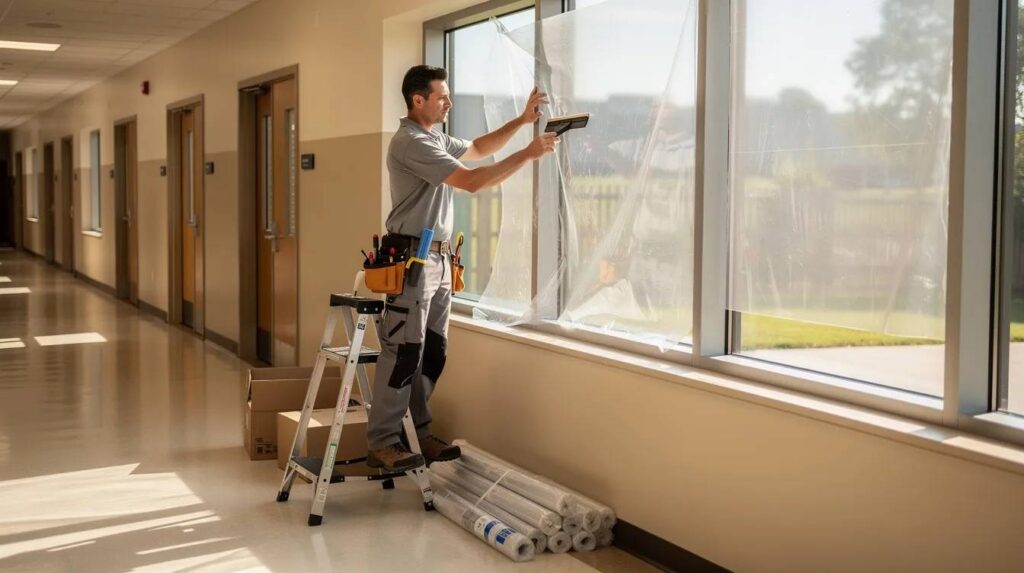
Picture a multi-story office building undergoing interior and exterior renovations during the summer of 2026. Dozens of curtain wall panels, storefront windows, and interior glass partitions are exposed daily to concrete splatter, grinding dust, paint overspray, and the unpredictable swing of a ladder.
Self-adhesive window protection films are the go-to for this environment. Typical construction-grade films run 2–3 mil thick, come in roll widths from 24 to 48 inches, and are available in UV-resistant variants rated for 30–180 days of outdoor exposure. Trimaco’s window film protects against dust and debris while resisting punctures, making it ideal for high-traffic job sites where tools and materials move constantly.
Spray- or paint-on peelable coatings offer a different advantage. Skudo Glass Advanced, for example, is applied with a sprayer or roller and dries to a flexible, removable skin. It resists cement, paint, and stucco splatter and can be left on for up to 12 months-long enough to cover an entire construction schedule. At roughly 140–180 sq ft per gallon with two coats, a project manager can estimate material needs quickly and start procurement early.
Specific threats on active job sites include:
- Cement slurry and stucco overspray that etch glass permanently
- Welding sparks and grinding debris that pit the surface
- Ladders, scaffolding, and tools making direct contact with panes
- Fine dust infiltrating glass edges, threatening seal integrity
From a project-management perspective, a correctly applied window protector means faster final cleaning, reduced risk of glass replacement, fewer punch-list delays, and easier compliance with safety and cleanliness standards.
When should you choose film over a liquid coating?
- Film works best on flat, accessible glass where rolls can be cut to size quickly
- Liquid coatings excel at height, on complex substrates, or where frames and mullions need coverage too
- For projects lasting over six months, coatings with 12-month dwell times reduce reapplication labor
- If visibility through the glass is required during construction, clear adhesive film typically offers better optical clarity
Protecting Glass Surfaces in Homes: From Sliding Windows to Patio Doors
Residential glass takes a beating from directions most homeowners do not anticipate. Large patio sliders face pet claws, thrown toys, and backyard sports. French doors near landscaping work catch sawdust and gravel spatter. South-facing picture windows bake under direct sun, accelerating fading of hardwood floors, furniture, and artwork inside.
Clear protective films applied to sliding windows, French doors, and fixed panes resist scratches, reduce shatter risk, and block UV that degrades indoor finishes. These films are virtually invisible once installed, maintaining the style and natural light of a room. Note that properly installed window guards can also prevent falls from open windows-an important safety consideration for families with young children. And while corded blinds pose a strangulation hazard to young children, cordless window covering options are recommended as a safer alternative for homes with kids.
Window screens still play a daily role. Standard insect screens keep mosquitoes and bugs at bay while providing a physical buffer against small impacts from wind-blown debris. Pet-resistant window screens use heavier mesh to withstand claws without tearing, and security-style screens can deflect wayward balls or small debris while maintaining airflow.
Practical examples worth noting: when repainting interior trim in a condo, a temporary window protector film on adjacent glass catches paint spills and overspray, then peels away without residue. During a deck renovation, covering glass balustrades with adhesive film shields the surface from sawdust and incidental tool contact.
Quick wins a homeowner can tackle in a weekend:
- Protect one high-traffic slider with scratch- and shatter-control film
- Add UV-resistant film to the sunniest room to reduce fading of floors and furniture
- Install pet-resistant screens on doors where animals interact with glass
- Replace any worn-out insect screens that no longer fit snugly in place
UV-Resistant Protection: Comfort, Fading Control, and Energy Savings
UV radiation in the 300–380 nm range silently degrades everything it touches indoors: hardwood floors lose their color, fabrics weaken, artwork fades, and adhesive sealants around glass assemblies break down faster. Thermal stress from infrared energy compounds the problem, expanding and contracting glass and frame materials through seasonal cycles.
High-quality window films can block up to 99% of harmful ultraviolet rays while preserving the visible light that keeps a room bright and inviting. Window protectors block UV rays to prevent fading of furniture and floors-a benefit that pays for itself over time in avoided replacement costs. Window films also reduce glare on screens without darkening the room, a major comfort upgrade for offices and classrooms where computer use is constant.
The energy efficiency connection is direct. Window films intercept solar energy right at the glass to reject infrared heat, lowering the cooling load on HVAC systems. In a 2026 retrofit of a south-facing retail storefront, installing UV-resistant film with a visible light transmittance around 50% and a solar heat gain coefficient drop from 0.70 to 0.45 could cut cooling costs by 15–25% during hotter summers-while protecting merchandise on display.
Typical performance metrics buyers will encounter:
- UV rejection: 99% or higher
- Visible light transmission (VLT): 20–60% depending on film type
- Solar heat gain coefficient (SHGC): reduced from a clear-glass baseline of 0.70–0.80 to below 0.40
- Total solar energy rejected (TSER): varies by film reflectivity and color, from gray to beige to black tints
Choosing the Right Window Protector for Commercial Buildings
Facility managers and architects responsible for offices, healthcare facilities, schools, and government buildings face a layered decision. The right window protector depends on what you are protecting against-construction damage, vandalism, everyday wear, UV degradation-and how long the protection needs to last.
Matching protection type to risk is the starting point. A building under active construction needs temporary films or peelable coatings that can be sold by the roll or gallon and removed at project close. A ground-floor retail space in a high-traffic urban environment may need anti-graffiti film or security glazing as a permanent deterrent. An occupied office tower dealing with glare and energy complaints needs solar control film that stays in place for years and requires no washing or mechanical adjustments for maintenance.
Walk through these decision factors before you purchase or specify:
- Building code and fire rating requirements-some films affect smoke assembly ratings
- Glass type: tempered, insulated, Low-E coatings each have compatibility considerations
- Budget and lifecycle cost: temporary film is low price per sq ft but must be reapplied; security glazing is higher upfront but permanent
- Access constraints: interior vs exterior, height, whether tenants are in place
- Installation timing: schedule protection before high-risk trades start on the project
Quick at-a-glance framework:
- Duration: days, months, or permanent?
- Impact level: light abrasion, tool contact, or windborne debris?
- Visibility: must glass remain clear, or is tinting acceptable?
- Cleaning needs: can the protector be washed in place?
- Removability: does it need to come off cleanly at delivery of the finished space?
How Professional Window Protector Installation Works
A professional installation follows a predictable sequence that minimizes risk and keeps your project on schedule.
It starts with a site visit and glass audit: documenting every window by size, type (tempered, insulated, Low-E), orientation, height, and current condition. This data drives the product recommendation. A sample application on a test pane confirms adhesion, optical quality, and removability before the crew commits to full coverage.
Surface preparation is where quality is won or lost. Glass surfaces and frames must be cleaned of dirt, oil, silicone, and any existing residue, then dried completely. Edge masking prevents coating bleed onto non-glass materials. Compatibility testing on Low-E or specialty coatings is required to ensure no delamination occurs.
Application methods depend on the product. Adhesive films are squeegee-applied using a wetting agent for large pieces, then trimmed precisely at edges. Peelable coatings go on via roller or airless sprayer at a minimum wet film thickness of around 10 mils to guarantee a clean peel later. Specialty protection screens require tensioned frames and secure fastener anchorage.
Expected timelines vary: a single retail storefront can be completed in a day, while a multi-building campus may be phased over several weeks with mid-project inspections built in. Working at height demands scaffolding or lifts, and interior applications in occupied buildings add noise and dust control requirements to the logistics plan.
Major milestones at a glance:
- Initial survey and glass audit
- Sample and test patch
- Product selection and procurement
- Surface preparation and edge masking
- Protection installation
- Mid-project inspections
- Removal, cleaning, and final check
Common Mistakes and Limitations to Avoid
The wrong window protector choice-or poor application-can damage glass, void manufacturer warranties, and add cost instead of saving it.
Applying liquid peelable coatings to acrylic or polycarbonate surfaces is a common and costly error; products like Skudo Glass Advanced explicitly warn against this because the coating bonds permanently to those materials. Leaving temporary films on past their rated duration leads to adhesive breakdown, yellowing, and stubborn residue that may require chemical removal or even glass replacement. Installing any film or coating over dirty, greasy, or wet glass traps moisture and contaminants, risking seal failure on insulated glazing units.
Temperature matters more than most people realize. Non-UV-resistant temporary films left on south-facing glass through a hot summer can cause the glass to overheat, potentially damaging sealants or Low-E coatings. Manufacturer data sheets often limit glass temperature to around 110°F during film exposure.
Even strong screens and films have limited ability to stop breakage from extreme weather, earthquakes, or hurricane-force wind. Building codes in high-risk regions require engineered glazing systems-no surface-applied product substitutes for that.
Red flags that call for immediate professional consultation:
- Visible glass distortion (waves or ripples) after film application
- Fogging between panes of insulated units, suggesting seal failure
- Unknown or undocumented coating on existing glass
- Adhesive bleed-through, early lifting, or discoloration
- Stress cracks appearing after a protector has been applied
Frequently Asked Questions About Window Protectors
Below are the practical questions buyers ask most often before choosing a window protection solution.
How long can temporary window protector films stay on my windows?
Most self-adhesive films are rated for 30–180 days of outdoor exposure, depending on UV grade and weather conditions. Certain construction-grade liquid coatings last longer-Skudo Glass Advanced can be left on for up to 12 months. Sun exposure, glass orientation, and local climate all affect lifespan. Check the product’s data sheet for the rated dwell time and plan removal accordingly.
Are these products safe for low-e and tinted glass surfaces?
Many modern films and coatings are designed for common Low-E surfaces, but a spot test is always required before full-scale application. Generic products that do not specify compatibility can cause delamination or adhesive damage. Ask for manufacturer confirmation and run a test patch on an inconspicuous area first.
Will a window protector stop my glass from breaking during storms or earthquakes?
Films, screens, and coatings can reduce shatter, hold fragments together, and deflect lighter debris-but they cannot guarantee absolute protection in severe events. Thicker safety and security films hold broken glass fragments together during impacts, buying time and reducing property damage. For high-risk regions, building codes and engineering-grade glazing systems are required to ensure windows are safe against extreme loads.
Can I still clean my windows with a film or coating installed?
Yes. Use mild, non-abrasive cleaners and soft microfiber cloths or a soft squeegee. Avoid razor blades, abrasive pads, or harsh chemicals that could damage or lift the protector. Window films require no washing or mechanical adjustments for maintenance beyond this basic care.
How do I remove temporary window protection without leaving residue?
For adhesive films, peel gradually at a consistent angle starting from a corner. Moderate temperatures make removal easier-avoid extremely cold or hot days. For peelable coatings, score the edge and pull in large sheets. Any light residue can typically be removed with an approved adhesive remover or glass-safe solvent.
What does professional window protector installation typically cost?
Costs depend on square footage, product type (temporary film vs security glazing vs UV-resistant film), access conditions (height, scaffolding, occupied spaces), and project location. A simple storefront might run a few dollars per sq ft for film; security glazing or large-scale construction coatings carry a higher price per unit. Accurate quotes follow an on-site assessment where all variables-glass type, environment, and timeline-are evaluated together.
Why Choose Our Team for Your Window Protection Project
Window Film Depot has specialized in window films and architectural surface solutions since 1992. Over three decades of national-scale projects-across government, education, retail, healthcare, and commercial portfolios-have given our team direct, hands-on experience with every major product category: solar control films, safety and security glazing upgrades, decorative privacy films, anti-graffiti film, and temporary window protector systems for active construction phases.
Our turnkey approach covers product selection, specification support for architects, coordination with general contractors, and experienced installation crews operating across multiple states. We maintain manufacturer relationships that ensure access to current-generation materials, and every installer carries proper insurance, training, and documented safety procedures. Whether you need to protect a single storefront or roll out film across a 200-location retail portfolio, our customers receive consistent quality and responsive project management from start to finish.
Next Steps: Plan and Schedule Your Window Protector Installation
If you have a 2026 renovation on the calendar, an upcoming tenant improvement, repeated glass damage on a busy façade, or escalating energy and glare complaints from building occupants, now is the time to act. Reach out to request a site assessment, send your floor plans or elevations, or schedule a consultation so we can match the right protection to your specific conditions.
Before contacting us, gather a few basics: building type, number and location of glass surfaces, primary concerns (UV, security, construction protection, or a combination), and your project timeline. The more detail you share upfront, the faster we can deliver a tailored recommendation and accurate quote.
Professional window protection is one of the most cost-effective ways to extend glass life, improve occupant safety, and keep projects on schedule. Let our team handle the details so your glass and your budget stay intact.