Table of Contents:
- The Question Behind the Specification: Replacement or Retrofit?
- What “Shatterproof Glass” Actually Means: A Technical Baseline for Specifiers
- Laminated Glass, Tempered Glass, and Security Window Film: A Side-by-Side Evaluation
- Compliance Is Non-Negotiable: Certification Standards Every Specifier Must Know
- The Real Cost of Shatterproof Glass: A Project-Level Cost and Risk Framework
- Why Retrofit Window Film Outperforms Full Glass Replacement for Renovation Projects
- Installation Logistics and Timeline Planning for Large-Scale Rollouts
- Putting the Framework into Practice: A Multi-Site Rollout Scenario
- Quick-Pick Decision Guide: Retrofit Film or Full Glass Replacement?
- Conclusion: Your Compliance and Risk-Mitigation Playbook for Shatterproof Glazing Decisions
- Frequently Asked Questions
The Question Behind the Specification: Replacement or Retrofit?
Shatterproof Glass requirements no longer automatically mean full glazing replacement on commercial projects. Modern retrofit security film systems now deliver certified fragment retention and forced-entry performance without disturbing existing frames or shutting down occupied spaces. This blog explains how shatterproof glass works, how retrofit film compares to laminated replacement, and why project managers increasingly choose retrofit strategies to control budgets, reduce disruption, and maintain compliance across large-scale renovation projects.
Why Construction and Renovation Managers Are Re-Evaluating the Default Answer
The default answer to a shatterproof glass requirement has always been full glass replacement. Specify laminated or tempered units, coordinate the glazing subcontractor, pull permits, and move on. That workflow made sense when retrofit alternatives were limited. It no longer makes sense for most renovation projects on existing commercial, education, or retail buildings.
The shift is driven by project economics and schedule reality. Full glass replacement in an occupied building triggers a cascade of disruption: swing space, temporary barriers, extended subcontractor access windows, and disposal logistics for the old glazing. For a 50,000-square-foot multi-floor office or a campus with dozens of buildings, those factors compound into budget overruns that no contingency line item covers cleanly.
Retrofit security window film has matured into a specification-grade solution, with ASTM-certified performance, documented compliance pathways, and installation processes that work around occupancy rather than against it. The question managers should be asking is not which type of shatterproof glass to specify, but whether glass replacement is the right intervention at all.
The Central Trade-Off: Full Glass Replacement vs. Retrofit Security Window Film
Full glass replacement delivers a known outcome: a new glazing unit engineered to a rated standard from the factory. The cost of that certainty is high. Installed laminated safety glass runs $25 to $50 per square foot depending on thickness, unit size, and local labor rates. Tempered units are less expensive per square foot but offer weaker post-break fragment retention, which limits their value in forced-entry and blast scenarios.
Retrofit security window film for commercial buildings typically runs $8 to $20 per square foot installed, depending on film specification and project scale. That range covers 3M Scotchshield and comparable safety films that meet ANSI Z97.1 and CPSC 16 CFR 1201 safety glazing standards. The performance gap between the two approaches is narrower than most specifiers expect, and in fragment retention scenarios, the film-based approach often performs comparably to laminated glass at a fraction of the replacement cost.
The trade-off is not performance versus budget. It is a question of which solution fits the project conditions: new construction with no existing glazing, or an existing building with serviceable frames and glass that simply needs a safety and security upgrade.
How to Use This Guide in Your Project Planning Workflow
This guide moves from technical foundation to procurement decision. The first section defines what shatterproof glass actually means at a specification level so you can evaluate claims accurately. The second section compares laminated glass, tempered glass, and security film side by side across the criteria that matter most to a commercial project: cost, disruption, compliance, and performance. Later sections cover certification standards, realistic cost modeling, installation logistics, and a multi-site scenario that illustrates how these decisions play out at scale.
If you already have a solid handle on glazing types and are looking for cost frameworks or timeline data, the comparison table and cost model sections are the right starting point. If you are building a specification from scratch or need to defend a retrofit recommendation to a client, start here.
What “Shatterproof Glass” Actually Means: A Technical Baseline for Specifiers
Safety Glass as a Category, Not a Single Product
“Shatterproof glass” is not a product type. It is a performance descriptor applied to several distinct glazing constructions that share one characteristic: when they break, they do not produce the large, sharp shards that cause lacerating injuries or enable rapid forced entry. The two primary product categories that meet this description are laminated glass and tempered glass. Security window film applied to standard annealed glass creates a third functional category.
Common Alternate Names: Safety Glazing, Security Glazing, Break-Resistant Glazing
You will encounter several terms used interchangeably in specifications and code documents.
- Safety glazing: the code-regulated category, defined by CPSC 16 CFR 1201 and ANSI Z97.1, focused on injury prevention in hazardous locations.
- Security glazing: a broader performance category that includes forced-entry resistance, blast mitigation, and ballistic resistance, governed by ASTM F1233 and GSA standards.
- Break-resistant glazing: a general marketing term without a fixed standard, often applied to polycarbonate and acrylic products as well as film-treated glass.
Understanding which category a project specification is calling for determines which standards apply and which solutions qualify.
How Shatterproof Glass Works: Interlayer Engineering and Impact Resistance
The Role of the Adhesive Interlayer
The defining feature of laminated shatterproof glass is the interlayer bonded between two glass lites. Polyvinyl butyral (PVB) is the most common interlayer material in standard safety glass. Ionomer interlayers, used in structural and blast-rated applications, provide higher stiffness and better adhesion under extreme loading. Security window film replicates this adhesion function by bonding directly to the interior glass surface and holding fragments in place after impact, functioning as a post-break retention layer rather than a pre-break structural interlayer.
Spider-Web Cracking vs. Sharp Fragment Fragmentation
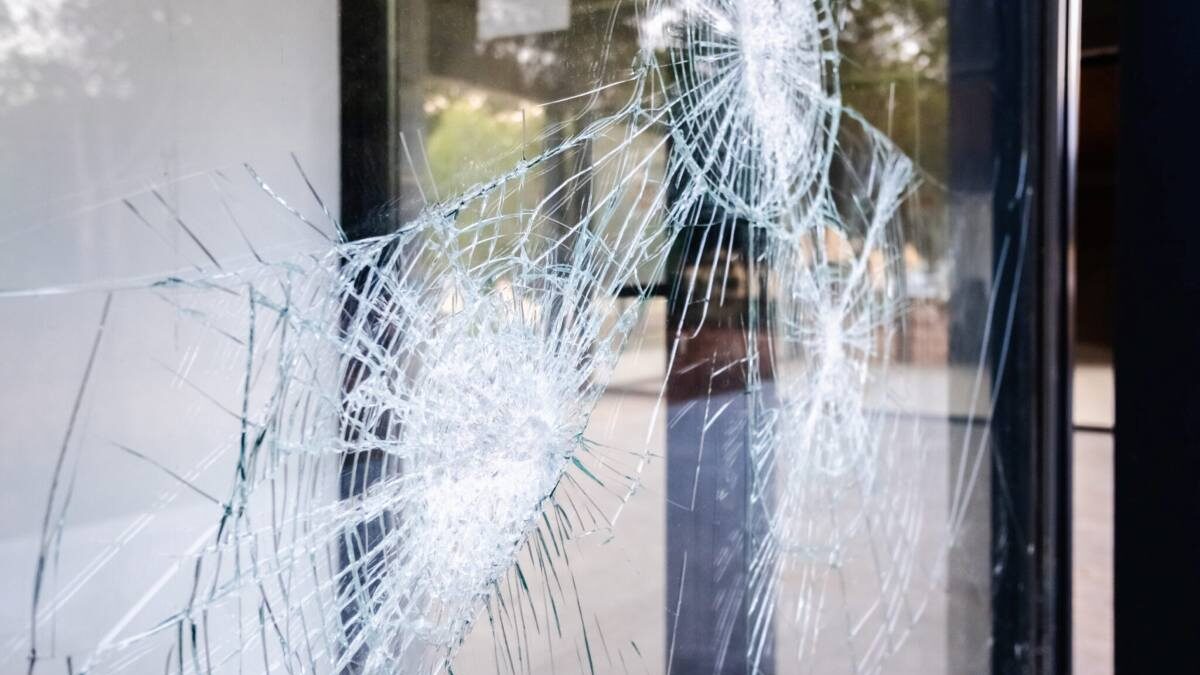
When laminated glass takes an impact beyond its elastic limit, the glass cracks but the interlayer holds the fragments in the frame. The result is the characteristic spider-web cracking pattern: cracks radiate from the point of impact, but the glazing unit stays intact. This matters for two reasons. First, it prevents the penetration that enables forced entry. Second, it contains the injury hazard at the point of failure rather than distributing sharp fragments across the surrounding area.
Tempered glass behaves differently. It shatters into small, relatively blunt cubes rather than long shards, which reduces laceration risk but eliminates fragment retention. A tempered unit that has been breached is an open aperture.
Force Thresholds and What “Impact Resistant” Quantifies
ASTM F1233 defines the test methodology for security glazing, with attack classifications ranging from hand tool attacks to high-powered rifle rounds. The standard specifies both the force applied and the acceptable response of the glazing system. A glazing unit or film-treated assembly that passes at a given classification level has resisted penetration for a defined time under defined attack conditions, not merely survived a single impact. Specifiers should match the classification level to the threat scenario rather than defaulting to the highest available rating.
Tempered vs. Laminated: Understanding the Structural Difference
Tempered glass is manufactured through a thermal process that puts the outer surfaces under compression and the core under tension. This stress profile gives tempered glass roughly four times the impact strength of standard annealed glass before breaking. However, once the stress threshold is exceeded, the entire unit shatters simultaneously into small fragments. There is no interlayer to retain the pieces.
Laminated glass breaks progressively. The interlayer absorbs energy across multiple impact events and maintains the integrity of the opening even after the glass lites crack. For any specification that requires post-break fragment retention, forced-entry resistance, or blast pressure management, laminated construction or a film-treated assembly is the correct approach. Tempered glass alone does not meet those requirements.
How Long Does Shatterproof Glass Last in a Commercial Environment?
Laminated glass units carry manufacturer warranties of 10 to 20 years depending on the interlayer type and exposure conditions. PVB interlayers are susceptible to edge delamination in high-humidity environments if the unit seal degrades. Ionomer interlayers are more moisture-resistant and typically rated for longer service lives in exposed applications.
Security window film installed on interior glass surfaces typically carries a manufacturer warranty of 10 to 15 years. 3M Scotchshield film warranties cover defects in adhesion, clarity, and delamination. Film performance is not meaningfully degraded by UV exposure on interior-facing installations, and interior-applied film is not subject to the edge seal failure mechanisms that affect laminated units in exterior applications.
Laminated Glass, Tempered Glass, and Security Window Film: A Side-by-Side Evaluation
The Three Primary Solutions and Their Structural Logic
Each of the three primary shatterproof solutions approaches the fragment retention and forced-entry problem from a different structural position. Laminated glass integrates the retention layer at manufacturing, producing a monolithic unit with defined performance from installation day one. Tempered glass engineers the break pattern but provides no retention capability. Security window film adds fragment retention and penetration resistance to existing glass without altering the frame or structural opening.
The structural logic matters for renovation projects because laminated and tempered glass both require full frame removal and reinstallation. Security window film does not. That single difference drives most of the cost and schedule divergence between the approaches.
Laminated Glass vs. Tempered Glass: What the Difference Means for Security Specifications
For a project with a forced-entry or blast resistance requirement, tempered glass does not qualify without additional measures. Many commercial buildings currently have tempered glass in locations that have since been reclassified as security-critical under updated building codes or insurance requirements. In those situations, the choice is between replacing the tempered units with laminated glass or applying security film to achieve fragment retention and delay-of-penetration performance on the existing tempered substrate. Both approaches can satisfy the specification. Only one requires a glazing subcontractor and a building permit.
Where Film-Based Solutions Fit in the Security Glazing Hierarchy
Security window film is not a compromise solution positioned below laminated glass. At the specification level, 3M Scotchshield Ultra Safety Series film meets ANSI Z97.1 Class A and CPSC 16 CFR 1201 Category II, which are the same standards required of laminated safety glass in hazardous locations under the International Building Code. At higher threat levels, thicker film specifications meet ASTM F1233 attack classifications for hand tool and blunt force scenarios.
Film does not create unbreakable glass in blast-rated curtain wall applications or ballistic glazing assemblies. Those applications require engineered laminated constructions with ionomer interlayers and specific frame anchorage. But those applications represent a fraction of the commercial renovation market. For the large majority of safety glazing upgrades in occupied buildings, film delivers compliant performance without the replacement cost.
| Criteria | Laminated Glass | Tempered Glass | 3M Security Window Film |
|---|---|---|---|
| Installed cost (per sq ft) | $25 to $50 | $15 to $30 | $8 to $20 |
| Installation disruption | High: frame removal, building permits, temporary barriers | High: same as laminated | Low: interior application, no frame work |
| Retrofit capability | No: requires full unit replacement | No: requires full unit replacement | Yes: applied directly to existing glass |
| Key compliance certifications | ANSI Z97.1, CPSC 16 CFR 1201, ASTM F1233 (security grades) | ANSI Z97.1, CPSC 16 CFR 1201 (safety grades only) | ANSI Z97.1 Class A, CPSC 16 CFR 1201 Cat II, ASTM F1233 (select specs) |
| Expected lifespan | 10 to 20 years | 20+ years (if not broken) | 10 to 15 years (manufacturer warranty) |
| Fragment retention and forced-entry resistance | High: interlayer retains fragments, resists penetration | None: unit disintegrates on breach | High: film retains fragments, delays penetration |
Compliance Is Non-Negotiable: Certification Standards Every Specifier Must Know
The Certification Landscape: ANSI Z97.1, CPSC 16 CFR 1201, ASTM F1233, and GSA Blast Standards
Four standards govern most commercial shatterproof glass specifications in the United States, and each covers a distinct threat scenario.
- ANSI Z97.1 and CPSC 16 CFR 1201 address safety glazing: injury prevention in locations where human impact with the glazing surface is foreseeable. Both use a drop-ball impact test. CPSC 16 CFR 1201 is the federal consumer product safety regulation. ANSI Z97.1 is the voluntary industry standard. The IBC references both.
- ASTM F1233 covers security glazing performance under deliberate attack, from hand tools through rifle fire. Attack classifications are tiered. A Class 1 rating covers light hand tool attacks, while higher classes address power tools and firearms. This is the standard most relevant to forced-entry resistance specifications.
- GSA Blast Standards (specifically GSA-TS01-2003 and the UFC 4-010-01 series) govern glazing performance under explosive loading for federal facilities. These apply to a narrower project set but set the performance ceiling for high-risk commercial and government buildings.
Knowing which standard a project triggers is the first compliance question. A retail storefront with a smash-and-grab risk needs ASTM F1233 Class 1 or 2 performance. A school corridor door sidelight needs CPSC 16 CFR 1201 Category II. Specifying to the wrong standard wastes budget or leaves a compliance gap.
Building Code Requirements for Shatterproof Glass in Commercial Buildings
IBC Hazardous Locations and Mandatory Safety Glazing Zones
The International Building Code mandates safety glazing in locations where an unaware occupant could walk into or fall through the glass. These hazardous locations include glazing in doors and sidelights within 24 inches of a door edge, glazing within 18 inches of the floor in walls and partitions, glazing in stairwells and landings, and glazing adjacent to wet areas in commercial facilities. In all of these locations, the glazing must meet ANSI Z97.1 or CPSC 16 CFR 1201. Both laminated safety glass and security film applied to existing glass can satisfy these requirements, provided the installed assembly has been tested and certified to the applicable standard.
Education Sector: School Security Glazing Standards and Forced Entry Resistance
K-12 facilities carry requirements that go beyond the base IBC. Several states have adopted school hardening standards that specify delay-of-entry performance at classroom doors and perimeter glazing. The most commonly referenced benchmark is the Sandia National Laboratories forced-entry test protocol, which requires a glazing assembly to resist penetration for a defined period under repeated blunt-force attack.
Security window film assemblies using 3M Scotchshield film with an attachment system anchored to the frame can meet these delay-of-entry standards without replacing the existing glazing units. This is a critical distinction for school renovation projects: the compliance pathway exists through retrofit, not just replacement.
Retail Sector: Smash-and-Grab Deterrence and Insurance Compliance
Retail specifications are typically driven by two factors: insurance carrier requirements and the ASTM F1233 attack classification needed to deter opportunistic theft. Most smash-and-grab incidents involve blunt force impact with a heavy object, which corresponds to the lower ASTM F1233 attack classifications. Film specifications in the 8-mil to 12-mil range, applied with an edge attachment system, typically satisfy these requirements and support insurer documentation requests. Some carriers offer premium reductions for certified security glazing installations. The documentation package from the film manufacturer is what substantiates that claim.
Do Shatterproof Glass Solutions and Security Films Meet ASTM Safety Standards?
Yes, but the qualification depends on the specific product and installation configuration, not the category. A laminated glass unit tested and certified to ASTM F1233 Class 1 meets that standard. A security film assembly tested to the same protocol on the same substrate meets the same standard. The key word is “assembly.” Film certifications are substrate-specific: a film certified on 1/4-inch annealed glass is not automatically certified on 1/4-inch tempered glass. When a film manufacturer’s data sheet lists ASTM F1233 compliance, confirm that the listed substrate matches your project conditions. This is the most common compliance gap in film specifications.
How to Ensure Your Shatterproof Specification Passes Inspection Before Project Handoff
Pre-Installation Audits: Glazing Condition Assessments and Substrate Compatibility
A glazing condition audit before installation is not optional on a compliance-driven project. Film applied to glass with existing edge damage, delamination, or failing seals will not perform to the tested specification and may fail adhesion during inspection. A qualified installer conducts a substrate assessment that documents glass type, thickness, condition, and frame compatibility. This assessment also confirms whether the existing glass is tempered, which affects both the film certification chain and the post-installation performance expectations.
Documentation and Certification Proof Required at Inspection Checkpoints
At project handoff, inspectors typically require the following.
- Manufacturer certification documentation confirming the product meets the specified standard.
- Installation records showing the film specification and square footage applied by location.
- Third-party test reports linking the film-substrate combination to the compliance standard cited in the specification.
- Installer credentials, including manufacturer authorization, confirming the installer is qualified to apply the product under warranty conditions.
Prepare this package before the inspection, not at the request of the inspector. Projects that arrive at handoff without organized certification documentation routinely face punch-list delays that cost more in schedule disruption than the documentation would have cost to assemble during installation.
The Real Cost of Shatterproof Glass: A Project-Level Cost and Risk Framework
Is Shatterproof Glass Expensive? Realistic Cost Ranges for Commercial Projects
Full Glass Replacement: Per-Square-Foot Material, Labor, and Disruption Costs
Installed laminated safety glass runs $25 to $50 per square foot for standard commercial applications. That range covers material, glazing labor, frame work, and basic site protection. It does not cover swing space, temporary barriers for occupants, permit fees, or glazing waste disposal, which in many jurisdictions requires a licensed hauler for units containing PVB interlayers. In urban markets or on occupied campuses, those ancillary costs add $5 to $15 per square foot to the true project cost.
Tempered glass replacement runs $15 to $30 per square foot installed, but as noted in the comparison section, tempered glass does not satisfy fragment retention or forced-entry requirements without supplemental measures. Specifying tempered glass to meet a security standard is not a cost savings. It is a compliance miss that generates rework.
Retrofit Security Window Film: Installed Cost Ranges and Total Cost of Ownership
Retrofit security film installs at $8 to $20 per square foot depending on film specification, project scale, and site conditions. At the midpoint of both ranges, the cost differential versus laminated glass replacement is roughly $17 per square foot. On a 10,000-square-foot project, that is $170,000 in avoided cost before accounting for disposal, permits, or occupancy disruption. The film also carries a 10-to-15-year warranty, which means total cost of ownership over a typical lease cycle is favorable compared to laminated replacement units that carry similar warranty terms at roughly twice the installed cost.
The Hidden Costs That Blow Commercial Budgets
Three cost categories are routinely underbudgeted in glazing replacement scopes.
Rework from measurement errors. Custom laminated and tempered units are manufactured to order. A dimensioning error discovered on delivery means a two-to-four-week lead time for a replacement unit, during which the opening is either temporarily boarded or the project schedule slips. Film installation uses on-site cutting, which eliminates fabrication lead time and the rework cost associated with unit misspecification.
Scheduling gaps from subcontractor sequencing. Glazing replacement in an occupied building requires coordination with security, facilities, and often tenants for each affected zone. A multi-floor office retrofit involving hundreds of individual openings can run six to ten weeks for a glazing crew. The same square footage in film can be completed in a fraction of that time with a larger crew running parallel shifts.
Disposal costs. Laminated glass waste is not standard construction debris. Units with PVB interlayers require separation from general waste streams in many jurisdictions. Budget $2 to $4 per square foot for compliant disposal of laminated units on replacement projects.
Illustrative Cost Model: Multi-Floor Office Retrofit vs. Full Glazing Replacement
Consider a 12-floor office building with 15,000 square feet of glazing requiring safety and security upgrades to meet updated IBC hazardous location requirements and an ASTM F1233 Class 1 forced-entry specification.
| Cost Category | Full Laminated Replacement | Retrofit Security Film |
|---|---|---|
| Material and installation (per sq ft) | $35 avg | $14 avg |
| Base project cost (15,000 sq ft) | $525,000 | $210,000 |
| Disposal and ancillary costs | $45,000 | $0 |
| Permit and inspection fees | $12,000 | $2,000 |
| Occupancy disruption (est. lost productivity, swing space) | $30,000 | $5,000 |
| Total estimated project cost | $612,000 | $217,000 |
These figures are illustrative, not a binding estimate. Actual costs depend on local labor rates, building access conditions, and the specific film specification selected. But the structure of the comparison holds across project types: the base material cost gap is significant, and the ancillary cost gap widens it further. A roughly $395,000 difference on a mid-size project is not a rounding error. It is a budget line that directly affects project feasibility.
Why Retrofit Window Film Outperforms Full Glass Replacement for Renovation Projects
The Retrofit Advantage: Equivalent Performance Without Structural Demolition
The framing of “retrofit vs. replacement” implies a performance trade-off that does not exist at the specification level for most commercial renovation scenarios. A certified film assembly meeting ANSI Z97.1 Class A and CPSC 16 CFR 1201 Category II satisfies the same IBC safety glazing requirement as a new laminated unit carrying the same certifications. The compliance outcome is identical. The project outcome is not: retrofit film preserves the existing frame, eliminates fabrication lead times, avoids structural opening modifications, and keeps the building occupied throughout installation.
For renovation managers, “equivalent performance” is not a marketing claim to be skeptical of. It is a documented fact recorded in third-party test reports that you can request from the manufacturer and submit at inspection.
Can Shatterproof Glass Film Be Installed on Existing Windows? What “Retrofit” Actually Enables
Security film is applied to the interior surface of existing glass, which means the existing frame, glazing compound, and structural opening stay intact. This matters for several reasons beyond cost. Historic buildings with non-standard frame profiles, curtain wall systems with proprietary frame components, and buildings where exterior façade modifications require additional approvals can all receive security glazing upgrades through interior film application without triggering those constraints. Retrofit is not just a cost strategy. In many buildings, it is the only practical path to compliance.
Need More Info?
The Window Film Depot team is happy to help.
3M Scotchshield Security Film: Specification-Level Performance Anchored to Certifiable Standards
3M Scotchshield Ultra Safety Series film is available in multiple specifications covering the safety glazing and security glazing tiers. The 8-mil specification meets ANSI Z97.1 Class A and CPSC 16 CFR 1201 Category II. Thicker specifications in the 14-mil and above range meet ASTM F1233 attack classifications for forced-entry scenarios. All specifications are backed by 3M’s manufacturer certification documentation, which is the exact format that AHJs and inspectors require at project handoff. Using a product from a manufacturer with that documentation infrastructure removes a significant compliance risk from your project.
Secondary Performance Benefits: Fragment Retention, UV Protection, and Energy Efficiency
Security film delivers performance that goes beyond the primary safety and security specification. Glass fragment retention in a post-break event keeps glass contained within the frame rather than projecting into the occupied space, directly reducing injury liability. UV rejection at 99% across most 3M Scotchshield specifications reduces solar heat gain and protects interior finishes from fading, providing a measurable impact on HVAC load and tenant comfort. These secondary benefits are not unique to film. Laminated glass with a low-e coating delivers similar outcomes. The difference is that film delivers them on existing glass, at $8 to $20 per square foot, without a glazing subcontractor or a permit.
Installation Logistics and Timeline Planning for Large-Scale Rollouts
How Long Does Shatterproof Window Film Installation Take for a Multi-Building Project?
Daily Square Footage Throughput and Crew Scaling
A two-person film installation crew installs between 500 and 800 square feet per day under normal commercial conditions, accounting for site setup, surface preparation, film cutting, application, and cleanup. On a 50,000-square-foot project, a single crew requires 63 to 100 working days. A four-crew deployment running in parallel reduces that to 16 to 25 working days on the same scope. National deployers with multiple certified crews can scale to six or eight crews on large campus projects, compressing timelines further without sacrificing installation quality.
This scalability is a structural advantage over glazing replacement. A glazing crew’s throughput is constrained by the number of units they can handle, the crane or lift access required for upper floors, and the curing time for frame sealants. Film crews are constrained primarily by crew count, which is a scheduling variable, not a physical one.
Phased Installation Scheduling to Maintain Occupancy in Active Facilities
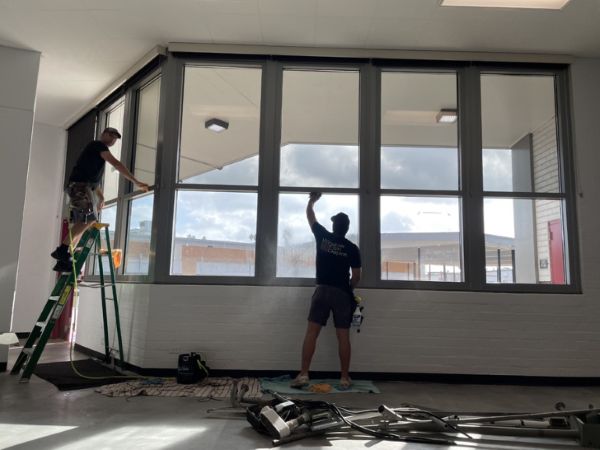
Film installation in occupied buildings follows a zone-by-zone phasing model. A floor or wing is scheduled for installation during off-peak hours or over a weekend, and occupants return to a completed space without disruption to their workday.
This stands in contrast to glazing replacement, which requires the opening to be unmaintained for the duration of unit removal, frame prep, new unit installation, and sealant cure. In occupied buildings, that sequence requires temporary barriers that affect air conditioning, security, and tenant access for each opening.
For a school, installation runs during summer recess or holiday breaks. For a retail center, installation runs before store open or after close. The installation footprint at any given moment is one to three rooms or zones, not an entire floor stripped of glazing.

What Is the Installation Timeline for Retrofit Security Glazing in Occupied Buildings?
A realistic planning benchmark: a 10,000-square-foot film installation in an occupied office building, using two crews working weekday off-hours, completes in approximately three to four weeks. The same scope in laminated glass replacement, accounting for unit fabrication lead time (typically three to five weeks for custom sizes), site preparation, installation, and sealant cure, runs eight to fourteen weeks from order to punch-list close. The timeline gap is not marginal. On a project with a fixed occupancy or opening date, it is often the deciding factor between retrofit and replacement, independent of cost.
Which Shatterproof Solution Requires the Least Project Disruption During Installation?
Retrofit security film. No frame removal, no structural opening modification, no temporary barriers for occupied spaces, no fabrication lead time, and no glazing waste disposal. The work surface is the interior face of the existing glass, and the crew leaves the space clean and functional at the end of each shift. For a renovation manager whose primary constraint is maintaining building operations while upgrading security glazing compliance, film is not one option among equals. It is structurally better suited to occupied-building conditions than any glass replacement approach.
Rework Risk Mitigation: Pre-Installation Protocols That Protect Your Schedule and Budget
The highest rework risk on a film installation project is substrate incompatibility discovered after mobilization. A qualified installer mitigates this through a pre-installation protocol that includes three components.
Glass type verification. Tempered, heat-strengthened, and annealed glass each interact differently with security film under stress. Substrate verification confirms glass type by location so the correct film specification is matched to each opening.
Frame and seal condition assessment. Film applied over a failing frame seal may peel at the edges within months of installation. The assessment identifies openings requiring frame maintenance before film application, preventing adhesion failures that would require film removal and reapplication.
Documented sign-off before mobilization. A pre-installation report signed by the installer and the project manager creates a clear accountability record. If a substrate condition changes between assessment and installation, the protocol has a defined escalation path. Projects that skip this step and discover substrate problems during installation face the worst-case scenario: a crew on site, a schedule commitment to the client, and a decision to proceed on a non-conforming substrate or delay.
Pre-installation audits add a day or two to the front end of a project. They routinely prevent punch-list items that cost five to ten times as much to resolve post-installation.
Putting the Framework into Practice: A Multi-Site Rollout Scenario
Illustrative Scenario: Security Glazing Retrofit Across a Multi-Building Education Campus
Project Parameters: Square Footage, Compliance Requirements, and Timeline Constraints
A regional school district with eight K-12 buildings and approximately 28,000 square feet of glazing across perimeter doors, corridor sidelights, and classroom door lites required a security upgrade to meet state-mandated school hardening standards. The compliance requirement included CPSC 16 CFR 1201 Category II for safety glazing zones and forced-entry delay performance at classroom and main entry door assemblies. The district’s capital budget was fixed. Full laminated glass replacement across all eight buildings had been quoted at $840,000 to $1.1 million, including disposal and permit costs. The construction window was a single summer recess: eleven weeks.
The existing glazing consisted primarily of 1/4-inch annealed glass in aluminum frames in good condition, with isolated tempered units at exterior entries. No frame replacement was needed. The substrate was compatible with film application across more than 90% of the identified openings.
Solution Selected, Standards Met, and Schedule Outcome vs. Full Replacement
The district selected a retrofit security film installation using 3M Scotchshield film in two specifications: an 8-mil safety film for IBC hazardous locations and a 14-mil security film with an attachment system at forced-entry priority openings. Both specifications met the required compliance standards, and the attachment system at door assemblies satisfied the state’s delay-of-entry benchmark for classroom doors.
Installed cost came in at $392,000 for the full scope, roughly 40% of the low end of the laminated replacement quote. Four certified installation crews ran in parallel across buildings, completing the 28,000-square-foot scope in seven weeks and leaving four weeks of buffer before the fall occupancy date. A full laminated replacement on the same scope, factoring in unit fabrication lead times of four to five weeks, would have required the construction window to begin before the school year ended or extend past the fall start date. The timeline alone made full replacement operationally infeasible, independent of cost.
What Separates a Qualified Large-Scale Installer from a General Glazing Contractor
A general glazing contractor can source and install laminated or tempered units competently. Running a multi-building film installation to a compliance deadline requires a different capability set.
The first differentiator is manufacturer authorization. 3M Scotchshield film is covered by manufacturer warranty only when installed by an authorized dealer trained to 3M’s installation specifications. An unauthorized installer can apply the same film and generate the same visual result, but the warranty is void and the certification documentation chain is broken. At project handoff, an inspector reviewing the certification package will identify the gap.
The second differentiator is project management capacity. A qualified large-scale installer deploys multiple crews on a defined phasing schedule, manages substrate assessments across hundreds of openings before mobilization, and produces the installation records and certification documentation required for inspection. That infrastructure does not exist in a two-person crew operating out of a single market.
The third differentiator is compliance knowledge. A film installer who understands the difference between an ANSI Z97.1 Class A certification and an ASTM F1233 attack classification can match film specifications to project requirements without creating gaps. A general contractor treating film as a commodity product often cannot.
Working With Window Film Depot: National Project Scale, 3M Authorization, and Performance Accountability
Window Film Depot operates as a 3M-authorized dealer with national deployment capability, which means the certification chain from manufacturer to installed product is intact on every project. For a renovation manager coordinating a multi-site rollout, that authorization is not a detail. It is the link between the installed work and the compliance documentation that closes out the project.
The scope assessment process starts with a site survey that documents glass type, square footage by specification requirement, frame condition, and any substrate issues requiring remediation before installation. That survey produces a written scope document with a line-item breakdown by building and glazing zone, which feeds directly into the project budget and scheduling framework.
For national or multi-region projects, Window Film Depot coordinates certified crews across markets to run parallel installations on the timeline the project requires, rather than sequencing a single crew across locations over an extended period. The project documentation package, including manufacturer certification records, third-party test reports, and installation logs by location, is assembled during the project and delivered at handoff.
Quick-Pick Decision Guide: Retrofit Film or Full Glass Replacement?
Answer these three questions to determine the right procurement path for your project.
Question 1: Does your existing glazing substrate qualify for retrofit?
If the existing glass is in serviceable condition (no significant edge damage, failing seals, or frame deterioration) and is 1/4-inch annealed or tempered glass in standard aluminum or wood frames, retrofit film is a viable substrate. If the glass is structurally compromised or the frames require replacement regardless of the glazing decision, full replacement is necessary.
Question 2: Does your compliance requirement exceed what certified film can deliver?
Blast-rated curtain wall applications, ballistic glazing assemblies, and GSA high-security facilities require engineered laminated constructions that film cannot replicate. For safety glazing (CPSC 16 CFR 1201, ANSI Z97.1) and forced-entry resistance (ASTM F1233 Class 1 and 2), certified film meets the specification. Confirm the compliance ceiling before ruling retrofit out.
Question 3: Can your project timeline absorb fabrication lead time?
Custom laminated and tempered units carry three-to-five-week fabrication lead times before site work begins. If your construction window is fixed by an occupancy date, a code deadline, or a lease commitment, that lead time is a schedule risk, not just a planning variable. Film installation begins when crews mobilize.
If your answers are yes, no, and no: contact Window Film Depot for a scope assessment. A site survey will confirm substrate compatibility, identify the correct film specification for your compliance requirements, and produce a project timeline and cost estimate you can bring into a planning meeting.
Conclusion: Your Compliance and Risk-Mitigation Playbook for Shatterproof Glazing Decisions
Why Full Replacement Is the Expensive Default, Not the Smart Default
Full glass replacement became the default answer to shatterproof glass requirements because it was once the only answer. That is no longer true. Certified retrofit security film meets the same IBC safety glazing standards as laminated glass, installs on existing frames without structural modification, and completes in a fraction of the time at a fraction of the cost. The campus scenario above is not an outlier. It reflects the economics and logistics that play out consistently across commercial office, retail, and education projects where the existing glazing substrate is serviceable.

The case for full replacement remains valid in specific circumstances: new construction without existing glass, blast-rated or ballistic applications requiring engineered laminates, or buildings where frame condition requires full unit removal regardless of the glazing decision. Outside those conditions, full replacement is the expensive default, not the technically required one.
The Specification Checklist: What to Lock Down Before Your Next Project Planning Meeting
Before walking into a planning meeting with a shatterproof glass specification, confirm the following.
- Compliance standard required by location type: CPSC 16 CFR 1201, ANSI Z97.1, ASTM F1233, or GSA blast standard.
- Existing substrate conditions: glass type and thickness confirmed by building records or on-site verification.
- Frame condition: any openings requiring frame work before or instead of glazing work.
- Project timeline: fabrication lead time tolerance and occupancy constraints.
- Documentation requirements: what the AHJ or inspector will require at project handoff.
- Installer qualification: manufacturer authorization confirmed, not assumed.
Each of these items is resolvable before mobilization. None of them are resolvable on the day of inspection.
Next Step: How to Engage a Qualified Vendor for Scope Assessment and Compliance Verification
The most useful next step is a scope assessment conducted by a qualified, 3M-authorized installer before the specification is finalized. That assessment confirms substrate compatibility, identifies the correct film specification for each compliance zone, and produces a cost and schedule framework based on actual project conditions rather than budget-phase estimates.
Contact Window Film Depot with your building count, approximate square footage, compliance requirements, and project timeline. The assessment process is structured to give you what you need for a project planning meeting: a line-item scope, a certification documentation outline, and a realistic installation schedule. If the assessment confirms retrofit film is the right solution, you have a procurement path with a clear compliance chain. If it identifies conditions that require full replacement in specific locations, you know that before the project is committed, not after mobilization.
Frequently Asked Questions
What are the building code requirements for shatterproof glass in commercial buildings?
The International Building Code mandates safety glazing in hazardous locations where occupants could walk into or fall through glass. These locations include glazing in and adjacent to doors, glazing within 18 inches of the floor, stairwell glazing, and glazing near wet areas. The glazing in these zones must meet ANSI Z97.1 or CPSC 16 CFR 1201. Certified security window film applied to existing glass can satisfy these requirements in the same way a laminated replacement unit can, provided the film-substrate assembly has been tested to the applicable standard.
How much does it cost to install shatterproof glass in a large commercial facility?
Installed laminated safety glass runs $25 to $50 per square foot, with ancillary costs for disposal, permits, and occupancy disruption adding another $5 to $15 per square foot in many markets. Retrofit security window film for commercial buildings typically installs at $8 to $20 per square foot with minimal ancillary costs. On a 15,000-square-foot project, that cost structure translates to a difference of roughly $395,000 between approaches before disruption costs are factored in.
What is the difference between laminated glass and window film for security?
Laminated glass integrates a polyvinyl butyral (PVB) or ionomer interlayer between two glass lites during manufacturing, creating a monolithic unit that retains fragments on impact. Security window film replicates that fragment retention function by bonding to the interior surface of existing glass, holding fragments in place after a break. At the safety glazing compliance level (ANSI Z97.1, CPSC 16 CFR 1201), both approaches can meet the same standard. The practical difference is that film installs on existing glass without frame removal, fabrication lead time, or structural modification.
Do shatterproof glass solutions and security films meet ASTM safety standards?
Yes, provided the specific product and installation configuration have been tested to the applicable standard. A security film assembly tested to ASTM F1233 on a defined substrate meets that standard for that substrate. The critical detail is that film certifications are substrate-specific: a film certified on 1/4-inch annealed glass is not automatically certified on 1/4-inch tempered glass. Always confirm that the substrate listed in the manufacturer’s test report matches your project conditions before specifying.
What is the installation timeline for retrofit security glazing in occupied buildings?
A 10,000-square-foot film installation in an occupied office building, using two crews working off-hours, typically completes in three to four weeks. The equivalent scope in laminated glass replacement runs eight to fourteen weeks from order to punch-list close, once fabrication lead time (three to five weeks), site work, and sealant cure are accounted for. For projects with fixed occupancy dates or code deadlines, that timeline gap frequently makes retrofit film the only operationally viable path.
How do you ensure shatterproof glass meets compliance before project handoff?
Compliance at handoff depends on preparation that begins before installation. A pre-installation substrate assessment confirms glass type, condition, and frame compatibility so the correct film specification is applied to each opening. During installation, the installer should be assembling the documentation package: manufacturer certification records, third-party test reports linking the film-substrate combination to the cited standard, and installation logs by location. At handoff, that package, along with installer authorization credentials, is what an AHJ or inspector will review. Organizing it in advance, rather than at the inspector’s request, is the single most effective way to prevent punch-list delays.