Table of Contents:
- The Decision That Defines Your Project Budget Before You Pull a Single Permit
- What Shatter Proof Glass Actually Is: Materials, Mechanics, and Why the Label Is Misleading
- Laminated vs. Tempered vs. Film: Understanding the Critical Differences Before You Write a Spec
- Building Codes and Safety Standards: The Compliance Foundation of Your Glazing Specification
- Full Glass Replacement vs. Security Window Film Retrofit: The Comparison Framework That Changes the Budget Conversation
- Application Contexts: Aligning Security Glazing Strategy to Facility Type
- Project Planning, Installation Timelines, and Multi-Site Rollout Logistics
- Total Cost of Ownership: Budgeting Security Glazing Upgrades Across the Project Lifecycle
- Conclusion: From Specification Confidence to Project Execution
- Frequently Asked Questions
The Decision That Defines Your Project Budget Before You Pull a Single Permit
Shatter proof glass has become a priority upgrade for schools, retail storefronts, offices, and institutional facilities facing rising security concerns. Modern shatter-resistant glazing systems improve fragment retention, delay forced entry, and reduce occupant injury risks after impact events. This blog explains how shatter proof glass works, how laminated glass compares to security film retrofit, and why project managers increasingly evaluate retrofit solutions before committing to full replacement specifications.
Why the Replacement-vs-Retrofit Question Is the First Specification You Must Answer
Before you finalize a glazing spec, before you issue an RFP, before you schedule a site walk, you need to answer one question: are you replacing the glass, or are you upgrading what’s already there? That single decision will shape your material budget, your labor estimate, your project timeline, and your disruption risk more than any other specification choice you make.
Most project managers default to replacement because it feels like the more complete solution. New glass, clean install, done. What that default obscures is cost. Full glass replacement in a commercial building typically runs four to eight times the cost of a professional security film retrofit covering the same square footage. On a multi-location project, that multiplier becomes a budget conversation you do not want to have after you’ve already committed to a spec.
The replacement-vs-retrofit question is not a product preference. It is a project strategy decision with budget, schedule, and code compliance implications that compound at scale.
What’s Actually at Stake: Budget Overruns, Schedule Risk, and Rework
Security glazing projects fail in predictable ways. The most common failure mode is specification mismatch, which means writing a spec for one product category and discovering mid-project that the existing framing, sightlines, or occupancy constraints won’t support it. Laminated glass is thicker than the annealed glass it replaces, typically by 1/8 to 3/16 of an inch depending on interlayer thickness. In older commercial buildings with narrow frame rebates, that difference requires frame modification or full frame replacement, a scope expansion that rarely shows up in the original budget.
The second common failure is schedule collision. Glass replacement in an occupied building means coordinating around business hours, relocating occupants, managing dust and debris, and sequencing work around active spaces. A 20,000-square-foot school glazing project that looks like a four-week job on paper routinely stretches to twelve weeks once occupied-building logistics take over. A security window film retrofit on the same building, by contrast, runs in days per zone with zero frame modification and near-zero occupant disruption.
Rework risk is the third factor. When glazing specifications are written without confirming existing frame compatibility, the change order risk is material. Getting the replacement-vs-retrofit question right at the outset eliminates the most expensive category of mid-project surprises.
How This Guide Is Structured
This guide moves through three phases. The first covers material science, including what shatter proof glass actually is, how laminated and tempered glass differ mechanically, and where security film fits as a performance-equivalent category. The second covers the compliance and comparison framework, including the code standards that govern security glazing and a structured cost and performance comparison between full replacement and film retrofit. The third covers execution: installation logistics, vendor qualification, total cost modeling, and how to build the business case that gets a retrofit specification approved by a building owner who has defaulted to replacement.
Each section is written to give you the technical vocabulary to write an accurate spec and the practical framework to defend it.
What Shatter Proof Glass Actually Is: Materials, Mechanics, and Why the Label Is Misleading
The Correct Industry Terminology: Shatter-Resistant, Not Shatterproof
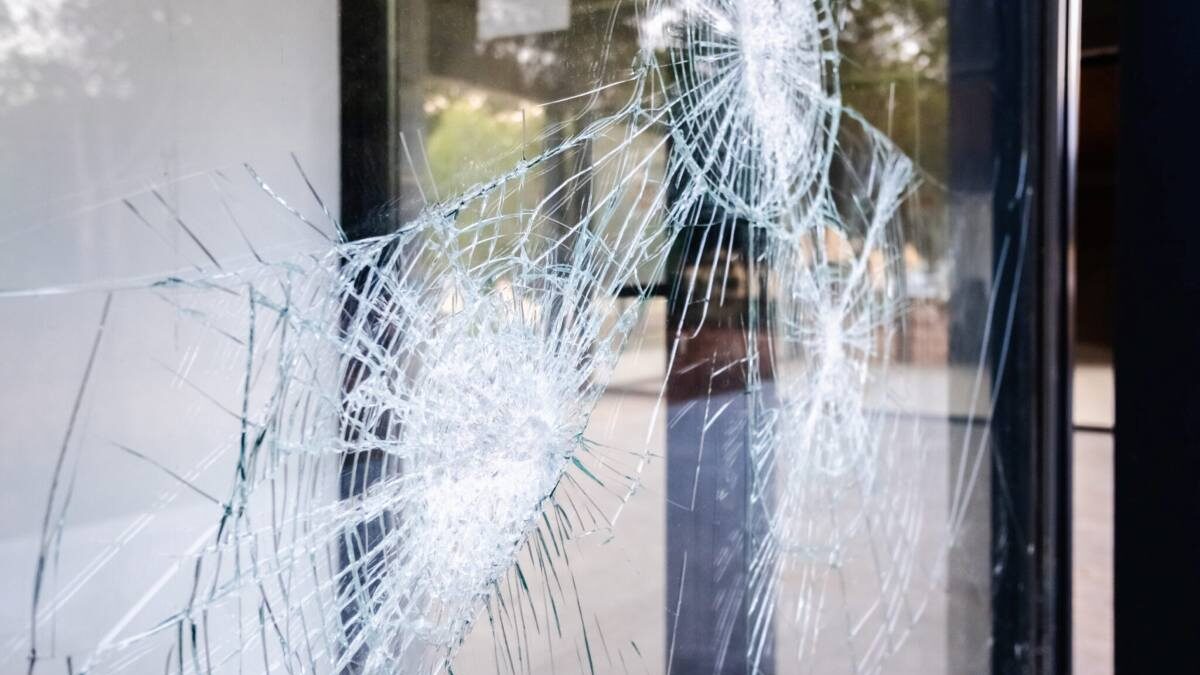
No glass is shatterproof. That label is a marketing term, not a performance standard. The correct industry classification is shatter-resistant, and it describes a specific failure behavior, not an absence of breakage. Shatter-resistant glass can and will break under sufficient force. What distinguishes it is what happens after the break: the glass holds together rather than fragmenting into loose shards.
When you write a spec, use the correct terminology. “Shatterproof glass” in an RFP signals to vendors that the specifier is working from general awareness rather than technical knowledge. “Laminated safety glass with a minimum 0.060-inch PVB interlayer meeting ANSI Z97.1 Class A requirements” signals the opposite.
Laminated Glass Construction: How PVB and EVA Interlayers Create Fragment Retention
A bonded interlayer sandwiched between two glass lites allows laminated glass to achieve fragment retention. When the glass breaks, the interlayer holds the fragments in place. The structural mechanism is adhesion: the interlayer bonds to both glass surfaces under heat and pressure during manufacturing, creating a composite assembly that behaves as a single unit under load.
The glass itself does not become stronger. The laminated assembly changes the failure mode. Instead of shattering into loose, dangerous fragments, the broken glass stays adhered to the interlayer and remains in the frame opening.
Polyvinyl Butyral (PVB): The Industry Standard Interlayer
PVB is the dominant interlayer material in commercial laminated glass, and for good reason. It bonds aggressively to glass, maintains flexibility across a wide temperature range, and absorbs and redistributes impact energy before the glass reaches its fracture threshold. Standard commercial laminated glass uses a 0.060-inch PVB interlayer. Higher-security applications use 0.090-inch or thicker interlayers, or multiple interlayer plies, to increase resistance to sustained attack.
PVB also provides meaningful acoustic attenuation, a secondary benefit that matters in school and office specifications where ambient noise control is a concurrent design requirement.
Ethylene-Vinyl Acetate (EVA): When It Is Specified
EVA interlayers are specified in applications where moisture exposure is a concern. PVB will delaminate at the glass edge if exposed to prolonged moisture infiltration, a real risk in exterior applications with compromised seals or in high-humidity environments like natatoriums or coastal facilities. EVA is more moisture-resistant and maintains optical clarity in those conditions.
For standard commercial and educational glazing in controlled environments, PVB is the correct default. Specify EVA when the project conditions genuinely warrant it, not as a general upgrade.
How Laminated Glass Fails, and Why That Failure Mode Is the Point
A laminated glass panel struck with enough force will crack, visibly and audibly, across both lites. What it will not do is create an immediate opening. The interlayer maintains the fragment matrix and, critically, maintains the barrier. A determined attacker must apply sustained, repeated force to breach a laminated assembly, and that delay is the security value.
This is why “shatterproof” is the wrong frame. The product does not prevent breakage. It converts a single high-energy break event into a prolonged forced-entry attempt that increases detection probability, alarm response time, and attacker deterrence. The failure mode is the feature.
Polycarbonate and Alternative Materials: When Framing Constraints Rule Out Traditional Glass
Polycarbonate glazing is genuinely impact-resistant in a way that glass-based laminates are not. It deforms under impact rather than fracturing, and it is specified in ballistic-resistance applications, detention facilities, and environments requiring the highest available resistance to sustained physical attack.
The tradeoffs are optical and practical. Polycarbonate scratches more easily than glass, yellows with UV exposure over time without coating maintenance, and is not thermally equivalent to glass in insulating unit applications. It also requires different frame systems and cannot simply replace existing glass lites without frame evaluation.
Specify polycarbonate when the threat profile genuinely demands it, such as ballistic risk or extreme forced-entry environments, or when no glass-based solution can meet the structural requirement. For the majority of commercial security upgrades, laminated glass or security film delivers the required performance at lower cost and with better long-term optical properties.
What Shatter Proof Glass Is and How It Works
The practical answer: shatter proof glass is any glazing assembly that retains its fragments after breakage through adhesive bonding between glass and an interlayer material. The two primary commercial forms are laminated glass, with an interlayer bonded at the factory between glass lites, and security window film, an interlayer applied to existing glass surfaces at installation. Both work on the same mechanical principle: adhesion that holds broken glass in place and maintains the barrier after impact.
The difference is where the bonding happens, inside the glass assembly at the factory or on the surface of existing glass in the field. That distinction drives nearly every project decision that follows.
Security Glazing Material Selection: A Step-by-Step Decision Checklist
Define the Threat Profile
- Forced entry and burglary deterrence, requiring a sustained attack delay of 60 or more seconds
- Smash-and-grab prevention, requiring rapid impact deterrence under 30 seconds
- Blast mitigation, requiring pressure wave and fragment retention
- General safety glazing for occupant protection from accidental breakage
The threat profile determines minimum performance requirements before any product discussion begins.
Assess Existing Frame Condition and Rebate Depth
- Measure existing glass thickness and frame rebate depth at representative openings.
- Determine whether existing frames can accommodate laminated glass, which is typically 1/4 inch to 9/16 inch thick depending on ply count.
- If rebate depth is insufficient for laminated glass without frame modification, a security window film retrofit is the default path.
Apply the Interlayer Selection Criteria
- Standard commercial glazing: PVB interlayer, minimum 0.060 inch
- High-security or sustained forced entry: PVB at 0.090 inch or multi-ply laminate
- High-moisture or coastal environments: EVA interlayer
- Existing glass surface application: security window film, a polyester-based product with pressure-sensitive adhesive
Check Code Applicability
- Is this a hazardous glazing location under the IBC, such as within 24 inches of a door, within 18 inches of the floor, or in a wet area? If yes, safety glazing is required. Confirm the product meets ANSI Z97.1 or CPSC 16 CFR 1201 Category II minimum requirements.
- Federal or GSA project? Blast mitigation requirements under GSA security standards apply.
- School or government building? Check state-specific security glazing mandates.
Apply the Retrofit vs. Replacement Decision Gates
- Replace the glass if:
- Existing glass is structurally compromised or thermally failed
- Frame rebate modification is already in scope
- New construction or full gut renovation is underway
- Ballistic or blast rating requires a multi-ply laminated or polycarbonate assembly
Retrofit with security window film if:
- The building is occupied during construction
- Multiple locations require simultaneous or phased deployment
- Budget constraints make replacement cost-prohibitive
- Existing frames are structurally sound and glass is optically clear
- The timeline cannot accommodate glass replacement lead times, which typically run four to eight weeks for custom laminated units
Laminated vs. Tempered vs. Film: Understanding the Critical Differences Before You Write a Spec
Tempered Glass vs. Laminated Glass: Not the Same Product
Laminated and tempered glass are both classified as safety glazing, but they solve different problems and should never be used interchangeably in a security specification. Tempered glass controls how glass breaks. Laminated glass controls what happens to the fragments after it breaks. That distinction determines which product belongs in a security application.
Tempered Glass: Why It Is Not a Security Product
Tempered glass is produced by heating annealed glass to approximately 1,200 degrees Fahrenheit and then rapidly cooling it, creating surface compression that dramatically increases resistance to bending stress. When tempered glass does break, it fractures into small, relatively blunt cubes rather than sharp shards, which is the characteristic cube-fracture pattern that defines the product.
That fracture pattern is exactly why tempered glass fails as a security product. When a tempered lite breaks, it disintegrates completely and immediately. The opening is instant. There is no fragment retention, no continued barrier, no delay for response. A single strike to the center of a tempered lite can breach the entire panel in under a second.
Tempered glass belongs in safety glazing applications such as shower enclosures, door lites, and sidelights, where occupant protection from accidental breakage is the goal. It does not belong in any opening where forced-entry delay is a requirement.
Annealed Glass as the Baseline Risk Profile
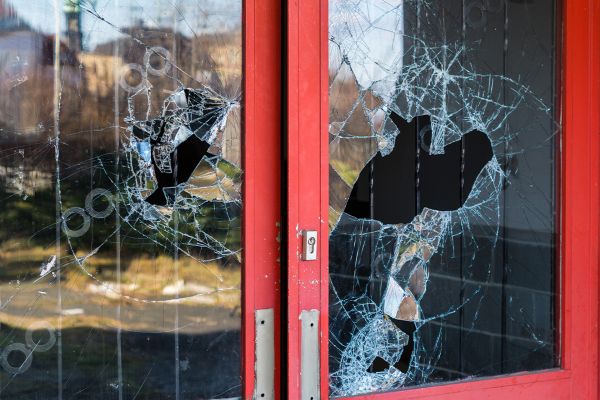
Most existing commercial buildings are glazed with annealed glass, which is standard float glass that has not been heat-treated or laminated. When annealed glass breaks, it fractures into large, irregular shards with sharp edges. It creates an immediate opening and poses a high injury risk to occupants near the break. It provides essentially zero resistance to forced entry or blast pressure beyond its initial fracture threshold.
Understanding this baseline matters for spec writing because it establishes what the upgrade must improve: fragment retention, barrier continuity after impact, and delay time under sustained attack. Any glazing solution you specify should be evaluated against these three performance dimensions relative to annealed glass.
Security Window Film as a Third Category: Retrofitting Existing Glazing
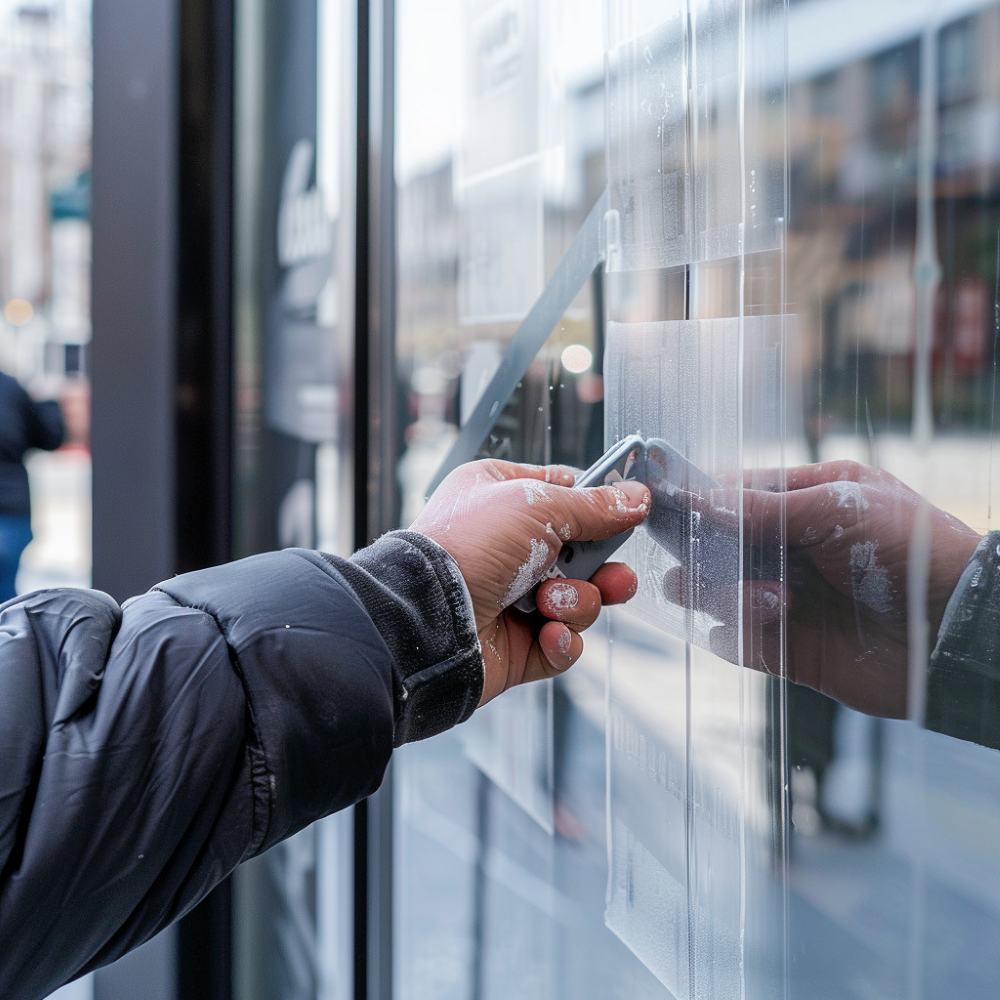
Security window film achieves fragment retention through the same adhesion principle as laminated glass. A polymer interlayer bonded to the glass surface holds fragments in place after breakage. The difference is application method: film is applied to the interior surface of existing glass using a pressure-sensitive adhesive, effectively converting annealed glass into a shatter-resistant assembly in the field.
Professional-grade security film is a multi-ply polyester construction, typically 4 to 14 mils thick depending on performance tier. Thicker films provide greater fragment retention and increased resistance to sustained attack. The film-to-glass bond strength is the critical performance variable, and it depends on proper surface preparation and installation technique, which is why installer certification matters in a security glazing specification.
Film does not change the glass itself. It changes the failure mode of the glazed assembly, which is the same outcome that laminated glass achieves through factory construction.
Realistic Performance Limits Across All Three Types
Each product category has genuine performance limits that a responsible spec must acknowledge.
Laminated glass will crack and eventually breach under sustained, repeated attack with heavy tools. The interlayer provides delay measured in minutes, not indefinitely. Thicker interlayers and multi-ply construction extend that delay but do not eliminate it.
Security film will hold glass fragments after a single impact event but provides less resistance to sustained attack than a factory-laminated assembly of equivalent thickness. High-performance film with attachment systems, where the film is anchored to the frame rather than relying solely on glass adhesion, narrows that gap significantly.
Tempered glass, as noted, provides no barrier continuity after breakage and should not be represented as a security product.
For most commercial security applications including forced entry deterrence, smash-and-grab resistance, and blast fragment mitigation, professional-grade security film and laminated glass both meet the performance threshold. The decision between them is driven by project constraints, not by a meaningful performance gap at the level most facilities require.
Matching Glass Type to Threat Profile
Different threat profiles call for different solutions, and conflating them produces either overspecification or under specification.
- Smash-and-grab: The goal is to prevent rapid breach under 60 seconds. Security film at the 7-mil or higher tier, or laminated glass with a minimum 0.060-inch PVB interlayer, both achieve this. Film retrofit is typically the faster and less expensive deployment path.
- Forced entry and sustained attack: The goal is delay measured in minutes. Factory-laminated glass with thicker interlayers or multi-ply construction outperforms film in this category at equivalent thickness, though high-performance film with frame attachment systems closes the gap for most commercial applications.
- Blast mitigation: Fragment retention under pressure wave loading is the primary requirement. Both laminated glass and security film can be specified to meet GSA and ASTM blast performance standards. Film retrofit is widely used in federal building upgrades for this reason.
- General impact and safety glazing: Code-minimum applications where ANSI Z97.1 compliance is the requirement. Both laminated glass and qualifying security film products meet this standard.
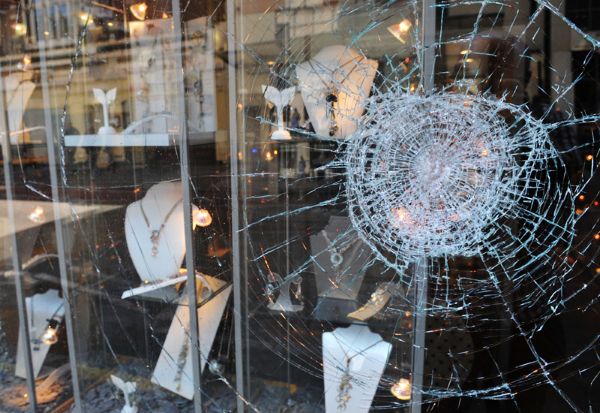
Matching the product to the actual threat profile, rather than the worst-case scenario or the most expensive available solution, is the discipline that separates projects that deliver value from those that overspend without proportional performance gain.
Building Codes and Safety Standards: The Compliance Foundation of Your Glazing Specification
ANSI Z97.1 and CPSC 16 CFR 1201: What They Require and Which Projects Trigger Compliance
Two standards govern safety glazing compliance in most commercial and institutional projects in the United States: ANSI Z97.1 and CPSC 16 CFR 1201. Both establish minimum performance requirements for glazing in hazardous locations, which are the specific openings where occupant injury from accidental breakage is a foreseeable risk.
ANSI Z97.1 is the voluntary consensus standard administered by the American National Standards Institute. CPSC 16 CFR 1201 is the federal regulatory standard from the Consumer Product Safety Commission. Both classify safety glazing into two performance categories. Category I covers lower-impact requirements typically for interior applications. Category II covers higher-impact requirements for exterior doors, sidelights, and high-traffic glazed areas. For most commercial security glazing projects, Category II is the applicable threshold.
Hazardous locations under the International Building Code include glazing within 24 inches of a door edge, glazing with a bottom edge less than 18 inches above the floor, and glazing in wet areas, stairways, and ramps. If your project touches any of these locations, safety glazing compliance is not optional. It is a code requirement that your spec must explicitly address.
GSA Security Standards: Federal and Institutional Project Applicability
Federal projects and facilities that receive federal funding operate under a separate layer of security requirements governed by the General Services Administration’s security standards and the Interagency Security Committee guidelines. These standards define minimum glazing performance based on facility security level, with higher levels requiring demonstrated blast fragment retention and increased forced-entry resistance.
For blast mitigation applications, the relevant performance standard is GSA TS01-2003 and its successor documents, which specify glazing performance under defined blast loading conditions. Laminated glass and security film both appear as compliant solutions in federal retrofit programs. The GSA’s own Building Technologies Program has documented film retrofits as cost-effective alternatives to full glass replacement in blast hardening projects.
If your project is a federal building, courthouse, embassy-adjacent facility, or publicly funded institution with a defined security level, confirm the facility security level classification before writing the glazing spec. That classification dictates minimum performance requirements that product selection must satisfy.
How Security Window Film Achieves Code-Equivalent Performance in Retrofit Contexts
Security window film can meet ANSI Z97.1 Category II and CPSC 16 CFR 1201 Category II requirements, but only when tested as an assembly on the specific glass substrate it will be applied to. This is the critical compliance detail that many retrofit specs get wrong.
Film is not independently certified. The film-plus-glass assembly is tested and certified. A film product that carries ANSI compliance documentation was tested on a specific glass type, thickness, and mounting configuration. When you specify film for a retrofit project, confirm that the product’s compliance certification covers the existing glass type in your building. If the existing glass is 1/4-inch annealed float, the film’s compliance documentation needs to reference that substrate. Applying a certified film to an uncertified substrate voids the compliance claim.
Laminated Safety Glass and the IBC: Jurisdiction-Specific Considerations
The International Building Code requires safety glazing in hazardous locations but does not mandate laminated glass specifically. It mandates compliance with ANSI Z97.1 or CPSC 16 CFR 1201, which laminated glass can satisfy along with tempered glass and qualifying film assemblies. The IBC is a model code, however, and jurisdictions adopt it with amendments. Several states have additional glazing requirements, particularly for hurricane-impact zones, seismic regions, and school facilities, that exceed IBC minimums.
Before finalizing any glazing spec, pull the adopted code version and local amendments for the project jurisdiction. This 30-minute task eliminates the risk of specifying a product that meets model code minimums but fails local requirements.
Stacking the Compliance Requirements
In practice, most commercial security glazing specifications need to address three layers of compliance simultaneously.
- Safety glazing under ANSI Z97.1 and CPSC 16 CFR 1201 for hazardous locations
- IBC Chapter 24 glazing requirements, as locally amended, for the project jurisdiction
- Project-specific security standards from GSA, ISC, or owner-defined threat-based requirements where applicable
These layers do not conflict. They stack. A product that meets the highest applicable standard in your project context satisfies the lower ones by definition. Write your spec to reference all applicable standards and require the installer to provide compliance documentation for each.
Writing the Compliance Section of Your RFP
A compliance section that protects your project reads like this: “All glazing in hazardous locations as defined by IBC Section 2406 shall meet CPSC 16 CFR 1201 Category II minimum performance requirements. Security window film applications shall be submitted with CPSC 16 CFR 1201 Category II test reports referencing the specific glass substrate in the as-installed condition. Compliance documentation shall be submitted with the product submittal package prior to installation.”
That language does three things. It identifies the applicable standard. It specifies the performance category. And it requires substrate-specific documentation, which eliminates the most common compliance gap in film retrofit specifications.
Full Glass Replacement vs. Security Window Film Retrofit: The Comparison Framework That Changes the Budget Conversation
Why Most Project Managers Default to Replacement and Why That Default Is Expensive
The replacement default comes from a reasonable instinct: new glass is a clean, complete solution with a straightforward warranty and no dependency on the condition of existing materials. The problem is that “clean and complete” carries a cost multiplier that rarely survives contact with a real project budget.
Full glass replacement in a commercial building runs $25 to $100 per square foot installed, depending on glass specification, frame system, and project location. Professional security film retrofit runs $8 to $20 per square foot installed for comparable performance tiers. On a 10,000-square-foot glazing project, that gap represents a difference of hundreds of thousands of dollars before accounting for frame modification, disposal, and occupied-building logistics that replacement adds and retrofit does not.
Performance Parity: Where Professional-Grade Security Film Meets Laminated Glass
For the two most common commercial security applications, smash-and-grab resistance and forced-entry delay, professional-grade security film at 8-mil and above with frame attachment meets the performance thresholds that laminated glass achieves at the safety glazing compliance tier. Both products retain fragments after impact, both maintain the barrier opening, and both satisfy ANSI Z97.1 Category II requirements when properly specified and installed.
Film with a mechanical attachment system, where the film edges are anchored to the frame rather than relying solely on glass-to-film adhesion, performs closer to laminated glass in sustained-attack scenarios. For blast mitigation, film has been used successfully in federal hardening programs because it achieves GSA-defined fragment retention at a fraction of replacement cost.
Where laminated glass outperforms film: multi-ply assemblies designed for ballistic resistance or sustained forced entry exceeding five minutes. For those applications, replacement is warranted. For the broad middle of commercial security requirements, the performance gap does not justify the cost gap.
Scenarios Where Full Glass Replacement Is Genuinely Warranted
Retrofit is not always the right answer. Replace the glass when:
- Existing glass is thermally failed, with IGU seal failure or visible fogging between lites
- The project is new construction or a full gut renovation with open framing
- The threat profile requires ballistic or multi-ply blast resistance beyond what film can deliver
- Existing glass is polycarbonate or acrylic that film does not bond to effectively
- Frame replacement is already in scope, making glass replacement incremental in cost
Outside these conditions, the default should shift to retrofit until the project data proves otherwise.
The Difference Between Security Film and Replacement Glass for Existing Windows
The functional difference is where the interlayer lives. Replacement laminated glass has the interlayer bonded between two glass lites at the factory. Security window film applies the interlayer to the surface of existing glass in the field. Both convert annealed glass into a shatter-resistant assembly. Both retain fragments after breakage. The end-state performance for standard commercial applications is comparable.
The practical differences are cost, lead time, and installation disruption. Laminated glass units for commercial projects typically carry four to eight-week lead times from order to delivery. Security film ships in days and installs without removing existing glass or modifying frames. For occupied buildings with active schedules, that difference alone often determines which solution is feasible.
Occupied Building Renovation: Why Film Retrofit Eliminates the Largest Schedule Risks
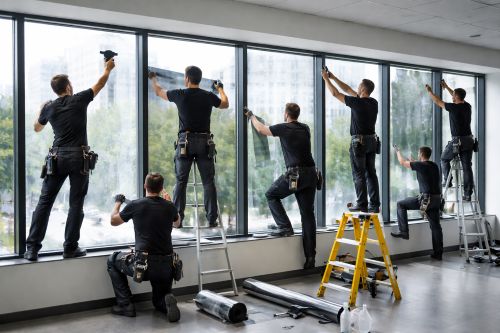
Glass replacement in an occupied building creates a cascade of logistical problems. Each opening requires temporary weatherproofing during the swap. Glazing crews need unobstructed access from both sides of the glass. Debris containment is required in occupied spaces. Work must be sequenced around business hours, class schedules, or tenant operations.
Film installation requires interior access only, produces no debris, and is complete in each opening within 30 to 90 minutes depending on size. A two-person film crew can cover 500 to 1,000 square feet per day in a commercial building without disrupting occupants in adjacent spaces. On a 20,000-square-foot school project, that translates to three to five weeks of phased installation versus ten to fourteen weeks for replacement under the same occupied-building constraints.
Multi-Location Rollouts: How Retrofit Logistics Scale
Replacement glass is a project-by-project logistics problem. Each location requires a site measure, a custom fabrication order with a four to eight-week lead, a delivery coordination, a glazier crew, and disposal of removed glass. Running ten locations in parallel means managing ten parallel supply chains with independent lead times and delivery windows.
Film retrofit scales differently. Product ships from a central source, installers can be mobilized across multiple locations simultaneously, and each site’s work scope is measured in days rather than weeks. For a 20-location retail rollout, the difference in schedule is typically six to eight weeks versus four to six months, and the budget difference compounds accordingly.
Application Contexts: Aligning Security Glazing Strategy to Facility Type
K-12 and Higher Education: School Security Glazing and the Occupied-Campus Constraint
School security glazing specifications carry a constraint that most other facility types do not: the building is almost always occupied during the academic year, and summer shutdown windows are short. Full glass replacement in a K-12 facility during a summer shutdown is feasible for small scopes, such as a single building or a focused set of entry points. For campus-wide programs covering multiple buildings, replacement scope routinely exceeds the available window. Security window film retrofit is how most district-level security programs actually execute at scale.
The performance requirement for school perimeter glazing typically centers on forced-entry delay, creating enough resistance at door and sidelight glazing to slow a determined intruder long enough for lockdown protocols to activate. Security film at the 8-mil or higher tier, with frame attachment at entry points, meets this requirement for most K-12 threat profiles and satisfies the security glazing language that many state education departments now include in school construction and renovation standards.
Commercial Office Buildings: Perimeter Security and Tenant Disruption Minimization
Commercial office glazing projects involve two complicating factors that school projects typically do not. First, multi-tenant buildings require work access coordination across multiple lease agreements. Second, buildings in urban cores may carry blast mitigation requirements alongside forced-entry deterrence.
For perimeter security in standard commercial office buildings, the threat profile is typically smash-and-grab at ground level and forced-entry at lobby and stairwell access points. Film retrofit covers both scenarios effectively and can be scheduled during off-hours or weekends to eliminate tenant disruption entirely.
For buildings with blast mitigation requirements, typically driven by proximity to high-profile targets or owner risk assessments, film specified to GSA fragment-retention standards is a documented and code-recognized retrofit path. It is also significantly faster to deploy than replacement glass, which matters when a security upgrade is responding to a defined threat timeline.
Retail Environments: Smash-and-Grab Prevention and Rapid Deployment
Retail security glazing is driven by a specific and measurable threat: smash-and-grab break-ins, where the attacker’s goal is breaching the glass barrier in under 60 seconds and exiting before law enforcement responds. The performance requirement is not prolonged forced-entry resistance. It is enough delay to defeat the time-sensitive attack window.
Security film at the 7-mil or higher tier changes the economics of a smash-and-grab attempt. Unprotected storefront glass fails in one or two strikes. Film-protected glass requires multiple strikes over 60 to 90 seconds to breach, which exceeds the window most smash-and-grab operations rely on.
The insurance dimension is real. Several commercial property insurers offer premium reductions for documented security glazing upgrades, and some require it in high-theft merchandise categories as a condition of coverage. Film provides the documentation trail, including manufacturer certificates, installer records, and product specifications, that underwriters require. Rapid deployment matters here as well: a retail operator responding to a smash-and-grab incident needs the glazing upgrade completed before the location reopens, which film retrofit can deliver in a single day where replacement glass cannot.

Illustrative Scenarios Across Facility Types
Scenario A: District-wide K-12 security upgrade, 12 school buildings, occupied campus.
Replacement approach: a four to six-month schedule requiring summer shutdown access at each building, with custom glass orders and frame modifications at older facilities. This scope likely exceeds a single summer window. Estimated budget for 40,000 square feet: $1.8M to $3.2M.
Film retrofit approach: a six to nine-week phased deployment across all 12 buildings with crews sequenced by building and zone. No frame modifications, no occupant displacement. Estimated budget for the same square footage: $480,000 to $800,000.
Scenario B: Urban office tower, floors 1-3 perimeter security upgrade, tenants in place.
Replacement requires weekend glazing crews, temporary weatherproofing at open frames overnight, and six to eight-week custom glass lead time per floor. Weekend-only access extends the schedule to four to five months.
Film retrofit runs evenings or weekends with no frame work and no open openings overnight. Full scope completes in three to four weeks with zero tenant complaints related to access or weather exposure.
Scenario C: Multi-location retail chain, 25 stores, smash-and-grab response program.
Replacement: 25 separate custom glass orders, 25 separate glazier mobilizations, a four to five-month total program timeline with rolling lead times.
Film retrofit: centralized product order ships within five business days, crews mobilized in regional clusters, all 25 locations complete within six weeks. Insurance documentation package delivered with the final inspection report.
Project Planning, Installation Timelines, and Multi-Site Rollout Logistics
How Long Does Shatter Proof Glass Installation Take on a Large Commercial Project?
Installation duration varies more by method than by square footage. A 50,000-square-foot film retrofit and a 50,000-square-foot glass replacement project are not comparable timelines. They are different categories of work with different supply chains, crew requirements, and site access needs.
The more useful framing: film retrofit is constrained by installer crew capacity and site access scheduling. Glass replacement is constrained by fabrication lead time, delivery logistics, frame preparation, and disposal. On large commercial projects, lead time and logistics dominate the replacement schedule in ways that have nothing to do with how quickly crews can actually install glass.
Installation Timeline Benchmarks: Film Retrofit vs. Full Glass Replacement at Scale
These are practical benchmarks based on commercial project execution.
- Film retrofit: 500 to 1,000 square feet per two-person crew per day in a commercial building. A 20,000-square-foot project runs 20 to 40 crew-days. With two crews running simultaneously, that is 10 to 20 working days on-site.
- Glass replacement: Custom laminated units carry four to eight-week fabrication lead times. Installation runs 200 to 400 square feet per crew per day due to handling, frame prep, setting, and glazing compound cure time. The same 20,000-square-foot project runs 50 to 100 crew-days on-site, after the fabrication lead time expires.
Need More Info?
The Window Film Depot team is happy to help.
For multi-location projects, add mobilization days between sites for replacement crews, who travel with heavy equipment, versus minimal mobilization for film crews, who are van-based with light equipment. At ten or more locations, that mobilization difference becomes a meaningful schedule variable.
Phasing Strategy for Occupied Buildings: Sequencing and Zone Planning
Phasing security glazing in an occupied building requires a zone map before any work begins. Divide the building into logical zones by floor, by wing, or by function, and sequence work to avoid simultaneous disruption to adjacent occupied spaces.
For film retrofit, the practical phasing rule is that a crew can work in any zone where occupants have four to six feet of clearance from the work area. There is no dust, no debris, and no open-to-exterior exposure during installation. Most commercial buildings can run film work during business hours with minimal coordination beyond advance notice to space occupants.
For glass replacement, zone planning must account for the open-frame window between removal and installation, typically two to four hours per opening. This requires either temporary weatherproofing or out-of-hours scheduling for exterior glazing. In multi-story buildings, debris management between floors adds coordination overhead that compounds with project size.
Vendor Evaluation Criteria: What to Require Before Awarding a Contract
Glazing installer quality drives project outcome more than product specification in most commercial security film projects. A correctly specified film installed by an undertrained crew will underperform a lesser-specified film installed by a certified crew with proper surface preparation and edge treatment. Vendor evaluation is not a procurement formality. It is a quality control decision.
Licensing, Insurance, and Manufacturer-Certified Installer Status
Require current state contractor licensing, general liability coverage at a minimum of $2M per occurrence, and manufacturer certification for the specific film product specified. Manufacturer certification means the installer has been trained and approved by the film manufacturer to install their product. It is not a general industry credential and is not interchangeable between brands.
Manufacturer-certified status also connects to warranty eligibility. Film products installed by uncertified contractors commonly carry no manufacturer warranty, which transfers all performance risk to the installer’s own warranty terms, a significantly weaker position for a project owner.
Quality Assurance Protocols, Warranty Terms, and Post-Installation Inspection Standards
Require a written QA protocol that specifies surface preparation steps, adhesive cure time before stress testing, and post-installation inspection criteria. The inspection checklist should confirm no visible bubbles or delamination at edges, film overlap at frame contact meeting manufacturer specification, and confirmed adhesion at a sample of representative openings.
Warranty terms should cover both the film product and installation workmanship separately. A 10-year manufacturer product warranty paired with a 2-year workmanship warranty is a reasonable commercial standard. Require both in writing before award.
How Manufacturer-Certified Installation Standards Affect Your Project Risk Profile
Manufacturer certification programs establish installation protocols that directly affect long-term film performance. Proper surface cleaning, correct solution application, edge sealing, and cure time management are all procedurally defined in certified installer training, and all are variables that affect whether a film assembly performs as tested five years after installation.
Specifying manufacturer-certified installation is not brand preference. It is a risk management decision. It connects your installed product to a documented performance standard, creates a warranty chain that protects the project owner, and gives you recourse if the installation fails to perform. For multi-location rollouts, requiring certified installer status across all deployment crews ensures consistent installation quality regardless of which regional subcontractors execute the work.
Total Cost of Ownership: Budgeting Security Glazing Upgrades Across the Project Lifecycle
How Much Does Shatter Proof Glass Cost Compared to Regular Glass and Film?
Standard annealed glass runs $5 to $15 per square foot installed in commercial applications. Laminated safety glass, the factory-manufactured shatter proof glass product, runs $25 to $100 per square foot installed depending on ply count, interlayer specification, and frame system. Professional security window film retrofit runs $8 to $20 per square foot installed for comparable performance tiers.
The cost gap between laminated replacement and film retrofit is not incremental. On a 15,000-square-foot commercial project, it is the difference between a $375,000 minimum spend and a $120,000 maximum spend for equivalent safety glazing performance at standard commercial security thresholds.
Building the TCO Model: Material, Labor, Disruption, and Lifecycle Costs Compared
Material and labor costs are the visible line items. The costs that break budgets are the ones that don’t appear in the original estimate.
For full glass replacement, the complete cost picture includes custom fabrication lead time carrying project overhead during that window, frame modification at openings where existing rebate depth does not accommodate laminated glass thickness, temporary weatherproofing at each open frame during the swap, glass disposal including hauling and in some jurisdictions disposal fees for laminated units, and occupied-building logistics such as after-hours labor premiums and phased access coordination.
For security window film retrofit, the cost picture is narrower: product cost, installation labor, and surface preparation. No frame work, no disposal, no temporary closures, no fabrication lead time carrying overhead.
On a 20,000-square-foot occupied commercial building, the disruption cost differential alone can run tens of thousands of dollars when replacement requires after-hours crews and phased tenant coordination. That number rarely appears in a replacement bid but materializes as change orders and schedule extensions once work begins.
What’s the ROI Case for Upgrading to Shatter Proof Glass in a Retail or School Setting?
The ROI case differs by facility type, but the structure is consistent: quantify avoided losses, add insurance and liability value, and measure against upgrade cost.
For retail, the calculation is straightforward. A single smash-and-grab event can result in significant merchandise loss plus emergency board-up and glass replacement costs. Security film at a typical storefront installation can prevent those losses entirely, and documented security upgrades reduce commercial property insurance premiums in many markets. The payback window for high-theft retail locations is often achieved within a few years.
For schools, the ROI frame shifts from loss prevention to liability and compliance. Districts that have experienced forced-entry incidents or carry state-mandated security glazing requirements face a specific calculation: the cost of non-compliance, which includes failed inspections, grant ineligibility, and liability exposure, versus the cost of upgrade. Film retrofit at district scale typically qualifies for school safety grant funding in states with active security grant programs, which further compresses the net cost.
Illustrative Cost Model: Single-Location vs. Multi-Location Retrofit Deployment
Single location: 2,500-square-foot retail storefront
- Film retrofit: $20,000 to $50,000 installed, one to two days on-site, zero operational disruption
- Glass replacement: $62,500 to $250,000 installed, two to three weeks including lead time, one to two days of closure during installation
Multi-location: 20-store retail chain, 2,500 square feet per location
- Film retrofit: $400,000 to $1,000,000 total, four to six-week program timeline with crews running in parallel across regions
- Glass replacement: $1,250,000 to $5,000,000 total, four to six-month program timeline with sequential fabrication and installation cycles
The multi-location numbers illustrate why retrofit’s scalability advantage compounds faster than the per-location cost difference suggests. At 20 locations, the budget gap is substantial and the schedule gap is four to six months of operational exposure during a protracted replacement program versus a six-week film deployment.
Maintenance Requirements and Long-Term Performance
Laminated glass in a commercial installation requires essentially no maintenance beyond standard glazing inspection at seal integrity. The interlayer does not degrade under normal interior or exterior conditions over a 20 to 30-year service life. If a lite is cracked, replacement is required, as partial repair of a laminated unit is not a practical field repair.
Security window film has a shorter maintenance cycle. Professional-grade exterior film typically carries a 10 to 12-year product warranty. Interior film runs longer, with many manufacturer warranties extending to 15 years, because it is not exposed to UV and weathering. After the warranty period, film can be removed and replaced without frame modification or glass removal at a cost significantly below original installation. That replaceability is a lifecycle advantage: the frame investment is permanent and the security layer is renewable.
Cleaning protocols differ as well. Film-protected glass requires non-ammonia cleaners and soft cloths for the first 30 days post-installation during the adhesive cure period. After that, standard commercial cleaning applies. Laminated glass has no cleaning restrictions.
Structuring the Business Case for Building Owners and Finance Stakeholders
Building owners and finance stakeholders evaluate glazing upgrades on three axes: capital cost, risk reduction, and operational impact. A project manager presenting a retrofit specification needs to address all three directly, not lead with product specifications.
Frame the capital cost comparison as a total investment number, not a unit cost. Present the full replacement scenario cost, including frame work, disposal, lead time overhead, and after-hours labor premiums, against the full retrofit cost. The per-square-foot numbers can favor replacement on paper when framed narrowly. The total project numbers favor retrofit in most existing-building scenarios.
Quantify risk reduction in terms the building owner recognizes: insurance premium impact, liability exposure from an unprotected hazardous location, and documented compliance with any applicable code or security standard. A glazing upgrade that satisfies a code requirement eliminates a specific liability exposure that a finance team can put a number on.
Present operational impact as a cost, not an inconvenience. Tenant disruption, temporary closure, and schedule extensions carry real dollar values. A retrofit that completes in three weeks without closing the building is not just more convenient. It avoids costs that belong in the comparison.
Six Numbers Every Project Manager Should Have Before the Spec Meeting
- $25 to $100 per square foot: installed cost range for laminated replacement glass in commercial buildings
- $8 to $20 per square foot: installed cost range for professional security film retrofit at equivalent performance tiers
- Four to eight weeks: typical fabrication lead time for custom laminated glass units
- One to two days: typical film installation time for a 2,500-square-foot retail location
- Five to fifteen percent: commercial property insurance premium reduction range for documented security glazing upgrades, as reported by many commercial insurers
- Ten to fifteen years: professional-grade security film warranty period for interior applications, with film replaceability at end of cycle without frame modification
Conclusion: From Specification Confidence to Project Execution
Recapping the Core Decision Framework
Most glazing specifications go wrong at the same point: the specifier defaults to full replacement without testing that assumption against project constraints. The result is a spec that is technically defensible in isolation but operationally expensive, logistically complicated, and often unnecessary for the actual threat profile the project is addressing.
What this guide has established is a different decision sequence. Start with the threat profile, not the product. Assess frame condition and rebate depth before assuming replacement is possible without modification. Confirm code applicability for the specific jurisdiction and project type. Then evaluate retrofit against replacement on total cost, not material cost alone, accounting for lead time, disruption, and scale.
For existing commercial, educational, and retail buildings, the evidence consistently points the same direction. Professional-grade security film delivers shatter-resistant performance at code-compliant levels, at a fraction of replacement cost, in a fraction of the schedule.
How to Use This Guide to Write, Defend, and Deliver a Security Glazing Specification
This guide provides the three components a defensible specification requires. The technical vocabulary is here: laminated glass construction, interlayer types, fragment retention mechanics, and the failure mode distinctions between tempered, annealed, and laminated assemblies. The compliance framework is here: ANSI Z97.1, CPSC 16 CFR 1201, IBC Chapter 24, and GSA standards, with guidance on how to layer them in an RFP. The cost framework is here: TCO modeling, ROI structure by facility type, and the line items that separate total project cost from bid cost.
Make use of the decision checklist to sequence your specification process. Use the compliance language template to write the glazing section of your RFP. Use the cost model structure to build the owner presentation. The goal is not to produce the most comprehensive specification. It is to produce the right specification, defensible at every level of review.
Engaging an Expert Installation Partner for Large-Scale and Multi-Location Security Projects
Product selection and specification writing get the project to the award decision. Installer quality determines whether the installed product actually performs as specified. For large-scale and multi-location security film programs, the installer evaluation criteria covered in the prior section apply directly: manufacturer certification, substrate-specific compliance documentation, written QA protocols, and warranty terms covering both product and workmanship.
An experienced security glazing partner brings more than installation capacity. They bring the site assessment expertise to identify frame compatibility issues before they become change orders, the compliance documentation to support code inspections, and the project management infrastructure to coordinate multi-location deployments without the scheduling fragmentation that derails large rollouts.
Window Film Depot operates as that partner for commercial, educational, and retail security glazing programs at scale, with manufacturer-certified installation capability, multi-location project management infrastructure, and the technical depth to support specification development from the earliest planning stage through final inspection. If you are building a security glazing program and need a partner who can deliver consistent quality across multiple locations, that conversation starts with a site assessment and a specification review.
Frequently Asked Questions
What is shatter proof glass and how does it work technically?
Shatter proof glass, more accurately called shatter-resistant glass, is any glazing assembly that retains its fragments after breakage through adhesive bonding between glass and an interlayer material. The two primary commercial forms are factory-laminated glass, where a PVB or EVA interlayer is bonded between two glass lites under heat and pressure, and security window film, where a polymer interlayer is applied to the surface of existing glass in the field. Both convert the failure mode of ordinary glass from immediate fragmentation into controlled fragment retention, maintaining the barrier even after impact.
Does shatter proof glass actually work, and what are the realistic limitations?
Yes, shatter-resistant glazing performs as specified, but it is not indestructible. Laminated glass and security film both retain fragments and maintain the barrier opening after impact, which is the core security value. The limitation is time: a sufficiently determined attacker with heavy tools can breach both products given enough uninterrupted time. Thicker interlayers and multi-ply construction extend the delay window. For most commercial applications, the goal is not indefinite resistance but enough delay to trigger an alarm response or deter a time-constrained attacker entirely.
What types of glass don’t shatter, and how do tempered, laminated, and film compare?
Laminated glass and security window film both qualify as shatter-resistant. Tempered glass does not. When tempered glass breaks, it disintegrates immediately into small cubes, creating an instant opening with no fragment retention or barrier continuity. Laminated glass holds fragments in the interlayer and keeps the opening closed after breakage. Security film achieves the same result by bonding a polymer interlayer to the surface of existing glass. For any application where forced-entry delay or fragment retention is the requirement, tempered glass is not an appropriate specification.
How much does shatter proof glass cost for commercial or multi-location projects?
Laminated safety glass runs $25 to $100 per square foot installed in commercial buildings, depending on ply count, interlayer specification, and frame system. Professional security window film retrofit runs $8 to $20 per square foot installed for comparable performance tiers. On a multi-location project, this cost difference compounds significantly. A 20-location retail program that costs $400,000 to $1,000,000 with film retrofit may cost $1,250,000 to $5,000,000 with full glass replacement, before accounting for frame modifications, disposal, and occupied-building logistics.
What’s the difference between shatter proof glass film and replacement glass for existing windows?
The functional difference is where the interlayer lives. Replacement laminated glass has the interlayer bonded between two glass lites at the factory before installation. Security window film applies the interlayer to the surface of existing glass at the job site, without removing or replacing the original glass. Both convert ordinary annealed glass into a shatter-resistant assembly, and both retain fragments after breakage. The practical differences are cost, lead time, and disruption: film installs in hours without frame modification, while laminated replacement units carry four to eight-week fabrication lead times and require frame preparation and glass removal.
What building codes or security standards apply to shatter proof glazing specifications?
Most commercial security glazing specifications need to address three compliance layers. Safety glazing requirements under ANSI Z97.1 and CPSC 16 CFR 1201 apply to hazardous locations defined by the IBC, including glazing within 24 inches of a door, within 18 inches of the floor, and in wet areas. IBC Chapter 24, as locally amended, governs glazing requirements for the project jurisdiction. Federal and institutional projects may also carry GSA or Interagency Security Committee standards that define minimum performance by facility security level. These standards stack rather than conflict: meeting the highest applicable standard satisfies the lower ones.
What’s the ROI or business case for upgrading to shatter proof glass in a retail or school setting?
For retail, the business case centers on loss prevention and insurance. A single smash-and-grab incident can generate significant merchandise loss and emergency replacement costs, and documented security glazing upgrades often reduce commercial property insurance premiums. For schools, the ROI frame shifts to liability reduction and compliance: the cost of a security glazing upgrade is measured against grant eligibility, code compliance exposure, and the liability risk of an unprotected facility. In both settings, security window film retrofit delivers the required performance at a fraction of replacement cost, and its documented installation record supports both insurance and compliance claims.