If you have street-facing windows, a ground-floor apartment, or a sun-drenched home office, you already know the dilemma: you want natural light, but you don’t want passersby watching you eat breakfast. One way window film solves that tension by turning your existing glass into a reflective surface on the outside while keeping your view crystal clear from the inside. This guide covers exactly how it works, where it falls short, and how to pick the right film for your space.
Table of Contents:
What Is One Way Window Film?
One way window film is a thin, metalized privacy window film applied directly to existing glass that provides daytime privacy by reflecting light on the brighter side. It allows visibility from the inside while blocking outside views during daylight hours, letting you enjoy natural light without sacrificing your personal space. People use it in homes, apartments, and offices wherever windows face streets, sidewalks, neighboring buildings, or other high-traffic areas.
This type of window film is a reflective mirror window film. It creates a one way mirror effect on the exterior-facing side of the glass while the interior remains transparent. The result is a sleek, mirrored appearance from the outside and a clear, barely tinted view from the inside.
Key points to understand from the start:
- One way window film is ideal for daytime privacy, not 24/7 total blackout. It works when the outside is brighter than the inside.
- It is applied to existing flat glass-no need to replace windows or install new panes.
- Common locations include living room street-facing windows, apartment balconies, ground-floor bedrooms, office reception areas, glass doors, and interior partitions.
- It also delivers meaningful heat reduction, glare reduction, and uv protection as secondary benefits.

How Does One Way Mirror Window Film Work?
The principle is straightforward: whichever side of the glass surface is brighter becomes the reflective side. A microscopic layer of reflective metal is sandwiched between protective layers in the film, and when sunlight hits the exterior face, most of that light bounces back as a mirror-like reflection. People outside see their own reflection; people inside see through with minimal obstruction.
The film structure in everyday terms looks like this: a polyester base layer, a thin metalized coating (usually aluminum or silver), an adhesive or static cling layer that bonds to the glass, and a protective topcoat that resists scratches.
Here’s how the daytime mirror window effect plays out in practice:
- On a sunny afternoon, the exterior side reflects sunlight, making the window look like a reflective mirror from the street.
- From the inside, light still passes through in both directions, but the contrast and reflection make it difficult to see into the darker side, creating privacy.
- The film only works effectively when the outside is at least three times as bright as the inside. Think of a typical July afternoon versus a dim interior room.
- The film relies on the principle of relative light balance to function effectively. The greater the light differential, the stronger the mirror effect.
Limitations worth noting: the effectiveness of the film decreases in shaded areas, on north-facing or heavily shaded windows, on overcast winter days, and whenever interior lights are much brighter than the outdoor environment. The side of the window that is brighter always becomes the reflective side-and that can shift depending on the time of day.
Daytime vs Nighttime Privacy (& Why Lighting Matters)
This is the most important thing to understand before buying: one way window film provides daytime privacy only and does not provide nighttime privacy. When indoor lights are on after dark, the effect reverses.
One-way window film reverses its effect at night when indoor lights are on. Nighttime visibility is reversed when outside light is absent. At 6 pm on a winter evening with your living room lit up and the street dark, people outside can now see in clearly while you see mostly your own reflection on the glass.
True one-way glass that works 24/7 doesn’t exist without tightly controlled lighting on both sides. No film on the market changes this fundamental physics.
Here’s a quick comparison:
| Condition | What outsiders see | What you see inside |
|---|---|---|
| Bright day, dim interior | Their own reflection (mirror effect) | Clear view outside |
| Overcast or shaded | Partial mirror, some visibility in | Slightly reflective, can still see out |
| Night, lights on inside | Clear view into your bright room | Mostly your own reflection |
| Night, lights off inside | Dark window both sides | Dark outside, limited view |
To maintain privacy after dark, traditional window treatments must be used with the film. Curtains or blinds are recommended for nighttime privacy. You don’t have to close curtains all day-just layer your strategy so blinds or drapes handle the hours the film cannot.
When planning your window privacy film setup, consider window orientation, local sunrise and sunset times, and whether street lighting creates enough ambient glow to affect the light balance.
Key Benefits: Privacy, Heat Reduction & Glare Control
One way window film offers multiple benefits well beyond privacy. If you have large glass areas, sun-exposed rooms, or simply want to modernize the look of older windows, the performance gains add up quickly.
- Daytime privacy: The “see out, not in” effect is the primary draw, especially for ground-floor and street-facing windows, home offices, and entry doors with sidelights. The film allows natural light while blocking views from outside during the day.
- Heat reduction: Reflective window film helps reduce solar heat gain in summer. Premium reflective films can reject approximately 80–82% of total solar heat, and the film reduces heat by 8–10°F in rooms with direct sun exposure. That translates to lower energy costs and less strain on your air conditioning.
- Glare control: The film reduces glare from direct sunlight, making screens easier to view. If you’ve ever tried to use a computer or watch TV in a west-facing room at 4 pm, you’ll appreciate glare reduction of up to 90–93% from high-performance films.
- UV protection: One way window film blocks 99% UV-B rays, protecting furniture, flooring, artwork, and fabrics from fading over time. This is a significant benefit for rooms that display art, photographs, or expensive rugs near windows.
- Aesthetics: One-way window film creates a mirror-like finish on the outside and remains transparent from the inside. The reflective appearance can modernize the exterior of older buildings and give your home a sleek, polished look.
- Energy efficiency: By helping reduce heat gain in summer, reflective films can support year-round comfort as part of a broader energy-saving strategy alongside insulation and efficient HVAC systems.
Comfort Improvements You’ll Notice Right Away
The before-and-after differences are tangible, especially in rooms with direct sun exposure:
- Sitting at a desk next to a large window in August feels noticeably cooler. Hot spots near the glass diminish, and you stop reaching for the thermostat every hour.
- Watching TV in a living room facing west at 5 pm actually becomes possible without squinting or repositioning your seating angle to avoid glare.
- Pets and plants benefit from softened, filtered sunlight instead of harsh direct sun through clear glass. Your furniture and flooring fade more slowly, extending the life of your interior finishes.
Types of Privacy Window Film (and When to Use Each)
Privacy film is a broad category, and way window film is just one option among several styles designed for different needs. Here’s how they compare:
- One way reflective mirror film: Best for strong daytime privacy on exterior windows where you want to maintain outside views. Also delivers the highest heat reduction and a bold reflective mirror appearance from the other side.
- Static cling window film: Uses no adhesive-it adheres through a suction-like effect and is repositionable and reusable. Ideal for renters, short-term use, and DIY projects. Some one-way and decorative films are available in static cling versions, though they typically last 1–3 years versus a decade or more for adhesive films.
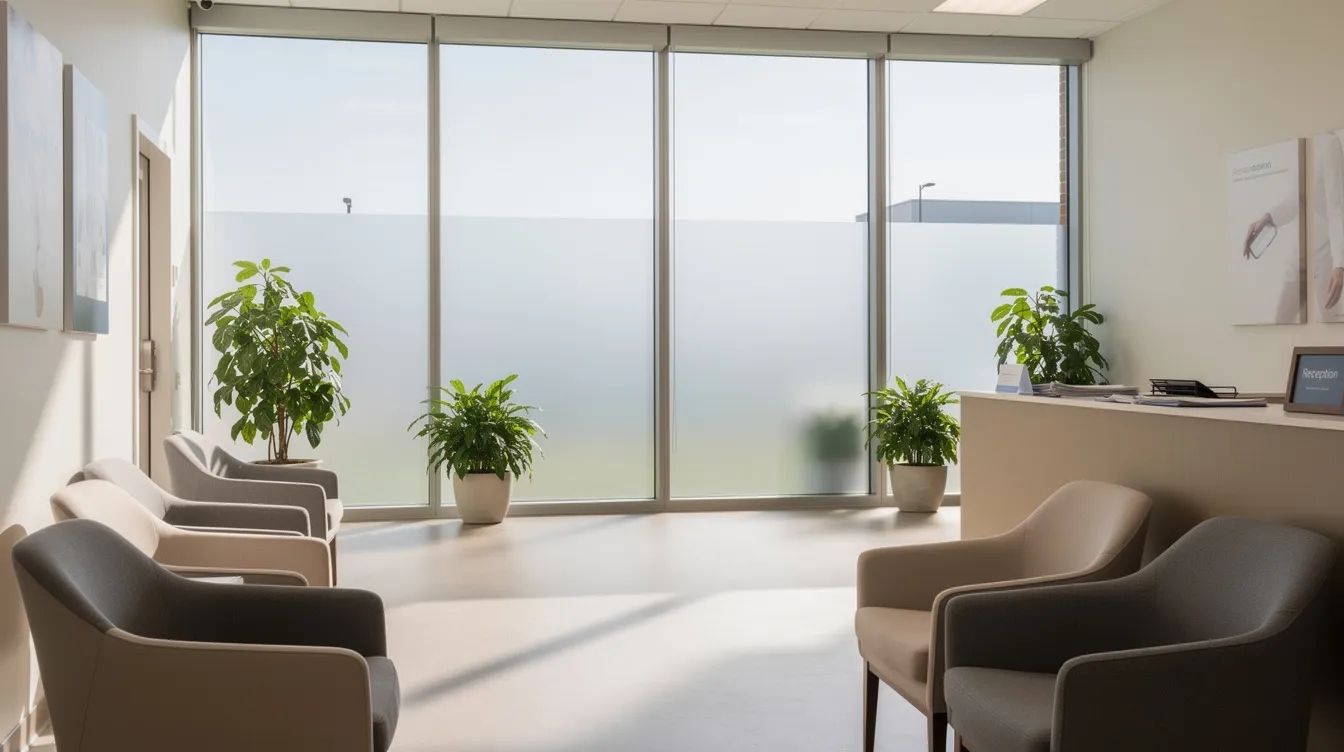
- Frosted and translucent privacy film: Creates a soft, blurred effect that provides 24-hour privacy while still allowing light through. This is the perfect solution for bathrooms, side windows, and offices where you need covering without any time-of-day limitations.
- Blackout and opaque window film: Total privacy and light blocking for spaces like storage rooms, media rooms, or sidelights where no visibility is desired in either direction.
- Decorative window privacy film: Patterns, textures, and 3D effects that combine privacy with design for front doors, shower enclosures, and interior partitions-adding visual interest to the glass while limiting what’s visible from one side.
You can also pair styles: one way film on main panes for daytime privacy plus frosted stripes at eye level on bathroom windows, or blackout film on a media room window that doesn’t need a view. This layered approach lets you create a tailored privacy plan for every room.
Choosing Between Adhesive and Static Cling Window Film
| Feature | Adhesive film | Static cling window film |
|---|---|---|
| Bond | Permanent adhesive | Clings without glue |
| Lifespan | 10–20 years (professional install) | 1–3 years |
| Repositionable | No | Yes |
| Best for | Long-term, high-traffic, commercial | Apartments, leased offices, seasonal use |
| Moisture areas | Handles well if properly sealed | Can lift at edges in high humidity |
| Removal | Requires effort and solution | Peels off, can be reused |
If you’re renting or need a temporary solution, static cling is hard to beat. If you own your home or want a secure, long-lasting install, adhesive film is the better investment per year of use.
Installation: DIY vs Professional Application
One way window film is easy to install on small, accessible windows as a DIY project. Larger panes, multi-story buildings, and commercial spaces benefit from professional help to ensure a clean, lasting result.
DIY basics-step by step:
- Clean windows multiple times with vinegar and alcohol solution. Dust, lint, or fingerprints trapped under the film will be visible forever, so this step is non-negotiable.
- Measure each window and cut film about an inch larger than the window size on all sides. You’ll trim the excess after application.
- Spray soapy water on both the film and window before application. This lubrication lets you slide the film into position and prevents premature sticking.
- Use two people to apply large pieces of film. One person holds the top edge while the other manages the bottom and smooths it down.
- Use a rubber squeegee to remove air bubbles during installation, working from the center outward in firm, overlapping strokes.
- Trim the edges with a sharp utility knife, leaving a tiny gap from the frame so moisture can escape during curing.
Common DIY mistakes to avoid:
- Not cleaning the glass surface thoroughly enough-this is the number one cause of visible imperfections
- Cutting too short and leaving gaps at edges
- Installing in direct sun or very hot conditions, which causes the film to stretch and trap bubbles
- Not wetting the glass enough before application
Professional installation advantages:
- Faster application across multiple windows with cleaner edges and fewer bubbles
- Access to commercial-grade films with higher quality and longer warranties
- Safe work at height for second-story or hard-to-reach windows
- Expert assessment of glass type (tempered, laminated, double-pane) to avoid compatibility issues
Properly installed interior films typically last 10–20 years depending on film quality, sun exposure, and maintenance. DIY adhesive installs average 3–7 years, and static cling versions last 1–3 years.
Interior vs Exterior Application
Most privacy and window tint films are designed for interior application. This protects the film from weather, UV degradation, and physical wear, extending its life significantly.
- Exterior-rated films exist for special cases-inaccessible inner surfaces, certain double-glazed units-but they typically last only 8–12 years even with proper care.
- Applying reflective window film to the interior keeps the reflective surface protected and simplifies maintenance.
- Check your glass type before applying any film. Tempered, laminated, double-pane, and low-E glass can affect thermal stress, and using incompatible film may void your window warranty. Always review manufacturer guidelines or contact a professional installer.
How to Choose the Right One Way Window Film for Your Home
Choosing window privacy film based on price or darkness alone leads to disappointment. Instead, think about privacy level, appearance, performance, and how the film will interact with your specific windows and environment.
- Privacy needs: Identify which rooms truly need daytime privacy. A street-facing living room or home office where you take video calls is a higher priority than a second-floor bedroom that barely faces any foot traffic.
- Visible light transmission (VLT): Darker tints (VLT around 15–30%) give a stronger mirror effect and more heat reduction but make rooms feel limited in natural light. Lighter tints (VLT 50–80%) are more subtle and keep interiors bright inside, but the privacy and heat rejection are weaker.
- Reflective intensity: Very shiny mirror films offer maximum privacy but create a bold, highly reflective appearance from the outside. Dual-reflective or neutral films blend more naturally with your home’s existing glass and display a softer look.
- Climate and orientation: South- and west-facing windows in hot regions benefit most from stronger heat-rejection films. Cooler climates or shaded elevations may only need a lighter tint for glare control.
- Glass compatibility: Insulated, low-E, or double-pane windows can trap heat between layers if the wrong film is applied, potentially causing thermal stress. Review manufacturer compatibility charts or consult an installer before committing.
- Budget: Higher-quality adhesive films cost more upfront but deliver lower cost per year over a 10–20 year lifespan. Static cling is cheaper initially but may need replacing every 1–3 years.
- Visual style: Match the film’s exterior appearance (sleek mirrored, subtle gray tint, or decorative pattern) to your home’s architecture and frame colors to create a cohesive look from the street.
Special Cases: Bathrooms, Balconies & Home Offices
- Bathrooms: Combine one way film with frosted or patterned privacy film at critical heights. This maintains daytime privacy from the reflecting exterior while ensuring you don’t need to worry about night time privacy gaps when you turn the lights on for a shower.
- Balconies and high-rise apartments: Reflective mirror films are valuable for daytime privacy from nearby buildings while you still enjoy the view. The security of knowing neighbors in adjacent towers can’t see into your living space makes a real difference in how you use the room.
- Home offices: Glare reduction on monitors is the standout benefit here. If your desk faces a large window, reflective film cuts harsh sunlight that washes out your computer screen and creates eye strain during video calls. The daytime privacy also means you don’t have to reposition your camera angle or close curtains to avoid being visible from outside.
FAQs About One Way Window Film
Here are the most common questions people ask about privacy window film and window tint before making a purchase.
Does one way window film work at night?
No. One way window film provides no nighttime privacy. When it’s dark outside and your interior lights are on, the effect reverses-outsiders can see in, and you see your own reflection. Use curtains, blinds, or shades after dark to maintain privacy.
Can I still see out clearly through reflective mirror window film?
Yes. From the inside during the day, the view through the film is clear with a slight tint depending on the VLT you choose. Darker films reduce brightness more, but even mid-range options provide a comfortable, visible view of the outside.
Will one way film make my room too dark?
That depends on the VLT rating. Films with 15–30% VLT will noticeably darken a room, while films at 50% or higher barely affect indoor brightness. Choose based on how much natural light your space receives and how much privacy you need.
How much heat reduction can I expect from privacy films?
High-performance reflective films can reject approximately 80–82% of solar heat and reduce room temperature by 8–10°F near sun-exposed windows. This can meaningfully lower cooling costs during summer months.
Is static cling window film as effective as adhesive film?
Static cling provides similar optical performance when new, but it has a limited lifespan of 1–3 years compared to 10–20 years for professional adhesive film. It’s also more prone to edge lifting and shrinkage, especially in high-humidity or high-heat environments.
Can I install window film on double-pane or low-E windows?
Some films are rated for double-pane and low-E glass, but not all. Applying the wrong film can trap heat between panes and cause thermal stress or cracking. Always check the manufacturer’s compatibility guide and consider professional help for these glass types.
How do I clean windows after film is installed?
Use a soft cloth or sponge with mild, non-abrasive cleaners. Avoid ammonia-based products and rough scrubbers that could scratch the reflective surface. Wait for the recommended curing period (typically 7–30 days after installation) before the first cleaning.
How long does window privacy film last before it needs replacing?
Interior adhesive films professionally installed typically last 10–20 years. DIY adhesive installs last 3–7 years on average. Static cling versions last 1–3 years. Signs that replacement is needed include peeling edges, discoloration, bubbling, or a noticeable decline in the mirror effect’s quality.
Care, Cleaning & Long-Term Maintenance
- After the curing period, clean with soft microfiber cloths and a mild soap-and-water solution. Never use ammonia or harsh chemical cleaners.
- Avoid razor blades, abrasive pads, or rough scrubbers-these will scratch the reflective surface and affect its appearance.
- Inspect edges periodically for lifting or peeling, particularly in high-moisture areas like kitchens and bathrooms.
- Signs of aging include discoloration, persistent bubbling, and reduced reflectivity. When these appear across a large area, it’s time to review replacement options.
Conclusion & Next Steps
One way window film delivers daytime privacy, meaningful heat reduction, glare control, and a modern reflective mirror look-all without replacing a single pane of glass. It’s a cost-effective upgrade for homes, apartments, and offices, especially on sun-facing or street-level windows where privacy and comfort matter most.
Start by walking through your home and identifying the windows where you feel most exposed or where sunlight creates the most discomfort. Match those windows to the right film type, VLT level, and installation method based on what you’ve learned here.
If you’re unsure which film suits your specific glass type, orientation, or privacy goals, reach out for tailored recommendations. Whether you install it yourself or bring in a professional, the right window film can transform how your space feels-cooler, more private, and far more comfortable-from the moment it goes on.