Table of Contents:
- Nighttime Privacy Window Film Challenges
- The Science of Light: Why Standard Reflective Films Fail at Night
- The Technical Solution: Achieving Better Nighttime Views with Dual-Reflective Film
- Alternative Strategies: Frosted and Opaque Films
- Partnering with an Expert to Avoid Costly Rework
- Conclusion: From Technical Specification to Client Satisfaction
- Frequently Asked Questions
- Related Posts from Window Film Depot
Nighttime Privacy Window Film Challenges
As a project manager, your goal is to deliver a finished space that meets every client expectation. When a project brief includes “privacy,” specifying window film seems like a straightforward solution. This is where a critical and costly misunderstanding often occurs, turning a successful installation into a significant project failure after sunset. We call this the “fishbowl effect,” and understanding how to prevent it is key to protecting your project’s timeline, budget, and reputation.
The Common Misconception About Privacy Film
The most common error is assuming a “one-way mirror” film provides constant, 24-hour privacy. This belief is understandable. During a daytime site walk, the film performs perfectly. It creates a sleek, reflective exterior that completely obscures the view into the building. The client is happy, and the project appears on track.
The problem is that this daytime performance is often mistaken for an inherent property of the film. The reality is that the term “one-way mirror” is a functional description, not a technical one. Its effectiveness is entirely dependent on lighting conditions. Assuming it works the same at night as it does during the day is the foundational error that leads to client complaints and costly rework.
The Nighttime Privacy Challenge in Commercial Spaces
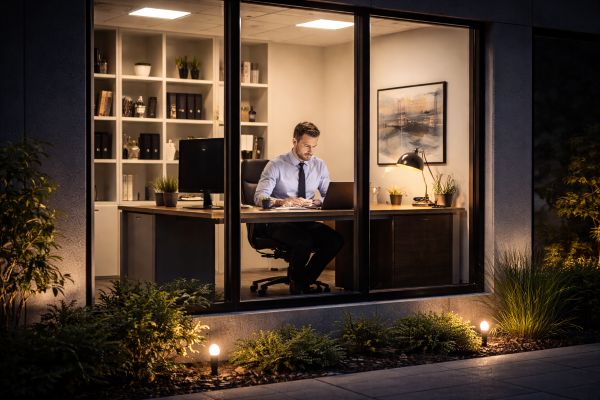
The nighttime privacy challenge is the complete reversal of the film’s daytime benefit. When evening comes and interior lights are switched on, the building’s windows, which offered privacy just hours before, can become perfectly transparent from the outside. The interior and its occupants are put on full display.
For your clients, the consequences are severe. In retail spaces, high-value merchandise and security systems are exposed after hours. In corporate offices, late-working employees and confidential information become visible to anyone outside, compromising both personal safety and corporate security. For high-end residential and hospitality projects, this sudden loss of privacy is a major failure of the building’s design and a source of intense dissatisfaction. This transformation from a privacy solution to a security liability is a direct result of specifying the wrong film for the project’s 24-hour requirements.
The High Cost of Getting It Wrong
Discovering this failure after project completion is the scenario every project manager dreads. The client’s complaint is not about a minor flaw, it’s about a fundamental failure to meet a core requirement. The fallout can be damaging and expensive.
Addressing the issue is not a simple fix. The incorrectly specified film must be professionally removed, a labor-intensive process that risks damaging the glass. Then, the correct film must be procured and installed, effectively doubling the cost of labor and materials for that portion of the project. This rework introduces delays, potentially impacting the final handover date and disrupting other work. Most importantly, it erodes client trust. A project that was considered complete is now the source of complaints and budget disputes, damaging your firm’s reputation.
The Science of Light: Why Standard Reflective Films Fail at Night
To prevent this costly project failure, it’s essential to move beyond misleading terminology and understand the science that governs film performance. The problem is not a product defect. It is a predictable outcome based on the physics of light, and understanding it is the first step toward specifying the correct solution.
Understanding the “One-Way Mirror” Effect and Light Differential
The “mirror” effect of a reflective window film is not a fixed property. It is created by a significant difference in the amount of light on one side of the glass compared to the other. This is known as the light differential.
The simple rule is that privacy is achieved on the brighter side of the glass. During the day, the sun makes the exterior significantly brighter than the building’s interior. The film reflects this bright exterior light, creating a mirror-like appearance for those outside and preventing them from seeing into the dimmer interior.
How Visible Light Transmission (VLT) Governs Daytime Privacy
The primary metric associated with this effect is Visible Light Transmission, or VLT. VLT measures the percentage of visible light that passes through the film. A film with a low VLT, such as 15% or 20%, blocks a significant amount of light. This contributes to the strong reflective appearance from the outside during the day.
From a project specification standpoint, a low VLT is often selected for its ability to provide excellent daytime privacy and reduce solar heat gain. However, VLT alone does not tell the whole story. Relying on it as the sole metric for privacy is what leads to the nighttime reversal problem.
The Inevitable Reversal at Night
At night, the light differential that created daytime privacy completely reverses. The outside becomes dark, while the inside is illuminated by artificial lighting. The interior is now the “brighter side.”
As a result, the reflective properties of the film also reverse. From the inside, occupants looking out will see a reflection of themselves and their room. From the outside, a person can now see directly into the illuminated space. The film is performing exactly as designed, but the change in lighting has turned it from a privacy tool into a viewing window.
Analyzing Key Metrics: Interior vs. Exterior Reflectivity
To specify a film correctly, you must look beyond VLT and analyze the manufacturer’s data sheet for other key performance indicators. The most critical for nighttime privacy are the values for Interior and Exterior Visible Light Reflectance (VLR).
A standard solar reflective film, designed primarily for heat control, will often have similar values for high exterior reflectivity (VLR-Ext) and high interior reflectivity (VLR-Int). While the high VLR-Ext is great for daytime privacy, the high VLR-Int is what creates the undesirable mirror effect inside at night. This technical detail is precisely why a consultation with a film specialist is essential to matching the film’s 24-hour performance to your client’s actual privacy goals.
The Technical Solution: Achieving Better Nighttime Views with Dual-Reflective Film
The failure of standard reflective films at night is a problem rooted in physics. The solution, therefore, must also be grounded in science. To overcome the challenge of light reversal, we must specify a film engineered with different properties on its interior and exterior surfaces. This is the core principle behind dual reflective window film technology.
How Dual-Reflective Film Works
Unlike a standard film that has the same high level of reflectivity on both sides, a dual-reflective film is designed with an intelligent, asymmetrical structure.
The exterior-facing surface has high reflectivity to provide excellent solar heat rejection and effective daytime privacy. The interior-facing surface, however, is engineered with much lower, more neutral reflectivity. This dual-action design directly counteracts the nighttime mirror effect. When interior lights are on after dark, the less-reflective inner layer allows building occupants to see out more clearly, dramatically reducing the stark reflection that plagues standard films.
Introducing the 3M™ Night Vision™ Series
A premier example of this technology is the 3M™ Night Vision™ Series. This product line was specifically engineered to address the trade-offs between daytime performance and nighttime visibility. Its patented construction allows for a lower interior reflectivity than traditional films, enabling clearer views out at night.
For a project manager, specifying a product from the Night Vision series means you are choosing a film that offers a comprehensive solution. It provides strong daytime privacy and industry-leading solar heat rejection, which lowers energy costs. Crucially, it also delivers a more enjoyable and functional nighttime experience for occupants by preserving the view.
Need More Info?
The Window Film Depot team is happy to help.
Balancing Privacy and Aesthetics for Storefronts and Offices
Selecting the right film is a process of balancing competing project priorities. The 3M Night Vision series offers different levels of tint, commonly identified by a number like Night Vision 15, 25, or 35 that corresponds to the VLT percentage.
A darker film like Night Vision 15 will offer the highest level of daytime privacy and heat rejection but will have a more noticeable tint. A lighter film like Night Vision 35 provides more natural light and a less reflective appearance but with a corresponding reduction in daytime privacy. The critical task is to work with a consultant to align the film’s performance level with the client’s specific goals for their storefronts or ground-floor offices.
Performance Specs That Matter for Nighttime Commercial Window Privacy
When reviewing product data sheets, focusing on the right metrics is essential. For nighttime applications, move beyond simple VLT numbers and analyze the following:
- Interior Visible Light Reflection: This is the most critical specification for this application. A lower percentage indicates the film will create less of a mirror effect on the inside at night. For example, 3M Night Vision films feature interior reflectivity as low as 13%, whereas traditional films can be 30% or higher.
- Exterior Visible Light Reflection: This metric quantifies how much of a “mirror” the window will appear to be from the outside during the day. A higher number provides strong daytime privacy.
- Visible Light Transmitted (VLT): VLT measures the darkness of the tint. A lower VLT number means a darker film, which contributes to greater privacy and glare reduction. This must be balanced with the client’s desire for natural light.
Alternative Strategies: Frosted and Opaque Films
In some project scenarios, the goal is not to preserve a view but to eliminate it entirely for guaranteed privacy. In these cases, reflective films are the wrong tool. The correct specification involves films designed to obscure the view through diffusion or opacity, providing a consistent solution 24 hours a day.
When to Specify 24/7 Obscurity
Frosted window film for privacy and opaque films are the ideal solution when the primary project requirement is total visual severance. They are perfect for interior glass walls in conference rooms, private offices, and data centers. On exterior windows, they are used as bathroom window film, for storage areas, or in any space where blocking the view is more important than maintaining it.
These films work by scattering light rather than reflecting it. This diffusion of light renders the glass translucent or opaque, preventing clear visibility from either side, regardless of the lighting conditions.
3M™ Fasara™ Glass Finishes for Total Privacy
For projects that require both total privacy and a high-end aesthetic, the 3M™ Fasara™ Glass Finishes series is the industry standard. These are sophisticated decorative films designed to mimic the appearance of etched or sandblasted glass at a fraction of the cost. With hundreds of patterns available, from simple matte frosts to complex designs, Fasara films allow you to specify the exact level of privacy and style required, transforming a functional need into a powerful design element.
The Trade-Off: Sacrificing the View for Guaranteed Privacy
As a project manager, it is critical to communicate the core trade-off of these films. The absolute commercial window privacy they provide comes at the direct cost of the view through the glass. This is not a product limitation but its intended function. Framing this as a deliberate strategic choice, choosing guaranteed privacy over visibility, is essential for managing client expectations. The performance of a frosted or opaque film is constant, offering a simple and predictable outcome.
Combining Solutions: Integrating Decorative and Performance Films
You do not have to choose between a performance film and a decorative one. In many cases, the optimal solution involves integrating both. For example, a common specification for commercial buildings is to apply a solar control film like 3M Night Vision to the entire window for energy savings. A band of 3M Fasara frosted film can then be applied across the vision line to provide targeted privacy for seated employees without completely blocking the view. This layered approach allows for a highly customized solution.
Partnering with an Expert to Avoid Costly Rework
Specifying the correct nighttime privacy window film is not a simple procurement task. It is a technical decision where an incorrect choice can lead directly to project failure. The most effective risk mitigation strategy is to engage a true technical consultant.
The Difference Between a Vendor and a Technical Consultant
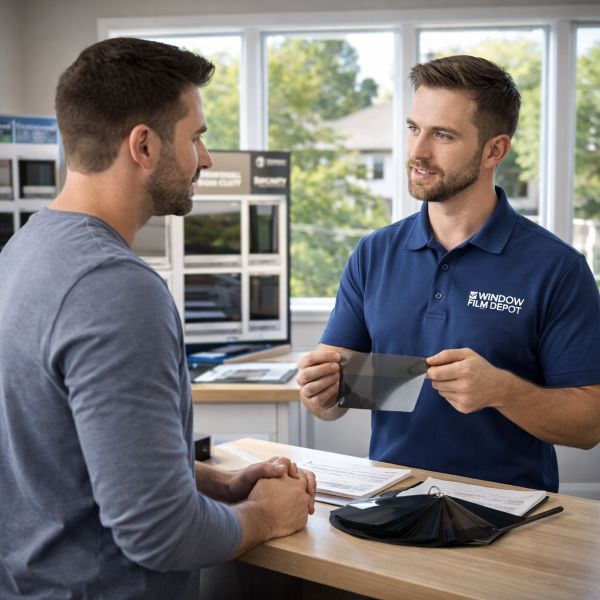
A film vendor is transactional. Their primary function is to supply a product you have already specified. If you request a “one-way mirror film” for 24-hour privacy, a vendor will likely provide a standard solar reflective film, fulfilling the order without questioning its viability at night. The responsibility for the specification error rests entirely on you.
A technical consultant, by contrast, is collaborative. Their primary function is to solve a problem. A consultant will respond to a request with clarifying questions about lighting conditions and the client’s specific privacy concerns.
They leverage deep product knowledge and an understanding of light science to diagnose the potential for failure and guide you to the right solution.
Why Expertise in the Full 3M™ Portfolio Matters
A consultant’s effectiveness is tied to the breadth of solutions they can offer. Comprehensive expertise in the full 3M Window Film portfolio is a decisive advantage. The optimal solution depends on a careful balance of aesthetics, performance, and budget. Access to the entire 3M catalog allows a consultant to specify with precision.
An expert doesn’t push a single product. They use their knowledge of the entire portfolio, including the 3M Night Vision Series, 3M Fasara Glass Finishes, and other specialized films, to select the exact product that aligns with your project’s objectives, preventing the compromises that lead to post-installation complaints.
Leveraging the #1 U.S. 3M™ Installer to De-Risk Your Specification
Choosing the right film is only half the battle. Partnering with the #1 U.S. Authorized Dealer for 3M Window Film transforms this potential liability into a strategic asset. This status represents a proven track record across thousands of projects, from single-site retail locations to multi-state corporate rollouts.
For a project manager, this translates directly to risk reduction. You gain a partner with:
- Standardized Processes: Consistent project management, installation quality, and communication across all sites.
- Deep Institutional Knowledge: Decades of collective experience in solving complex challenges like nighttime privacy.
- Direct Manufacturer Support: A premier relationship with 3M that ensures access to the latest technical data and warranty support.
Leveraging this expertise means you are not just buying film. You are integrating a specialized team dedicated to ensuring your specification is right the first time.
The Consultation Process: From Needs Analysis to Flawless Installation
A structured consultation process is the mechanism that ensures a successful outcome. It is a systematic approach designed to eliminate assumptions and base decisions on data.
- Needs Analysis and Goal Definition: The process begins with a detailed discussion to understand the core problem. We move beyond “we need privacy” to define the specifics for hours of operation, aesthetic goals, and security concerns.
- Technical Site Assessment: A specialist evaluates the project environment. This includes measuring light levels, analyzing existing glazing, and identifying any site-specific challenges.
- Solution Proposal and Specification: Based on the data, we present a set of viable options. Each option includes a clear explanation of how it will perform, its aesthetic impact, and a transparent cost breakdown.
- Professional Installation and Project Management: Our dedicated project management team coordinates the installation, ensuring the film is applied to 3M’s exacting standards.
- Post-Installation Review: We conclude with a final walkthrough to ensure the solution meets every client expectation.
Conclusion: From Technical Specification to Client Satisfaction
Recapping the Science: Light Differential Is Key
The performance of any reflective window film hinges on a single principle: the law of light differential. The “mirror” effect is a direct result of the exterior being significantly brighter than the interior. When night falls and interior lights turn on, this differential reverses. The privacy effect flips with it. Understanding this is the first step in avoiding a common and costly project failure.
Key Takeaways for Your Next Commercial Window Project
To translate this technical understanding into successful project outcomes, focus on performance specifications over simple aesthetics.
- Define Privacy Holistically: The first question should not be “What look do we want?” but rather “When and where do we need privacy?”. Documenting requirements for both daytime and nighttime is critical.
- Acknowledge Technology Limits: Standard solar reflective films are excellent for daytime privacy and heat control. They are not a viable solution for nighttime privacy.
- Match the Film to the 24-Hour Need: For consistent privacy, your project will require a different class of film. This typically involves dual-reflective films that improve the view out at night or decorative films like frosted options that obscure the view completely.
- Analyze Performance Trade-offs: Each solution comes with its own set of considerations. A dual reflective window film preserves the view out but does not provide 100% privacy at night. A frosted film guarantees privacy but eliminates the view. These trade-offs must be aligned with client goals.

Making the Right Choice: A Critical Technical Decision
Ultimately, selecting a nighttime privacy window film is not an aesthetic choice but a technical specification. The difference between a satisfied client and a request for a budget-breaking replacement lies in choosing a product based on its scientific properties, not just its daytime appearance.
A film that fails to provide the expected nighttime privacy can compromise security and erode client trust. Engaging with a window film specialist early in the design process is a foundational step in project risk management. This ensures the film specified is engineered to perform correctly under all lighting conditions, delivering the intended functionality and securing client satisfaction long after project completion.
Window Film Depot has been providing window film solutions for years and has experience with the professional installation of nighttime privacy window film.
Frequently Asked Questions
What is the best window film for 24/7 privacy?
For guaranteed, 24/7 privacy, the best solutions are non-reflective films. A frosted window film for privacy, such as those from the 3M Fasara Glass Finishes line, will obscure the view completely from both sides, day or night. These films work by scattering light rather than reflecting it, so their performance is not dependent on lighting conditions. The trade-off is that you will lose the ability to see through the glass.
Can I still have a view out at night with a privacy film?
Yes, but with important qualifications. A dual reflective window film, like the 3M Night Vision Series, is specifically engineered for this purpose. It has a low-reflectivity interior surface that significantly reduces the “mirror effect” inside at night, allowing for a much clearer view out compared to standard reflective films. However, it will not make your interior completely private at night. People outside will still be able to see into the lit space, though the view is less clear than with plain glass.
Will dual-reflective film make my office completely private at night?
No, it will not. The primary benefit of dual-reflective film is preserving the view out for occupants at night. While the exterior surface is still reflective, the bright interior lights will allow outsiders to see in. It offers a balance between daytime privacy, solar control, and an improved nighttime view out, but it is not a total nighttime privacy solution. For total privacy, an opaque or frosted film is required..
Is it possible to combine a solar control film with a privacy film?
Absolutely. This is a common and effective strategy. For example, you can apply a solar control film like the 3M Night Vision Series to an entire window to manage heat and provide daytime privacy. Then, a band of 3M Fasara frosted film can be added at eye level to provide targeted, 24/7 privacy where it’s needed most, without completely blocking the view or natural light.
Why is Visible Light Transmission (VLT) not the only metric for nighttime privacy?
VLT only tells you how dark a film’s tint is. While a very low VLT contributes to strong daytime privacy, it doesn’t account for what happens when the light source moves inside at night. The most critical metric for the nighttime experience is Interior Visible Light Reflection. A film with low interior reflection will create less of a mirror for occupants looking out, which is key to avoiding the “fishbowl effect” and preserving the view.