Table of Contents:
- Understanding the Physics: The Light Differential Rule in Window Film
- Professional-Grade Solution 1: Harnessing Dual-Reflective Window Films for Balanced Privacy
- Professional-Grade Solution 2: Achieving Consistent Obscurity with Frosted and Decorative Films
- One Way Window Film Day and Night Expert Consultation
- One Way Window Film Day and Night Privacy Flawless Implementation and Expertise
- Conclusion: Elevating Commercial Privacy Solutions and Project Success
- Frequently Asked Questions
- Related Posts from Window Film Depot
Project managers frequently encounter client requests for “one-way” privacy film, assuming it provides continuous concealment. While standard reflective films offer significant daytime advantages, a fundamental physical principle dictates their limitations once the sun sets. Understanding this distinction is crucial for setting accurate client expectations and specifying appropriate solutions.
The Core Misconception: Reflectivity and Perceived One-Way Vision
The term “one-way” vision in standard reflective window film often leads to a critical, common misunderstanding. These films do not possess an inherent, fixed directional privacy mechanism like a magical one-way valve. Instead, they operate on the principle of light differential between the interior and exterior environments. They reflect a high percentage of light on the brighter side while allowing transmission from the darker side. This creates a perception of one-way vision where observers on the brighter side see only a reflection.
Illustrating the Daytime Effect: How Standard Film Creates Privacy from the Exterior
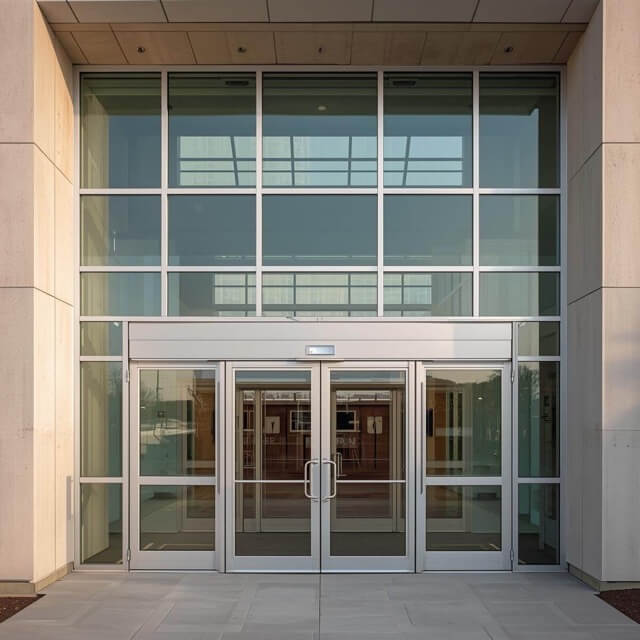
During daylight hours, the exterior environment is overwhelmingly brighter than a typical building interior. When a standard reflective film is applied, the film’s metallic layers efficiently reflect the intense exterior sunlight, sky, and surrounding environment. From an outside perspective, the window appears as a mirror, making it extremely difficult to see into the building. Simultaneously, because the interior is significantly darker, the light transmitted from the inside out is sufficient for occupants to maintain a clear view of the exterior. This is the scenario where reflective film performs exactly as expected for privacy.
The Critical Flaw: What Happens When the Lights Come On Inside After Dark
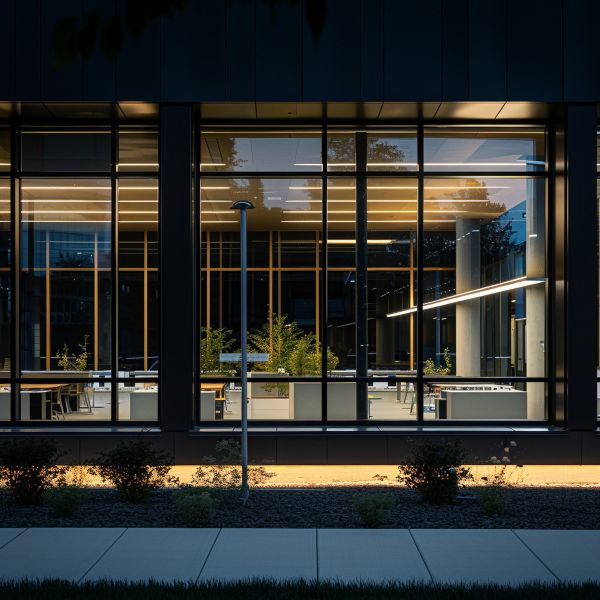
Here lies the inherent limitation that impacts countless commercial projects seeking nighttime or blackout window film for commercial buildings. As evening approaches and interior lights are switched on, the light differential reverses. The interior space becomes the brighter side, while the exterior descends into darkness. Under these conditions, the reflective film begins to mirror the interior light. Suddenly, anyone outside can see clearly into the illuminated commercial space, while occupants inside see only their own reflection, significantly diminishing their outward view. The very mechanism that provided daytime privacy now works against it, exposing the interior to external view.
The Role of Interior vs. Exterior Light Levels
Standard reflective film efficacy depends entirely on the ratio of light intensity between both sides of the glass. For true privacy, the exterior must be considerably brighter than the interior to create the mirror effect. When interior illumination surpasses exterior light after dark, the privacy effect dissipates completely for the building. This is a fundamental physical characteristic of light interaction rather than a defect in the film product. These properties make standard reflective films unsuitable for 24/7 one-way privacy requirements in occupied commercial spaces.
Understanding the Physics: The Light Differential Rule in Window Film
Achieving consistent privacy through privacy window film, especially across a 24-hour cycle, often runs into a fundamental wall: the laws of physics. As project managers, understanding this principle is crucial for setting realistic client expectations and specifying appropriate solutions.
Defining the Light Differential Principle and Its Impact on Visibility
The “light differential principle” is the core concept explaining why a standard reflective window film provides a one-way mirror effect only under specific lighting conditions. Simply put, a reflective film works by reflecting light towards its source. For privacy to be established, there must be significantly more light on one side of the glass than the other. The side with more light becomes the “mirror,” reflecting images, while the darker side becomes the “viewing pane,” allowing visibility through. This principle dictates which side appears reflective and which appears transparent at any given moment.
How Visible Light Transmission (VLT) and Reflectivity Interact in Different Lighting Conditions
Window films are characterized by their Visible Light Transmission (VLT) and their reflectivity. VLT measures the percentage of visible light that passes through the film, while reflectivity indicates the percentage of visible light reflected away. During daylight hours, the sun’s intensity creates a high exterior light differential. A film with a lower VLT and higher exterior reflectivity will reflect the bright outdoor light, making the exterior appear like a mirror and obscuring views in. Conversely, the interior, being less illuminated, allows occupants to see out clearly through the film’s VLT.
The Inverse Relationship: Explaining Interior and Exterior Light Balance
This dynamic shifts dramatically when evening falls. As the sun sets, the exterior darkens, and interior lights are typically turned on. The light differential reverses. Now, the interior becomes the brighter side, causing the film to reflect the indoor light into the room. From the exterior, the film no longer appears reflective. Instead, the brighter interior lights illuminate the space, effectively turning the window into a transparent pane that allows outsiders to see in. The film’s reflective properties now work against privacy, creating an “inverse relationship” where the very mechanism that provided daytime privacy contributes to nighttime exposure.
Practical Implications for Achieving Consistent Commercial Privacy
For commercial projects, this physical reality has significant implications. If a client specifies one-way privacy window film for a conference room or an office from a standard reflective film, they likely envision this protection lasting around the clock. However, without additional measures or different film technology, a standard reflective film will consistently fail to provide privacy once interior lights are on at night. This can lead to client dissatisfaction, costly callbacks, and project rework, directly impacting the project manager’s ability to meet client demands for security and aesthetics.
Dispelling the Illusion of Constant One-Way Privacy
It is a common misconception that a single transparent film can offer constant, 24/7 one-way privacy. While marketing materials might sometimes imply this, the underlying physics of light transmission and reflection unequivocally demonstrate that such a film is a physical impossibility. True privacy, especially at night when interior spaces are illuminated, requires a more sophisticated approach than relying solely on the light differential of a standard reflective film.
Professional-Grade Solution 1: Harnessing Dual-Reflective Window Films for Balanced Privacy
Understanding the limitations of standard reflective films sets the stage for introducing professional-grade solutions. Dual-reflective window films represent a significant leap forward in addressing the challenge of maintaining some degree of nighttime privacy while optimizing daytime performance.
Introducing Dual-Reflective Technology: An Overview of Its Advanced Design
Dual-reflective window films are engineered with a sophisticated, multi-layered construction that provides different levels of reflectivity on each side of the film. Unlike traditional reflective films that have a uniform reflective coating, dual-reflective films are designed to manage both exterior glare and interior reflection more effectively. This advanced design aims to offer a balanced approach to privacy and view clarity across various lighting conditions.
The Mechanics of Dual-Reflective Films: Managing Interior and Exterior Reflection Simultaneously
The core innovation of dual-reflective films lies in their ability to maintain a higher exterior reflectivity while significantly reducing interior reflectivity. The outside surface of the film incorporates a more reflective layer to provide strong daytime privacy and solar control by reflecting sunlight away. Simultaneously, the inside surface is designed with a much lower interior reflectivity. This strategic layering minimizes the “mirror effect” that occupants experience inside a building, especially at night when interior lights are on. The result is a film that offers robust daytime privacy and heat rejection, coupled with a clearer, less reflective view from the interior during the evening hours.
Need More Info?
The Window Film Depot team is happy to help.
Case in Point: The 3M Night Vision Series Explained for Enhanced Privacy and Clarity
A prime example of effective dual-reflective technology is the 3M Night Vision Series. These films are specifically engineered to address the inverse relationship of the light differential principle. During the day, they provide excellent solar heat rejection and glare reduction, creating a comfortable indoor environment and maintaining strong privacy from the outside. Critically, as evening approaches and interior lights are activated, the low interior reflectivity of the Night Vision series films allows for significantly better outward visibility compared to traditional reflective films. While some reflection of interior lights will always be present, the design substantially reduces this effect, offering a more open and natural view out.
Advantages for Commercial Applications: Integrating Security, Aesthetics, and Energy Efficiency
For commercial projects, specifying dual-reflective films like the 3M Night Vision series offers several compelling advantages:
- Enhanced Nighttime View: Occupants benefit from a clearer, less obstructed view out at night, improving comfort and aesthetic appeal.
- Daytime Privacy & Solar Control: They continue to provide effective one-way privacy during the day and significantly reduce solar heat gain, contributing to energy efficiency.
- Glare Reduction: The films effectively cut down on harsh glare, improving visual comfort for employees and reducing eye strain.
- UV Protection: Most dual-reflective films block a high percentage of harmful UV rays, protecting interior furnishings and occupants.
- Maintained Aesthetics: From the exterior, these films present a consistent, attractive appearance during the day, contributing positively to a building’s facade.
These combined benefits directly address Project Manager Paul’s needs for balancing security, aesthetics, and energy efficiency, offering a robust solution that manages client expectations more effectively.
Key Considerations and Specific Limitations of Dual-Reflective Films for Project Specifications
While dual-reflective films are a significant improvement, project managers must understand their specific limitations. They provide a balanced approach to privacy, not an absolute one-way mirror effect at night. If interior lights are very bright and external conditions are completely dark, some visibility into the interior from the outside will still occur. The goal is to reduce the severity of the internal reflection and enhance the outward view. Therefore, careful consideration of the specific lighting conditions, the film’s VLT, and the desired level of privacy is essential when specifying these films. They offer a practical and professional compromise, but a physical law cannot be entirely circumvented by any transparent film.
Professional-Grade Solution 2: Achieving Consistent Obscurity with Frosted and Decorative Films
While dual-reflective films offer a robust solution for managing light differential in specific scenarios, they still operate on the principle of light balance. When a project demands unwavering, consistent privacy regardless of external light conditions, the solution often lies in films that provide full obscurity or significant light diffusion. This brings us to frosted and decorative films, which fundamentally alter the visual transparency of the glass itself.
When Full Obscurity is the Goal: Understanding the Properties and Benefits of Frosted Films
Frosted films are designed to diffuse light rather than reflect it, creating a translucent, etched-glass appearance. This diffusion effectively blocks direct sightlines from both sides of the glass, delivering consistent privacy 24 hours a day, irrespective of whether it’s day or night, or which side is more brightly lit. Unlike reflective films, their performance is not dependent on a light differential, making them ideal for areas where constant visual separation is paramount.
Their primary benefit is providing bidirectional privacy without eliminating natural light. While vision through the glass is obscured, soft, diffused light can still pass through, maintaining a sense of openness within interior spaces. This makes them a practical and aesthetically pleasing alternative to physical barriers or permanently etched glass, often at a fraction of the cost and with easier installation and removal.
Enhancing Both Aesthetics and Consistent Privacy with Decorative Films
Building on the functional foundation of frosted films, decorative films introduce an aesthetic dimension. These films come in an expansive range of patterns, textures, and colors, and can even be custom-printed with branding elements or unique designs. They retain the core privacy-enhancing properties of frosted films—offering consistent, 24/7 obscurity by diffusing vision—but add significant design versatility.
Project managers can leverage decorative films to achieve not only privacy but also to enhance interior design, create branded environments, or simply add visual interest to otherwise plain glass surfaces. They provide a cost-effective way to transform spaces, offering the look and feel of specialized glass treatments without the permanence or expense of custom glass fabrication.
Versatile Applications in Commercial Settings: From Conference Rooms to Retail Spaces
The consistent obscurity provided by frosted and decorative films makes them exceptionally versatile across a multitude of commercial applications. They are indispensable for:
- Conference Rooms and Offices: Ensuring confidentiality for meetings and protecting sensitive information displayed on screens, while still allowing ambient light.
- Medical and Dental Facilities: Safeguarding patient privacy in examination rooms, waiting areas, and administrative offices.
- Retail Environments: Obscuring back-of-house areas, changing rooms, or creating dynamic visual displays that control visibility into a space.
- Interior Partitions and Glass Walls: Defining spaces within open-plan offices, enhancing acoustic privacy (when combined with other materials), and adding design elements.
- Restrooms and Locker Rooms: Providing essential visual privacy for occupants.
Advantages and Practical Trade-offs for Meeting Diverse Client Needs
When considering frosted and decorative films, it’s crucial to understand their specific advantages and inherent trade-offs:
Advantages:
- Consistent 24/7 Privacy: Reliably obscures vision from both sides at all times, independent of light conditions.
- Aesthetic Versatility: Offers a vast array of design options, from subtle frosting to intricate patterns and custom graphics.
- Cost-Effective: Significantly more affordable than etched or sandblasted glass, with easier installation and less disruption.
- Light Diffusion: Allows natural light to enter while eliminating harsh glare and hot spots.
- UV Protection: Most films block a high percentage of harmful UV rays, protecting interiors and occupants.
Practical Trade-offs:
- No Outward View: By design, these films eliminate the ability to see clearly through the glass, which may not be suitable where exterior views are desired.
- Reduced Natural Light: While they diffuse light, they inevitably reduce the total amount of visible light entering a space, requiring careful consideration of lighting design.
- Permitted Use: Requires client acceptance of complete visual obstruction for the specified area.
Strategies for Combining Different Film Solutions for Layered Privacy Strategies
Often, a single film solution cannot address all the complex requirements of a project. This is where a layered or combined film strategy becomes invaluable. Frosted or decorative films can be integrated with other film types to achieve a multifaceted outcome. For example, a lower portion of a window could utilize a frosted film for privacy, while the upper section employs a clear solar control film to manage heat gain without sacrificing the view.
Alternatively, a decorative film might be applied to interior glass partitions for design and privacy, while exterior windows are treated with a low-reflectivity solar film for energy efficiency. Understanding how to strategically combine these technologies—frosted for consistent visual obstruction, reflective for managing light differential, and solar for energy performance—allows project managers to craft truly bespoke solutions that meet precise client specifications and avoid common pitfalls.
One Way Window Film Day and Night Expert Consultation
As a project manager, your role extends beyond mere installation oversight; it encompasses expert consultation, translating client aspirations into technical specifications. This proactive guidance is critical to preventing project rework, managing expectations, and ultimately delivering a high-quality, durable solution that aligns with the client’s long-term operational needs.
Assessing Client Privacy Needs: Day, Night, Functionality, and Aesthetic Preferences
The foundational step to any successful window film privacy project is a thorough assessment of the client’s actual needs. This goes beyond a simple request for “privacy film.” Engage in a detailed dialogue to uncover:
- Day vs. Night: Is privacy needed primarily during the day, at night, or consistently 24/7? This is the most crucial differentiator in selecting film technology.
- Functionality: Is outward visibility required from one or both sides? Is the goal to obscure a messy storage area, protect intellectual property, or provide personal discretion?
- Light Transmission: How much natural light is acceptable or desired? Is glare reduction a priority?
- Aesthetic Preferences: Does the film need to be invisible, decorative, branded, or simply functional? Consider the interior design scheme and brand identity.
These questions form the bedrock upon which appropriate film recommendations are built, ensuring alignment between client expectations and technological capabilities.
Educating Stakeholders: Managing Expectations About 24 Hour Privacy Window Film Capabilities
This is perhaps the most critical conversation you will have with your clients. The common misconception that a single transparent film can provide true 24/7 one-way privacy needs to be directly addressed. Explain, in clear terms, the physics of light and why “mirror films” or standard reflective films lose their one-way effect when interior lighting exceeds exterior lighting.
Position yourself as the knowledgeable guide, illustrating that while ideal, constant one-way transparency isn’t physically possible with a single film. Instead, present the professional-grade solutions—dual-reflective films (with their specific light-dependent behavior) or frosted/decorative films (for consistent obscurity)—as viable, effective alternatives tailored to their specific “day” or “night” or “all-the-time” privacy requirements. This transparency builds trust and prevents future dissatisfaction.
Key Technical Specifications for Project Managers: Interpreting VLT, Reflectivity, and Performance Data
For each film solution, project managers must understand and interpret specific technical data. These metrics are not just numbers; they are the quantifiable performance indicators that validate a film’s suitability for a given application.
- Visible Light Transmission (VLT): Indicates the percentage of visible light passing through the film. Lower VLT means less light (and often more privacy for frosted films).
- Visible Light Reflectivity (VLR): Measured for both interior and exterior, this indicates how much visible light is reflected by the film. Critical for reflective films to understand the “mirror effect.”
- Solar Heat Gain Coefficient (SHGC): Measures how much solar heat is blocked. Lower SHGC means better heat rejection, crucial for energy savings.
- UV Rejection: Percentage of ultraviolet light blocked, protecting interiors from fading and occupants from harmful rays.
Understanding these specifications allows you to confidently select and specify films that meet not only privacy needs but also energy efficiency, glare reduction, and UV protection goals, providing a holistic solution.
Avoiding Costly Errors: The Importance of Accurate Specification Documents and Planning
Inaccurate film specification is a frequent cause of costly project errors, leading to change orders, rework, and client dissatisfaction. Meticulous planning and detailed specification documents are non-negotiable.
Ensure your specifications clearly state:
- Exact Film Type and Manufacturer: Avoid generic terms; specify the precise product.
- Performance Data: List the VLT, SHGC, UV rejection, and reflectivity values.
- Application Location: Clearly define which windows or glass panels receive which film.
- Installation Protocols: Any specific requirements for installation or post-installation care.
These detailed documents serve as a critical reference for installers, procurement, and the client, minimizing ambiguity and safeguarding project integrity.
Integrating Privacy Solutions with Broader Project Goals: Security, Energy Savings, and Design
Privacy film often needs to serve multiple purposes within a larger project context. A truly effective solution considers how the privacy film contributes to, or integrates with, other overarching project goals. For instance, a security film can also be frosted for privacy, providing both protection and visual obscurity. Similarly, a decorative film might also offer solar control properties, enhancing aesthetics while contributing to energy savings.
By taking a holistic view, you can identify opportunities to select multi-functional films or strategically combine different film types to achieve layered benefits. This integrated approach not only optimizes project outcomes but also demonstrates your expertise in delivering comprehensive, value-driven solutions.
One Way Window Film Day and Night Privacy Flawless Implementation and Expertise
Selecting the correct window film technology is only half the equation for a successful project. Even the most advanced film, perfectly matched to the client’s privacy goals, will underperform if not installed with precision and consistency. For project managers overseeing commercial sites, particularly those with multiple locations, partnering with an experienced, nationally-aligned installer is not just a preference, but a critical component of risk mitigation and quality assurance. This partnership extends the technical specification from paper to a flawless real-world application.
The Value of a National Network of Certified, Experienced Installers
A national network of certified installers offers a distinct advantage over fragmented local contractors. It ensures that every team member, regardless of their specific region, adheres to a standardized protocol for installation, safety, and project management. This level of coordination guarantees that the advanced film solution, whether it’s a dual-reflective privacy film or a custom decorative option, is applied uniformly, maintaining both the aesthetic and functional integrity across all sites. Such a network significantly streamlines logistical challenges for multi-site deployments, providing a single point of contact and accountability.
Ensuring Quality Control and Consistent Application Across Multiple Commercial Sites (Unmatched National Reach and Project Experience)
When managing projects that span multiple commercial sites, consistency is paramount. A national partner, with extensive reach and deep project experience, brings a unified approach to quality control. This means standardized training, shared best practices, and a consistent methodology are applied from coast to coast. This unmatched national experience ensures that every film installation, from the initial site survey to the final inspection, meets the same rigorous standards, preventing variations in performance or appearance that could lead to client dissatisfaction or costly rework down the line.
Why Expertise Matters: Avoiding Rework, Minimizing Disruptions, and Ensuring Longevity
The intricacies of modern window film require a high degree of specialized expertise for proper installation. Incorrect preparation, improper film handling, or inadequate application techniques can lead to bubbling, peeling, or compromised optical clarity, diminishing the film’s intended performance and aesthetic. Entrusting the installation to experienced professionals minimizes these risks. Their deep understanding of substrate compatibility, adhesion science, and environmental factors specific to commercial settings significantly reduces the likelihood of rework, thereby preventing schedule delays and budget overruns. Moreover, expert installation is crucial for maximizing the film’s lifespan and ensuring the client receives the full value of their investment over many years.
The Advantage of Working with a 3M Authorized Dealer and Installer (Exclusive Status as the #1 U.S. 3M Window Film Installer)
Collaborating with a 3M Authorized Dealer and Installer, particularly one with exclusive status as the number one U.S. installer, offers unparalleled benefits. This authorization signifies a direct partnership with 3M, guaranteeing access to the latest product innovations, proprietary application techniques, and comprehensive factory training. Such an installer is fully versed in 3M’s rigorous performance standards and installation guidelines, ensuring that every project is executed to the highest specifications. This exclusive status reflects a proven track record of successful, high-volume installations and a deep commitment to excellence, providing project managers with a trusted, reliable partner for even the most complex privacy and security film projects.
Understanding Long-Term Benefits: Warranties, Maintenance, and Ongoing Support
The partnership extends well beyond the initial installation. A reputable window film provider stands behind its work with robust product and labor warranties, offering peace of mind for the long term. This includes clear guidance on proper film maintenance and cleaning to preserve its appearance and performance characteristics. Furthermore, ongoing support ensures that any questions or concerns that arise years after installation can be addressed promptly and effectively. This comprehensive approach to long-term care protects the client’s investment and reinforces the project manager’s decision to specify a premium solution and partner with an expert installer.
Conclusion: Elevating Commercial Privacy Solutions and Project Success
Recapping the Essentials: From Common Misconception to Mastered Specification
Our exploration has underscored a critical shift in understanding commercial window privacy: moving beyond the common misconception that standard reflective films offer 24/7 one-way privacy. We have established that true day-and-night privacy requires a nuanced approach, often involving specialized solutions such as dual-reflective films, frosted films, or strategically applied decorative options. This deeper understanding transforms a frequent project specification error into an opportunity for mastered specification, where the chosen film precisely matches the client’s real-world needs and expectations.
Empowering Project Managers for Informed Decision-Making and Client Confidence
Armed with this expert knowledge, project managers are empowered to engage with clients more confidently and effectively. You can now articulate the physical limitations of light and reflection, explain the differences between various film technologies, and present viable, professional-grade alternatives. This capability allows you to manage client expectations proactively, steer specifications towards appropriate solutions, and ultimately build greater trust and confidence, preventing callbacks and ensuring a successful outcome from the outset.
The Future of Commercial Window Film Technology and Innovation
The landscape of commercial window film technology is continuously evolving, driven by advancements in materials science and manufacturing. Innovations are leading to films with enhanced optical properties, improved energy efficiency, and more sophisticated security features. Staying abreast of these developments will be key to offering cutting-edge solutions that address emerging client needs. Engaging with partners who are at the forefront of these innovations ensures access to the best and newest products as they become available.
Proactive Planning: The Key to Client Satisfaction and Rework Prevention
Ultimately, the success of any commercial window film project hinges on proactive planning and informed decision-making at every stage. By integrating a deep understanding of film technology with the strategic advantage of a national, expert installation partner, project managers can mitigate risks, control costs, and deliver projects that consistently meet or exceed client expectations. This approach not only prevents costly rework but also fosters lasting client satisfaction, solidifying your reputation as a trusted and knowledgeable project leader.
Frequently Asked Questions
Why does my “one-way” privacy film stop working at night?
One-way privacy is not a fixed feature of the film; it is a result of light differential. Standard reflective films mirror the side with the most light. During the day, the sun makes the exterior brighter, creating a mirror effect for outsiders. At night, once interior lights are switched on, the inside becomes brighter than the outside. This reverses the effect, allowing people outside to see in while occupants inside see their own reflection.
Can I achieve 24/7 privacy while still being able to see out?
Technically, no single transparent film can provide total one-way privacy 24/7 due to the laws of physics. However, Dual-Reflective films (like the 3M Night Vision Series) are the best compromise. They maintain high exterior reflectivity for daytime privacy but feature significantly lower interior reflectivity, which reduces the “mirror look” at night and allows for a much clearer view out than standard films.
What is the difference between “Reflective” and “Frosted” films for privacy?
Reflective films rely on light balance. They provide privacy only when it is brighter outside than inside. They allow you to maintain a clear view of the outdoors.
Frosted films work by light diffusion. They provide consistent, bidirectional privacy 24/7 regardless of lighting conditions. However, you cannot see through them, though they still allow soft, natural light to enter the room.
How do I choose the right Visible Light Transmission (VLT) for a project?
VLT is the percentage of light that passes through the film.
Lower VLT (5%–15%): Provides maximum privacy and heat rejection but makes the interior noticeably darker.
Higher VLT (25%–35%): Maintains a brighter, more natural interior feel but offers less “one-way” mirror effect, especially on cloudy days or under heavy interior lighting.
As a project manager, you must balance the client’s desire for privacy against their need for natural interior light.
Are there films that provide both privacy and security?
Yes. Many privacy solutions can be “layered” or come as integrated products. You can specify Safety & Security film that has a frosted or reflective finish. This provides a multi-functional solution: it obscures the view to protect intellectual property or sensitive areas while simultaneously strengthening the glass against forced entry, spontaneous breakage, or extreme weather.