Table of Contents:
- Beyond Darkness: Specifying Light Blocking Window Film for Commercial Projects
- Solving Client Demands for Absolute Light Control
- Enhancing Visual Security and Protecting Sensitive Areas
- Mitigating Glare and UV Damage in Specialized Environments
- Achieving Specific Aesthetic Goals with Opaque Finishes
- Decoding the Spec Sheet: Key Metrics for Light Control Films
- From Spec Sheet to Site: Solving Real-World Project Challenges
- Partnering for Success: A Blueprint for National Film Installations
- Conclusion: The Strategic Value of Professional Light Control
- Frequently Asked Questions
- Related Posts from Window Film Depot
Beyond Darkness: Specifying Light Blocking Window Film for Commercial Projects
For project managers, the term “light blocking” often suggests a simple blackout shade. In professional applications, however, specifying a light blocking window film is a strategic decision driven by precise client needs that go far beyond creating a dark room.
These films are engineered solutions designed to solve specific operational, security, and aesthetic challenges that consumer-grade products cannot address.
Understanding when to deploy these specialized films is key to meeting and exceeding client expectations.
The decision hinges on moving past a general desire for darkness and identifying the exact performance outcome required for the space.
Solving Client Demands for Absolute Light Control
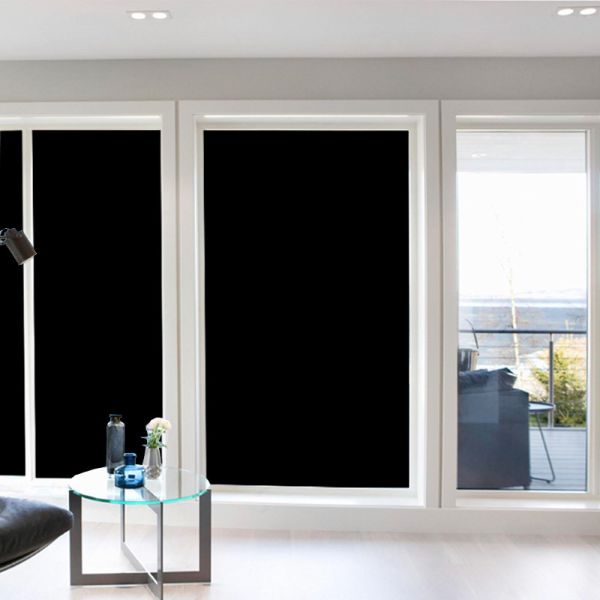
Certain environments demand not just low light, but its complete absence. Any light leakage, however minimal, can compromise the function of the space. In these scenarios, professional opaque films provide a seamless, gap-free solution that traditional window treatments like blinds or curtains can never guarantee.
Consider these applications:
- Photography Darkrooms and A/V Studios: Even a sliver of ambient light can ruin sensitive materials or interfere with precise video calibration.
- University and Corporate Research Labs: Experiments involving light-sensitive compounds or optical equipment require a fully controlled environment.
- Sleep Study Centers and Sensory Rooms: In healthcare or wellness settings, creating a total blackout environment is critical for patient outcomes and data integrity.
In these cases, specifying a film with zero percent visible light transmission is the only way to ensure the project meets its stringent functional requirements from day one.
Enhancing Visual Security and Protecting Sensitive Areas
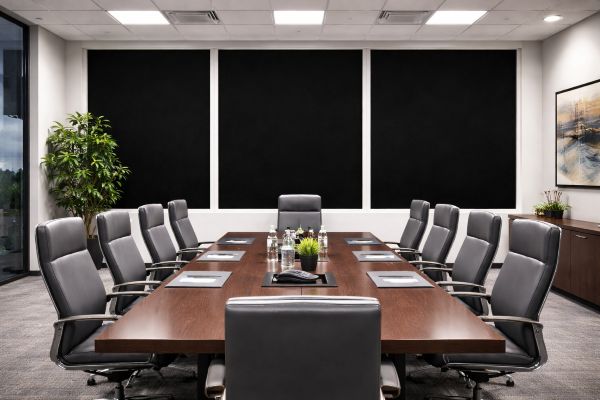
In a commercial setting, controlling light is often synonymous with controlling information. An opaque window film for glass serves as a powerful tool for visual security, creating an impenetrable barrier against unwanted observation. This is a crucial consideration for areas where confidentiality is paramount.
While frosted or decorative films offer privacy, opaque films provide absolute visual denial. This is essential for protecting sensitive operations in spaces such as:
- Executive boardrooms where confidential strategies are discussed.
- Human resources offices during sensitive interviews or meetings.
- Data centers or server rooms housing critical infrastructure.
- Glass-walled rooms used for the storage of high-value goods.
By making a glass surface completely opaque, you remove the risk of both casual and intentional visual intrusion, directly addressing a core security concern for your client.
Mitigating Glare and UV Damage in Specialized Environments
Sometimes the primary goal is not darkness itself, but the complete mitigation of its harmful components: glare and ultraviolet radiation. Opaque films offer the ultimate solution for asset protection in environments where light-induced degradation is a major financial or curatorial risk.
Museums, art galleries, and archives use these films to protect priceless artifacts from fading and damage. Similarly, luxury retail stores apply them to window displays or storage areas to preserve the color and integrity of high-end merchandise. Because professional-grade opaque films block over 99% of UV rays, they provide a level of guaranteed protection that is a core requirement for any project involving sensitive assets.
Achieving Specific Aesthetic Goals with Opaque Finishes
Beyond their functional benefits, opaque films are a versatile design tool for achieving specific architectural and aesthetic goals. They allow project managers to transform the look of glass surfaces, creating clean lines and uniform facades that might otherwise be impossible or cost-prohibitive.
A common application is applying black opaque film to the interior side of curtain wall windows to hide insulation, structural elements, or plenum space, creating a sleek, uniform exterior appearance. White opaque films are also frequently used on interior glass partitions to create privacy, enhance a minimalist aesthetic, or serve as a functional whiteboard surface for collaborative spaces. This dual-purpose capability adds value without requiring additional fixtures.
Decoding the Spec Sheet: Key Metrics for Light Control Films
Selecting the right film requires moving from the project’s ‘why’ to the product’s ‘how.’ This means translating client needs into technical specifications. A professional film’s data sheet is not a marketing document, it is a statement of guaranteed performance. Understanding a few key metrics will empower you to specify a solution with confidence.
Understanding Visible Light Transmission (VLT)
Visible Light Transmission, or VLT, is the most fundamental metric for any light control film. Expressed as a percentage, it measures how much visible light passes through the filmed glass. A higher VLT percentage means more light gets through, while a lower percentage means less light.
- A typical clear, untreated window has a VLT of 70-90%.
- A light, glare-reducing film has a VLT of 35-50%.
- A true blackout film or commercial blackout window film has a VLT of 0%.
For a project manager, a film’s stated VLT is a performance guarantee. When you specify a film with 0% VLT, you are ensuring the client receives a complete blackout solution, not just a “darkening” effect.
Evaluating Opacity vs. Translucency
It is crucial to distinguish between opacity and translucency. While both provide privacy, they control light very differently.
- Translucent films, like frosted or sandblasted finishes, obscure the view but still allow a significant amount of light to pass through. They are ideal for creating privacy in spaces where maintaining natural daylight is also desirable, such as an open-plan office.
- Opaque films block both the view and the light completely. These are the true blackout solutions required for the security, light-control, and asset protection scenarios discussed earlier.
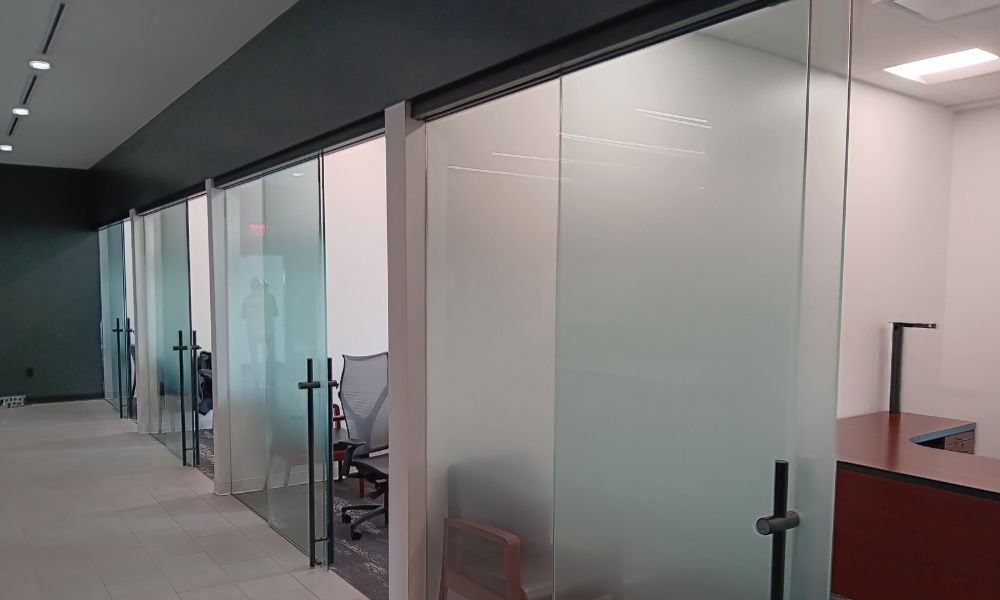
Matching the right type of film to the project’s primary goal, be it privacy with light or privacy with total darkness, is a fundamental step in the specification process.
The Critical Role of UV Rejection
A significant benefit of professional window films is their inherent UV blocking capability. Nearly all commercial-grade films, including opaque varieties, are engineered to block more than 99% of the sun’s harmful ultraviolet radiation.
This is a critical specification for any interior space. UV rays are the leading cause of fading in furniture, flooring, artwork, and merchandise. By installing a professional film, you are not only addressing the primary light control or security concern but also providing a powerful, built-in layer of asset protection. This secondary benefit adds immense value and longevity to a client’s interior investments.
From Spec Sheet to Site: Solving Real-World Project Challenges
Understanding the technical distinctions between film types is the foundation. The next step is translating that knowledge into effective solutions for real-world project challenges. For a project manager, the goal is not just to install a film, but to solve a specific operational or environmental problem for the client.
Corporate Offices: Securing Conference Rooms
Modern office design favors glass partitions to promote an open atmosphere. This creates a challenge for rooms where confidentiality is paramount, such as boardrooms and HR meeting spaces. A decorative frosted film might obscure direct sightlines, but shadows and movements can still be discernible. This is where a true opaque or blackout film becomes a strategic tool for information security. By specifying a film with a VLT of less than 1%, you guarantee that sensitive discussions are completely shielded from view, making the film a functional component of a company’s privacy protocol.
Educational Facilities: Controlling Light in Labs and Focus Rooms
In educational settings, controlling ambient light is a functional necessity.
- Media and A/V Labs: Uncontrolled light can disrupt color accuracy on screens and interfere with light-sensitive work in darkrooms.
- Science Classrooms: Certain experiments require near-total darkness to observe phenomena like fluorescence or light spectrums.
- Sensory and Focus Rooms: In special education, minimizing external visual stimuli is critical for creating a calm, non-distracting space.
In these cases, a consumer-grade “room darkening” solution is inadequate. A professional-grade blackout film with near-zero VLT is the only way to ensure the predictable, total light control required for these specialized applications.
Retail Environments: Protecting Displays and Managing Aesthetics
For retail project managers, window films address a dual challenge: protecting assets and controlling brand presentation. High-end merchandise is susceptible to fading from UV radiation and intense visible light. Opaque films serve several strategic purposes in retail:
- Inventory Protection: During off-hours, a blackout film can completely eliminate light exposure, offering the highest level of protection for delicate goods.
- Operational Concealment: Opaque films are ideal for blocking the view into back-of-house storage areas or sections under renovation, presenting a clean facade.
- Vacancy Management: For unoccupied storefronts, a white or black opaque film provides a professional appearance that is far superior to paper coverings.
When project requirements demand guaranteed performance, specifying a proven product is essential. This is where specialized films like 3M light control film demonstrate their value. For applications requiring both opacity and branding, the 3M Scotchcal series of opaque graphic films offers a versatile solution. These films not only provide 100% opacity but are also designed to be a stable surface for printed graphics, allowing a storefront to block visibility while displaying brand messaging.
Partnering for Success: A Blueprint for National Film Installations
For project managers overseeing regional or national rollouts, ensuring the first site in California has the exact same finish as the last in New York is a major logistical challenge. A strategic partnership with a national installer becomes a critical asset, transforming a complex series of jobs into a single, streamlined project.
The Challenge of Brand and Performance Consistency
When a brand invests in a new look for its locations, consistency is paramount. Relying on a patchwork of local installers introduces variables that threaten this standard. Different contractors may have varying skill levels or use different application techniques, leading to visible discrepancies in trim lines, bubbles, or peeling. Improper installation can even compromise the film’s VLT rating, meaning one location may not meet the light-blocking specification while another does.
The Value of a Single-Source National Installer
Engaging a single-source national installer eliminates the variables that jeopardize multi-site projects. This approach centralizes control and simplifies every aspect of project execution. Communication is streamlined to a single point of contact. You are no longer vetting and managing contracts for dozens of individual vendors. Most importantly, a national installer enforces a uniform standard of excellence. Every installer is trained on the same protocols for the specific film being used, ensuring the commercial installation is identical from site to site.
Streamlining Specification, Logistics, and Installation
A true national installation partner provides end-to-end project management that integrates with your workflow.
- Coordinated Specification and Auditing: The partnership begins with a comprehensive needs analysis. A national partner can help audit all site locations, account for variables like glass type, and solidify a single film specification that meets the project’s goals everywhere.
- Centralized Logistics and Material Management: The installer procures the specified film, managing inventory and shipping directly to each job site. This guarantees material authenticity and prevents delays caused by local supply chain issues.
- Synchronized Installation and Reporting: A national partner manages the entire installation schedule, deploying certified crews to align with your timeline. Upon completion, you receive consistent, standardized reporting and photo documentation from every site.
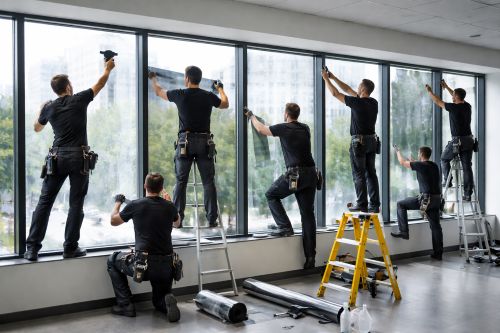
Executing large-scale rollouts for major brands requires operational maturity. Deploying high-performance materials like 3M blackout films demands precision. Environmental factors like humidity and temperature vary significantly between sites in Florida and Colorado, impacting the curing and adhesion process. A seasoned national team anticipates these variables and adjusts its methods accordingly, ensuring a successful outcome at every location.
Conclusion: The Strategic Value of Professional Light Control
The selection of a light blocking window film is a technical decision with far-reaching consequences. Moving from concept to final installation requires a clear understanding of material performance, not just aesthetic intent. The right film solution elevates a space from simply functional to precisely calibrated for its intended use.
Key Takeaways for Specifying Light Blocking Films
- VLT is the Definitive Metric: Rely on Visible Light Transmission percentages, not ambiguous marketing terms. A true blackout film offers 0% VLT. Defining this number is the first step in a successful project specification.
- Exterior Aesthetics Matter: Consider how the film will integrate with the building’s facade and any architectural guidelines. A black film on the interior creates a different exterior appearance than a white one.
- Durability Is Non-Negotiable: Professional-grade films are engineered with robust adhesives and scratch-resistant coatings designed for commercial environments, backed by comprehensive warranties.
- Integrated Performance Is Standard: A high-quality light blocking film does more than control light. It should also block over 99% of UV radiation, protecting interior assets from fading.
Viewing window film as a simple commodity is a common but costly mistake. A professionally specified light control film should be treated as a strategic building asset. When selected correctly, it is a targeted solution that solves multiple problems at once, transforming a simple material purchase into a guaranteed performance outcome.
Next Steps for Your Project
To ensure your project successfully meets its light control objectives, a structured planning process is essential.
- Define the Performance Criteria: Document the exact requirements. Is the goal 100% light elimination for a darkroom or significant glare reduction? Quantify the needs for VLT, UV rejection, and privacy.
- Assess the Glazing and Environment: Identify the type of glass being treated (e.g., single-pane, dual-pane, tempered). The film must be compatible with the glazing system to avoid thermal stress fractures.
- Consult a Film Installation Specialist: Engaging with an expert early is the most critical step. A specialist can analyze your criteria and site conditions to recommend the optimal film and ensure it will perform as intended.
- Request Material Samples and Mockups: Before committing, request physical samples. Applying a small test installation allows you and your client to validate the film’s aesthetic and light blocking capability in the actual environment.
Frequently Asked Questions
What is the difference between blackout and opaque window film?
The terms are often used interchangeably, but there can be a technical difference. A true “blackout film” is designed to achieve a Visible Light Transmission (VLT) of 0.0%, meaning it blocks all visible light. An “opaque film” also blocks the view completely but might have a VLT of less than 1%, allowing a minuscule, often unnoticeable, amount of light through. For sensitive applications like a photo darkroom, specifying a 0.0% VLT blackout film is critical.
Can light blocking window film damage my windows?
When installed correctly by a professional, light blocking film is safe for most types of commercial glass. However, applying a dark, heat-absorbing film to certain types of dual-pane or laminated glass can increase the risk of thermal stress fractures. A professional installer will assess your existing glazing system and recommend a film that is compatible and safe, ensuring you are covered by both manufacturer and installer warranties.
How much does commercial blackout window film cost?
The cost of a commercial blackout window film project depends on several factors, including the specific film selected, the total square footage, the complexity of the installation (e.g., high-reach windows or intricate glass shapes), and labor rates in your region. The price is typically calculated on a per-square-foot basis that includes both materials and professional installation. It’s best to get a detailed quote from a qualified national installer who can account for all project variables.
How long does a professional window film installation last?
Professionally installed commercial-grade light blocking films are highly durable. They are protected by a hard, scratch-resistant coating to withstand normal cleaning and use in a commercial environment. Most high-quality films from manufacturers like 3M come with a comprehensive warranty of 10-15 years against peeling, bubbling, and discoloration, ensuring a long-term return on your investment.