Table of Contents:
- Introduction: Why Commercial Building Window Tinting Matters in 2026
- How Commercial Window Films Work in Modern Commercial Buildings
- Types of Window Films for Commercial Buildings
- Energy Saving Benefits, Cost Reduction & Sustainability
- Security, Safety & Vandalism Protection for Commercial Properties
- How the Commercial Building Window Tinting Process Works
- FAQs About Commercial Building Window Tinting
- Why Choose Window Film Depot for Your Commercial Building
- Next Steps: Schedule a Commercial Window Film Assessment
Introduction: Why Commercial Building Window Tinting Matters in 2026
Commercial building window tinting is one of the most practical, high-return upgrades a facility manager or building owner can make right now. At its core, it involves applying thin, high-performance window film to existing glass, transforming how your building handles heat, light, security, and appearance without tearing out a single pane.
Since 2022, rising energy costs have put enormous pressure on operating budgets for office buildings, schools, government facilities, and retail stores. Add in the daily frustrations that building occupants deal with-hot spots near west-facing glass, cold spots along older curtain walls, excessive glare on screens, fading interior furnishings from harmful UV radiation, and growing security concerns at entry points-and it becomes clear why so many commercial properties are turning to window films as a retrofit solution.
Unlike full window replacement, commercial window tinting works with the glass you already have. It’s faster, far less disruptive, and delivers measurable results within weeks. Window Film Depot installs commercial window tinting and solar control films, security film, decorative films, anti-graffiti solutions, and specialized film products for commercial clients nationwide, managing everything from single-building upgrades to multi-site roll-outs.
How Commercial Window Films Work in Modern Commercial Buildings
Commercial window film is a multi-layer polyester product with specialized coatings-metallic, ceramic, or hybrid-applied to the interior side of existing commercial windows and curtain wall glass. The film bonds to glass through a pressure-sensitive adhesive, creating a durable protective layer that modifies the optical and thermal performance of the glazing assembly.
Solar control films manage heat, light, and UV by reflecting and absorbing portions of the solar spectrum. Window films reduce solar heat gain in summer while still allowing natural light to pass through. Quality films block up to 99.9% of harmful UV radiation, protecting both building occupants and interior furnishings from damage. Key factors to consider when selecting window tinting include solar heat gain coefficient (SHGC) and visible light transmission (VLT)-metrics that determine how much heat and daylight the film allows in.
Most projects involve interior application, though exterior films are sometimes used on hard-to-access or high-performance glazing systems. Films can reduce HVAC workload by improving insulation performance across single-pane, double-pane, tinted, and low-E glass. This makes commercial building window tinting an affordable alternative to full window replacement for virtually any existing glazing system.
Types of Window Films for Commercial Buildings
Most commercial buildings benefit from a mix of film types across different elevations and interior glass surfaces. Common types of commercial window films include solar control, privacy, and security films, and tinting films can be tailored based on building orientation and climate. Window Film Depot primarily installs 3M and other high-performance architectural films, customizing the selection to each site’s specific business needs.
Solar Control Films for Energy Savings and Comfort
Solar control films block heat and glare while allowing light into your space, making them the most popular choice for office buildings, classrooms, and retail environments. These films cut solar heat gain, easing the load on your HVAC system and stabilizing indoor temperatures. Solar control films can cut cooling costs by up to 50% on heavily exposed facades, and window tinting can lower air conditioning costs by up to 15% annually across a whole building.
Ceramic films provide strong heat rejection without interfering with wireless signals, which matters in modern commercial spaces packed with connected devices, and they’re one of several decorative and architectural film options available for tailoring both aesthetics and performance. Reflective films can reject up to 79% of solar energy but create a more mirror-like exterior. Neutral, spectrally selective options reject 30–60% of solar energy while preserving daylight and views. Window tinting minimizes glare from sunlight on computer screens, and displays-a constant complaint in open-plan offices-and effective window films can improve employee comfort by stabilizing indoor temperatures throughout the day.
Certain films help retain indoor warmth in winter by incorporating low-emissivity properties, trimming heating loads alongside cooling costs. UV protection prevents fading of furniture and flooring, and because window films block up to 99% of UV rays, solar control films also help protect occupants from skin cancer caused by prolonged exposure to harmful UV radiation.
Consider a mid-rise office in Houston with large west-facing glass: after solar control film installation, afternoon heat gain drops dramatically, tenant comfort complaints disappear, and energy bills go down within the first billing cycle.

Security Film and Safety Glazing Upgrades
Security films reinforce glass against breakage and shattering, adding a critical protective layer to vulnerable entry points. These thicker, multi-layer polyester products are designed so that specialized security films hold shattered glass together when impacted-whether from forced entry, accidents, storms, or blast events. Safety films provide critical protection against break-ins at schools, government buildings, banks, and street-level retail stores.
When properly anchored to the window frame, safety and security films dramatically reduce the risk of flying glass shards entering occupied spaces during natural disasters or violent impacts. Security films make glass more resistant to breakage, buying critical time during an intrusion attempt. Many security window films can also be combined with solar control performance for dual-benefit protection-both safety security and energy savings from a single installation.
A national retail chain, for example, might install security film and attachment systems on storefronts across dozens of locations to reduce smash-and-grab theft. The film is optically clear and doesn’t change how the building’s exterior looks, maintaining curb appeal and brand standards.
Anti-Graffiti Film for Storefronts, Transit Hubs & Public Buildings
Anti-graffiti films are sacrificial transparent layers applied to glass surfaces, mirrors, and display cases to protect against spray paint, acid etching, and scratching, and Window Film Depot supplies these protective films for a wide range of commercial and public environments. Anti-graffiti films protect glass surfaces from vandalism-and when damage occurs, facility teams simply remove and replace the affected film panel rather than replacing expensive glass.
For a downtown transit station or urban retail corridor, anti-graffiti film keeps doors and display windows looking clean with minimal downtime and at a fraction of the cost of broken glass replacement. These films are optically clear and designed not to alter the building’s exterior appearance, which matters for brand-conscious retailers and property managers who want to maintain a uniform appearance.
Decorative Film and Branding for Interior Glass and Building Exteriors
Decorative films enhance aesthetics without replacing glass, offering frosted glass effects, gradients, patterns, and custom-printed graphics for conference rooms, sidelites, lobby partitions, and retail storefronts, and they can be installed by an experienced 3M window film installation company to ensure consistent quality and performance. Privacy films allow for daylight while obscuring outside views, making them ideal for medical offices, legal practices, and executive suites where confidentiality matters. Privacy films make it harder for passersby to see inside, and tinted windows limit outside visibility for enhanced privacy without sacrificing natural light.
Commercial window films can enhance the aesthetic appearance of a building from the outside world as well, softening a facade, concealing back-of-house areas, or unifying the look of a multi-tenant property. Window Film Depot can integrate company logos, wayfinding graphics, and branded designs using custom-printed decorative films and privacy films that limit outside visibility for confidentiality while still letting daylight through, leveraging its role as a leading 3M window film installation company for commercial projects. Blackout films are also available where complete light control is needed.
A multi-tenant office building, for instance, might use a decorative film package to create frosted privacy bands on individual offices and give the lobby a cohesive, professional look-all without structural changes to the glass.
Energy Saving Benefits, Cost Reduction & Sustainability
Commercial building window tinting delivers measurable energy savings that show up on your very next utility statement, especially when implemented by an experienced national window film retrofit specialist. Energy savings from window films can start immediately after installation, and window films help reduce energy costs significantly, particularly in buildings with large glass envelopes or heavy solar exposure. Installing window films can enhance comfort without high costs, making it a smart investment for any commercial property facing high energy costs.
Many retrofit projects see 5–15% whole-building energy savings, with cooling load reductions of 20–40% on the most exposed facades. Window tinting costs about one-tenth of window replacement, making it a dramatically more cost-effective path to better building performance. Solar control films reduce peak cooling loads, helping facilities manage rising electricity costs, demand charges, and air conditioning costs-especially in southern and western climates where reducing heat through glass is a year-round priority.
Window films can also contribute to green building programs. Projects have earned LEED points under Energy & Atmosphere and Indoor Environmental Quality categories by demonstrating improved energy efficiency and occupant comfort. Indirect savings add up too: reduced fading of flooring, furniture, and merchandise from blocking heat and harmful UV rays, lower HVAC maintenance from running equipment less aggressively, and fewer hot and cold complaints from building occupants who finally have a comfortable environment.
Estimating ROI and Payback on Window Film Upgrades
Window Film Depot evaluates ROI by reviewing utility data, glazing types, building orientation, and HVAC system performance before recommending specific films. Typical ROI for window films is often 3 years or less for energy-focused commercial window tinting films, with payback ranges commonly falling between 2 and 7 years depending on climate, exposure, and whether utility rebates are available. Window tinting can cut cooling costs by up to 50% on the most aggressive installations.
For perspective: a 100,000-square-foot office building spending $180,000 annually on cooling might save $18,000–$27,000 per year after solar control film installation. That puts simple payback well within 3–5 years-and for buildings with utility rebate programs, payback can drop below two years. Large portfolios and multi-site retailers can standardize on certain film types to streamline budgeting and track energy-saving benefits across every location. Rather than relying on generic claims, request an energy analysis or film modeling study specific to your building.
Security, Safety & Vandalism Protection for Commercial Properties
Glass is one of the most vulnerable elements of any commercial building envelope. A single broken window can mean stolen merchandise, injured occupants from flying glass shards, or costly emergency repairs. Security film, attachment systems, and anti-graffiti solutions fit into a broader risk management strategy alongside alarms, cameras, and access control-but they address the physical vulnerability that those electronic systems can’t.
In 2024–2026, K–12 schools have accelerated entry protection upgrades with security films on vestibule and classroom glazing, taking advantage of providers that offer nationwide window film installation locations to support multi-campus rollouts. Retailers are combating smash-and-grab theft by reinforcing storefronts with safety and security films that hold shattered glass in place, delaying intruders long enough for response. City facilities in high-traffic zones are mitigating vandalism with anti-graffiti film on doors and windows. Unlike bars, shutters, or plywood, these films are discreet-they don’t change how the building looks from the outside world, and they preserve natural light and curb appeal.
How the Commercial Building Window Tinting Process Works
The commercial window tinting process at Window Film Depot follows a straightforward path: site assessment, film selection, proposal, scheduling, professional installation, and quality check. The goal is minimal disruption to tenants-work is often performed outside core hours or phased by floor and facade so commercial spaces remain fully operational. For national clients, Window Film Depot coordinates multi-location roll-outs and timelines across dozens or hundreds of sites, including large commercial window film projects in Washington, DC, and other major markets.
Site Assessment, Film Selection & Project Planning
A specialist evaluates glass types, exposures on each elevation, interior use of each space, and your goals-whether that’s energy savings, enhanced privacy, security, or branding. Tools like BTU meters, light meters, and manufacturer performance data help match the right specialized film to your specific requirements. Samples and mockups let decision-makers see exactly how different commercial window tinting films will look on the building’s exterior and from the interior side before committing. For sensitive retrofit projects in government or healthcare settings, the team coordinates with architects, engineers, and security consultants. Professional installation ensures proper adhesion and warranty coverage across every pane.
Installation Day: What Facility Managers Can Expect
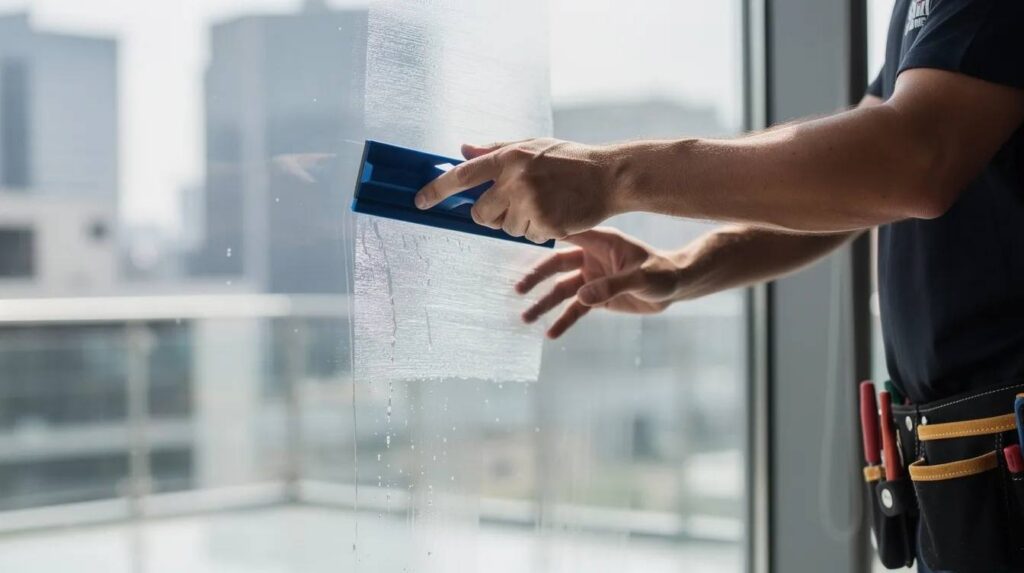
On installation day, crews protect floors and interior furnishings, then windows must be thoroughly cleaned before film application-surface preparation is critical to a clean bond. Film is applied using specialized tools to avoid bubbles, with each panel cut to size, positioned with a slip solution, squeegeed to remove moisture, and detailed at the edges. Installation typically takes a few days, depending on the number of windows, though individual office spaces or tenant suites can often be completed in a single day or over a weekend.
During curing, film may appear slightly hazy or show small water pockets for several days to a few weeks-this is completely normal and resolves as moisture evaporates. Once cured, most films are virtually maintenance-free, requiring only simple cleaning with non-abrasive products.
FAQs About Commercial Building Window Tinting
Will window film make my building too dark?
Not necessarily. Modern neutral and spectrally selective films maintain a VLT of 50–70%, meaning plenty of natural light still enters your space without sacrificing natural light or views. Darker reflective options exist for maximum heat rejection, but most commercial projects use films that balance daylight with reducing glare and heat. Your installer should show you samples on your actual glass before you commit.
How long do commercial window films last?
Most quality commercial window films last 15–20 years with proper care, and many come with manufacturer-backed warranty coverage. Lifespan depends on film type, glass orientation, and climate exposure, but professionally installed films on interior glass surfaces consistently deliver long-term performance.
Can window film be applied to any type of commercial window?
Most films work with clear, tinted, double-pane, and low-E glass. However, certain combinations-laminated, older tempered, or spandrel glass-require professional assessment to avoid thermal stress or condensation issues. That’s why a site evaluation matters before any commercial window film project.
What’s the difference between window film and replacing my commercial windows?
Window tinting costs about one-tenth of window replacement and takes days instead of months. There’s no structural disruption, no permitting headaches, and no displaced tenants. Commercial window film delivers strong energy efficiency improvements and UV protection at a fraction of the cost, making it the go-to option for most retrofit projects.
Is commercial window tinting compliant with local codes?
Yes, when installed by experienced professionals who understand local reflectivity limits, safety glazing requirements, and building codes. Window Film Depot ensures every project meets applicable standards, including considerations for exterior reflectance that could affect neighboring properties or roadways.
Can window film be removed or changed later?
Absolutely. Professional removal leaves the glass clean and undamaged, which is useful for lease changes, rebranding, or upgrading to newer film technology. This flexibility makes window tinting a practical choice for tenants and property managers alike.
Will it change my building’s exterior appearance?
That depends on the film you choose. Near-invisible neutral films preserve your current look. Reflective films create a sleek, uniform appearance. Decorative films can transform the facade entirely. The range runs from completely undetectable to a bold design statement-your choice.
Why Choose Window Film Depot for Your Commercial Building
Window Film Depot is a family-owned company founded in 1992 in Marietta, Georgia, now serving commercial clients across the United States. With over three decades of experience, the team specializes in 3M window films, security glazing, decorative and privacy films, and complex multi-site roll-outs that demand coordination, consistency, and accountability.
Facility managers, building owners, architects, energy managers, and security directors across corporate, retail, government, education, and healthcare sectors trust Window Film Depot for turnkey project management. The company has handled office towers, university campuses, federal and municipal buildings, and big-box retail locations, delivering on time, on spec, and backed by certified installers and manufacturer warranties.
What sets Window Film Depot apart is the combination of national reach with local expertise. Every project starts with a real assessment-not a generic quote-and ends with post-installation support for maintenance questions and future upgrades. When you need a partner who understands the many benefits of commercial window tinting and can execute at scale, this is the team to call.
Next Steps: Schedule a Commercial Window Film Assessment
If your building’s glass is working against you-driving up cooling costs, creating hot spots, generating glare complaints, or leaving storefronts exposed-commercial building window tinting is one of the fastest ways to turn that around.
Contact Window Film Depot for a free site visit, energy analysis, or budgetary quote. Whether you’re dealing with a recent spike in energy bills, tenant complaints about indoor temperatures, an upcoming facade refresh, or a security review triggered by recent break-ins, now is the right time to act. Multi-location and national brands are welcome to discuss phased roll-outs and standardized film specifications.
Request your free commercial window film assessment today by calling Window Film Depot or submitting a quote request through the website, whether you need local commercial window film and tinting in Los Angeles or support across multiple regions. Your glass should be an asset, not a liability.