Table of Contents:
- Why Business Window Tinting Belongs in Your Critical Path, Not Your Punch List
- Choosing the Right Film for Commercial-Scale Performance Requirements
- The Operational ROI of Commercial Window Tinting: Energy, Comfort, and Risk Reduction
- Planning a Large-Scale Commercial Window Film Installation Without Derailing Your Schedule
- Compliance, Documentation, and Certification Standards You Cannot Afford to Skip
- How to Evaluate a Commercial Window Film Contractor for Large or Multi-Site Projects
- Budget Management and Risk Mitigation for Multi-Building Window Film Projects
- Conclusion: Managing Window Film Like the Critical Scope Item It Is
- Frequently Asked Questions
Why Business Window Tinting Belongs in Your Critical Path, Not Your Punch List
Business Window Tinting is one of the smartest upgrades companies can make to improve comfort, reduce cooling costs, and create a better workplace environment. By helping block heat, glare, and harmful UV rays, commercial window film makes offices, retail stores, and multi-site properties more efficient and inviting. It also adds privacy, improves appearance, and supports long-term building performance without major disruption.
The Hidden Schedule Risk That Catches Project Managers Off Guard
Window film gets scheduled like paint touch-ups and managed like neither. Most project managers slot it into the punch list during closeout, which is exactly when it creates the most disruption.
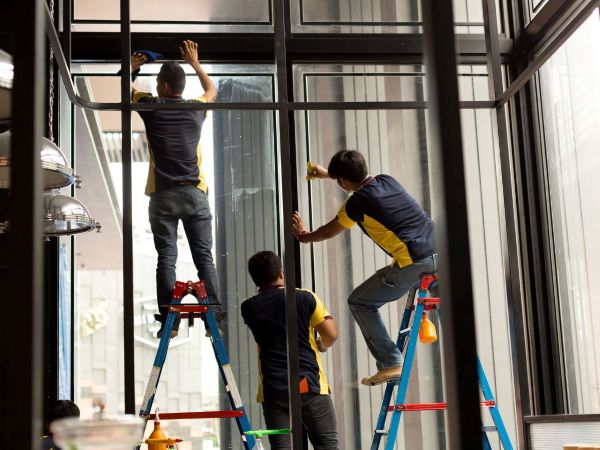
Film installation requires clean, accessible glass, a dust-controlled environment, and cure time before the space can be occupied or fully commissioned. When those conditions don’t exist because trades are still on site, HVAC hasn’t been balanced, or the tenant is already moving furniture in, the installation gets compressed, delayed, or redone.
The result is a change order on a line item that should have been locked weeks earlier. On a multi-floor or multi-building project, that schedule slip compounds. The earlier you treat business window tinting as a sequenced trade, the fewer problems it creates at closeout.
How Window Film Affects Building Envelope Performance, Commissioning, and Occupancy Timelines
Window film directly affects how a building performs during commissioning. Solar control film changes the thermal load profile of the envelope, which means HVAC commissioning data collected before film installation may not reflect actual occupied conditions. On energy-code-sensitive projects, this can create discrepancies between modeled and measured performance that require reconciliation before occupancy approval.
Cure time is the other variable that catches teams off guard. Most professional-grade films require 30 to 60 days to fully cure, depending on film type, ambient temperature, and sun exposure. During that window, the film may show minor haziness or small water pockets. Both are normal, but both are capable of generating tenant complaints if occupants move in without being briefed. Scheduling film installation before final occupancy and coordinating the cure period with your occupancy timeline eliminates this problem entirely.
Reframing the Scope: Window Film as a Building Systems Decision
The practical case for elevating window film in your project hierarchy is straightforward. It affects energy performance, occupant comfort, code compliance, and in some applications, life safety. Films specified for blast mitigation or forced-entry resistance are part of the building’s security infrastructure. Safety films carry compliance requirements tied to glazing standards. These are not finishing-trade decisions.
Treating film selection as a building systems decision also changes how you evaluate vendors. You are not looking for the lowest bid on a commodity install. You are qualifying a subcontractor who needs to coordinate with your glazing contractor, understand your energy model assumptions, provide compliant documentation, and execute across potentially dozens of locations without creating schedule risk. That is a fundamentally different conversation than “how much per square foot.”
Choosing the Right Film for Commercial-Scale Performance Requirements
Solar Control Films: Understanding SHGC, VLT, and Heat Rejection Trade-Offs
Two numbers govern solar control film specification: Solar Heat Gain Coefficient (SHGC) and Visible Light Transmittance (VLT). SHGC measures how much solar energy passes through the glazing system, where lower values indicate better heat rejection. VLT measures how much visible light comes through, where higher values mean a brighter interior. The trade-off between them is where most specification errors happen.
A film with a very low SHGC will reject significant solar heat, but if it also drops VLT below 35 to 40 percent, you are adding artificial lighting load to offset what you saved on cooling. The net energy benefit narrows considerably. On south- and west-facing facades with high solar load, a spectrally selective film that maintains higher VLT while still achieving an SHGC in the 0.25 to 0.35 range typically delivers the best overall energy performance. On north-facing glass with minimal solar exposure, the SHGC discussion is largely irrelevant, and other film properties take priority.
Ceramic Window Film: Performance Profile and Ideal Use Cases
Ceramic window film uses non-metallic nanoparticle technology to reject infrared heat without a reflective appearance. These films deliver SHGC values in the 0.27 to 0.40 range with VLT options from 40 to 70 percent, making them well-suited for tenant spaces where occupants want natural light and exterior visibility without thermal discomfort.
Ceramic film is the right specification for:
- Class A office interiors where a mirrored exterior look is not acceptable
- Healthcare environments requiring non-metallic materials near imaging equipment
- Retrofit projects on existing single-pane glass where interior heat gain is the primary complaint
The performance profile is durable and consistent. Ceramic films resist fading and color shift over time, which matters significantly on a 10-year ownership horizon.
Reflective and Spectrally Selective Films: When Aesthetics and Solar Rejection Must Coexist
Reflective films use a metalized layer to reject solar energy, achieving some of the lowest SHGC values available, often below 0.25. The trade-off is a mirrored or silver exterior appearance that not all tenants or municipalities will approve. They work well on industrial facilities, parking structures, and commercial buildings where exterior aesthetics are secondary to performance.
Spectrally selective films split the difference. By targeting infrared wavelengths specifically, they reject heat while maintaining higher VLT and a more neutral appearance. For mixed-use developments, retail facades, or projects with design review board requirements, spectrally selective films allow you to hit energy performance targets without compromising the building’s visual design intent.
3M Prestige Series: Performance Benchmarks for High-Solar-Load Commercial Environments
The 3M Prestige Series represents the current performance ceiling for non-reflective commercial solar film. The Prestige 70, for example, achieves a 0.38 SHGC while maintaining 70 percent VLT, rejecting a substantial portion of infrared heat with no metallic content and no mirror effect.
For high-rise office projects with floor-to-ceiling glazing on sun-exposed facades, this performance profile is difficult to match with alternative products.
The series is relevant to project managers not just as a product specification, but as a benchmark. When a vendor proposes a solar control film, the 3M Prestige performance data gives you an objective reference point for evaluating competing proposals.
Safety, Security, and Blast Mitigation Films: Beyond Basic Shatterproofing
Safety film is not a single product category. It is a compliance-driven specification with meaningful performance differences between tiers. Getting the tier wrong has consequences ranging from a failed inspection to a genuine life-safety gap.
ANSI Z97.1 Compliance and the 3M Safety Series
ANSI Z97.1 is the governing standard for glazing safety in occupied buildings. It defines the impact resistance thresholds that safety film must meet to qualify glass as a compliant safety glazing material. On renovation projects where existing annealed glass does not meet current code, applied safety film can bring that glass into compliance, but only if the film itself meets ANSI Z97.1 requirements and is installed by a certified applicator.
The 3M Safety Series S-series films are tested and certified to ANSI Z97.1. For project managers on institutional projects, including schools, healthcare facilities, and government buildings, this certification is not optional. Verify it before the film goes on the glass, not during the building department inspection.
Blast Mitigation and Ballistic-Resistant Options for Institutional and Government Projects
Federal and municipal government facilities, courthouses, and transit hubs often require window film that goes beyond ANSI Z97.1 compliance. GSA standards, UFC 4-010-01 (the DoD unified facilities criteria for anti-terrorism), and specific state procurement requirements may mandate blast mitigation film tested to ASTM F1642 or ISO 16933.
These films are significantly thicker, typically 7 to 14 mil compared to 4 mil for standard safety film, and require attachment systems that anchor the film to the window frame to prevent glass migration during a pressure event. Specifying the film alone without the attachment system does not meet blast mitigation standards. The installation methodology is part of the compliance requirement, not an optional add-on.
Security Film Integration with Glass Retention Systems
On high-security projects, window film is one component of a layered glazing strategy. Security film works in concert with structural silicone attachment systems, security window frames, and in some cases, interlayer laminates on the glass itself. A vendor who does not understand how film performance interacts with frame anchorage and glass construction cannot properly specify a security glazing system.
When coordinating with your glazing contractor on these projects, confirm that the glass substrate is compatible with the film specification. Certain tempered glass configurations limit the adhesive options available for heavy-mil security films, and some heat-absorbing glass types create thermal stress risks when paired with high-rejection films. These conversations belong in the specification phase, not during installation.
Decorative and Privacy Films: Functional Aesthetics at Scale
Decorative and privacy films serve a dual purpose on commercial projects. They control sightlines and subdivide spaces without construction costs, and they can carry brand graphics, etched glass appearances, or frosted patterns that the interior design specification requires. On large-scale office fit-outs or healthcare projects, these films replace specialty glass in conference rooms, reception areas, and patient-facing environments at a fraction of the glazing cost.
From a project management perspective, the key variable is consistency across multiple installations. If the same frosted or patterned film is being applied across dozens of conference rooms in a corporate campus rollout, you need a vendor who can maintain visual uniformity, consistent opacity, clean edge lines, and matched pattern alignment, across every location.
Anti-Graffiti Film: Total Cost of Ownership Logic for High-Traffic Environments
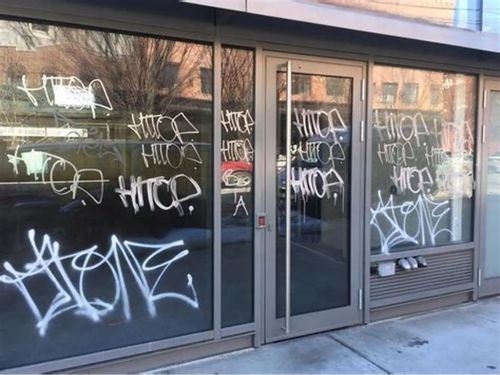
Graffiti removal from unprotected glass can run several hundred dollars per incident in labor and materials. Anti-graffiti film acts as a sacrificial layer. When the surface is tagged or scratched, you replace the film rather than the glass.
On transit environments, retail corridors, or any facility where vandalism is a recurring maintenance issue, the film pays for itself quickly.
A clear anti-graffiti film typically runs $4 to $8 per square foot installed. For a transit authority managing hundreds of stations or a retail chain with high-traffic urban locations, the total cost of ownership argument is straightforward and defensible to a finance committee.
Commercial Film Selection Matrix
| Film Category | SHGC Range | VLT Range | ANSI Z97.1 | Security Rating | Best Deployment Context |
|---|---|---|---|---|---|
| Ceramic Solar Control | 0.27 – 0.40 | 40% – 70% | Select products | None | Class A office, healthcare, retrofit single-pane |
| Reflective Solar Control | 0.18 – 0.35 | 15% – 50% | Select products | None | Industrial, west/south facades, high solar load |
| Spectrally Selective | 0.25 – 0.40 | 50% – 75% | Select products | None | Mixed-use, design-sensitive facades, retail |
| Safety Film (4 mil) | Neutral | Neutral | Yes (certified) | Impact resistance | Schools, healthcare, code-compliance retrofit |
| Blast Mitigation (7-14 mil) | Neutral | Neutral | Yes + ASTM F1642 | Blast / forced entry | Government, courts, transit, DoD facilities |
| Decorative / Privacy | Varies | 0% – 60% | Select products | None | Conference rooms, reception, patient areas |
| Anti-Graffiti (clear) | Neutral | 90%+ | No | Surface protection | Retail, transit, urban street-level glazing |
SHGC and VLT ranges reflect typical product families. Specific performance values vary by product and should be confirmed against manufacturer data sheets for specification purposes.
The Operational ROI of Commercial Window Tinting: Energy, Comfort, and Risk Reduction
Quantifying Energy Savings: Solar Heat Gain, HVAC Load Reduction, and Energy Code Alignment
Solar control film’s energy impact is measurable in HVAC tons, not just utility bills. On a south- or west-facing commercial floor with floor-to-ceiling glazing, untreated glass can account for a significant share of peak cooling load.
Reducing the SHGC with a quality solar film cuts that load meaningfully, which translates directly to reduced chiller demand, smaller peak draws, and in some cases, HVAC equipment that no longer needs to be oversized for worst-case conditions.

On energy-code-sensitive projects, film can help close the gap between an existing building’s envelope performance and current ASHRAE 90.1 or Title 24 requirements. For renovation projects where replacing glazing to meet code would be cost-prohibitive, film is frequently the most efficient compliance path. Document the pre- and post-installation SHGC values with manufacturer data sheets and include them in your energy model reconciliation. Building departments and commissioning agents will want that paper trail.
UV Rejection, Fade Prevention, and Interior Asset Protection
Most commercial solar films block 99 percent of UV radiation regardless of their visible light transmittance rating. That single performance characteristic drives a cost avoidance argument that is easy to quantify for asset-intensive spaces.
Consider what depreciates under unfiltered UV exposure: carpet, hardwood flooring, upholstered furniture, artwork, retail merchandise, and in healthcare environments, specialized equipment finishes. UV degradation accelerates that depreciation curve by years. Film extends the useful life of those assets, which directly reduces the frequency and cost of interior refresh cycles. On a 10-year ownership model, the deferred replacement cost often exceeds the film installation cost by a wide margin. This is the argument that lands with finance committees and asset managers, not just facilities teams.
Glare Reduction and Occupant Comfort as Productivity and Retention Variables
Glare is a building performance problem that post-occupancy surveys consistently rank among the top occupant complaints in glass-heavy commercial spaces. It drives behavioral workarounds that undercut the original design intent: blinds stay closed, workstations get repositioned, and conference rooms become unusable during certain hours. All of this happens because the glazing system was not specified with occupant comfort as a design parameter.
Solar control film, particularly spectrally selective products with high VLT, resolves glare without sacrificing daylight. For a corporate tenant negotiating lease renewals, occupant comfort scores and workspace usability are real retention variables. For a healthcare operator, staff environment quality affects recruitment and turnover in a labor market where both are expensive problems. These outcomes do not show up directly on an energy bill, but they are financially material.
How Window Film Contributes to LEED Certification and Sustainable Building Goals
Window film contributes to LEED credits in two primary categories: Energy and Atmosphere and Indoor Environmental Quality. On the energy side, documented SHGC improvements feed directly into the energy performance baseline calculation underlying the Optimize Energy Performance credit. On the indoor environmental quality side, glare control and thermal comfort improvements support credits for occupant comfort and controllability of systems.
For projects pursuing LEED BD+C or LEED O+M certification, the documentation requirements are specific. You need manufacturer performance data confirming SHGC and VLT values, a calculation showing the modeled energy impact, and installation records confirming the specified product was installed. A vendor who can provide that documentation package as part of their standard deliverables saves your project team meaningful coordination hours during the certification process.
Establishing Realistic Cost-Per-Square-Foot Benchmarks
Commercial window film installation typically runs $8 to $25 per square foot installed, depending on film type, site conditions, and project scale. Solar control films at the standard end land in the $8 to $14 range. Ceramic and spectrally selective films run $12 to $18. Security and blast mitigation films, which require thicker materials and attachment system installation, run $18 to $30 or higher depending on specification.
Scale affects unit cost significantly. A single-location retail installation of 500 square feet will carry a higher per-square-foot cost than a large multi-floor corporate rollout, where mobilization is amortized across a larger scope and scheduling efficiency improves.
If you are budgeting a multi-site project, get square footage estimates by location type rather than just a total, so you can identify where scale discounts apply and where site-specific variables will drive cost above baseline.
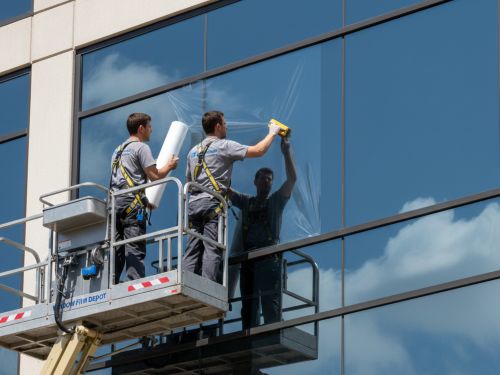
Access complexity adds cost that many initial budgets miss. Film installed on exterior-facing glass above the fourth floor requires swing stage or lift equipment. High ceilings in atrium or lobby environments require specialized rigging. Factor those line items in early.
Planning a Large-Scale Commercial Window Film Installation Without Derailing Your Schedule
Phasing Strategy: How to Sequence a Multi-Building or Multi-Floor Rollout
On multi-site projects, the temptation is to sequence by geography and mobilize location by location. The better approach sequences by occupancy status and construction readiness. Vacant floors or buildings at substantial completion should be completed first. You get the cleanest installation conditions, no tenant disruption risk, and you bank square footage before the occupied-space complications begin.
For occupied floors, group by operational similarity. A floor of open-plan workstations can be done floor by floor with one-day advance notice. Executive suites, trading floors, or data center-adjacent spaces require individualized protocols and advance coordination with the tenant or department head. Batching by space type lets the installation crew maintain efficiency without requiring you to manage exception after exception.
How Long Does Commercial Window Film Installation Take Per Location?
A professional crew typically installs 500 to 800 square feet of film per day under standard interior conditions. For a single-story retail location with 1,200 square feet of glazing, plan on two to three days including surface prep, installation, and post-installation inspection.
A full floor of a commercial office building, typically 2,000 to 3,500 square feet of exterior glass, runs three to five days with a two-person crew, assuming clear access and no major rigging requirements. Multi-floor projects benefit from crew continuity. The same team moving floor to floor maintains quality consistency and builds pace as they develop familiarity with the building’s glazing layout.
Need More Info?
The Window Film Depot team is happy to help.
For scheduling purposes, add a 10 to 15 percent buffer to the installation timeline to account for glass condition surprises, access coordination delays, and the occasional film re-cut on non-standard window configurations.
Occupied-Space Protocols: Protecting Tenants, Staff, and Operations During Active Installations
Film installation in occupied spaces is workable, but it requires explicit coordination protocols documented before work begins. The core risks are water migration from the installation process reaching electronics or flooring, temporary visual obstructions creating slip or navigation hazards, and occupant complaints about odor from the installation solution.
A professional installer working in an occupied space should provide:
- Advance notice documentation to tenants, typically 24 to 48 hours minimum
- Drop cloth and plastic sheeting coverage for workstations and equipment within the splash zone
- A defined work window that avoids peak occupancy hours where the project schedule allows
- Post-installation cleanup and inspection before the crew leaves the floor
For healthcare or laboratory environments, coordination with department managers is non-negotiable before scheduling. Some clinical spaces cannot accept any installation activity during operational hours, which requires evening or weekend shifts and corresponding labor cost adjustments in the budget.
Subcontractor Coordination: Where Window Film Fits in the Construction Schedule
Commercial window film installation should follow glazing completion, interior finish painting, and HVAC rough-in, and precede final cleaning and occupancy. The practical logic: film requires clean, intact glass, so any activity that could generate debris, overspray, or glass damage should be complete first. HVAC should be operational during installation because temperature and humidity affect cure time and adhesion quality.
On the back end, film installation should complete before final cleaning because the installation process leaves water residue and the edges require a cleanup pass. Scheduling film after final cleaning creates rework. Coordinate that sequence explicitly with your cleaning subcontractor.
Putting the Phasing Framework Into Practice: An Illustrative Multi-Site Rollout
Consider a 12-location corporate office rollout across three metro areas. A workable sequencing approach identifies the two or three locations at substantial completion, or where tenant occupancy is furthest out, and mobilizes there first. This lets the installation crew establish quality benchmarks on lower-pressure sites before moving into active occupied locations.
Locations in the same metro area should be batched into continuous mobilization blocks to minimize travel overhead. Within each location, sequence vacant floors first, then occupied floors by department type. Plan a two-week buffer between the final installation date and the project’s practical completion date to absorb schedule variation and allow cure time documentation to be collected.
At approximately 600 square feet per day per crew and an average of 2,500 square feet per location, each site represents roughly four days of installation work. A single experienced two-person crew can complete a 12-location rollout in 10 to 12 weeks with tight scheduling. That is a realistic timeline for a competent vendor and a useful benchmark for evaluating whether a proposed schedule is credible.
Compliance, Documentation, and Certification Standards You Cannot Afford to Skip
What Compliance Documentation Is Required for Institutional Window Film Installations?
On institutional projects, documentation is not a post-installation deliverable. It is a pre-qualification requirement. Before a single roll of film goes on the glass, you should have in hand: manufacturer product data sheets confirming performance values, relevant test certifications (ANSI Z97.1, ASTM F1642, or others as applicable), the installer’s proof of certification, and the product’s warranty terms in writing.
After installation, the documentation package should include as-built records identifying which film product was installed on which elevation and floor, a signed certificate of installation from the installer, and the warranty registration confirmation from the manufacturer. For LEED projects, add the energy model inputs updated to reflect installed SHGC values.
If the building department or authority having jurisdiction requires a glazing substitution submittal for safety film upgrades, prepare that package before installation begins, not after the inspector asks for it.
Building Code Intersections: Energy Codes, Fire Ratings, and Glass Performance Standards
Three code frameworks intersect with window film on commercial projects, and conflating them creates specification errors.
Energy codes, including ASHRAE 90.1, California Title 24, and state equivalents, govern the thermal performance of the glazing assembly. Film changes the assembly’s SHGC, which must be documented and may require a compliance demonstration if the project is subject to prescriptive or performance path energy compliance.
Fire ratings are a separate concern. Window film does not carry a fire rating and cannot be applied to fire-rated glazing assemblies without voiding the rating. If a project has fire-rated glass, typically in stairwells, corridors, or rated partitions, those lites must be excluded from the film scope. This coordination point between your glazing contractor and film installer needs to happen at specification, not during installation.
Glass performance standards, including the ANSI Z97.1 safety glazing requirements discussed earlier, govern where safety film must meet specific testing thresholds. On renovation projects where the existing glass inventory includes unrated annealed glass in hazardous locations, a code analysis before specification confirms where film alone can achieve compliance and where glass replacement is required.
What Certifications Should a Commercial Window Film Installer Hold?
3M Authorized Dealer Status: What It Means for Warranty Integrity
3M’s authorized dealer program is not a marketing credential. It is a warranty delivery mechanism. 3M’s commercial film warranties, which extend up to 10 years on many products, are only valid when the film is installed by an authorized dealer using approved installation methods. An installation by a non-authorized installer using 3M product voids the manufacturer warranty.
On a project where the film specification references a 3M product, authorized dealer status is a contractual requirement, not a vendor preference. Verify it before award. 3M’s authorized dealer network is searchable on their commercial website, so confirmation takes a few minutes and eliminates warranty exposure on what may be a six-figure installation.
Occupied-Space Safety and Insurance Documentation
A commercial installer working in occupied buildings should carry general liability coverage of at least $2 million per occurrence and active workers’ compensation insurance. Request certificates of insurance before mobilization, named to your project entity as an additional insured.
Beyond insurance, confirm the installer has a written occupied-space safety protocol covering access control during installation, protection of adjacent surfaces and equipment, chemical handling procedures for the installation solution, and incident response procedures. For healthcare and education facilities, a facility-specific safety orientation and sign-in protocol is typically required before any subcontractor begins work.
Compliance Considerations for Education, Healthcare, and Government Facilities
These three facility types each add compliance layers that do not apply to standard commercial projects.
Education facilities, particularly K-12, increasingly require safety film to meet updated glazing standards following forced-entry and active-threat response guidelines. Some state departments of education have issued specific film performance requirements. Confirm applicable state guidelines before specifying, because the acceptable product list may be narrower than what a standard ANSI Z97.1 certification covers.
Healthcare environments add infection control considerations. Installation in clinical areas may require the installer to follow the facility’s infection control risk assessment (ICRA) protocols, which dictate containment, PPE, and traffic routing requirements. Coordinate with the facility’s safety officer, not just the project manager, before scheduling clinical space installations.
Government facilities, particularly federal, may require personnel security clearances for installers working in sensitive areas, background checks as a baseline, and product traceability documentation confirming the film supply chain.
On DoD or GSA projects, confirm these requirements with the contracting officer during pre-award. They are not discoverable from the project drawings.
How to Evaluate a Commercial Window Film Contractor for Large or Multi-Site Projects
The Vendor Qualification Framework: Separating Operational Partners from Product Vendors
Most business window tinting vendors are optimized for single-location installs. They carry good product, employ skilled applicators, and can execute a straightforward retail or office job without issue. That operational profile does not translate to a 15-location institutional rollout. The qualification question for a multi-site project is not “can they install film?” It is “can they manage a project?”
The distinction matters because the failure modes on large deployments are almost never product failures. They are coordination failures: wrong film shipped to the wrong location, no occupied-space protocol in place when a tenant objects, installation sequencing that conflicts with another active trade, documentation that does not satisfy the building department. These are project management failures, and they happen when you hire a product vendor rather than an operational partner.
Can a Window Film Vendor Handle a National Rollout? The Right Questions to Ask
Vendors who can handle national scale will have specific, verifiable answers to direct questions. Ask for:
- References from at least two multi-site projects with more than five locations, completed within the last three years
- A named project manager or account lead who owns coordination across all locations, not a regional representative who hands off to local crews
- Documentation of how they manage quality consistency when installation crews vary by geography
- A sample project schedule from a comparable rollout showing phasing logic, not just a list of locations
If the vendor’s answer to the coordination question is “we have crews everywhere,” push harder. Crew coverage is not the same as project management capacity. A vendor with national reach but no centralized coordination structure will create the same schedule fragmentation as hiring separate local vendors in each market.
How to Phase Window Tinting Across Multiple Locations Without Disrupting Operations
The phasing section above covered sequencing logic in detail. What vendor evaluation adds is the accountability question: who owns the phase plan, and how is it enforced across locations?
A capable vendor should arrive at the kickoff meeting with a draft phasing framework, not a blank template waiting for your input. They should have considered which locations should go first based on construction readiness, occupancy status, and access complexity. They should proactively flag which sites will require evening or weekend shifts before you discover it mid-installation. If the vendor’s phasing conversation is reactive rather than leading, that signals how the rest of the project will go.
Red Flags in Vendor Proposals for Large-Scale Deployments
Proposals reveal operational maturity faster than sales conversations. Watch for these warning signs:
- A single blended per-square-foot price across all locations with no site-specific variables accounted for
- No line item for access equipment on elevated or atrium glazing
- Warranty terms that reference the manufacturer but do not specify the installer’s own workmanship guarantee
- No mention of occupied-space protocols or tenant coordination procedures
- A timeline that assumes continuous access without accounting for phased occupancy or trade conflicts
A proposal that ignores site complexity is a proposal that will generate change orders. The vendor is either inexperienced with multi-site logistics or is deliberately underpricing to win the award. Neither outcome serves your project.
Warranty Structures, Performance Guarantees, and Post-Installation Accountability
Manufacturer warranties and installer workmanship warranties are separate documents covering separate risks. Manufacturer warranties, typically five to 10 years on commercial-grade film, cover product defects: delamination, color shift, adhesive failure. Installer workmanship warranties cover installation defects: bubbling, edge lifting, contamination trapped under the film. Both should be in writing before award.
The post-installation accountability structure matters as much as the warranty terms. Confirm who handles a warranty claim at location 11 of 15 after the installing crew has moved on. A vendor with centralized account management can dispatch a response. A vendor who relies on the local crew who did the original installation may not have a clear answer. For institutional clients with facilities teams who will manage the building for the next decade, that response structure is a real operational variable.
Budget Management and Risk Mitigation for Multi-Building Window Film Projects
Where Commercial Window Film Budgets Break Down
Budget surprises on window film projects cluster around three categories that initial estimates consistently undercount: access, site conditions, and scope drift.
Access costs, including lift equipment, swing stage, and interior rigging for high-ceiling lobbies, can add $3 to $8 per square foot to the baseline installed cost on affected areas. If those areas are not identified in the estimate, they appear as change orders. Site condition issues include glass that has not been properly cleaned, construction debris on the glazing surface, or existing film that requires removal before new film can be applied. Film removal runs $2 to $4 per square foot and is frequently discovered after contract award.
Scope drift is the subtler problem. A project scoped for solar control film on exterior glazing expands to include interior glass partitions, decorative film in lobbies, and anti-graffiti protection on ground-level storefronts. Each addition is reasonable in isolation. Together, they can grow the original scope by 20 to 30 percent before anyone formally amends the contract.

Locking In Budget Certainty Across Locations
The most effective budget protection tool on a multi-site film project is a detailed scope matrix completed before contract execution. For each location, document the specific glazing areas included, the film product specified for each zone, access method assumptions, and any existing film or condition issues identified during site walk. That matrix becomes the change order benchmark. Anything added to it after contract award is a formal change, priced and approved before work begins.
Require the vendor to conduct pre-installation site walks at every location, not just representative samples. Site walk findings should be incorporated into the contract scope before mobilization. A vendor who is willing to price a multi-site project without walking the sites is a vendor who will issue change orders on every site.
Building the Internal Justification for Commercial Window Tinting Investment
The internal approval case for a large window film project typically needs to address three audiences: facilities leadership focused on maintenance cost reduction, finance focused on payback period, and operations focused on occupant impact during installation.
For facilities and finance, the quantifiable case rests on HVAC load reduction, UV-related asset protection, and in high-vandalism environments, glass replacement cost avoidance. Energy savings on solar-exposed facades can generate payback periods in the range of three to six years on standard solar control film, though actual results vary by project. Safety and security film carries a different justification: compliance risk reduction and liability exposure management rather than direct operating cost savings.
For operations, the relevant data is installation timeline and disruption scope. If the phasing plan limits each location’s active installation to two or three days with advance tenant notice, the disruption argument loses most of its force. Quantify it explicitly in your internal presentation.
Long-Term Film Performance and Avoiding Premature Replacement Costs
Commercial-grade film on interior glazing, installed correctly and maintained with appropriate cleaning protocols, routinely performs for 15 to 20 years. The variables that shorten that lifespan are installation quality, cleaning chemical compatibility, and sun exposure intensity on exterior-facing applications.
Instruct facilities teams at each location on approved cleaning methods before the installation crew demobilizes. Abrasive cleaners and ammonia-based products degrade adhesive and scratch film surfaces. The cleaning protocol is a one-page document. The vendor should provide it as a standard deliverable, not something you have to request separately. A film that fails at year seven due to improper maintenance is not a warranty claim. It is a facilities management gap that generates a replacement cost the original budget did not anticipate.
Quick-Reference Vendor Qualification Checklist
Five criteria that are non-negotiable for a commercial window film contractor on a multi-site or institutional deployment:
- Verified multi-site project experience with references you can call, covering projects of comparable scale and occupancy complexity
- Authorized dealer status for the specified manufacturer, confirmed through the manufacturer’s dealer portal before contract award
- Centralized project management with a named account lead who owns coordination across all locations throughout the engagement
- Insurance documentation meeting your project’s requirements, including general liability at $2 million per occurrence minimum and active workers’ compensation
- Written warranty terms covering both manufacturer product defects and installer workmanship, with a documented process for warranty service at any project location after installation is complete
Conclusion: Managing Window Film Like the Critical Scope Item It Is
The Project Management Principles That Separate Successful Deployments from Costly Rework
The projects that execute cleanly share a consistent set of decisions made early. Film is scoped as a building system, not a finishing trade. Vendor qualification happens before bid, not after award. Site conditions are walked, documented, and priced before the contract is signed. Phasing is built around occupancy status and construction readiness, not geography. Compliance documentation is assembled before installation begins, not collected retroactively when the building department asks.
None of these principles are complicated. What separates successful deployments is the discipline to apply them when the schedule is already compressed and the temptation is to treat business window tinting as the easy line item that will sort itself out.
Why Your Vendor Choice Is the Single Highest-Leverage Decision in This Scope
You can manage around a mediocre product. You cannot manage around a vendor who lacks the operational capacity to execute your project. A film that performs at 90 percent of specification delivers almost all of the energy, comfort, and compliance value you specified. A vendor who cannot coordinate phasing, misses occupied-space protocols, or delivers incomplete documentation creates rework, schedule risk, and potential compliance exposure that no amount of project management on your end will fully contain.
This is the asymmetry that makes vendor selection the most consequential decision in this scope. The product choice matters. The installer choice matters more.
Engaging Window Film Depot as Your Strategic Installation Partner
Window Film Depot operates specifically at the project scale where the qualification criteria above are determinative. Multi-site corporate rollouts, institutional facilities, government and education projects, and occupied commercial environments are the deployment contexts where the operational disciplines described throughout this guide, from phasing frameworks and compliance documentation to occupied-space protocols and centralized project management, are built into how the work gets done.
If you are evaluating vendors for a large or multi-site commercial window film installation, the conversation worth having is not about price per square foot. It is about whether your vendor can manage a project at your scale without creating the risks you were hired to prevent. Contact Window Film Depot to discuss your project scope, timeline, and qualification requirements with a team that has executed at that level before.
Frequently Asked Questions
How much does it cost to tint business windows?
Commercial window film installation typically runs $8 to $25 per square foot installed, depending on film type, site conditions, and project scale. Standard solar control films land in the $8 to $14 range, while ceramic and spectrally selective films run $12 to $18. Security and blast mitigation films, which require thicker materials and frame attachment systems, run $18 to $30 or higher. Access requirements for elevated glazing and atrium environments add cost that initial estimates frequently miss, so budget those line items early.
What certifications should a commercial window film installer have?
At minimum, verify that the installer holds authorized dealer status with the specified film manufacturer, which is required for manufacturer warranty coverage to be valid. For institutional projects, confirm the installer carries ANSI Z97.1-compliant product certifications for any safety film scope, and ASTM F1642 certification for blast mitigation applications. Insurance documentation, including general liability at $2 million per occurrence and active workers’ compensation, is a baseline requirement for any occupied commercial or institutional project.
How long does commercial window film installation take per location?
A professional two-person crew installs 500 to 800 square feet per day under standard interior conditions. A single-story retail location with 1,200 square feet of glazing typically requires two to three days including prep and inspection. A full commercial office floor with 2,000 to 3,500 square feet of exterior glass runs three to five days, assuming clear access and no major rigging requirements. Add a 10 to 15 percent schedule buffer to account for glass condition surprises and access coordination delays.
What compliance documentation is required for institutional window film installations?
Before installation begins, you should have manufacturer product data sheets confirming SHGC and VLT values, applicable test certifications (ANSI Z97.1, ASTM F1642, or others as required), proof of installer certification, and written warranty terms. Post-installation, the package should include as-built records by elevation and floor, a signed certificate of installation, and warranty registration confirmation. For LEED projects, updated energy model inputs reflecting installed SHGC values are also required. If a glazing substitution submittal is needed for safety film upgrades, prepare it before installation, not after the inspector requests it.
Can a window film vendor handle a national rollout?
Yes, but crew coverage alone does not equal project management capacity. A vendor capable of national scale will have a named project manager who owns coordination across all locations, documented quality consistency protocols for geographically distributed crews, and verifiable references from multi-site projects of comparable scale completed within the last three years. Ask for a sample project schedule showing phasing logic. If the vendor cannot produce one, that is a reliable indicator of how the project will be managed.
How do I phase window tinting across multiple locations without disrupting operations?
Sequence by occupancy status and construction readiness rather than geography. Complete vacant or substantially finished locations first to establish quality benchmarks under clean conditions. For occupied locations, batch spaces by operational type, grouping open-plan floors together and handling sensitive environments like executive suites or clinical spaces with individualized protocols and advance coordination. Require your vendor to arrive at kickoff with a draft phasing framework already built, not a blank template. A vendor who leads that conversation is a vendor who has done it before.