Table of Contents:
- The Full Spectrum: Understanding Total Solar Energy Rejected (TSER) and Solar Heat Gain Coefficient (SHGC)
- The Science of Protection: Decoding Advanced Window Film Technologies for Commercial Use
- Setting the Standard: Why 3M Window Films Lead the Way in UV Protection Innovation
- The Unsung Hero: Why National Installation Expertise is Non-Negotiable for Flawless Performance
- Empowering Project Managers: Strategically Specifying UV Film for Client Satisfaction and Project Success
- Conclusion: Elevating UV Protection from a Line Item to a Strategic Asset Investment
- Frequently Asked Questions
- Related Posts from Window Film Depot
Navigating the landscape of window film specifications can be challenging. Nearly every product claims to block “99% of UV rays.” For a project manager like Paul, selecting a solution requires more than just headline figures. It demands a deeper understanding of performance metrics to ensure the chosen film not only meets but exceeds expectations for asset protection, energy efficiency, and occupant comfort across diverse commercial applications. The true measure of a superior UV film lies in its comprehensive performance profile, not just a single percentage. This guide will help you understand the specifics of the best uv protection film for windows.
Deconstructing UV Rejection: Why 99% Isn’t the Full Story
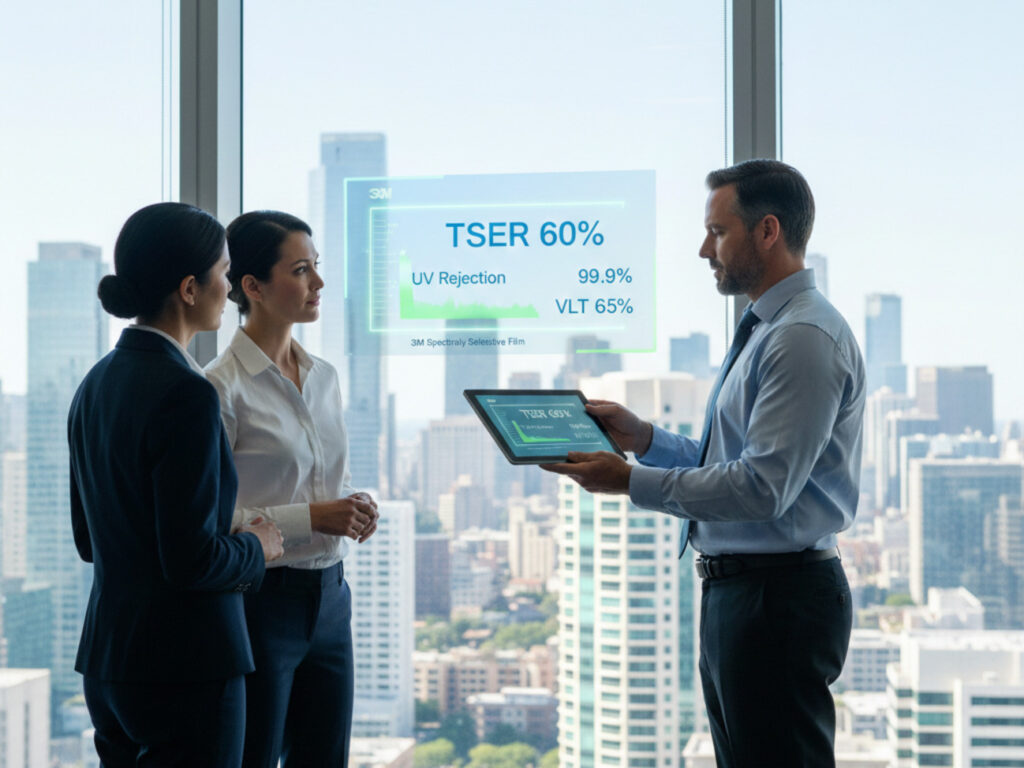
A 99% UV rejection rate is a critical baseline for quality window film. It is essential to understand what that percentage truly represents. Ultraviolet radiation is categorized into UV-A, UV-B, and UV-C. Most atmospheric UV-C is absorbed by the ozone layer. The primary concerns for interiors are UV-A and UV-B. Both types contribute to fading, material degradation, and potential health risks.
3M high-performance commercial films consistently reject nearly all UV-A and UV-B radiation. This comprehensive blocking protects sensitive merchandise, valuable furnishings, and electronics from premature fading. The differentiator is advanced material science, achieving protection without compromising other critical film properties. This is crucial for effective anti-fade window film.
The Full Spectrum: Understanding Total Solar Energy Rejected (TSER) and Solar Heat Gain Coefficient (SHGC)
For commercial projects, UV rejection is just one component of managing solar impact. Project managers must also consider how a film handles the broader solar spectrum.
- Total Solar Energy Rejected (TSER): This metric represents the percentage of total solar energy (including UV, visible light, and infrared) that is blocked by the film. A higher TSER directly translates to reduced heat gain through windows, which is a significant factor in a building’s HVAC load. For large-scale facilities, even a modest increase in TSER can lead to substantial energy cost savings over the lifespan of the film.
- Solar Heat Gain Coefficient (SHGC): SHGC measures the fraction of solar radiation admitted through a window, either directly transmitted or absorbed and re-radiated inward. It is expressed as a number between 0 and 1. Lower values indicate less solar heat gain. An optimal SHGC allows project managers to precisely control indoor temperatures, enhance occupant comfort, and minimize the operational strain on cooling systems, further de-risking project budgets through energy efficiency.
TSER and SHGC metrics provide a holistic view of a film’s thermal performance. These data points allow informed decisions regarding long-term operational costs and environmental footprints. This information is key for commercial window tinting and UV protection.
Preserving Visibility and Comfort: The Role of Visible Light Transmission (VLT) in Commercial Spaces
Blocking harmful rays and heat is crucial, but not at the expense of a building’s natural illumination or aesthetic appeal. Visible Light Transmission (VLT) indicates the percentage of visible light that passes through the film. A high-quality UV film, particularly one developed with multi-layer optical film technology, can achieve exceptional UV and heat rejection while maintaining high VLT.
This balance is critical for several reasons:
- Occupant Comfort and Productivity: Abundant natural light improves mood, reduces eye strain, and has been linked to increased productivity in commercial environments.
- Energy Savings (Lighting): Maximizing natural light reduces the reliance on artificial lighting during daylight hours, contributing to overall energy efficiency.
- Aesthetic Integrity: Maintaining clear, unobstructed views is vital for tenant satisfaction and the architectural intent of the building.
Advanced films selectively filter the solar spectrum, allowing desirable visible light to pass through the glass. These films simultaneously reject damaging ultraviolet radiation and solar heat. This capability is a hallmark of superior 3M film technology.
Health and Safety Standards: Decoding Skin Protection Factor (SPF) Ratings for Window Films
Beyond protecting physical assets, proactive UV management extends to occupant health and safety. While most associate SPF ratings with sunscreen, select high-performance window films also carry an SPF rating. This rating quantifies the level of protection against skin damage from UV radiation.
Films with ratings exceeding SPF 1000 justify investments for project managers prioritizing occupant well-being. This metric provides a tangible standard for communicating health benefits to stakeholders and tenants. It underscores a commitment to creating safer, healthier indoor environments. This adds project value and reinforces the decision to invest in premium UV protection.
The Science of Protection: Decoding Advanced Window Film Technologies for Commercial Use
Traditional Approaches vs. Modern Innovation: Understanding Film Construction
Historically, window films used dyed layers or metalized coatings for solar control. These early films often appeared dark and interfered with wireless signals. Modern innovation has revolutionized film construction. Today’s advanced films leverage multi-layer optical technology and nano-particle formulations. These films provide superior performance without previous compromises. This evolution allows films to precisely target specific light wavelengths. This offers sophisticated control over a building’s environment.
The Evolution of Performance: Exploring Spectrally Selective Film Technology
Spectrally selective films represent a significant leap forward in window film technology. Unlike traditional films, they are engineered to allow maximum visible light to pass through. These films selectively reject wavelengths that cause heat gain and harmful ultraviolet radiation. This sophisticated approach represents a fundamental shift toward highly engineered solutions. The result maintains natural daylighting and views for occupant comfort and productivity. These films deliver exceptional protective qualities without the need for traditional dark tinting.
Precision Engineering: How Spectrally Selective Films Balance Light, Heat, and UV Protection
Spectrally selective technology manages the solar spectrum with remarkable precision. These films block over 99% of harmful UVA and UVB rays. This protection prevents interior fading and occupant skin damage. Simultaneously, the films achieve high TSER values by rejecting infrared energy. They maintain high visible light transmission, often reaching 50-70%. Commercial spaces benefit from heat reduction without appearing dark. This balance preserves building aesthetics while allowing ample natural light.
Practical Applications: Matching Film Technology to Diverse Commercial Needs
Understanding these advanced film properties allows project managers to select solutions tailored to specific commercial demands. Different environments present unique challenges, and matching the right spectrally selective film technology can optimize outcomes:
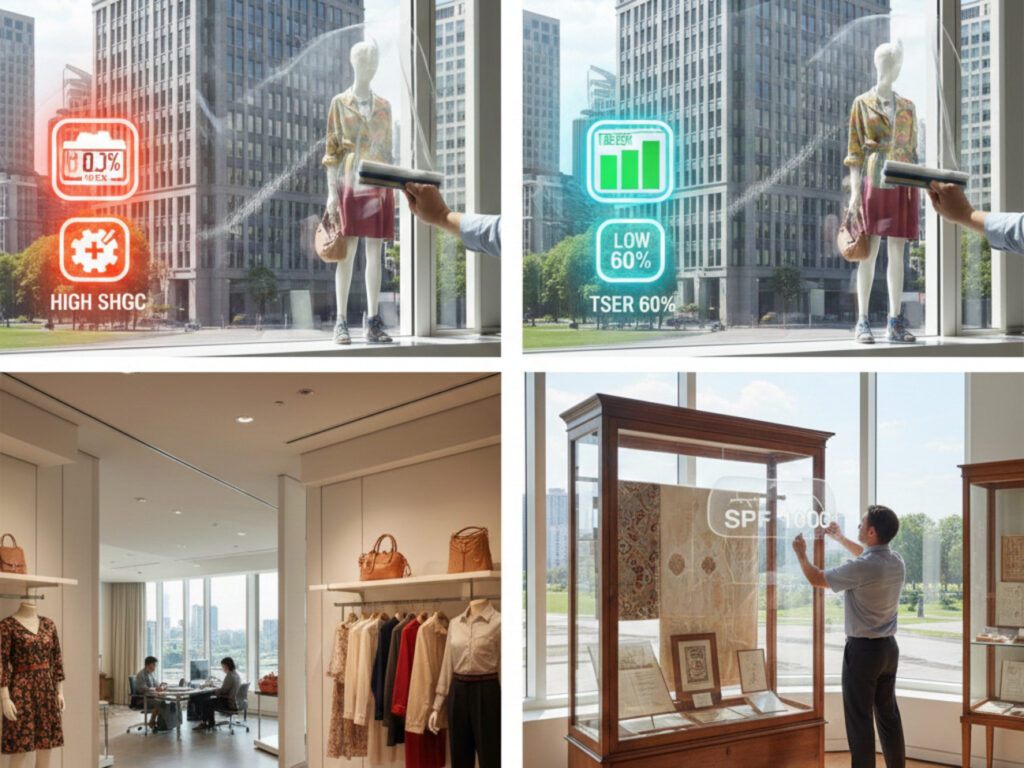
- Retail Spaces: High VLT films are essential to showcase merchandise accurately, while robust UV rejection protects valuable inventory from merchandise fading and sun damage.
- Museums and Archives: Maximum Ultraviolet (UV) radiation and IR rejection is paramount to preserve delicate artifacts and documents, preventing irreversible degradation without altering exhibition lighting.
- Corporate Offices: Films offering a balance of high VLT for natural light and effective TSER for comfort and energy efficiency create more productive work environments, protecting furnishings and equipment from UV exposure.
- Healthcare Facilities: Solutions that reduce glare and heat while maintaining privacy and an open feel contribute to patient comfort and operational efficiency, all while safeguarding interior assets.
Setting the Standard: Why 3M Window Films Lead the Way in UV Protection Innovation
A Legacy of Excellence: 3M’s Commitment to Advanced Film Technology
3M stands as a pioneer in materials science and innovation, a legacy that extends profoundly into window film technology. Their commitment to research and development has consistently pushed the boundaries of performance, moving beyond conventional film solutions to engineer products that address complex commercial challenges. This deep-rooted expertise positions 3M not just as a manufacturer, but as an innovator continually setting new benchmarks for quality, durability, and effectiveness in solar control and Ultraviolet (UV) radiation protection. For project managers, this commitment translates into reliable, cutting-edge products backed by decades of scientific advancement. This is why 3M UV window film is often a top choice.
Engineering for Performance: Exploring the Key 3M Film Series and Their Technical Superiority
3M’s advanced film series exemplifies their leadership in precision engineering, offering solutions that provide superior UV protection without the compromises often associated with older technologies.
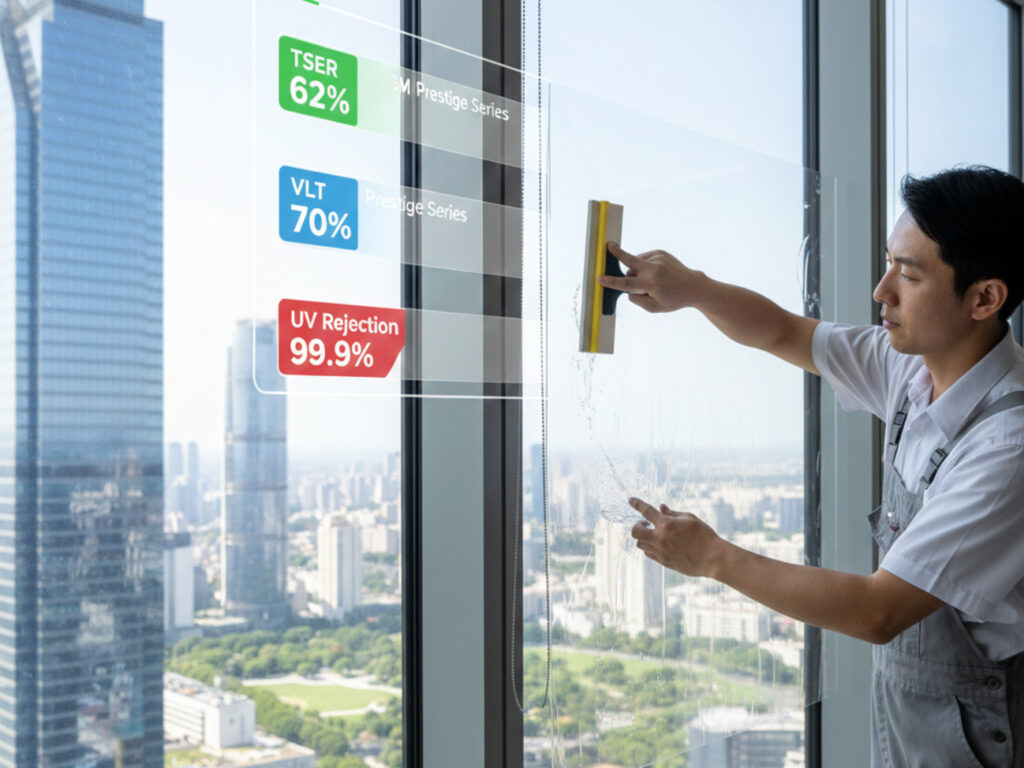
- 3M Prestige Series: These films utilize a proprietary, non-metallized, multi-layer optical film construction, featuring hundreds of micro-layers. This technology allows them to reject up to 97% of the sun’s heat-producing infrared light and 99.9% of UV rays, all while being virtually clear and maintaining the building’s original appearance. They are also non-corrosive and do not interfere with cellular or GPS signals.
- 3M Crystalline Series: Employing similar multi-layer technology, Crystalline films achieve exceptional TSER and Ultraviolet (UV) radiation rejection (99.9%) with remarkable clarity. Their construction allows for high visible light transmission even at significant solar rejection levels, making them ideal for projects where aesthetics and unobstructed views are critical.
3M’s engineering allows for industry-leading UV rejection combined with impressive heat control and clarity. These solutions fulfill the sophisticated demands of modern commercial projects.
Documented Performance: Leveraging 3M’s Data to Justify Superiority
For a project manager evaluating solutions, verifiable data is paramount. 3M provides extensive, transparent performance specifications for all its films, offering a robust foundation for decision-making and stakeholder justification. This includes detailed metrics such as:
- UV Rejection Percentage: Consistently demonstrating over 99% rejection of UVA and UVB rays, directly addressing concerns about fading protection and health.
- Total Solar Energy Rejected (TSER): Providing clear percentages of how much total solar energy, including visible light, infrared, and UV, is blocked.
- Visible Light Transmitted (VLT): Quantifying the amount of natural light allowed through the film, directly correlating to interior brightness and aesthetics.
- Shading Coefficient and Solar Heat Gain Coefficient (SHGC): Essential for energy modeling and demonstrating long-term operational savings.
These detailed specifications allow Project Manager Paul to present a data-driven case to clients and stakeholders, proving the tangible benefits and return on investment of choosing 3M films. This documentation de-risks the selection process by providing objective, measurable performance assurances for commercial asset protection.
Endorsed for Protection: The Significance of Recommendations from Organizations like the Skin Cancer Foundation
External validation from respected third-party organizations provides an invaluable layer of credibility for 3M films. Recommendation by the Skin Cancer Foundation serves as a powerful endorsement for these products. This signifies that films meet strict criteria for protecting occupants from harmful ultraviolet radiation. This endorsement offers a compelling, health-focused argument for asset protection and well-being. It provides concrete proof that resonates with stakeholders concerned with safety and corporate responsibility. Choosing 3M films becomes a clear, justifiable, and responsible decision for project managers.
The Unsung Hero: Why National Installation Expertise is Non-Negotiable for Flawless Performance
Beyond the Product: The Crucial Role of Professional Installation in Achieving Stated Performance
Selecting premium 3M UV-protective film is foundational for any project. However, stated performance metrics are contingent upon flawless application. Inexperienced installation can severely compromise a film’s inherent technical capabilities. Imperfections like air bubbles or dust contamination degrade aesthetic quality and structural integrity. Poor adhesion also reduces the film’s ability to block harmful rays effectively. Project managers must recognize that on-glass performance depends on installation skill. Expert application is a critical component of commercial asset protection.
Consistency Across the Board: The Complexities of National Rollouts for Commercial Projects
Commercial projects spanning multiple locations face significant logistical challenges regarding uniform quality. Consistent installation is paramount for maintaining brand standards and equitable asset protection. Every location must benefit from the specified UV and energy performance. National installers provide standardized training and certified technicians. Centralized project management addresses these complexities effectively. This ensures every square foot meets rigorous quality control standards. This approach minimizes variability and leads to predictable project outcomes.
Mitigating Risk: How a National Installer Guarantees Project Continuity and Predictable Outcomes
Engaging a national installer for large-scale window film projects strategically de-risks your operations. These partners provide high accountability and operational resilience. Their established infrastructure supports project continuity and handles unforeseen challenges efficiently. This prevents material shortages and costly scheduling delays.
Key risk mitigation benefits include:
- Standardized Protocols: Adherence to proven installation methodologies, ensuring consistent quality regardless of location.
- Comprehensive Insurance and Bonding: Robust coverage protects against liability and unforeseen issues.
- Resource Mobilization: The capacity to deploy trained teams and materials swiftly across diverse geographies.
- Centralized Project Management: A single point of contact simplifies communication and oversight for multi-site deployments.
This structured approach translates directly into predictable project timelines and outcomes, which is invaluable for project managers accountable for budget and schedule adherence.
The Logistics Advantage: Ensuring Timely Execution and Quality Control for Multi-Location Deployments
A national installation partner’s logistical prowess is the cornerstone of successful multi-location commercial projects. Effective supply chain management ensures the right film arrives exactly when needed. This minimizes on-site storage issues and potential project delays. Furthermore, national installers employ sophisticated scheduling and deployment strategies. They coordinate multiple teams across different time zones or challenging access scenarios effectively.
Their logistical advantage extends to:
- Efficient Material Procurement: Leveraging relationships with manufacturers like 3M for consistent supply.
- Optimized Scheduling: Minimizing disruption to client operations through flexible and coordinated installation windows.
- Rigorous Quality Control Checks: Implementing multi-stage inspection processes to verify application standards at every site.
This comprehensive logistical framework guarantees that the project progresses smoothly, efficiently, and to the highest quality standards, from the initial order to the final walkthrough at every single location.
Empowering Project Managers: Strategically Specifying UV Film for Client Satisfaction and Project Success
Defining Project Goals: Aligning Film Selection with Asset Protection and Energy Efficiency Objectives
Effective UV film specification begins with a clear understanding of the client’s overarching project goals. While UV protection is a primary concern for safeguarding interiors from fading and degradation, project managers must also consider other critical objectives. These often include energy efficiency targets, glare reduction, enhanced privacy, or even security improvements. For instance, a client focused on reducing operational costs might prioritize films with a high TSER value. A museum, however, might choose a virtually clear film offering maximum UV rejection with minimal impact on visible light transmission (VLT). Aligning film selection with these specific objectives ensures that the chosen solution delivers multifaceted value, extending beyond mere Ultraviolet (UV) radiation filtration.
Translating Technical Specs into Tangible Benefits: Communicating Value to Clients and Stakeholders
Project managers often need to bridge the gap between technical specifications and concrete business benefits when communicating with clients and stakeholders. A film’s impressive 99% UV rejection figure, while important, resonates more powerfully when translated into protecting millions of dollars in retail merchandise from sun damage, preserving invaluable historical artifacts, or preventing the premature aging of interior furnishings. Similarly, a high TSER rating translates into reduced HVAC load, which directly impacts energy consumption and operational expenditures. By framing technical data in terms of asset preservation, cost savings, tenant comfort, and extended material lifespan, project managers can effectively articulate the long-term value proposition of premium window film solutions.
Building Your Case: Leveraging Data and Expertise to Justify Premium Film and Installer Choices
Justifying the investment in premium 3M window films and a national installation partner requires a data-driven approach supported by expert insights. Project managers can build a compelling case by presenting quantifiable performance data directly from 3M. This includes specific UV rejection percentages for different film types, TSER values, and light transmission ratings. This factual information should be complemented by the national installer’s proven track record, demonstrated through case studies of successful multi-location projects, references, and a clear outline of their standardized processes and quality control measures. Emphasizing the reduced risk, guaranteed consistency, and long-term reliability offered by this combined approach provides robust justification for choosing a superior, albeit potentially higher-initial-cost, solution for the best UV protection film for windows.
Long-Term Value: Understanding ROI, Warranties, and the Contribution to Certifications like LEED
The long-term value proposition of premium UV film installations extends significantly beyond immediate asset protection. Project managers should highlight the substantial Return on Investment (ROI) derived from energy savings due to improved thermal performance, which can be modeled over various payback periods. Furthermore, comprehensive warranties, covering both the 3M film product and the national installer’s labor, offer unparalleled peace of mind and protection against future defects or performance issues. For clients focused on sustainability, specifying certain window films can contribute to achieving crucial building certifications, such as LEED certification. These contributions can include optimizing energy performance credits or enhancing indoor environmental quality, further cementing the strategic value of a meticulously chosen film and installation partner.
Conclusion: Elevating UV Protection from a Line Item to a Strategic Asset Investment
In the intricate landscape of large-scale commercial projects, seemingly minor line items can carry significant long-term implications. UV protection, often viewed simply as a necessary expense, fundamentally shifts its character when understood as a strategic investment. For project managers tasked with safeguarding high-value assets and ensuring consistent operational integrity, the objective is not merely to block UV rays but to do so with unparalleled efficacy, minimal aesthetic compromise, and guaranteed implementation.
The true measure of superior UV protection extends beyond the ubiquitous “99% UV rejection” claim. While this figure is standard for most quality films, the critical differentiator lies in how effectively a film simultaneously mitigates other detrimental solar impacts, such as heat gain, while preserving natural light and views. This is where advanced solutions, exemplified by 3M’s innovative film technologies, redefine the standard for the best UV protection film for windows. By specifying films that deliver high Total Solar Energy Rejected (TSER) values alongside their robust UV blocking capabilities, you are not just preventing fading protection. You are actively managing energy consumption and enhancing occupant comfort, directly impacting the asset’s operational efficiency and value.
Beyond the film’s technical specifications, the consistent and flawless application across a single facility or a nationwide portfolio is paramount. A superior product incorrectly installed yields negligible benefits. This underscores the indispensable role of a proven national installer for commercial window tinting for UV protection. Their logistical expertise, certified installation teams, and comprehensive project management capabilities transform the theoretical benefits of advanced film into tangible, verifiable performance. This partnership de-risks your project, providing a singular point of accountability and ensuring uniform adherence to manufacturer specifications and warranty conditions, which is crucial for asset longevity and stakeholder confidence.
Ultimately, presenting a UV protection strategy that combines 3M’s leading-edge film technology with the logistical certainty and installation excellence of a national partner like Window Film Depot provides a robust justification for stakeholders. It positions this choice not as a mere procurement decision, but as an informed, strategic investment that yields multiple dividends:
- Commercial Asset Protection: Protecting interiors, merchandise, and critical infrastructure from Ultraviolet (UV) radiation degradation.
- Operational Efficiency: Reducing HVAC loads through superior heat rejection, lowering energy costs.
- Enhanced Occupant Experience: Maintaining natural light while mitigating glare and hot spots.
- Project De-risking: Guaranteeing consistent performance and warranty adherence across all locations.
- Long-term Value: Contributing to the sustained aesthetic and functional integrity of commercial properties, and potentially contributing to LEED certification.
By focusing on these multifaceted benefits and leveraging the combined strengths of advanced film technology and expert installation, project managers can elevate UV protection from a simple cost to a strategic asset investment that demonstrably contributes to a project’s overall success and financial viability.
Frequently Asked Questions
What does “99% UV rejection” really mean for window films?
Accordion content. While 99% Ultraviolet (UV) radiation rejection is a good baseline, it primarily refers to blocking harmful UV-A and UV-B rays. The true performance for commercial applications also considers how effectively a film manages the entire solar spectrum, including heat (infrared) and visible light, without compromising natural light or appearance.
Why are Total Solar Energy Rejected (TSER) and Solar Heat Gain Coefficient (SHGC) important?
TSER measures the total solar energy blocked by the film, directly impacting heat gain and HVAC costs. SHGC indicates how much solar radiation is admitted through the window. Both are crucial for energy efficiency, occupant comfort, and lowering long-term operational costs in commercial settings.
How do spectrally selective films improve on traditional window tinting?
Spectrally selective films use advanced technology to allow maximum visible light through while specifically rejecting heat-producing infrared and harmful Ultraviolet (UV) radiation. This means better natural lighting, reduced heat, and superior protection without making windows look dark or reflective, offering a balanced solution for commercial window tinting for uv protection.
Why is professional, national installation critical for commercial UV film projects?
Professional, national installation ensures consistent quality, adherence to manufacturer specifications, and warranty validity across all locations. It mitigates risks like improper application, offers centralized project management for multi-site rollouts, and guarantees the film’s stated performance metrics are achieved, delivering predictable and reliable outcomes for commercial asset protection.
Can choosing a specific window film contribute to LEED certification?
Yes, specifying high-performance window films can contribute to LEED certification. Films that optimize energy performance by significantly reducing solar heat gain (indicated by a good Solar Heat Gain Coefficient, SHGC) and enhance indoor environmental quality by maintaining natural light and reducing glare can help earn LEED credits.
What does “99% UV rejection” really mean for window films?
Accordion content. While 99% Ultraviolet (UV) radiation rejection is a good baseline, it primarily refers to blocking harmful UV-A and UV-B rays. The true performance for commercial applications also considers how effectively a film manages the entire solar spectrum, including heat (infrared) and visible light, without compromising natural light or appearance.