Table of Contents:
- Why Ballistic Glass Is Not Always the Right Answer for Your Project
- What Ballistic Film for Windows Actually Is and How It Works
- Understanding Ballistic Protection Ratings: UL 752, NIJ Levels, and What They Mean on the Job
- Ballistic Film vs. Ballistic Glass: A Practical Comparison for Project Managers
- Where Ballistic Window Film Is Most Commonly Specified
- Installation Logistics for Large-Scale and Multi-Site Projects
- How to Evaluate a Ballistic Film Installer Before You Commit
- Integrating Ballistic Film into a Broader Glass Security System
- Conclusion: From Specification Confidence to Project Execution
- Frequently Asked Questions
Why Ballistic Glass Is Not Always the Right Answer for Your Project
Choosing the right ballistic film for windows starts with understanding real threats, realistic budgets, and building operations. Many facilities assume full ballistic glass replacement is the only serious option, but that is often the most disruptive and expensive path. Modern ballistic film can provide tested protection against common handgun-level threats while preserving existing glazing and avoiding major construction downtime. This guide explains where film fits, where glass is still required, how ratings work, and how project managers can build a defensible security specification with confidence.
The Default Assumption Project Managers Make — and Why It Deserves Scrutiny
Most security upgrade projects start with the same default specification: replace existing glazing with ballistic glass. It’s the intuitive answer. If the threat involves projectiles, the solution must be the glass itself. But that assumption collapses quickly when you run the numbers on a 200-window school district retrofit or a municipal building with curtain-wall glazing from the 1990s.
Ballistic glass replacement means full frame-out on every opening: structural assessment, new framing in many cases, weeks of construction disruption per building, and per-opening costs that routinely run five to ten times higher than film-based alternatives. For many projects, the budget simply doesn’t support it. For others, the construction timeline doesn’t either.
The smarter question isn’t “should we use ballistic glass?” It’s “what protection level does this facility actually require, and what assembly achieves that level at acceptable cost and disruption?” That reframe is where ballistic film for windows enters the specification conversation as a serious candidate.
How Ballistic Window Film Fits the Commercial and Institutional Security Spectrum
Ballistic window film occupies a specific and well-defined band on the glazing security spectrum. Not the top, but not the bottom either. It performs above standard anti-intrusion and blast film, and it achieves meaningful, testable protection against lower-caliber ballistic threats when properly specified and installed.
For schools, government offices, retail branches, and similar facilities, the realistic threat profile typically involves handguns and forced-entry attempts rather than rifle fire. Film-based assemblies, tested and rated under UL 752, address that threat band directly. They won’t stop a .30-caliber rifle round, and no reputable installer will claim otherwise. But for the threat levels that actually drive most institutional security briefs, film delivers documented performance at a fraction of replacement glazing cost.
Defining the Scope: What This Article Will and Will Not Claim About Film Performance
This article provides an accurate picture of what ballistic film for windows can and cannot do, framed around the standards that govern its performance, the installation variables that determine whether those standards are met in the field, and the project logistics that matter when you’re specifying across multiple sites.
What this article will not do is overstate film’s capabilities to make it sound like a universal solution. Film does not turn standard glass into bulletproof glass. It is not a substitute for ballistic-rated glazing when the threat profile demands it. The goal here is precision: helping you determine where film is the right specification, and where it isn’t.
What Ballistic Film for Windows Actually Is and How It Works
The Physical Mechanism: Impact Absorption, Glass Retention, and Penetration Delay
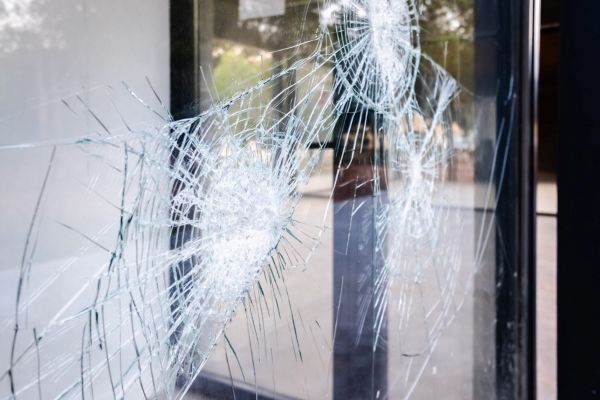
Ballistic window film is a multi-layer polyester laminate, typically 11 to 14 mils thick, bonded directly to the interior surface of existing glass. When a projectile or blunt impact strikes the pane, the glass fractures as it normally would, but the film holds the fragments together and maintains the integrity of the opening.
The protection mechanism is not absorption of the round itself. It is resistance to penetration through a compromised pane. The film stretches under load, distributes impact energy across a wider surface area, and delays the time-to-breach by keeping the glass intact as a barrier even after fracture.
How Film-to-Frame Anchoring Transforms a Standard Pane Into an Attack-Resistant Assembly
Film applied to glass without edge attachment provides fragment retention but limited resistance to complete pane displacement. The critical upgrade is film-to-frame anchoring, which extends the film past the glass edge and bonds it directly to the frame, typically with a structural silicone or mechanical attachment system.
This edge bond transfers impact load from the glass to the frame, turning the entire glazed opening into a load-sharing assembly. A properly anchored film system resists pane blow-out, significantly increases the force required to breach the opening, and is the configuration required for ballistic and blast test ratings. Film applied without edge attachment does not meet the same performance threshold, regardless of film thickness.
Fragment Retention Versus Bullet Stopping: Why the Distinction Matters for Specification
These are two different performance claims, and conflating them is the most common specification error. Fragment retention, which keeps glass in place after fracture, is achievable with security film across a wide range of products. Ballistic performance, meaning resistance to penetration by a projectile, requires specific film thicknesses, construction methods, and documented test results against defined threat levels.
When a project manager asks whether a film is bulletproof, the technically correct answer is that no film product is bulletproof, but rated ballistic film assemblies are tested to resist penetration at specific calibers and velocities. Specifying based on that distinction protects you from both underselling the product’s real capability and overclaiming it to a facilities committee.
How Ballistic Film Differs from Standard Security Film and Laminated Safety Glass
Standard security film, typically 4 to 8 mils thick, addresses forced entry, breakage, and blast pressure. It holds glass together under impact but does not provide ballistic resistance at any rated level. Ballistic film products start at thicker constructions, use higher-tensile polyester substrates, and are tested specifically against projectile threats.
Laminated safety glass achieves its performance through an interlayer bonded between two glass lites during manufacturing, with the protection built into the glass unit itself. Ballistic film retrofits that concept onto existing single-pane or insulating glass units without full replacement. That’s the source of both its primary advantage (cost, retrofit feasibility) and its primary limitation: a film-glass assembly will not match the performance ceiling of purpose-built ballistic-rated glazing.
Understanding Ballistic Protection Ratings: UL 752, NIJ Levels, and What They Mean on the Job
How UL 752 Levels Are Structured and Which Threat Categories They Address
UL 752 is the primary standard governing ballistic-resistant glazing in the United States. It defines eight protection levels, each corresponding to a specific firearm caliber, bullet weight, velocity, and number of shots. Level 1 addresses 9mm handgun fire. Levels escalate through .357 Magnum, .44 Magnum, and high-powered rifle at Level 8. Each level is tested at a defined distance with three shots grouped within a specified area, with no complete penetration allowed.
The standard applies to the complete assembly as tested, not to the film alone. A film product rated under UL 752 was tested as part of a specific glass-film configuration, at a defined thickness, with or without edge attachment. Specifying a film product without matching the tested assembly conditions does not guarantee the rated performance.
Where Ballistic Film Sits on the UL 752 Scale
Current ballistic film products tested under UL 752 typically achieve Levels 1 through 3, covering 9mm, .357 Magnum, and .44 Magnum handgun threats. Some advanced multi-layer constructions have demonstrated performance at Level 4 (.30 caliber rifle) under specific test conditions, but this is not universal across product lines.
Levels 5 through 8, covering 7.62mm rifle, 9mm submachine gun, and .50 BMG, are not achievable with film applied to standard commercial glass. Those threat levels require purpose-built ballistic glazing products. If a project’s risk assessment identifies rifle-level threats as credible, film is not the appropriate primary glazing defense for those openings.
NIJ Ballistic Standards and How They Relate to Commercial Glazing Specifications
The National Institute of Justice (NIJ) standards, primarily NIJ 0108.01, govern ballistic-resistant protective materials and are more commonly referenced in law enforcement and corrections specifications than in commercial construction. NIJ Level IIA and Level II correspond roughly to the handgun threat range where ballistic film operates. Level III and IIIA address rifle and high-velocity handgun threats that exceed film capability.
For most commercial and institutional projects, UL 752 is the controlling standard. NIJ levels become relevant when a project involves law enforcement facilities, detention environments, or federal specifications that reference NIJ directly. Understanding both frameworks matters when you’re presenting a specification to a procurement committee that may use the terminology interchangeably.
Relevant Supplementary Standards: ASTM F1233, GSA Blast Requirements, and Building Code Intersections
ASTM F1233 governs forced-entry resistance, a performance category distinct from ballistic resistance but often specified alongside it. Many ballistic film assemblies carry dual ratings under both UL 752 and ASTM F1233, which is relevant for facilities where both gunfire and forced-entry delay are specification objectives.
GSA blast mitigation requirements apply to federal facilities and use a hazard rating system tied to glazing fragment hazard after blast loading. Ballistic film assemblies with edge attachment can satisfy certain GSA blast ratings, which creates a useful specification overlap for government projects where both blast and ballistic concerns are present. Local building codes rarely address ballistic performance directly, but any specification should be reviewed against applicable life safety and glazing codes for the jurisdiction.
What Protection Level Does a School, Government Building, or Retail Chain Actually Need?
The honest answer requires a documented threat assessment, not a one-size answer. That said, practical patterns emerge across facility types.
K-12 schools and universities addressing active shooter scenarios most commonly specify UL 752 Level 1 through Level 3 because that matches the documented threat profile of school-based incidents. Government offices at the state and municipal level typically target Level 2 or Level 3 as a baseline, with higher levels at specific high-risk access points. Retail locations, particularly financial institutions and pharmacy chains, focus on Level 1 through Level 2 for teller lines and customer-facing glazing.
Need More Info?
The Window Film Depot team is happy to help.
The facility zone matters as much as the building type. A school’s main entrance vestibule may warrant Level 3 film with edge attachment, while interior corridor windows may be appropriately addressed with anti-intrusion film only. Matching protection level to zone-specific risk is how you build a defensible specification and avoid overbuilding at a cost the project cannot sustain.
Specification Evaluation Framework: A Decision Process for Project Managers
Use this framework to structure your glazing security specification before engaging vendors or presenting to a facilities committee.
Step 1:
- Document the Threat Profile. Identify the specific threats driving the security upgrade for each facility zone: handgun, rifle, forced entry, blast, or a combination. Use local law enforcement input, insurance requirements, and incident history as inputs. Avoid defaulting to “maximum protection” without a documented threat basis, as it inflates cost and complicates vendor selection.
Step 2:
- Identify Applicable Standards. Determine which standards govern the specification. UL 752 covers ballistic resistance and is the primary standard for commercial glazing. ASTM F1233 covers forced-entry resistance. GSA blast hazard ratings apply to federal facilities. NIJ standards apply when law enforcement or corrections specifications are involved.
Step 3:
- Assess Existing Glazing Conditions. Have a certified installer inspect existing glass for condition, thickness, frame type, and edge detail. Film-to-frame anchoring feasibility depends on frame material and condition. Cracked, delaminated, or non-standard glass may require partial replacement before film installation.
Step 4:
- Map Protection Level to Facility Zone. Assign a target UL 752 level to each zone category, including primary entry, perimeter windows, interior glazing, and high-risk areas. Zones with rifle-level threat requirements should be flagged for ballistic glass replacement. Zones with handgun-level requirements are candidates for ballistic film.
Step 5:
- Evaluate Film vs. Glass vs. Hybrid Assembly. For each zone, compare the required protection level against film’s tested capability, retrofit feasibility and construction disruption tolerance, budget per opening and total project cost, and lead time requirements. Zones where film meets the protection requirement should default to film unless operational or aesthetic factors override. Zones where the required protection level exceeds film capability should specify ballistic glass, and that distinction should be documented in the project record.
Step 6:
- Define Installation Specifications. For all film specifications, document the required assembly configuration: film product, glass type, edge attachment method, and test standard reference. This protects the specification from substitution by vendors offering lower-performing products.
Ballistic Film vs. Ballistic Glass: A Practical Comparison for Project Managers
Protection Level by Level: Where Film Performs and Where Glass Takes Over
The protection gap between ballistic film and ballistic glass is real, but it’s narrower than glass manufacturers typically represent and wider than film advocates sometimes admit. Ballistic film assemblies, properly specified and installed with edge attachment, cover UL 752 Levels 1 through 3. That range addresses 9mm, .357 Magnum, and .44 Magnum handgun threats. For the documented threat profiles driving most institutional security briefs, that coverage is sufficient.
Where glass takes over is above Level 3. Rifle-caliber threats, including 7.62mm, 5.56mm, and higher, require purpose-built ballistic glazing. Film applied to standard commercial glass cannot absorb the kinetic energy of a rifle round, and no credible test data suggests otherwise. If a threat assessment identifies rifle fire as a credible scenario for specific openings, those openings require ballistic glass. That’s not a limitation of film technology. It’s a calibration issue. Specify the right tool for the documented threat level.
Retrofit Feasibility: Why Film Changes the Construction Equation on Existing Buildings
Replacing existing glazing with ballistic-rated glass means removing frames, assessing rough openings, often upgrading structural support, and reinstalling.
That process typically requires full perimeter access, construction barriers, and weeks of disruption per building. On a functioning school or occupied government facility, that construction footprint is a major constraint.
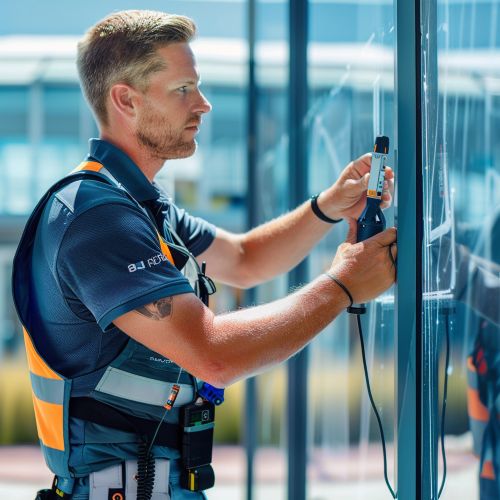
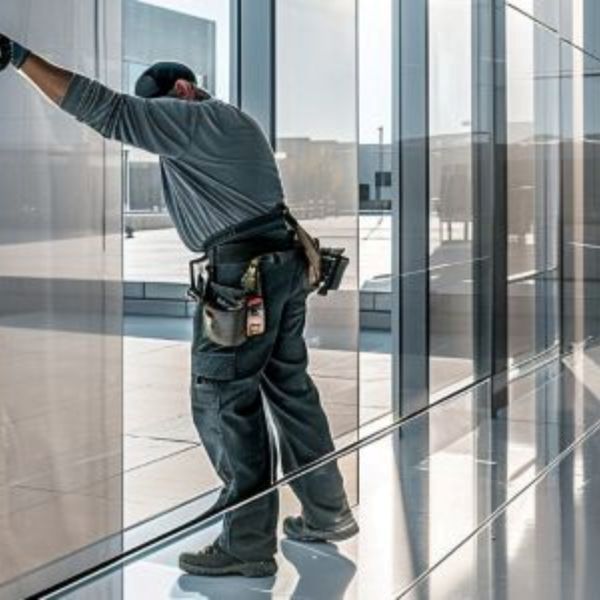
Film installation works on existing glass in existing frames. A qualified crew applies the film to the interior glass surface, extends it to the frame with a structural attachment system, and completes the opening without any frame removal or structural modification.
A standard classroom window takes a fraction of the time that a glazing replacement requires. Across a 40-school district, the cumulative schedule difference runs into months, not weeks.
Lead Time, Procurement, and Supply Chain Realities for Each Solution
Ballistic glass units are custom-fabricated to opening dimensions and typically carry lead times of eight to sixteen weeks, sometimes longer for higher protection levels or non-standard sizes. A multi-building project requires coordinated delivery sequencing, staging space, and installation crews available in alignment with delivery windows.
Ballistic film ships from distributor stock in most cases, with lead time measured in days to a few weeks rather than months. For a school district operating on a summer construction window or a government facility with a fiscal-year deadline, the procurement timeline difference alone can determine whether a project is executable in the target cycle. Film also eliminates the breakage and reorder risk that comes with custom glass units on large projects.
Aesthetic and Operational Impact: Visibility, Daylighting, and Occupant Experience
High-quality ballistic film is optically clear. When properly installed, it is effectively invisible to building occupants and visitors. Vision glazing areas maintain their transparency, daylighting is unaffected, and the visual character of the building interior and exterior does not change. This matters for schools and government buildings where a hardened appearance would conflict with institutional or community expectations.
Ballistic glass may introduce visible distortion depending on the glass construction and protection level, particularly at higher levels where thicker laminate interlayers are required. Some lower-level units are visually acceptable in standard applications, but aesthetic trade-offs become more significant as protection level increases. For facilities where occupant experience and architectural intent must be preserved, film’s transparency is a specification advantage that deserves explicit weight in the evaluation.
Cost Comparison: Modeling Film vs. Glass Across Common Project Types
The cost difference between film and glazing replacement is not marginal. Film-based ballistic upgrades typically run $20 to $50 per square foot installed, depending on film specification, opening complexity, and edge attachment requirements. Ballistic glass replacement at comparable protection levels typically runs $150 to $400 per square foot or higher, including removal, framing, and installation. A 5x to 10x cost differential is a reasonable working assumption for planning purposes.
Illustrative Cost Model: Single-Facility Retrofit
Consider a municipal office building with 120 standard windows averaging 15 square feet each, totaling 1,800 square feet of glazing. A UL 752 Level 2 film specification with edge attachment at approximately $40 per square foot installed yields a total of roughly $72,000. The same openings upgraded to Level 2 ballistic glass could realistically cost $250 per square foot or more, bringing the total above $450,000 before accounting for frame modifications and extended construction disruption. The film specification delivers the same rated protection for the documented threat at roughly 15% of the glazing replacement cost.
Illustrative Cost Model: Multi-Site District or Chain Deployment
Scale amplifies the cost differential. A 30-school district with an average of 200 windows per building and a targeted UL 752 Level 1 specification faces roughly 90,000 square feet of glazing. At $35 per square foot installed for film, the total project cost runs approximately $3.15 million. A glass replacement approach at $200 per square foot carries a baseline of $18 million, before the extended schedule that may require phased execution across multiple budget years. For a facilities committee evaluating both paths, the film specification isn’t a compromise. It’s the financially defensible choice for the documented protection requirement.
Where Ballistic Window Film Is Most Commonly Specified
K-12 and Higher Education: Balancing Active-Threat Response with Operational Continuity
School security specifications face a constraint unique to the building type: the hardening solution cannot make the building feel like a prison. Administrators and school boards consistently reject approaches that compromise the open, welcoming character of educational environments, regardless of the security benefit. Ballistic film resolves that tension. It upgrades the protective performance of existing glazing without changing how a building looks or operates.
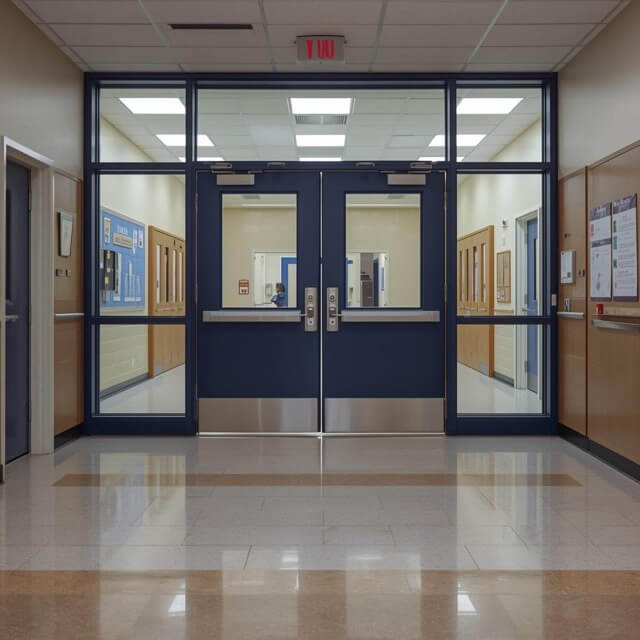
The typical school specification focuses on entry vestibules, administrative office glazing, and corridor-facing classroom windows, which are the zones where a delayed-entry or containment function delivers the highest protective value.
A well-designed zone-based film specification addresses those priorities without treating every window in the building as a Level 3 threat target. That precision keeps project costs manageable and the specification defensible to school boards evaluating both security and budget.
Government and Municipal Buildings: Compliance Frameworks and Procurement Considerations
Government building specifications frequently involve layered compliance requirements: GSA standards for federal facilities, state procurement rules for municipal buildings, and sometimes NIJ references for law enforcement-adjacent environments. Ballistic film assemblies with documented UL 752 ratings and, where applicable, ASTM F1233 forced-entry ratings give procurement teams the standards documentation they need to satisfy compliance review.
Municipal projects often require formal bid processes with product substitution restrictions. Specifying film by assembly configuration, covering film construction, glass type, edge attachment method, and test standard reference, rather than by brand alone, protects the specification from being diluted by lower-performing substitutions during procurement. Experienced installers who work regularly in the government space understand how to support that documentation.
Retail and Commercial: High-Traffic Perimeter Protection Without Architectural Disruption
Retail glazing presents a different challenge: high visual exposure, constant foot traffic, and an operational requirement that the facility never go dark. Pharmacies, financial branches, and jewelry retailers specify bullet resistant window film for teller lines, service counters, and storefront glazing where the combination of forced-entry delay and ballistic resistance addresses the actual threat profile, including smash-and-grab, armed robbery, and targeted theft.
Installation in occupied retail environments requires night or off-hours scheduling, panel-by-panel sequencing to keep display areas intact, and crews experienced in working around active sales floors. The film installs without the dust, debris, or extended closure that glazing replacement would require, making it the practical choice for any retail operator who cannot afford extended downtime.
How Facility Zone Risk Assessment Drives Film Specification Across a Single Building
Within a single building, the protection specification should not be uniform. Entry vestibules and lobby glazing facing public access warrant higher film specifications than interior office partitions. Glazing adjacent to cash handling or high-value storage warrants different treatment than perimeter windows in lower-risk zones.
A practical zone mapping process assigns each glazed opening to a risk tier based on access level, incident history, adjacency to high-value areas, and operational function. That map drives the film specification: UL 752 Level 3 with edge attachment at primary entry points, Level 1 or 2 at secondary perimeter windows, and standard security film for interior glazing where ballistic risk is not the controlling threat. The result is a specification that concentrates protective investment where it has the highest impact.
Installation Logistics for Large-Scale and Multi-Site Projects
Surface Preparation, Glass Condition Assessment, and Pre-Installation Requirements
Film performance depends on adhesion quality, and adhesion quality depends on glass condition. Before any film is cut or staged, a qualified installer inspects every pane for existing damage: chips, cracks, delamination on insulating glass units, and surface contamination. Panes with edge damage or compromised seals on IGUs can fail after film installation, creating warranty and performance disputes. Identifying those conditions before installation, not after, is a core project management responsibility.
Surface preparation includes cleaning to remove silicone residue, adhesive traces, and hard water deposits that would compromise bond strength. On older buildings, this step takes longer than anticipated and should be budgeted explicitly in the project schedule. Skipping or shortcutting prep is the most common source of installation failures on large projects.
Scheduling Across Multiple Buildings or Sites Without Disrupting Operations
Large-scale film projects succeed or fail on sequencing logic. The installer’s project manager should deliver a site-by-site schedule that accounts for occupancy patterns, restricted access windows, and coordination requirements with facilities staff at each location. For a school district, that typically means summer execution with defined start and completion dates per building. For government buildings, it may mean after-hours installation on occupied floors.
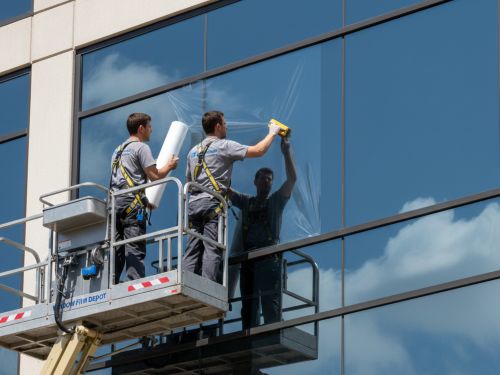
Crew deployment strategy matters at scale. A single crew moving sequentially through 30 school buildings cannot complete a summer window. Parallel deployment, with multiple crews operating simultaneously across sites, requires the installer to have both the staffing depth and the project management infrastructure to coordinate quality consistently across all active sites.
What a Qualified Installer’s Project Management Process Looks Like at Scale
A qualified installer operating at scale assigns a dedicated project manager to the contract, not a sales representative who transitions to a service role after award. That project manager owns the schedule, coordinates site access with each facility’s staff, manages material staging and crew deployment, and tracks completion against the project plan.
Pre-mobilization documentation should include a site survey report for every building, a per-opening specification matrix confirming film product and assembly configuration, and a signed access coordination plan with each facility contact. Projects that skip this documentation phase tend to discover scope discrepancies and access conflicts mid-execution, when they’re most expensive to resolve.
Can a Professional Window Film Installer Handle a Large Multi-Building Project on Schedule?
The answer depends entirely on the installer’s organizational infrastructure, not their technical competence alone. A firm that installs film competently on individual commercial projects is not automatically capable of managing a 30-building concurrent deployment. The differentiating factors are crew depth, project management staffing, materials supply relationships, and experience with institutional procurement and documentation requirements.
When evaluating a vendor for a large multi-site project, ask specifically: How many concurrent multi-building projects has this firm executed in the past 24 months? What was the largest by square footage? Can they provide a reference contact at a comparable school district or government client? Those questions surface capability gaps that credentials and portfolio photos won’t reveal.
Quality Control, Documentation, and Post-Installation Verification
Every installation should be documented at the opening level. That means a completion record for each pane that includes the film product applied, installation date, crew member, and any pre-existing glass conditions noted during prep. This documentation supports warranty claims, serves as evidence of specification compliance for facilities committees, and provides the baseline for future re-lamination planning.
Post-installation verification should include visual inspection for bubbles, edge-seal integrity, and adhesion quality across a defined sample of completed openings. On larger projects, a third-party inspection on a percentage of openings provides independent documentation of specification compliance, which is particularly useful when presenting project completion to a government procurement authority.
Interior vs. Exterior Installation: Technical Trade-Offs and Site-Specific Decisions
Most ballistic film installations are interior applications. The film bonds to the interior glass surface, the edge attachment connects to the interior frame, and the assembly is protected from weather and UV exposure by the glass itself. Interior installation also allows the crew to work without exterior access equipment on upper floors, which reduces schedule complexity and cost.
Exterior installation is technically feasible with specific film products designed for outdoor exposure, and it makes sense in cases where interior access is restricted or where the film needs to address exterior surface threats. The trade-offs are reduced film lifespan due to UV and weather exposure, higher maintenance requirements, and more complex edge attachment to exterior frames. Interior installation is the default specification for anti-ballistic window protection in most commercial and institutional applications.
How to Evaluate a Ballistic Film Installer Before You Commit
Credentials, Certifications, and Manufacturer Authorization
Manufacturer authorization is the baseline credential. A certified installer has completed the manufacturer’s training program for the specific product line, which means they understand the application requirements, adhesion protocols, and edge attachment specifications for the films they’re selling. Authorization also typically means the manufacturer will back the product warranty when the installer certifies the installation.
Industry certifications from organizations like the International Window Film Association (IWFA) indicate a commitment to professional standards and ongoing education. For ballistic film specifically, look for installers who can produce test documentation for the assemblies they’re proposing. Any installer who cannot produce UL 752 test reports for the specific film-glass assembly being specified should be treated with caution.
Capacity Indicators: How to Assess Whether a Vendor Can Handle Your Project Volume
Beyond certifications, capacity assessment requires direct questions about organizational structure. How many installation crews does the firm operate? Do they use employees or subcontractors, and if subcontractors, how do they manage quality control? What is their current project backlog, and can they commit to your mobilization timeline?
Request a project reference list with contact information, not a testimonial but an actual client you can call. Ask that reference specifically about schedule adherence, communication quality, and how the installer handled problems when they arose. A firm that has executed comparable projects will provide this information without hesitation.
The Right Questions to Ask About Insurance, Warranties, and Performance Guarantees
Minimum insurance requirements for commercial installation projects typically include general liability coverage of $2 million per occurrence and workers’ compensation. For government projects, higher limits may be required by the contract. Verify that the installer’s certificate of insurance names the facility owner as an additional insured and that coverage extends through the warranty period.
Warranty structure matters as much as warranty term. Ask specifically what the warranty covers, including film delamination, edge seal failure, and optical defects. Clarify whether the manufacturer warranty applies or only the installer’s labor warranty, and what recourse the building owner has if the installer goes out of business during the warranty period. A credible installer answers these questions directly and provides documentation.
Long-Term Considerations: Film Lifespan, Degradation Timelines, and Re-Lamination Planning
Quality ballistic film products installed on interior glass surfaces typically carry a manufacturer’s warranty of 10 to 15 years, with realistic service lives extending to 15 to 20 years under normal conditions. Degradation indicators include edge lifting, hazing, and adhesion failure, conditions that become visible before film performance is fully compromised, which allows planned replacement rather than emergency response.
Building owners should establish a re-lamination schedule as part of the initial project documentation. For a school district that installs film across 30 buildings in year one, a phased replacement program beginning in year 12 to 15 is a foreseeable capital planning item, not a surprise. Installers who provide lifecycle cost modeling, including re-lamination costs over a 20-year horizon, are demonstrating the kind of long-term partnership orientation that large institutional projects require.
Integrating Ballistic Film into a Broader Glass Security System
Layered Defense Principles: How Film Functions Within a Perimeter Security Strategy
Ballistic film for windows is a perimeter hardening tool, not a standalone security system. Its role in a layered defense model is specific: it increases time-to-breach at glazed openings, retains glass fragments after impact, and forces an attacker to spend more time and effort at the perimeter. That time is what alarm response, law enforcement, or lockdown protocols use. Film buys time. Everything else in the security system uses that time.
That framing matters for how you present the specification. Film does not detect a threat, alert occupants, or stop a determined attacker indefinitely. It works because perimeter delay has measurable value when the rest of the security system is functional.
A building with rated ballistic film but no alarm monitoring, no lockdown protocol, and no access control at primary entry points has not implemented a security system. It has installed one component of one.
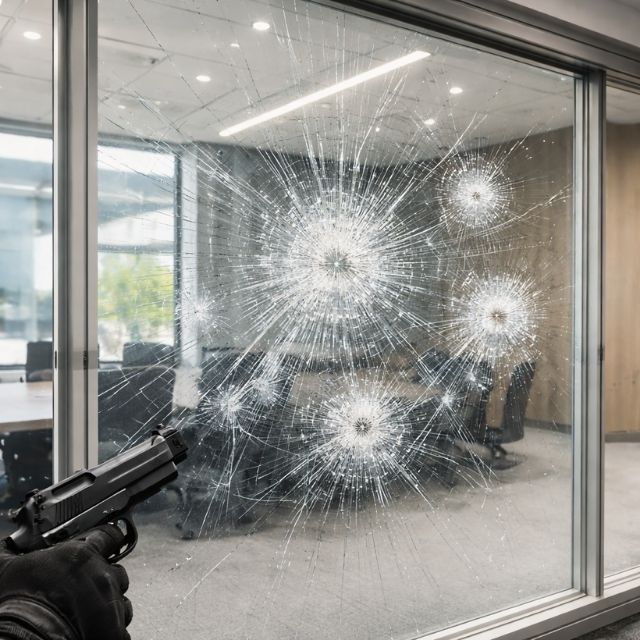
For project managers building a specification, glazing upgrades and procedural security measures should be scoped together. Film upgrades specified in isolation from access control and response protocols address the physical vulnerability without addressing the operational one.
Hybrid Approaches: Combining Film with Architectural Glass Upgrades by Facility Zone
Most large institutional projects do not have a single glazing solution across all zones. The practical approach is a hybrid specification: ballistic film on the majority of openings where handgun-level protection meets the threat requirement, and purpose-built ballistic glazing at the specific openings where the risk profile demands higher-rated protection.
A school district example illustrates the logic. Main entry vestibules and administrative reception windows may warrant UL 752 Level 3 laminated ballistic glass, since those openings are the most likely forced-entry point and the most symbolically significant for deterrence. Classroom windows, corridor glazing, and secondary perimeter openings can be addressed with UL 752 Level 1 or Level 2 film with edge attachment. The result is a facility that concentrates ballistic glass investment at the highest-risk access points and uses film to cost-effectively cover the larger glazing inventory.
This zone-differentiated approach requires either a single contractor who can manage both scopes or a well-coordinated handoff between a glazing contractor and a film installer. Document the specification boundary clearly in the project record: which openings receive which assembly, and which standard governs each. Ambiguity at the specification boundary creates substitution risk during procurement.
Blast Mitigation Considerations and the Relationship Between Ballistic and Blast Film Assemblies
Ballistic film and blast film address different physical phenomena, but they share a common mechanism: glass retention through film lamination and edge attachment. The distinction is in the load type. Blast loading is a pressure wave that pushes a pane inward over milliseconds. Ballistic loading is a point impact at high velocity. Film products optimized for one threat profile are not automatically rated for the other.
Some multi-layer film assemblies carry dual ratings under both UL 752 and GSA blast hazard standards, which makes them useful for government facilities where both threat types are credible. When a project requires both ballistic and blast protection at the same opening, the specification should require documented test data for both performance categories from the same assembly configuration. A film that is ballistic-rated but not blast-tested does not satisfy both requirements by inference.
For facilities where blast is the primary driver and ballistic resistance is secondary, including embassies, federal courthouses, and certain municipal buildings in high-risk environments, blast film assemblies with edge attachment may already meet lower UL 752 ballistic levels as a byproduct of their construction. Verify this against actual test documentation rather than assuming overlap.
What Ballistic Film Does Not Replace: Access Control, Glazing Upgrades, and Structural Hardening
Three categories of security investment exist outside film’s scope entirely. Access control, including card readers, mantrap vestibules, and visitor management systems, determines who reaches the glazing in the first place. Film has no bearing on access control performance, and a well-hardened glazing perimeter behind an inadequate access control system simply pushes the attack to the door instead of the window.
Ballistic glazing replacements remain necessary at openings where the threat assessment identifies rifle-level threats or where operational requirements, such as a ballistic transaction window requiring a rated pass-through, demand a purpose-built assembly. Film does not retrofit that capability.
Structural hardening addresses the frame, wall, and anchoring systems that support glazed openings. A film assembly transfers impact load to the frame, which means a frame in poor condition or inadequate for the load can fail even when the film performs correctly. On older buildings, frame condition assessment is a prerequisite for specifying film, not an afterthought.
Key Specification Takeaways
- Ballistic film addresses UL 752 Levels 1 through 3 (handgun threats). Rifle-level threats require ballistic glass.
- Film-to-frame edge attachment is required for rated ballistic and blast performance. Film without edge attachment is not a ballistic assembly.
- Zone-differentiated specifications, with film on most openings and ballistic glass at highest-risk access points, deliver the strongest cost-to-protection ratio on large projects.
- Film buys perimeter delay time. It performs only within a functioning security system that includes access control and response protocols.
- Require UL 752 test documentation for the specific film-glass assembly being proposed, not the film product alone.
- Budget re-lamination at 12 to 15 years as a planned capital item, not a contingency.
Conclusion: From Specification Confidence to Project Execution
What Ballistic Film Can Deliver at Commercial and Institutional Scale
Across schools, government buildings, and retail environments, ballistic film for windows delivers documented, standards-rated protection against handgun-level threats at a cost and schedule profile that glazing replacement cannot match. That is not a marketing position. It is a function of test data, cost models, and installation logistics covered in detail throughout this article.
The specification is not appropriate for every opening or every threat profile. Where rifle-level protection is required, film is not the answer. But for the vast majority of glazed openings in the facilities most likely to specify it, film applied to the correct assembly configuration meets the documented threat requirement, satisfies applicable standards, and preserves operational continuity in a way that months of glazing replacement cannot.
The decision framework is straightforward: document the threat, map it to a UL 752 level, assess retrofit feasibility, and compare cost against the protection delivered. Where that analysis points to film, the specification is defensible to any facilities committee with access to the test data and cost models.
Why Installer Expertise Determines Whether the Specification Performs
A correctly specified film assembly that is incorrectly installed does not perform to its rated level. Edge attachment executed without structural adhesive compliance, film applied to unprepped glass, or assemblies installed in a configuration that doesn’t match the tested setup, all of these failures produce an installation that looks correct and performs below specification.
This is why installer selection is as consequential as product selection. The film product creates the performance ceiling. The installer determines whether the installation reaches it.
Manufacturer authorization, documented experience with comparable project scale, and a project management process that includes pre-installation glass assessment and opening-level documentation are the practical differentiators. Credentials without demonstrated capacity at your project’s scale are insufficient.
How Window Film Depot’s Project Team Supports Large-Scale Ballistic Film Specifications
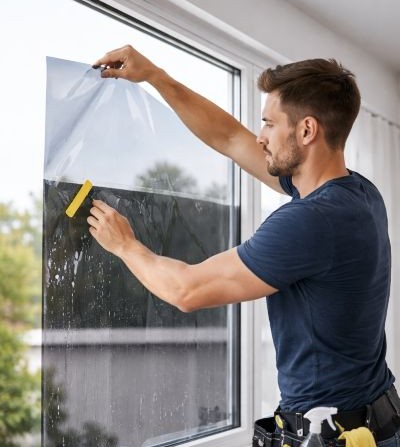
Window Film Depot operates as a specification partner from the initial threat assessment conversation through post-installation documentation. For project managers managing multi-site deployments, that means a dedicated project team that owns scheduling, site coordination, crew deployment, and quality documentation across every building in the scope.
The team carries manufacturer authorization across leading ballistic film product lines, including multi-layer assemblies with dual UL 752 and blast ratings for government applications. Every proposed specification includes test documentation for the specific assembly being recommended, not the product line in general. And every completed project delivers opening-level installation records that satisfy procurement documentation requirements and support future re-lamination planning.
For project managers who need to present a blast and ballistic window security specification to a facilities committee or procurement authority with confidence, the combination of accurate performance data, defensible cost modeling, and a contractor with demonstrated large-project capacity is what closes the gap between what film can do and what your project needs. Contact Window Film Depot today for an estimate and expert guidance on the right ballistic film for windows for your project.
Frequently Asked Questions
Is ballistic window film really bulletproof, or is it just hype?
Neither characterization is accurate. Ballistic film is a tested, standards-rated product that performs exactly as its documentation says it performs, against the specific threat levels for which it was rated, and only when installed to the assembly configuration under which it was tested. It is not bulletproof in the absolute sense, but UL 752-rated assemblies provide documented resistance to handgun-caliber threats at Levels 1 through 3. The hype comes from vague marketing language that blurs the line between “ballistic-rated” and “bulletproof.” The dismissal comes from comparing film to full ballistic glass without accounting for the different threat profiles each is designed to address.
How much does ballistic film cost compared to ballistic glass?
Film-based ballistic upgrades typically run $20 to $50 per square foot installed, depending on film specification, opening complexity, and edge attachment requirements. Ballistic glass replacement at comparable protection levels typically runs $150 to $400 per square foot or higher, including removal, framing, and installation. For a practical reference point, a 1,800-square-foot municipal building glazing scope might cost roughly $72,000 with a UL 752 Level 2 film specification, compared to $450,000 or more for ballistic glass replacement at the same rating. A 5x to 10x cost differential is a reasonable working assumption for planning purposes.
What is the difference between ballistic film and ballistic glass?
Ballistic glass is a purpose-built glazing product that achieves its protection through an interlayer bonded between glass lites during manufacturing. Ballistic film is a multi-layer polyester laminate applied to the interior surface of existing glass, retrofitting protection onto openings that don’t require full replacement. Ballistic glass has a higher performance ceiling, covering UL 752 Levels 1 through 8 depending on the product. Ballistic film typically covers Levels 1 through 3. The practical difference for most projects is cost, installation disruption, and retrofit feasibility: film works on existing frames without structural modification, glass replacement does not.
What protection level do I need for a school or government building?
The answer requires a documented threat assessment specific to your facility and jurisdiction, but practical patterns are consistent across similar building types. K-12 schools and universities addressing active shooter scenarios most commonly specify UL 752 Level 1 through Level 3, which covers handgun threats matching the documented threat profile of school-based incidents. Government offices at the state and municipal level typically target Level 2 or Level 3 as a baseline. The facility zone matters as much as the building type: primary entry vestibules generally warrant higher specifications than secondary perimeter windows or interior glazing.
How long does ballistic film installation take, and will it disrupt building operations?
A standard commercial or classroom window typically takes one to two hours per opening for a qualified crew, including surface preparation and edge attachment. For a building with 100 windows, a two-crew team can typically complete the scope within a standard work week. Film installation does not require frame removal, structural modification, or extended facility closure, which means most projects can be scheduled around normal building operations. Large school district projects are commonly executed during summer recess to eliminate any occupancy conflict entirely.
What certifications and credentials should I look for in a ballistic film installer?
Manufacturer authorization for the specific product line being specified is the baseline requirement. It confirms the installer has completed product-specific training and that the manufacturer will back the warranty on certified installations. Industry credentials from the International Window Film Association (IWFA) indicate a commitment to ongoing professional standards. Beyond credentials, ask the installer to produce UL 752 test reports for the specific film-glass assembly they’re recommending, not just the film product in general. For large multi-site projects, documented experience with comparable project scale, including references at school districts or government clients, is as important as any certification.