Table of Contents:
- What Ballistic Window Film Actually Does — and What It Does Not
- The Specification Framework: UL 752, NIJ, and Threat Level Classification
- Ballistic Window Film vs. Full Glazing Replacement: A Specification-Driven Comparison
- Where Ballistic Film Delivers the Greatest Project-Level Impact
- Installation Requirements, Logistics, and What the Process Involves
- What to Demand from a Ballistic Window Film Installer Before You Sign Anything
- Conclusion: Specification Confidence and Project Delivery
- Frequently Asked Questions
What Ballistic Window Film Actually Does — and What It Does Not
Ballistic Window Film is one of the most effective ways to strengthen existing glass without the cost of full window replacement. Designed to help hold shattered glass together after impacts, this protective film adds an extra layer of defense against break-ins, storms, accidents, and flying debris. Whether for homes or commercial buildings, it is a smart investment in safety, security, and peace of mind.
Defining the Technology: Multi-Layer Lamination and Impact Absorption
Ballistic window film is a thick, multi-layer polyester laminate bonded to the interior surface of existing glazing using a pressure-sensitive or dry-adhesive system. Standard security film runs 4 to 8 mils thick.
Ballistic-rated film starts at 12 mils and typically ranges from 14 to 20 mils or more, depending on the protection level required. That additional mass does more than add thickness, it actively absorbs energy through engineered design.
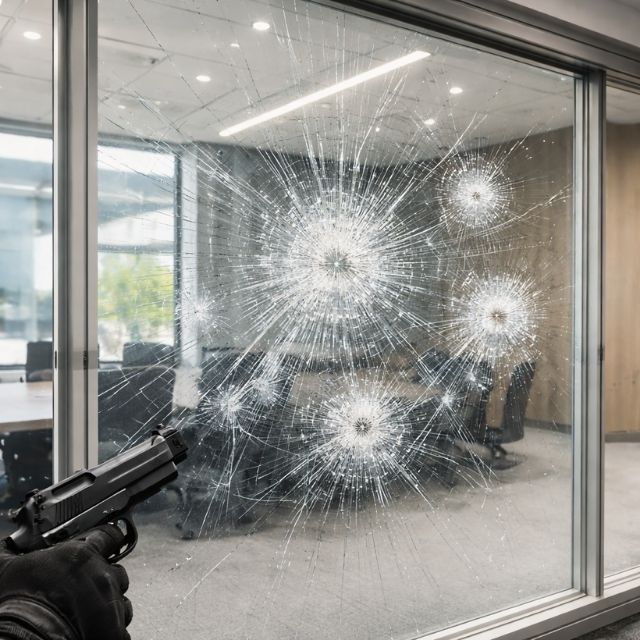
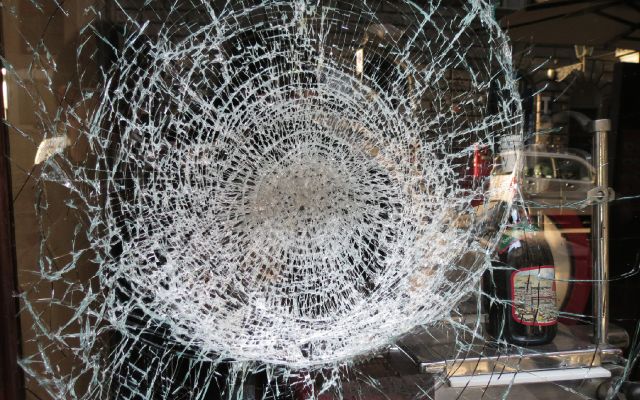
When a projectile strikes the glass, the glazing fractures as it normally would. The film’s job begins at that moment. The laminate stretches and deforms, dissipating kinetic energy across the film stack rather than allowing penetration. The film layer holds the spider-web fracture pattern together instead of allowing a catastrophic breach.
The Correct Way to Think About “Bulletproof”: Deter, Delay, and Contain
No window film is bulletproof. That framing is technically incorrect and, for specification purposes, misleading. The operative framework is deter, delay, and contain, and each function has distinct project value.
Deterrence comes from visible hardening. An attacker who can see that glazing is reinforced may redirect to a softer target. Delay is the more measurable function: ballistic film increases the number of rounds and the time required to breach an opening. Against handgun threats, properly specified film can delay breach by 30 to 90 seconds, which is operationally significant in active threat scenarios where law enforcement response time matters. Containment refers to fragment retention, which means keeping glass from becoming a secondary injury hazard. For a project manager, this is the metric that translates most directly into life-safety compliance.
Glass Fragment Retention as a Life-Safety Function
Fragment retention is where ballistic window film delivers its most consistent, documentable value. An unlaminated pane struck by a projectile — or by blast overpressure — shatters into high-velocity shards that can injure occupants well away from the point of impact. Film eliminates that mechanism.
This matters beyond active shooter scenarios. Seismic events, hurricane-force debris, and accidental impacts all produce the same fragmentation hazard.
Many facilities that specify ballistic film simultaneously satisfy hurricane or blast-resistance requirements, which improves the return on investment considerably when presenting the project to a facilities committee or a board.
How Threat Resistance Is Engineered Into the Film Stack
The film stack typically consists of multiple bonded polyester layers, an optically clear adhesive system, a scratch-resistant hard coat, and in ballistic-grade products, a polycarbonate or additional polyester reinforcement layer. Some systems incorporate a proprietary tear-resistant interlayer that further slows penetration.
The edge-sealing method is as critical as the film itself. Properly edge-sealed film transfers impact loads to the structural frame instead of peeling away from the glass. An unsealed or improperly sealed installation can fail at a lower threat level than the film’s certification would suggest. This is one of the first technical details to audit when evaluating an installer.
The Specification Framework: UL 752, NIJ, and Threat Level Classification
UL 752 Protection Levels Explained: From Handgun to Rifle Calibers
UL 752 is the primary standard governing bullet resistant window film and glazing assemblies in the United States, published by Underwriters Laboratories. It classifies protection across eight levels, each defined by a specific caliber, bullet type, muzzle velocity, and number of shots at defined distances. The standard tests complete assemblies rather than materials in isolation, which has direct implications for how film is specified and installed.
Levels 1 Through 3: Handgun Resistance
Levels 1 through 3 address the most common threat profile for commercial and institutional facilities.
- Level 1: 9mm, 124-grain, full metal jacket, three shots at 1,175 fps
- Level 2: .357 Magnum, 158-grain, jacketed soft point, three shots at 1,250 fps
- Level 3: .44 Magnum, 240-grain, lead semi-wadcutter, three shots at 1,350 fps
Ballistic window film, when applied to adequately thick substrate glazing, can achieve UL 752 Level 1 through Level 3 ratings as a tested assembly. This covers the overwhelming majority of active shooter scenarios documented at schools and commercial facilities, where handguns are the predominant weapon type.
Levels 4 Through 8: Rifle and High-Powered Threats
Levels 4 through 8 address rifle calibers, beginning with a .30 caliber super-powered rifle round at Level 4 and escalating through 7.62mm NATO and beyond at higher levels.
Film-only solutions generally do not achieve UL 752 Levels 4 and above. At those threat levels, the glazing substrate must use ballistic glass such as laminated glass, insulating glass with ballistic interlayers, or polycarbonate-clad glass, while film serves as a supplemental layer or fragment-retention backup. If a facility’s threat assessment identifies rifle-caliber threats, full glazing replacement or a composite glazing-plus-film assembly is the correct specification path.
How UL 752 Differs from UL 972 and NIJ Ballistic Ratings
UL 972 is a forced-entry standard, not a ballistic standard. It tests glazing against manual attack tools such as hammers, axes, and picks rather than projectiles. Many security films meet only UL 972, meaning they resist smash-and-grab attacks or forced entry but lack ballistic certification. When reviewing vendor submittals, confirm the claimed standard and verify that it matches your threat scenario.
The National Institute of Justice establishes NIJ ballistic ratings, which law enforcement body armor and detention facility specifications most commonly reference. NIJ and UL 752 are not interchangeable, though some manufacturers publish both ratings for the same product. For commercial and institutional glazing projects, UL 752 is the relevant standard for code submittals and specification compliance documentation.
Specification Standards for Government and Education Facilities
Government facilities typically reference UL 752 for glazing specifications, often tied to the Interagency Security Committee (ISC) Security Design Criteria, which assigns Facility Security Levels (FSL I through V) and corresponding glazing requirements. Education facilities increasingly specify UL 752 Level 1 or Level 2 as a baseline, particularly for entry vestibules, administrative offices, and main corridor glazing.
For GSA projects, UFC 4-010-01 (DoD Minimum Antiterrorism Standards) governs and may require blast resistance in addition to ballistic ratings. Those projects typically demand tested glazing assemblies rather than film-only solutions, unless the film is part of a pre-tested composite system.
Specification Compliance Verification and Documentation for Code Review
A ballistic film installation is only as defensible as its documentation. For code review and project closeout, collect the following from your installer at minimum:
- UL 752 test reports for the specific film product, specifying the substrate type and thickness used during testing
- A letter of conformance from the film manufacturer confirming the installed assembly matches the tested configuration
- Installation records documenting glass thickness, film lot number, and edge-seal method for each opening
The substrate condition matters. A film tested on 1/4-inch annealed glass does not carry the same rating when applied to 3/16-inch tempered glass. An installer who cannot produce substrate-matched test documentation is offering an unverified assembly, regardless of what the product data sheet claims.
Does Ballistic Window Film Require Recertification After Installation?
The short answer is no. Ballistic window film does not require periodic recertification of the installed assembly under UL 752. The product’s certification is established at the factory through third-party testing and does not expire based on calendar time.
Two conditions can void or compromise a film’s effective protection level: physical damage to the film — scratches, delamination, or edge-seal failure — and glass replacement after the original installation. If a pane is broken and replaced, the new glass must be re-filmed and edge-sealed to restore the rated assembly. Some facility operators build an annual inspection protocol into their maintenance contracts specifically to identify these conditions before they become a compliance gap. That practice is worth including in a project’s operations and maintenance documentation.
Ballistic Window Film vs. Full Glazing Replacement: A Specification-Driven Comparison
Performance Parity: Where Film Matches Ballistic Glass and Where It Does Not
For UL 752 Levels 1 through 3, a properly specified and installed ballistic window film assembly on adequate substrate glazing delivers protection that is functionally equivalent to purpose-built ballistic glass. That covers the threat profile — handguns at close range, multiple rounds — applicable to the vast majority of commercial and institutional security scenarios. At those levels, the performance argument for full glazing replacement is not stronger, and the cost and schedule argument certainly is not.
The gap opens at Level 4 and above. Rifle-caliber threats require the substrate itself to provide ballistic resistance. No film system alone achieves this because the glazing shatters before the film can fully arrest penetration. At Levels 4 through 8, purpose-built ballistic glass provides the correct solution. Laminated glass, polycarbonate composites, or glass-clad polycarbonate carry the primary protection load, while film may serve as a secondary fragment-retention layer.
Retrofit Feasibility on Existing Glazing Systems
Full ballistic glass requires complete frame replacement in most retrofit scenarios. Ballistic glazing units are significantly thicker and heavier than standard commercial glass, and existing frame profiles — aluminum curtainwall, hollow metal, thermally broken systems — rarely accommodate the increased unit weight and thickness without structural modification. That means the scope is not just replacing glass. It means replacing frames, potentially modifying rough openings, and in some cases reinforcing the surrounding wall assembly.
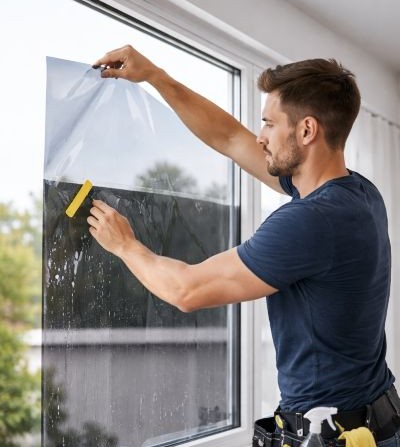
Ballistic window film applies to the existing pane in place. The primary constraint is substrate compatibility: apply the film to glass of sufficient thickness, typically 1/4 inch or greater for annealed or heat-strengthened glass, and ensure the glass remains in sound condition without pre-existing delamination or seal failure in insulating glass units. On a standard commercial or institutional building constructed after 1990, the vast majority of existing glazing is film-compatible without structural modification.
Schedule and Operational Impact: Film Installation vs. Full Glazing Replacement
A typical ballistic film installation on a single opening runs two to four hours per pane, depending on size and access conditions. A multi-story commercial building with 80 to 120 openings can be fully retrofitted in two to three weeks with a properly staffed crew. The building remains occupied throughout, offices stay open, and schools do not need to schedule around academic calendars with the same level of constraint.
Full glazing replacement demands the opposite. Frame removal creates temporary openings that require weather protection and site security measures.
Structural framing work may require interior access to adjacent spaces. Lead times on custom-sized ballistic glazing units run 8 to 16 weeks from most manufacturers, which means the project schedule is largely controlled by a fabrication queue before installation crews ever arrive on site.
Budget Impact Across Protection Levels and Building Types
Ballistic glass units for UL 752 Level 1 through Level 3 protection typically cost $150 to $400 per square foot for the glazing alone, before frame modification, labor, and disposal of existing glass. Ballistic window film for equivalent protection levels runs $25 to $75 per square foot installed, inclusive of surface preparation and edge sealing. On a 100-opening project with average pane sizes of 15 square feet, that differential compounds quickly.
For Level 4 and above, full glazing replacement costs increase substantially, often reaching $500 to $800 per square foot for rifle-rated assemblies. At those threat levels, film is not a cost-competitive alternative because it cannot achieve the rating.
Decision Matrix: Ballistic Window Film vs. Full Ballistic Glazing Replacement
Use this rubric to determine which solution fits your project parameters across the dimensions that matter most to specification compliance and project delivery.
| Dimension | Ballistic Window Film | Full Ballistic Glazing |
|---|---|---|
| UL 752 coverage | Levels 1–3 as tested assembly | Levels 1–8 depending on product |
| Retrofit compatibility | High — applies to existing frames and glazing in most standard commercial systems | Low — typically requires frame replacement and structural modification |
| Cost per opening | $375–$1,125 (15 sq ft avg at $25–$75/sq ft installed) | $2,250–$6,000+ (15 sq ft avg at $150–$400/sq ft, glazing only) |
| Installation timeline | 2–4 hours per opening; full building in 2–3 weeks | 8–16 week fabrication lead time; installation adds 1–3 weeks |
| Operational disruption | Minimal — building remains occupied | Significant — temporary openings, dust, structural access |
| Recertification requirement | None — product certification is factory-established; inspect annually for physical damage | None for the glazing unit itself; re-glazing after breakage requires new documented installation |
| Recommended use case | Handgun threat environments (schools, commercial offices, government facilities at ISC Level I–III); retrofit projects with budget or schedule constraints | Rifle threat environments (ISC Level IV–V, high-security government, detention); new construction where glazing systems are being specified from scratch |
The matrix is a starting point, not a final answer. Facilities with mixed threat profiles — high-risk entry vestibules combined with lower-risk corridor glazing — often use a hybrid approach: ballistic glass at primary access points and ballistic film across the broader envelope.
When Full Glazing Replacement Is the Right Call
Three project conditions make full glazing replacement the correct path regardless of cost or schedule.
First, when the threat assessment identifies rifle-caliber risks at Level 4 and above, film is not a specification-compliant option and should not be presented as one. Second, when existing glazing is in poor condition with failed seals, significant scratching, or cracked panes, the cost of glass-by-glass evaluation and selective replacement may approach the cost of a full upgrade anyway. Third, for new construction or major renovation where glazing systems are being specified from scratch, integrating ballistic glass into the original specification eliminates the retrofit penalty entirely and is worth pricing against the film option before either path is committed.
Where Ballistic Film Delivers the Greatest Project-Level Impact
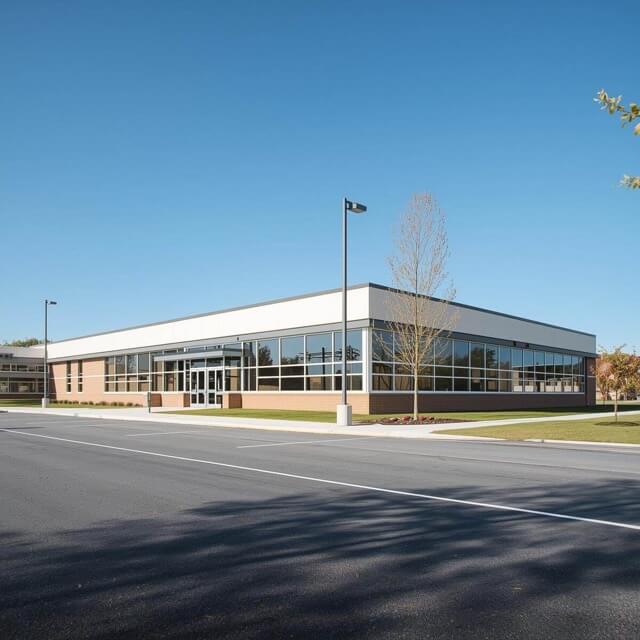
Schools and Educational Campuses: Security Glazing Priorities and Entry-Point Logic
School security upgrades follow a predictable priority hierarchy: harden the entry vestibule first, then administrative areas, then classroom corridor glazing. This logic reflects how active threat incidents progress.
Entry resistance buys response time before a threat reaches occupied spaces. Ballistic window film at UL 752 Level 1 or Level 2 on entry vestibule glazing and administrative office sidelites addresses the highest-probability breach points at a cost that fits within most district capital budgets.
The film-first approach also aligns with how school security funding typically flows. Federal grants through programs like the STOP School Violence Act are often structured for targeted physical hardening rather than comprehensive building replacement. Film installations are easier to document, phase, and close out within grant cycle timelines than full glazing replacements.
Government Buildings and Public Facilities: Compliance Mandates and Procurement
ISC Security Design Criteria assigns Facility Security Levels based on occupancy, criticality, and threat profile. FSL II and III facilities — which cover most federal office buildings, courthouses, and public-facing agencies — typically require UL 752 Level 1 through Level 3 glazing protection at primary access points. Ballistic window film assemblies that are tested and documented to the matching UL 752 level satisfy this requirement and can be submitted through standard GSA procurement vehicles.
The documentation burden is real. GSA and agency reviewers require test reports that match the installed substrate configuration, letters of conformance from the manufacturer, and installation records by opening. An installer who cannot produce this package in a format that survives a procurement audit is a liability on a government project. Procurement officers should make documentation deliverables a contract requirement, not an afterthought.
Commercial Office and Retail: Threat Assessment and Tiered Protection Strategies
Commercial clients rarely face a single uniform threat profile across an entire facility. A ground-floor retail banking branch has different risk drivers than a 10th-floor executive suite. Effective ballistic film specification for commercial projects starts with a threat assessment that maps openings by risk tier, then assigns protection levels accordingly rather than applying a single standard uniformly across every pane.
This tiered approach controls budget without compromising protection where it counts. Ground-floor perimeter glazing, lobby entries, and security reception areas receive UL 752-rated film. Upper-floor glazing and interior partitions may justify standard safety film at a lower cost point. A well-structured threat assessment — even a simplified one using publicly available crime and incident data for the facility’s address — gives the project team a defensible basis for specification decisions that a facilities committee or insurance underwriter can review.
Integration with Existing Physical Security Systems
Ballistic window film does not replace access control, CCTV, intrusion detection, or security staffing. It reinforces their effectiveness by extending the time an attacker needs to breach a glazed opening. That delay interval is what gives other systems time to respond. A 30-second delay at entry glazing means an access control alert has time to generate a lockdown command. A 60-second delay means responding security personnel can reach the entry point.
For project managers coordinating security upgrades across multiple systems, film specification should be coordinated with the access control and alarm system designers. Glass-break sensors on filmed glazing behave differently than on bare glass because the fracture pattern changes, and sensitivity thresholds may need adjustment. This is a minor integration task, but it belongs on the coordination checklist.
Multi-Site Campus Projects: Prioritizing High-Risk Areas in a Phased Rollout
Sequencing Openings When a Full Retrofit Is Not Immediately Feasible
When budget does not allow a simultaneous full-campus retrofit, sequence by threat exposure rather than by geography or administrative convenience. Primary pedestrian entries, main reception areas, and administrative offices that control building access functions represent the highest-value openings to film first. Secondary entries, mechanical and service entries, and upper-floor glazing can follow in later phases without materially compromising the protection delivered by Phase 1.
Document the phasing plan explicitly in the project’s security master plan. This creates a record of intentional prioritization, which matters if an incident occurs during the gap period between phases.
Coordinating Installation Across Multiple Buildings Without Operational Disruption
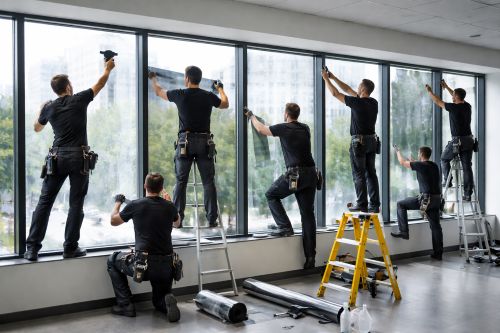
Multi-building campus projects require a mobilization plan that treats each building as a discrete operational unit. Film installation crews should move through one building at a time, with a confirmed schedule communicated to building occupants at least 72 hours in advance. Installation in occupied spaces takes two to four hours per opening with minimal noise, no structural dust, and no temporary weather exposure, but occupants still need to clear workspace near windows during application.
Shared infrastructure projects — university campuses, corporate campuses, hospital systems — often benefit from a site supervisor embedded with the installation crew as a single point of coordination contact for all building managers. This prevents the communication gaps that cause schedule slippage on large multi-site projects.
Installation Requirements, Logistics, and What the Process Involves
Interior vs. Exterior Application: Technical Trade-Offs and Glazing Compatibility
The large majority of security window film installations are interior applications. Interior film is protected from UV degradation, weathering, and physical abrasion, which directly extends service life. It is also substantially easier to quality-control during installation because temperature and humidity can be managed and adhesive cure conditions remain consistent.
Exterior film is available and used in specific scenarios: where interior access is restricted, where interior aesthetics prohibit visible film edge lines, or where condensation on the interior surface creates adhesion problems. Exterior applications require a film with an enhanced UV-resistant coating and are more susceptible to edge lifting over time without aggressive edge-seal maintenance. For ballistic applications, interior installation is the correct default, and any deviation from that should require documented technical justification.
Surface Preparation, Adhesive Systems, and Edge-Sealing Standards
Glass surface preparation directly affects adhesion quality and long-term performance. The installation crew should clean each pane with a dedicated glass cleaning solution to remove contaminants, then squeegee dry before film application. Any silicone, caulk residue, or paint overspray on the glass surface must be removed because these create adhesion voids that can become peel initiation points under impact load.
Ballistic film uses a pressure-sensitive adhesive system that activates and builds bond strength over a cure period of 30 to 60 days. During that window, the film should not be subjected to impact or pressure. Edge sealing is applied after the film is positioned and squeegeed, bonding the film perimeter to the frame system. A proper edge seal runs continuously around the perimeter with no gaps and is applied before the adhesive cure period begins.
Typical Timeline for a Multi-Building Commercial or Campus Project
A realistic project timeline for a 200-opening, three-building campus retrofit looks like this:
- Weeks 1–2: Site survey, substrate assessment, opening inventory, and specification confirmation
- Weeks 3–4: Film procurement and crew mobilization
- Weeks 5–9: Installation, building by building, with daily production of 8–12 openings per two-person crew
- Week 10: Final inspection, documentation package assembly, and client closeout
This assumes standard commercial glazing in accessible locations. High-rise buildings, glazing above 10 feet requiring lift equipment, and heavily tinted or coated glass requiring additional preparation add time and should be flagged during the site survey.
What Happens After Installation: Inspection, Documentation, and Performance Verification
The closeout package for a ballistic film installation should include a per-opening installation record covering glass dimensions, substrate type and thickness, film product and lot number, edge-seal method, and installation date. It should also include the manufacturer’s certificate of conformance and UL 752 test reports matched to the installed substrate configuration. This package is what survives a code review or security audit, and it is the installer’s contractual deliverable.
Post-installation inspection should verify that the film is free of bubbles, delamination, and edge-seal gaps. A small number of micro-bubbles visible immediately after installation are normal and typically disappear during the 30-day cure period. Persistent bubbles or visible edge lifting after 60 days indicate an adhesion failure that should be remediated before the opening is counted as compliant.
Can Ballistic Film Be Removed or Replaced If Specifications Change?
Film can be removed, but the process is labor-intensive and the glass is not always undamaged. Heat application softens the adhesive, and the film is peeled from the glass in sections. Adhesive residue requires solvent cleaning. In most cases, the glass surface remains intact and reusable, but tempered glass with micro-surface scratches is more vulnerable to damage during removal than annealed glass.
Replacement film can be applied to the same glass after the original film is removed and the surface is properly cleaned. If a facility’s threat assessment changes and an upgraded threat profile requires a higher UL 752 level, the correct path is film removal and reinstallation with the appropriate product, documented to the new specification. This is significantly less disruptive than replacing an entire glazing system.
What to Demand from a Ballistic Window Film Installer Before You Sign Anything
Vendor selection is where projects succeed or fail long after the installation crew leaves the site. A ballistic film product can carry every certification on the data sheet and still deliver a non-compliant installation if the installer lacks the documentation discipline, technical training, or project management capacity to execute at the scale the facility requires.
Confirming a Vendor Can Document Specification Adherence
Ask for a sample closeout package before awarding the contract. A qualified installer can produce a redacted example from a completed project showing the per-opening installation records, manufacturer certificate of conformance, and UL 752 test reports matched to the installed substrate configuration. If a vendor cannot show you what that documentation looks like in practice, they cannot reliably deliver it on your project.
The test report is the critical document. Confirm that the report lists the specific substrate type and thickness used during testing, not just the film product name. A film tested on 1/4-inch annealed glass does not transfer its rating to a 3/16-inch tempered substrate. Project specifications should define the required substrate configuration, and the installer’s documentation must match it opening by opening.
Warranties, Performance Guarantees, and Contractual Liability
A warranty on ballistic window film is only as useful as the specific language in it. Many product warranties cover film delamination, discoloration, and edge-seal failure under normal service conditions but exclude damage from impact events. That exclusion is not unreasonable for ballistic applications where the film may perform its rated function and still show visible damage after doing so. What matters is that the warranty covers defective installation and names a specific remedy.
Manufacturer warranties on commercial ballistic film typically run 10 to 15 years for interior applications and cover delamination, bubbling, excessive discoloration, and edge-seal failure under normal conditions. Some manufacturers extend longer coverage for products installed by authorized dealers, which creates an incentive for installers to maintain their authorization status.
The installation warranty is separate and sits with the installer. It should cover workmanship defects, adhesion failures attributable to improper surface preparation, and edge-seal failures within a defined period, typically two to five years. Get both warranties in writing before contract execution and confirm they are backed by a company with the financial standing to honor them on a multi-year timeline.
Installer Credentials: Certification, Manufacturer Authorization, and Track Record
Manufacturer authorization matters because authorized installers receive product-specific training, access to technical support, and in many cases extended warranty coverage that unauthorized installers cannot offer. An installer applying ballistic film outside of a manufacturer authorization program is also unlikely to have access to current test documentation for the specific film product as installed.
Beyond authorization, ask for a portfolio of completed ballistic or security film projects at comparable scale. A vendor who has successfully delivered 50-opening school projects can execute a 50-opening school project. A vendor whose reference list consists of residential window tint jobs cannot demonstrate the documentation discipline or crew management capability that a commercial security project requires. Request three client references from projects of similar scope and follow up with calls.
Multi-Site Project Management Capability: Logistics, Coordination, and Accountability
Large-scale ballistic film retrofits fail most often in the coordination layer, not the installation layer. A vendor who can film glass competently but cannot manage crew scheduling across four buildings, communicate with multiple facility managers simultaneously, and maintain daily production records is a project management liability.
Before awarding a multi-site contract, ask the vendor how they structure site supervision, how they communicate schedule changes to building stakeholders, and how they track per-opening installation data in real time. A vendor with enterprise-scale project management infrastructure will answer these questions with specifics. A vendor without it will offer assurances.
Request a project execution plan as part of the proposal, not as a post-award deliverable. The plan should include crew size, daily production targets, phasing sequence, communication protocols, and a documentation workflow. Evaluating that plan tells you more about a vendor’s capability than any reference call.
Financing and Phased Installation Options for Large-Scale Projects
Budget cycles rarely align with security upgrade timelines. Vendors who offer phased installation structures allow a facility to begin hardening high-priority openings immediately while spreading the full project cost across multiple fiscal years.
This is particularly relevant for school districts and municipal facilities operating under annual appropriation constraints.
Ask specifically whether the vendor can price the project in discrete phases tied to defined opening groups and whether each phase can be closed out with independent documentation. A phased project that produces per-phase closeout packages gives you a clean audit trail and allows each phase to be funded and approved independently.

How Window Film Depot’s Position as the Number-One U.S. 3M Installer Addresses These Requirements
Window Film Depot holds the top-ranked authorized installer position for 3M in the United States, which directly addresses the credential and documentation requirements outlined above. As an authorized 3M dealer, Window Film Depot installs under the manufacturer’s authorization program, giving clients access to 3M’s extended warranty coverage, current product test documentation, and technical support for specification compliance verification.
The scale of Window Film Depot’s commercial and institutional portfolio means the project management infrastructure for multi-building, multi-site retrofits is in place and field-tested. For project managers who need a single accountable vendor across a campus or multi-facility rollout, that track record is the most reliable predictor of delivery.
Five Non-Negotiable Questions Before You Award a Ballistic Film Contract
Get clear answers to these before signing anything:
- Can you provide a sample closeout package from a completed project of comparable scope, including substrate-matched UL 752 test reports?
- Are you an authorized installer for the specific ballistic film product you are proposing?
- What does your installation warranty cover, what does it exclude, and for how long?
- How do you structure site supervision and daily production tracking on multi-building projects?
- Can you structure this project in independently closeable phases with per-phase documentation?
If any answer is vague or deferred to post-award, treat that as a disqualifying signal.
Conclusion: Specification Confidence and Project Delivery
Why Ballistic Film Is the Strategically Superior Choice for Most Renovation Projects
The case for ballistic window film as the primary security glazing solution for commercial and institutional renovation projects is not primarily a cost argument, though the cost differential is substantial. It is a specification argument. For the threat profile that applies to most schools, government offices, and commercial facilities, UL 752 Levels 1 through 3 cover the documented risk. Ballistic window film, properly specified and installed as a tested assembly, achieves those levels on existing glazing without frame replacement, structural modification, or operational shutdown.
Full glazing replacement is the right answer for Level 4 and above threats. For everything below that threshold, it represents an over-engineered solution that consumes budget and schedule without delivering measurably superior protection against the threats the facility will actually face.
Matching Protection Level to Facility Risk Profile Without Over-Engineering
Specification decisions should start with a threat assessment, not a product catalog. Map openings by risk exposure: primary entries and administrative glazing first, secondary entries and corridor glazing next. Assign UL 752 levels based on documented threat scenarios for the facility type and location rather than applying a highest-common-denominator standard uniformly across every pane.
Over-specified film is not harmful, but it consumes budget that could fund Phase 2 of a phased rollout or additional security system integration. A Level 2 assembly on a school entry vestibule backed by an access control alert and a documented response protocol delivers more effective security than a Level 3 assembly on the same opening with no supporting systems.
How to Move from Specification Uncertainty to a Compliant Installation
The path from uncertainty to a compliant installation follows a defined sequence: threat assessment, opening inventory and substrate evaluation, protection level assignment by opening group, vendor qualification against the documentation and credential criteria above, phased installation with per-phase closeout, and final documentation package assembly. Each step produces a deliverable that supports the next. A facility that runs this sequence ends with a security upgrade that is defensible to code reviewers, insurance underwriters, and facility boards.
Initiating a Project Consultation with Window Film Depot
Window Film Depot’s consultation process starts with a site survey and substrate assessment, which is the foundation for every specification decision that follows. For multi-building campus projects, the survey produces an opening inventory with substrate condition notes and a preliminary protection level recommendation by opening group, which can be used directly in budget requests or grant applications.
Contact Window Film Depot to schedule a consultation. Bring your facility’s current security assessment if one exists, the protection level requirements from your specification documents, and a rough opening count. The consultation will produce a project framework and actionable documentation, not a sales pitch, and you will leave with what you need to move the project forward.
Frequently Asked Questions
What specification standard should ballistic window film meet for government and education facilities?
For government facilities, UL 752 is the governing standard for bullet resistant window film and glazing assemblies, often referenced alongside ISC Security Design Criteria for Facility Security Level compliance. Education facilities increasingly require UL 752 Level 1 or Level 2 as a minimum for entry vestibules and administrative glazing. NIJ ratings are applicable primarily to detention and law enforcement contexts and are not a substitute for UL 752 in commercial or institutional code submittals.
How do I verify that a ballistic film installer can guarantee compliance with my facility’s security requirements?
Request a sample closeout package from a completed project before awarding the contract. That package should include substrate-matched UL 752 test reports, a manufacturer letter of conformance, and per-opening installation records. If an installer cannot demonstrate what compliant documentation looks like on a prior project, they cannot reliably produce it on yours. Manufacturer authorization status is the second checkpoint — authorized installers carry product-specific training credentials and access to current test data.
What is the typical timeline and cost for installing ballistic film across a multi-building campus?
A 200-opening, three-building campus retrofit typically completes in eight to ten weeks from site survey through final closeout, including procurement and phased installation. Installed cost runs $25 to $75 per square foot depending on film specification, substrate condition, and access complexity. For comparison, full ballistic glazing replacement for equivalent UL 752 Levels 1 through 3 protection runs $150 to $400 per square foot for the glazing alone, before framing and labor.
How does ballistic film perform compared to full glazing replacement, and when should I choose one over the other?
For UL 752 Levels 1 through 3, a properly installed ballistic window film assembly on adequate substrate glazing delivers functionally equivalent protection to purpose-built ballistic glass at a fraction of the cost and schedule impact. Full glazing replacement becomes the required path at Level 4 and above, where rifle-caliber threats demand a ballistic-rated substrate. For most schools, commercial offices, and government facilities operating below that threshold, film on existing glazing is the specification-compliant and operationally superior choice.
Does ballistic window film require recertification or re-testing after installation?
No periodic recertification is required under UL 752. The product’s protection rating is established through factory third-party testing and does not expire based on time. The two conditions that can compromise a film’s effective rating are physical damage to the film itself and glass replacement without re-filming. Building an annual inspection protocol into your maintenance contract is the practical way to ensure the installed assembly remains compliant between project closeout and occupancy.
What warranties and performance guarantees do reputable ballistic film vendors offer?
Manufacturer warranties on commercial ballistic film typically cover 10 to 15 years for interior applications and include delamination, bubbling, excessive discoloration, and edge-seal failure under normal service conditions. Installation workmanship warranties, held by the installer, typically run two to five years and should explicitly cover adhesion failures and edge-seal defects. Products installed through an authorized dealer program often qualify for extended manufacturer coverage. Get both warranties in writing before contract execution, and confirm the issuing parties have the financial standing to honor long-term claims.
Are there financing or phased installation options for large-scale ballistic film projects?
Yes. Vendors with enterprise project management capability can structure large-scale retrofits in discrete phases tied to defined opening groups, with each phase carrying its own documentation package and closeout. This approach allows facilities operating under annual appropriation constraints — school districts, municipal agencies, multi-site corporate portfolios — to begin hardening high-priority openings immediately while spreading full project costs across multiple fiscal years. Confirm during vendor qualification that the proposed installer can price and close out phases independently, not just sequence installation across a single contract.