Table of Contents:
- The Unbreakable Rule of One-Way Mirror Tint
- From Concept to Specification: Understanding Key Film Metrics
- How Reflective Film Technology Actually Works
- Key Applications in Commercial Buildings
- Why Expert Installation is Critical for Performance
- Partnering with a National Installer for Multi-Site Rollouts
- Frequently Asked Questions
- Related Posts from Window Film Depot
The Unbreakable Rule of One-Way Mirror Tint
The most critical mistake a project team can make is specifying a “one-way mirror” film without understanding the physics that govern its performance. The common belief that these films provide absolute, 24/7 privacy is the single largest source of client complaints, rework, and budget strain. This predictable failure is not a product defect. It is a direct consequence of the laws of physics, a reality an expert consultation would have identified and planned for during the specification phase.
The truth is, the “one-way” effect is not an inherent property of the film. It is a visual phenomenon created by a significant difference in light levels, or a light differential, between two spaces. The film’s mirrored surface will always face the brighter side.
During the day, the bright sunlight makes the exterior of the glass highly reflective, granting daytime privacy to occupants in the dimmer interior. At night, the situation reverses. When interior lights are on and it is dark outside, the inside becomes the brighter space. The film’s effect flips, allowing outsiders to see in clearly while occupants see their own reflection. For any project where nighttime privacy is a key objective, relying solely on standard one way mirror tint will result in a complete failure to meet client expectations.

From Concept to Specification: Understanding Key Film Metrics
To move from an idea to a practical application, you must be familiar with the technical data sheets that define a film’s performance. When discussing options with a specialist, these three metrics are non-negotiable for achieving predictable results.
- Visible Light Transmission (VLT): This value is the percentage of visible light that passes through the filmed glass. A lower VLT means a darker tint and less light entering the space. This is a crucial factor in establishing the light differential needed for the mirror effect. For example, a film with a 20% VLT allows only 20% of sunlight through, making it easier to keep the interior darker than the exterior.
- Visible Light Reflectance (VLR): This metric tells you the percentage of visible light reflected by the film’s surface. A high Exterior VLR is what creates the mirror itself. Films designed for a strong one-way effect can have exterior reflectance values of 50% or more, a specification that directly correlates to the mirror’s potency.
- Glare Reduction: While primarily a privacy solution, reflective window film offers a significant benefit in occupant comfort. This spec measures the percentage by which the film reduces harsh glare. A high glare reduction, often 70-80% or more, can dramatically improve the usability of a space, reducing eye strain and improving visibility on screens.
An unqualified installer might suggest a film based on looks, but a technical partner will use this data to model performance and prevent a costly mismatch between expectation and reality.
How Reflective Film Technology Actually Works
The “magic” behind the mirror effect is a sophisticated manufacturing process. These are advanced multi-layer polyester substrates engineered with a micro-thin layer of metal. This metallized layer is the engine of the film’s performance.
Using a process called sputtering, metals like aluminum, silver, or copper are bonded to the film. It is this layer that reflects a high percentage of visible light and solar energy, creating the powerful mirror effect. A generic dark tint, by contrast, primarily absorbs light and lacks this crucial reflective property. Installing it will simply make the windows look dark, failing to provide the desired daytime privacy.
The choice of metal and the thickness of the coating directly influence the film’s VLT, VLR, and color. For instance, a silver-based film like a 3M mirror film will produce a highly reflective, neutral-toned mirror, while other metals can create a bronze or gray appearance. The specific architectural needs and lighting conditions of your project require a film with a specific material composition.
Key Applications in Commercial Buildings
When specified and installed correctly, one way mirror tint is a powerful and versatile tool for solving complex design and operational challenges. Partnering with a film specialist allows you to leverage its true capabilities and deliver exceptional results for your clients.
Enhancing Privacy in Office Partitions and Exterior Windows
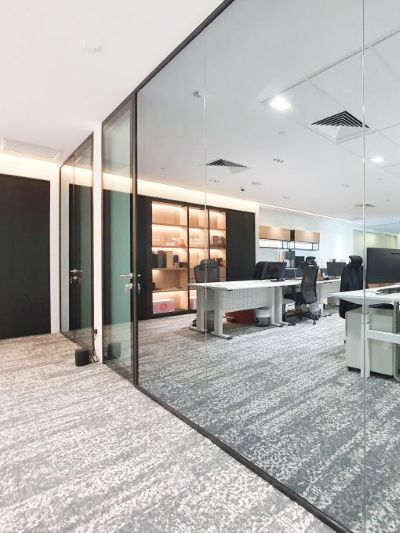
In modern office design, glass is used extensively for openness and light, but this often creates privacy challenges.
For exterior-facing offices or ground-floor conference rooms, a privacy window film for office use provides complete daytime privacy from public view without sacrificing the connection to the outdoors for those inside.
Internally, it can be used for HR, executive, or legal departments.
By ensuring the adjacent hallway is more brightly lit than the private office, you can create one-way observation that maintains confidentiality.
Improving Security and Aesthetics in Retail Storefronts
For retail projects, one way mirror film serves two key functions. From a security standpoint, it is an essential tool for loss prevention. It allows staff to monitor the sales floor from a back room without being seen. Aesthetically, the film provides a clean, uniform look to a building’s facade, concealing the visual clutter of shelving and inventory from the public.
Managing Sightlines and Solar Heat Gain
In sensitive facilities like data centers, research labs, or healthcare facilities, controlling both visibility and heat is paramount. This film is an ideal solution for preventing unauthorized observation. Beyond privacy, the film’s reflective surface is exceptionally effective at rejecting solar heat gain. By blocking a significant portion of the sun’s infrared radiation, it helps maintain stable interior temperatures, protects equipment, and reduces HVAC cooling loads, delivering a measurable return on investment through energy savings.
Why Expert Installation is Critical for Performance
Selecting the ideal reflective window film is only half the battle. The project’s ultimate success hinges on the quality of the installation. A technically superior product like 3M Sun Control Window Film can be rendered ineffective, or worse, become a visual liability, if not applied with expert precision.
The visual difference between a professional installation and an amateur attempt is immediate. A subpar installation creates a host of new problems that require costly rework:
Need More Info?
The Window Film Depot team is happy to help.
- Contamination: Entrapped dust, hair, or fibers that create permanent blemishes under the film.
- Bubbles: Pockets of air or water that look unprofessional and compromise the adhesive bond.
- Peeling Edges: Improper trimming or cleaning that leads to the film pulling away from the glass.
- Creases and Scratches: Permanent damage from mishandling the film during application.
Correcting these errors requires stripping the failed film, re-cleaning the glass, and performing a full re-installation. This process translates directly into doubled material costs, additional labor, and significant project delays.
Furthermore, professional installation is a prerequisite for activating the manufacturer’s warranty. Companies like 3M provide comprehensive warranties, but these are contingent on the film being installed by a certified professional according to strict technical guidelines. By partnering with a certified team, you secure the long-term value of your investment and ensure that if a product issue ever arises, you are fully covered.
Partnering with a National Installer for Multi-Site Rollouts
For project managers overseeing regional or national brand rollouts, sourcing specialized vendors is magnified. Inconsistent application of one-way mirror tint across dozens of sites can lead to widespread project failure and significant budget overruns.
Partnering with a national installation specialist becomes a strategic imperative. It shifts the burden of sourcing, vetting, and managing multiple local contractors to a single, expert partner who can ensure consistency and performance across the entire portfolio.
A national partner eliminates variables by specifying a single, high-performance product and applying the same rigorous technical and installation standards everywhere, ensuring the film performs as intended from Boston to San Diego.
The logistical advantages are clear. A single point of contact centralizes communication, contracting, and billing, reducing administrative burden and simplifying budget tracking. This streamlined approach allows your team to focus on other critical project milestones, confident that the window film scope is being managed efficiently by a single, accountable partner.

As the #1 U.S. 3M Window Film Installer, we have a documented history of managing the most complex architectural film projects. This designation signifies deep, institutional knowledge and a collaborative relationship with 3M’s technical teams. For your project, this means you are gaining a partner with unparalleled access to product data, performance modeling, and advanced application techniques. This level of expertise is the difference between hoping for a result and guaranteeing it.
Partner with Window Film Depot to specify and install one-way mirror tint that delivers dependable daytime privacy and long-term performance.
Frequently Asked Questions
Does one-way mirror tint work at night?
No, a standard one way mirror tint does not provide privacy at night. The mirror effect is created by a light imbalance, with the mirrored side always facing the brighter area. At night, when interior lights are on, the inside is brighter than the outside, and the effect reverses, allowing people outside to see in.
What is the difference between reflective film and a dark tint?
While both reduce the amount of light passing through glass, they work differently. A dark tint primarily absorbs light and heat. A true one way mirror film, also called reflective window film, has a micro-thin metallic layer specifically designed to reflect a high percentage of light, which is what creates the mirror effect and provides daytime privacy.
How much privacy does one way mirror film provide?
The level of daytime privacy depends on the film’s specifications and the lighting conditions. For a strong mirror effect, the outside “public” side should be at least three to five times brighter than the inside “private” side. A film with a lower Visible Light Transmission (VLT) and a higher Visible Light Reflectance (VLR) will create a stronger effect.
Can I install privacy window film for my office myself?
For commercial applications, professional installation is critical. An improper installation can result in bubbles, peeling, and contamination, which compromises both the look and performance of the film. More importantly, using a certified installer is typically required to validate the manufacturer’s warranty, protecting your investment for its full-service life.