Table of Contents:
- The Technology Behind Year-Round Energy Savings
- Key Performance Metrics That Matter to Your Bottom Line
- Calculating the ROI: A Framework for Project Managers
- Film vs. Replacement: A Cost, Timeline, and Disruption Analysis
- Project Spotlight: A Data-Driven Case for Window Film
- Why Partnering with a National Installer Mitigates Project Risk
- Frequently Asked Questions
- Related Posts from Window Film Depot
The Technology Behind Year-Round Energy Savings
To build a compelling business case for any fenestration upgrade, a project manager must understand the underlying technology. While performance data is critical, grasping how an energy saving window film achieves its results provides the foundation for justifying the investment. This section deconstructs the science behind modern window film, translating complex principles into practical project advantages.
Defining Low-Emissivity (Low-E)
At its core, window insulating film functions because of its low-emissivity, or Low-E, properties. Emissivity is a measure of a surface’s ability to radiate thermal energy. A material with high emissivity, like a standard pane of glass, readily absorbs and radiates heat. A material with low emissivity is a poor radiator of heat and acts as a thermal reflector.
Think of it like a high-tech thermos for your building. A thermos doesn’t create heat or cold. It simply has a reflective lining that dramatically slows the transfer of thermal energy. Low-E window film applies this same principle directly to your existing glass, coating it with a microscopically thin, transparent layer of metal that reflects thermal energy back to its source.
The Dual-Season Advantage of 3M Thinsulate Film
The primary value of a Low-E upgrade is its dual-season effectiveness, which translates directly into year-round HVAC energy savings. Products like 3M Thinsulate Climate Control Window Film are engineered to adapt to the direction of heat flow, providing benefits in both heating and cooling seasons.
In winter, the film works to reduce heat loss. As your building’s heating system warms the interior, that valuable heat radiates toward colder window surfaces. The Low-E coating reflects a significant portion of this long-wave infrared heat back into the room. This reduces the load on the heating system, improves occupant comfort near windows, and lowers utility bills.
In summer, the function reverses to combat solar heat gain. As the sun’s energy strikes the window, the same Low-E coating reflects unwanted solar infrared heat away from the glass before it can enter the building. This substantially reduces the cooling load, a critical factor for buildings with large glass facades, which directly lowers electricity costs associated with running air conditioning systems.

How Film Manages Light and Heat
The film’s ability to perform these two distinct functions lies in its spectrally selective design. It is engineered to differentiate between the different wavelengths of the sun’s energy.
The technology allows high levels of natural daylight to pass through, preserving views and reducing the need for artificial lighting. It is, however, highly reflective to the long-wave infrared energy generated by your building’s interior heating system. It is also effective at rejecting a significant portion of short-wave infrared energy, which is the primary source of heat from direct sunlight. This intelligent filtering is what enables the film to retain interior heat in the winter while rejecting exterior solar heat in the summer.
Transforming Glass into a High-Performance System
The installation of insulating film effectively transforms a building’s existing windows from a point of significant energy liability into a high-performance asset. A single-pane window, which has a very poor insulating value, can be upgraded to perform more like a double-pane window. Applying the film to an existing double-pane window can elevate its performance to approach that of a triple-pane unit.
This upgrade is achieved without the cost, disruption, and landfill waste of a full window replacement. For the project manager, this represents a direct path to improving the building envelope’s thermal performance. It helps meet modern energy code requirements, contributes to LEED certification points, and delivers a rapid, verifiable return on investment through measurable energy savings.
Key Performance Metrics That Matter to Your Bottom Line
When justifying a capital expenditure, the numbers must be clear, credible, and directly linked to operational savings. For any fenestration upgrade, two key performance metrics dictate nearly all energy and cost implications: U-factor and the Solar Heat Gain Coefficient (SHGC). Understanding these allows you to move from a general desire for efficiency to a data-backed project proposal.
Understanding U-Factor: The Measure of Heat Loss
U-factor measures how well a window assembly prevents non-solar heat from escaping a building. It is the primary metric for gauging insulation performance during colder months. The lower the U-factor, the better the window’s insulating properties.
For a project manager, a high U-factor on your building’s existing windows translates directly to higher heating costs. During winter, heat generated by your HVAC system constantly leaks out through inefficient glass, forcing the system to run longer to maintain the setpoint temperature. This is a significant and quantifiable drain on your operating budget.
Decoding SHGC: Controlling Unwanted Solar Heat
The Solar Heat Gain Coefficient (SHGC) measures how much solar radiation passes through a window and is released as heat inside a building. It is the most critical metric for performance in warmer months or in climates with high sun exposure. The value is expressed as a number between 0 and 1, where a lower SHGC means less solar heat is entering the space.
In a commercial setting, a high SHGC is a primary driver of cooling costs. Uncontrolled solar gain can dramatically increase the indoor temperature, creating an immense load on the air conditioning system. This leads to higher electricity consumption, particularly during peak demand hours when energy rates are often highest.
How Film Dramatically Improves Window Performance
This is where the business case for window film becomes undeniable. Installing a high-performance commercial window insulation product like 3M Thinsulate Climate Control Window Film is functionally equivalent to upgrading the glass itself. The film adds a Low-E layer to your existing window, which significantly improves its performance.
- Improving U-Factor: The Low-E coating reflects interior heat back into the room during winter, preventing it from escaping through the glass. This can improve a single-pane window’s insulating performance by up to 40%, effectively turning it into a double-pane performer for a fraction of the cost.
- Lowering SHGC: In the summer, the same technology works in reverse, reflecting a significant portion of the sun’s infrared heat away from the window before it can enter the building. This drastically reduces solar heat gain and directly impacts the cooling load.
By applying film, you fundamentally change the performance of your existing assets, bringing them closer to the specifications of new, energy-efficient windows.
From Performance Data to Tangible Benefits
Improved U-factor and SHGC are not just abstract numbers on a spec sheet. They represent a direct reduction in the work your building’s HVAC system must do. A lower HVAC load results in immediate, measurable operational savings.
When your cooling system does not have to fight against intense solar gain and your heating system is not compensating for constant heat loss, you see a direct drop in kilowatt-hour (kWh) consumption.
This reduction in energy use is the foundation of the ROI calculation and the primary justification for the project. Reducing the strain on your HVAC equipment can also lead to lower maintenance costs and a longer operational lifespan for these expensive assets.

Calculating the ROI: A Framework for Project Managers
A successful project proposal hinges on a credible Return on Investment analysis. For a window film installation, this process is straightforward and can be modeled with a high degree of accuracy, providing the financial confidence needed for stakeholder approval.
Establishing Your Baseline
The first step is to quantify your starting point with a clear-eyed assessment of your building’s current state.
- Energy Bill Analysis: Gather at least 12 to 24 months of utility bills. This data will reveal seasonal spikes in energy consumption that can often be correlated directly with heating and cooling loads.
- Fenestration Audit: Document the specifications of your existing windows. Are they single-pane or double-pane? Knowing the current U-factor and SHGC provides the performance baseline you aim to improve.
This baseline data is the “before” picture used to demonstrate the project’s impact.
Projecting Savings with Energy Modeling
A partnership with a qualified 3M dealer and installer becomes invaluable at this stage. Using industry-standard software like DOE-2, they can build a digital twin of your building.
This energy model incorporates your baseline data, local weather patterns, utility rates, and building occupancy schedules. The model is then run again with the performance specifications of the proposed 3M window film applied to the windows. The output is a detailed report forecasting the annual energy savings in kWh and dollars. This simulation provides a precise, defensible projection of the project’s financial benefits, removing guesswork from the equation.
Calculating the Payback Period
With a total project cost and a projected annual savings figure, calculating the simple payback period is straightforward.
Total Project Cost / Projected Annual Energy Savings = Payback Period (in years)
For most commercial window film projects, the payback period is remarkably short, often falling within the 3 to 5-year range. When you compare this to the 15 to 20-year payback period common for a full window replacement, the financial advantage is clear. This rapid ROI makes window insulating film one of the most attractive capital improvement projects available.
Beyond Dollars: The ROI of Comfort, Retention, and Certification
A comprehensive business case includes the project’s impact on building value and tenant satisfaction.
- Improved Tenant Comfort: Window film significantly reduces hot and cold spots near windows, creating a more consistent indoor environment. This reduction in complaints and increase in occupant satisfaction is a key factor in tenant retention.
- LEED and Green Building Certification: Upgrading window performance can contribute points toward LEED certification in the Energy and Atmosphere (EA) and Indoor Environmental Quality (EQ) categories.
- UV Protection: 3M window films block up to 99% of the sun’s damaging ultraviolet rays. This helps protect expensive interior assets like flooring, furniture, and artwork from fading, extending their life and reducing future replacement costs.
Film vs. Replacement: A Cost, Timeline, and Disruption Analysis
When evaluating capital improvements for energy efficiency, the discussion often defaults to full window replacement. A detailed analysis, however, reveals that this approach carries significant hidden costs and operational burdens. For project managers tasked with maximizing ROI and minimizing disruption, understanding the comparative metrics is critical.
The All-In Project Cost Comparison
The most compelling argument for specifying high-performance insulating film begins with the budget. A full window replacement is one of the most expensive capital expenditures a building owner can undertake. The total cost for a window film installation, in contrast, is typically a small fraction of that, often coming in at one-fifth to one-tenth the price.
An “all-in” replacement cost must account for extensive labor for demolition and installation, scaffolding, disposal fees, interior finishing work, and potential structural modifications. Window film carries a much simpler cost structure, consisting of the material and professional installation labor. By delivering a significant portion of the energy-saving benefits for a fraction of the cost, film presents a vastly superior payback period.
Project Timelines and Speed to Savings
Project timelines directly impact budgets and tenant relations. A full window replacement can span many months, or even years for a large property. Lead times for custom-fabricated commercial windows often exceed six months before the first unit arrives on site.
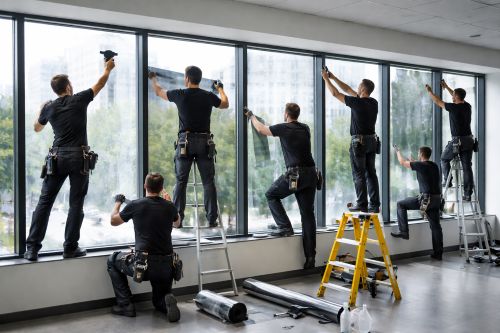
Film installation operates on an exponentially faster timeline. Once the building’s glass is professionally measured, the film can be procured and installed in a matter of weeks. A skilled team can complete an entire floor of a typical office building in just a few days. This speed accelerates the project’s completion, allowing the building to realize energy savings and improved comfort almost immediately.
The Low-Impact Advantage of Film Installation
For an occupied commercial building, operational disruption is a direct financial liability. Window replacement is an inherently invasive and disruptive process that generates significant noise, dust, and debris. It requires entire office spaces to be vacated for days at a time.
Film installation is a quiet, clean, and minimally disruptive procedure performed from the building’s interior. Installers work within the existing space with minimal intrusion. Furnishings are shifted slightly, not removed, and there is no noise from demolition. Tenants can often remain in their space or return within a very short period. This low-impact approach preserves business continuity and tenant satisfaction, mitigating a major project risk.
Upgrading Without Altering the Building Envelope
Replacing windows means breaking the building’s weather and air barrier. Every opening creates a new potential point for future air infiltration or water intrusion if not sealed perfectly. For buildings with historical or unique architectural character, replacing original windows can also permanently compromise their aesthetic value.
Window insulating film upgrades the performance of the existing glazing system without any of these risks. The installation does not disturb the building envelope, preserving the original seals and structural integrity. Modern films like 3M Thinsulate are virtually invisible, maintaining the original appearance of the building while dramatically improving the glass’s insulating performance.
Project Spotlight: A Data-Driven Case for Window Film
To move from abstract comparisons to tangible project metrics, let’s model a common scenario. This data-driven approach is essential for building a business case and securing stakeholder approval.
The Building Profile
Consider a 15-story, 200,000-square-foot commercial office tower built in the early 1990s. The building features an aging curtain wall system with 1/4-inch monolithic, lightly tinted glass. This single-pane glazing offers minimal insulation and poor solar heat rejection, resulting in a significant energy penalty.
The Challenge
The facility management team faces two primary issues. First, the annual energy spend is excessive, with HVAC systems accounting for over 40% of the building’s electricity consumption.
Second, tenant complaints about hot and cold spots near windows are a constant operational drain.
The HVAC system runs constantly in an attempt to maintain setpoints, driving up both energy use and maintenance costs.

The Proposed Solution
Instead of a multi-million dollar window replacement, the proposed solution is to retrofit all 60,000 square feet of existing glass with 3M Thinsulate Climate Control 75 Window Film. This film is chosen for its year-round performance, effectively turning the single-pane windows into dual-pane performers. Using energy modeling software, we can input the building’s specifications, local weather data, and utility rates to accurately forecast the performance improvement.
Projected Outcomes
The energy model provides the precise data needed to justify the project. For this hypothetical building, the projected outcomes are clear and compelling.
- Total Project Cost: The estimated all-in cost for the film installation is projected at approximately $450,000. A full window replacement was quoted at over $4 million.
- Annual Energy Savings: The model projects a reduction in annual heating and cooling costs of approximately $85,000. This represents a 12% reduction in the building’s total energy bill.
- Simple Payback Period: Based on the projected savings, the project achieves a payback period of just over 5 years.
- HVAC Load Reduction: The film is projected to reduce peak cooling demand by over 40 tons. This not only saves energy but also reduces strain on the building’s chillers, potentially extending their service life.
- ESG and Comfort Benefits: Beyond financial metrics, the film stabilizes interior temperatures, directly resolving tenant complaints. The documented energy reduction also provides a tangible contribution to the company’s ESG targets and can contribute points toward LEED certification.
Why Partnering with a National Installer Mitigates Project Risk
Selecting the right window film is only half the equation. The execution, particularly for large or multi-site portfolios, carries risks related to cost, quality, and scheduling. Engaging a certified national installation partner is a strategic decision that establishes a centralized system for quality control, communication, and accountability.
A Single Point of Contact for Nationwide Portfolios
For project managers overseeing a portfolio of properties across different regions, coordinating multiple local vendors is a significant drain on resources. A national installation partner eliminates this complexity by providing a single, dedicated point of contact. This centralizes all project communication, from initial scoping and scheduling to progress reporting and final billing. This streamlined model saves administrative hours and ensures a more predictable project lifecycle.
Ensuring Specification and Installation Consistency
The performance of 3M Thinsulate window film is contingent on using the specified product and installing it correctly. A certified national partner enforces strict standards across their entire network.
- Specification Integrity: The exact 3M film specified in the master contract is the film installed at every location. Centralized procurement prevents any deviation from the project specifications.
- Installation Consistency: National partners invest in standardized, manufacturer-certified training programs for all technicians. This means the application technique will be identical in Miami and Seattle, ensuring the film’s aesthetic clarity, adhesion, and long-term durability.
This consistency is fundamental to achieving the engineered energy savings and project goals.
The Importance of a Comprehensive Warranty
A key component of risk mitigation is securing a robust warranty that protects the capital investment.
- Manufacturer Warranty: 3M provides a comprehensive warranty against film defects. This warranty is contingent on the film being installed according to their stringent guidelines, which a certified partner guarantees.
- Installer Warranty: The installer provides a warranty covering their workmanship. With a national partner, this warranty is uniform and backed by a stable, nationwide corporate entity, simplifying any future service needs.
This dual-layer protection provides complete peace of mind and safeguards the project’s value for years to come.
Leveraging Expertise for Accurate Scoping and Analysis
Sophisticated national installers act as technical consultants, not just contractors. Their value begins long before the first roll of film is applied. These partners use advanced energy modeling software to provide a detailed analysis of your portfolio. This analysis quantifies the tangible outcomes you can expect, including:
- Projected annual energy savings in kWh and dollars.
- Peak demand reduction.
- Calculation of the simple payback period and overall ROI.
- Documentation to support applications for utility rebates or LEED certification points.
This upfront analysis transforms the project from a theoretical upgrade into a predictable financial investment.
For a proven, high-performance solution backed by expert analysis and installation, partner with Window Film Depot to maximize your project’s results.
Frequently Asked Questions
What is the typical payback period for commercial window insulating film?
The simple payback period for most commercial window film projects is remarkably fast, typically falling in the 3 to 5-year range. This rapid ROI is achieved by delivering significant energy savings at a fraction of the cost of full window replacement.
Will installing window film make our building dark or change its appearance?
No. Modern high-performance films like 3M Thinsulate Climate Control Window Film are designed to be virtually invisible. They are spectrally selective, allowing high levels of natural light to pass through while blocking invisible infrared and UV light. The aesthetic character and views of your building will be preserved.
How does window film installation compare to a full window replacement in terms of disruption?
Window film installation is a quiet, clean, and minimally invasive process performed from the interior of the building. A skilled team can often complete an entire floor in a few days with little to no disruption to tenants. This is a stark contrast to a full window replacement, which is a noisy, messy, and lengthy process requiring spaces to be vacated.
Can window insulating film help us achieve LEED certification?
Yes. By improving the energy performance of your building’s existing windows, window film can directly contribute points toward LEED certification. It primarily impacts credits in the Energy and Atmosphere (EA) and Indoor Environmental Quality (EQ) categories.