Table of Contents:
- What Is Privacy Film for Glass Walls & Why It Matters in 2026
- Key Benefits of Privacy Film on Glass Walls, Doors & Partitions
- Types of Privacy Window Film for Glass Walls (and Where Each Works Best)
- Installation & Maintenance: How Window Film Depot Delivers Turnkey Results
- Why Choose Window Film Depot for Privacy Film on Glass Walls
- FAQs About Privacy Film for Glass Walls
- Next Steps: Talk to Window Film Depot About Your Glass Walls
What Is Privacy Film for Glass Walls & Why It Matters in 2026
Glass walls, glass doors, and interior partitions have become the architectural default for offices, schools, clinics, and retail spaces across the U.S. The open, light-filled aesthetic that people love comes with a real trade-off: anyone walking by can see confidential documents on a screen, a patient consultation in progress, or a tense HR conversation happening in real time. In 2026’s hybrid work environments and compliance-heavy industries, that exposure is no longer just uncomfortable – it’s a liability.
Privacy film for glass walls is a thin, PET-based window film applied directly to existing glass surfaces to obscure sightlines without tearing out and replacing the glazing. It can be frosted, decorative, reflective, or even switchable, and it lets facility teams upgrade an entire floor of conference rooms or a chain of retail storefronts in a fraction of the time and cost of construction. Privacy films for glass walls enhance seclusion without replacing glass, and they can be utilized in both residential and commercial environments – from a single home office to a 200-location retail rollout.
Unlike traditional blinds, which block natural light and collect dust, privacy films diffuse or redirect light so interiors stay bright and visually open. There is an important distinction worth noting: privacy film used on interior glass walls (conference rooms, corridor partitions) typically relies on frosted or opaque technology that works consistently regardless of lighting. Window privacy film used on exterior windows and bathroom windows, on the other hand, often prioritizes solar control, UV rejection, and reflective properties where the lighting differential between inside and outside drives performance.
For facility managers dealing with HIPAA requirements in healthcare settings, FERPA concerns in schools, or simply the need for confidential meeting spaces, 3M window film products and installation provide a fast compliance path that doesn’t sacrifice the transparency and openness people expect from modern architecture.
Key Benefits of Privacy Film on Glass Walls, Doors & Partitions
The real value of privacy film becomes clear when you look at what it solves day-to-day for the people who manage buildings. Here’s what facility managers, architects, and building owners consistently find most useful.
Visual Privacy Without Sacrificing Openness
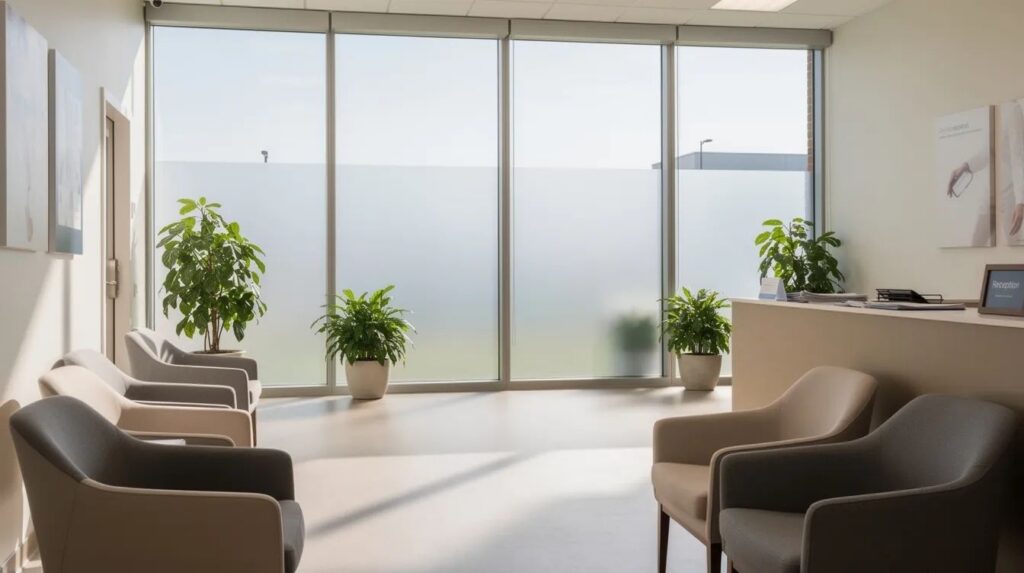
Frosted or patterned window film blocks direct sightlines through conference room glass, clinic intake areas, glass-front offices, and school administrative suites. A privacy band applied at eye level on a medical consultation room, for example, obscures facial features and screen content while still letting ambient light flow above and below. Privacy films obscure visibility day and night, which makes them far more reliable than solutions that depend on lighting conditions.
Light Management and Comfort
Harsh sun glare on perimeter glass walls creates hotspots, washes out monitors, and makes certain desks unusable for hours each day. Many privacy films reduce UV radiation and glare, distributing daylight more evenly and making screen-based work significantly more comfortable for employees and students. The result is a space that feels bright without feeling punishing.
Energy and UV Performance
This is where privacy film starts pulling double duty. High-end films block up to 99% of UV radiation, protecting carpets, furniture, artwork, and retail merchandise from fading. Solar control variants can reduce total solar energy rejected (TSER) by 50–70%, meaningfully cutting cooling loads on south- and west-facing façades. For building owners chasing energy code compliance, combining privacy with solar control in a single film layer avoids the cost and complexity of full reglazing.
Safety and Security
Thicker films (8–14 mils) add a shatter-resistant layer to glass doors and sidelites. If glass is struck, the film holds shards together, reducing injury risk. In retail, this helps deter smash-and-grab events. In schools, security glazing films that meet standards like ASTM F3561 are increasingly specified for door vision panels. Privacy and safety can live in the same product.
Aesthetic and Branding Benefits
Artistic decorative films can reinforce branding and aesthetics in office spaces – think custom-printed logos in reception areas, gradient fades along corridor partitions, or geometric patterns that make a creative agency’s interior feel intentional rather than generic. These options cost a fraction of custom etched or sandblasted glass.
Operational Advantages
Installing film is faster, cleaner, and far less disruptive than ripping out glass or building new drywall. Crews can work nights and weekends in occupied buildings. For national retail chains, this means a rollout that doesn’t shut down stores. It’s a great fit for any project where minimizing downtime matters.
Types of Privacy Window Film for Glass Walls (and Where Each Works Best)
Not all window films are the same, and the right choice depends on how much privacy you need, what the space looks like, and whether the glass walls face inside the building or catch direct sun from outside. Privacy films come in types ranging from blackout to decorative patterns, and the selection also includes stained glass and frosted glass designs. Here’s how the main categories break down.
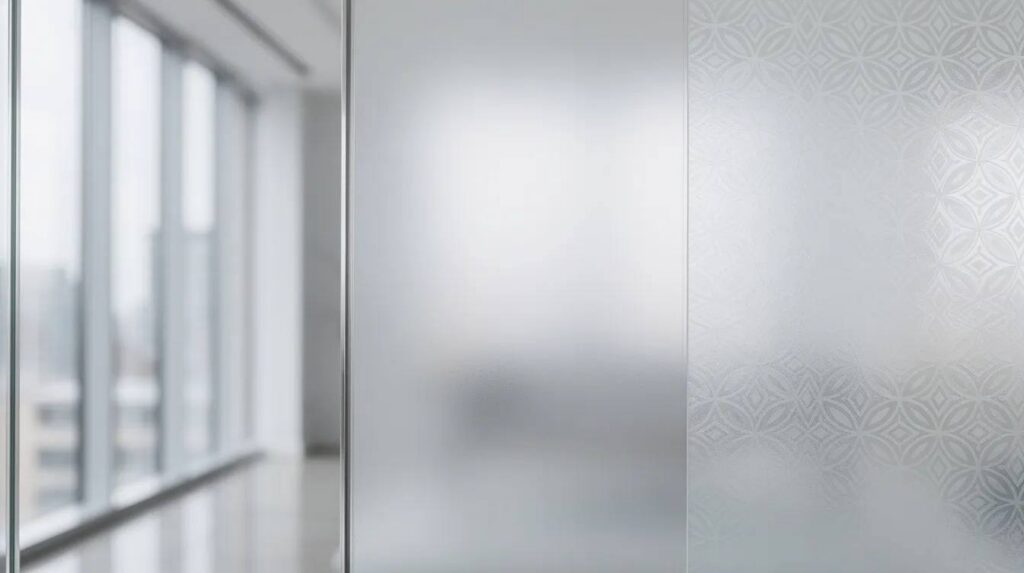
Frosted and Opaque Films
Frosted films are the workhorse of interior privacy. They obscure visibility while allowing light to pass through, typically maintaining a visible light transmission (VLT) of 50–80%. Full-coverage frost delivers maximum privacy in HR offices, medical consult rooms, and bathroom windows. Partial bands or stripes on conference room glass give occupants privacy at seated eye level while keeping the upper and lower portions clear for an open feel.
Frosted films are ideal for bathrooms and private offices where consistent, all-hours privacy is non-negotiable. They provide privacy while allowing natural light to fill the space – a combination that blinds simply can’t match.
Decorative and Patterned Films
Decorative films enhance privacy through patterns and textures that mimic etched, sandblasted, or pebble glass without the permanent commitment or cost. Options range from geometric patterns and organic textures to reeded and linen effects. Gradient films offer privacy at specific heights while maintaining openness elsewhere – useful in conference rooms where you want the upper glass to stay transparent.
Decorative films can enhance the aesthetic of glass surfaces in creative agencies, universities, hospitality lobbies, and co-working spaces. They also serve a practical code purpose: in schools and healthcare facilities, patterned films can double as the glass manifestation markings required under ADA guidelines, making glass doors visible to people approaching and preventing collisions.
Decorative films can enhance window aesthetics while providing privacy, which is why architects increasingly spec them alongside functional performance requirements.
Solar and Reflective Privacy Films
For exterior-facing glass walls that need daytime privacy, glare reduction, and energy savings, tinted or reflective window film is the go-to solution. Reflective films provide excellent daytime privacy by reflecting light back toward the brighter exterior, creating a mirrored finish on the outside while people inside can see out clearly. Mirrored finish films are available for added privacy in lobbies, ground-floor offices, and sun-exposed façades.
One-way window films provide privacy during the day, but there’s a critical limitation to understand: reflective films have limitations at night when interior lights are brighter than the exterior. When the lighting balance flips after dark, the mirror effect reverses and visibility from outside increases. If round-the-clock privacy is the goal, day and night privacy window film solutions based on frosted or decorative constructions are the safer bet. Some films prevent visibility even at night with lights on – these tend to be frosted or opaque rather than reflective.
Blackout and Smart Films
Blackout films completely block visibility and light, making them the right choice for storage rooms, media rooms, or certain clinical spaces where zero light transmission is required.
On the other end of the spectrum, switchable smart films change from transparent to opaque on demand, toggling via an electric current. These are increasingly popular in conference rooms and executive suites where flexibility matters – opaque for a board meeting, transparent for collaborative work ten minutes later. They remain significantly more expensive than static films, but pricing continues to drop as the technology matures.
Custom-Printed Films
Window Film Depot can integrate logos, text, and wayfinding graphics directly into privacy films for corporate campuses, large public buildings, and multi-location retail environments. This lets organizations turn a functional upgrade into a branding opportunity without adding a separate graphics layer.
Installation & Maintenance: How Window Film Depot Delivers Turnkey Results
Professional installation matters far more on large glass walls, curved glass, and complex door systems than most people realize. A bubble, a misaligned seam, or an edge that peels within six months undermines the entire investment. Here’s how the process actually works when Window Film Depot manages the project.
Site Assessment
Before anything is ordered, a project manager reviews floor plans, visits the site (or works from detailed photos and measurements for remote locations), and assesses the existing glazing – single pane, insulated, tempered – along with sun exposure, interior lighting, and specific privacy needs. This is where the right 3M or equivalent privacy and window film product gets matched to the application. Choosing the wrong film spec for the wrong glass type can cause thermal stress cracking, so this step isn’t optional.
Preparation and Installation
Installers start by making sure every surface is ready. Clean and dry the window before applying the film – any dust, residue, or moisture trapped beneath the film will create defects that are impossible to fix after curing. Old films or coatings get removed first, which adds roughly $1.50 per square foot in labor.
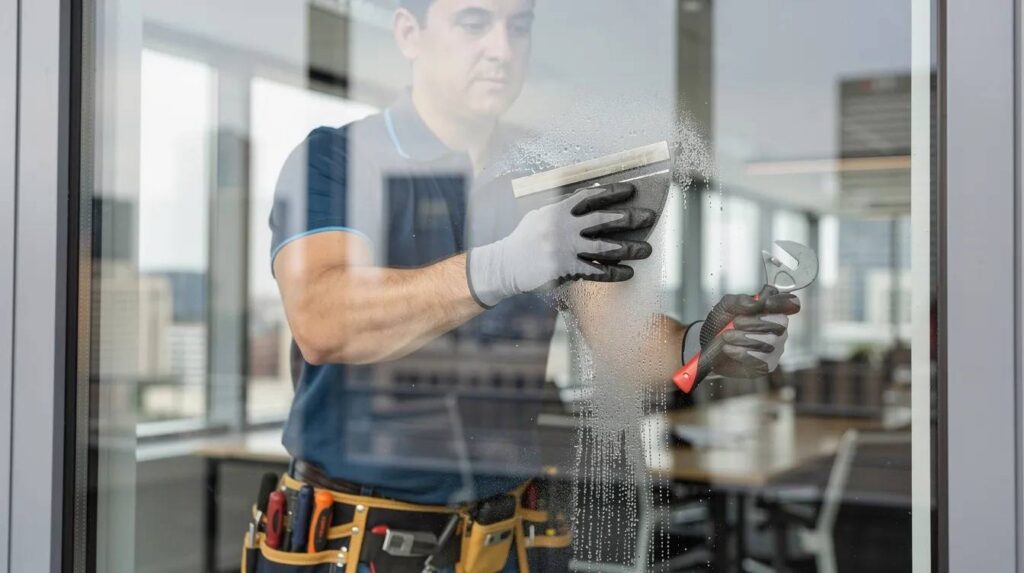
For larger panels, installers soak the film in hot water before application to improve flexibility and adhesion. A slip solution is applied to the glass, the film is positioned, and then a squeegee is used to remove bubbles during installation, working from the center outward. Experienced installers cut the film to overhang the edges by 1 inch, then use a sharp knife for clean edges after installation, trimming precisely around gaskets, hardware, and the frames of glass doors.
On a large glass wall span, the difference between a DIY attempt and a professional install is immediately visible. Seams, edges, and corners are where amateur jobs fall apart.
Phasing for Occupied Buildings
For offices, schools, government facilities, and retail chains, Window Film Depot schedules crews during nights, weekends, or in phased-by-floor sequences so that normal operations continue without waiting for construction to wrap up. A school wing might get filmed over spring break. A corporate floor might be completed across two overnight shifts. National retail rollouts coordinate across dozens of locations simultaneously.
Maintenance and Longevity
Maintaining filmed glass is easy: use soft cloths and non-ammonia cleaners, avoid razor blades near edges, and allow the adhesive its full cure time (typically several days to a few weeks depending on conditions). Remember that pressing on or stressing freshly applied film before it’s cured can cause failures.
Interior frosted and decorative films typically last 10–15 years with proper care, and high-quality installations in controlled environments can push well beyond that. Privacy films can last over 20 years without issues when the glass is sound and maintenance is consistent. Exterior films exposed to intense sun may degrade sooner, but still offer years of reliable performance.
Warranty and Performance
Films from leading manufacturers carry multi-year warranties covering optical clarity, adhesive performance, and delamination – conditional on installation by authorized dealers like Window Film Depot. Performance documentation (U-value improvements, TSER, UV rejection, VLT) is provided for architects and facility managers who need it for specification records.
Real-World Example
In 2025, Window Film Depot upgraded glass walls across dozens of branch locations for a national financial services firm. The project required frosted privacy bands on conference rooms, decorative branding film in lobbies, and solar control film on exterior façades – all delivered on a compressed timeline with zero disruption to branch operations. Centralized procurement and nationwide installation teams ensured consistent appearance and performance across every site.
Why Choose Window Film Depot for Privacy Film on Glass Walls
Window Film Depot has been solving glazing challenges for commercial and institutional clients since 1992. As a family-owned company based in Marietta, Georgia, with a national footprint, the firm brings a combination of scale, product depth, and hands-on project management that’s difficult to find elsewhere.
Experience and Scale
Over three decades of work with government agencies, Fortune 500 offices, retail chains, schools, and hospitals across North America means that most project scenarios – tight timelines, union labor requirements, phased rollouts, complex code compliance – have already been handled and refined.
Product Depth
Access to high-performance privacy, decorative, solar control, security, and anti-graffiti window film solutions from manufacturers like 3M allows Window Film Depot to tailor specifications to each project. This isn’t a one-size-fits-all catalog. Films are selected based on glass type, orientation, climate, privacy requirements, and aesthetic goals.
Turnkey Delivery
In-house project management covers everything from initial site assessment through commercial window film installation, post-install inspection, and warranty support. The ability to coordinate multi-site or multi-state deployments – with union and non-union crews as required – is a differentiator that matters for enterprise-scale clients. You won’t find this level of coordination and accountability on amazon or through a general contractor who subcontracts the work.
Quality and Compliance
Every installer is trained on manufacturer guidelines. Attention to fire codes, building codes (including safety glazing requirements under ANSI Z97.1 and CPSC 16 CFR 1201), and documentation standards means architects and facility managers get the paperwork they need alongside the finished product.
Support for Trade Partners
Window Film Depot also supplies wholesale rolls of privacy and window film to glass and glazing contractors seeking a reliable source across North America. Trade partners get access to the same premium product lines and technical support.
Long-Term Relationships
Clients come back because of responsiveness, post-install support, and a commitment to performance – not just competitive pricing. When a building’s needs change in three years, the relationship and project history are already in place.
FAQs About Privacy Film for Glass Walls
These are the questions facility managers and designers ask most often when evaluating privacy film for glass walls. If your situation is more specific, Window Film Depot’s team can walk you through the details.
Does privacy film work at night when the lights are on?
It depends entirely on the film type. Frosted and opaque films provide consistent privacy day and night because they physically diffuse light rather than relying on reflective properties. Reflective one-way films, however, lose their privacy advantage at night when interior lights are brighter than the exterior – the mirror effect reverses, and people outside can see inside. For spaces like bathroom windows or offices that need round-the-clock privacy, the best window film for nighttime privacy is typically a frosted or opaque construction. Some films prevent visibility even at night with lights on, specifically those with heavy frost or full-opacity construction.
Can privacy window film be removed later without damaging the glass?
Yes. Quality films on sound, properly prepared glass typically come off cleanly when removed by a professional. Adhesive residue may remain, but it’s removed with solvents during the process. This makes privacy film ideal for leased office spaces where tenants need privacy now but can’t make permanent alterations. Removal does add labor cost – roughly $1.50 per square foot – so it’s worth factoring in if you know the film is temporary.
Will window film make my glass walls darker?
Frosted and decorative films diffuse light rather than heavily tinting it, so the space stays bright. The glass may appear softer or slightly less transparent, but overall light transmission remains high (typically 50–80% VLT for frosted films). Solar control films can be specified in lighter or darker shades depending on how much glare reduction and energy performance you need. Your installer can show you samples on your actual glass before committing.
Is privacy film suitable for glass shower walls or restroom areas?
Many films work well for bathroom windows, locker rooms, and shower enclosures. The key is selecting a film with moisture-resistant adhesive and ensuring proper edge sealing to prevent water ingress in high-humidity environments. Frosted films are the most common choice here because they obscure visibility completely while letting diffused light through. Professional installation matters more than usual in wet environments – poor edge work leads to premature peeling.
How long does installation take for a typical office floor of glass walls?
A small office suite with a handful of glass partitions and glass doors might be completed in a single day. A full corporate floor or school wing with extensive glass walls typically requires several nights or a weekend, depending on crew size and complexity. Window Film Depot can staff larger crews to compress timelines when project schedules are tight, and phased approaches keep the space operational throughout.
What does privacy film cost compared to replacing glass or adding new walls?
Privacy film is typically a fraction of the cost of new glass or drywall construction. Installed costs for standard frosted or decorative privacy film generally fall between $8 and $20 per square foot, depending on film specification, total square footage, and site conditions. Compare that to the cost of demolition, new framing, drywall, painting, and disruption – film is almost always the more practical path. For a tailored estimate, the best approach is to share your glass dimensions, photos, and goals with Window Film Depot’s project team.
Next Steps: Talk to Window Film Depot About Your Glass Walls
Privacy film for glass walls, glass doors, and interior partitions is one of the fastest, lowest-disruption upgrades you can make to an existing building. Whether the goal is confidentiality in a medical office, comfort in a sun-drenched classroom, or a branded aesthetic across a national chain, professional 3M window film installation by the right team delivers measurable results.
Before you reach out, gather a few basics: photos of your current glass walls, approximate measurements or floor plans if available, and a short description of what you’re trying to solve. This lets Window Film Depot provide a more accurate initial recommendation and move quickly toward a site survey.
Contact Window Film Depot today – by phone or through the online form – to schedule a site assessment, discuss film options such as 3M cloaking window film installation, or start planning a multi-location rollout. The team serves both commercial and select residential projects nationwide, and also provides wholesale film supply to qualified trade partners looking for a reliable, expert-backed source.
Whether you’re a facility manager upgrading a single floor or an architect specifying film across a portfolio of buildings, the conversation starts with a simple quote request.