Table of Contents:
- Understanding the Science of One-Way Window Film and Light Differential
- Decoding the Data Sheet: Key Metrics for Specifying Commercial Privacy Film
- Ideal Commercial Applications for One-Way Window Film
- Managing the Nighttime Reversal: A Critical Conversation with Your Client
- Why Professional-Grade 3M Films and Expert Installation Matter
- Conclusion: Mastering Privacy Film Specification for Project Success
- Frequently Asked Questions
- Related Posts from Window Film Depot
Understanding the Science of One-Way Window Film and Light Differential
To translate a client’s aesthetic request into a successful technical specification, you must first understand the physics governing reflective window films. The “one-way mirror” effect is not a feature built into the film. It is an optical illusion created by the interplay between the film’s properties and the lighting conditions in your specific environment. Mastering this concept is the key to setting correct expectations and delivering a predictable, successful outcome.
The Fundamental Principle: Privacy Follows the Light
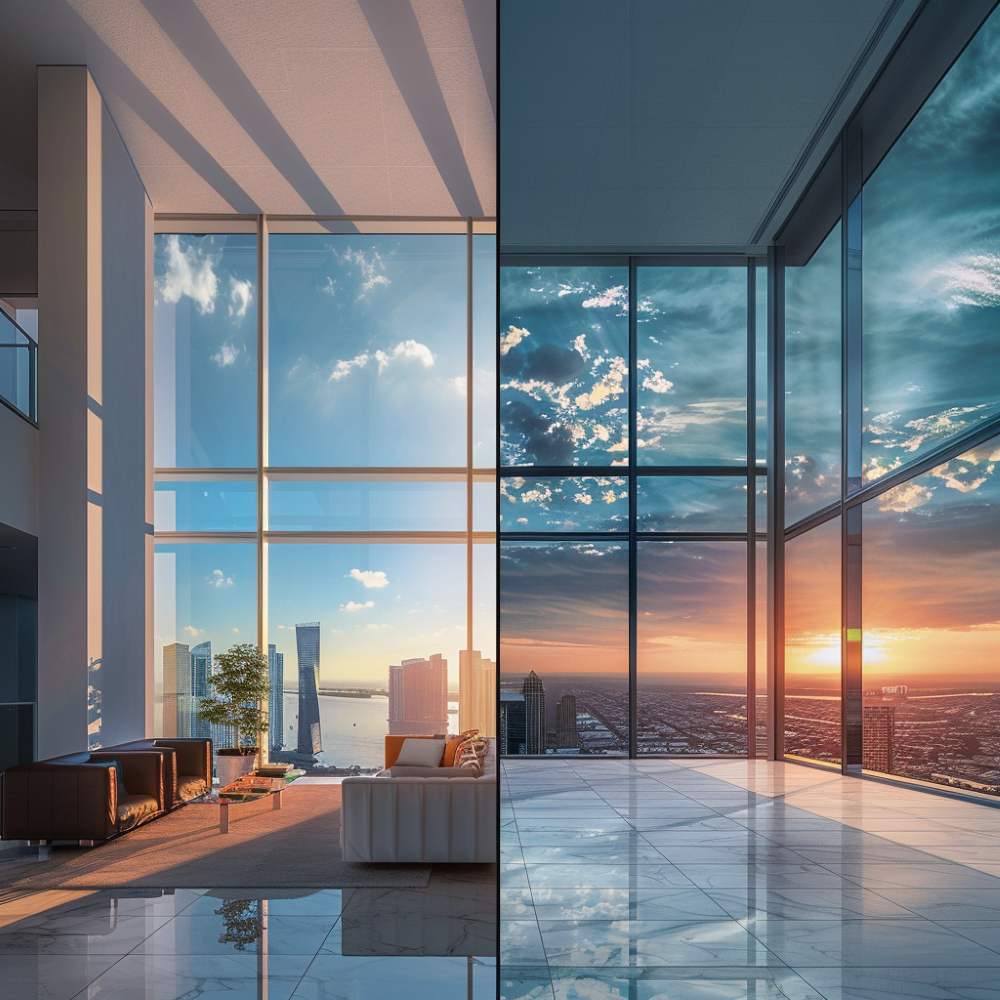
The single most important rule is that privacy is created on the side of the glass that is brighter. The film itself has no “inside” or “outside” face for its reflective properties. It will always make the side with more light the reflective, mirror-like side. Consider a standard window in an illuminated office building at night. From the dark street, you can see in clearly, while from inside, the window acts as a dark mirror reflecting the room’s interior.
Reflective privacy film operates on this exact same principle but dramatically enhances the effect. The film is a passive material reacting to the light differential between two spaces. During the day, the sun makes the exterior significantly brighter than the building’s interior.
The film reacts by reflecting this intense exterior light, creating a mirror for anyone looking in. At night, when the sun is gone and interior lights are on, the light differential reverses. The interior is now brighter, and the film reacts accordingly, allowing outsiders to see in.
Unpacking Reflectivity: How Mirror Film Manipulates Light
Reflective window films, such as the 3M Sun Control Window Film Night Vision Series, are marvels of material science. They are typically constructed from durable polyester and contain an incredibly thin, vapor-coated layer of metal particles. These microscopic metal deposits give the film its reflective quality.
When light strikes the film, three things happen: some light is reflected, some is absorbed, and the rest is transmitted through the glass. A highly reflective window film is engineered to maximize reflection and minimize transmission. For example, a film might reflect 60% of visible light, absorb 20%, and only transmit the remaining 20% into the interior space.
This manipulation of light creates the illusion of a one-way mirror. To an outside observer during the day, the 60% of light being reflected back at them completely overpowers the 20% of light transmitted from the darker interior. Their eyes perceive a mirror. For someone inside, their view is composed of that 20% of transmitted daylight, which is still much brighter than the light being reflected from inside the room. This allows them to see out clearly.
Why It’s a Daytime Privacy Film, Not a 24/7 Security Shield
Understanding the mechanics of light differential and reflectivity brings us to the most critical point for any project manager. These films provide daytime privacy. Confusing this with a 24-hour solution is the most common point of failure. The film’s effectiveness is entirely dependent on the time of day and the lighting choices within the building.
The Daytime Effect: Achieving Desired Privacy
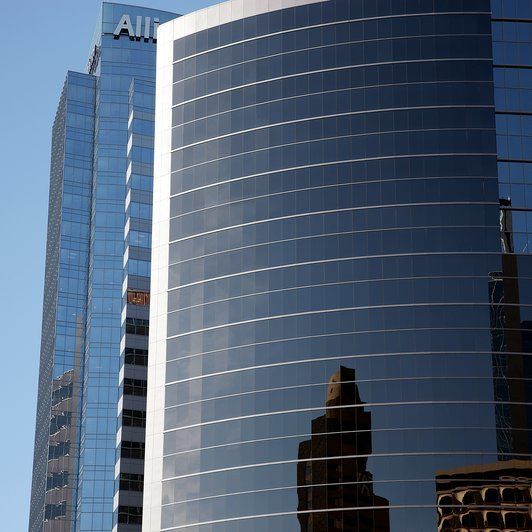
In a typical commercial application, the goal is to prevent observation into ground-floor offices, conference rooms, or lobbies during business hours. In this scenario, reflective film is an ideal solution. The sun provides a powerful light source, ensuring the light differential is firmly in your favor. The exterior becomes a clean, modern, mirrored facade, while occupants enjoy unobstructed views and a more comfortable interior due to reduced glare and heat gain.
The Nighttime Reversal: The Critical Limitation
As soon as dusk falls and interior lights are switched on, the physics reverse. The office interior becomes the primary light source, and the outdoors becomes dark. The light differential flips, and so does the film’s effect. Occupants looking at the window will see a reflection of themselves and the room, while anyone on the outside will have a clear view inside. This is not a product defect. It is the predictable behavior of the technology and must be accounted for in the project plan, especially for spaces requiring privacy after dark.
Decoding the Data Sheet: Key Metrics for Specifying Commercial Privacy Film
To move from a conceptual understanding to a successful specification, you need to speak the language of performance data. The product data sheet is your most critical tool for aligning film capabilities with project requirements. Failing to interpret these metrics correctly is where many projects go wrong, leading to privacy that doesn’t perform as anticipated.
Let’s demystify the three most important values for any project involving commercial privacy film.
VLT (Visible Light Transmission): Balancing Privacy and Natural Light
Visible Light Transmission, or VLT, is the percentage of visible light that passes through the filmed glass. It is a direct measure of how dark or light the tint will appear from the inside.
A lower VLT percentage means a darker film, which blocks more light. This can enhance privacy, but it will also reduce the amount of natural daylight entering the space. A higher VLT allows more light in, creating a brighter interior, but may offer less perceived privacy. The key is to balance the client’s desire for a daylit environment with their need for privacy. For instance, a VLT of 15% will create significant privacy but will noticeably darken the room, whereas a VLT of 35% will feel much more open.
VLR (Visible Light Reflection): Quantifying the Mirror Effect
Visible Light Reflection, or VLR, is the metric that directly corresponds to the mirror effect. It measures the percentage of visible light reflected by the film. For daytime privacy, you are primarily concerned with the VLR-Exterior value.
A higher exterior VLR creates a more potent mirror-like appearance on the outside of the glass, preventing people from seeing in. This is the cornerstone of one way window film. This metric also proves the effect is not absolute. Every film also has a VLR-Interior value. At night, when interior lights are brighter than the exterior darkness, this interior reflectance becomes dominant, and the privacy effect reverses. The glass becomes a mirror for those inside while allowing clear views in from the outside.
TSER (Total Solar Energy Rejected): The Added Benefit of Energy Efficiency
While not a direct measure of privacy, Total Solar Energy Rejected, or TSER, is a critical performance indicator that adds significant value. This metric calculates the film’s ability to block solar heat, which includes visible light, infrared, and UV radiation.
A film with a high TSER can dramatically reduce a building’s cooling load, leading to tangible energy savings and a more comfortable environment. For a project manager, framing a privacy film specification around its energy efficiency benefits can often help justify the investment to stakeholders focused on operational costs and sustainability goals. It turns an aesthetic upgrade into a smart capital improvement with a clear return on investment.
Applying Performance Data: A Look at 3M Film Product Lines
With these metrics in hand, you can make an informed comparison between different film options. The choice is about selecting the film whose data profile best matches your project’s specific priorities.
Let’s consider two popular 3M series as an example:
- 3M Sun Control Window Film, Silver Series: This product line is engineered for maximum daytime privacy and heat rejection. It features a very high exterior VLR, creating a strong mirror effect during the day. Its TSER is also among the highest available. The trade-off is a lower VLT, meaning a darker interior, and a more noticeable privacy reversal at night. This is ideal for commercial facades where daytime privacy and energy control are the top priorities.
- 3M Sun Control Window Film, Night Vision Series: This line is designed to balance performance. It offers good heat rejection and daytime privacy but with a lower exterior VLR than the Silver series. Its unique benefit is its low interior reflectivity, which helps preserve the view looking out, especially at night. This makes it an excellent choice for offices or storefronts where the client wants to maintain nighttime views from the inside while still getting effective glare and heat control during the day.
The right specification depends on asking the right question. Is the primary goal maximum daytime privacy, or is it a balance of performance with clearer nighttime views? The data sheet provides the definitive answer.
Ideal Commercial Applications for One Way Window Film
Understanding the physics of light differential allows you to identify project scenarios where reflective film will perform exactly as your client hopes. By targeting the right applications, you can deliver successful outcomes and reinforce your reputation.
Enhancing Privacy for Ground-Floor Storefronts and Offices
This is the quintessential application. Ground-floor spaces adjacent to public sidewalks, plazas, or parking lots are perfect candidates for daytime privacy film. During business hours, the film effectively shields employees, clients, and sensitive on-screen information from the view of passersby. Occupants can enjoy an unobstructed view of the outside world, feeling connected to their surroundings rather than closed off. The crucial management piece is communicating the need for blinds or curtains to maintain privacy after sunset.
Creating Modern Aesthetics with Interior Glass Partitions
Reflective films are not limited to a building’s exterior. They can be used on glass walls for conference rooms, private offices, or human resources departments to create on-demand privacy. In this scenario, the light differential is controlled not by the sun, but by the building’s own lighting design. For a meeting room to be private, the adjacent hallway or open-plan office must be more brightly lit. This application requires close coordination with the lighting designer to ensure the desired effect is achievable.
Securing Sensitive Areas and Control Rooms During Daytime Hours
For facilities that house control rooms, security monitoring stations, or research labs, preventing unauthorized observation is a key operational requirement. Reflective window film provides a simple, effective layer of daytime security. It allows personnel inside these critical areas to monitor exterior activity without being seen themselves. This is far preferable to blocking views entirely with opaque walls or drawn blinds, which can create an isolated work environment.
Reducing Glare and Heat Gain in Commercial Buildings
Often, the primary driver for a film project is not privacy but comfort and energy efficiency. Reflective films are exceptionally effective at reducing solar heat gain and cutting uncomfortable glare on computer screens. In these projects, the daytime privacy created by the film is a valuable secondary benefit. When presenting options to a client focused on occupant comfort or ESG goals, leading with the TSER and glare reduction data can be the most effective strategy.
Managing the Nighttime Reversal: A Critical Conversation with Your Client
The success of a privacy film specification hinges on managing expectations. Proactively addressing the physical limitations of reflective film with your client is a fundamental part of a successful project.
Explaining the “Fishbowl Effect” When Interior Lights are On
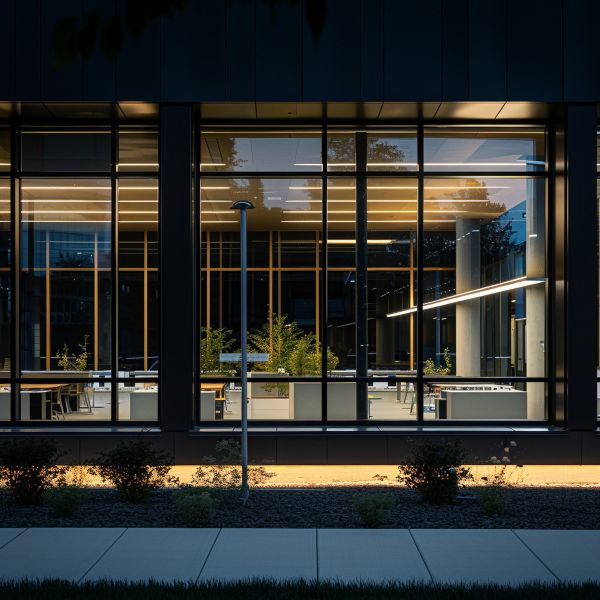
The most common point of failure is a misunderstanding of what happens after sunset. Once the sun goes down and interior lights are on, the space that was private all day becomes clearly visible from the outside.
The same physics that created daytime privacy now works in reverse. With the interior now significantly brighter than the dark exterior, the reflective surface effectively flips. It creates a mirror for those inside and a clear window for anyone looking in.
We call this the “fishbowl effect,” and it is essential to explain this to your client in simple terms. It is not a product defect.
It is an immutable property of how light and reflection work. Setting this expectation early prevents late-stage disappointment and costly disputes.
Strategies for Mitigating Nighttime Privacy Concerns
Since the film itself cannot provide nighttime privacy, the solution lies in a layered approach. Your role is to guide the client toward a comprehensive strategy that addresses their needs around the clock.
- Traditional Window Coverings: The most straightforward solution is pairing the window film with conventional blinds, shades, or drapes that can be closed at night. The film provides excellent daytime privacy and solar control, while the blinds offer a guaranteed nighttime solution.
- Exterior Lighting Design: In some commercial settings, you can maintain the light differential by installing strategic exterior lighting. By illuminating the building’s facade, you can sometimes keep the exterior brighter than the interior, preserving the film’s one-way effect. This requires careful planning with a lighting designer.
- Alternative Film Solutions: If 24/7 privacy is a non-negotiable requirement, a reflective film may not be the right tool. In these cases, a decorative or frosted privacy film, like 3M Fasara Glass Finishes, is a better specification. These films provide privacy day and night by obscuring the view, regardless of lighting conditions.
Documenting Limitations to Protect Your Project
Clear communication is your best tool for risk management. After discussing the nighttime reversal effect, it is critical to document this conversation and the client’s acknowledgement. This protects your reputation and ensures all stakeholders have the same understanding.
Incorporate a clause in your proposal and final sign-off documents that explicitly states the film provides daytime privacy based on a light differential and that the effect will reverse at night when interior spaces are illuminated. This simple step transforms a potential client complaint into a documented and understood project parameter.
Why Professional Grade 3M Films and Expert Installation Matter
Once you and your client have aligned on a strategy, the focus shifts to selecting a product and installation partner that can deliver on performance, durability, and aesthetics. The gap between consumer-grade products and professional solutions is immense, with significant implications for your project’s outcome.
The Performance Gap: Sputtered vs. DIY Reflective Window Film
The technology used to manufacture the film is a primary determinant of its quality. Professional-grade films, such as those from 3M, are typically created using a process called sputtering. This advanced technique embeds microscopic layers of metal particles onto the film, resulting in a product with exceptional optical clarity, stable color, and consistent performance. In contrast, many lower-cost DIY films are simply dyed or use less sophisticated coatings. These products are prone to fading, bubbling, and developing a hazy appearance over time.
Durability, Clarity, and Warranty: Hallmarks of a Professional Solution
A professional-grade film installation is an investment in the building’s performance. With a superior product like 3M Window Film, you are specifying a solution that delivers tangible, long-term benefits.
- Durability: 3M films feature a robust, scratch-resistant coating that stands up to the rigors of daily cleaning in a commercial environment.
- Clarity: The advanced manufacturing process ensures zero optical distortion. The view from the inside remains crisp and clear.
- Warranty: Specifying 3M films installed by a certified dealer provides your client with a comprehensive manufacturer’s warranty, protecting the investment against defects.
The Value of Certified Installation Expertise
Even the best film will fail if not installed correctly. Proper installation is a craft that requires precision and experience to avoid issues like peeling, contamination, or unsightly gaps. As a 3M Authorized Prestige Dealer, Window Film Depot guarantees that every installation is performed by highly trained professionals. Our national network of installers ensures that whether your project involves a single headquarters or a rollout across dozens of locations, the standard of quality remains consistently high.
Conclusion: Mastering Privacy Film Specification for Project Success
The success of any one way window film installation hinges on a clear understanding of its capabilities and limitations. Managing client expectations is just as critical as selecting the right product. By grounding your specifications in the physical principles of light, you can prevent misunderstandings and deliver results that meet both aesthetic and functional goals.
Key Takeaway: The Inescapable Rule of Light Differential
If there is one principle to commit to memory, it is this: reflective film works by reflecting the side with more light. During the day, the bright exterior makes the film reflective from the outside, creating privacy. At night, when interior lights are on, this effect reverses, allowing for a clear view into the space. This is not a product flaw, it is a law of physics. Acknowledging and planning for this light differential is the single most important factor in a successful specification.
A Project Manager’s Checklist for Reflective Film
- Define the Primary Goal: Is the main objective daytime privacy, glare reduction, or heat control?
- Analyze Lighting Conditions: Have you assessed the lighting for key hours of occupancy, including daytime sun and nighttime artificial light?
- Set Nighttime Expectations: Have you clearly communicated to the client how the film will perform after sunset and discussed solutions like blinds for nighttime privacy?
- Consider VLT: Does the chosen film’s VLT percentage align with the desired level of interior brightness?
- Request a Mock-Up: Have you planned for a test installation on a small section of glass to confirm performance and get client sign-off?
- Evaluate Glass Compatibility: Is the existing glazing single-pane or dual-pane? Confirming film compatibility is essential to avoid thermal stress and warranty issues.

Next Steps: Consulting with a Technical Film Expert
Navigating film specifications and glass compatibility can be complex. The most effective way to mitigate risk is to partner with a technical expert early in the planning phase. A professional Window Film Depot consultant can provide detailed performance data, help you balance aesthetics with needs like heat rejection and UV protection, and facilitate on-site mock-ups. This collaborative approach removes guesswork and positions your project for success from the start.
Frequently Asked Questions
Why can I see into my office at night even with one-way window film?
One-way window film works by reflecting light. It creates a mirror effect on whichever side is brighter. During the day, the bright sun makes the outside of your window a mirror. At night, when your interior lights are on, your office becomes brighter than the dark outdoors, so the mirror effect “flips” to the inside. This allows people outside to see in. It’s a normal function of the film’s physics, not a defect.
Will reflective window film make my office too dark?
It depends on the film you choose. Every film has a Visible Light Transmission (VLT) rating, which tells you how much light it lets through. A film with a low VLT (e.g., 15%) will offer more privacy but will be noticeably darker inside. A film with a higher VLT (e.g., 35%) will let in more natural light. It’s a trade-off between brightness and the strength of the privacy effect.
What’s the difference between reflective film and frosted privacy film?
Reflective film provides daytime privacy by acting like a mirror, but you can still see clearly through it from the darker side. Its effectiveness depends entirely on the light difference. Frosted privacy film, like 3M Fasara, obscures the view completely from both sides, day and night, regardless of the lighting. It provides 24/7 privacy but blocks the view out.
Is one way window film good for 24/7 security?
No. It is a daytime privacy solution. Because the effect reverses at night when interior lights are on, it cannot be relied on for 24/7 security or privacy. For nighttime privacy, reflective film should be paired with other solutions like blinds, curtains, or a 24/7 privacy film like a frosted or decorative option.