Table of Contents:
- What Is Commercial Window Frosting & How Does It Work?
- Key Benefits of Commercial Window Frosting for Businesses
- Types of Commercial Window Frosting & Where Each Works Best
- How the Commercial Window Frosting Process Works (From Site Visit to Installation)
- What to Consider Before Choosing Commercial Window Frosting
- Why Choose Window Film Depot for Commercial Window Frosting
- FAQs About Commercial Window Frosting
- Next Steps: Schedule a Commercial Window Frosting Consultation
Commercial window frosting enhances business environments by providing privacy, reducing glare, and improving energy efficiency-all without replacing existing glass. In 2026, facility managers, architects, and building owners are choosing frosted window film over costly glass replacement to transform office partitions, storefronts, healthcare facilities, and government buildings.
Here is what this page covers:
- How frosted films deliver privacy while letting natural light enter
- Branding and aesthetics options for commercial spaces
- Measurable energy savings and UV protection
- Comfort improvements for tenants and customers
- A step-by-step look at the installation process
This article focuses on real-world commercial applications-not DIY home crafts or shop-grade static cling.
What Is Commercial Window Frosting & How Does It Work?
Commercial window frosting is professionally installed, specification-grade frosted window film applied to existing glass in offices, retail locations, schools, healthcare facilities, and government buildings. It is engineered for durability, code compliance, and long-term performance in high-traffic commercial conditions.
There are two primary ways to get a frosted finish on glass. Factory-etched or acid-etched glass is manufactured with the frosted texture built in, permanent, but expensive to retrofit. The alternative is frosted window film: a polyester-based, self-adhesive film applied directly to existing windows and glass doors. Self-adhesive frosted window films are preferable for commercial spaces because they can be installed quickly, removed when needed, and deliver a similar appearance to etched glass at a lower cost.
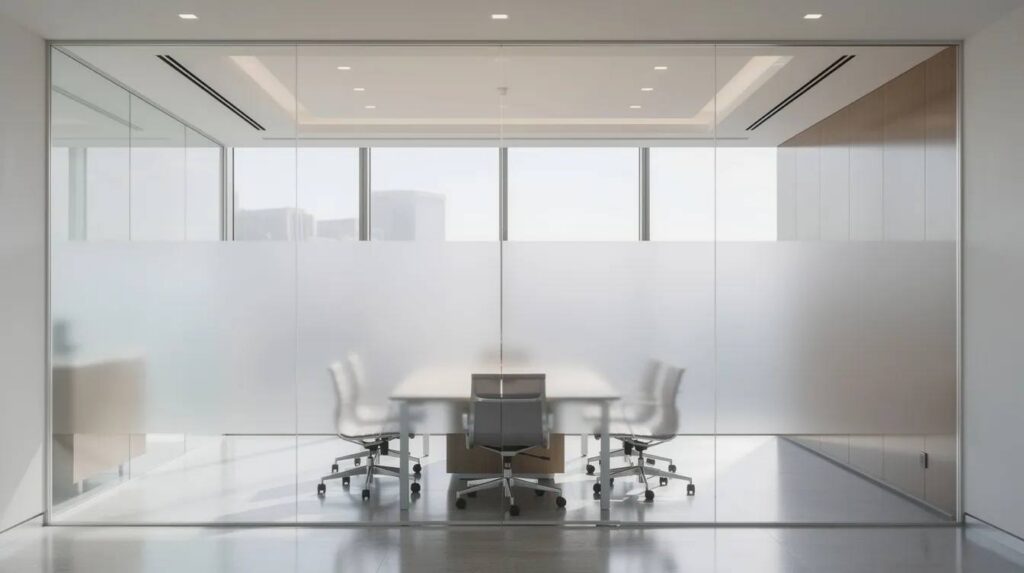
Modern frosted films use micro-etched textures or printed matte patterns to scatter incoming light rather than block it entirely. A “light frost” film may transmit around 90% of visible light while softening shapes and outlines. A “heavy frost” drops transmission to roughly 30%, providing near-complete privacy. In both cases, frosting provides essential privacy while allowing natural light to enter.
Commercial window frosting sits within the broader category of commercial window tinting and window films, which also includes solar control films, security films, and anti-graffiti films. Many decorative frost products include UV rejection and moderate solar performance specs in addition to their privacy function, and these benefits can be maximized by selecting from a range of window glass film products and brands designed for specific performance goals.
Key Benefits of Commercial Window Frosting for Businesses
The return on investment for frosted film goes well beyond appearance. Here is how it impacts occupant comfort, operating costs, and compliance for facility managers and building owners.
Privacy and focus. Frosting minimizes visual distractions in office environments by blocking direct sightlines through glass conference rooms, HR suites, healthcare intake areas, bank transaction windows, and K–12 administrative offices. Frosting creates a professional atmosphere by enhancing comfort without sealing off daylight or creating a closed, oppressive environment.
Aesthetics and branding. Decorative window films enhance aesthetics and provide privacy simultaneously. Frosted films can incorporate logos and custom graphics to reinforce brand identity across conference rooms, storefronts, and reception areas. The result is a clean, modern look that upgrades standard clear glass without replacing the glazing assembly.
Comfort, UV protection, and energy savings. 3M window film can block up to 99% of UVA/UVB rays, protecting furnishings, finishes, and occupants from UV damage. Window films also reduce glare and improve indoor comfort-frosting protects against harsh sunlight on screens, which matters in any open-plan office. Some decorative films provide solar control by reducing heat gain, with total solar energy rejection reaching around 31% for products like Madico’s Frost Matte. Energy-saving window films can significantly reduce energy costs when paired with dedicated solar control film on sun-exposed facades. 3M anti-glare and solar control films can improve energy efficiency significantly, especially in buildings with extensive south- or west-facing glass.
Safety and compliance. Bands of frosting help meet code requirements for glass visibility-ADA-style safety markings in corridors, stairwells, and glass doors. In healthcare and behavioral health settings, privacy films support HIPAA-related visual privacy for intake, therapy, and observation areas. Security films increase glass durability and prevent shattering, and frosted films themselves strengthen glass against breakage by holding fragments together on impact.
Types of Commercial Window Frosting & Where Each Works Best
Frosting is not one-size-fits-all. Frosting options range from standard privacy films to customized decorative designs, and each type solves a different problem, especially when you consider the broader family of decorative film for interior and exterior glass.
| Type | Best For | VLT Range |
|---|---|---|
| Full-coverage heavy frost | Wellness rooms, back-of-house, legal offices | ~30–40% |
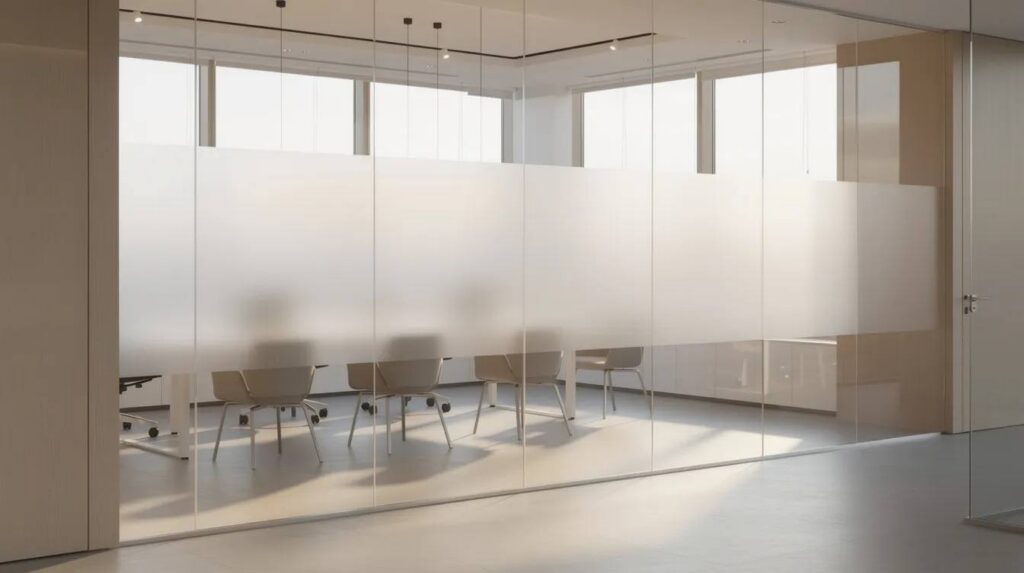
| Gradient frost | Office partitions, executive suites | 40–80% |
| Banding / striped frost | Code-compliant safety bands, corridors | Varies |
| Patterned / decorative frost | Lobbies, retail display areas, branded spaces | 50–75% |
| Dual-purpose privacy + solar | Sun-exposed facades needing privacy and heat control | 40–65% |
| Frosting allows for geometric patterns and stained glass styles, giving architects a wide variety of creative options. Frosting provides customizable branding options for conference rooms and storefronts through printed or cut designs. |
Here is where each type shows up in practice. In corporate environments, a 10-story office building might use gradient frost on huddle rooms and full frost on HR and legal suites. In retail and banking, storefront sidelites and teller lines receive branded patterned frost to protect sensitive areas while keeping the sales floor visible to customers. In education, counselor offices and nurse stations use medium frost to allow supervision while shielding confidential conversations. Government and public buildings-permit counters, court admin offices, voting centers-use banding for safety compliance and identity graphics for wayfinding.
Dynamic films represent an emerging option: these switchable PDLC films can switch from transparent to opaque on demand, making them ideal for boardrooms or adaptable spaces where privacy needs change throughout the day.
How the Commercial Window Frosting Process Works (From Site Visit to Installation)
For a busy facility manager, here is what to expect from consultation through handover.
The process begins with a consultation and a glass survey. A project team conducts an on-site walk-through or reviews floor plans and photos remotely. They identify glass types-tempered, laminated, insulating glass units, low-E coatings-along with exposure, code considerations, and any conditions that affect film selection.
Next comes design and product selection. Working with architectural or design teams, the team selects the right opacity level, pattern, band height, and branding elements. Manufacturer-grade 3M window film products and installation options are specified rather than low-cost online vinyls that lack warranty and safety certifications.
Precise field measurements are entered into plotter software. Patterns, logos, and text are cut or printed for consistent, repeatable results across every floor or location in a multi-site project. This ensures the appearance matches across an entire property or national portfolio.
Professional installation uses a wet application method with slip solution and squeegees. Work is often scheduled evenings or weekends to minimize disruption to tenants and operations. Dust control and protection of furnishings are standard practice.
After film is applied, a curing period of several days to a few weeks follows depending on film type and climate. Small bubbles or haze may be visible during drying-this is normal and settles out. Care instructions are provided, including a recommended waiting period of about 30 days before cleaning near edges.
What to Consider Before Choosing Commercial Window Frosting
Think of this as your buyer’s checklist for 2026 projects.
Privacy level vs. light transmission. Heavy frost on the only daylight wall in a deep floorplate is a common mistake-it darkens the inside space and increases reliance on electric lighting. Choose light or gradient frost where daylight penetration matters most, and reserve heavy frost for areas where complete privacy outweighs daylighting.
Integration with energy-saving window film. Solar films improve energy efficiency in commercial buildings, and pairing interior frost with exterior solar control film produces the strongest energy savings when implemented by an experienced 3M window film installation company. However, combining films must respect glass type and manufacturer guidelines to avoid thermal stress or glass breakage. Always verify compatibility.
Durability, warranties, and maintenance. Specification-grade adhesive frost films typically last 10 to 15 years under normal interior conditions. Warranties from leading brands cover defects like bubbling, peeling, and color shift for 5 to 10+ years when properly installed. Use soft cloths and non-ammonia cleaners; abrasive pads and solvent-based products can damage the film surface.
Code, life safety, and security. Ensure frosting does not conflict with emergency egress markings or required sightlines. Where impact protection matters, pair privacy film with safety or security window film to prevent shattering and deter forced entry by intruders.
Multi-site consistency. For national brands, school districts, or franchise operations, standardize patterns, band heights, and opacity across locations to ensure a uniform appearance at every property.
Why Choose Window Film Depot for Commercial Window Frosting
Window Film Depot is a family-owned company established in 1992, based in Marietta, Georgia, serving clients nationwide. As the leading 3M installer in the U.S., the company brings decades of documented experience to every commercial project. Over 1,500 companies have used American Window Film services through the Window Film Depot network.
The company offers a full solution portfolio of window films: frosted privacy films, 3M solar control film, safety and security glazing, anti-graffiti films that protect surfaces from scratches and vandalism, and commercial graphics-all managed as a turnkey service from survey through installation. For projects requiring coordinated roll-outs across multiple locations, the team provides nationwide installer coverage, rapid deployment, and consistent quality documentation.
Window Film Depot’s track record includes high-profile work on projects like the Oculus Transit Hub in New York City, where the 3M window film installation team provided protective film and decorative glass finishes to protect and upgrade glazing in one of the country’s busiest transit environments. Wholesale supply of window film rolls is also available for glass and glazing trade partners interested in material-only orders.
FAQs About Commercial Window Frosting
These questions come directly from facility managers, architects, and building owners evaluating frosting for their next construction or retrofit project.
Is frosted window film permanent, and can it be removed later?
Adhesive frosted film is designed to last 10 to 15 years but can be professionally removed without damage to the glass. Static cling films are temporary and repositionable but lack the durability and warranty needed for commercial use.
Will commercial window frosting make my space darker?
Light frost films transmit up to 90% of visible light, so most spaces stay bright. Heavy frost reduces transmission to around 30%. Gradient or banded designs let you keep the view and daylight above eye level while blocking sightlines where privacy matters.
Can frosted window film help with energy savings, or do I need separate solar film?
Frosted film alone provides moderate solar energy rejection-roughly 24–31% depending on the product. For measurable reductions in cooling load and energy costs, pair interior frost with dedicated solar control window film on exterior glass.
How do I clean windows after frosting is applied?
Wait at least 30 days after installation. Then use soft cloths or squeegees with non-ammonia, non-abrasive cleaners. Avoid razor blades and water pressure directly on film edges.
What does commercial window frosting typically cost?
Installed costs for specification-grade frosted film typically range from $8 to $20 per square foot, depending on square footage, design complexity, access, and whether security or solar films are included. Always request a site-specific quote.
How long does installation take, and will it disrupt operations?
A single office or shop floor can often be completed in one evening. Multi-floor buildings may take several days. Window Film Depot schedules work during off-hours to minimize disruption to tenants and daily operations.
Next Steps: Schedule a Commercial Window Frosting Consultation
Commercial window frosting is one of the quickest, least invasive ways to improve privacy, branding, and comfort across any building without replacing a single pane of glass. Whether you need to transform a single conference room or coordinate a national roll-out across dozens of locations, the right film and the right installer make all the difference.
Contact Window Film Depot to learn more about your options and discuss your project. Gather your floor plans, photos, and basic glass information before reaching out-it will help the team deliver a quick, accurate quote. If you are also interested in security film, sun control film, or anti-graffiti protection, the team can address those issues in the same consultation. Click to read more or reach out today to ensure your building receives the upgrade it deserves.