Table of Contents:
- The Critical Distinction: Bullet-Resistant vs. Bulletproof Solutions
- Understanding UL 752 Ballistic Resistance Levels for Informed Specification
- The Science Behind the Shield: How Bullet-Resistant Film Works
- Specifying the Right Solution: Retrofit Film vs. Glazing Replacement
- Precision in Practice: Key Installation Considerations for Maximum Performance
- Why Certified Expertise Matters: Selecting a Specialized Security Film Partner
- Conclusion: Engineering Delay and Mitigating Risk in Comprehensive Security Systems
- Frequently Asked Questions
- Related Posts from Window Film Depot
Bullet Resistant Glass Film: Understanding Real Security Capabilities
Commercial project managers must ensure window security infrastructure meets genuine threats, stakeholder expectations, and budget constraints. Specifying solutions requires a deep understanding of actual capabilities rather than relying on marketing jargon. This is particularly true for glazing enhancements designed to resist ballistic threats. Bullet-resistant glass film is fundamental to managing risk, protecting occupants, and safeguarding project liability.
Why Bullet-Resistant Film is a Strategic Component, Not a Standalone Solution
Ballistic glass should be viewed as a critical component within a multi-layered security strategy, rather than a singular, standalone solution. Its efficacy is maximized when integrated with other security measures, such as access control, alarm systems, surveillance, and reinforced door systems. The film enhances existing glass, providing an additional layer of defense that complements, but does not replace, other security protocols. This strategic integration is key to creating a robust protective envelope tailored to specific threat profiles and operational needs.
Setting Clear Expectations: The Foundation for Successful Security Projects
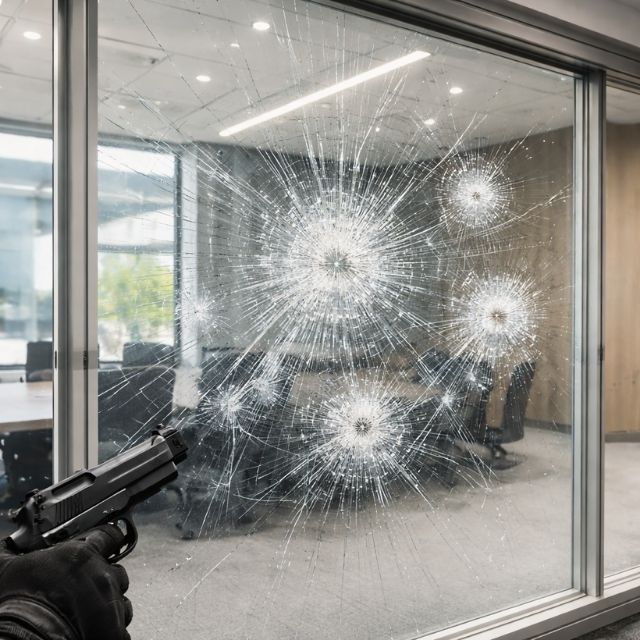
Successful security projects hinge on setting precise, fact-based expectations from the outset. For bullet-resistant film, this means moving beyond general assurances and presenting specific performance data and limitations to clients and stakeholders. Clearly articulating film capabilities based on UL 752 standards establishes trust and prevents future misunderstandings. This proactive communication mitigates unmet expectations that lead to project delays, cost overruns, or legal disputes.
The Critical Distinction: Bullet-Resistant vs. Bulletproof Solutions
Debunking the Myth: Why “Bulletproof” Misleads in Commercial Applications
The term “bulletproof” is a significant misnomer, particularly in commercial building applications. It inaccurately implies absolute invulnerability to all ballistic threats, which is neither practically achievable nor economically feasible for glass systems. A true bulletproof shield is typically extremely thick, opaque, and prohibitively expensive for most commercial projects. Using this term sets unrealistic expectations and can create a false sense of security for building owners. This potentially exposes occupants and the project to unforeseen risks and significant liability issues.
The Engineering Reality: How “Bullet Resistant” Film Creates Strategic Delay
The engineering reality behind “bullet-resistant” film centers on energy absorption and forced entry delay. Rather than stopping a bullet entirely without any effect on the glass, these advanced films are designed to hold shattered glass fragments together upon impact. This action dissipates the bullet’s kinetic energy and maintains the integrity of the glass pane for a critical period.
The Role of Delay and Spall Mitigation
- Strategic Delay: The primary function is to delay forced entry, providing invaluable time for occupants to seek shelter, for security personnel to respond, or for an alarm system to trigger and dispatch emergency services. This delay transforms a rapid breach into a time-consuming and noisy endeavor.
- Spall Mitigation: A crucial, often overlooked, benefit is the mitigation of spall. Spall refers to the secondary projectiles of glass fragments that can break off the non-attack side of a window when struck by a bullet or other force. Bullet-resistant film significantly reduces or eliminates this dangerous shower of glass, thereby mitigating severe injuries to occupants inside the building.
The film’s performance is quantified by rigorous testing protocols, such as those established by UL 752, which rate materials based on their ability to resist specific types of ballistic threats for a defined duration.
Implications for Threat Mitigation and Project Liability
Understanding the distinction between “bulletproof” and “bullet-resistant” has profound implications for both threat mitigation strategies and project liability.
Enhancing Threat Mitigation
By creating a strategic delay and mitigating spall, bullet-resistant film significantly enhances a building’s overall threat mitigation capabilities. It turns a vulnerable entry point into a fortified barrier, buying precious seconds or minutes during an active threat scenario. This time can be the difference between a successful breach and a contained incident, contributing directly to the safety and survivability of building occupants. It is a proactive measure that reduces the immediate danger from ballistic impacts and forced entry.
Protecting Against Project Liability
Accurately specifying and communicating bullet-resistant film capabilities is a powerful safeguard against liability for project managers. Misrepresenting a system as “bulletproof” exposes all involved parties to significant legal and financial repercussions. Relying on UL 752 standards and documenting performance levels demonstrates due diligence and aligns with client requirements. This precision in communication protects the project team while building long-term client trust and professional credibility.
Understanding UL 752 Ballistic Resistance Levels for Informed Specification
Deciphering UL 752: A Guide to Ballistic Performance Standards
For project managers navigating security specifications, understanding standardized performance metrics is paramount. UL 752, developed by Underwriters Laboratories, serves as the industry benchmark for testing and categorizing bullet-resistant materials. This standard provides a rigorous, objective framework to assess how various materials, including glass-film combinations, withstand ballistic threats. It outlines specific projectile types, velocities, and shot patterns to ensure consistent and reproducible results across different products. Relying on UL 752 ratings allows project managers to make data-driven decisions, manage client expectations accurately, and significantly mitigate project liability by specifying verified security solutions.
Key Ballistic Resistance Ratings and Their Practical Applications
UL 752 assigns ballistic resistance levels ranging from Level 1 to Level 8, each corresponding to a specific threat profile based on weapon type, caliber, and bullet velocity. These levels are critical for matching the security solution to the identified threat.
- UL Level 1-3 (Handgun Threats): These levels typically address common handgun calibers such as .38 Special, 9mm, and .44 Magnum. Applications often include retail storefronts, teller lines, administrative offices, and reception areas where protection against opportunistic or common handgun threats is required.
- UL Level 4-6 (High-Powered Rifle Threats): As the levels increase, the materials are tested against more powerful rifle rounds, including various assault rifle calibers. These are critical for high-security environments like government buildings, data centers, and executive protection areas where the risk of more sophisticated threats exists.
- UL Level 7-8 (Armor-Piercing Rifle Threats): The highest levels certify protection against armor-piercing rifle ammunition. These specifications are reserved for extremely high-risk facilities requiring maximum ballistic resistance.
It is crucial to note that bullet-resistant film typically enhances existing glazing to achieve specific UL 752 levels, often in conjunction with specialized glass. It rarely functions as a standalone ballistic barrier capable of meeting higher UL ratings without significant backing.
Beyond Ballistics: Evaluating Film for Forced Entry and Blast Mitigation
While UL 752 specifically addresses ballistic resistance, the protective capabilities of high-performance security films extend well beyond preventing bullet penetration. For project managers, recognizing these broader applications is essential for a comprehensive security strategy. Bullet-resistant film significantly enhances forced entry resistance by making glass much harder to break through, creating crucial delay. This delay can be measured in minutes, providing valuable time for occupants to react and security forces to respond, turning a vulnerable entry point into a significant obstacle.
Furthermore, these films play a vital role in blast mitigation. In the event of an explosion, whether accidental or malicious, ordinary glass shatters into dangerous projectiles that can cause severe injury or death. Security film’s primary function in such scenarios is to hold the shattered glass intact within the window frame, dramatically reducing the risk of flying debris. This containment minimizes injury, property damage, and post-event cleanup, making it a critical component for safety in areas prone to potential blast threats.
Integrating Comprehensive Threat Assessment into Material Selection
Effective material selection begins with a thorough and professional threat assessment. For project managers, this means moving beyond general assumptions and engaging specialists to identify precise vulnerabilities and threat vectors. A detailed assessment will consider:
- The types of threats likely to be encountered (e.g., handguns, rifles, forced entry, blast).
- The specific vulnerabilities of the building’s architecture and existing glazing.
- The required level of protection is balanced against budget constraints and aesthetic considerations.
- Local building codes and safety regulations.
Integrating this assessment into material selection ensures that specified solutions, including bullet-resistant film, are appropriately matched to the actual risks. Partnering with a specialized vendor, like Window Film Depot, that possesses deep expertise in both threat assessment and advanced film technologies, becomes invaluable. This collaboration ensures that the chosen films not only meet performance criteria but also integrate seamlessly into the overall security strategy, optimizing both safety and cost-efficiency.
The Science Behind the Shield: How Bullet-Resistant Film Works
The Core Mechanism: Energy Dissipation and Glass Retention
The effectiveness of bullet-resistant film lies in its sophisticated engineering, primarily centered around energy dissipation and glass retention. When a ballistic projectile or significant impact strikes glass treated with security film, the film’s multi-layered construction absorbs and redistributes the immense kinetic energy across a wider surface area. Unlike untreated glass, which shatters outward or inward into sharp, dangerous shards, the film acts as a robust, flexible membrane. It bonds powerfully to the glass, holding the fractured pieces firmly in place within the window frame. This retention prevents the glass from disintegrating upon impact, maintaining the structural integrity of the barrier and significantly delaying forced entry attempts.
Mitigating Injury: The Critical Role of Spall and Fragmentation Control
One of the most critical, yet often overlooked, aspects of ballistic and blast protection is the control of spall and fragmentation. Spall refers to the secondary projectiles created when a bullet strikes a barrier, causing pieces of the barrier material (in this case, glass) to break off and project inward on the protected side. Even if a projectile does not fully penetrate, spall can inflict severe, even fatal, injuries. High-performance bullet-resistant films are engineered specifically to mitigate this threat. Their elastic and adhesive properties ensure that when glass shatters, these fragments remain adhered to the film, drastically reducing or eliminating spall. This critical function directly protects occupants from glass shrapnel, a primary cause of injury in ballistic and blast events, thereby reducing potential liability for the project.
Comparative Analysis: Film’s Interaction with Laminated and Polycarbonate Glazing
Understanding how security film interacts with different glazing types is key to specifying the optimal solution.
- Standard Annealed Glass: When applied to standard annealed glass, security film dramatically enhances its resistance to forced entry and mitigates spall upon impact. While not typically providing standalone ballistic resistance to UL 752 standards, it creates a much more formidable barrier than untreated glass.
- Laminated Glass: Laminated glass inherently offers some level of forced entry and spall mitigation due to its interlayer. However, adding a high-performance security film can further improve its ballistic performance and enhance its ability to withstand repeated impacts or more powerful threats. The film works synergistically with the laminated interlayer to dissipate energy more effectively.
- Polycarbonate Glazing: Polycarbonate is a highly impact-resistant plastic, often used in standalone ballistic applications. While film can be applied to polycarbonate for scratch resistance or solar control, its primary role in ballistic scenarios is generally to enhance adhesion to a multi-ply system or to provide additional spall protection on the interior surface, not to impart ballistic resistance to the polycarbonate itself.
For project managers, the strategic use of film can often upgrade existing glass to meet specific threat levels at a fraction of the cost of full replacement with specialized ballistic glazing.
The Technological Edge: Understanding 3M Scotchshield Ultra Films in Ballistic Resistance
Leading manufacturers like 3M have developed advanced film technologies that push the boundaries of glass protection. 3M Scotchshield Ultra Films, for instance, utilize a unique micro-layered construction that provides exceptional strength and tear resistance without excessive thickness. Unlike conventional films, these films are engineered with hundreds of micro-layers, allowing them to absorb and distribute shockwaves more effectively. This technological advantage translates directly into superior performance in several key areas:
Need More Info?
The Window Film Depot team is happy to help.
- Enhanced Energy Dissipation: The micro-layers deform and stretch upon impact, absorbing a significant amount of the projectile’s kinetic energy.
- Superior Glass Retention: The advanced adhesive and robust construction ensure that even severely fractured glass remains firmly bonded to the film, minimizing spall and maintaining a barrier.
- Increased Forced Entry Delay: The film’s remarkable tear resistance makes it significantly harder for intruders to create an opening, extending the critical delay time.
Specifying products like 3M Scotchshield Ultra Films means leveraging cutting-edge material science. This not only provides a high level of performance but also underscores the importance of partnering with specialized integrators who understand and can properly install these advanced systems to achieve their full protective capabilities.
Specifying the Right Solution: Retrofit Film vs. Glazing Replacement
Understanding the nuances between retrofit bullet-resistant film and full security glazing replacement is paramount for project managers. Each solution offers distinct advantages and serves different security objectives, impacting budget, timeline, and overall project scope. The choice hinges on a precise assessment of threat levels, existing infrastructure, and desired performance outcomes.
Strategic Advantages of Retrofit Film for Existing Infrastructure
Retrofit bullet-resistant film offers a compelling solution for upgrading security without the extensive costs and disruptions associated with full window replacement. Its primary strength lies in its ability to enhance existing glazing systems quickly and cost-effectively. For projects targeting enhanced forced entry resistance and significant spall mitigation, retrofit film often presents the most pragmatic option. It preserves the building’s existing aesthetic, crucial for historical properties or those with specific architectural designs, while adding a critical layer of defense. The installation process is typically far less intrusive, allowing for operational continuity in active environments.
Determining When Full Security Glazing Replacement is the Optimal Path
While retrofit film is effective, full security glazing replacement is sometimes the optimal or even necessary path. This is true for higher ballistic protection, such as UL 752 Level 3, requiring thicker glass laminates. New construction projects benefit from integrated security glazing, allowing a holistic design approach for the building envelope. If existing glass is compromised or incompatible with film, replacement is the only viable security option. This ensures the facility achieves the desired security posture through seamless incorporation of advanced resistance.
Critical Factors for Decision-Making: Performance, Aesthetics, Budget, and Timeline
The decision-making process for selecting between retrofit film and full glazing replacement involves a careful evaluation of several interconnected factors:
- Performance: Define the specific security threats. Is the goal to delay forced entry for minutes, mitigate glass spall from an explosive event (referencing standards like GSA TS01), or stop specific ballistic rounds (UL 752)? Retrofit film excels at forced entry delay and spall mitigation, while full glazing replacement is necessary for higher-level ballistic resistance.
- Aesthetics: Consider how each option impacts the visual integrity of the building. Films are virtually invisible, maintaining the original appearance. Glazing replacement, especially with thicker laminates, might alter sightlines or frame profiles.
- Budget: Retrofit film generally represents a lower capital expenditure and faster return on investment for specific threat mitigation. Full security glazing replacement, while more expensive upfront, offers a comprehensive, integrated solution for maximum protection and a longer expected lifespan.
- Timeline: Retrofit film installations are significantly faster, minimizing disruption to operations. Glazing replacement is a more involved construction project, requiring longer lead times and installation periods.
Enhancing Security: The Role of Robust Attachment Systems in Glazing Security
The performance of any security film, particularly for forced entry applications, is intrinsically linked to its attachment system. Even the strongest film will only delay an intruder for a short period if the entire glass pane can be pushed or pulled out of its frame. Robust attachment systems are designed to mechanically or chemically bond the film-laminated glass directly to the window frame, effectively transforming the glass into a structural component of the opening.
- Structural Silicone: This method uses a high-strength, flexible sealant to create a continuous bond between the film (or the edge of the glass beneath the film) and the window frame. This prevents the glass from being dislodged, even after repeated impacts, ensuring the film’s integrity and delaying entry.
- Mechanical Attachment Systems: These systems employ metal or plastic retention clips, bars, or specialized gaskets that physically secure the filmed glass within the frame. They provide a visible, high-strength barrier that works in concert with the film to keep the glass from popping out of its sash.
Without these critical attachment systems, the inherent capabilities of security film are severely limited, underscoring the importance of a comprehensive system approach rather than relying solely on the film itself.
Precision in Practice: Key Installation Considerations for Maximum Performance
The effectiveness of bullet-resistant film is not solely determined by its material specifications but equally by the precision and expertise of its installation. Even the highest-rated film can fail to meet its engineered performance objectives if applied incorrectly. This highlights the value of specialized installers who understand the intricacies involved beyond basic window tinting.
The Intricacies of Applying Ballistic-Resistant Film for Engineered Outcomes
Applying ballistic or forced entry resistant film is a highly specialized craft that demands meticulous attention to detail and extensive technical knowledge. Unlike decorative or solar films, security films are significantly thicker, often multi-layered, and inherently more challenging to handle and apply without defects. Achieving a uniform, bubble-free application across large surfaces, while ensuring precise cuts and complete edge coverage, directly impacts the film’s ability to absorb and distribute impact forces. The installation process is an engineered procedure, where each step, from surface preparation to final adhesion, contributes to the overall security and integrity of the glazing system. Any compromises in this process can lead to vulnerabilities that undermine the film’s intended protective qualities.

The Crucial Role of Edge Retention and Frame Integration in Security Integrity
As previously noted, edge retention and proper frame integration are non-negotiable for maximizing the performance of security films. During installation, the chosen attachment system—whether structural silicone, mechanical battens, or a combination—must be expertly applied to create a continuous, strong bond between the filmed glass and the existing window frame. This process effectively turns the entire window assembly into a unified security barrier. The film holds the glass together after impact, and the edge retention system ensures that the entire damaged pane remains within the frame, preventing unauthorized entry. Misalignments, insufficient adhesion, or improper curing of attachment compounds during installation can create critical weak points, allowing an intruder to bypass the system even if the film itself remains intact.
Mitigating Common Pitfalls: Ensuring Film Performance Matches Specification
Project managers must be aware of common installation pitfalls that can compromise the performance of bullet-resistant films. These include inadequate surface preparation, which can lead to poor adhesion and premature film failure. Incorrect film sizing, resulting in gaps at the edges, can create leverage points for forced entry. Furthermore, the use of non-specialized tools or techniques by inexperienced installers often results in air bubbles, creases, or inconsistent film thickness, all of which degrade the film’s impact resistance. Partnering with certified, experienced installers is critical to ensure that the installed film system truly meets the specified performance criteria, thereby protecting both occupants and project liability.
The Impact of Environmental Factors on Film Durability and Efficacy
The long-term durability and efficacy of security film are subject to various environmental factors that must be considered during both selection and installation. Prolonged exposure to ultraviolet (UV) radiation can degrade certain film adhesives and materials over time, potentially leading to delamination or reduced flexibility. Extreme temperature fluctuations can induce stress on the film-to-glass bond, potentially leading to bubbling or peeling if the film or adhesive is not formulated for such conditions. High humidity can also affect adhesive curing and long-term stability. Specifying films designed for the specific climate and ensuring proper post-installation care and cleaning procedures are crucial. These measures help maintain the film’s integrity and performance throughout its intended lifespan, ensuring the security investment continues to deliver its designed protection.
Why Certified Expertise Matters: Selecting a Specialized Security Film Partner
The Non-Negotiable Value of Certified Installation for Project Security
The performance of a bullet-resistant film, even one engineered to stringent standards like UL 752, is profoundly dependent on its professional installation. Certification ensures that installers possess the specific training and expertise required to apply these advanced materials correctly. Unlike decorative or solar films, security film application is a precision process involving critical factors such as edge-to-edge adhesion, proper anchor system integration, and environmental controls. Subpar installation can compromise the film’s structural integrity, leading to reduced impact resistance, premature degradation, and ultimately, a failure to perform as specified under attack conditions. This directly impacts both the safety objectives and the project’s liability profile.
Beyond General Tinting: The Technical Demands of Ballistic Resistant Film Projects
Applying bullet-resistant film is far more complex than standard window tinting, requiring a specialized skillset and material science knowledge. General tinting focuses on aesthetics and solar control; security film demands knowledge of impact dynamics and anchoring methodologies. Installers must account for glass types and frame materials to ensure the film system integrates effectively. This involves custom cutting, precise squeegeeing, and the meticulous application of structural adhesives to the window frame. Generalist tinters lack the specialized tools, training, and experience necessary to meet these rigorous technical specifications. Expert installation is crucial for achieving rated performance against forced entry and ballistic threats.
The Strategic Advantage: Partnering with a #1 3M Window Film Installer
Collaborating with a top-tier 3M Window Film Installer provides a distinct strategic advantage for project managers. These certified specialists have unparalleled access to the latest product innovations and technical data from 3M. Their training includes advanced techniques for mitigating specific threats and optimizing film performance. They adhere to strict quality assurance standards across diverse architectural conditions. This expertise minimizes project risks and ensures compliance with manufacturer warranties. It guarantees that security solutions perform as intended, providing project managers with confidence.
Collaborative Project Planning: From Initial Assessment to Post-Installation Verification
Effective security film deployment begins long before installation, necessitating a collaborative planning process with a specialized partner. This engagement typically involves an initial site assessment to evaluate existing glass types, frame conditions, and potential vulnerabilities. The specialist assists in selecting the appropriate film and anchoring system based on the specific threat profile and UL 752 or other relevant security ratings. Post-installation, a reputable partner will provide verification documentation, including warranty information and performance specifications. This thorough, integrated approach, from initial consultation through to final sign-off, ensures that the installed system aligns perfectly with security objectives, budget constraints, and project timelines.
Conclusion: Engineering Delay and Mitigating Risk in Comprehensive Security Systems
Recapping the Strategic Role of Bullet-Resistant Film in Modern Security
Bullet-resistant film serves a critical, yet often misunderstood, role within a comprehensive security strategy. It is not designed to create an impenetrable barrier against ballistic threats but rather to engineer a vital delay in forced entry and to mitigate the dangerous effects of glass spall upon impact. By holding shattered glass fragments together, it significantly reduces the risk of injury from flying debris and maintains a robust barrier that buys precious time for occupants to react and for security personnel to respond. This strategic delay is the cornerstone of its value proposition in protecting assets and lives.
Empowering Project Managers for Confident, Informed Security Decisions
Understanding the precise capabilities and limitations of bullet-resistant film empowers project managers to make confident and informed security decisions. Moving beyond the ‘bulletproof’ myth, PMs can now accurately specify solutions that align with realistic threat assessments and operational requirements. This clarity in expectation setting and performance definition enables better budget allocation, more accurate scheduling, and clearer communication with stakeholders, ensuring that security investments yield tangible and reliable results.
The Imperative of Specialized Partnership for Project Success and Liability Protection
The successful implementation of bullet-resistant film projects hinges on partnering with specialized, certified installers. Their expertise in product selection, precise application, and understanding of complex security standards like UL 752 is paramount. This specialized knowledge directly translates into project success by ensuring optimal performance, validating warranty compliance, and significantly reducing potential liability for the project manager and their client. Entrusting such critical security installations to generalist contractors introduces unacceptable risks that compromise both safety and investment.
Looking Ahead: Continuous Advancements in Film Technology and Security Protocols
The field of advanced film technology is continuously evolving, with ongoing research and development yielding stronger, more durable, and more versatile security film solutions. Project managers should anticipate further advancements in material science, installation techniques, and integration with smart building systems. Staying informed about these developments, facilitated by relationships with leading manufacturers and certified installers, will be crucial for maintaining state-of-the-art security postures and adapting to emerging threats effectively.
Frequently Asked Questions
If the film isn’t “bulletproof,” what exactly am I paying for in a high-security project?
You are investing in engineered delay and life safety. In a security event, time is the most valuable commodity. Bullet-resistant film transforms a window from a “point of instant failure” into a robust barrier that requires significant time and effort to breach, even after the glass has been shattered. Additionally, you are paying for spall mitigation, which prevents the interior of the glass from exploding into lethal shards when struck, protecting occupants even if the projectile itself is stopped.
How do I determine which UL 752 level is appropriate for my specific building?
The specification must be driven by a professional threat assessment.
Levels 1–3 are the industry standard for most commercial applications (retail, corporate offices, and banks), as they protect against the most common handgun threats.
Levels 4–8 are typically reserved for high-value targets like government buildings or critical infrastructure where the threat of high-powered rifles or armor-piercing rounds is a documented risk.
Can I achieve a UL 752 rating by simply retrofitting film onto my existing 1/4″ tempered glass?
Unlikely. Achieving a verified UL 752 rating usually requires a system-based approach. While film significantly upgrades the performance of existing glass, a specific ballistic rating (like Level 1 or 2) often requires the film to be paired with thicker glass or specific laminates. However, a retrofit application is an excellent, cost-effective way to provide “ballistic-grade” protection and forced-entry delay where a full glass replacement is over-budget or architecturally impossible.
Why is “Edge Retention” mentioned as a separate line item in my security quote?
Edge retention (or an attachment system) is what prevents the entire “sheet” of filmed glass from being pushed out of the frame after it has been broken. Without it, the film holds the shards together, but the window becomes a flexible “blanket” that can be easily bypassed.
Wet Glaze: Uses high-strength structural silicone (like Dow 995) to bond the film to the frame.
Mechanical: Uses metal profiles to physically bolt the film/glass assembly into the window sash.
How does the installation of security film impact my building’s compliance with fire and egress codes?
This is a critical consideration for project managers. Because security film makes glass much harder to break, it can inadvertently complicate emergency egress (exiting through a window during a fire) or firefighter access. A specialized partner will ensure that your security upgrades do not violate local building codes, often by specifying specific “break-out” points or ensuring the film is only applied to non-egress windows.