Vandalism costs U.S. property owners billions every year, and glass surfaces bear the brunt of the damage. Anti-graffiti window film gives facility managers a practical, budget-friendly way to protect storefronts, mirrors, elevator cabs, and interior partitions without sacrificing the view. Here is what you need to know about how these films work, where they deliver the most value, and how to get started.
Table of Contents:
How Anti-Graffiti Window Film Works & Why It Matters
Anti-graffiti window film is a clear, durable polyester film applied directly to glass, mirrors, or metal. It acts as a sacrificial layer that absorbs vandalism damage so the underlying surface stays intact. When a panel is tagged or etched, it can be removed quickly and replaced at a fraction of the cost of new glass.
The scale of the problem is staggering. The U.S. spends $12 billion annually on graffiti cleanup, with annual graffiti abatement costs estimated at $10 to $12 billion when you factor in indirect expenses like lost revenue and administrative time. New York City’s graffiti removal costs alone rose from $300,000 to $10 million since 1993. Properties with graffiti lose 15% of their value, and in affected neighborhoods graffiti reduces property values by that same 15%, making rapid response a financial priority – not just a cosmetic one.
Vandals typically target storefront windows, transit shelters, elevator panels, and restroom mirrors with spray paint, acid etching, scratching, and marking with permanent markers. Each of these attack types can cause permanent property damage to unprotected glass. Anti-graffiti films absorb that damage instead. The film absorbs damage from acid etching, scratches, spray paint, and markers, keeping the original substrate unharmed beneath the protective film layer.
Optical clarity is a key feature of quality anti-graffiti films. Modern products like 3M Scotchgard anti-graffiti window film are optically clear and distortion-free, with visible light transmission around 81–86% on standard quarter-inch glass. The film maintains the appearance of the original glass, so customers, students, and staff never notice it during day-to-day use. The film acts as a protective shield against vandalism without changing the look or feel of your surfaces.
The film is applied directly to glass, mirror, stainless steel, or other smooth surfaces, creating a removable barrier that can be swapped out during a scheduled maintenance visit rather than requiring emergency glass replacement. Removing graffiti within 48 hours reduces repeat vandalism risk, and anti-graffiti film makes fast removal practical because crews only need to strip the damaged layer and install a fresh one – often in under an hour.
Benefits, Use Cases & Installation of Anti-Graffiti Films
Given how quickly vandalism escalates both appearance and cost issues, facility managers, retailers, schools, and public agencies gain significant value from anti-graffiti films. Here is how that value breaks down in practice and where these products deliver the strongest return.
Cost Savings That Compound Over Time
Replacing a damaged film is less expensive than replacing etched or broken glass – substantially so. A single commercial tempered or laminated glass panel (4×8 ft) can run $400 to $1,500 or more, plus fabrication lead times of one to three weeks. A film replacement panel on the same surface typically costs $150 to $400, and the initial installation runs $200 to $600 depending on thickness and site access. Anti-graffiti film is commonly used on storefront windows precisely because those panes get hit repeatedly. Over multiple incidents, the savings compound: one Houston retail strip with six storefront panels spent roughly $1,056 on film protection over 18 months compared to an estimated $3,600 to $7,000 in glass replacement costs.
Appearance, Branding & Safety
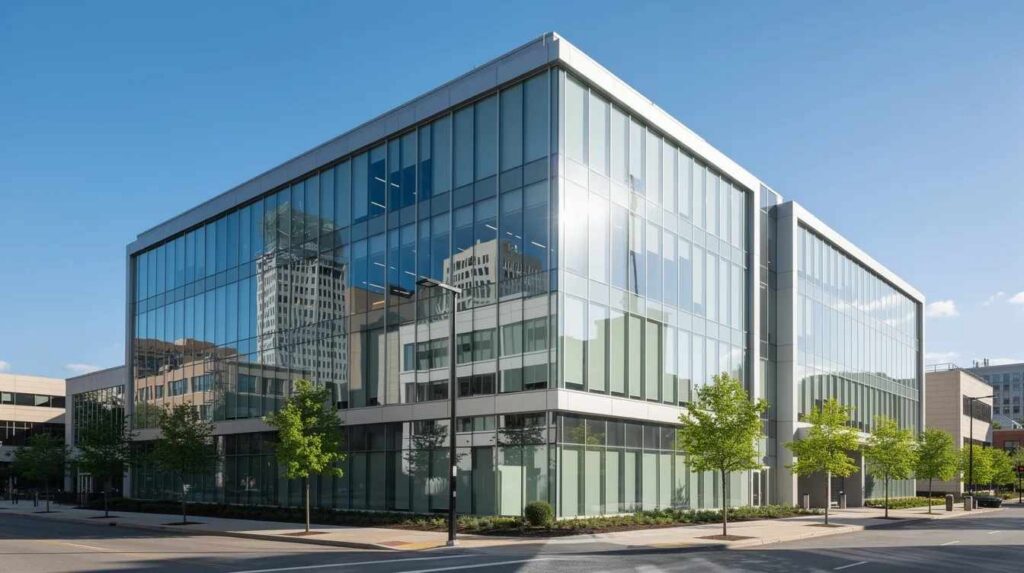
Clear anti-graffiti films keep storefronts and glass partitions looking clean, protecting brand image in busy retail corridors, transit hubs, and campuses. Anti-graffiti films can protect storefronts and glass from paint, scratches, and acid etching without changing the view from either side of the glass. Additionally, they hold shattered glass in place, enhancing safety in the event of accidental impact – though they are not a substitute for dedicated security glazing.
Damaged glass often requires emergency board-up, permit coordination, and after-hours work. Film allows planned, non-emergency service instead, reducing operational disruption and overtime labor costs.
Common Commercial Applications
Anti-graffiti window film is one of several window protection film solutions to reinforce glass and shows up in a wide range of environments:
- National retail chains on high-foot-traffic streets
- K–12 schools and college campuses (doors, corridors, restroom mirrors)
- Bus shelters, train stations, and airport concourses
- Parking garages and hospital lobbies
- Municipal buildings and government facilities
- Glass elevators and interior partitions
In each of these settings, the film protects vulnerable surfaces that face daily public exposure and makes it possible for maintenance teams to remove damage on a predictable schedule rather than reacting to emergencies.
How Installation Works
From Window Film Depot’s perspective as a leading 3M window film installation company for commercial projects, a typical project follows a straightforward path:
- Site survey and assessment. Identify the most vulnerable glass, mirrors, and metal surfaces – usually street-level windows, doors, restroom mirrors, and elevator cabs. Evaluate glass type, framing, and accessibility.
- Film grade recommendation. These films are typically 4 mil to 6 mil thick, and thickness is an important consideration when selecting anti-graffiti film. A 4-mil film suits moderate-risk interior applications, while 6-mil film is better for exterior glass or locations with frequent incidents. Defendor film is available in 4 mil and 7 mil thicknesses for properties that need heavier-duty protection, complementing our broader window glass film products and brands. Defendor film is virtually invisible when applied to glass, just like the Scotchgard line.
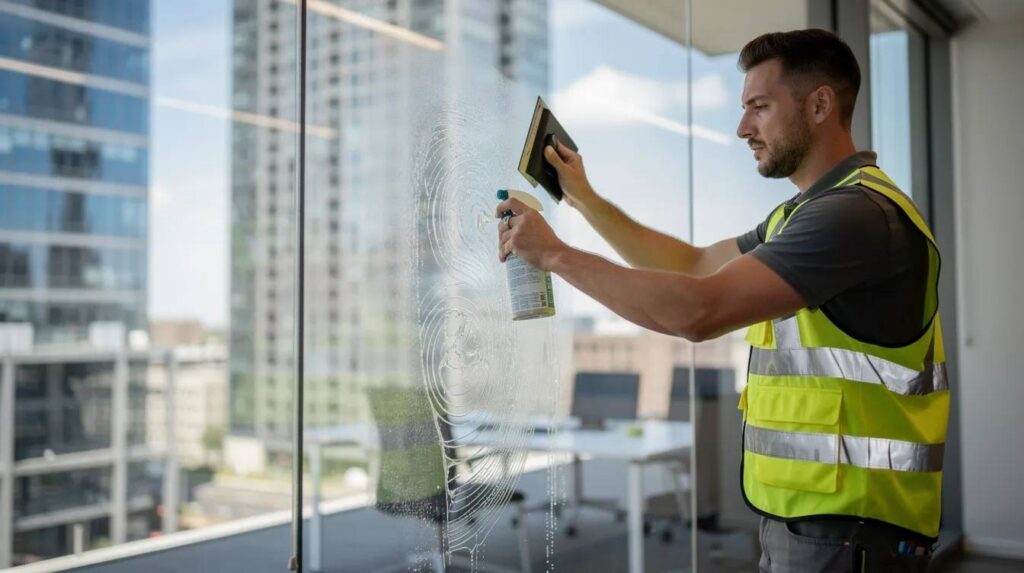
- Professional installation. Crews use slip solutions to position the film, squeegees to expel air and moisture, and precision trimming to frame edges. Work is coordinated around store hours, class schedules, or transit operations to minimize disruption. These films can be applied to glass, metal, or mirrors, covering nearly any smooth substrate in a commercial environment.
Maintenance & Replacement Indicators
Day-to-day upkeep is simple. Defendor film can be easily cleaned with household window cleaners, and most anti-graffiti films respond well to any non-abrasive cleaner. Avoid harsh solvents or abrasive pads that could compromise the film’s surface coating, just as you would with other 3M window film products and installations.
Signs it is time to replace a panel include:
- Visible haze or clouding from accumulated micro-scratches
- Deep gouges or scratches that impair clarity
- Edge lifting, peeling, or yellowing
- Vandalism damage (spray paint, acid etching, deep scratching)
If vandalized, the film can be easily removed and replaced. Removable adhesive allows for straightforward removal without damage to the underlying glass. In low-risk interior locations, a single panel may last five to seven years undisturbed. In high-vandalism zones, replacement cycles are driven by incidents and may happen several times per year – but each swap still costs a fraction of what new glass would run.
Why Facility Managers Choose Window Film Depot for Anti-Graffiti Protection
Window Film Depot is a family-owned window film company founded in 1992 and headquartered in Marietta, Georgia. For more than three decades, we have sold and installed high-performance window film products for government buildings, big-box retailers, banks, universities, and transit systems nationwide, supported by window film installation locations across all 50 states. Our sales and project management teams handle everything from single-location pilot installs to multi-site national rollouts.
As a 3M-authorized dealer and installer, Window Film Depot regularly deploys Scotchgard anti-graffiti window films and related protection products as part of broader window protection film systems. Scotchgard film is optically clear and distortion-free, and Scotchgard film blocks 99 percent of damaging ultraviolet rays – giving clients surface protection and UV defense in a single layer. Multi-site brands and public agencies can standardize one anti-graffiti spec and rely on our team for turnkey project management, whether for local window film installation in Washington, DC, or national programs, with union and non-union coordination, and night or weekend work where required.
Glass shops, glaziers, and other trade partners across North America can also source anti-graffiti and specialty window films through our Window Film Depot wholesale division for their own installation teams.
Ready to get started? Request a site assessment, send photos of damaged glass for a quick opinion, or schedule a pilot installation on your most frequently hit locations. Contact Window Film Depot by phone or through our online form to discuss anti-graffiti window film options, budget ranges, and installation timelines tailored to your property.
FAQs About Anti-Graffiti Window Film
Below are answers to the questions facility managers and building owners ask most often about anti-graffiti window film.
How long does anti-graffiti window film typically last?
In moderate-traffic locations with infrequent vandalism, films often last five to seven years before showing wear. In heavy-vandalism zones, the replacement cycle is driven more by incidents than by aging. Either way, the pressure-sensitive adhesive is designed for clean removal even after extended service, so swapping a panel does not damage the glass beneath.
Will energy-efficient window film make my rooms too dark or eliminate natural light?
No. Modern spectrally selective and ceramic films maintain high visible light transmission while blocking a disproportionate amount of solar heat and UV. Spaces stay bright but noticeably more comfortable. WFD routinely tests sample swatches on a few panes so clients can evaluate the balance of natural light, glare reduction, and appearance before choosing a final film type.
Will anti-graffiti film change the look of my glass or mirrors?
No. High-quality anti-graffiti films are optically clear and virtually invisible on glass and mirrors, with no noticeable tint or distortion. Any minor edge line created during installation is usually hidden by the window framing, so the view from both sides remains unchanged.
Can anti-graffiti window films resist acid etching and scratching?
Yes. These films are engineered to absorb surface etching, scratching, and marker or spray paint damage, protecting the underlying substrate. Once the protective film is damaged, only the film layer needs to be replaced – the original glass or mirror stays untouched.
Where are anti-graffiti films most commonly installed?
The most common locations include retail storefronts, mall entrances, school doors and corridors, bus shelters, train stations, glass elevators, restroom mirrors, and public facility lobbies. Essentially, any surface with public exposure and a history of vandalism is a candidate.
Is professional installation necessary, or can my team apply the film?
Professional installation is recommended for commercial buildings due to the need for dust-free application, precise trimming, and safe work at height. That said, some small, flat interior mirrors or windows can be handled by trained in-house maintenance staff using pre-cut film sold through a wholesale supply program – Window Film Depot’s wholesale division supports exactly this kind of arrangement.
Does anti-graffiti window film also provide UV or solar control benefits?
Many clear anti-graffiti films block up to 99% of harmful UV rays, helping reduce fading of merchandise, furnishings, and interior finishes over the course of a year or more. The films often block up to 99% of harmful UV rays while remaining completely transparent. If heat and glare reduction is also a priority, anti-graffiti film can be combined with a separate solar control film for comprehensive window protection.