Table of Contents:
- The Misleading Myth of One-Way Glass Film
- The Core Principle: Privacy is a Product of Light Differential
- Reading the Spec Sheet: Key Metrics for Project Success
- Common Applications for Daytime Privacy Film
- Managing Project Risk: Communicating the Nighttime Reversal
- Specifying the Right Solution: A Guide to 3M™ Options
- Conclusion: From Product Specifier to Project Partner
- Frequently Asked Questions
- Related Posts from Window Film Depot
The Misleading Myth of One-Way Glass Film
To specify the right film and prevent costly project failures, we must move past marketing terms and understand the physics that govern performance. The success of your installation depends not on a magical property of the film, but on a predictable scientific principle. Relying on the idea of a true “one way glass film” without understanding the underlying science is a common and costly mistake.
The classic image of a police interrogation room, where detectives observe a suspect unseen, has created a powerful but misleading assumption. That effect is not a feature of the glass itself but a result of carefully controlled lighting. The observation room is kept dark, while the interrogation room is brightly lit. As a project manager, when a client requests this effect, it’s your opportunity to demonstrate expertise by explaining this distinction and managing expectations from the start.
The Core Principle: Privacy is a Product of Light Differential
Reflective window films function by reflecting a significant portion of visible light. The “one-way” mirror effect occurs on whichever side of the glass has a greater amount of light. The film is not intelligent, it simply reflects light from the brighter environment more intensely than it transmits light from the darker one.
Think of your home at night. Standing in a brightly lit room, you look out a standard window and see your own reflection. Conversely, anyone standing outside can see into your illuminated room with perfect clarity. A reflective window film amplifies this natural phenomenon.
- During the day, the exterior is significantly brighter than the interior. The film’s reflective surface faces outward, creating a mirror-like appearance for anyone looking in. From the inside, occupants can see out clearly.
- At night, the conditions reverse. With lights on inside, the interior becomes the brighter space. The film then reflects the interior light, turning the window into an internal mirror. For an observer outside, the film becomes transparent, compromising all privacy.

For the mirror effect to function, the target area for privacy must be significantly brighter than the area you want to see from. As a reliable field guideline, we work with a minimum light ratio of 5:1. This means the exterior must be at least five times brighter than the interior. This ratio explains why performance changes dramatically throughout the day and is the single most critical factor for success.
Reading the Spec Sheet: Key Metrics for Project Success
To accurately compare products, you need to be familiar with the data on a film’s specification sheet. These three terms are the most critical for evaluating a reflective film for a commercial privacy application.
- Visible Light Transmittance (VLT): This is the percentage of visible light passing through the filmed glass. A lower VLT means a darker tint, which reduces glare and transmits less light.
- Visible Light Reflectance (VLR): This is the percentage of visible light reflected by the film. It is the primary indicator of the mirror effect’s strength. For daytime privacy applications, a high exterior VLR is essential.
- Total Solar Energy Rejected (TSER): This metric measures the film’s ability to block solar energy, including UV light, visible light, and infrared heat. High-performance films designed to reject heat often have a highly reflective quality, allowing you to solve for both privacy and energy efficiency with a single product.
Common Applications for Daytime Privacy Film
When the principle of light differential is correctly applied, this film is a powerful tool for specific commercial needs. The success of each application depends entirely on your ability to control the lighting environment.
Securing Perimeters and Entrances
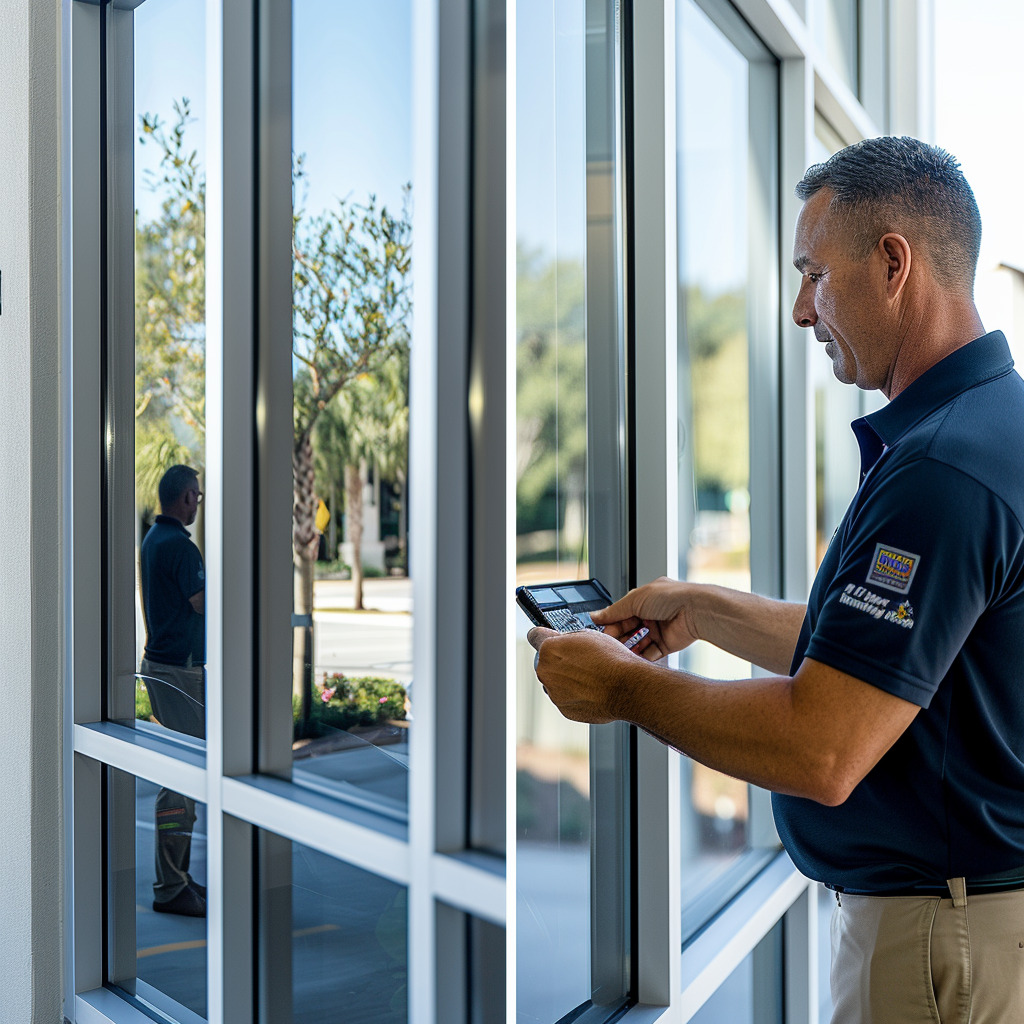
For ground-floor offices, lobbies, and street-facing entrances, reflective window film provides excellent daytime privacy.
It deters casual surveillance and enhances a building’s security posture during business hours.
For these projects, you must confirm the client understands the effect reverses at night and that a different solution, like blinds, is required for after-hours privacy.
Glass Partitions and Conference Rooms
Using these films on interior glass requires careful planning. To make a glass-walled conference room private, the surrounding office or hallway must be significantly brighter than the lighting inside the room. This is often difficult to maintain. If lighting levels on both sides are equal, the film will simply act as a dark tint, offering no real privacy.
Specialized Uses in Controlled Environments
Security booths and observation rooms are ideal use cases. A monitoring area is kept intentionally dark, while the area being observed is brightly lit. This creates a permanent, 24/7 one-way effect for discreet surveillance. Similarly, retail displays can use the film to create a “reveal” effect, where a product inside a box is hidden until internal lights are triggered, making the film transparent.
Managing Project Risk: Communicating the Nighttime Reversal
A successful project hinges on delivering predictable results. Failing to address the physics of light will almost certainly lead to a call from a dissatisfied client who feels exposed in their brightly lit office at night.
Proactive communication is the most effective tool for preventing these issues. It is crucial to set realistic expectations with the client before a single roll of film is applied.
- Set the Terminology: From the first conversation, refer to the product as “daytime privacy film” or “reflective solar film.” Avoid using “one way mirror film” to prevent false expectations.
- Explain the Principle: Clearly state that the film’s privacy function is dependent on light and that at night, when interior lights are on, the effect will reverse.
- Document the Discussion: Ensure the film’s limitations, specifically the nighttime reversal, are noted in your scope of work or proposal. This creates a shared understanding and a clear record.
Need More Info?
The Window Film Depot team is happy to help.
For areas requiring continuous privacy, the most effective strategy is often exterior illumination. Directing sufficient lighting onto the building’s facade can maintain a light imbalance where the outside remains brighter than the inside. The most practical solution, however, is a layered window treatment. A daytime one way privacy window film can be installed for solar control and daytime privacy, while traditional blinds or curtains are used after dark.
Specifying the Right Solution: A Guide to 3M™ Options
Once expectations are aligned, the next step is selecting a film that matches the project’s performance requirements. 3M™ Window Films offer a range of sophisticated options.
For Maximum Daytime Privacy: 3M™ Sun Control Window Film
When the primary objective is strong daytime privacy and solar heat rejection, the 3M™ Sun Control Window Film Traditional Series, particularly Silver P18, is a benchmark solution. These films have a very high exterior reflectivity, creating a powerful mirror-like appearance that offers excellent privacy during daylight hours. They are a cost-effective and proven choice for commercial projects where confidentiality and energy efficiency are key drivers.
For Enhanced Nighttime Views: 3M™ Night Vision™ Series
For clients concerned about harsh interior reflections at night, the 3M™ Night Vision™ Series presents a more advanced solution. This film is engineered with a lower interior reflectivity than its exterior reflectivity. The result is not nighttime privacy. Instead, the film significantly reduces the mirror effect for occupants looking out at night, allowing for clearer, more natural views. Specifying the 3M Night Vision Series is an excellent strategy when the client values their nighttime view but still requires strong daytime privacy.
Beyond Privacy: Glare Reduction, UV Protection, and Energy Savings
It is important to communicate the additional high-value benefits that these films deliver.
- Glare Reduction: Cuts distracting glare on computer screens, improving employee comfort and productivity.
- UV Protection: 3M Sun Control Window Film blocks up to 99% of harmful UV rays, protecting furniture, flooring, and artwork from fading.
- Energy Efficiency: By rejecting solar heat, the films reduce the load on HVAC systems, leading to tangible energy savings and a faster project ROI.
Conclusion: From Product Specifier to Project Partner
The challenge of specifying a privacy film is not in selecting a product but in mastering the environment where it will be installed. By internalizing the principle of light differential, you can move from simply installing a product to delivering a predictable, high-performance privacy solution.
Your most significant risk is a mismatch between client expectation and physical reality. The best tool for mitigating this risk is proactive education.
When you can clearly explain the physics to your client before the contract is signed, you transform a potential limitation into an understood performance characteristic. This foresight builds trust, solidifies your credibility as an expert partner, and ensures the final installation is judged by the correct criteria.
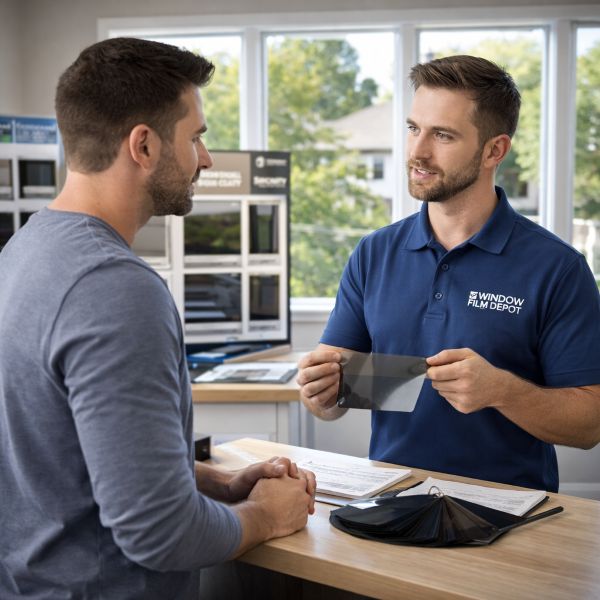
Partner with Window Film Depot to specify and install one-way window film that delivers reliable daytime privacy and long-term performance.
Frequently Asked Questions
Can one way glass film provide privacy at night?
No. Standard one way glass film, more accurately called daytime privacy film, cannot provide privacy at night when interior lights are on. The effect reverses, and people outside will be able to see in clearly. For 24-hour privacy, this film must be paired with another solution like blinds, curtains, or strategic exterior lighting.
What is the difference between VLT and VLR on a spec sheet?
VLT (Visible Light Transmittance) measures how much light passes through the film, indicating how dark the tint will be. VLR (Visible Light Reflectance) measures how much light the film reflects, which determines the strength of the mirror effect. For strong daytime privacy, you want a film with a high VLR.
Is there any window film that provides privacy both day and night?
Currently, no standard window film can provide one-way privacy 24/7 on its own, as performance is always dictated by the light differential. For complete nighttime privacy, the most reliable solution is to combine a daytime privacy film with traditional window coverings like blinds or shades.
How much brighter does it need to be outside for the film to work?
For a reliable privacy effect, the exterior should be at least five times brighter than the interior (a 5:1 light ratio). On a sunny day, this ratio is easily achieved. On heavily overcast days, the effect may be diminished, and some “ghosting” or partial transparency can occur.
Will a reflective window film make my office too dark?
It can. The level of darkness depends on the film’s VLT (Visible Light Transmittance). A lower VLT provides more privacy and glare reduction but allows less natural light into the space. It is important to balance the need for privacy with the desire for a bright interior. Reviewing film samples on-site is the best way to make a final decision.