Table of Contents:
- Beyond Glare Reduction: The Power of Window Film Insulation
- Performance Metrics: Film Insulation vs. Full Window Replacement
- Calculating the ROI: A Framework for Estimating Payback
- Specifying for Performance: The Case for 3M™ Thinsulate™
- Logistical Advantages for Large-Scale Renovations
- Putting Theory into Practice: An Illustrative Project Scenario
- Frequently Asked Questions
- Related Posts from Window Film Depot
Beyond Glare Reduction: The Power of Window Film Insulation
When project managers hear “window film,” they often think of solar films designed to reduce glare and block UV rays. While those are valuable benefits, they represent only a fraction of what modern film technology can achieve. Advanced insulating window films are a distinct category of building material, engineered specifically to improve a window’s thermal performance and function as a transparent layer of insulation.
Unlike purely reflective films, these advanced heat control window film products manage heat transfer year-round. They provide a powerful, non-invasive upgrade to a building’s thermal envelope, directly addressing high energy costs associated with inefficient windows without requiring their replacement.
The Science of Low-E: How Insulating Films Control Heat Transfer
The technology behind insulating films is a low-emissivity, or Low-E, coating. Emissivity is a measure of a surface’s ability to radiate thermal heat. Materials with high emissivity, like clear glass, readily absorb and then radiate heat. A Low-E coating is a microscopically thin, transparent layer of metal or metallic oxides that reflects long-wave infrared energy, which we feel as heat.
In the winter, this means the low-e window film reflects the radiant heat from your HVAC system back into the room, preventing it from escaping through the glass. During the summer, the same film works in reverse. It reflects outside heat from the sun and hot pavement away from the glass, reducing the load on your cooling systems. This selective reflectivity is the key to year-round energy savings.

Key Performance Metrics: U-Factor and R-Value
To quantify the impact of insulating film, it’s essential to understand two key metrics used in the fenestration industry. These values allow you to conduct a direct, data-driven comparison between products.
- U-Factor: This measures the rate of heat transfer and shows how well a window system prevents heat from escaping a building. It is the standard metric for windows and glass according to the National Fenestration Rating Council (NFRC). The lower the U-Factor, the better the window’s insulating properties.
- R-Value: This is more commonly associated with wall and roof insulation and measures thermal resistance. R-Value is the mathematical inverse of U-Factor (R=1/U). The higher the R-Value, the greater the insulating effectiveness.
Adding a low-e insulating film to an existing window lowers its U-Factor and increases its R-Value, directly improving its ability to keep a building comfortable and energy-efficient.
Year-Round Performance: Saving on Heating and Cooling
A common misconception is that window films only provide benefits during the summer. While they are highly effective at rejecting solar heat, the Low-E properties of window insulating films create significant value during the heating season as well.
By reflecting interior radiant heat back into the space, the film helps maintain stable indoor temperatures and reduces the workload on boilers and furnaces. This dual-season performance is critical for calculating a comprehensive return on investment, as the energy savings are not limited to just a few months. For buildings in mixed or northern climates, winter heating savings can be just as substantial as summer cooling savings, accelerating the project’s payback period.
Transforming Single-Pane Performance to Rival Double-Pane Windows
The value of insulating film is most apparent when upgrading older, single-pane windows. A typical single-pane window is a major source of energy loss, with a U-Factor of approximately 1.10. By installing a high-performance energy saving window film like 3M Thinsulate Climate Control Window Film, you can lower that U-Factor to around 0.70.
This single upgrade provides an improvement in insulating performance of nearly 40%. More importantly, it elevates the window’s performance to a level that approaches that of a standard, untreated double-pane window. This allows project managers to deliver a significant portion of the energy savings of a full window replacement, often up to 90% of the insulating benefit, at a fraction of the capital cost and with virtually zero operational disruption.
Performance Metrics: Film Insulation vs. Full Window Replacement
When evaluating an upgrade to a building’s envelope, performance data is the ultimate arbiter. While full window replacement has long been the default solution, a data-driven comparison reveals that advanced insulating films offer a compelling, and often superior, alternative. By analyzing key industry metrics like U-factor and Solar Heat Gain Coefficient (SHGC), project managers can build a clear, quantitative case for the most strategic investment.
U-Factor Improvements: A Data-Driven Analysis
U-factor measures how well a window or door prevents non-solar heat flow. In simpler terms, it quantifies heat loss in the winter. A lower U-factor indicates better insulation, and for any project in a heating-dominated climate, improving this metric is a primary goal.
Consider a commercial building with original single-pane windows, which have a U-factor of approximately 1.1. A full replacement with modern, commercial-grade double-pane windows might bring that U-factor down to around 0.5. This is a significant improvement, but it comes at a tremendous capital cost.
Applying a high-performance insulating film, such as 3M Thinsulate Climate Control Window Film, can upgrade that same single-pane window to achieve a U-factor of nearly 0.6. This retrofit delivers a performance level that closes the gap with new double-pane windows and provides a substantial insulation boost for a fraction of the cost. The film effectively turns a single-pane unit into a much more efficient thermal barrier.
Solar Heat Gain Coefficient (SHGC): Managing Summer Heat Loads
While U-factor is critical for winter performance, the Solar Heat Gain Coefficient (SHGC) is the key metric for managing summer cooling costs. SHGC measures the fraction of solar radiation admitted through a window that is released as heat inside. A lower SHGC means less solar heat gain, which reduces the load on your HVAC system.
Existing, untreated glass, particularly older clear panes, can have a very high SHGC, often above 0.80. This allows a massive amount of solar energy to pour into the building, leading to high air conditioning costs and uncomfortable hot spots.

Sun control window films excel in this area. Many insulating films are engineered to provide exceptional solar control. They can reduce a window’s SHGC by 50% or more without significantly impacting visible light. This targeted heat rejection directly translates into lower energy consumption during peak cooling season. Window replacement can also lower SHGC, but the specific performance is locked in at the time of purchase and comes with a much higher price tag.
Longevity and Warranty: Assessing Lifespan
A common question revolves around the lifespan of each solution. New commercial windows typically have a functional lifespan of 20 to 30 years. Professionally installed, high-quality window films, like those from 3M, come with comprehensive commercial warranties for up to 15 years.
At first glance, the longer lifespan of new windows may seem like an advantage. This perspective overlooks the most critical financial metric: the payback period. Window film projects often deliver a full return on investment in just 2 to 5 years. This means the film pays for itself many times over within its warranted life. When the film reaches the end of its life, it can be replaced with newer, potentially more advanced technology at a low cost, whereas replacing 15-year-old windows is a massive capital undertaking.
Aesthetic and Visual Light Transmission (VLT)
A primary concern for building owners is the aesthetic impact of any window upgrade. There is a misconception that insulating films will make windows dark or highly reflective. Modern film technology has rendered this concern obsolete.
Advanced products like 3M Thinsulate films are virtually invisible, maintaining the original look of your building’s glass. They are engineered for high Visual Light Transmission (VLT), allowing a large percentage of visible light to pass through. This preserves natural daylighting and maintains clear views, which is crucial for tenant satisfaction. Film also offers a unique benefit, as it can be used to create a uniform exterior appearance on a building that has mismatched glass from previous repairs.
Calculating the ROI: A Framework for Estimating Payback
For any project manager, presenting a clear and defensible return on investment (ROI) is paramount. The financial case for window film insulation is one of its most powerful advantages. The following framework provides a process for modeling savings and presenting a compelling business case to clients and stakeholders.
Step 1: Audit Your Current Fenestration and Energy Costs
The first step is to establish a clear baseline. You cannot accurately measure an improvement without knowing your starting point. This audit involves gathering key information:
- Fenestration Data: Document the total square footage of glass, the type of windows (single-pane, double-pane), and the condition of the frames and seals.
- Energy Bills: Collect at least 12 to 24 months of utility bills to reveal seasonal spikes and provide an average cost per kilowatt-hour (kWh) and per therm.
- Qualitative Data: Note any evidence from building occupants, such as complaints about drafts, hot or cold rooms, or issues with glare.
Step 2: Model Energy Savings with an Energy Saving Window Film
With a baseline established, you can accurately project the savings. Reputable manufacturers like 3M provide access to energy modeling software that uses your building’s specific data, including its location, utility rates, and existing window types, to simulate performance improvement.
The model calculates the projected reduction in both heating and cooling loads based on the film’s specified U-factor and SHGC improvements. The output is a data-rich report that forecasts annual energy savings in clear, annual dollar savings. This document becomes a cornerstone of your business case.
Step 3: Factor in Total Project Costs and Reduced HVAC Load
The “investment” side of the ROI calculation is the total installed cost. For window film, this is a straightforward calculation of material and professional labor. The installation is quiet, clean, and fast, causing minimal disruption.
For window replacement, the total cost is far more complex. It includes not only the new units but also extensive labor, cranes or lifts, interior and exterior finish repair, waste disposal, and significant disruption or even relocation costs for tenants.
A critical and often-overlooked financial benefit of window film tint is the potential to reduce HVAC capital costs. By lowering peak heating and cooling loads, a building’s HVAC system doesn’t have to work as hard. In a new build or major renovation, this can allow you to specify a smaller, less expensive HVAC system. In an existing building, it extends equipment life and lowers maintenance costs.
Need More Info?
The Window Film Depot team is happy to help.
Step 4: Present the Business Case and Payback Period
The final step is to synthesize this data into a simple, powerful comparison. The payback period is calculated by dividing the total project cost by the projected annual energy savings.
- Insulating Window Film: With its lower upfront cost and significant energy savings, the payback period for a commercial window film project is typically between 2 and 5 years.
- Full Window Replacement: Due to its high capital cost, the payback period for full window replacement can easily stretch to 15, 20, or even 25 years. This timeline often exceeds a building owner’s investment horizon.
When presented side-by-side, the financial argument becomes undeniable. A 3-year payback with comparable performance versus a 20-year payback makes the strategic choice clear.
Specifying for Performance: The Case for 3M™ Thinsulate™
When evaluating building envelope upgrades, project managers require solutions that are not just effective but also technologically proven and reliably implemented. 3M™ Thinsulate™ Climate Control Window Film stands apart by offering a unique combination of advanced material science, documented performance, and a support network designed for large-scale commercial application.
The Technological Edge of 3M Thinsulate Window Film
The performance of 3M Thinsulate film is rooted in its patented, multi-layer optical film technology. Unlike a simple solar control film, Thinsulate is a low-emissivity (low-e) solution that works year-round. In summer, it helps reflect solar heat, reducing the load on cooling systems. In winter, it reflects a significant portion of indoor radiant heat back into the room.
This dual-action capability effectively transforms existing single-pane windows into thermal performers on par with double-pane units, and it upgrades double-pane windows to the performance level of triple-pane glass. The film accomplishes this while remaining virtually invisible, preserving the building’s aesthetic and natural light.
Documented Performance and Adherence to ASHRAE Standards
For a project manager, quantifiable data is essential. 3M provides extensive testing and documentation to validate the performance claims of Thinsulate film. The film’s ability to improve the U-factor is a key metric that directly relates to energy savings.
These performance gains help buildings meet or exceed energy code requirements, including those in ASHRAE 90.1. By bringing an existing building’s glazing performance closer to modern standards, you are not just making a discretionary upgrade. You are implementing a solution that aligns with industry-recognized benchmarks for energy efficiency, providing a defensible and data-backed choice.
The Importance of a Certified Installation Network
The most advanced film technology cannot deliver its benefits if installed improperly. A key advantage of specifying 3M is access to a national network of certified dealer installers. These professionals are trained specifically on 3M products and application techniques, ensuring a consistent, high-quality installation across every window, floor, or even multiple building sites.
For a large-scale renovation, this network eliminates the risk and variability of using unvetted local contractors. It guarantees adherence to 3M’s stringent quality standards, protects the comprehensive product warranty, and provides a single point of contact for project coordination.
Protecting Furnishings from UV Fading
Beyond thermal performance, 3M Thinsulate Window Film provides significant asset protection. The film blocks up to 99% of the sun’s harmful ultraviolet (UV) rays, which are the leading cause of fading in furniture, carpeting, flooring, and artwork.
This feature extends the life of expensive interior furnishings and finishes, reducing long-term replacement costs. It is a powerful secondary benefit that adds another layer to the overall return on investment.
Logistical Advantages for Large-Scale Renovations
The operational impact of a renovation is a primary concern for project managers. This is where the logistical superiority of window film installation becomes a decisive factor. The process is fundamentally less invasive, faster, and lower risk than a full window replacement.
Minimizing Tenant Disruption
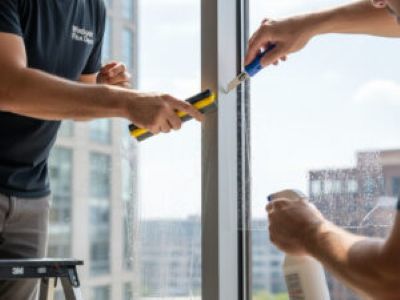
A full window replacement is a loud, dusty, and prolonged process that often requires tenants to vacate their space. The installation of 3M window film, by contrast, is a quiet, clean, and efficient operation completed with minimal disruption to daily business.
- Window Replacement: Involves noisy demolition, dust and debris, potential security risks, and significant displacement of occupants.
- Window Film Installation: A quiet process performed from the interior with simple hand tools. It generates no dust, and a typical office can be completed in hours, often without employees leaving their desks.
This drastic reduction in disruption preserves business continuity, a critical factor in maintaining tenant satisfaction.
Avoiding Structural Alterations and Project Risks
Replacing windows in a commercial building is rarely a simple swap. It often involves modifications to the building envelope, interior drywall, and exterior facade. This work introduces project risk, including the potential to uncover unforeseen issues that lead to costly change orders and schedule delays.
Window film installation is a surface application that requires no structural alteration. By working with existing windows, you eliminate the risk of scope creep associated with demolition and reconstruction, allowing for a more predictable budget and timeline.
Accelerating Project Timelines
The speed and simplicity of film installation directly translate into an accelerated project schedule. A team of certified installers can complete dozens of windows in a single day, a task that would take weeks for a window replacement crew.
For project managers, this acceleration is a major strategic advantage. A shorter project duration reduces overhead, allows the property to realize energy savings sooner, and increases the likelihood of an on-time, on-budget project delivery.
Reducing Landfill Waste and Enhancing Sustainability
A full window replacement sends tons of old glass, metal frames, and construction materials to the landfill. Choosing window film is an inherently more sustainable approach. It upgrades existing assets rather than discarding them, resulting in minimal material waste. This can help projects achieve sustainability goals, contribute to LEED certification points, and align with corporate ESG (Environmental, Social, and Governance) objectives.
Putting Theory into Practice: An Illustrative Project Scenario
Abstract performance data is useful, but project decisions are made on tangible numbers. To move from the theoretical to the practical, let’s analyze a common renovation scenario to provide a clear, head-to-head comparison.
The Project Baseline: A Mid-Sized Commercial Office Building
We will consider a 12-story commercial office building from the late 1980s. The building’s envelope is showing its age, leading to high HVAC operating costs and tenant complaints about thermal discomfort.
- Building Type: Multi-tenant commercial office space.
- Total Glazing: 800 individual window units, each 5×6 feet, totaling 24,000 square feet of glass.
- Existing Windows: Original double-pane windows with clear, untreated glass and aging seals.
- Project Goal: Substantially improve thermal performance to reduce energy consumption by at least 15%, enhance tenant comfort, and modernize the asset.
The Financials: Head-to-Head Cost and Payback Analysis
The financial divergence between full replacement and a film retrofit is significant.
Option 1: Full Window Replacement
- Estimated Project Cost: At a conservative $1,800 per unit for materials and labor, the total is $1,440,000. Factoring in a 10% contingency for ancillary repairs brings the expected outlay to over $1,580,000.
- Energy Savings & Payback: New windows could reduce annual HVAC energy costs by an estimated 20%. On a $500,000 annual energy bill, this is $100,000 in savings per year. The simple payback period would be approximately 15.8 years.
Option 2: Insulating Window Film Installation
- Estimated Project Cost: Using a mid-range estimate of $15 per square foot for high-performance insulating film, the total installed cost is $360,000.
- Energy Savings & Payback: Modern insulating film can deliver up to 90% of the insulating benefit of new windows, resulting in an estimated 18% reduction in HVAC energy costs. This translates to an annual savings of $90,000. The simple payback period is 4 years.
The window film retrofit delivers nearly identical energy savings for approximately 25% of the initial capital cost, with a payback period nearly four times faster.
Project Timeline: Disruption and Installation Days Compared
For an occupied commercial building, project duration is as critical as the budget.
Full Window Replacement Timeline
- Lead Time: Custom commercial windows can have lead times of 16 to 24 weeks.
- Installation Duration: Replacing 800 windows is a floor-by-floor process that would likely take a dedicated crew 5 to 7 months to complete.
- Operational Disruption: Significant. Tenants must be relocated from perimeter offices during the work. The process generates considerable noise, dust, and debris.
Insulating Window Film Timeline
- Lead Time: Film is a stock material, with lead times measured in days.
- Installation Duration: A skilled crew can install 15 to 20 windows of this size per day. The entire 800-window project could be completed in approximately 8 to 10 weeks.
- Operational Disruption: Negligible. Installers work from the interior with minimal, quiet equipment. An office can be completed in hours, and tenants rarely need to leave their workspace.
The Final Report: Justifying the Film Specification
When presenting your recommendation, the data provides a compelling narrative. The objective is to choose the strategically superior option, not just the cheaper one.
Your executive summary should lead with the conclusion: Specifying an advanced insulating window film retrofit delivers the core project goal of improved energy performance while dramatically outperforming full window replacement on every key project metric.
Key talking points for your report include:
- Capital Efficiency: The film project requires an investment of $360,000 compared to over $1.5 million for new windows, preserving over $1.1 million in capital.
- Accelerated ROI: With a payback period of just 4 years, the film project begins generating a positive return in a timeframe that aligns with typical asset management goals.
- Minimized Operational Risk: The film installation can be completed in under three months with negligible disruption to tenants, eliminating the risks of lost productivity and tenant complaints.
- Performance Parity: The film retrofit is projected to achieve 18% energy savings, delivering over 90% of the thermal performance benefits of the much costlier full replacement option.
By framing the decision in these terms, you move the conversation from “How do we fix our windows?” to “How can we achieve our energy and comfort goals in the most financially and logistically intelligent way?”. The answer, in this common scenario, is the specification of window film insulation.
For expert guidance and professional installation, connect with Window Film Depot to turn these performance gains into measurable results for your building.
Frequently Asked Questions
How long does window film insulation last?
Professionally installed, high-quality insulating films, such as those from 3M, come with a comprehensive commercial warranty for up to 15 years. While new windows may have a longer total lifespan, the film’s rapid payback period of 2-5 years means it pays for itself many times over within its warranted life.
Will insulating window film make my building look dark or reflective?
No. Modern low-e window film technology, like 3M Thinsulate, is designed to be virtually invisible. It has a high Visual Light Transmission (VLT), meaning it allows most natural light to pass through, preserving clear views and the original appearance of the glass.
Can window film really be as good as new windows?
In terms of thermal performance, yes. Applying an advanced insulating film can bring the U-factor and SHGC of an existing window very close to the levels of a new double-pane or triple-pane unit. It delivers a majority of the energy-saving benefits, often over 90%, for a fraction of the cost and disruption of a full replacement.
Is insulating film only useful in cold climates?
No, it provides year-round savings. The same low-e technology that reflects indoor heat back into a room during the winter also reflects outdoor solar heat away from the glass in the summer. This dual-action performance reduces both heating and cooling costs, making it a valuable upgrade for buildings in any climate.