This guide covers everything you need to know about whether security window film really works, how it performs during break-ins and natural disasters, and when professional installation is worth the investment.
Table of Contents:
- What Is Security Window Film and How Does It Work?
- Types of Security Films and Safety Films for Different Risks
- The Technology Behind Modern Safety and Security Window Film
- Key Benefits: How Security Window Film Protects People and Property
- Pros and Cons: What Security Film Can and Cannot Do
- Where Security Window Film Makes the Biggest Difference
- How to Choose the Right Safety and Security Film
- Professional Installation vs. DIY
- Costs, Lifespan, and Long-Term Value
- Maintaining Security Window Film
- Common Questions About Security Window Film
- Why Choose a Specialized Installer
- Next Steps
What Is Security Window Film and How Does It Work?
Security window film is a thick, engineered polyester (PET) or urethane layer applied directly to the interior surface of existing glass windows and doors. It upgrades standard glass into a safer, more resilient barrier without requiring full window replacement. Security window films range from 4 to 15 mils in thickness, where film thickness is measured in “mils” – with 1 mil equal to 1/1000 of an inch.
Not all window film is security film. Decorative films, solar control films, and privacy tints serve different purposes. True safety and security films are specifically engineered to hold broken glass together during impacts. The adhesive layer bonds the film to the glass pane to minimize glass collapse, creating a bonded laminate that keeps shards attached to the film rather than sending flying glass shards into occupied spaces.
It is important to understand that security film is one critical layer in a broader safety and security strategy. It complements locks, alarms, cameras, and access control rather than replacing them. Security film does not make a window burglar-proof or bulletproof. What it does is slow down intrusion attempts and contain dangerous glass fragments – buying time and reducing injuries in the moments that matter most.
Types of Security Films and Safety Films for Different Risks
There are several types of safety and security films, and choosing the right one depends on your risk profile, building type, and performance goals.
Basic safety film (4–7 mil) meets safety glazing requirements and protects occupants from accidental glass breakage. These are commonly used in homes, offices, and public buildings where the main concern is containing small pieces of glass after an impact rather than resisting a determined intruder. The Safety Series is available in 7, 8, and 14 mil sizes, giving specifiers flexibility across risk levels.
Thicker security window film (8–14 mil and above) is designed to resist forced entry, vandalism, and more severe impacts. These thicker films are often paired with attachment systems that mechanically tie the film to the window frame. For extreme applications, 3M Scotchshield S2400 is 24 mils thick and made of urethane, offering substantially higher performance for government and critical infrastructure projects.
Combination safety and solar control films provide both better protection and energy benefits like heat rejection and glare reduction. The Ultra Prestige Series blocks up to 99.9% of harmful UV rays while still delivering reliable protection. Some security films offer additional UV protection beyond their core safety function, making them attractive for building owners who want to reduce sun damage and energy costs in a single installation.
Specialty safety films include anti-graffiti sacrificial layers, spall control films for existing laminated or ballistic glass, and 3M safety product lines engineered for specific threat environments. Some options remain virtually invisible, while tinted or reflective films reduce visibility into the building and still allow natural light through.
The Technology Behind Modern Safety and Security Window Film
Understanding how safety and security window film is constructed helps explain why it works so well under stress.
Modern security films use multi-layer polyester and urethane constructions. Stacking thin layers with specialized adhesive creates a tear-resistant, flexible barrier that stretches instead of snapping. This layered architecture gives the film exceptional tear strength – the ability to resist tearing even when the glass behind it has shattered into hundreds of fragments.
The high-tack, pressure-sensitive adhesive chemically bonds to glass so the film holds broken glass together under impact. When the glass breaks, the film absorbs and redistributes impact energy across a larger surface area of the pane, reducing the chance of complete glass fallout. 3M Scotchshield film absorbs more energy than standard films, which is why it is frequently specified for high-risk openings.
Premium 3M safety films and similar systems are tested to meet ANSI Z97.1 safety standards, giving facility managers quantifiable performance data instead of marketing claims. Independent third-party testing is recommended for any security film being considered for commercial or institutional projects. Films should maintain high optical clarity without darkening a room unnecessarily; optical clarity is important for high-security films to avoid distorting the view for occupants and surveillance cameras alike.
Attachment and anchoring systems further strengthen performance. A specialized silicone bead can secure the film directly to the window frame, preventing the whole filmed glass panel from popping out during a severe event. Without this step, even a strong film can be defeated if the glass simply separates from the frame.
Key Benefits: How Security Window Film Protects People and Property
The practical advantages of security window film touch safety, property protection, and building performance.
Forced entry delay. Security films can delay intruders by up to 3 minutes by keeping glass in the opening longer. During break in attempts, this buys critical time for occupants to react, reach secure areas, and for alarms to trigger a response. In documented retail incidents, intruders have abandoned attempts entirely when the glass refused to give way after repeated strikes.
Storm and disaster protection. During natural disasters – hurricanes, tornadoes, straight-line winds, earthquakes – security films hold shattered glass together, reducing injury risk. The film keeps shattered glass attached and in the frame rather than scattering across interior spaces as dangerous projectiles. This minimizes injury to building occupants and minimizes property damage from secondary glass impacts.
Everyday accident safety. Security films can prevent flying glass injuries during an accident – from a stray ball hitting a school window to someone falling into a glass door. Security films trap dangerous flying shards and loose splinters in place, containing the hazard until the pane can be safely replaced.
UV and sun protection. Security window films block up to 99% of harmful UV rays, protecting furnishings, flooring, merchandise, and artwork from fading and sun damage. 3M films block up to 99% of harmful UV rays across most product lines, supporting both occupant health and interior preservation.
Energy performance. Security window films help reduce energy costs by blocking heat, and when combined with sun control properties, they can reduce glare and lower cooling loads – contributing to measurable energy savings over time.
Privacy and aesthetics. Tinted or reflective security films limit visibility into sensitive spaces like server rooms, cash offices, and storage areas without sacrificing daylight. Compatibility with an attachment system enhances forced-entry protection while maintaining a clean appearance on glass windows and doors.
These benefits connect directly to business outcomes: reduced liability, better protection of inventory, and improved continuity after an incident.
Pros and Cons: What Security Film Can and Cannot Do
Security window film is highly effective within its design limits, but it is not a magic shield. Here is an honest look at what you can and cannot expect.
Pros:
- Invisible retrofit on existing regular glass or tempered glass – no window replacement needed
- Holds glass together when it breaks, protecting people from flying glass
- Adds meaningful delay against forced entry, giving occupants and responders time
- UV protection and potential energy efficiency improvements
- Relatively low disruption compared with full glazing replacement
- Thicker films generally offer better impact resistance and durability
Cons:
- Safety films are not bulletproof. Security film cannot stop bullets or completely prevent glass breakage
- Security window film does not guarantee an intruder cannot get through the window – it delays, not prevents
- Old or corroded frames, poorly anchored mullions, or weak surrounding walls can limit system performance even with strong film installed
- Very thick security films or dark tints may slightly reduce visible light transmission, which matters for showrooms, museums, and view-sensitive applications
Best results come when security film is planned as part of layered security measures – doors, locks, alarms, access control, lighting, and staff training all contribute to reliable protection.
Where Security Window Film Makes the Biggest Difference
Here is where safety film fits across building types so you can quickly see whether it applies to your situation.
Residential. Homeowners install security window film on ground-floor glass windows, patio doors, and sidelights to strengthen home security and protect families from glass during severe weather. Even basic safety films on vulnerable openings can deter opportunistic break ins.
Retail. Storefronts and display windows are prime targets for smash-and-grab theft. When a national retailer rolled out 8 mil security film with structural anchoring across more than 900 locations, the goal was simple: keep glass intact long enough that intruders could not easily gain entry and access merchandise.
Schools and campuses. Classroom doors with glass lites, entry lobbies, and corridor windows benefit from safety film that slows forced entry and reduces glass-related injuries during emergencies. Multiple school districts have phased installations during breaks to protect people – students and staff – with minimal disruption.
Offices and commercial buildings. Lobby curtain walls, conference rooms, and executive suites in offices use safety and security window film to protect occupants, equipment, and confidential spaces from both accidents and deliberate attacks.
Government, healthcare, and critical infrastructure. Blast-mitigation and high-performance films support resilience planning and compliance in facilities where failure is not an option.
How to Choose the Right Safety and Security Film
Selecting the right film starts with understanding your specific needs, not defaulting to the thickest option available.
- Define your primary goals first. Is your priority break-in resistance, protection from accidental injury, storm resilience, privacy, or a combination that includes solar control? Each goal points toward different products.
- Match film thickness to risk profile. Lighter safety films work for interior partitions and low-risk areas. Thicker security films plus attachment systems are appropriate for ground-floor and street-facing standard glass. Thicker security films can range from 4 to 15 mils thick for durability, but performance depends on the whole system.
- Consider clarity versus tint. Choose virtually invisible safety film for historic facades and showrooms. Tinted or reflective films suit sunbelt offices and privacy-sensitive areas.
- Check specifications and ratings. Look for documented impact resistance, tear strength, and compliance with relevant safety standards (ANSI, CPSC, GSA, or blast ratings) – especially for commercial and institutional projects.
- Request documentation. Building owners should ask installers for samples, case studies, and warranty coverage details so they can compare real performance rather than just price per square foot.
Several factors influence the final recommendation, and a qualified installer will walk you through each one based on your building’s specific conditions.
Professional Installation vs. DIY: Getting Better Protection from Your Film
Correct installation is critical for safety and security film performance. Errors during application can quietly undermine the protection you are paying for.
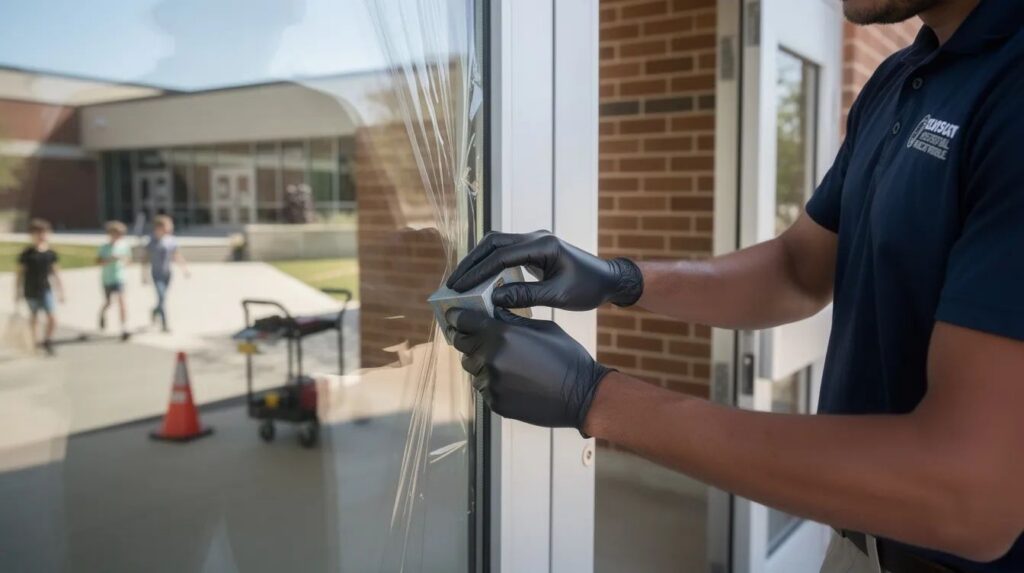
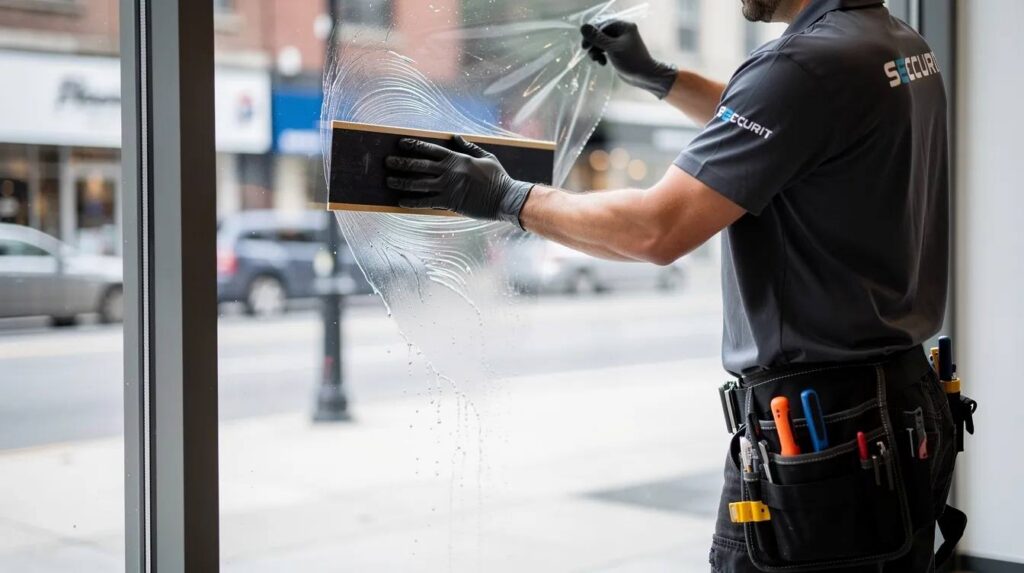
What professional installation includes: A trained installer performs a site survey, assesses glass type and frame condition, recommends the right film, prepares surfaces, applies the film with precision cutting and edge detailing, and installs optional attachment systems where needed. Professional installation typically takes one to three days depending on the scope. Professional installation may add to the total project cost, but it comes with manufacturer-backed warranty coverage and documented proof of quality – essential for facility managers and risk managers.
When DIY might be acceptable: For small residential panes or non-critical interior glass, DIY is possible. DIY installation requires cleaning, measuring, and cutting the film carefully. However, the risk of bubbles, contamination, misalignment, and poor edge bonding is real – and any of those defects reduce break-in resistance and can void warranties.
For large glass areas, high-traffic buildings, older glass, or any project where code compliance or safety audits matter, professional installation is strongly recommended.
Costs, Lifespan, and Long-Term Value of Security Films
Cost varies based on several factors, and exact pricing depends on your project’s specifics. Here are realistic ranges for 2025–2026.
- Installed cost: Security film costs range from $7 to $15 per square foot depending on film type, thickness, access, and anchoring requirements. A 3′ × 5′ window installation costs between $105 and $225.
- Anchoring adds cost: Adding anchoring to installation increases overall costs but dramatically improves forced-entry resistance. Installation costs vary based on film type and window size – larger commercial projects with complex glazing or high-security specifications cost more per square foot.
- Lifespan: Quality security films, properly installed, often last 10–20 years. Many include manufacturer warranties covering product integrity and sometimes labor.
- Long-term value: Avoided glass replacement costs, reduced downtime after incidents, lower risk of injury-related liability, and energy savings when safety and solar control are combined. Building owners should view safety film as a capital improvement supporting safety programs, insurance discussions, and resilience planning – not a cosmetic upgrade.
Maintaining Security Window Film for Lasting Performance
Proper care extends film life and ensures it performs when needed.
Cleaning. Wait until the adhesive has fully cured (usually 30 days), then clean filmed glass with a soft cloth or squeegee and mild, non-ammonia cleaners. Avoid abrasives, sharp tools, and harsh chemicals that can scratch or degrade the film surface.
Inspection. Add a basic check to your annual maintenance routine or schedule it during regular window cleaning. Look for edge lifting, bubbles, contamination, or damage from tape and stickers.
Signs film needs attention. Significant peeling, clouding, discoloration, or visible damage after an impact event or vandalism means the film may need repair or replacement.
When to call a professional. Contact your original installer or a qualified specialist when issues are found. Patch jobs can void warranties or reduce the safety performance you expect from the film.
Common Questions About Security Window Film
Below are answers to the most common questions we hear from homeowners and building professionals evaluating security films.
Does security window film really stop break-ins?
Security window film does not make glass unbreakable, but it holds broken glass together and keeps it in place, which can delay intruders for critical seconds or minutes. Security films can delay intruders by up to 3 minutes depending on film type, anchoring, glass thickness, and the determination of the intruder.
In many documented cases, intruders abandon break in attempts when the glass does not easily give way or when repeated blows are required. No reputable provider guarantees a specific number of minutes, but the delay makes a filmed site far less attractive than softer targets. Best practice is to pair security film with solid doors, quality locks, lighting, and monitored alarm systems for layered security.
How does safety film perform in storms and natural disasters?
Safety films help reduce hazardous flying glass when windows break during hurricanes, tornadoes, severe weather events, or earthquakes by keeping fragments attached to the film. Security films hold shattered glass together during impacts, significantly reducing interior glass hazards.
Films do not eliminate the need for shutters or other structural storm protections where required, but they keep openings more intact until repairs can be made. Building owners in coastal or storm corridors should seek films tested to relevant impact and windborne debris standards such as ASTM E1886/E1996.
What thickness of security film is best for most buildings?
For many security applications, films in the 8–14 mil range are commonly specified. Thinner films handle basic safety glazing, while thicker or layered systems address higher-threat environments. Thicker films provide more tear resistance for security applications, but “thicker is always better” is a misconception if you ignore glass type, frame condition, and attachment method.
Advanced multi-layer films can sometimes deliver higher tear resistance at lower overall thickness, which benefits projects needing high performance with minimal visual change. Consult a professional who can match film thickness and anchoring to your building’s risk profile.
Can security window film be installed on any existing glass?
Most clear, smooth glass surfaces – including annealed, tempered glass, and laminated glass – can accept security films. Each glass type behaves differently during breakage, which affects film selection. Very old, damaged, or heavily textured glass, or glass with failing seals, may require repair before film installation.
Professional installers perform a site evaluation, identifying coated glass, insulated units, and specialty glazing before recommending a specific safety film. Interior plastics or polycarbonate panels may need different products or surface preparation than standard glass.
How long does security window film last, and will it peel or discolor?
High-quality safety and security films installed correctly can last 10–20 years without significant peeling or discoloration under normal conditions. UV-stable adhesives and scratch-resistant coatings help maintain clarity and durability even on sun-exposed facades.
Cheap, non-certified films are more prone to yellowing, bubbling, and premature failure – which is why many building owners choose branded, warrantied products from established manufacturers. Periodically inspect film around high-moisture areas or where cleaning practices might be harsher, and address any issues early to preserve protection.
Is security window film suitable for renters and leased spaces?
Security window film is typically a reversible, non-structural upgrade, making it attractive for tenants who want better protection without altering the building envelope. Renters and commercial tenants should obtain landlord approval since films change the glazing system and may interact with existing warranties or facade requirements.
In many multi-tenant buildings, property managers welcome coordinated safety film projects to ensure consistent appearance and performance across suites. At the end of a lease, films can usually be removed by professionals without damaging the underlying glass, though removal costs should be clarified in advance.
Why Choose a Specialized Security Window Film Installer
Results depend as much on design and installation as on the film brand. Experienced installers bring product knowledge, field expertise, and the ability to solve problems that arise with unusual glass, frames, and building conditions.
Look for an installer with years of experience in safety and security film, access to leading 3M safety lines and other certified products, and a proven track record in schools, government, healthcare, retail, and office projects. For multi-site building owners, national or regional coverage ensures consistent specifications and workmanship across portfolios.
A reputable installer provides on-site assessments, detailed proposals, sample sections, references, and clear documentation of film specifications and warranties. Ask about training, certifications, insurance, and how the company coordinates with facility teams to minimize disruption during installation.
Next Steps: Protecting Your Windows, Occupants, and Operations
Security window film is one of the most practical, cost-effective upgrades you can make to existing glass. It delivers better protection against break-ins, accidents, and natural disasters while adding UV protection and comfort benefits that pay dividends every day.
Start by gathering your floor plans or window counts, identifying the highest-risk locations – ground floor, public-facing facades, vulnerable entry points – and preparing questions about performance, installation timing, and warranties. Then schedule a professional assessment to review glass types, prioritize openings, and receive a tailored recommendation.
Contact Window Film Depot to discuss your project, request a site visit, or obtain a budgetary estimate. With over three decades of experience in safety and security glazing, our team is ready to help you protect what matters most.