Table of Contents:
- The Privacy Dilemma: Why Reflective Window Films Fail at Night
- How Light Dictates Privacy: The Physics Behind Window Film
- Scaling Privacy: Challenges for Commercial and Multi-Family Projects
- The Solution: Partnering with an Architectural Film Specialist
- Key Takeaways for Specifying True 24/7 Privacy
- Frequently Asked Questions
- Related Posts from Window Film Depot
The Privacy Dilemma: Why Reflective Window Films Fail at Night
For any project manager specifying materials for a building’s envelope, privacy is a critical design requirement. The request often sounds simple: a film that allows occupants to see out but prevents outsiders from seeing in. This leads many to consider reflective or “one-way mirror” films, which seem to offer an ideal solution. Their real-world performance, however, is often misunderstood. This can lead to unmet expectations and potential security vulnerabilities, especially in a commercial or multi-family context.
The Daytime Promise of Reflective Film
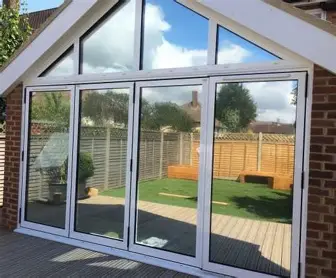
During daylight hours, reflective window film performs exactly as expected. The exterior surface of the glass acts like a mirror, reflecting the brighter outdoor environment and obscuring the view into the building’s interior.
From the inside, occupants enjoy an unobstructed, tinted view of the outside world. This effect provides excellent daytime privacy, reduces glare, and can significantly lower solar heat gain, contributing to energy efficiency.
For office buildings, ground-floor retail, or residential complexes, this daytime performance is a powerful benefit.
The Nighttime Reversal Effect
The problem arises after sunset. Once interior lights are turned on, the functional dynamics of the film reverse. Occupants looking out see their own reflection, making it difficult to view the exterior. More critically, anyone outside can now see directly into the illuminated space. The very film installed to create privacy now exposes the interior, a phenomenon often called the “nighttime reversal” or “fishbowl” effect. For a project manager, this failure to provide consistent privacy can be a significant liability, undermining the security and comfort of the building’s occupants.
The term “one-way mirror film” is a commercial label, not a technical one. These films are not truly one-way. They are semi-transparent, metallized sheets that reflect a percentage of light while allowing the rest to pass through. The mirror effect is an illusion created entirely by a differential in light levels. The film will always appear as a mirror from the brighter side and as a tinted window from the darker side.
Given this dependency on light, the concept of a transparent 24 hour privacy window film is a fundamental misconception. No passive, view-through film can defy the laws of physics. Any product marketed this way is typically a decorative film, like a frosted or patterned finish. These materials obscure the view 24/7 by diffusing light rather than reflecting it. While effective for privacy, these films also block the view from the inside out, which is a different solution entirely. Understanding this distinction is the first step for project managers in specifying a truly effective privacy solution.
How Light Dictates Privacy: The Physics Behind Window Film
To move from the problem to a viable solution, it is essential to understand the scientific principles governing window film performance. The success or failure of a reflective privacy film is not a product flaw but a predictable outcome based on the physics of light. For a project manager, a grasp of these concepts is crucial for setting realistic expectations and selecting the right architectural film for the project’s specific needs.
The Light Differential
The one-way mirror effect is achieved only when there is a significant light imbalance, or light differential, between the two sides of the glass. For the exterior to appear reflective, the light level outside must be substantially higher than the light level inside. As a general rule, a light ratio of at least 5:1 (exterior to interior) is needed to create effective visual privacy. When this ratio is met, the film reflects enough of the brighter exterior light to overpower the dimmer light being transmitted from the interior, rendering the inside view obscure.
Visible Light Transmission (VLT)
Every architectural film is rated with a Visible Light Transmission (VLT) percentage. This metric defines how much visible light passes through the film. A lower VLT number means less light is transmitted, resulting in a darker tint and a more reflective appearance.
- Low VLT (e.g., 5-20%): These films offer the highest level of daytime privacy. The strong reflective quality makes it very difficult to see inside during the day. However, they also create a darker interior and can compromise views from the inside, especially on overcast days.
- High VLT (e.g., 50-70%): These films are primarily designed for solar control and UV protection, not privacy. They allow a great deal of natural light to pass through and offer minimal visual obstruction, making them unsuitable for privacy applications.
Selecting a film with a lower VLT can enhance the daytime mirror effect, but it does not change the fundamental physics. The film will still become transparent from the outside at night when the light differential reverses. This is the core issue with using one way mirror film at night.
The entire system collapses once artificial lighting makes the building’s interior the primary light source. As darkness falls outside, even a small amount of interior light can be enough to reverse the light differential. The side of the film facing the brighter space, now the interior, becomes the reflective surface. On a large-scale project, this means every activated light in an office or residential unit effectively deactivates the film’s privacy function. Ultimately, achieving see-through window tint for home privacy day and night with a single, passive film is not scientifically possible.
Scaling Privacy: Challenges for Commercial and Multi-Family Projects
While the physics of light control remain the same, the stakes and complexity of window film applications escalate dramatically from a single home to a commercial or multi-family property. Successfully deploying a privacy solution across a large building envelope requires a strategic partner who understands how to manage challenges related to scale, public exposure, aesthetic consistency, and variable interior needs.
Why Residential Solutions Fail at Scale
The core issue is one of scale and consequence. A solution designed for a handful of residential windows is fundamentally inadequate for a project involving hundreds or thousands of square feet of glass. Off-the-shelf films can have slight variations in color and adhesive quality from batch to batch. While unnoticeable on a single bathroom window, these inconsistencies become glaringly obvious when installed across a large curtain wall, compromising the building’s professional appearance.
Installation quality standards are also exponentially higher. A minor imperfection like a small bubble or a slightly misaligned edge is a costly callback on a commercial project, reflecting poorly on the construction manager and the client’s brand. Commercial-grade applications demand precision, specialized tools, and an installation methodology designed for large surfaces to ensure a flawless, durable finish that meets architectural specifications.
The Amplified Privacy Challenge for Storefronts and Ground-Floor Offices
For any street-level commercial space, from a retail storefront to a ground-floor office, commercial privacy is a matter of security and operational integrity. A lapse in privacy can expose valuable inventory, reveal sensitive client information on monitors, or compromise confidential meetings. This creates a dual requirement: preventing unwanted inward views while often needing to maintain outward visibility.
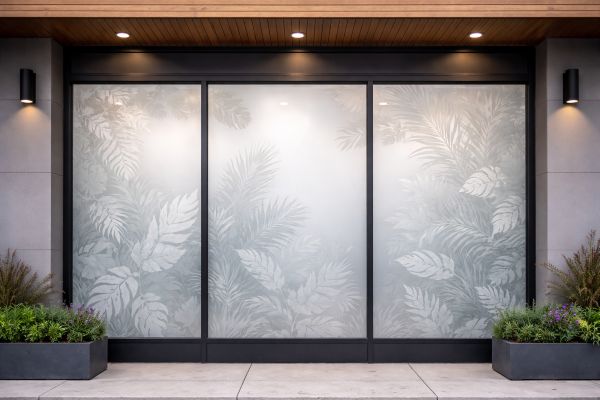
A simple blackout film might solve the privacy issue but creates an uninviting facade. A strategic application of a commercial decorative window film or partially applied frosted window film can effectively obscure sensitive areas on storefront glass while still allowing for a degree of light and visibility.
Maintaining Aesthetic Uniformity
A key architectural goal for any large building is a cohesive exterior appearance. Achieving this with window film is complex. An expert partner will account for several variables to ensure a consistent look, such as variable light exposure on different facades, the type and intensity of interior lighting, and shifting viewing angles from public vantage points. Achieving true uniformity may even require the strategic specification of multiple films with slightly different technical properties to create a visually identical result across the entire building envelope.
Addressing Variable Needs in Offices and Multi-Family Buildings
Large-scale projects are rarely homogenous. A single building often contains a wide array of spaces with distinct privacy requirements, from open-plan workspaces and private executive offices to common areas and private residences. This complexity renders a one-size-fits-all solution ineffective. A successful project requires a portfolio approach. This might involve using a decorative frosted window film for glass-walled conference rooms and office partitions, applying a full-coverage blackout film in secure server rooms, and specifying an elegant patterned film like 3M Fasara Glass Finishes for a lobby to enhance both aesthetics and privacy.
The Solution: Partnering with an Architectural Film Specialist
Achieving nuanced privacy, security, and aesthetic goals is not a product problem, it is a project execution challenge. Success hinges less on the film itself and more on the partner responsible for specifying, managing, and installing it. For a construction manager, selecting a window film partner is not a simple procurement task. It is the delegation of a critical architectural and logistical function.
The Value of a Consultative Approach
A true project partner operates from a consultative standpoint. Where a vendor might respond to a request for “privacy film” with a single product and a quote, a specialist initiates a diagnostic process. This involves a thorough review of architectural drawings, elevation plans, and client objectives for each distinct space. This consultative approach analyzes the specific function of each area, the light conditions, and the desired aesthetic, ensuring the final solution is fully aligned with the building’s design intent and operational requirements.
The Advantage of National Project Management
For multi-site retail rollouts, national corporate offices, or large-scale multi-family developments, managing window film installation across different locations presents a significant logistical hurdle. A partner with a national project management framework eliminates these variables. By centralizing the entire process, they provide a single point of contact and ensure a uniform standard of excellence.
This centralized model delivers key advantages:
- Brand Consistency: Ensures every location features the exact same film application and finish.
- Standardized Quality: Utilizes consistent installation protocols and a vetted network of certified installers.
- Streamlined Logistics: Simplifies scheduling, material procurement, and communication.
- Predictable Outcomes: Mitigates risks and provides reliable performance and timelines.
The Advantage of Proven Expertise
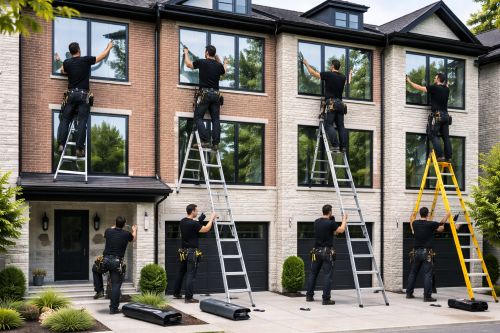
Partnering with a top-tier installer provides a tangible strategic advantage. This status signifies an unparalleled depth of product knowledge across a manufacturer’s extensive portfolio, including advanced decorative, security, and specialty architectural films. This expertise is critical when designing complex solutions. A leading partner has direct access to manufacturer technical resources, enabling them to solve unique challenges and validate specifications with factory support. For a project manager, this de-risks the selection process and guarantees access to the most effective and innovative solutions on the market.
Ultimately, the goal for any project manager is to deliver a project on time and on budget with minimal complications. By entrusting the entire film scope to a single, expert entity, procurement is radically simplified. One contract, one point of contact, and one invoice replace the complexity of managing multiple vendors.
Key Takeaways for Specifying True 24/7 Privacy
The common search for a single window tint for home privacy day and night is based on a misunderstanding of the technology. Standard reflective window film operates on the principle of light differential, and its privacy effect predictably reverses at night. Acknowledging this physical limitation is the first step toward a successful specification.
Adopt a Strategic, Multi-Film Approach
True privacy on a commercial scale requires a critical shift in perspective. The goal is not to procure a specific type of film, but to design a comprehensive architectural solution that addresses the unique requirements of each space.
A robust privacy solution might involve:
- Decorative Frosted Films: For conference rooms, private offices, or restroom partitions where light transmission is desired but direct visibility must be eliminated.
- Blackout or Whiteout Films: For sensitive areas like data centers or secure storage where complete opacity is the primary objective.
- Strategic Layering: Combining films to create a zoned privacy system.
This methodology treats window film as an integral component of the building’s function and design.
Next Steps for Your Project Specification
To avoid specification errors and ensure a successful outcome, the procurement process must begin with a clear understanding of the project’s specific needs. Before engaging a specialist, project managers should prepare by defining the following variables.
- Audit and Zone Your Spaces: Delineate which areas require absolute 24/7 privacy versus those where daytime privacy or simple light diffusion is sufficient.
- Define Functional and Aesthetic Goals: For each zone, clarify the primary objective. Is it to block all visibility, obscure shapes, allow for partial light, or integrate a branded design element?
- Engage an Expert Early: The most costly mistakes happen when film is treated as an afterthought. Bringing in a national film specialist during the design phase ensures that the specified solution is both technically feasible and budget-aligned, preventing costly change orders and project delays.
For a reliable, expertly managed solution, partner with Window Film Depot to ensure your privacy strategy performs exactly as intended.
Frequently Asked Questions
Why doesn’t my one-way mirror film work at night?
One-way mirror film, or reflective film, works based on a light differential. It appears as a mirror from the brighter side. During the day, the outside is brighter, so it provides privacy. At night, when your interior lights are on, the inside becomes brighter. This reverses the effect, making your windows transparent from the outside and reflective from the inside.
Is there any window film that provides privacy day and night?
No single, transparent film can provide see-through privacy 24/7 due to the laws of physics. However, you can achieve 24/7 privacy by using decorative films like frosted, patterned, or blackout films. These films obscure or block the view entirely, regardless of the lighting conditions, but they also prevent you from seeing out.
What’s the best window film for a commercial storefront?
The best solution depends on your goals. For daytime privacy and solar control, a low-VLT reflective film is effective. For 24/7 privacy, especially in sensitive areas, a decorative frosted film or a full blackout film may be necessary. Many projects use a combination, such as a frosted band across the middle of the glass, to balance privacy, security, and aesthetics.
Why should I use a national installer for a large or multi-site project?
A national installer provides a single point of contact to ensure consistency in product quality, installation standards, and project management across all your locations. This simplifies procurement, reduces your administrative burden, and guarantees a uniform, professional result that protects your brand’s integrity, which is difficult to achieve when coordinating multiple local vendors.