Table of Contents:
- The Blueprint Material: From Raw Elements to Annealed Float Glass
- The Core Advantage: Understanding Tempered Glass Properties and Performance
- Beyond Basic Safety: The Inherent Limitations of Tempered Glass for Security
- Elevating Protection: Bridging the Security Gap with Advanced Film Technology
- Strategic Implementation: Integrating Advanced Security Films into Project Planning
- Conclusion: Empowering Project Managers for Comprehensive Glass Security
- Frequently Asked Questions
- Related Posts from Window Film Depot
The Blueprint Material: From Raw Elements to Annealed Float Glass
Understanding the intrinsic properties of tempered glass begins with an examination of its manufacturing process. This journey involves more than technical details; it forms the foundation for the material’s performance, safety benefits, and ultimate limitations as a standalone security product. For project managers, grasping these stages provides the necessary context for informed specification and risk management.
The journey of tempered glass window starts with its raw form, known as annealed float glass. This is the standard, everyday glass found in many common applications. Production involves melting silica sand, soda ash, and limestone at extremely high temperatures. The molten glass floats onto a bed of molten tin to form a flat sheet. Annealed glass possesses a fundamental brittleness that limits its use in safety-critical applications. When subjected to force, it breaks into large, jagged, and potentially lethal shards. This failure mode underscores the need for materials that offer enhanced safety through thermal tempering.
The Science of Stress: Introducing the Thermal Tempering Process
The transformation of annealed glass into tempered glass is a sophisticated exercise in controlled stress. At its core, thermal tempering is a process designed to induce permanent compressive stress on the glass surface and compensating tensile stress in its core. This engineered stress profile is the secret behind tempered glass’s superior strength and its unique fracture pattern.
- Compressive Stress: The outer surfaces of the glass are put into a state of compression, meaning they are being pushed together. Glass is naturally very strong under compression.
- Tensile Stress: Conversely, the inner core of the glass is in a state of tension, being pulled apart. Glass is inherently weak under tension.
By strategically creating this balance, the tempering process makes the glass significantly more resistant to breakage from impact, thermal shock, and bending stresses compared to its annealed counterpart.
The Critical Transformation: Inside the Tempering Furnace
Once the annealed float glass is cut to its final dimensions and any fabrication, such as drilling or edge work, is completed – as tempering occurs after shaping – it enters the tempering furnace. Here, the glass is uniformly heated to a critical temperature, typically above 600°C (1112°F), but below its softening point. At this temperature, the glass softens just enough for its molecular structure to become pliable without deforming its shape. This stage is central to the tempered glass manufacturing process.
This precise heating is paramount. If the temperature is too low, the glass will not temper effectively. If it is too high, the glass can distort. The careful control of heat within the furnace ensures that the entire sheet of glass reaches a state where its molecules can freely rearrange, setting the stage for the subsequent and most critical phase.
Controlled Precision: The Art and Science of Rapid Cooling (Quenching)
The true “tempering” of the glass occurs during the quenching process. Immediately after exiting the furnace, the superheated glass is subjected to a rapid and uniform cooling, typically achieved by blowing high-pressure air onto both surfaces simultaneously. This sudden cooling causes the outer surfaces of the glass to cool and solidify much faster than the inner core. This is how safety glass is made with its distinctive properties.
As the surfaces rigidify, the still-molten interior continues to cool and contract. However, because the outer layers are already solid and set, they resist this contraction, effectively pulling the core into a state of tension and simultaneously forcing the already solidified outer surfaces into a state of compression.
This meticulously controlled cooling is what endows tempered glass with its distinctive characteristics:
- Enhanced Strength: The compressive stress on the surface makes the glass four to five times stronger than annealed glass against blunt impact.
- Thermal Shock Resistance: The engineered stress profile allows tempered glass to withstand wider and more rapid temperature fluctuations.
- Safe Breakage Pattern: When tempered glass does break, the stored energy from the internal tensile stress and external compressive stress is released uniformly. This causes the glass to fracture into thousands of small, relatively blunt, cube-like pieces, known as “dicing.” This dicing characteristic significantly reduces the risk of serious injury from sharp shards, making tempered glass a safety glass product as defined by building codes.
From a project manager’s perspective, understanding this specific breakage pattern is crucial. The dicing characteristic is a paramount safety feature that mitigates the danger of jagged shards. However, it is important to recognize that this feature does not inherently offer robust security. The design that makes the glass safe also ensures the entire pane quickly disintegrates when compromised. This creates an open access point that provides minimal resistance to forced entry. The distinction between safety and security forms the critical nexus for specifying appropriate glazing solutions.
The Core Advantage: Understanding Tempered Glass Properties and Performance
Strength Under Pressure: The Mechanics of Compressive and Tensile Stress
Tempered glass gains superior strength and resilience through a precise thermal tempering process. During manufacturing, annealed glass is heated to approximately 1,110°F and then rapidly cooled. This quenching causes the outer surfaces to solidify quickly while the inner core remains molten. As the core cools and contracts, it pulls on the rigid outer layers. This induces high compressive stress on surfaces and balances tensile stress within the core. The engineered stress differential makes the glass resistant to impact, damage, and thermal shock. This internal architecture allows the glass to withstand considerable force before failure.
Designed for Safety: The Unique Shatter Pattern and Its Implications
The internal stress of tempered glass creates its defining characteristic: a distinctive shatter pattern. When an object compromises the surface integrity, the glass instantaneously releases its stored internal energy. This reaction causes the entire pane to disintegrate into thousands of small, blunt, and uniform granules.
Experts call this phenomenon “dicing,” a deliberate safety feature of the manufacturing process. While annealed glass breaks into large, jagged, and potentially lethal shards, these diced fragments significantly reduce the risk of severe lacerations. This design intent prioritizes human safety in environments where broken glass poses a primary threat.
Verifying What’s Built: Practical Identification of Tempered Glass on Site
Accurately identifying tempered glass on a job site is crucial for compliance and quality assurance. Several practical methods exist for verification, though it is not always immediately obvious. Often, tempered glass will have a permanent stamp etched into one of its corners. This mark indicates that the material meets specific safety standards. Visual inspection using polarized sunglasses or specialized viewers can reveal subtle stress patterns. These distortions appear as dark, leopard-spot-like patterns within the glass. This confirms the internal compressive and tensile stress created by the thermal tempering process.
Meeting the Mandate: Adherence to Industry Safety Standards (ANSI Z97.1, CPSC 16 CFR 1201)
The unique safety properties of tempered glass are why it is mandated by building codes for specific applications where there is a high risk of human impact. Standards such as ANSI Z97.1 (American National Standard for Safety Glazing Materials Used in Buildings – Safety Performance Specifications and Methods of Test) and CPSC 16 CFR 1201 (U.S. Consumer Product Safety Commission Safety Standard for Architectural Glazing Materials) set the performance criteria for safety glazing. Tempered glass effectively meets these mandates, requiring its use in areas like:
- Doors, including patio doors and storm doors.
- Windows or panels adjacent to doors.
- Bathroom shower and tub enclosures.
- Windows that are large or close to the floor in walking areas.
Adherence to these standards ensures occupant safety by reducing the severity of injuries should the glass break. However, it is vital to recognize that these safety standards are primarily concerned with injury prevention from glass breakage, not with maintaining a security barrier against intrusion or other external threats.
Need More Info?
The Window Film Depot team is happy to help.
Beyond Basic Safety: The Inherent Limitations of Tempered Glass for Security
A Paradox of Protection: How Tempered Glass’s Safety Feature Becomes a Security Vulnerability
While the dicing characteristic of tempered glass offers a significant safety advantage by minimizing injury, this very attribute creates a fundamental vulnerability when security is the objective. Tempered glass is designed to fail upon impact, shattering into small pieces that are easily removed. This means that a single point of impact is sufficient to eliminate the glass barrier, rendering it ineffective as a security measure. The paradox lies in its design: it protects people from glass shards, but simultaneously offers no resistance against penetration or forced entry once broken. This makes it an incomplete solution for any project where both safety from breakage and security against intrusion are required.
The Breach Point: Why Immediate Shattering Creates Security Risks
The immediate and total fragmentation of tempered glass upon impact creates an instant and unimpeded opening. This rapid failure mechanism is a critical weakness in security contexts. An intruder, equipped with even a simple tool, can gain access within seconds, bypassing the entire window assembly. Unlike other glazing types, such as laminated glass or glass treated with advanced security films, tempered glass does not remain in its frame as a continuous barrier after impact. This swift breach provides minimal to no deterrence, alarm activation time, or resistance, significantly increasing the risk of theft, vandalism, or unauthorized entry.
Evaluating Threat Scenarios: Where Standard Tempered Glass Falls Short
When evaluating a project’s security needs, standard tempered glass proves inadequate across a range of common threat scenarios:
- Forced Entry: Whether from an opportunistic burglar or a determined vandal, tempered glass offers virtually no resistance to impact tools, leading to immediate access.
- Active Threat Response: In scenarios involving active threats, tempered glass provides no ballistic protection, nor does it contain fragments that could become dangerous projectiles if shot at. It fails to slow down or impede an assailant.
- Blast Mitigation: In the event of an explosive blast, tempered glass will shatter instantly, creating a dangerous shower of high-velocity glass fragments that pose a severe threat to occupants and property.
- Severe Weather: While more resistant to wind loads, tempered glass offers minimal protection against windborne debris during hurricanes or severe storms. A single impact can cause complete failure, exposing the interior to the elements.
In each of these critical situations, the designed-for-safety dicing feature of tempered glass directly translates into a security liability, highlighting its inherent limitations.
The Cost of Compromise: Understanding the Liability and Reputation Risks for Project Managers
For Project Manager Paul, overlooking the inherent security limitations of tempered glass can have significant consequences beyond the immediate project scope. Specifying standard tempered glass in applications where enhanced security is an unstated, yet critical, client expectation or an implicit project requirement can lead to substantial risks:
- Client Dissatisfaction and Financial Claims: In the event of a security breach or incident where the glass fails to provide protection, clients may pursue claims for damages, stolen property, or business interruption, directly impacting project budgets and relationships.
- Reputational Damage: A security vulnerability resulting from inadequate glass specification can harm the project manager’s and the firm’s professional reputation, potentially affecting future project opportunities.
- Legal Liability: If a claimant demonstrates that a professional failed to meet a reasonable standard of care, or if that professional misunderstood or misapplied specific client security requirements, the law may establish grounds for legal liability.
Understanding the precise capabilities and limitations of tempered glass is not merely a technical detail, it is a critical component of risk management and client advisory for project managers, ensuring specifications align with the full spectrum of client needs, including security.
Elevating Protection: Bridging the Security Gap with Advanced Film Technology
The Next Level of Defense: How Security Window Film Transforms Tempered Glass
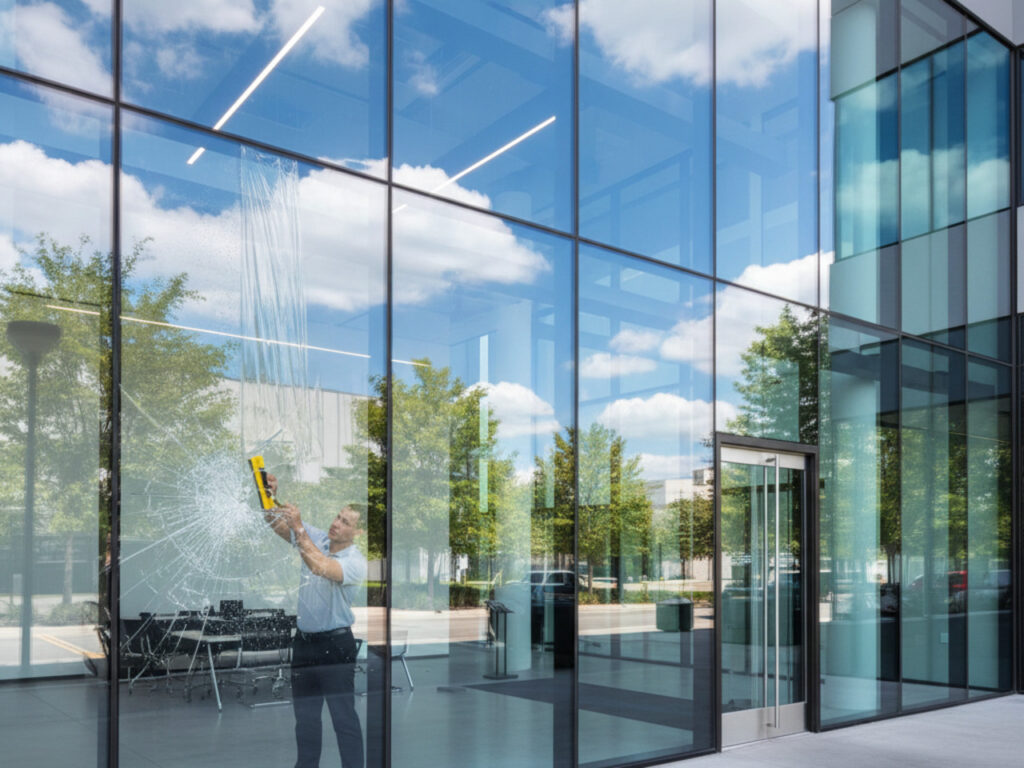
While tempered glass excels in safely fragmenting upon impact, its inherent design results in an immediate loss of barrier integrity. This characteristic, beneficial for preventing laceration injuries, creates a critical vulnerability when security is paramount. Security window film directly addresses this gap by transforming how tempered glass behaves post-impact, maintaining a robust, continuous barrier even after the glass itself has shattered.
The application of security film prevents the typical “dicing” fragmentation of tempered glass from creating an open entry point. Instead, the film’s strong adhesive and durable layers hold the fragmented glass pieces firmly within the frame. This ensures that the window, though compromised, remains an effective impediment, significantly delaying unauthorized access and containing hazards.

Engineering Resilience: The Core Technology Behind Advanced Films
The efficacy of advanced security films stems from sophisticated engineering and material science. These films are typically constructed from multiple layers of high-tensile polyester, bonded together with specialized, pressure-sensitive adhesives. This multi-ply construction allows the film to absorb and dissipate impact energy over a wider area, drastically increasing the glass assembly’s resistance to penetration.
Key to their performance is the strength of the adhesive, which forms a molecular bond with the glass surface. Engineers design this bond to withstand extreme forces, ensuring the shattered glass adheres tenaciously to the film even under severe impact. This process creates a flexible, tear-resistant membrane that continues to protect the opening even after an intruder or impact destroys the original glass substrate.
Holding the Line: The Role of 3M Security Window Film in Mitigating Breaches
Leading manufacturers like 3M provide solutions that actively deter and mitigate various security threats. 3M™ Security Window Film is engineered to delay forced entry attempts significantly. This delay offers crucial time for occupants to react or for security personnel to respond. It effectively turns an immediate entry point into a formidable challenge for intruders.
Beyond intrusion, these films are instrumental in blast mitigation and natural disaster preparedness. They prevent dangerous shards from becoming projectiles by containing glass fragments within the frame. This significantly reduces the risk of injury to occupants and damage to interior assets.
A Strategic Specification: Integrating Film for Enhanced Safety and Security Performance
For project managers, integrating advanced security film represents a strategic upgrade to any glazing system utilizing tempered glass. It elevates the performance of tempered glass from merely a safety product, preventing injury from falling glass, to a comprehensive safety and security solution. Specifying film ensures that the beneficial dicing characteristic of tempered glass works with the security objective, rather than against it.
This combination fully utilizes the inherent strength and thermal properties of tempered glass while simultaneously overcoming its vulnerability to rapid barrier failure. This proactive measure provides a higher level of protection for occupants, assets, and structural integrity, aligning with stringent client demands for robust security measures.
Strategic Implementation: Integrating Advanced Security Films into Project Planning
Assessing Project Needs: Matching Film Solutions to Specific Security Demands
Effective implementation of security window films begins with a thorough assessment of the project’s specific security requirements and potential threat profiles. Not all films are created equal, and their performance varies based on thickness, adhesive strength, and intended application. Project managers must work with clients to define the primary security concerns:
- Intrusion Deterrence: For general smash-and-grab or forced entry attempts.
- Blast Mitigation: To protect against terrorist attacks or industrial explosions.
- Natural Disaster Protection: For areas prone to hurricanes, tornadoes, or earthquakes.
- Ballistic Resistance: When combined with specific glass laminates for advanced threat levels.
Understanding these needs dictates the appropriate film type, thickness (often measured in “mils,” with higher mil ratings indicating greater strength), and the necessity of additional attachment systems.
Specifying for Performance: Key Considerations for Film Selection and Installation
Accurate specification is critical to achieving desired security outcomes. Beyond film thickness, project managers should consider:
- Adhesive System: High-performance adhesives are essential for maintaining integrity post-impact.
- Edge Retention Systems: Mechanical systems, such as wet glaze or structural silicone, anchor the film directly to the window frame. These systems prevent an intruder from pushing out the entire glass-film unit—a critical requirement for blast and forced entry resistance, especially in fenestration.
- Optical Clarity: Ensuring the film does not compromise visibility or aesthetics, particularly for architectural applications.
- Manufacturer Warranties: Understanding the lifespan and performance guarantees of the film and its installation.
Proper installation by certified professionals is non-negotiable. Even the highest-grade film will underperform if not installed correctly, especially concerning adhesion and edge sealing.
Collaborative Advantages: Partnering with Specialized Installers for Optimal Results
Engaging specialized security film installers early in the project planning phase offers significant advantages. These experts possess a deep understanding of film properties, installation techniques, and applicable building codes and standards. They can provide invaluable guidance on:
- Product Selection: Recommending the most cost-effective and appropriate film for the identified threats.
- System Design: Advising on necessary edge retention systems and their integration with existing or new fenestration.
- Installation Logistics: Planning for seamless execution, especially in occupied buildings or complex architectural designs.
This collaborative approach ensures that the specified film solution is not just a product, but a fully integrated, high-performance system designed for longevity and maximum protective capability.
Future-Proofing Assets: Long-Term Benefits of Combined Glass and Film Solutions
Investing in security window film represents a strategic decision that offers enduring benefits far beyond immediate threat mitigation. For Project Manager Paul and his clients, this solution future-proofs assets by:
- Extending Asset Lifespan: Protecting interiors from UV degradation, which can fade furnishings and artwork.
- Reducing Operational Downtime: In the event of an incident, the contained glass significantly minimizes cleanup time and allows for faster re-securing of the premises.
- Enhancing Occupant Confidence: Providing a tangible layer of security that contributes to a safer and more secure environment for occupants.
- Potential Insurance Premium Reductions: Demonstrating proactive risk mitigation to insurance providers.
These long-term advantages underscore the value proposition of specifying advanced security films as a critical component in any comprehensive security strategy, transforming tempered glass into a truly resilient barrier.
Conclusion: Empowering Project Managers for Comprehensive Glass Security
Key Takeaways: Reconciling Safety, Security, and Project Success
Understanding what tempered glass is made of is paramount for specifying effective glazing solutions. Its manufacturing process provides significant strength and a superior safety profile upon breakage. However, it is crucial to recognize that these attributes define its limitations as a standalone security barrier. The dicing effect is designed to prevent hazardous shards during a failure.
This process simultaneously eliminates structural integrity, leaving an immediate and unprotected opening. Project managers must account for this rapid loss of integrity when planning building security.

This core distinction between safety and security drives the need for a comprehensive approach. Relying solely on tempered glass for security applications overlooks its inherent design purpose and exposes a critical vulnerability. Project success, therefore, hinges on a nuanced appreciation of how glass properties align with diverse project requirements, especially when security is a primary concern.
Strategic Imperatives: Informed Decisions for Client Protection and Liability Reduction
For project managers, making informed decisions about glass specifications extends beyond material cost and aesthetic appeal. It directly impacts client protection and mitigates potential liability. Assuming that tempered glass, due to its robustness, offers sufficient resistance against forced entry is a misconception that can lead to significant vulnerabilities. Specifying the right solution begins with a clear understanding of threat profiles and performance objectives.
To navigate this complexity effectively, consider these strategic imperatives:
- Differentiate Safety from Security: Always clarify whether the primary objective is occupant safety from glass breakage or resistance to external threats. These require distinct solutions.
- Assess Vulnerabilities Holistically: Recognize that glass is often the weakest point in a building’s envelope. A comprehensive security strategy must address this vulnerability directly.
- Educate Stakeholders: Proactively inform clients and design teams about the limitations of standard tempered glass in security applications and the benefits of integrating advanced film solutions. This prevents misaligned expectations and potential project delays.
- Mitigate Liability: By specifying appropriate security films alongside tempered glass, project managers fulfill their due diligence in protecting assets and occupants, thereby reducing the risk associated with inadequate security measures.
A Forward-Looking Approach: Continuous Improvement in Glazing Security
The landscape of building security is constantly evolving, driven by new threats and technological advancements. A forward-looking approach to glazing security acknowledges that static solutions are insufficient for dynamic challenges. Continuous improvement means embracing technologies that enhance existing materials and provide adaptive layers of protection.
Advanced security window films represent a critical component of this progressive strategy. They transform the weakest link, the glass, into a formidable barrier, ensuring that even if tempered glass breaks, its fragments remain contained, maintaining an effective deterrent and delaying unauthorized entry. This integration of film technology enables scalable security solutions that technicians can tailor to specific threat levels and architectural requirements. This approach ensures that buildings remain resilient against a spectrum of potential incidents.
Next Steps: Leveraging Expertise for Superior Building Performance and Peace of Mind
Achieving superior building performance and providing peace of mind for clients demands more than just material procurement. It requires leveraging specialized expertise. For projects where security is paramount, the next steps involve a collaborative and informed approach to specifying glazing systems.
- Engage Glazing Security Specialists: Partner with experts in advanced security film technology early in the design phase. Their knowledge can optimize specifications and identify the most effective solutions for your project’s unique security challenges.
- Conduct Thorough Risk Assessments: Work with security consultants to perform detailed threat assessments that inform the performance requirements for glazing. This ensures that film solutions are precisely matched to anticipated risks.
- Integrate Film Specifications Proactively: Rather than an afterthought, consider security film an integral part of the glazing system from the outset. This streamlines installation, optimizes performance, and ensures seamless integration with the overall architectural design.
By meticulously understanding the design intent of tempered glass and strategically integrating advanced security films, project managers can confidently deliver building envelopes that offer both safety and robust protection, securing client assets and providing lasting peace of mind.
Frequently Asked Questions
What is the primary difference between annealed glass and tempered glass?
The main difference lies in their strength and how they break. Annealed glass is standard glass that breaks into large, sharp, and dangerous shards. Tempered glass, through a thermal tempering process, is significantly stronger and, when broken, shatters into thousands of small, relatively blunt pieces (dicing), making it a much safer option for human impact areas..
How does the manufacturing process make tempered glass safer?
The thermal tempering process involves heating annealed glass to a high temperature and then rapidly cooling it (quenching). This process creates a state of high compressive stress on the glass’s surface and tensile stress in its core. This internal stress profile makes the glass four to five times stronger than annealed glass and causes it to break into small, harmless fragments, addressing how safety glass is made.
Why isn’t tempered glass considered a complete security solution on its own?
While tempered glass is designed for safety, its dicing characteristic, while preventing dangerous shards, means that upon impact, the entire pane disintegrates, creating an immediate and unimpeded opening. This rapid failure offers minimal resistance against forced entry or other security threats, rendering it ineffective as a standalone security barrier.
How do security window films improve the security of tempered glass?
Security window films are multi-layered polyester films with strong adhesives applied to the glass. When tempered glass breaks, the film holds the shattered fragments firmly within the window frame. This maintains a continuous barrier, significantly delaying unauthorized access, containing dangerous glass fragments from blasts or severe weather, and preventing an immediate breach.
What are some key standards that mandate the use of safety glass like tempered glass?
In the United States, primary standards that mandate the use of safety glass, including tempered glass, in high-risk areas are ANSI Z97.1 (American National Standard for Safety Glazing Materials Used in Buildings) and CPSC 16 CFR 1201 (U.S. Consumer Product Safety Commission Safety Standard for Architectural Glazing Materials). These standards ensure occupant safety in applications such as doors, windows near doors, and shower enclosures.