Table of Contents:
- Key Commercial Applications for One-Way Film
- Managing Expectations: The Science of One-Way Film Performance
- Selecting the Right Film: Understanding Key Performance Metrics
- Your Installation Partner: The Critical Factor for Success with One-Way Film
- Frequently Asked Questions
- Related Posts from Window Film Depot
Key Commercial Applications for One-Way Film
Understanding the science of light differential is the first step. The next is identifying the commercial environments where this principle solves client problems and adds tangible value. For a project manager, specifying one-way window film is most successful when the application aligns perfectly with the film’s performance characteristics.
Securing Lobbies and Ground-Floor Offices with Commercial Privacy Film
Lobbies and ground-floor offices are a primary use case for reflective window film. These spaces are highly vulnerable to public view, creating challenges for both security and confidentiality. During daylight hours, the significant light differential between the bright exterior and the more moderately lit interior creates ideal conditions for the film to perform.
From the outside, the film presents a clean, uniform, and reflective surface. This aesthetic enhances the building’s architectural profile while preventing passersby from seeing into the lobby or peering at employee computer screens. For a project manager, this delivers on several key objectives:
- Enhanced Security: It obscures the view of valuable assets, reception desk activities, and the general layout of the space, deterring opportunistic observation.
- Occupant Privacy: Employees and visitors can work and meet without the distraction or concern of being watched from the street.
- Aesthetic Control: It provides a sleek, modern alternative to blinds or curtains, which can appear dated, require constant cleaning, and block the view for those inside.
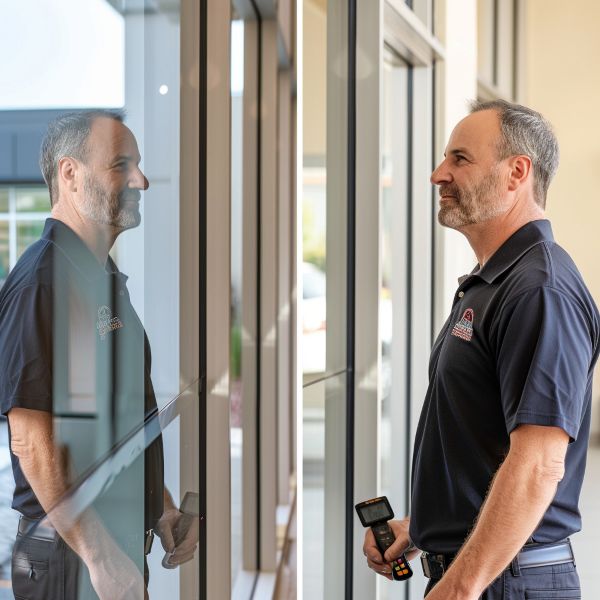
A critical specification detail is managing the transition into evening hours. As exterior light fades and interior lights turn on, the privacy effect will reverse. This is not a product failure but a predictable outcome of the light ratio changing. Planning for this with the client by supplementing with other window coverings for after-hours privacy is a hallmark of a well-managed project.
Enhancing Retail Storefronts and Managing Interior Views
In the retail sector, one-way film serves a dual purpose. It enhances a storefront’s visual appeal and helps direct the customer’s experience. A reflective film can give a storefront a dramatic, high-end appearance that distinguishes it from surrounding businesses. It also reduces incoming glare, which prevents harsh reflections on merchandise and creates a more comfortable shopping environment just inside the entrance.
Perhaps the most valuable application for storefront privacy in retail is for interior glass partitions. Project managers are often tasked with creating a seamless customer experience while hiding back-of-house operations. One-way film is an elegant solution for glass walls separating the sales floor from stockrooms, administrative offices, or break rooms. As long as the customer-facing area is more brightly lit than the staff-only area, the film provides a mirrored surface on the public side, effectively concealing clutter and activity. This allows for an open-concept feel without sacrificing operational privacy.
Improving Privacy and Safety in Institutional Buildings
For schools, universities, and government facilities, managing visibility is a core component of safety and operational protocol. One-way film provides a practical tool for enhancing building security without creating a fortified or unwelcoming atmosphere.
Applying this daylight privacy film to ground-floor classrooms, administrative offices, and libraries prevents casual observation from the outside, protecting students and staff. More importantly, it serves as a critical layer in a facility’s security strategy. By denying a potential external threat a clear view of the building’s interior layout and occupancy, the film acts as a deterrent and removes a key element of intelligence gathering. In an active threat scenario, this visual obstruction can impede a perpetrator’s ability to target occupants.
When specifying film for these environments, it is essential to consider solutions that combine privacy with other safety features. Many one-way privacy films are available in thicker security film constructions that also provide shatter resistance, helping to hold glass fragments together if the window is broken. This combined benefit of privacy and safety makes it a powerful and cost-effective upgrade for any institutional project manager.
Managing Expectations: The Science of One-Way Film Performance
For any project manager, the goal is a successful installation that meets client expectations without call-backs. With one-way privacy film, the most critical element to manage is the client’s understanding of how it performs after sunset. This is not a product flaw but a function of physics. Communicating this clearly during the specification phase is the mark of a professional and trustworthy project partner.
Why the Mirror Effect Reverses at Night
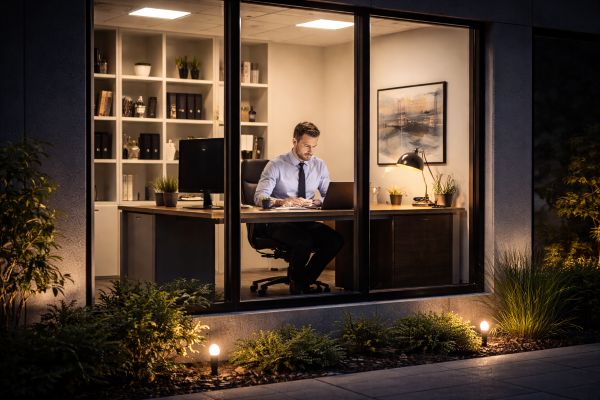
The reflective properties of one-way window film are activated by a differential in light levels. The film’s “one-way” characteristic is created when one side of the glass is significantly brighter than the other. The brighter side is what an observer sees as a mirror.
During the day, the exterior of a building is much brighter than the interior. A person outside looking at the window sees a reflection of the outside world, granting daytime privacy to those inside. When the sun sets and interior lights are turned on, this light ratio inverts.
The interior becomes brighter than the dark exterior, causing the reflective effect to reverse. Occupants inside will now see their own reflection, while anyone outside can see directly into the illuminated space. This reversal is a predictable and unavoidable aspect of mirror film.
Communicating Film Limitations to Clients
Addressing the nighttime reversal of one-way film is not about highlighting a weakness. It is about demonstrating expertise and ensuring the specified solution aligns perfectly with the client’s operational needs. A transparent conversation prevents future dissatisfaction and costly rework.
We recommend the following approach during client consultations:
- Educate on the Principle: Clearly explain that the film’s effectiveness is based on the light differential. Frame it as a function of environmental physics, not a product limitation.
- Provide Visual Aids: Use project photos or digital mockups to show the contrast between the film’s daytime performance and its nighttime appearance.
- Confirm the Primary Objective: Reiterate that the film is being specified to solve the primary need for daytime privacy and solar control.
- Document the Discussion: Ensure the client’s acknowledgment of the film’s lighting-dependent nature is noted in project documentation.
Planning for 24/7 Privacy: A Layered Approach
When a client requires privacy around the clock, one-way film should be specified as part of a layered strategy. For nighttime privacy, the most effective approach is to pair daytime reflective films with traditional window treatments. Solutions such as blinds, shades, or curtains can be drawn after sunset. For interior applications like conference rooms, other technologies like Casper Cloaking Film, which obscures digital screens, or decorative frosted films can be considered. The key is to identify the full scope of the privacy requirement and specify a system, not just a single product.
Selecting the Right Film: Understanding Key Performance Metrics
Once the principles of one-way film are understood, the focus shifts to selecting the correct product. This is where technical data sheets become invaluable. A successful specification requires a nuanced understanding of how key performance metrics interact to create the desired outcome.
Specifying Visible Light Transmission (VLT)
Visible Light Transmission, or VLT, measures the percentage of visible light that passes through the window and film. This metric directly influences both the interior environment and the building’s exterior appearance.
A lower VLT percentage indicates a darker, more reflective film. This creates a more pronounced privacy effect and significantly reduces glare, but it also reduces the amount of natural light entering the space. A higher VLT film allows more natural light but offers less glare reduction and a weaker privacy effect. The correct VLT specification is a careful balance between the client’s desire for privacy, the need for natural light, and the building’s aesthetic goals.
Understanding Reflectivity Ratings and Their Impact on Privacy
The second critical metric is Visible Light Reflectance (VLR), which measures the percentage of visible light reflected away from the window. For one-way privacy applications, a high exterior VLR is essential to creating the desired mirror effect during the day. The greater the difference between the light levels outside and inside, and the higher the film’s VLR, the stronger the privacy.
Project managers should note that VLT and VLR are often inversely related. Highly reflective films that are excellent for privacy typically have a lower VLT, meaning they are darker. This trade-off is fundamental to film technology. Selecting a film requires analyzing both metrics in tandem to find the optimal balance for the specific application.
Beyond Privacy: Analyzing Solar Control and Energy Efficiency Data
Modern privacy window film offers significant additional benefits that strengthen the project’s overall value. Analyzing the solar and energy performance data on a spec sheet, such as those for 3M Window Film, reveals opportunities for a measurable return on investment.
Key metrics to analyze include:
- Total Solar Energy Rejected (TSER): This is a comprehensive measure of the film’s ability to block solar heat. A higher TSER value translates directly into reduced load on HVAC systems and lower energy costs.
- Solar Heat Gain Coefficient (SHGC): This represents the fraction of solar radiation admitted through a window. In climates with high cooling costs, specifying a film with a low SHGC is critical for managing heat gain.
- UV Rejection: Most high-quality solar control film, including products from 3M, blocks over 99% of ultraviolet radiation. This protects expensive interior furnishings, flooring, and artwork from fading.
By specifying a film that excels in both privacy and solar control, you deliver a multifaceted solution that enhances building performance, improves occupant comfort, and provides a tangible financial return.
Your Installation Partner: The Critical Factor for Success with One-Way Film
Selecting the right reflective window film is only the first step. For any commercial project, the successful execution of your privacy objectives depends entirely on the expertise of your installation partner. A high-performance film installed incorrectly, or specified without a thorough analysis of the environment, will fail to deliver the intended results. This can lead to client dissatisfaction and costly rework.
The Risk of Inconsistent Results in Large-Scale Projects
On a large campus or across a portfolio of national retail locations, consistency is paramount. A client expects the same level of privacy and the same aesthetic finish at their Seattle office as they have in Phoenix. Achieving this uniformity is a technical challenge that a standard contractor may not be equipped to handle. The performance of a film is a direct function of the light ratio, which is influenced by numerous site-specific variables.
- Building Orientation: A north-facing glass wall receives diffuse, indirect light, creating a vastly different light ratio than a west-facing wall in direct sun.
- Regional Climate: The ambient light in an overcast region differs greatly from the bright conditions common in the Southwest. A film specification that works perfectly in one climate may underperform in another.
- Glazing System Variations: Different types of glass, like clear, low-e, or factory-tinted, have different VLT values. Applying the same film over these will produce varied results.
- Installation Technique: Without nationally standardized training, techniques can vary, resulting in visible seams or contamination under the film.
How Expert Specification Mitigates Delays and Complaints
The most effective way to avoid project setbacks is through meticulous planning and expert specification before work begins. An experienced installation partner moves beyond a simple product order to a consultative process.
First, an expert partner educates the client on the science behind the solution, including a clear explanation of why the privacy effect reverses at night. Setting this expectation from the outset prevents the most common client complaint associated with one-way film. Proper specification also prevents delays caused by selecting the wrong material.
A specialist will analyze lighting conditions, measure the VLT of the existing glass, and recommend a film with the precise level of reflectivity. They will also perform a crucial glass compatibility assessment to ensure the chosen film will not induce thermal stress, a rare but serious risk that can cause glass to crack.

The Advantage of Partnering with the #1 U.S. 3M Window Film Installer
Engaging a national leader with specific expertise in architectural films provides a distinct project management advantage. As the largest 3M Authorized Window Film Installer in the United States, Window Film Depot offers a level of coordination, technical depth, and risk assurance that local vendors cannot match.
For a project manager tasked with delivering on time and on budget, these advantages are tangible:
- Standardized National Execution: Our network operates under a unified project management system. This ensures every installation adheres to the same high standards for site assessment, technique, and quality control.
- Unmatched Product Knowledge: Our status provides direct access to 3M’s extensive portfolio of solar, security, and decorative films. We can specify the optimal product based on empirical performance data, not just what a local shop has in stock.
- Comprehensive Risk Management: Our process includes detailed site surveys, glass-to-film compatibility checks, and proactive communication to manage client expectations, effectively de-risking the commercial window tinting component of your project.
- A Single Point of Accountability: We provide a single point of contact for project coordination, billing, and warranty support, streamlining your workflow and ensuring clear accountability.
Partner with Window Film Depot to install one-way film that delivers reliable privacy, energy efficiency, and consistent performance across your project.
Frequently Asked Questions
Why does one way film not work at night?
One-way film relies on a light differential to create a mirror effect. The side with more light becomes reflective. During the day, the bright outdoors makes the film reflective to people outside. At night, when interior lights are on, the inside becomes brighter than the outside, causing the effect to reverse. Anyone outside can now see in.
What is the best VLT for commercial privacy film?
There is no single “best” VLT. The ideal choice depends on balancing privacy needs with the desire for natural light. A lower VLT (e.g., 10-20%) offers stronger privacy and glare control but makes the interior darker. A higher VLT (e.g., 30-40%) allows more light in but provides a less pronounced privacy effect. An expert consultation can help determine the right balance for your specific project.
Can one way film save money on energy bills?
Yes. Most one way film is also a type of solar control film that rejects a significant amount of solar heat. By reducing the amount of heat entering a building, the film lessens the load on HVAC systems, which can lead to measurable energy savings, especially in climates with high cooling costs.
Is reflective window film difficult to install?
Achieving a professional, bubble-free finish on a large commercial scale requires specialized training and tools. Inconsistent technique, contamination, and improper edge finishing can ruin the aesthetic. For multi-site projects or critical applications, partnering with a certified national installer is the best way to ensure consistent, high-quality results.