Table of Contents:
- The High-Stakes Choice: Why Your Commercial Project Needs More Than a Local Tinter
- How an Unqualified Vendor Derails Your Project Schedule
- The True Cost: Budget Overruns and Hidden Liabilities
- The Quality Control Gap in Large Scale Window Film Projects
- Security Film: The Critical Difference Between Privacy and Protection
- How to Qualify a National Window Film Installer
- Frequently Asked Questions
- Related Posts from Window Film Depot
The High-Stakes Choice: Why Your Commercial Project Needs More Than a Local Tinter
As a project manager, vendor selection is a pivotal decision. When sourcing a window film installer, a search for “home window tint near me” might yield dozens of local options for solutions like mirror tint for home windows. While a low bid from a residential-focused company can seem like an early budget win, the downstream consequences often prove disastrous for large-scale projects. An undersized or underqualified vendor introduces unacceptable risks that a professional commercial partner is specifically structured to mitigate. Understanding this distinction is the first step toward protecting your project’s integrity, budget, and timeline.
How an Unqualified Vendor Derails Your Project Schedule
On any large-scale project, the schedule is everything. Trades are interconnected, and a single delay creates a domino effect of costly disruptions. A vendor accustomed to single-day residential jobs is fundamentally unprepared for the pace and scale of a commercial site.
A small crew, while perfectly adequate for a suburban house, becomes an immediate bottleneck when faced with hundreds or thousands of windows.
They lack the manpower to work on multiple floors simultaneously or to deploy teams across a large facility. This inability to scale means their work takes exponentially longer than projected, preventing subsequent trades like painters or furniture installers from starting.
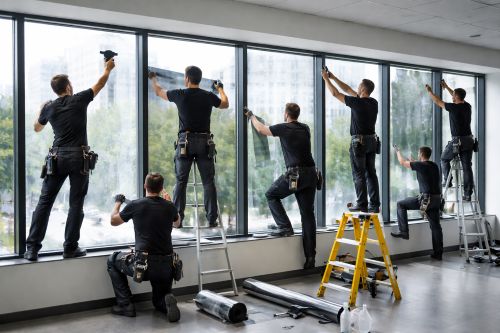
In contrast, a commercial partner builds an execution plan around your master schedule, deploying appropriately sized, certified teams to meet your deadlines without compromising the workflow of other contractors.
The True Cost: Budget Overruns and Hidden Liabilities
That attractive residential bid often conceals a minefield of financial risks. What appears as initial savings can quickly evaporate, leaving you with significant budget overruns and liability exposure.
Key financial red flags include:
- Inadequate Insurance: A residential contractor’s general liability and workers’ compensation policies are rarely sufficient for the requirements of a large commercial job site. If an accident occurs, this insurance gap could expose your company to enormous financial and legal liability.
- The Cost of Rework: Inconsistent application and a lack of standardized quality control inevitably lead to rework. The cost of removing and reapplying film, especially after the project is considered “complete,” falls on your budget and creates further schedule delays.
- Change Orders for “Unforeseen” Needs: A vendor inexperienced with commercial projects may not account for essential equipment like high-reach lifts, scaffolding, or specialized site safety protocols. These “unforeseen” needs reappear as costly change orders that dismantle your original budget. A professional commercial estimate anticipates and includes these elements from the start.
The Quality Control Gap in Large Scale Window Film Projects
On a multi-unit property or a national retail rollout, consistency is not a luxury, it is a core requirement. Every window and every location must meet the same exact standard. This is where a small operator’s lack of a standardized process becomes a critical failure point.
Without a documented training program and uniform installation procedures, quality depends on the individual installer. This results in noticeable variations, from visible seams and trapped debris on one floor to a perfect application on another. For a brand, this inconsistency is unacceptable. A national installation partner mitigates this risk through rigorous, centralized training and documented standard operating procedures (SOPs). This ensures the first window installed in Miami is identical to the last one installed in Seattle.
Security Film: The Critical Difference Between Privacy and Protection
Nowhere is the gap between residential and commercial expertise more dangerous than with security window films. A residential installer might offer a “security film” that is little more than thickened polyester designed to deter a burglar. This is fundamentally different from a commercial-grade security or blast mitigation film system.
True commercial safety and security film applications are engineered life-safety systems. They involve specific film thicknesses and compositions tested against rigorous industry standards, such as those from the General Services Administration (GSA). The film is just one component.
A proper commercial window film installation requires a specialized attachment system, often a structural silicone like Dow Corning 995, that bonds the film and glass to the window frame. This system is designed to manage immense force from explosions or extreme weather, holding shattered glass together to prevent deadly fragments from entering the space.
Applying a residential-grade film and calling it “security” is a serious liability that creates a false sense of safety and fails to meet the project’s true risk-mitigation requirements.
How to Qualify a National Window Film Installer
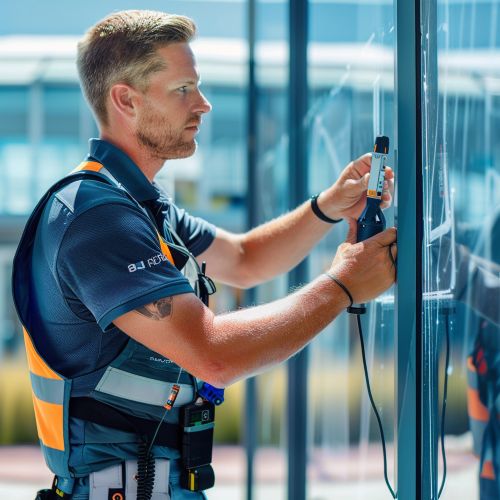
To move forward with confidence, your vetting process must probe beyond surface-level promises and focus on tangible proof of commercial capability. When interviewing potential installers, ask targeted questions that separate specialists from generalists. A qualified national partner can answer the following without hesitation:
- Can you provide case studies for at least three projects of a similar national scale and scope?
- Describe your commercial project management methodology. Who will be our dedicated point of contact?
- How do you ensure consistent installation quality and brand standards across different states?
- What are your standard insurance liability limits, and can you meet our site-specific requirements?
- What is your relationship with manufacturers like 3M, and how does that benefit our project in terms of warranty and support?
Need More Info?
The Window Film Depot team is happy to help.
The answers will provide a clear picture of a vendor’s capabilities. A partner prepared for your large-scale window film project will have documented processes, extensive experience, and the infrastructure to back it up, giving you the confidence needed to protect your investment. For reliable home window tinting for privacy on projects of any scale, trust Window Film Depot’s proven expertise.
Frequently Asked Questions
What is the main difference between residential vs commercial window tint?
The primary difference lies in capability, not just the film itself. Commercial window film installation involves logistical planning for large-scale projects, adherence to strict construction specifications, robust insurance coverage, and standardized training to ensure absolute consistency across hundreds or thousands of windows. Residential tinters are structured for single-day, single-location jobs.
Why can’t I just hire a few local companies for a national rollout?
Managing multiple local vendors creates significant project management overhead and introduces massive inconsistencies. You would have to vet each one individually, manage separate contracts and schedules, and deal with varying quality standards. A single national partner provides one point of contact, one standard of quality, and a unified logistical plan for the entire multi-site installation.
Is all security film the same?
No. Residential “security film” is typically a basic deterrent for break-ins. Commercial-grade security film, especially blast mitigation film, is an engineered life-safety system. It requires a specific film thickness and a structural attachment system that bonds the glass to the frame to protect occupants from explosive force or severe weather, meeting stringent government and industry testing standards.
What insurance should a commercial window film installer have?
At a minimum, they should carry general liability and workers’ compensation policies with limits high enough to meet the requirements of a major commercial construction site. This is often in the millions of dollars and far exceeds the coverage held by a typical residential contractor. Always request a certificate of insurance and verify that the coverage is adequate for your project scope.