Table of Contents:
- Analyzing Project Timelines and Installation Speed
- Comparing Total Cost of Ownership
- Evaluating On-Site Disruption and Complexity
- Key Applications for Commercial Privacy Film
- Specifying the Right Material: A Look at 3M Fasara Glass Finishes
- The Logistics of a Large-Scale Frost Window Film Installation
- Conclusion: A Framework for Frost Film Success
- Frequently Asked Questions
- Related Posts from Window Film Depot
When evaluating materials for privacy and design, the choice between decorative window film and traditional etched glass has significant implications for your project’s budget, schedule, and long-term viability. For a project manager, understanding these differences is a critical strategic decision, not just a simple aesthetic choice.
Analyzing Project Timelines and Installation Speed
The most immediate and impactful difference lies in the project timeline. Specifying etched or sandblasted glass introduces a long-lead manufacturing process. Each panel requires custom ordering, fabrication, and shipping, a cycle that can take weeks or even months. Crews then completely remove the existing glass and install the new, heavy lites, a labor-intensive activity that demands significant coordination.
In contrast, high-performance frost window film is an on-site application. Once the design is finalized, the material can be shipped and installed by a professional crew in a fraction of the time.
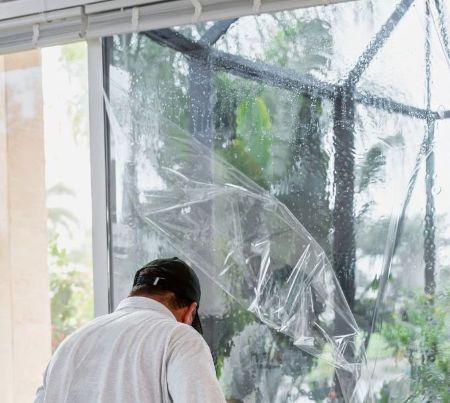
- Film Preparation: Professionals clean and prep the existing glass, a quick and non-invasive process. They remove all existing film.
- Etched Glass Preparation: This involves the full de-glazing and re-glazing of the opening, a complex task with more variables and potential for delays.
For large-scale rollouts or projects with tight deadlines, film installation can reduce the time required for glass-front fit-outs from weeks to days. This de-risks your critical path and accelerates overall project completion.
Comparing Total Cost of Ownership
From a budget perspective, the upfront cost difference is substantial. Etched glass involves the cost of the raw glass, the specialized etching process, complex logistics, and extensive installation labor. Professional-grade frost film achieves the same high-end aesthetic for a fraction of that initial capital expenditure.
The analysis must also extend to the Total Cost of Ownership (TCO). While both surfaces are durable and easy to maintain, the true value of film emerges over the building’s lifecycle. If a panel of etched glass is damaged, replacing it requires re-initiating the entire costly and time-consuming manufacturing process. If a section of film is scratched or damaged, only that specific panel needs to be replaced in a quick and inexpensive repair.
Design Flexibility and Reversibility
Perhaps the most significant strategic advantage of frost film is its reversibility. Etched glass is a permanent alteration. If a tenant’s branding changes or the space is reconfigured for a new occupant, the glass must be completely replaced to update the design. This represents a significant, recurring capital expense for property owners.
Frost window film turns a permanent architectural feature into a flexible design element. It can be removed cleanly without damaging the underlying glass, allowing for:
- Cost-effective rebranding for new tenants or corporate identity updates.
- Easy updates to office layouts and privacy levels as needs evolve.
- Restoring glass to its original state at the end of a lease, simplifying turnover.
This flexibility future-proofs the asset, empowering facility managers to adapt spaces quickly and affordably.
Evaluating On-Site Disruption and Complexity
For any project manager overseeing an active site or a retrofit in an occupied building, minimizing disruption is paramount. The installation of etched glass is a construction activity. It is noisy, creates debris, and requires cordoning off areas for safety. This can halt work for other trades or disrupt tenant operations.
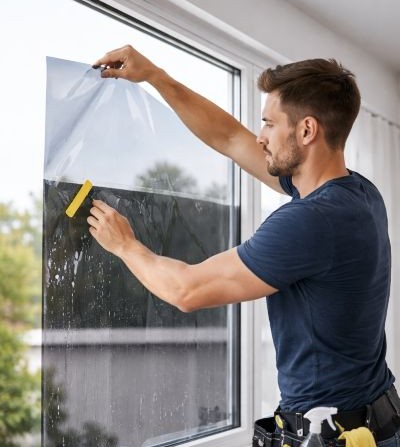
Installing frost film is a quiet, clean, and contained process. Certified installers work with minimal equipment, primarily using a water-based solution that produces no dust, fumes, or significant noise. Teams can easily phase the work and schedule it after business hours to achieve zero operational downtime for the client. This reduction in on-site complexity simplifies scheduling, reduces risk, and ensures a smoother project flow.
Key Applications for Commercial Privacy Film
Strategically deploying frost film moves it from a simple finish to a functional architectural element. For a project manager, knowing where to specify these films can solve common design challenges, meet client requirements, and address building code mandates, all while adhering to the project scope and budget.
Enhancing Privacy in Open-Plan Offices
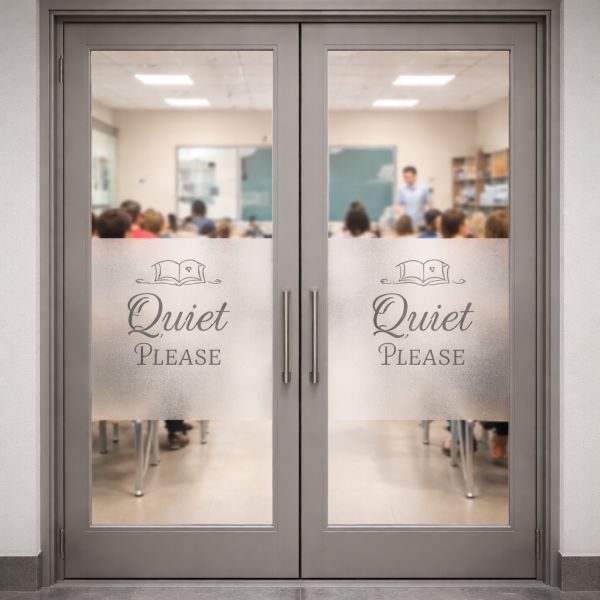
The modern office aesthetic heavily favors glass partitions to promote transparency and maximize natural light. This creates a conflict with the need for privacy in meeting rooms, executive offices, and HR departments. A common and effective solution is a “privacy band,” a horizontal strip of frost film applied at eye level to obscure direct lines of sight while leaving the glass above and below clear. This maintains an open feel while providing necessary confidentiality for focused work or sensitive conversations. This targeted approach is more cost-effective and flexible than full-panel etching.
Creating Branded Environments with Decorative Office Film
In consumer-facing environments like retail stores and hotels, brand identity is paramount. Frost film serves as a powerful medium for translating a brand’s visual language onto glass surfaces. By using custom-cut frost film, you can seamlessly integrate logos, brand patterns, or mission statements onto storefronts, entryways, and interior partitions.
This application is particularly strategic for national rollouts. Achieving a consistent branded look across hundreds of locations using etched glass presents a logistical and financial challenge. A national installation network can replicate a single design file with perfect consistency using decorative office film. This approach ensures brand integrity, accelerates the fit-out timeline, and simplifies updates during future brand refreshes.
Managing Light Diffusion in Healthcare and Education
Healthcare and educational settings have unique requirements. In hospitals, patient privacy is non-negotiable. Frost film on patient room doors and consultation rooms provides immediate visual separation. Certain film textures also contribute to a calming environment by diffusing harsh light to reduce glare without darkening the space.
In schools and universities, frost film helps create conducive learning environments. Schools can use it on classroom doors to minimize distractions from hallway traffic or in libraries to create quiet study zones.
The light-diffusing properties are also beneficial, softening direct sunlight that can cause glare on screens and desktops.
Achieving Code Compliance for Glass Manifestation
A critical but often overlooked application is using frost film to meet building code requirements. Many safety codes, like the International Building Code (IBC), mandate marking large glass panels to prevent accidental collisions. These distraction markers must be applied at specific heights to remain effective.
Frost film provides an elegant and economical solution. Simple dots, squares, or bands can satisfy code requirements. This also presents a design opportunity. Instead of purely functional markings, you can specify custom-cut patterns or logos that align with the building’s overall design, turning a safety requirement into a sophisticated aesthetic feature.
Specifying the Right Material: A Look at 3M Fasara Glass Finishes
Once you identify the application, the next step is selecting the right material. For large-scale commercial projects, specifying a high-performance, commercial-grade product like 3M Fasara Glass Finishes is essential for ensuring longevity, consistency, and client satisfaction.
Understanding the 3M Fasara Product Families
The 3M Fasara collection is organized into distinct families, making it easy to find a style that aligns with your project’s design goals.
- Frosts and Mattes: These are foundational products offering classic, subtle finishes, from a simple acid-etch look to more opaque milky whites. They are the workhorses for creating clean, simple privacy.
- Gradations: These films feature a pattern that fades from opaque to clear, providing a dynamic and sophisticated way to manage sightlines.
- Stripes and Lines: Offering clean, geometric patterns, this family is ideal for creating visual interest or meeting code requirements for distraction markers with a designer’s touch.
- Fabric and Natural Patterns: These films mimic the look of materials like rice paper and linen. They add warmth and organic texture, ideal for hospitality or wellness environments.
- Prisms and Dots: This family provides geometric and abstract patterns that play with light, offering a bold design statement for feature walls or branded spaces.
Matching Film Properties to Client Demands
Beyond aesthetics, each film has specific performance characteristics you must match to functional requirements. The two most critical properties are the level of privacy (opacity) and the Visible Light Transmission (VLT).
For a conference room where sensitive data is discussed, you need a film with high opacity to completely obscure views, like 3M Fasara Milky White (SH2MAML). For a collaborative workspace where the goal is a visual break without sacrificing brightness, you would specify a film with a higher VLT. The technical data sheets for each Fasara product provide these precise metrics, allowing you to make an informed, data-driven specification.
The Role of Custom Cut Film
One of the greatest advantages of film over etched glass is the ease of customization. Any standard Fasara film can be plotter-cut into intricate designs, including corporate logos, complex patterns, or wayfinding text. This digitally driven process ensures absolute precision and repeatability. This capability is a powerful tool for delivering bespoke branding elements without the high cost and long lead times of custom-etched glass.
Differentiating Commercial-Grade Film from Alternatives
Specifying a professional-grade film like 3M Fasara is a crucial risk management decision. While lower-cost, PVC-based vinyl films may seem attractive, they introduce significant long-term risks.
Commercial-Grade Polyester Film (e.g., 3M Fasara)
- Made from durable, dimensionally stable polyester.
- Uses advanced, clear adhesives that will not yellow or fail.
- Maintains consistent color and texture across production runs.
- Resistant to shrinking and peeling at the edges.
- Backed by a comprehensive manufacturer warranty.
Lower-Quality Vinyl (PVC) Film
- Prone to shrinking over time, leaving an undesirable adhesive outline.
- Adhesive can yellow, bubble, or peel when exposed to UV light.
- Color and texture can be inconsistent between rolls.
- Can become brittle and difficult to remove, increasing future labor costs.
- Typically comes with a limited or non-existent warranty.
Opting for a lower-quality alternative can jeopardize the project’s outcome, leading to premature failure, client dissatisfaction, and costly rework.
The Logistics of a Large-Scale Frost Window Film Installation
Specifying the right frost window film is only the first step. For a multi-site project, success hinges on flawless execution from your installation partner. Demanding operational excellence is essential for protecting your timeline, budget, and the client’s brand.
Vetting Your National Installation Partner
Choosing an installation partner for a national rollout is different from hiring a local contractor. You are integrating a key logistical team into your project. Your partner must have the infrastructure and processes to function as a seamless extension of your own team. When evaluating partners, scrutinize their operational capacity.
- Dedicated Project Management: Do they assign a single point of contact to oversee the entire scope? This individual is your primary liaison for all scheduling, reporting, and issue resolution.
- Proven National Footprint: Can they demonstrate a history of successfully completing projects of a similar scale? Ask for case studies for multi-state rollouts.
- Standardized Training: Are all installers trained to the same standard? Manufacturer certifications and in-house training programs indicate a commitment to quality.
- Comprehensive Insurance and Safety: Do they carry adequate insurance to meet enterprise-level requirements and have robust safety protocols?
- Technological Integration: Do they use modern project management software for real-time updates and digital sign-offs?
Developing a Phased Rollout Plan
A phased rollout plan is the cornerstone of a manageable project. Collaborate with your installation partner to develop a detailed plan that groups sites logically, often by region or priority. A well-structured plan should define the scope for each phase, establish realistic timelines, and outline communication protocols for coordinating with local site managers.
Ensuring Quality Control and Consistency
How can you be certain the film installed in Phoenix has the same flawless finish as the one in Boston? True national partners achieve consistency through rigorous, systemized quality control. This system relies on standardized materials, strict Standard Operating Procedures (SOPs) for installation, and a robust quality assurance process, such as mandatory completion photos reviewed by a central quality manager.
Navigating Pre-Installation Site Audits
No two job sites are identical. A proactive national partner will conduct pre-installation site surveys to identify and solve problems before they cause delays. During these audits, a technician assesses variables like glass conditions, access needs, and site-specific rules. The output is a detailed report that allows you to confirm the final scope and gives the installation team a precise plan of action for each unique location. This preparation transforms potential surprises into manageable tasks.
Conclusion: A Framework for Frost Film Success
Viewing frost window film as a strategic architectural component is the key to unlocking its full potential. For project managers on complex commercial projects, professional-grade frost film offers a reliable, scalable, and sophisticated solution that directly addresses the core challenges of budget, timeline, and client satisfaction.
Key Takeaways: Cost, Speed, and Flexibility
The business case for high-performance frost window film is built on three pillars of project management success.
- Significant Cost Reduction: Frost film delivers the elegant aesthetic of etched glass at a fraction of the cost, with savings on materials, labor, and demolition.
- Accelerated Project Timelines: Film installation is a clean, non-disruptive process that can be scheduled with flexibility, compressing the overall project schedule.
- Unmatched Design Agility: Unlike permanent glass alterations, frost film is a reversible solution, allowing for easy updates to branding and privacy levels.
Integrating Film Specification into Your Workflow
To successfully deploy frost window film, incorporate it into your standard project phases.
- Early Design and Scope: During initial design, work with stakeholders to identify all areas where privacy, light diffusion, or branding is required on glass. Define the specific objectives for each location.
- Partner Selection and Material: Vet national installation partners with a proven track record. A capable partner will act as a consultant, helping you select the right film and provide precise specifications for your construction documents.
- Coordinated Execution and QC: Your chosen partner should provide a clear project plan, a single point of contact for national rollouts, and a robust quality control process to ensure consistency.
As you plan your next project, challenge the assumption that etched glass is the only solution. By engaging a professional film consultant early, you can explore a wider range of design possibilities that are more flexible and budget-conscious. Think of your national film installer not as a subcontractor, but as a strategic partner whose expertise can help you mitigate risks and deliver a consistent, high-quality aesthetic across an entire portfolio.
Frequently Asked Questions
What is the difference between professional polyester frost film and cheaper vinyl film?
Professional-grade films, like 3M Fasara, are made from durable, dimensionally stable polyester. They use advanced adhesives that resist yellowing and peeling and are backed by a comprehensive manufacturer warranty. Cheaper vinyl (PVC) films are prone to shrinking, bubbling, and color inconsistency, often leading to costly removal and replacement down the line.
How long does professional frost window film last?
When installed correctly by certified professionals, high-quality commercial privacy film is designed to last for many years. Leading products like 3M Fasara Glass Finishes often come with manufacturer warranties of 10 years or more, ensuring long-term performance without peeling, bubbling, or discoloration.
Can you create custom logos and designs with frost film?
Yes. One of the biggest advantages of decorative office film is its customizability. Any frost film can be digitally cut with high precision to create intricate company logos, specific patterns, or branded text. This process is highly repeatable, making it ideal for ensuring brand consistency across multiple locations in a national rollout.
Is it possible to install frost window film in an occupied office?
Absolutely. The installation process for frost film is clean, quiet, and non-disruptive. Installers use a simple water-based solution, producing no dust, fumes, or significant noise. For occupied spaces, work can often be scheduled during off-hours or weekends to achieve zero operational downtime for the client.
How do you clean glass with decorative film installed?
You can clean glass with frost film using standard, non-abrasive cleaning methods. A simple solution of mild soap and water applied with a soft cloth or rubber squeegee is all that is needed. You should avoid abrasive powders, hard-bristled brushes, or ammonia-based cleaners, which could damage the film’s surface.